國
立
交
通
大
學
網路工程研究所
碩
士
論
文
長期演進技術下適用於多媒體路況回報系統
之服務品質感知資源管理
QoS-aware Resource Management for
Multimedia Traffic Report Systems over LTE
研 究 生:劉姿瑾
指導教授:王國禎 教授
長期演進技術下適用於多媒體路況回報系統
之服務品質感知資源管理
QoS-aware Resource Management for
Multimedia Traffic Report Systems over LTE
研 究 生:劉姿瑾 Student:Tzu-Chin Liu
指導教授:王國禎 Advisor:Kuochen Wang
國 立 交 通 大 學
網 路 工 程 研 究 所
碩 士 論 文
A ThesisSubmitted to Institute of Network Engineering College of Computer Science
National Chiao Tung University in Partial Fulfillment of the Requirements
for the Degree of Master
in
Computer Science
June 2013
Hsinchu, Taiwan, Republic of China
長期演進技術下適用於多媒體路況回報系統
之服務品質感知資源管理
學生:劉姿瑾 指導教授:王國禎 博士
國立交通大學網路工程研究所
摘 要
多媒體路況回報系統是現今一個新穎的無線車載網路應用;此系
統可以藉由車用設備與感測器提供各種種類的交通路況資訊,並採用
長期演進技術(LTE)來達到遠距傳輸和較好的移動性。儘管有如此的
改善,此系統中的資源管理問題須被重視。現存的資源管理研究主要
致力於維持通道品質與滿足非車載應用的服務品質(QoS)需求,但若
要得到最多且完整的交通路況資訊,包含地理覆蓋率,一個更符合多
媒體車載應用特性的資源管理方法是不可或缺的。
在本篇論文中,我們針對多媒體路況回報系統,提出一個適用於
LTE環境的QoS感知資源管理方法,稱為QoS-MTRS。此方法的主要
設計理念是將資源依照每筆交通路況資訊的重要價值來分配,並且將
通道的可用性也加入考量,以確保傳輸的可行性。此演算法的目標是
在一定的資源(例如無線電資源)限制下,提高交通路況資訊的多樣性、
完整性和總價值。最後,我們實作一個包含LTE環境的模擬環境,以
測試此演算法的效能。模擬的結果顯示出,若採用QoS-MTRS,在同
一地區收到兩種以上路況資訊的機率比採用頻寬與QoS感知排程演
算法(BQA)、貪婪演算法(Greedy)和先來先服務演算法(FCFS)高出
65%、58%和48%,且可 將路況 資訊重複 率 平均 減低一半 。 採 用
QoS-MTRS所獲得的路況資訊總價值比起BQA、Greedy和FCFS分別
高出27%、18%和54%,且在車輛僅有20輛的情況下,採用本演算法
依然能達到87%的地理覆蓋率。
關鍵詞:長期演進技術、多媒體路況回報系統、QoS感知、資源管理、
車載網路。
QoS-aware Resource Management for
Multimedia Traffic Report Systems over LTE
Student:Tzu-Chin Liu Advisor:Dr. Kuochen Wang
Institute of Network Engineering National Chiao Tung University
Abstract
The multimedia traffic report system is a new type of applications in wireless vehicular networks. This system can provide various kinds of traffic information, which are directly obtained from on-car sensors and devices via LTE. By leveraging LTE technologies, the system can support wide-range transmission and better mobility. Despite of these improvements, the resource management problem needs to be addressed as well. Existing resource management studies focus on channel quality or QoS requirements for non-vehicular applications. To get the most useful and complete traffic information, including location coverage, a proper resource management mechanism for multimedia vehicular applications is indispensable. In this paper, we propose a QoS-aware resource management mechanism for multimedia traffic report systems over LTE (QoS-MTRS). The main idea is to schedule resources according to the importance degree of each traffic data. Furthermore, we take channel availability into consideration to make sure that the transmission is feasible. The objective of QoS-MTRS is to improve the diversity, completeness and overall traffic data value under certain resource (e.g., radio or bandwidth) limitations. We provide a
system-level simulation that includes an LTE network environment to evaluate our design. Simulation results show that by adopting QoS-MTRS, the probability of receiving more than one kind of traffic data in a location is 65%, 58% and 48% higher than BQA (bandwidth and QoS-aware scheduler), Greedy and FCFS, respectively; the duplication ratio can be decreased by 50% on average. In terms of the overall traffic data value, QoS-MTRS is 27%, 18% and 54% higher than BQA, Greedy and FCFS. In addition, QoS-MTRS can achieve at least 87% of coverage even when the number of vehicles is as low as 20.
Keywords: LTE, multimedia traffic report system, QoS-aware, resource management,
Acknowledgements
Many people have helped me with this thesis. I deeply appreciate my thesis advisor, Dr. Kuochen Wang, for his intensive advice and guidance. I would like to thank all the members of the Mobile Computing and Broadband Networking Laboratory (MBL) for their invaluable assistance and suggestions. I also want to thank a Ph.D. student and also an engineer of the Network Benchmarking Lab (NBL) of NCTU, Chia-Yu Ku, for helping me with this thesis. This work was supported by the project of 4th generation mobile broadband testing technology development, 101-EC-17-A-03-S1-193. Finally, I thank my family for their endless love and support.
Contents
Abstract (Chinese) ... i
Abstract ... iii
Contents ... vi
List of Figures ... viii
List of Tables ... ix
Chapter 1 Introduction ... 1
Chapter 2 Background ... 3
2.1 QoS control in LTE [9] ... 3
2.1.1. Default / dedicated EPS bearer ... 4
2.1.2. GBR / non-GBR bearer ... 4
2.1.3. QoS parameters and TFT ... 4
2.1.4. Policy controller / PCRF ... 6
2.2 Multimedia traffic report systems [18] ... 6
Chapter 3 Resource Management Issues and Problem Statement ... 8
3.1 Homogeneous traffic data and incomplete coverage ... 8
3.2 Duplicated traffic data ... 9
3.3 Poor channel quality ... 9
3.4 Problem statement ... 9
3.4.1 Constraints of resource management ... 10
3.4.2 Variables for resource scheduling ... 10
3.4.3 Performance metrics ... 11
Chapter 4 Related Work ... 13
Chapter 5 QoS-MTRS: QoS-aware Resource Management for Multimedia Traffic Report Systems ... 17
5.1 Information importance analysis ... 18
5.2 Channel availability check ... 19
5.3 EPS bearer establishment and QoS parameter setting ... 19
5.4 Design approach ... 20
5.4.1 Deriving pre-defined QoS requirements ... 20
5.4.2 Vehicle connection establishment... 21
5.4.3 Information importance analysis... 21
5.4.4 Channel availability check ... 23
5.4.5 Resource reservation ... 25
Chapter 6 Performance Evaluation ... 26
6.1 Experimental setup ... 26
6.2 Evaluation results of QoS-MTRS ... 28
Chapter 7 Conclusion and Future Work ... 35
7.1 Concluding remarks ... 35
7.2 Future work ... 35
List of Figures
Figure 1 LTE EPS bearers. ... 3
Figure 2 The classification tree of related works. ... 13
Figure 3 The overall system flowchart of QoS-MTRS. ... 18
Figure 4 An example map that shows location blocks. ... 21
Figure 5 Comparison of appearance probability distributions of the received data types per location block. ... 29
Figure 6 Comparison of duplication ratio. ... 30
Figure 7 Comparison of overall traffic data value. ... 31
Figure 8 Comparison of End-to-end delay. ... 32
Figure 9 Comparison of system throughput... 33
List of Tables
Table 1 Standardized QCI characteristics in LTE [23]. ... 5
Table 2 Definitions and notations. ... 10
Table 3 The qualitative comparison of existing resource management mechanisms and the proposed QoS-MTRS. ... 16
Table 4 CQI MCS mapping table in LTE [24]. ... 24
Table 5 Simulation parameter settings [12][13]. ... 26
Table 6 Importance degrees of sensors/devices. ... 27
Table 7 Importance degrees of vehicles. ... 27
Chapter 1
Introduction
Nowadays, multimedia applications for multiuser account for an increasing proportion in the mobile application market. These applications, such as video sharing, Internet telephony and online games, bring us a more convenient and fascinating life by leveraging high mobility of broadband telecommunication technologies. The Long Term Evolution (LTE) is one of the most influential broadband wireless communication standards developed by the Third Generation Partnership Project (3GPP), in which the peak data rate has been increased with the potential of reaching up to 100 Mbps in downlink and 50 Mbps in uplink [26]. With the benefits of LTE, mobile services can be further expanded to high mobility vehicular environments.
Recently, with the help of wireless network technologies, vehicular communication grows rapidly not only for inter-car communications, but for various new vehicular applications. Besides IEEE 802.11p series, LTE is another suitable choice for vehicular applications because of the supports of wide-range transmissions and better scalability [14]. Applications such as road-safety systems [7], inter-car group communications [8] and traffic report systems [16] [18] [19] are now considered as some potential topics in the aspect of vehicular communication over LTE.
Despite of the advantages of LTE, its resource management problem is still a significant issue [3]. Serving numerous users with highly-diverse multi-format contents under limited resource is a challenge. For example, we have to fulfill vary QoS (Quality of Service) requirements of different traffic types on each UE (user equipment), and each UE is under different channel condition. Moreover, user
experience is very important in real-time multimedia applications, which usually have more QoS demands than other applications.
The resource management problem in vehicular environments can be further challenging. Besides the above difficulties, new concerns like high mobility and geographic characteristics are taken into considerations when it goes to resource allocation. In vehicular multimedia traffic report systems, deriving the most complete traffic data properly in a particular serving area is the main objective [18]. In Chapter 2, we will review multimedia traffic report system in detail.
In this paper, we propose a QoS-aware resource management mechanism for multimedia traffic report systems over LTE, which determines how resources are allocated to vehicles by setting related QoS parameters. The main idea of our approach is to schedule resources according to the importance degrees of sensors/devices on cars, which can provide traffic data with different values. Furthermore, we take channel availability into consideration to make sure the transmission is feasible. Simulation results show that the proposed QoS-MTRS can improve the diversity, completeness and overall value of received traffic data.
The remainder of this paper is organized as follows: Chapter 2 gives the required background knowledge of QoS control in LTE and multimedia traffic report systems. Chapter 3 focuses on the resource management issues we concern and describes the problem statement. Chapter 4 presents the related work of resource management in LTE. Chapter 5 depicts the proposed QoS-MTRS. Chapter 6 shows the performance evaluation of the proposed design. Chapter 7 concludes this paper and presents our future work.
Chapter 2
Background
2.1 QoS control in LTE [9]
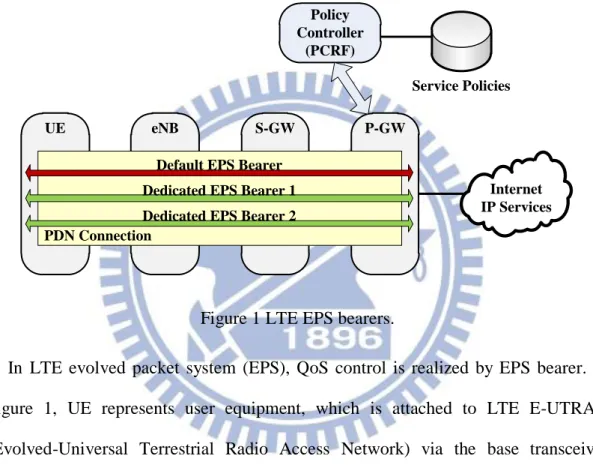
Figure 1 LTE EPS bearers.
In LTE evolved packet system (EPS), QoS control is realized by EPS bearer. In Figure 1, UE represents user equipment, which is attached to LTE E-UTRAN (Evolved-Universal Terrestrial Radio Access Network) via the base transceiver station, eNB (eNodeB). S-GW (serving-gateway) and P-GW (packet data network-gateway) are components of LTE core network; every packet UE sent will be routed by S-GW, and P-GW is an entry to public Internet for IP services. As Figure 1 shows, each UE will maintain an end-to-end connection as a PDN (packet data network) connection to support packet transmission, and each IP service will establish an EPS bearer for different QoS provisioning.
Internet IP Services
UE eNB S-GW P-GW
PDN Connection
Default EPS Bearer Dedicated EPS Bearer 1 Dedicated EPS Bearer 2
Policy Controller
(PCRF)
2.1.1. Default / dedicated EPS bearer
When UE requests an IP service, a default EPS bearer will be established for basic transmission and signaling. If the service requires further QoS guarantee, a dedicated EPS bearer will be constructed, which can provide QoS control via the settings of QoS parameters and TFT (traffic flow template).
2.1.2. GBR / non-GBR bearer
Bearers can be classified into two types; guaranteed bitrate (GBR) and non-guaranteed bitrate (non-GBR) bearers. All the default bearers are non-GBR bearers. The GBR bearer will reserve network resources to retain the required bitrate for maintaining service quality while the non-GBR bearer will not.
2.1.3. QoS parameters and TFT
There are several parameters for QoS controlling: QCI (QoS class identifier), ARP (allocation and retention priority), GBR (guaranteed bitrate) and MBR (maximum bitrate). In EPS, each bearer is assigned a QCI to specify traffic flow type, delay constraint, packet error-rate and priority, Table 1 shows the standardized QCI characteristics in LTE [23]. ARP is used to decide whether a bearer can be established or modified when resources are limited. GBR and MBR are only for GBR-bearers, which can indicate the guaranteed and maximum bitrate reservation for a bearer. TFT is a set of packet flow filters for further QoS control over IP packets.
Table 1 Standardized QCI characteristics in LTE [23]. QCI Resource Type Priority Packet Delay Budget (ms) Packet Error Loss Rate Example Services 1 GBR 2 100 10-2 Conversational Voice 2 4 150 10-3 Conversational Voice (Live Streaming)
3 3 50 10-3 Real Time Gaming
4 5 300 10-6 Non-Conversational Video (Buffered Streaming) 5 Non-GBR 1 100 10-6 IMS Signaling 6 6 300 10-6 Video (Buffered Streaming), TCP-based (e.g., www, e-mail, chat, ftp, p2p file sharing, progressive video, etc.) 7 7 100 10-3
Voice, Video (Live Streaming) Interactive Gaming 8 8 300 10-6 Video (Buffered Streaming), TCP-based (e.g., www, e-mail, chat, ftp, p2p file sharing, progressive video, etc.) 9 9
2.1.4. Policy controller / PCRF
In the LTE EPS, the policy controller or so called PCRF (policy and charging resource function) is used to decide how resources should be arranged according to QoS demands. The policy controller derives QoS requirements and charging policies from a backend database, and allocates resources based on these constraints by executing a resource management algorithm.
2.2 Multimedia traffic report systems [18]
The Intelligent Transportation System (ITS) attracts great attention in recent years. Along with wireless technologies and related software, the ITS can integrate vehicle communications with many applications like traffic surveillance, emergency notification and navigations. The multimedia traffic report system is a part of ITS. Its main function is to provide traffic conditions for monitoring usage or further analysis. The traffic data collection of traditional traffic report systems is based on road-side cameras, while now we can gather traffic data directly via sensors or devices equipped on cars. Because of the diversity of on-car devices, the traffic data received contain various types; for example, the event data recorder (EDR) and camera can capture video or images on roads, the e-compass and GPS (global position system) tracker can provide directions and positions of cars.
These traffic data gathering from on-car devices or sensors must be transmitted to a back-end server on the Internet through wireless networks. Due to the characteristic of limited radio resources and numerous devices, the management of vehicular wireless networks is an important aspect in the multimedia traffic report systems. The integration of vehicular networks and LTE can leverage the M2M (machine-to-machine) technology [20]. In order to acquire plenty, diverse traffic data
under certain wireless network environment, a proper resources management mechanism is required.
Chapter 3
Resource Management Issues and
Problem Statement
In this chapter, we introduce potential problems in multimedia traffic report systems and provide a formal problem statement for resource management issues. To receive the most diverse and plentiful traffic data from enormous number of devices, we have to decide which of them should transmit to meet our needs. In addition, due to the transmission is under wireless environments, checking radio channel quality can help us to improve resources utilization efficiency. Here we focus on several aspects to discuss the resource management issues:
3.1 Homogeneous traffic data and incomplete
coverage
The homogeneous traffic data and incomplete coverage problems could happen if we do not consider location information and capabilities of on-car devices. In the multimedia traffic report systems, large amounts of traffic data may come from any places in different data types or data formats. If devices locations and capabilities are ignored when doing scheduling, we may receive traffic data from the same place or all the traffic data are in the same type.
3.2 Duplicated traffic data
The duplicated traffic data issue is a severe case of above-mentioned problem. If any of two traffic data entries are from an identical location and in the same data type, we consider them are “duplicated traffic data”. If many duplications are received in multimedia traffic report systems, there must be a portion of resources are wasted, because we use much more resources to transmit the same traffic data. We will describe duplication check and grouping in chapter 5.
3.3 Poor channel quality
Since the data transmission of multimedia traffic report systems is under wireless networks, the concerns of radio channel quality and resources limitation become more important than those in wired networks. The geographical landscape, vehicular scenario and car speed can affect channel quality, and poor channel quality may cause transmission failures, and lead to data impairment or video distortion. To prevent this kind of problems, the AMC (adaptive modulation and coding) in LTE will adjust the modulation and coding scheme to suit the current wireless environment. But this may result in resource wasting because it will allocate more radio resources for a sender to transmit the same quantity of data when its channel quality is poor. Moreover, the number of served sensors/devices will reduce due to limited resources.
3.4 Problem statement
In the design of traffic report system, the main objective is to improve the completeness, diversity and overall traffic data value of received traffic data under certain environment constraints. In the following, we describe the constraints, variables and performance metrics in detail, and related definitions and notations are shown in Table 2.
3.4.1 Constraints of resource management
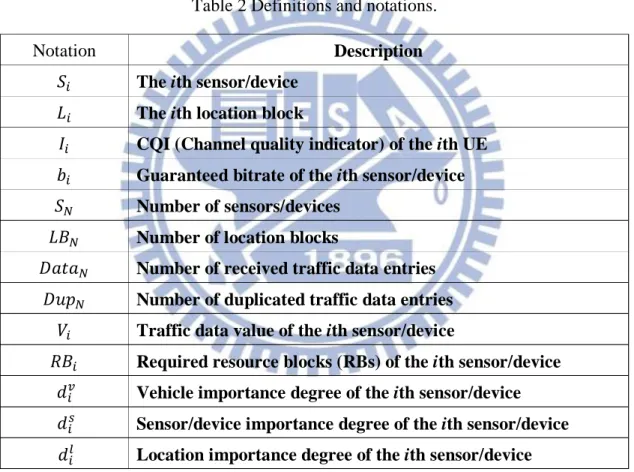
There are many limitations affecting the resource management procedure. is the CQI (channel quality indicator) of the ith UE, is the guaranteed bitrate that is required by the ith sensor/device, and represents the importance degrees corresponding to vehicle type, sensor/device type and location of the ith sensor/device, respectively. The importance degrees are used to compute the traffic data value of each sensor/device for scheduling resources.
3.4.2 Variables for resource scheduling
In the proposed resource management mechanism, we schedule resources according to two variables, and . is the traffic data value provided by the
ith sensor/device, which indicates the importance value of this traffic data.
Table 2 Definitions and notations.
Notation Description
𝑆𝑖 The ith sensor/device
𝐿𝑖 The ith location block
𝐼𝑖 CQI (Channel quality indicator) of the ith UE
𝑏𝑖 Guaranteed bitrate of the ith sensor/device
𝑆𝑁 Number of sensors/devices
𝐿𝐵𝑁 Number of location blocks
𝐷𝑎𝑡𝑎𝑁 Number of received traffic data entries
𝐷𝑢𝑝𝑁 Number of duplicated traffic data entries
𝑉𝑖 Traffic data value of the ith sensor/device
𝑅𝐵𝑖 Required resource blocks (RBs) of the ith sensor/device
𝑑𝑖𝑣
Vehicle importance degree of the ith sensor/device
𝑑𝑖𝑠
Sensor/device importance degree of the ith sensor/device
3.4.3 Performance metrics
In the traffic report system, its performance can be evaluated by location coverage, duplication ratio and overall traffic data value. The performance metrics to evaluate our design are shown below:
Location coverage:
We expect the received traffic data to have the maximum location coverage. represents the coverage of the received traffic data. The definition of is:
∑
{
We divide a map into multiple location blocks. is the total number of location blocks. Thus, ∑ is the summation of location blocks which have received traffic data. Therefore, indicates the percentage of location blocks containing received traffic data.
Duplication ratio:
Since too much duplicated data may decrease the diversity of traffic data and further lead to resource wasting. Hence, to minimize the number of duplications is one of our objectives. The definition of duplication ratio is:
Where represents the total number of received traffic data entries, and is the total number of duplicated data entries.
Overall traffic data value:
In our design, each vehicle, sensor/device and location has its own importance degree, which indicates the traffic data value that it can provide. Therefore, when
allocating resources, we have to consider the traffic data value of each sensor/device. The definition of overall traffic data value S is:
∑
{
Where value represents the overall value of the traffic data we obtained. means the traffic data value provided by the th sensor/device if we allocate resources to the th sensor/device. is the number of sensors/devices.
Chapter 4
Related Work
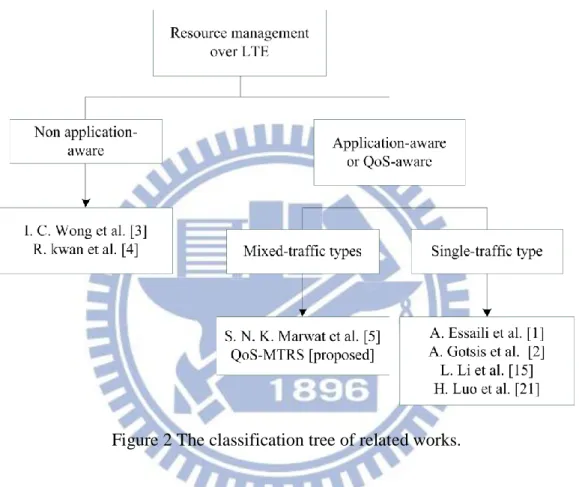
The researches related to resource management problems in LTE can be roughly classified into two types: (1) non application-aware (2) application-aware mechanisms. Figure 2 is the classification tree of related work. In addition, application-aware resource management mechanisms can be applied either to mixed-traffic, which includes various types of data, or just single-type traffic. Our work is dedicated to application-aware resource management for mixed-traffic over LTE, and the application we concerned is the traffic report system. Follows are brief review of related work:
R. Kwan et al. [4] proposed an uplink resource management algorithm based on PF Figure 2 The classification tree of related works.
(proportional fair) basis. The authors focused on the multiuser fairness problem of resource scheduling strategies, and they also provided a suboptimal solution with low complexity. By leveraging their PF scheduler, the variations of user bit rates can be effectively reduced compared to Max-Rate scheduler.
I. C. Wong et al. [3] presented a resource management algorithm for uplink LTE. They modeled the resource allocation problem as a pure binary-integer program, and provided a greedy-based heuristic approach with low complexity. Their simulation results indicate that the spectrum efficiency can be improved by 50% using their algorithm while using the optimal algorithm can be improved by 100%.
H. Luo et al. [21] presented a cross-layer weighted-RR (round robin) QoS-aware resource management solution for downlink LTE. They focused on the application layer QoS requirements to optimize the video transmission. In their research, they jointly concern channel quality, delay-constraints and user fairness among all users against each resource block, and further dynamically adjust the MCS (modulation and coding scheme) and encoding parameters to achieve better video quality. The performance evaluation results show that the video’s PSNR is significantly improved by adopting their method.
L. Li et al. [15] dedicated to the mapping function between QoS class identifier (QCI) to Diffserv Code Point (DSCP) (QCI/DSCP mapping), which can extend the QoS provision from the bearer-level to the transport-level. The authors also presented a system level performance management tool for end-to-end QoS monitoring.
A. Gotsis et al. [2] introduced the challenges and solutions of M2M scheduling over LTE. The authors pointed out main issues when M2M comes to LTE: numerous devices, sparse transmission, and widely range of applications. These issues lead to signaling overhead in the control plane, and the diverse QoS requirements are hard to
granularity of scheduling. The idea of group-based scheduling is to schedule resources among device-groups rather than devices themselves, while time granularity of scheduling focused on the scheduling time period.
El Essaili A. et al. [1] proposed a QoE-driven optimistic resource allocation method for LTE uplink. They formulize the Quality of Experience (QoE) value, by using the mean opinion score (MOS) function to determine the quality of user experience. This research focuses on the popularity of user generated video contents transmitted over LTE radio networks. The popularity is used to rank the video contents, while the network control entity (e.g., eNodeB) can schedule resources among content producers.
S. N. K. Marwat et al. [5] proposed a scheduling algorithm based on weighted-PF on multimedia applications, called BQA (bandwidth and QoS-aware scheduler). They concern throughput, delay, fairness and the different QoS requirements of each traffic types, and allocate resources based on weighted values calculated from the above parameters. The results show that with the help of QoS weights, each traffic bearer can attain better performance.
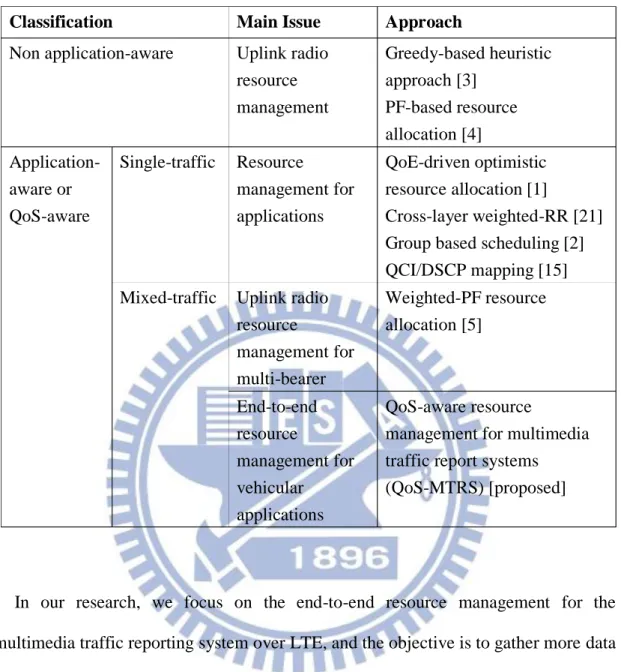
In our research, we focus on the end-to-end resource management for the multimedia traffic reporting system over LTE, and the objective is to gather more data in a specific area. The qualitative comparison among our work and related work is shown in Table 3. The main feature of our work is that we allocate resources not only by channel availability but by information and location importance degrees.
Table 3 The qualitative comparison of existing resource management mechanisms and the proposed QoS-MTRS.
Classification Main Issue Approach
Non application-aware Uplink radio resource management Greedy-based heuristic approach [3] PF-based resource allocation [4] Application- aware or QoS-aware Single-traffic Resource management for applications QoE-driven optimistic resource allocation [1] Cross-layer weighted-RR [21] Group based scheduling [2] QCI/DSCP mapping [15] Mixed-traffic Uplink radio
resource management for multi-bearer Weighted-PF resource allocation [5] End-to-end resource management for vehicular applications QoS-aware resource
management for multimedia traffic report systems
Chapter 5
QoS-MTRS: QoS-aware Resource
Management for Multimedia Traffic
Report Systems
In this chapter, we introduce our proposed QoS-aware resource management for multimedia traffic report systems (QoS-MTRS) in detail. QoS-MTRS is an end-to-end resource management mechanism over LTE. It leverages the functions of EPS bearer and policy controller to support the QoS provisioning. The resource management mechanism in our design is used to guarantee the performance of multimedia traffic report systems.
To derive the most complete and valuable traffic data under certain channel conditions and limited resources, the proposed QoS-MTRS acts as a policy controller in the LTE packet core to make all the allocating decisions. Its responsibility is to decide how bandwidth resources and QoS parameters are reserved to each bearer.
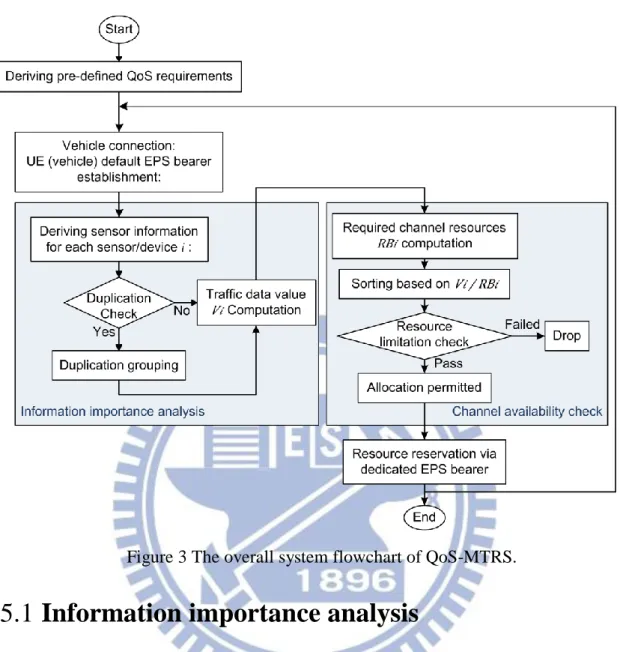
The overall system flowchart of QoS-MTRS is shown in Figure 3. In our design approach, there are two important functional modules, information importance analysis and channel availability check, which are described in section 5.1 and 5.2:
5.1 Information importance analysis
In this module, we analyze information importance of all the traffic data and check for traffic data duplications. First, we have to compute the traffic data value of every on-car sensor/device. Because of limited channel resources, choosing the most worthwhile information to transmit can prevent resource wasting. There are three variables can affect of each sensor/device, which are vehicle type, sensor/device type, and location. For example, a video traffic data from a police car at a crossroad may be more urgent than an audio one from a household vehicle at an alley. Therefore, we compute of all the sensors/devices for later sorting.
Another issue for this module is the traffic data duplication problem. For instance, vehicles at the same location may report identical traffic data at a certain time if they are equipped similar sensors/devices. Hence, checking whether there are duplicated traffic data and removing them is required in saving resources.
5.2 Channel availability check
When allocating resources, it is necessary to make sure radio channel quality and the transmission environment are suitable for sending data. The CQI must be measured and concerned to prevent transmission failures and resource wasting. For example, if a vehicle is under poor channel condition, it may be allocated more radio resources to transmit its data because the data rate has been reduced due to the poor channel. Therefore, checking CQI and derive the required resources is necessary for efficient resources management.
5.3 EPS bearer establishment and QoS parameter
setting
When a vehicle enters the LTE network, it must establish an EPS bearer for IP network services. The default EPS bearer is used to support basic transmission and signaling control for dedicated EPS bearer establishment. The dedicated EPS bearer is the level of granularity for bearer-level QoS control [9], which indicates the bandwidth resource allocation in the form of multiple QoS parameters, including QCI, GBR and MBR. In our design, the resource manager acts as a policy controller to manage the resource arrangements and the QoS parameter settings.
5.4 Design approach
In our design, there are five stages in the whole process, and here we describe each stage in detail:
5.4.1 Deriving pre-defined QoS requirements
In the beginning, resource manager will derive the QoS requirements from back-end database for later usages. These requirements include importance degree and guaranteed bitrate of each vehicle type, sensor/device type, and location. The importance degrees are regarded as given values because they are derived from numerous statistics data or based on the needs of service providers. There are three types of importance degrees:
Importance degree of vehicles:
Traffic data reported by different vehicle types may have different importance degrees. For example, the importance degree of a police car is higher than that of a household vehicle.
Importance degree of sensors/devices:
The type and ability of each sensor/device can cause the divergence of reported traffic data. For instance, video data can provide better understanding of multimedia traffic conditions than text data, and the resolution of a video affects the quality of the reported data.
Importance degree of locations:
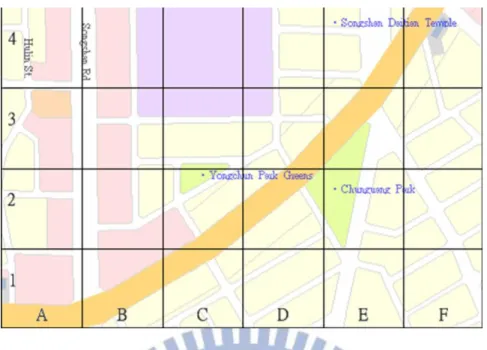
For traffic report system, some locations like crossroads need more attention for safety monitoring. We partition a map into several blocks as shown in Figure 4, and each block takes a given importance degree. Note that the map image is from the Taipei e-Map [22].
5.4.2 Vehicle connection establishment
After deriving all the needed QoS requirements, the resource manager waits for vehicle connection requests. When vehicles enter LTE network and try to establish default EPS bearers, the information of sensors/devices equipped on these vehicles will be transmitted as request payloads. These sensors/devices information will be sent to the resource manager for determining how resources will be allocated.
5.4.3 Information importance analysis
In this stage, all the sensor/device information received by resource manager will be processed to compute their traffic data values and determine if these traffic data are duplicated or not. The details are as follows:
Deriving sensor/device information
After the vehicle connection establishment stage, the resource manager will receive all the vehicle information, which contains equipped sensors/devices
capabilities, types, and their locations. The resource manager then extracts the sensors/devices information from the vehicle information and stores them separately.
Duplication check and grouping
In this step, the resource manager checks whether there are duplicated traffic data in a certain area. The occurrence of duplicated traffic data implies that there are more than one sensor/device can provide the same type of traffic data within a location block. The resource manager will group them together and choose several of them in each group to allocate resources based on their CQI.
Traffic data value computation
Traffic data value computation is a major step in the information importance analysis stage, which computes the traffic data value of each sensor/device. The value is used to determine whether the traffic data provided by these sensors/devices are important or not. We compute based on vehicle type, sensor/device ability, and location. Each of them corresponds to an importance degree which is derived from the QoS requirements.
The equation below computes the traffic data value based on three importance degrees: .
Where , and are the normalized results of , and , respectively, By using Min-Max Normalization, below is an example for showing how to derive :
( )
Where and are the minimal and maximal value of the original range of . and are the minimal and maximal value of the new range
The normalization procedure is used to equalize the influence of each importance degree on the traffic data value. Letting the normalized results fall in the same numerical range and make each influence will not be affected by its original maximum value.
5.4.4 Channel availability check
Before allocating resources, the resource manager will make sure whether the channel environment is suitable for transmission.
Required channel resources computation
The resource allocation unit of radio resource in LTE is called a resource block. The resource manager computes the number of required resource blocks for each sensor/device based on its CQI and sensor/device data producing rate. The cost of traffic data transmission must be measured to evaluate the cost effectiveness of resource management. In our design, the parameter is adopted to evaluate the transmission cost. The number of required resource blocks is computed as below:
Where is the data producing rate of sensor/device , which can be derived from its guaranteed bitrate, . is the available data rate under certain CQI, , which also represents the data consuming rate. Based on , we can learn the modulation scheme and code rate to obtain the available data rate according to the LTE specification, which is shown in Table 4 [24]. Note that the larger indicates that we need more resource blocks to support the transmission, therefore, can be used to present the transmission cost.
Sorting for resource allocation priority
We sort each sensor/device based on the ratio of the traffic data value to the required resource blocks:
Where is the traffic data value and is the number of required resource blocks. We prefer higher traffic data value and less required resource blocks, so we sort all the values in descending order. The sorted result represents the priority list of allocating resources.
Table 4 CQI MCS mapping table in LTE [24].
CQI index Modulation Code rate x 1024 efficiency
0 Out of range 1 QPSK 78 0.1523 2 QPSK 120 0.2344 3 QPSK 193 0.3770 4 QPSK 308 0.6016 5 QPSK 449 0.8770 6 QPSK 602 1.1758 7 16QAM 378 1.4766 8 16QAM 490 1.9141 9 16QAM 616 2.4063 10 64QAM 466 2.7305 11 64QAM 567 3.3223 12 64QAM 666 3.9023 13 64QAM 772 4.5234 14 64QAM 873 5.1152 15 64QAM 948 5.5547
Resource limitation check
This step is used to check whether there are enough radio resource blocks for a certain sensor/device. The checking order is according to the previous sorted result. Let be the total number of resource blocks and is the remaining number of resource blocks. The number of can be derived from the channel bandwidths [25]. We will sequentially check for each if is enough to allocate or not as follows:
∑
Allocation permitted
After the above procedure, resource manager permits to reserve resources to the vehicular sensors/devices, and decide the QoS parameter settings including QCI, GBR and MBR based on QoS requirements.
5.4.5 Resource reservation
Finally, the resource manager sends the resource allocation results back to the LTE P-GW. Once the dedicated bearer establishment procedure starts, P-GW will inform UEs (vehicles) how resources are allocated based on the previous results.
Chapter 6
Performance Evaluation
6.1 Experimental setup
We implement a system level simulation for our resource management algorithm for multimedia traffic report systems (QoS-MTRS). The environment we built is under the open source network simulator, NS3 [10]. The simulation parameters show in Table 5 below. We simulated 50 eNodeBs, 100 UEs (vehicles) and 200 sensors distributed in a map with 24/54/100 location blocks. The map and the movement trace file of UEs are generated via VanetMobiSim [11].
Table 5 Simulation parameter settings [12][13].
Parameter Value
eNB tx power 30 dBm
eNB noise figure 5dB
UE tx power 10 dBm
UE noise figure 9 dB
Fading model ETU 3 km/h
Mobility model IDM_LC (by VanetMobiSim) RandomWayPoint
Simulated areas 0.3 x 0.2 / 0.4 x 0.5 / 1 x 1 km2
Topology Urban/suburban
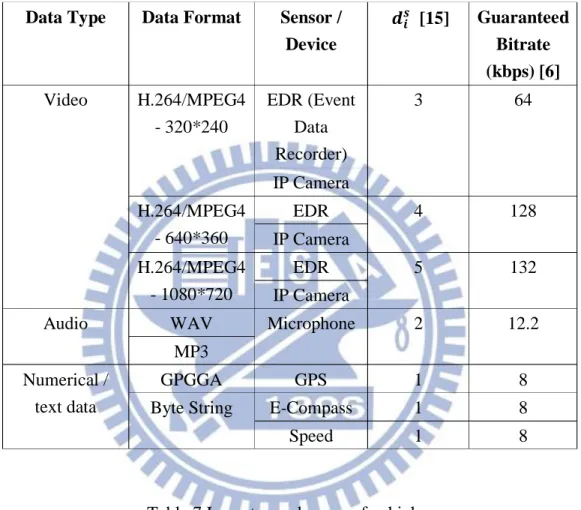
Table 6, Table 7 and Table 8 are the importance degrees we adopted in the simulations. Since we regard importance degrees as given values, the numerical values of them are generated randomly.
Table 7 Importance degrees of vehicles.
Vehicle Type 𝒅𝒊𝒗
Police/ Ambulance/ Fire truck 3
Public transportation 2
Household vehicle 1
Table 6 Importance degrees of sensors/devices.
Data Type Data Format Sensor / Device 𝒅𝒊𝒔 [15] Guaranteed Bitrate (kbps) [6] Video H.264/MPEG4 - 320*240 EDR (Event Data Recorder) 3 64 IP Camera H.264/MPEG4 - 640*360 EDR 4 128 IP Camera H.264/MPEG4 - 1080*720 EDR 5 132 IP Camera
Audio WAV Microphone 2 12.2
MP3 Numerical /
text data
GPGGA GPS 1 8
Byte String E-Compass 1 8
6.2 Evaluation results of QoS-MTRS
For performance evaluation, we compare the proposed QoS-MTRS with BQA (bandwidth and QoS-aware scheduler) [5] and two static methods: FCFS (first-come, first-served) and Greedy (greedy, based on traffic data value) scheduler. The performances we concerned are the appearance probability of received traffic data types, overall system throughput, end-to-end delay, duplication ratio (Dup), coverage (Cov) and overall value of received traffic data (S). The above performance metrics have been defined in Chapter 4.
Table 8 Importance degrees of location blocks.
Location block 𝒅𝒊𝒍 Location block 𝒅𝒊𝒍 A1 1 D1 4 A2 5 D2 1 A3 2 D3 5 A4 6 D4 2 B1 2 E1 4 B2 6 E2 1 B3 3 E3 4 B4 7 E4 3 C1 3 F1 4 C2 7 F2 1 C3 4 F3 3 C4 1 F4 3
Figure 5 shows the appearance probability distribution of the received sensor/device types per location block by using our proposed QoS-MTRS and other scheduling mechanisms. Let n represents the number of received sensor/device types in a certain block. n = 0 means there is no traffic data reported by any sensor/device. In our proposed method, the probability of n = 0 is 80% lower than that of any other method on average, and the probability of n > 1 is 65%, 58% and 48% higher than BQA [5], Greedy and FCFS, respectively, representing that the proposed QoS-MTRS has more chances to receive traffic data in various types.
Figure 5 Comparison of appearance probability distributions of the received data types per location block.
Figure 6 presents the comparison of duplication ratio, . The duplicated data may result in resource wasting because we allocate more resources but only received few kinds of data. Hence, low is preferred. Simulation result shows that our proposed method can decrease 50% of the duplicated data on average.
The overall traffic data value, , (excluded duplicated data) is shown in Figure 7. It represents the overall traffic data value we received, which means the worth of the received traffic data. Simulation result shows that our proposed QoS-MTRS can get the most valuable traffic data even when duplicated data are discarded. In terms of , the proposed QoS-MTRS is 27%, 18% and 54% higher than BQA [5], Greedy and FCFS, respectively.
Figure 8 shows the cumulative distribution function of end-to-end delay. Here, end-to-end means from UE to the traffic report application server in the Internet. We measured the end-to-end delay from the simulated trace file produced by NS3. Simulation result shows that there are 90% of the end-to-end delay under 0.016 seconds in the proposed QoS-MTRS and BQA [5], while for Greedy and FCFS, there are just 63% of the end-to-end delay under 0.016 seconds.
Figure 9 presents the system throughput. The throughput was derived from the simulated packet trace files produced by NS3, and was further processed by the Wireshark software. The stable growth of our proposed method indicates that the resources are allocated properly with channel quality checking. Simulation result indicates that the throughput of the proposed QoS-MTRS is 27%, 27% and 83% higher than that of BQA [5], Greedy and FCFS, respectively.
Figure 10 shows the coverage ( ) comparison among different methods. Our proposed QoS-MTRS always achieves at least 87% coverage even when the number of vehicles is only 20, while BQA [5], Greedy and FCFS just reach 30%, 58% and 64% coverage, respectively.
Chapter 7
Conclusion and Future Work
7.1 Concluding remarks
In this paper, we have presented a QoS-aware resource management mechanism for multimedia traffic report systems (QoS-MTRS) over LTE. The main idea of the proposed mechanism is that we consider both information importance and channel quality to improve the diversity, completeness and overall traffic data value under certain resource (e.g., radio) limitations. We have conducted a system-level simulation that includes LTE network environment to evaluate our design. Simulation results show that by adopting the proposed QoS-MTRS, the probability of receiving more than one kind of traffic data in a location is 65%, 58% and 48% higher than BQA [5], Greedy and FCFS, respectively; the duplication ratio can be decreased by 50% on average. The overall traffic data value of QoS-MTRS is 27%, 18% and 54% higher than that of BQA [5], Greedy and FCFS, respectively. In addition, QoS-MTRS always achieves at least 87% coverage even when the number of vehicles is as low as 20.
7.2 Future work
In the proposed QoS-MTRS, the importance degrees of vehicle, sensor/device types and locations are given values, and we just focus on the end-to-end resources management in LTE networks. For our future works, we will derive importance degrees from statistical data and integrate the QoS-MTRS with M2M architecture to support resource management between LTE networks and sensor networks, and further port the QoS-MTRS to LTE-A environments. Moreover, the resource
management problem may be modeled as an optimization problem for mathematical analysis.
References
[1] A. E. Essaili, E. Steinbach, D. Munaretto, S. Thakolsri and W. Kellerer, “QoE-driven resource optimization for user generated video content in next generation mobile networks,” in Proc. 2011 18th IEEE International Conference
on Image Processing (ICIP), Sep. 2011, pp. 913-916.
[2] A.G. Gotsis, A. S. Lioumpas and A. Alexiou, “M2M scheduling over LTE: challenges and new perspectives,” in Vehicular Technology Magazine, IEEE, Vol. 7, pp. 34-39, Sep. 2012.
[3] I. C. Wong, O. Oteri and W. McCoy, “Optimal resource allocation in uplink SC-FDMA systems,” in IEEE Transactions on Wireless Communications, Vol. 8, May. 2009.
[4] R. Kwan, C. Leung, and J. Zhang, “Proportional fair multiuser scheduling in LTE,” in IEEE Signal Processing Letters, Vol. 16, pp. 461-464, Jun. 2009.
[5] S. N. K. Marwat, Y. Zaki, C. Goerg, T. Weerawardane and A. Timm-Giel, “Design and performance analysis of bandwidth and QoS aware LTE uplink scheduler in heterogeneous traffic environment,” in Proc. IEEE International
Wireless Communications and Mobile Computing Conference (IWCMC), Aug.
2012, pp. 499-504.
[6] M. Salah, N. A. Ali, A. Taha and H. Hassanein, “Evaluating uplink schedulers in LTE in mixed traffic environments,” in Proc. IEEE International Conference on
Communications (ICC), Jun. 2011, pp. 1-5.
[7] R. Atat, E. Yaacoub, M. Alouini and F. Filali, “Delay efficient cooperation in public safety vehicular networks using LTE and IEEE 802.11p,” in Proc. IEEE
Consumer Communications and Networking Conference (CCNC), Jan. 2012, pp.
316-320.
[8] R. Sivaraj, A. K. Gopalakrishna, M. G. Chandra and P. Balamuralidhar, “QoS-enabled group communication in integrated VANET-LTE heterogeneous wireless networks,” in Proc. IEEE 7th International Conference on Wireless and
Mobile Computing, Networking and Communications (WiMob), Oct. 2011, pp.
17-24.
[9] H. Ekstrom, “QoS control in the 3GPP evolved packet system,” in IEEE
Communications Magazine, Vol. 47, pp. 7-83, Feb. 2009.
[10] “NS3,” [Online]. Available: http://www.nsnam.org.
[11] M. Fiore, J. Harri, F. Filali and C. Bonnet, “Vehicular mobility simulation for VANETs,” in Proc. 40th Annual Simulation Symposium (ANSS), Mar. 2007, pp. 301-309.
[12] G. Remy, S.-M. Senouci, F. Jan and Y. Gourhant, “LTE4V2X: LTE for a centralized VANET organization,” in Proc. IEEE Global Telecommunications
Conference (GLOBECOM), Dec. 2011, pp. 1-6.
[13] L. Costantino, N. Buonaccorsi, C. Cicconetti and R. Mambrini, “Performance analysis of an LTE gateway for the IoT,” in Proc. IEEE International Symposium
on World of Wireless, Mobile and Multimedia Networks (WoWMoM), Jun. 2012,
pp. 1-6.
[14] A. Vinel, “3GPP LTE versus IEEE 802.11p/WAVE: which technology is able to support cooperative vehicular safety applications?” in IEEE Wireless
Communications Letters, Vol. 1, pp. 125 -128, Apr. 2012.
[15] L. Li and S. Shen, “End-to-end QoS performance management across LTE networks,” in Proc. 13th Asia-Pacific Network Operations and Management
[16] “NAVTEQ,” [Online]. Available: http://www.traffic.com.
[17] 3GPP TS 36.300: Evolved Universal Terrestrial Radio Access (E-UTRA) and Evolved Universal Terrestrial Radio Access Network (E-UTRAN); Overall description; Stage 2.
[18] S. Cheung and P. Varaiya, “Traffic surveillance by wireless sensor networks: final report,” California PATH Research Report, [Online]. Available: http://www.its.berkeley.edu/publications/UCB/2007/PRR/UCB-ITS-PRR-2007-4. pdf.
[19] “SIGALERT,” [Online]. Available: http://www.sigalert.com.
[20] ETSI TS 102.690: Machine-to-machine communications (M2M); Functional architecture, 2011.
[21] H. Luo, S. Ci, D.Wu, J. Wu and H. Tang, “Quality-driven cross-layer optimized video delivery over LTE” in IEEE Communications Magazine, Vol. 48, pp. 102-109, Feb. 2010.
[22] Public Works Department of Taipei City Government, “Taipei e-Map,” [Online]. Available: http://163.29.36.21/eGISmap/index.aspx?slang=zh-tw.
[23] 3GPP TS 23.203: Digital cellular telecommunications system (Phase 2+); Universal Mobile Telecommunications System (UMTS); Policy and charging control architecture.
[24] 3GPP TS 36.213: Evolved Universal Terrestrial Radio Access (E-UTRA); Physical layer procedures.
[25] 3GPP TS 36.104: Evolved Universal Terrestrial Radio Access (E-UTRA); Base Station (BS) radio transmission and reception.
[26] 3GPP TR 25.913: Universal Mobile Telecommunications System (UMTS); Requirements for Evolved UTRA (E-UTRA) and Evolved UTRAN (E-UTRAN).
![Table 1 Standardized QCI characteristics in LTE [23]. QCI Resource Type Priority Packet Delay Budget (ms) Packet Error Loss Rate Example Services 1 GBR 2 100 10 -2 Conversational Voice 2 4 150 10-3Conversational Voice (Live Streaming)](https://thumb-ap.123doks.com/thumbv2/9libinfo/8749126.205509/16.893.135.761.167.1049/standardized-characteristics-resource-priority-services-conversational-conversational-streaming.webp)
![Table 4 CQI MCS mapping table in LTE [24].](https://thumb-ap.123doks.com/thumbv2/9libinfo/8749126.205509/35.893.140.752.165.797/table-cqi-mcs-mapping-table-in-lte.webp)
![Table 5 Simulation parameter settings [12][13].](https://thumb-ap.123doks.com/thumbv2/9libinfo/8749126.205509/37.893.136.747.430.988/table-simulation-parameter-settings.webp)