White-light generation and energy transfer in Sr Zn 2 ( P O 4 ) 2 : Eu , Mn phosphor for
ultraviolet light-emitting diodes
Woan-Jen Yang and Teng-Ming Chen
Citation: Applied Physics Letters 88, 101903 (2006); doi: 10.1063/1.2182026 View online: http://dx.doi.org/10.1063/1.2182026
View Table of Contents: http://scitation.aip.org/content/aip/journal/apl/88/10?ver=pdfcov Published by the AIP Publishing
Articles you may be interested in
Sr 3 B 2 O 6 : Ce 3 + , Eu 2 + : A potential single-phased white-emitting borate phosphor for ultraviolet light-emitting diodes
Appl. Phys. Lett. 91, 081902 (2007); 10.1063/1.2772195
White light emitting diode by using - Ca 2 P 2 O 7 : Eu 2 + , Mn 2 + phosphor Appl. Phys. Lett. 90, 261113 (2007); 10.1063/1.2752725
White light generation under violet-blue excitation from tunable green-to-red emitting Ca 2 Mg Si 2 O 7 : Eu , Mn through energy transfer
Appl. Phys. Lett. 90, 161901 (2007); 10.1063/1.2722670
Tunable full-color-emitting La 0.827 Al 11.9 O 19.09 : Eu 2 + , Mn 2 + phosphor for application to warm white-light-emitting diodes
Appl. Phys. Lett. 89, 231909 (2006); 10.1063/1.2398887
White-light-emitting phosphor: Ca Mg Si 2 O 6 : Eu 2 + , Mn 2 + and its related properties with blending Appl. Phys. Lett. 89, 221916 (2006); 10.1063/1.2399338
This article is copyrighted as indicated in the article. Reuse of AIP content is subject to the terms at: http://scitation.aip.org/termsconditions. Downloaded to IP: 140.113.38.11 On: Thu, 01 May 2014 02:06:20
White-light generation and energy transfer in SrZn
2„PO
4…
2: Eu, Mn phosphor
for ultraviolet light-emitting diodes
Woan-Jen Yang and Teng-Ming Chena兲
Department of Applied Chemistry, National Chiao Tung University, Hsinchu 30050, Taiwan, Republic of China
共Received 19 October 2005; accepted 10 February 2006; published online 6 March 2006兲
The SrZn2共PO4兲2: Eu2+, Mn2+ phosphor shows two emission bands under ultraviolet radiation; the one observed at 416 nm is attributed to Eu2+occupying the Sr2+sites and the other asymmetric band deconvoluted into two peaks was found to center at 538 and 613 nm, which originate from Mn2+ occupying two different Zn2+ sites. The energy transfer from Eu2+to Mn2+has been demonstrated to be a resonant type via a dipole-quadrupole mechanism. By utilizing the principle of energy transfer and appropriate tuning of activator contents, we have demonstrated that SrZn2共PO4兲2: Eu2+, Mn2+is potentially useful as an ultraviolet-convertible phosphor for white-light emitting diodes. © 2006 American Institute of Physics. 关DOI:10.1063/1.2182026兴
The quest for new light-emitting-diode共LED兲 converted phosphors has triggered active research efforts in the inves-tigation of single-phased white-emitting phosphors. It has been well known that Eu2+ may act as an efficient sensitizer transferring energy to Mn2+ in several host lattices.1–3
The energy transfer from Eu2+to Mn2+共ETEu→Mn兲 in luminescent materials has been studied extensively during the past few years.4–7The main interest is in the development of new and single-phased 共instead of combination of red, green, and blue兲 phosphors for white-light ultraviolet light-emitting di-odes 共UVLEDs兲. In this letter, we have demonstrated that with appropriate tuning of activator contents SrZn2共PO4兲2: Eu2+, Mn2+ 共SZP:Eu,Mn兲 phosphors exhibit great potential to act as a single-phased white-emitting phos-phor for UVLEDs. The energy transfer mechanism among the luminescent centers in SZP:Eu,Mn has also been inves-tigated and reported herein.
The compound SrZn2共PO4兲2共SZP兲 was confirmed to ex-ist as a single phase in the Sr3共PO4兲2– Zn3共PO4兲2 system in 1961 by Hummel8and, although only unindexed x-ray pow-der data were reported, the luminescent properties of the SZP: Eu2+ were reported in 1968 by Hoffman.9 Until 1990, the crystal structure of SZP was then determined by Hemon10 to be a Hurlbutite-type structure with the composition CaBe2共PO4兲2,11which was found to emit blue light by Eu2+ doping under 254 nm excitation.12
SZP:Eu,Mn phosphors were synthesized through a solid-state reaction route. The starting materials SrCO3, ZnO, NH4H2PO4, Eu2O3, and MnCO3with purity of 99.99% were mixed in the requisite proportions and calcined at 900– 1000 ° C under 5:95 H2/ Ar atmosphere. The phase pu-rity of the as-prepared phosphor samples was checked by powder x-ray diffraction共XRD兲 analysis by using a Bruker AXS D8 advanced automatic diffractometer with Cu K␣ ra-diation operated at 40 kV and 20 mA. The XRD profile of SZP:Eu,Mn is shown in Fig. 1 and it agrees well with that reported in JCPDS file 80-1062, indicating that codoping Eu2+ and Mn2+ does not cause any significant change in the host structure. SZP crystallizes in a monoclinic system with
the space group of P21/ c and has five crystallographically independent cation sites in a unit cell, namely, one seven-coordinated Sr2+ site, two four-coordinated Zn2+ sites, and two four-coordinated P5+sites.10
Based on the effective ionic radii of cations with different coordination numbers,13 we have proposed that Eu2+ and Mn2+ are expected to occupy the Sr2+ and Zn2+ sites preferably, respectively, since the ionic radii of Eu2+ 共1.20 Å兲 and Mn2+ 共0.66 Å兲 are close to that of Sr2+ 共1.21 Å兲 and Zn2+共0.60 Å兲, respectively. How-ever, the P5+ sites with ionic radius of 0.17 Å are too small for Eu2+and Mn2+to occupy.
The measurements of photoluminescence共PL兲 and pho-toluminescence excitation 共PLE兲 spectra for SZP:Eu,Mn phosphors were performed by using a Spex Fluorolog-3 spectrofluorometer共Instruments S.A., Edison, N.J.兲 equipped with a 450 W Xe light source and double excitation mono-chromators, and the details have been described in our pre-vious work.7As shown in Fig. 2, the PLE spectrum of SZ-P:Eu shows an optimal excitation band centered at 365 nm, consisting of unresolved bands due to the 4f5d multiplets of the Eu2+excited state, and the PL spectrum of that shows an intense broad band centered at 416 nm, which could be at-tributed to the typical 4f65d1共t
2g兲→4f7共8S7/2兲 transition of Eu2+. The PLE spectrum of SZP:Mn consists of several
a兲Author to whom correspondence should be addressed; electronic mail:
FIG. 1. XRD patterns of共a兲 SrZn2共PO4兲2共JCPDS file No. 80-1062兲 and 共b兲
共Sr0.99Eu0.012+ 兲共Zn1.99Mn0.012+ 兲共PO4兲2phosphor.
APPLIED PHYSICS LETTERS 88, 101903共2006兲
0003-6951/2006/88共10兲/101903/3/$23.00 88, 101903-1 © 2006 American Institute of Physics
This article is copyrighted as indicated in the article. Reuse of AIP content is subject to the terms at: http://scitation.aip.org/termsconditions. Downloaded to IP: 140.113.38.11 On: Thu, 01 May 2014 02:06:20
bands centered at 350, 372, 416, 429, and 468 nm, corre-sponding to the transitions of Mn2+ from6A
1共
6S兲 to4E共4D兲, 4
T2共4D兲, 关4A1共4G兲,4E共4G兲兴,4T2共4G兲,4T1共4G兲 levels,
respec-tively. The broad and asymmetric emission band of SZP:Mn is attributed to the spin-forbidden 4T1共4G兲→6A1共6S兲
transi-tion of Mn2+ occupying two crystallographically distinct Zn2+ sites. Therefore, by deconvoluting the observed emis-sion band of Mn2+, we could obtain two peaks centered at 538 and 613 nm, respectively.
As shown in Fig. 2, a significant spectral overlap was observed between the emission band of Eu2+ centered at 416 nm and the Mn2+ excitation transition multiplets of 6A
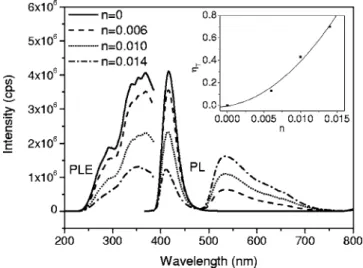
1共6S兲→4T1共4G兲, 4T2共4G兲, 关4A1共4G兲,4E共4G兲兴. Therefore, the effective resonance-type ETEu→Mn is expected. Figure 3 shows the PLE and PL spectra for 共Sr0.99Eu0.012+ 兲 ⫻共Zn2−nMnn
2+兲共PO
4兲2phosphors with different Mn2+ dopant contents n of 0, 0.006, 0.010, and 0.014, respectively. Inter-estingly and reasonably, with increasing Mn2+ dopant con-tent, the PL intensity of Mn2+activator共or energy acceptor兲 was observed to increase, whereas that of Eu2+sensitizer共or energy donor兲 was simultaneously found to decrease
mono-tonically. The energy transfer efficiency 共T兲 from Eu2+ to Mn2+can be expressed by14
T= 1 −
IS
IS0
, 共1兲
where IS0and IS are the luminescence intensity of sensitizer 共Eu2+兲 in the absence and presence of activator 共Mn2+兲. The
T from Eu2+ to Mn2+ in 共Sr0.99Eu0.012+ 兲共Zn2−nMnn
2+兲共PO 4兲2 was calculated as a function of n and is illustrated in Fig. 3. With increasing Mn2+ dopant content, theT was found to increase gradually.
On the basis of Dexter’s energy transfer formula of mul-tipolar interaction and Reisfeld’s approximation, the follow-ing relation can be obtained:15
0
⬀ Cn/3 共2兲
where0and are the luminescence quantum efficiency of Eu2+ in the absence and presence of Mn2+, respectively; the values0/can be approximately calculated by the ratio of related luminescence intensities共IS0/ IS兲; C is the content of Mn2+; n = 6, 8, and 10, corresponding to dipole–dipole, dipole–quadrupole, and quadrupole–quadrupole interactions, respectively. The IS0/ IS-Cn/3 plots are represented in Figs. 4共a兲 and 4共b兲, and only when n=8 does it exhibit a linear relation, indicating clearly that ETEu→Mn is the dipole– quadrupole mechanism, which is similar to that observed in CaAl2Si2O8: Eu, Mn previously investigated in our group.7
For the dipole–quadrupole mechanism, the critical dis-tance共Rc兲 of ETEu→Mncan be expressed by7
Rc 8 = 0.63⫻ 1028fqS 2Q A fdES4
冕
FS共E兲FA共E兲dE, 共3兲 where QA= 4.8⫻10−16fd is the absorption cross section of Mn2+, fd= 10−7 and fq= 10−10are the oscillator strengths of the dipole and quadrupole electrical absorption transitions for Mn2+;S共in Å兲 and E 共in eV兲 are emission wavelength and emission energy of Eu2+;兰F
S共E兲FA共E兲dE represents the spectral overlap between the normalized shapes of Eu2+ emission FS共E兲 and Mn2+ excitation FA共E兲, and it is esti-mated at about 4.35 eV−1. So the Rc of ETEu→Mn in SZ-P:Eu,Mn was calculated to be about 11.4 Å, which is slightly
FIG. 2. PLE and PL spectra for共Sr0.99Eu0.012+ 兲Zn
2共PO4兲2共PLE monitored at
416 nm and PL exited at 365 nm兲 and Sr共Zn1.96Mn0.042+兲共PO4兲2共PLE
moni-tored at 538 nm and PL excited at 416 nm兲 and peak-fitting spectra for PL band of Sr共Zn1.96Mn0.042+兲共PO4兲2.
FIG. 3. PLE and PL spectra for共Sr0.99Eu0.012+ 兲共Zn
2−nMnn2+兲共PO4兲2phosphors
共PLE monitored at 416 nm and PL excited at 365 nm兲, and dependence of the energy transfer efficiencyTon Mn2+content n.
FIG. 4. Dependence of IS0/ ISof Eu2+on共a兲 C6/3and共b兲 C8/3.
101903-2 W.-J. Yang and T.-M. Chen Appl. Phys. Lett. 88, 101903共2006兲
This article is copyrighted as indicated in the article. Reuse of AIP content is subject to the terms at: http://scitation.aip.org/termsconditions. Downloaded to IP: 140.113.38.11 On: Thu, 01 May 2014 02:06:20
longer than that 共i.e., 10.8 Å兲 reported for CaAl2Si2O8: Eu, Mn.7
The Commission International de I’Eclairage 共CIE兲 chromaticity coordinates for 共Sr1−mEum
2+兲共Zn 2−nMnn
2+兲共PO 4兲2 phosphors were measured and summarized in Table I and the CIE coordinates are also represented as series A in Fig. 5. We have observed that the共x,y兲 coordinates vary systematically from共0.17, 0.06兲, 共0.26, 0.22兲, 共0.32, 0.31兲, 共0.37, 0.37兲 to 共0.46, 0.46兲, corresponding to hues of blue, aqua, white, and eventually to yellow; and the PL image of white-light emis-sion is also shown in inset共a兲 of Fig. 5. To demonstrate that 共Sr0.99Eu0.012+ 兲共Zn1.99Mn0.012+ 兲共PO4兲2 is a single-phased white-emitting phosphor, we have investigated the photolumines-cence of the phosphor particles by using a fluoresphotolumines-cence mi-croscope 共Olympus IX70兲 with a mercury light source and the fluorescence image obtained with 365 nm radiation is shown in inset共b兲 of Fig. 5. The observed golden rather than white colored image has been attributed to possible chro-matic aberration of the microscope system, indicating that our SZP:Eu,Mn phosphor is truly a single-phased phosphor.
Therefore, our observation confirms the fact that both Eu2+ and Mn2+ simultaneously codoped into SrZn
2共PO4兲2 rather than the respective doping. Furthermore, to evaluate the po-tential of the wavelength-tunable SZP:Eu,Mn as white-emitting phosphors, we have investigated and compared the chromaticity characteristics of the simulated white light gen-erated from commercial Y3Al5O12: Ce共YAG:Ce, Nichia Co., Japan兲 excited with monochromatic blue light of 467 nm with coordinates of 共0.15, 0.04兲 represented as series B in Fig. 5. The experimentally determined chromaticity coordi-nates were found to be 共0.48, 0.50兲 for YAG:Ce and 共0.31, 0.27兲 for simulated white light, respectively, and the color saturation was found to be inferior to that generated from our SZP:Eu,Mn phosphor. In practice, with an increasing amount of electrical current, the hue of a white-light LED changes from yellow to white and to blue. Therefore, the white-light LED based on YAG:Ce excited by a blue-emitting chip tends to produce color aberration when the LED chip is degrading. In contrast, our SZP:Eu,Mn phosphors excited with UV light will not have that problem because the excited light is invis-ible. The above observations hint at the promising applica-tion of SZP:Eu,Mn as a single-phased white-emitting phos-phor for UVLEDs.
In conclusion, the white-light generation has been real-ized through tuning of Eu2+ and Mn2+ contents in SrZn2共PO4兲2under UV radiation. We have also demonstrated that the energy transfer from Eu2+ to Mn2+ in SrZn2共PO4兲2: Eu2+, Mn2+ phosphors is a resonant type via a dipole–quadrupole mechanism. Therefore, by utilizing the principle of energy transfer and adjusting activator contents properly, we have shown that SrZn2共PO4兲2: Eu2+, Mn2+ can act as a potential single-phased white-emitting phosphor for UVLEDs.
The authors acknowledge the generous financial support from the National Science Council of Taiwan, R.O.C. under Contract No. NSC94-2113-M009-001.
1N. Ruelle, M. Pham-Thi, and C. Fouassier, Jpn. J. Appl. Phys., Part 1 31,
2786共1992兲.
2U. G. Caldino, A. F. Munoz, and J. O. Rubio, J. Phys.: Condens. Matter 5,
2195共1993兲.
3A. Mendez, F. Ramos, H. Riveros, E. Camarillo, and U. Caldino, J. Mater.
Sci. Lett. 18, 399共1999兲.
4J. S. Kim, P. E. Jeon, J. C. Choi, H. L. Park, S. I. Mho, and G. C. Kim,
Appl. Phys. Lett. 84, 2931共2004兲.
5J. S. Kim, P. E. Jeon, Y. H. Park, J. C. Choi, H. L. Park, G. C. Kim, and
T. W. Kim, Appl. Phys. Lett. 85, 3696共2004兲.
6J. S. Kim, K. T. Lim, Y. S. Jeong, P. E. Jeon, J. C. Choi, and H. L. Park,
Solid State Commun. 135, 21共2005兲.
7W.-J. Yang, L. Luo, T.-M. Chen, and N.-S. Wang, Chem. Mater. 17, 3883
共2005兲.
8J. F. Sarver, M. V. Hoffman, and F. A. Hummel, J. Electrochem. Soc. 108,
1103共1961兲.
9M. V. Hoffman, J. Electrochem. Soc. 115, 560共1968兲.
10A. Hemon and G. Courbion, J. Solid State Chem. 85, 164共1990兲. 11M. E. Mrose, Am. Mineral. 37, 931共1952兲.
12J. M. P. J. Verstegen, W. H. M. M. V. Spijker, and E. P. J. D. Meester, U.S.
Patent 4,049,992共1977兲.
13R. D. Shannon, Acta Crystallogr., Sect. A: Cryst. Phys., Diffr., Theor. Gen.
Crystallogr. A32, 751共1976兲.
14P. I. Paulose, G. Jose, V. Thomas, N. V. Unnikrishnan, and M. K. R.
Warrier, J. Phys. Chem. Solids 64, 841共2003兲.
15H. Jiao, F. Liao, S. Tian, and X. J. Jing, J. Electrochem. Soc. 150, H220
共2003兲. TABLE I. Comparison of CIE chromaticity coordinates for共Sr1−mEum
2+兲
⫻共Zn2−nMnn
2+兲共PO
4兲2phosphors and simulated white light using
commer-cial YAG:Ce phosphor. ex 共nm兲 Sample 共x,y兲 365 m = 0.01 n = 0 共0.17,0.06兲 365 m = 0.01 n = 0.006 共0.26,0.22兲 365 m = 0.01 n = 0.010 共0.32,0.31兲 365 m = 0.01 n = 0.014 共0.37,0.37兲 416 m = 0 n = 0.04 共0.46,0.46兲 467
Simulated white light
with YAG:Ce 共0.31,0.27兲
FIG. 5. 共Color online兲 CIE chromaticity diagram for 共Sr1−mEum2+兲
⫻共Zn2−nMnn
2+兲共PO
4兲2phosphors with different Mn2+dopant contents
repre-sented as series A共m=0.01 excited at 365 nm, m=0 excited at 416 nm兲 and simulated white light generated with YAG:Ce represented as series B 共excited at 467 nm兲; inset 共a兲 PL image and 共b兲 fluorescence image under 40⫻ magnification of 共Sr0.99Eu0.01
2+ 兲共Zn 1.99Mn0.01
2+ 兲共PO 4兲2.
101903-3 W.-J. Yang and T.-M. Chen Appl. Phys. Lett. 88, 101903共2006兲
This article is copyrighted as indicated in the article. Reuse of AIP content is subject to the terms at: http://scitation.aip.org/termsconditions. Downloaded to IP: 140.113.38.11 On: Thu, 01 May 2014 02:06:20