
IEEE ANTENNAS AND WIRELESS PROPAGATION LETTERS, VOL. 4, 2005 355
Tapered Bent Folded Monopole for Dual-Band
Wireless Local Area Network (WLAN) Systems
Yu-De Lin, Member, IEEE, and Pei-Ling Chi
Abstract—An antenna structure based on the geometry of the bent folded monopole is described in this letter. This novel tapered bent folded monopole is designed to cover popular frequency spec-trum of the 2.4 and the 5 GHz wireless local area network (WLAN) bands. The proposed antenna capable of dual-frequency operation is fed by the coplanar waveguide (CPW) and fabricated on the RO4003 substrate. Obtained numerical results are in good agree-ment with the experiagree-mental data. It has been validated that the configuration can meet the demands for the WLAN systems and ef-fectively enhance the impedance bandwidth to 12.5% for the lower band and 32.4% for the upper band forVSWR 2 : 1.
Index Terms—Coplanar waveguide, folded monopole, tapered structure, wireless local area network.
I. INTRODUCTION
D
UE to the widespread popularity of wireless local area net-work (WLAN) in both the 2.4 and 5 GHz bands, dual-band antennas have received more and more attention. In addition to the property of dual-band, one integrated device that com-bines good performance, low cost, and small size is the natural trend for current research and commercial demand. Due to the constraint on physical size of antennas, one simple technique that incorporates multiple resonant paths into a single antenna has been discussed for decades. A number of dual-band an-tennas such as monopole and printed inverted-F antenna (PIFA) [1]–[4] have been devised based on this method. Recently, the folded loop and bent folded monopole are extensively investi-gated and used in wireless communication systems [5], [6]. In this letter, we propose a coplanar waveguide (CPW)-fed tapered bent folded monopole fabricated on RO4003 substrate. With the features of dual/broad bandwidth and compact size, it can be shown that the antenna is suitable for mobile stations in nowa-days wireless communication requirement.II. ANALYSIS ANDDESIGN OF THECPW-FED TAPERED
BENTFOLDEDMONOPOLE
The tapered bent folded monopole is shown in Fig. 1(a). For the bent folded monopole, the path of resonance for the second resonant frequency (5 GHz) can be shown to be short-circuited at point A, open-circuited at point B, and short-circuited at point C from the current flows in the conductor [see Fig. 1(a)]. In
Manuscript received March 4, 2005; revised July 28, 2005. This work was supported in part by the National Science Council under Grants NSC 92-2815-C-009-014 and NSC 93-2219-E-009-024.
The authors are with the Antenna Laboratory, Institute of Communication Engineering, National Chiao Tung University, Hsinchu, Taiwan, R.O.C.
Digital Object Identifier 10.1109/LAWP.2005.857035
Fig. 1. (a) Circuit configuration of the tapered bent folded monopole. (b) Circuit configuration of the conventional bent folded monopole.
order to increase the impedance bandwidth for the upper fre-quency range, the proposed antenna adopts a tapered geometry at point C (short-circuited), also for point D. Compared with the conventional bent folded monopole [see Fig. 1(b)] done previ-ously as a control group (the typical performance of the conven-tional bent folded monopole can refer to the papers [5], [6]), the simulated result shows that the proposed modification greatly broaden the bandwidth from 10.4% to 32.4%. The entire circuit was manufactured on an RO4003 substrate to re-duce the dielectric loss and the substrate thickness is 0.508 mm. The structural parameters for the tapered bent folded monopole are as follows [see Fig. 1(a)]: , ,
, , .
Both numerical and experimental results of the return loss of the tapered bent folded monopole are shown in Fig. 2. As shown, they are in good agreement. The return loss of the tapered bent
356 IEEE ANTENNAS AND WIRELESS PROPAGATION LETTERS, VOL. 4, 2005
Fig. 2. Measured and calculated return loss of the tapered bent folded monopole.
Fig. 3. Radiation patterns measured at 2.5 GHz for the tapered bent folded monopole.
folded monopole was measured with an Agilent E5071A net-work analyzer. The results show that the antenna circuit has a return loss of 17.2 dB at 2.44 GHz, a bandwidth of 12.5% for , and a return loss of 12.1 dB at 5.2 GHz, a bandwidth of 32.4% for .
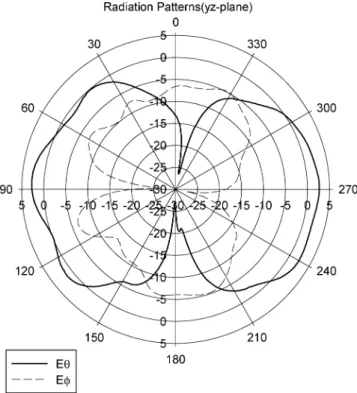
Radiation patterns of the antenna were measured with an HP85301 antenna measurement system in an anechoic chamber. The radiation pattern plots of the dual-band antenna for both frequencies are shown in Figs. 3–6. As shown in graphs, the omnidirectional patterns in the xz-plane (see Fig. 1) are observed for both frequencies.
Fig. 4. Radiation patterns measured at 5.2 GHz for the tapered bent folded monopole.
Fig. 5. Radiation patterns measured at 2.5 GHz for the tapered bent folded monopole.
III. CONCLUSION
Analysis and design of a tapered bent folded monopole on a low-loss RO4003 substrate for the 2.4-GHz ISM and the en-tire 5-GHz bands is described in this letter. Numerical anal-ysis has been validated by measurement results. From the data shown, this antenna indeed satisfies the demand for wide-band and dual-frequency working functions. With its features of easy
LIN AND CHI: TAPERED BENT FOLDED MONOPOLE FOR DUAL-BAND WLAN SYSTEMS 357
Fig. 6. Radiation patterns measured at 5.2 GHz for the tapered bent folded monopole.
fabrication, low cost, dual/wide bandwidth, and omnidirectional patterns, the proposed tapered bent folded monopole is very suitable for the applications in wireless communication systems.
REFERENCES
[1] W. L. Stutzman and G. A. Thiele, Antenna Theory and Design, 2nd ed. New York: Wiley, 1998.
[2] P. Salonen, M. Keskilammi, and M. Kivikoski, “Dual-band and wide-band PIFA with U- and meanderline-shaped slot,” in Proc. IEEE
An-tennas and Propagation Society Int. Symp. Dig., vol. 2, Jul. 8–13, 2001,
pp. 116–119.
[3] P. Salonen and M. Keskilammi, “Novel dual-band planar inverted-F an-tenna,” in Proc. Asia-Pacific Microwave Conf. Dig., Sydney, Australia, Dec. 3–6, 2000, pp. 706–710.
[4] P. Salonen, M. Keskilammi, and M. Kivikoski, “Single-feed dual-band planar inverted-F antenna with U-shaped slot,” IEEE Trans. Antennas
Propag., vol. 48, no. 8, pp. 1262–1264, Aug. 2000.
[5] F. Niu, “Folded L-antennas,” in Proc. IEEE Antennas and Propagation
Society Int. Symp. Dig., vol. 3, 2000, pp. 1666–1669.
[6] E. Lee, P. S. Hall, and P. Gardner, “Dual band folded monopole/loop antenna for terrestrial communication system,” Electron. Lett., vol. 36, no. 24, pp. 1990–1991, Nov. 2000.


![[102-2] WNFA lab4 - A Tiny Wireless Sensor Network 2014/5/12 Chih-Hsien Ou](data:image/gif;base64,R0lGODlhAQABAIAAAP///wAAACH5BAEAAAAALAAAAAABAAEAAAICRAEAOw==)