
http://www.elsevier-deutschland.de/jplhp
Nitric oxide acts as an antioxidant and delays methyl
jasmonate-induced senescence of rice leaves
Kuo Tung Hung, Ching Huei Kao*
Department of Agronomy, National Taiwan University, Taipei, Taiwan, Republic of China
Received April 8, 2003 · Accepted June 4, 2003
Summary
In the present study, we evaluate the protective effect of nitric oxide (NO) against senescence of rice leaves promoted by methyl jasmonate (MJ). Senescence of rice leaves was determined by the decrease of protein content. MJ treatment resulted in (1) induction of leaf senescence, (2) increase in H2O2and malondialdehyde (MDA) contents, (3) decrease in reduced form glutathione (GSH) and
ascorbic acid (AsA) contents, and (4) increase in antioxidative enzyme activities (ascorbate peroxi-dase, glutathione reductase, peroxidase and catalase). All these MJ effects were reduced by free radical scavengers such as sodium benzoate and GSH. NO donors [N-tert-butyl-
α
-phenylnitrone (PBN), sodium nitroprusside, 3-morpholinosydonimine, and AsA+NaNO2] were effective in reducingMJ-induced leaf senescence. PBN prevented MJ-induced increase in the contents of H2O2 and
MDA, decrease in the contents of GSH and AsA, and increase in the activities of antioxidative enzymes. The protective effect of PBN on MJ-promoted senescence, MJ-increased H2O2content
and lipid peroxidation, MJ-decreased GSH and AsA, and MJ-increased antioxidative enzyme activ-ities was reversed by 2-(4-carboxy-2-phenyl)-4,4,5,5-tetramethyl-imidazoline-1-oxyl-3-oxide, a NO-specific scavenger, suggesting that the protective effect of PBN is attributable to NO released. Reduction of MJ-induced senescence by NO in rice leaves is most likely mediated through its ability to scavenge active oxygen species including H2O2.
Key words:active oxygen species – lipid peroxidation – methyl jasmonate – nitric oxide – Oryza
sativa
Abbreviations:AOS= active oxygen species. – APOD = ascorbate peroxidase. – AsA = ascorbic acid. – CAT= catalase. – c-PTIO = 2-(4-carboxy-2-phenyl)-4,4,5,5-tetramethylimidazoline-1-oxyl-3-oxide. – FW= fresh weight. – GR = glutathione reductase. – GSH = reduced glutathione. – MDA = malondialdehyde. – MJ= methyl jasmonate. – NO = nitric oxide. – PBN = N-tert-butyl-
α
-phenylnitrone. – POD= peroxidase. – SB = sodium benzoate. – SIN-1 = 3-morpholinosydonimine. – SNP = sodium nitroprusside. – SOD= superoxide dismutase* E-mail corresponding author: [email protected]
Introduction
Jasmonic acid and its methyl ester, methyl jasmonate (MJ), collectively named jasmonates, have been proposed as natu-rally occurring plant growth regulators because of their wide natural distribution (Meyer et al. 1991) and their effects on many physiological processes in plants (Sembdner and thier 1993, Creelman and Mullet 1997, Wasternack and Par-thier 1997). Jasmonates have been shown to be powerful pro-moters of leaf senescence (Ueda and Kato 1981, Weidhase et al. 1987, Chou and Kao 1992, Tsai et al. 1996, Chen and Kao 1998, Hung and Kao 1998). Recent molecular studies have confirmed that jasmonic acid may play a role in leaf senes-cence (He et al. 2002).
Lipid peroxidation is considered to be an important mech-anism of leaf senescence (Thompson et al. 1987, Strother 1988). Active oxygen species (AOS) can initiate lipid peroxi-dation (Kellogg and Fridovich 1975). It has been shown that MJ causes the generation of H2O2 (Orozco-Cárdenas and
Ryan 1999, Orozco-Cárdenas et al. 2001) and lipid peroxida-tion expressed as malondialdehyde (MDA) producperoxida-tion in plant cells (Hung and Kao 1998). Thus, MJ leads to oxidative stress in plant cells.
Nitric oxide (NO) is a bioactive free radical implicated in a number of physiological functions, including intra- and inter-cellular mediation of some animal responses (Anbar 1995, La-mattina et al. 2003). NO is involved in many physiological re-sponses of plants: pathogen response (Delledonne et al. 1998, Klessig et al. 2000, Orozco-Cárdenas et al. 2001), pro-grammed cell death (Pedroso et al. 2000, Beligni et al. 2002), growth (Leshem and Haramaty 1996), germination (Beligni and Lamattina 2000), root organogenesis (Pagnussat et al. 2002), phytoalexin production (Noritake et al. 1996), internal iron availability (Graziano et al. 2002), salt and heat tolerance (Uchida et al. 2002), cytokinin action (Scherer and Holk 2000), abscisic acid-dependent stomatal closure (Garcia-Mata and Lamattina 2002, Neill et al. 2002), and ethylene emission (Leshem 2000).
Several reports convincingly demonstrate that NO is able to counteract the toxicity of paraquat and diquat, which are known to generate AOS, in potato and rice leaves (Beligni and Lamattina 1999 a, b, 2002, Hung et al. 2002), and block H2O2production induced by jasmonic acid in tomato leaves
(Orozco-Cárdenas and Ryan 2002). Thus, a possible partici-pation of NO in the antioxidant system in plants, as observed in animals (O’Donnell et al. 1997, d’Ischia et al. 2000), is sug-gested. In rice leaves, it has been shown that NO donors re-duced paraquat toxicity through a decrease in lipid peroxida-tion (Hung et al. 2002). More recently, we showed that the promotion of rice leaf senescence caused by abscisic acid, which induces H2O2production and lipid peroxidation, can
be counteracted by NO donors (Hung and Kao 2003). Jas-monates have both chemical and physiological similarities to abscisic acid (Anderson et al. 1989). It is logical to speculate that NO is also effective in counteracting MJ-induced
senes-cence of rice leaves. In the present investigation, we exam-ined the effect of NO on MJ-promoted senescence of rice leaves.
Materials and Methods
Plant material and chemicals
Rice (Oryza sativa L., cv. Taichung Native 1) was sterilized with 2.5 % sodium hypochlorite for 15 min and washed extensively with distilled water. These seeds were then germinated in Petri dishes with wetted filter paper at 37 ˚C under dark condition. After 48 h incubation, uni-formly germinated seeds were selected and cultivated in a 500 mL beaker containing half-strength Kimura B solution as described pre-viously (Chu and Lee 1989). The hydroponically cultivated seedlings were grown for 12 days in a Phytotron with natural light 30 ˚C day (12 h)/25 ˚C night (12 h) and 90 % relative humidity. The apical 3 cm of the third leaf was used in all experiments. A group of ten segments was floated in a Petri dish containing 10 mL of test solution. Incubation was carried out at 27˚C in the dark.
Test solutions included MJ, NO donors, a NO scavenger [2-(4-car-boxy-2-phenyl)-4,4,5,5-tetramethylimidazoline-1-oxyl-3-oxide; c-PTIO], and free radical scavengers. PBN (N-tert-butyl- α-phenylnit-rone), 3-morpholino-sydonimine (SIN-1) and sodium nitroprusside (SNP) were used as NO donors. We also used a solution containing ascorbic acid (AsA) and NaNO2as another NO donor. Sodium
ben-zoate (SB) and reduced glutathione (GSH) were used as free radical scavengers. All chemicals were purchased from Sigma Co. (St. Louis, MO, USA).
Determinations of protein, H
2O
2, lipid peroxidation,
GSH, and AsA
The senescence of detached rice leaves was followed by measuring the decrease of protein content. For protein extraction, leaf segments were homogenized in 50 mmol L–1sodium phosphate buffer (pH 6.8).
The extracts were centrifuged at 17,600 gnfor 20 min, and the
super-natants were used for determination of protein by the method of Brad-ford (1976) and enzyme activities. The H2O2content was measured
colorimetrically as described by Jana and Choudhuri (1981). H2O2
was extracted by homogenizing leaf tissue with phosphate buffer (50 mmol L–1, pH 6.5) containing 1mmol L–1hydroxylamine. The
homo-genate was centrifuged at 6,000 gnfor 25 min. To determine H2O2
con-tent, the extracted solution was mixed with 0.1 % titanium chloride in 20 % (v/v) H2SO4. The mixture was then centrifuged at 6,000 gnfor
25 min. The absorbance was measured at 410 nm. The H2O2content
was calculated using the extinction coefficient 0.28µmol–1cm–1. MDA,
routinely used as an indicator of lipid peroxidation, was extracted with 5 % (w/v) trichloroacetic acid and determined according to Heath and Packer (1968). GSH in 3 % sulfosalicylic acid extract and AsA in 5 % (w/v) trichloroacetic acid extract were determined as described by Smith (1985) and Laws et al. (1983), respectively.
Enzyme assays
Peroxidase (POD) activity was measured using a modification of the procedure of MacAdam et al. (1992). Activity was calculated using the extinction coefficient [26.6 (mmol L–1)–1cm–1at 470 nm] for
tetraguaia-col. Catalase (CAT) activity was assayed by measuring the initial rate of disappearance of H2O2(Kato and Shimizu 1987). The decrease in
H2O2was followed as the decline in absorbance at 240 nm, and
activ-ity was calculated using the extinction coefficient [40 (mmol L–1)–1
cm–1at 240 nm] for H
2O2(Kato and Shimizu 1987). Superoxide
dismu-tase (SOD) was determined according to Paoletti et al. (1986). Ascor-bate peroxidase (APOD) was determined according to Nakano and Asada (1981). The decrease in AsA concentration was followed as the decline in optical density at 290 nm and activity was calculated using the extinction coefficient [2.8 (mmol L–1)–1cm–1at 290 nm] for AsA.
Glutathione reductase (GR) was determined by the method of Foster and Hess (1980). One unit of activity for CAT, POD, SOD, APOD, and GR was defined as the amount of enzyme which degraded 1µmol H2O2per min, caused the formation of 1µmol tetraguaiacol per min,
inhibited by 50 % the rate of NADH oxidation observed in control, degraded 1µmol of AsA per min, and decreased 1 A340 per min,
respectively.
Experimental design
Protein, H2O2, MDA, AsA, and GSH contents were expressed per g
fresh weight (FW). Enzyme activities were expressed as unit mg–1
pro-tein. In the present investigation, rice seedlings were grown for 12 days in a greenhouse, where natural light was provided. The growth of rice seedlings is very sensitive to light and varies with different light intensities. Experiments were carried out at different times of the year. Thus, absolute levels of each measurement varied among experi-ments because of seasonal effects. However, the patterns of re-sponse to MJ and/or NO donors were reproducible. All measurements described here were repeated three times. Similar results and identi-cal trends were obtained each time. The data reported here are from a single experiment.
Results
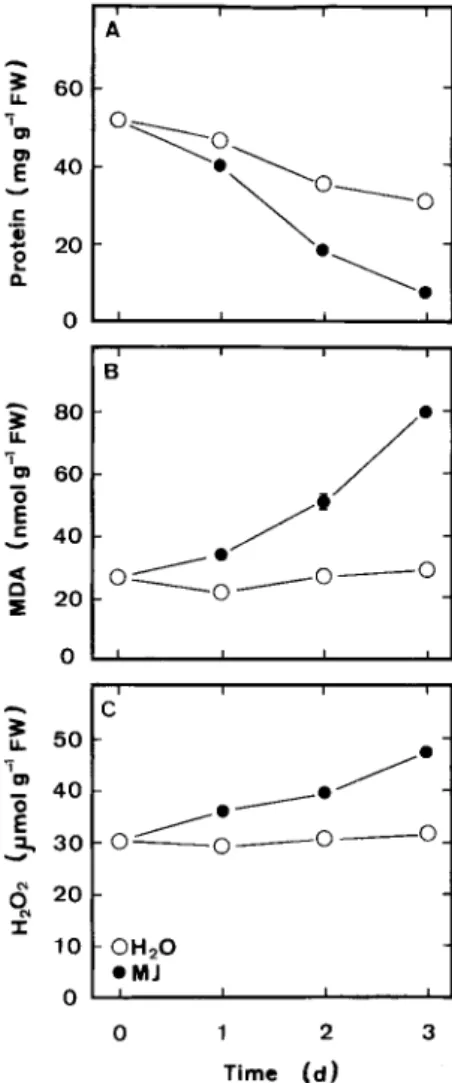
The obvious character of leaf senescence is yellowing. Chlorophyll loss has been considered to be the principal cri-terion of senescence. The protein breakdown during leaf se-nescence has been realized from earlier studies. We have shown that protein breakdown precedes chlorophyll loss dur-ing rice leaf senescence (Kao 1980). Thus, senescence of rice leaves in the present investigation was followed by meas-uring the decrease of protein. The changes in protein and MDA contents in detached rice leaves treated with 45
µ
mol/L–1MJ in the dark are shown in Figures 1A and 1B. The decrease in protein and increase in MDA were evident at day 1 after MJ treatment. Clearly, MJ is effective in promoting senescence of rice leaves. MJ treatment resulted in a marked increase in MDA, indicating that MJ brings about lipid peroxidation. Lipid peroxidation is caused by AOS (Kellogg and Fridovich 1975, Thompson et al. 1987). MJ treatment also caused an increase in H2O2content (Fig. 1 C). In the present investigation, when
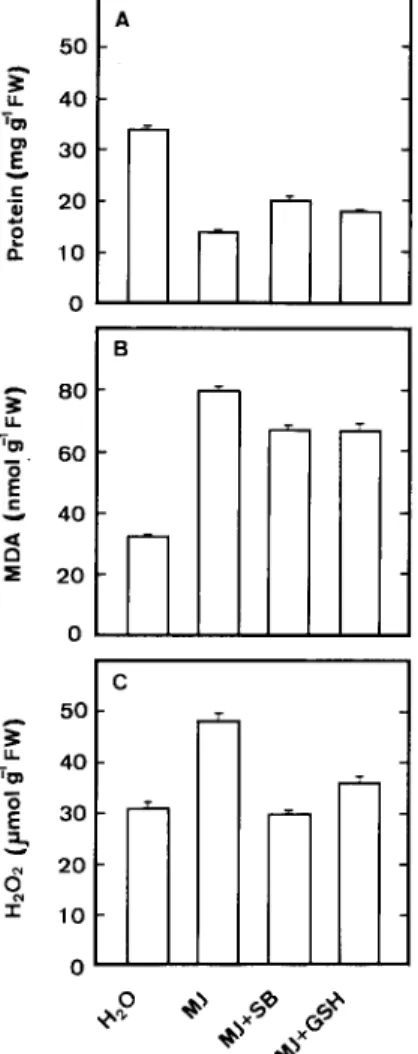
free radical scavengers such as SB and GSH, were used to-gether with MJ, it was found that they partially inhibited the re-duction in protein content (Fig. 2 A) and the increase in MDA
Figure 1.Changes in the contents of protein (A), MDA (B), and H2O2
(C) in rice leaves treated with MJ. Detached rice leaves were treated with either water or 45µmol L–1MJ in the dark. Data are means (± SE) of four replicates of a single typical experiment. Three series of inde-pendent experiments were carried out giving reproducible results.
(Fig. 2 B) and H2O2(Fig. 2 C) contents caused by MJ. These
results support the involvement of AOS as the chemical spe-cies inducing MJ-enhanced senescence in rice leaves.
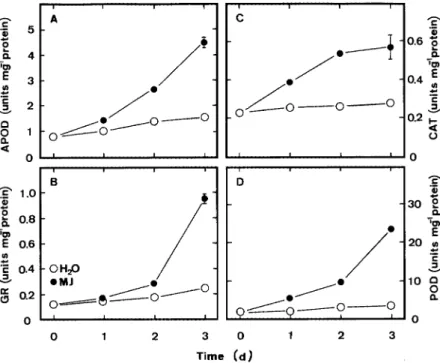
Plant cells are equipped with several AOS detoxifying en-zymes and antioxidants to protect them against oxidative damage. Antioxidative enzymes include SOD, APOD, GR, CAT, and POD (Foyer et al. 1997). AsA and GSH are two main water-soluble antioxidants (Foyer et al. 1997). The striking in-crease in lipid peroxidation seen in rice leaves treated with MJ may be a reflection of the change of the activities of anti-oxidative enzymes and the contents of antioxidants. As shown in Figures 3 A, 3 C, and 3 D, MJ-treated rice leaves had higher activities of APOD, POD, and CAT than the controls at day 1 after dark incubation. Higher GR activity in MJ-treated rice leaves was observed only at 2 days after dark incubation (Fig. 3 B). But MJ treatment had no effect on SOD activity in
Figure 2.Effect of free radical scavengers (SB and GSH) on protein (A), MDA (B), and H2O2(C) contents in rice leaves treated with MJ.
The concentrations of MJ, SB, and GSH were 45µmol L–1, 10 mmol L–1,
and 30 mmol L–1, respectively. All measurements were determined 3
days after treatment in the dark. Data are means (± SE) of four repli-cates of a single typical experiment. Three series of independent experiments were carried out giving reproducible results.
rice leaves (data not shown). Treatment with MJ significantly decreased AsA and GSH contents compared with the control leaves; it occurred at day 1 after treatment (Figs. 4 A and 4 B). The increased activities of antioxidative enzymes and the de-creased contents of AsA and GSH in response to MJ further suggest a strong induction of oxidative stress. As expected, treatment with free radical scavengers (SB and GSH) inhib-ited the increase in the activities of antioxidative enzymes (Figs. 5 A, 5 B, and 5 C) and the decrease in the contents of AsA and GSH (Figs. 5 D and 5 E) in rice leaves caused by MJ.
We show that the promotion of senescence of detached rice leaves by MJ is linked to lipid peroxidation or oxidative stress. NO is known to counteract oxidative stress in plants (Beligni and Lamattina 1999 a, b, 2002, Beligni et al. 2002,
Table 1.Effect of NO donors on protein content in rice leaves treated with MJ. Treatment Protein (mg g– 1FW) H2O 50.1±1.1 MJ 38.1±0.21 MJ+ PBN 47.2±0.91 MJ+ SIN–1 43.7±0.11 MJ+ SNP 42.9±0.73 MJ+ AsA + NaNO2 41.8±0.18
The concentrations of MJ, PBN, SIN – 1, SNP, AsA, and NaNO2were
45, 100, 100, 100, 100, and 200µmol L– 1, respectively. Protein
con-tent was determined 1 day after treatment in the dark. Data are means (± SE) of four replicates of a single typical experiment. Three series of independent experiments were carried out giving reproducible re-sults.
Cheng et al. 2002, Hung et al. 2002, Hung and Kao 2003). Thus, it is of great interest to know whether the protective role of NO is also active in MJ-promoted senescence of rice leaves. Consequently, detached rice leaves were treated with MJ in the presence or absence of NO donors, such as PBN, SIN-1, SNP, and a mixture of AsA and NaNO2in the dark. As
indicated in Table 1, all NO donors were effective in inhibiting MJ-promoted senescence of rice leaves. We also observed that PBN is more effective in inhibiting MJ-promoted leaf se-nescence than SIN-1, SNP, and AsA plus NaNO2(Table 1).
PBN alone had no effect on protein content (Fig. 6). When applied together with MJ, PBN concentrations between 25 and 200
µ
mol L–1produced a clear protection against proteinloss (Fig. 6). The optimal concentration of PBN in inhibiting MJ-promoted leaf senescence was observed to be 100
µ
mol L–1(Fig. 6).To investigate whether the protective effect induced by PBN treatment was the result of the production of NO, 100
µ
mol L–1c-PTIO, a NO-specific scavenger, was applied along with 100µ
mol L–1PBN. The effect of PBN onMJ-pro-moted protein loss (Fig. 7 A) and increase in MDA and H2O2
contents (Figs. 7 B and 7 C) could be reversed by c-PTIO. We also observed that PBN counteracted MJ-induced increase of activities of antioxidative enzymes (CAT, POD and APOD) and c-PTIO reversed the effect of PBN-decreased enzyme activ-ities (Figs. 8 A, 8 B, and 8 C). Furthermore, the effect of PBN on MJ-decreased AsA and GSH contents could be reversed by c-PTIO (Figs. 8 D and 8 E). Clearly, the effect of NO donor PBN is attributable to NO released.
Discussion
Jasmonates have both chemical and physiological similarities to abscisic acid (Anderson et al. 1989). Since endogenous
Figure 3.Changes in the activities of APOD (A), GR (B), CAT (C), and POD (D) in rice leaves treated with MJ. Detached rice leaves were treated with either water or 45µmol L–1MJ in the dark. Data are means
(± SE) of four replicates of a single typical experi-ment. Three series of independent experiments were carried out giving reproducible results.
Figure 4.Changes in the contents of AsA (A) and GSH (B) in rice leaves treated with MJ. Detached rice leaves were treated with either water or 45µmolL–1MJ in the dark. Data are means (± SE) of four rep-licates of a single typical experiment. Three series of independent experiments were carried out giving reproducible results.
abscisic acid content decreased in MJ-treated rice leaves (Wang and Kao 1999), it is unlikely that the effect of MJ on promoting senescence of rice is mediated through abscisic acid.
It has been shown that MJ can cause an increased pro-duction of H2O2 (Orozco-Cárdenas and Ryan 1999) and
in-duce lipid peroxidation (Hung and Kao 1998). These suggest that MJ treatment causes oxidative stress in plants. Our re-sults not only have shown that MJ increased the content of H2O2 (Fig. 1 C) and the activities of APOD (Fig. 3 A), GR
(Fig. 3 B), CAT (Fig. 3 C), and POD (Fig. 3 D), but also demon-strate that MJ caused a decrease in AsA (Fig. 4 A) and GSH contents (Fig. 4 B). Meanwhile, protein loss (Fig. 1 A) and lipid peroxidation (Fig. 1 B) were observed in MJ-treated rice leaves. All these results suggest that MJ causes oxidative stress and that MJ-promoted senescence of rice leaves is mediated through oxidative stress. This suggestion is further supported by the observations that free radical scavengers (SB and GSH) inhibit induced senescence (Fig. 2 A), MJ-increased lipid peroxidation (Fig. 2 B) and H2O2 content
(Fig. 2 C), MJ-increased antioxidative enzyme activities (Figs. 5 A, 5 B, and 5 C), and MJ-decreased antioxidants (Figs. 5 D and 5 E).
There is only limited information about the mechanism of MJ-induced H2O2 production. In several model systems
in-vestigated in plants, the accumulation of H2O2appears to be
mediated by the activation of a membrane-bound NADPH oxidase complex (Orozco-Cárdenas and Ryan 1999, Pei et al. 2000, Zhang et al. 2001, Jiang and Zhang 2002). Our unpub-lished observations indicate that diphenyleneiodonium chlo-ride and imidazole, inhibitors of NADPH oxidase (Cross 1990, Pei et al. 2000), prevented MJ-induced H2O2production,
MJ-promoted senescence, MJ-increased antioxidative enzyme activities and MJ-decreased antioxidants in rice leaves. Sim-ilar results were obtained by using dimethylthiourea, a chemi-cal trap for H2O2(unpublished data). Here, we show that MJ
Figure 5.Effect of free radical scavengers on the activities of antioxidative enzymes [CAT (A), POD (B), and APOD (C)] and the contents of AsA (D) and GSH (E) in rice leaves treated with MJ. The concentrations of MJ, SB, and GSH were 45µmol L–1, 10 mmol L–1, and 30 mmol L–1,
respectively. All measurements were determined 3 days after treatment in the dark. Data are means (± SE) of four replicates of a single typical experiment. Three series of independent experiments were carried out giving repro-ducible results.
caused the increase in H2O2content in rice leaves (Fig. 1 C).
In a short term experiment, we also observed that the in-crease in H2O2 content caused by MJ preceded the
de-Figure 6. Effect of PBN concentrations on protein contents of rice leaves treated with MJ. Detached rice leaves were treated with either water or 45µmolL–1MJ for 1 day in the dark. Data are means (± SE) of
four replicates of a single typical experiment. Three series of inde-pendent experiments were carried out giving reproducible results.
crease in protein content and increase in MDA content (un-published data). It appears that H2O2is a key signaling
mole-cule involved in MJ-induced senescence of rice leaves. AsA is a major antioxidant in photosynthetic and non-photosynthetic tissues which reacts directly with AOS and is utilized as a substrate for APOD-catalysed H2O2
detoxicfica-tion (Noctor and Foyer 1998). GSH is involved in AsA regen-eration and functions also as a direct antioxidant of AOS (Noctor and Foyer 1998). Elevated AsA and GSH contents have been measured in plants subjected to abiotic stress (May et al. 1998, Kocsy et al. 2001, Khan et al. 2002, Ruiz and Blumwald 2002). However, there are other reports indicating that AsA and GSH levels decreased in plants in response to abiotic stress (Boo and Jung 1999, Hernandez et al. 2000, Shalta et al. 2001). In the present investigation, we observed that MJ treatment resulted in decreased AsA and GSH in rice leaves (Figs. 4 A and 4 B). We made the same observation for H2O2(unpublished data). The decrease in AsA and GSH
con-tents in rice leaves treated with MJ is believed to be the result of impaired AsA and GSH metabolism.
It has been suggested that NO is an antioxidant in plants and its action may be explained by its ability to scavenge AOS (Beligni and Lamattina 1999 a, b, 2002, Cheng et al.
Figure 7.Effect of PBN on protein (A), MDA (B), and H2O2(C)
con-tents in MJ-treated rice leaves in the presence or absence of c-PTIO. The concentrations of MJ, PBN, and c-PTIO were 45, 100, and 100µmol L–1, respectively. All measurements were determined 1 day
after treatment in the dark. Data are means (± SE) of four replicates of a single typical experiment. Three series of independent experiments were carried out giving reproducible results.
2002, Hung et al. 2002, Hung and Kao 2003). If NO acts as an antioxidant, NO may reduce AOS levels in MJ-treated rice leaves. Since H2O2is involved in MJ-induced senescence of
rice leaves (Fig. 1 C and unpublished data) and NO reduces MJ-increased H2O2content (Fig. 7 C), it appears that NO
in-deed has the ability to scavenge AOS. Orozco-Cárdenas and Ryan (2002) also reported that NO blocked the H2O2
produc-tion that was induced by jasmonic acid.
In the present investigation, we found that NO reduced MJ-increased MDA content (Fig. 7 B) and antioxidative enzyme activities (Figs. 8 A, 8 B, and 8 C) in rice leaves. These results are in agreement with our previous work, in which we demon-strated that NO counteracted paraquat-increased MDA con-tent and antioxidative enzyme activities (Hung et al. 2002). Because lipid peroxidation and the increase in antioxidative enzyme activities are the consequence of AOS overproduc-tion (Kellogg and Fridovich 1975, Thompson et al. 1987) and since NO acts as an AOS scavenger, the reduction of MDA content and antioxidative enzyme activities could be a result of low levels of H2O2in rice leaves treated with NO and MJ.
The fact that NO counteracts MJ-decreased AsA and GSH (Figs. 8 D and 8 E) results in an increase in the capacity of NO to scavenge H2O2in rice leaves treated with NO and MJ
com-pared to rice leaves treated with MJ alone and might account in part for the decreased contents of H2O2observed in rice
leaves treated with NO and MJ (Fig. 7C).
CAT, APOD, and POD have been shown to be directly in-hibited by NO (Ferrer and Barceló 1999, Clark et al. 2000). However, our results show that PBN treatment alone did not affect antioxidative enzyme activities in rice leaves (data not shown). Thus it is unlikely that the reduction of MJ-induced in-crease in antioxidative enzyme activities by NO is due to a di-rect NO-mediated inhibition of the enzymes.
In animals, NO displays cytotoxic activity but may also play a cytoprotective role in oxidative stress (Kroncke et al. 1997). In plants that the combination of NO with AOS is also de-scribed as either toxic or protective depending on the cir-cumstances (Beligni and Lamattina 1999 c, 2001). AOS can react with NO to form peroxynitrite (Kim and Han 2000, Marti-nez et al. 2000), which is often thought to have cytotoxic ef-fects (Huie and Padmaja 1993, Alamillo and Garcia-Olmedo 2001, Beligni and Lamattina 2001). Proxynitrite has been shown to react with H2O2to yield nitrite ion and oxygen
(Mar-tinez et al. 2000). This reaction has been suggested to be the mechanism of NO cytoprotection in animals (Wink et al. 1993). Based on our results, it appears that this mechanism is operating in rice leaves as well.
Previously, we have shown that NO counteracts oxidative stress in rice leaves induced by paraquat, dehydration, poly-ethylene glycol, and abscisic acid (Cheng et al. 2002, Hung et al. 2002, Hung and Kao 2003). Herein, we report that NO donors act similarly as free radical scavengers (SB and GSH) in inhibiting MJ-promoted rice leaf senescence. These results strongly suggest that the antioxidant properties of NO are counteracting oxidative stress.
Acknowledgements. This work was supported by grant NSC 90-2313-B-002-267 from the National Science Council of the Republic of China.
Figure 8.Effect of PBN on the activities of antioxidative enzymes [CAT (A), POD (B), APOD (C)] and the con-tents of AsA (D) and GSH (E) in MJ-treated rice leaves in the presence or absence of c-PTIO. The concentrations of MJ, PBN, and c-PTIO were 45, 100, and 100µmol L–1,
respectively. All measurements were determined 1 day after treatment in the dark. Data are means (± SE) of four replicates of a single typical experiment. Three series of independent experiments were carried out giving repro-ducible results.
References
Alamillo JM, Garcia-Olmedo F (2001) Effect of urate, a natural inhibitor of peroxynitrite mediated toxicity, in the response of Arabidopsis
thaliana to the bacterial pathogen Pseudomonas syringae. Plant J
25: 529 – 540
Anbar M (1995) Nitric oxide: a synchronizing chemical messenger. Experientia 51: 545 – 550
Anderson JM, Spilatro SR, Klauer SF, Franceschi VR (1989) Jasmonic acid-dependent increase in the level of vegetative storage proteins in soybean. Plant Sci 62: 45 – 52
Beligni MV, Lamattina L (1999 a) Nitric oxide counteracts cytotoxic processes mediated by reactive oxygen species in plant tissues. Planta 208: 337– 344
Beligni MV, Lamattina L (1999 b) Nitric oxide protects against cellular damage produced by methyl violgen herbicides in potato plants. Nitric Oxide Biol Chem 3: 199 – 208
Beligni MV, Lamattina L (1999 c) Is nitric oxide toxic or protective? Trends Plant Sci 4: 199 – 200
Beligni MV, Lamattina L (2000) Nitric oxide stimulates seed germina-tion and de-etiolagermina-tion, and inhibits hypocotyls elongagermina-tion, three light-inducible responses in plants. Planta 210: 215 – 221
Beligni MV, Lamattina L (2001) Nitric oxide in plants: the history is just beginning. Plant Cell Environ 24: 267– 278
Beligni MV, Lamattina L (2002) Nitric oxide interferes with plant photo-oxidative stress by detoxifying reactive oxygen species. Plant Cell Environ 25: 737–748
Beligni MV, Fath A, Bethake PC, Lamattina L, Jones RL (2002) Nitric oxide acts as an antioxidant and delays programmed cell death in barley aleurone layers. Plant Physiol 129: 1462 –1650
Boo YH, Jung J (1999) Water deficit-induced oxidative stress and anti-oxidative defenses in rice plants. J Plant Physiol 155: 255 – 261 Bradford MM (1976) A rapid and sensitive method for the quantitation
of microgram quantities of protein utilizing the principle of protein-dye binding. Anal Biochem 72: 248 – 254
Chen SJ, Kao CH (1998) Methyl jasmonate, ammonium, and leaf se-nescence in rice. J Plant Physiol 152: 353 – 357
Cheng F-Y, Hsu S-Y, Kao CH (2002) Nitric oxide counteracts the se-nescence of detached rice leaves induced by dehydration and polyethylene glycol but not by sorbitol. Plant Growth Regul 38: 265 – 272
Chou CM, Kao CH (1992) Methyl jasmonate, calcium and leaf senes-cence in rice. Plant Physiol 99: 1693 –1694
Chu C, Lee TM (1989) The relationship between ethylene biosynthesis and chilling tolerance in seedlings of rice (Oryza sativa). Bot Bull Acad Sin 30: 263 – 273
Clark D, Dunar J, Navarre DA, Klessig DF (2000) Nitric oxide inhibition of tobacco catalase and ascorbate peroxidase. Mol Plant-Microbe Interact 13: 1380 –1384
Creelman RA, Mullet JE (1997) Biosynthesis and action of jasmonates in plants. Annu Rev Plant Physiol Plant Mol Biol 48: 355 – 381 Cross AR (1990) Inhibitors of leukocyte superoxide generating
oxi-dase: mechanisms of action and methods for their elucidation. Free Radic Biol Med 8: 71– 93
Delledonne M, Xia Y, Dixon RA, Lamb C (1998) Nitric oxide functions as a signal in plant disease resistance. Nature 394: 585 – 588 d’Ischia M, Palumbo A, Buzzo F (2000) Interactions of nitric oxide with
lipid peroxidation products under aerobic conditions: Inhibitory effects on the formation of malondialdehyde and related thiobabi-turic acid-reactive substances. Nitric Oxide Biol Chem 4: 4 –14 Ferrer MA, Barceló AR (1999) Differential effects of nitric oxide on
per-oxidase and H2O2production by the xylem of Zinnia elegans. Plant
Cell Environ 22: 891– 897
Foster JG, Hess JL (1980) Responses of superoxide dismutase and glutathione reductase activities in cotton leaf tissue exposed to an atmosphere enriched in oxygen. Plant Physiol 66: 482 – 487 Foyer CH, Lopez-Delgado H, Dat JF, Scott IM (1997) Hydrogen
per-oxide and glutathione-associated mechanism of acclimatory stress tolerance and signaling. Physiol Plant 100: 241– 254
Garcia-Mata C, Lamattina L (2002) Nitric oxide and abscisic acid cross talk in guard cells. Plant Physiol 128: 790 –792
Graziano M, Beligni MV, Lamattina L (2002) Nitric oxide improves in-ternal iron availability. Plant Physiol 130: 1852 –1859
He Y, Fukushige H, Hildebrand DF, Gan S (2002) Evidence supporting a role of jasmonic acid in Arabidopsis leaf senescence. Plant Phys-iol 128: 876 – 884
Heath RL, Packer L (1968) Photoperoxidation in isolated chloroplasts. I. Kinetics and stoichiometry of fatty acid peroxidation. Arch Bio-chem Biophys 125: 189 –198
Hernandez JA, Jimenez A, Mullineaux P, Sevilla F (2000) Tolerance of pea (Pisum sativum L.) to long-term salt stress is associated with induction of antioxidant defenses. Plant Cell Environ 23: 853 – 862 Huie RE, Padmaja S (1993) The reaction of NO with O2. –. Free Radic
Res Commun 235: 264 – 267
Hung KT, Kao CH (1998) Involvement of lipid peroxidation in methyl jasmonate-promoted senescence in detached rice leaves. Plant Growth Regul 24: 17– 21
Hung KT, Kao CH (2003) Nitric oxide counteracts the senescence of rice leaves induced by abscisic acid. J Plant Physiol 160: 871– 879 Hung KT, Chang CJ, Kao CH (2002) Paraquat toxicity is reduced by
nitric oxide in rice leaves. J Plant Physiol 159: 159 –166
Jana S, Choudhuri MA (1981) Glycolate metabolism of three sub-merged aquatic angiosperm during aging. Aquat Bot 12: 345 – 354 Jiang M, Zhang J (2002) Involvement of plasma membrane NADPH
oxidase in abscisic acid- and water stress-induced antioxidant de-fense in leaves of maize seedlings. Planta 215: 1022 –1030 Kao CH (1980) Senescence of rice leaves IV. Influence of
benzylade-nine on chlorophyll degradation. Plant Cell Physiol 21: 1255 –1262 Kato M, Shimizu S (1987) Chlorophyll metabolism in higher plants. VII.
Chlorophyll degradation in higher pants. VII. Chlorophyll degrada-tion in senescing tobacco leaves: Phenolic-dependent peroxid-ative degradation. Can J Bot 65: 729 –735
Kellogg EW, Fridovich I (1975) Superoxide, hydrogen peroxide, and singlet oxygen in lipid peroxidation by xanthine oxidase system. J Biol Chem 250: 8812 – 8817
Khan MH, Singha KLB, Panda SK (2002) Changes in antioxidant level in Oryza sativa L. roots subjected to NaCl-salinity stress. Acta Physiol Plant 24: 145 –148
Kim YS, Han S (2000) Nitric oxide protects Cu, Zn-superoxide dismu-tase from hydrogen peroxide-induced inactivation. FEBS Lett 479: 25 – 28
Klessig DF, Durner J, Noad R, Navarre DA, Wendehenne D, Kumar D, Zhou JM, Shah J, Zhaud S, Kachroo P, Trifa Y, Pontier D, Lam E, Silva H (2000) Nitric oxide and salicylic acid signaling in plant de-fense. Proc Natl Acad Sci USA 97: 8849 – 8855
Kocsy G, Galiba G, Brunvld C (2001) Role of glutathione in adaptation and signalling during chilling and cold acclimation in plants. Phys-iol Plant 113: 158 –164
Kroncke K-D, Fehsel K, Kolb-Bachofen V (1997) Nitric oxide: Cyto-toxicity versus cytoprotection- how, why, when, and where? Nitric Oxide Biol Chem 2: 107–120
Lamattina L, Garcia-Mata C, Graziano M, Pagnussat G (2003) Nitric oxide: the versatility of an extensive signal molecule. Annu Rev Plant Biol 54: 109 –136
Laws MY, Charles SA, Halliwell B (1983) Glutathione and ascorbic acid in spinach chloroplasts: the effect of hydrogen peroxide and of paraquat. Biochem J 210: 899 – 903
Leshem YY (2000) Nitric Oxide in Plants. Occurrence, Function and Use. Kluwer Academic Publishers, Dordrecht
Leshem YY, Haramaty E (1996) Plant aging: the emission of NO and ethylene and effect of NO-releasing compounds on growth of pea (Pisum sativum) foliage. J Plant Physiol 148: 258 – 263
MacAdam JW, Nelson CJ, Sharp RE (1992) Peroxidase activity in the leaf elongation zone of tall fescue. Plant Physiol 99: 872 – 878 Martinez GR, DiMascio P, Bonini MG, Augusto O, Briviba K, Sies H,
Mauer P, Röthlisberger U, Herold S, Koppenol WH (2000) Peroxy-nitrite does not decompose to singlet oxygen (′∆gO2) and nitroxyl
(NO–). Proc Natl Acad Sci USA 97: 10307–10312
May MJ, Vernoux T, Leaver C, Van Montagu M, Inzé D (1998) Gluta-thione homeostasis in palnts: implications for environmental sens-ing and plant development. J Exp Bot 49: 649 – 667
Meyer A, Miersch O, Buttner C, Dathe W, Sembdner G (1991) Occur-rence of the plant growth regulator jasmonic acid in plants. J Plant Growth Regul 3: 1– 8
Nakano Y, Asada K (1981) Hydrogen peroxide is scavenged by ascor-bate-specific peroxidase in spinach chloroplasts. Plant Cell Physiol 22: 867– 880
Neill SJ, Desikan R, Clarke A, Hancock JT (2002) Nitric oxide is a novel component of abscisic acid signaling in stomatal guard cells. Plant Physiol 128: 13 –16
Noctor G, Foyer CH (1998) Ascorbate and glutathione: keeping active oxygen under control. Annu Rev Plant Physiol Plant Mol Biol 49: 249 – 279
Noritake T, Kawakita K, Doke N (1996) Nitric oxide induces phytoale-xin accumulation in potato tuber tissues. Plant Cell Physiol 37: 113 – 116
O’Donnell VB, Chunley PH, Hogg N, Bloodsworth A, Darley-Usmar VM, Freeman BA (1997) Nitric oxide inhibition of lipid peroxidation: Kinetics of reaction with lipid peroxyl radicals and comparison with α-tocopherol. Biochemistry 36: 15216–15223
Orozco-Cárdenas M, Ryan CA (1999) Hydrogen peroxide is gener-ated systemically in plant leaves by wounding and systemin via the octadecanoid pathway. Proc Natl Acad Sci USA 96: 6553 – 6557 Orozco-Cárdenas M, Ryan CA (2002) Nitric oxide negatively
mod-ulate wound signaling in tomato plants. Plant Physiol 130: 487– 493 Orozco-Cárdenas M, Narváez-Vásquez J, Ryan CA (2001) Hydrogen
peroxide acts as a second messenger for the induction of defense genes in tomato plants in response to wounding, systemin, and methyl jasmonate. Plant Cell 13: 179 –191
Pagnussat GC, Simontacchi M, Puntarulo S, Lamattina L (2002) Nitric oxide is required for root organogenesis. Plant Physiol 129: 954 – 956
Paoletti F, Aldinucci D, Mocali A, Capparini A (1986) A sensitive spec-trophotometric method for the determination of superoxide dismu-tase activity in tissue extracts. Anal Biochem 154: 536 – 541 Pedroso MC, Magalhases JR, Durzan D (2000) Nitric oxide induces
cell death in Taxus cells. Plant Sci 157: 173 –180
Pei ZM, Murata N, Benning G, Thomine S, Klüsener B, Allen GJ, Grill E, Schroeder JI (2000) Calcium channels activated by hydrogen peroxide mediate abscisic acid signaling in guard cells. Nature 406: 731–734
Ruiz JM, Blumwald E (2002) Salinity-induced glutathione synthesis in
Brassica napus. Planta 214: 965 – 969
Scherer GFE, Holk A (2000) NO donors mimic and NO inhibitors in-hibit cytokinin action in betaine accumulation in Amaranthus
cau-datus. Plant Growth Regul 32: 345 – 350
Sembdner G, Parthier B (1993) The biochemistry and the physiologi-cal and molecular actions of jasmonates. Annu Rev Plant Physiol Plant Mol Biol 44: 569 – 589
Shalta A, Mittova V, Volokita M, Guy M, Tal M (2001) Response of the cultivated tomato and its wild salt-tolerant relative Lycopericon
pennellii to salt-dependent oxidative stress: the root antioxidative
system. Physiol Plant 112: 487– 494
Smith IK (1985) Stimulation of glutathione synthesis in photorespiring plants by catalase inhibitors. Plant Physiol 79: 1044 –1047
Strother S (1988) The role of free radicals in leaf senescence. Geron-tology 34: 151–156
Thompson JE, Legge RL, Barber RF (1987) The role of free radical in senescence and wounding. New Phytol 105: 317– 344
Tsai FY, Hung KT, Kao CH (1996) An increase in ethylene sensitivity is associated with jasmonate-promoted senescence of detached rice leaves. J Plant Growth Regul 15: 197– 200
Uchida A, Jagendorf AT, Hibino T, Takabe T (2002) Effects of hydro-gen peroxide and nitric oxide on both salt and heat stress toler-ance in rice. Plant Sci 163: 515 – 523
Ueda J, Kato J (1981) Promotive effect of methyl jasmonate on oat leaf senescence in the light. Z Pflanzenphysiol 103: 357– 359
Wang J-W, Kao CH (1999) Endogenous abscisic acid levels are not linked to methyl jasmonate-promoted senescence of detached rice leaves. Plant Growth Regul 28: 17– 20
Wasternack C, Parthier B (1997) Jasmonate-signalled plant gene ex-pression. Trends Plant Sci 2: 302 – 307
Weidhase RA, Lehmann J, Kramell H, Sembdner G, Parthier B (1987) Degradation of ribulsoe-1,5-bisphosphate carboxylase and chloro-phyll in senescing barley leaf segments triggered by jasmonic acid methylester, and counteraction by cytokinin. Physiol Plant 69: 161– 166
Wink DA, Hanbauer I, Krishna MC, DeGraff W, Gamson J, Mitchell JB (1993) Nitric oxide protects against cellular damage and cyto-toxicity from reactive oxygen species. Proc Natl Acad Sci USA 90: 9813 – 9817
Zhang X, Zhang L, Dong F, Gao J, Galbraite DW, Song C-P (2001) Hy-drogen peroxide is involved in abscisic acid-induced stomatal clo-sure in Vicia faba. Plant Physiol 126: 1438 –1448
![Figure 5. Effect of free radical scavengers on the activities of antioxidative enzymes [CAT (A), POD (B), and APOD (C)] and the contents of AsA (D) and GSH (E) in rice leaves treated with MJ](https://thumb-ap.123doks.com/thumbv2/9libinfo/8856181.243873/6.892.88.513.101.637/figure-effect-radical-scavengers-activities-antioxidative-contents-treated.webp)

![Figure 8. Effect of PBN on the activities of antioxidative enzymes [CAT (A), POD (B), APOD (C)] and the con-tents of AsA (D) and GSH (E) in MJ-treated rice leaves in the presence or absence of c-PTIO](https://thumb-ap.123doks.com/thumbv2/9libinfo/8856181.243873/8.892.92.517.104.677/figure-effect-activities-antioxidative-enzymes-treated-presence-absence.webp)
