2006年7月6日 國立中山大學 高雄市 Kaohsiung, Taiwan
EFFECT OF HEAVY METALS ON NANOSCALE ZERO-VALENT IRON
FOR DECHLORINATION OF CARBON TETRACHLORIDE
Yu-Sheng Jhuo, Li-Hua Chen and Hsing-Lung Lien*Dept of Civil and Environmental Engineering, National Univ. of Kaohsiung, Kaohsiung 811, Taiwan NSC 93-2211-E-390-006-
Abstract
Effects of heavy metals on the dechlorination of carbon tetrachloride by iron nanoparticles were investigated in terms of reaction kinetics and product distribution using batch systems. Removal of heavy metals and the interaction between heavy metals and iron nanoparticles at the iron surface were also examined. It was found that Cu(II) enhanced the carbon tetrachloride dechlorination by iron nanoparticles and led to produce more benign products (i.e., CH4). Pb(II) may increase reduction rate slightly but also increase the production of more toxic intermediates such as dichloromethane. In comparison to the iron reduction system without heavy metals, effects of As(V) were negligible while Cr(VI) decreased the dechlorination rate by a factor of two. Removal of As(V) by iron nanoparticles behaved pseudo-first order reaction kinetics but a fast initial removal followed by a slow subsequent process was found in the case of Cu(II) and Pb(II). Scanning electron microscopy-energy dispersive X-ray (SEM-EDX) analysis indicated the deposition of heavy metals onto the iron surface. X-X-ray diffraction (XRD) analysis showed Cu(II) was reduced to metallic copper and cuprite (Cu2O) at the iron surface. The enhanced dechlorination by Cu(II) can be attributed to the deposition of metallic copper and cuprite at the iron surface. This study suggests that implementation of iron nanoparticles rather than engineered bimetallic iron nanoparticles for remediation of mixed contamination with both chlorinated organics and heavy metals is sufficient
1. Introduction
Chlorinated organic solvents and heavy metals are two common classes of contaminants often detected in contaminated subsurface. Chlorinated organic solvents such as tetrachloroethylene and trichloroethylene have been in widespread use for several decades in industrial applications including the manufacture of herbicides, plastics and solvents [1]. Many of them had been listed as priority pollutants by the U.S. Environmental Protection Agency (US EPA). On the other hand, increasingly higher quantities of heavy metals are being released into the environment through anthropogenic activities, primarily associated with industrial processes, manufacturing and disposal of industrial and domestic refuse and waste materials [2] .
Remediation of contaminated groundwater using iron nanoparticles has been developed [3]. Iron nanoparticles with a diameter less than 100 nm can be delivered into hot spot through a direct injection technology [4]. Iron nanoparticles are capable of treating a wide variety of contaminants including chlorinated organic solvents [5], heavy metals [6], and other inorganic contaminants (e.g., perchlorate) [7] .
Engineered bimetallic iron nanoparticles have widely been reported for improving the performance of monometallic iron nanoparticles [8]. Engineered bimetallic iron nanoparticles (e.g., Pd/Fe, Ni/Fe) can be synthesized by chemical reduction and precipitation.
M2+ + Fe0 M0 + Fe2+ (M2+ = e.g., Pd2+, Ni2+) (1)
The deposition of a small amount of a second metal at the iron surface increased reaction rates significantly. For example, surface-area-normalized reactivity of bimetallic Pd/Fe nanoparticles is 1-2 orders of magnitude higher than that of iron nanoparticles [5] .
2006年7月6日 國立中山大學 高雄市 Kaohsiung, Taiwan It is not an unusual case that the mixed contamination of heavy metals and chlorinated solvents occurs at the same site [9]. The presence of heavy metals in contaminated sites could be capable of serving as the source of second metals resulting in the in situ formation of bimetallic iron nanoparticles when monometallic iron nanoparticles were implemented. Treatments of mixed contaminants containing both chlorinated organic compounds and toxic metals using reactive iron have recently received attention [10]. In this study, we focused on the effect of heavy metals on the influence of performance for iron nanoparticles in reacting with carbon tetrachloride. Heavy metals including As(V), Cu(II) and Pb(II) were investigated systematically. Interface reaction between heavy metals and iron was examined by X-ray diffraction (XRD) and scanning electron microscopy-energy dispersive X-X-ray (SEM-EDX) analysis. Hexavalent chromium, Cr(VI), was also selected to test its effect on the iron-mediated dechlorination.
2. Materials and Methods
2.1 ChemicalsAll chemicals were reagent grade or above and used without further purification. A standard gas mixture for GC analysis was obtained from Supelco, which contained 1% each of ethane, ethylene, acetylene, and methane.
2.2 Synthesis of iron nanoparticles
Synthesis of iron nanoparticles was achieved by adding 1:1 volume ratio of NaBH4 (0.25 M) into FeCl3•6H2O (0.045 M) solution. The borohydride to ferric iron ratio was 7.4 times higher than that of the stoichiometric requirement (eq. 2). Excessive borohydride was applied to accelerate the synthesis reaction and ensure uniform growth of iron crystals. Ferric iron was reduced by borohydride according to the following reaction:
4Fe3+ + 3BH4- + 9H2O 4Fe0 + 3H2BO3- + 12H+ + 6H2 (2)
The suspension was mixed vigorously under room temperature (22±1°C). The iron particles were then washed with large volume (> 1000 mL/g iron) of Milli-Q water for at least three times and were used without further treatments unless indicated otherwise.
2.3 Batch Tests
For the study of heavy metal removal, experiments were carried out in a 250 mL high density poly(ethylene), HDPE, vessel containing 2.5 g/L iron nanoparticles in 100 mL of metal ion solution at 221C. Initial concentrations of metal ions were 25 mg/L corresponding to 1 wt% of iron content in the batch tests. Reaction vessels were placed on a rotary shaker (50 rpm). The solution pH was controlled only at the beginning of the reaction and adjusted to at pH 7.0 0.2. The experiments were conducted in duplicate to check the reproducibility of batch results.
For the study of carbon tetrachloride degradation, batch experiments were conducted in 150 mL serum bottles (Wheaton, actual volume was approximately 162 mL). For each batch bottle, 20 µL methanol solution of carbon tetrachloride was spiked into a 100 mL aqueous solution. In a typical experiment, the initial concentration of carbon tetrachloride and individual metal ion was 30 and 25 mg/L, respectively. The metal loading of iron nanoparticles was 2.5 g/L. The serum bottles were then capped with a Teflon faced septum and aluminum crimp cap and mixed on a rotary shaker (50 rpm) at room temperature (22±1°C).
2.4 Method of Analyses
Analysis of heavy metals was carried out using an inductively coupled plasma-optical emission spectrometry (ICP-OES, PerkinElmer Optima 2000DV, PerkinElmer Inc.). The wavelength of As(V), Cu(II) and Pb(II) was set at 193.7, 324.8 and 220.4 nm, respectively. Prior to analysis, samples were filtered through 0.2 μm filters and acidified with 3% HNO3. Analyses of duplicate samples indicated a relatively analytical error of less than 5% for metal concentration analyzed in the laboratory.
Concentrations of carbon tetrachloride and its intermediates were measured by a headspace-gas chromatograph (GC) method. At selected time intervals, a 50-µl headspace gas aliquot was withdrawn by a gastight syringe for GC analysis. Headspace samples were analyzed by a HP4890 GC-FID equipped
2006年7月6日 國立中山大學 高雄市 Kaohsiung, Taiwan with a DB-624 capillary column (J&W, 30 m × 0.32 mm). Temperature conditions were programmed as follows: oven temperature at 45°C for 5 minutes, injection port temperature at 250°C, and detector temperature at 300°C. Concentrations of hydrocarbons were measured by a HP4890 GC-FID equipped with a GS-GASPRO capillary column (J&W, 30 m × 0.32 mm).
2.5 Solid-Phase Characterization
Characterization of iron nanoparticles was conducted using X-ray diffraction (XRD), and scanning electron microscopy (SEM). XRD measurements were performed using a X-ray diffractometer (Siemens D5000) with a copper target tube radiation (Cu K) producing X-ray with a wavelength of 1.54056 Å . Samples were placed on a quartz plate and were scanned from 20 to 80 (2θ) at a rate of 2 2θ/minute. Morphological analysis of iron nanoparticles was performed by SEM using a Hitachi S-4300 microscope (Hitachi Science Systems, Ltd.) with energy-dispersive X-ray (EDX) analysis (at 10 kV).
2.6 Reaction Kinetics
The reaction rate of both organic and inorganic contaminant removal was determined with pseudo-first-order reaction kinetics:
C dt dC a k (3)
where C is the concentration of contaminants in the aqueous phase (mg/L); ka is the observed first-order rate constant (h-1); and t is time (h).
3. Results and Discussion
3.1 Removal of heavy metals by iron nanoparticles
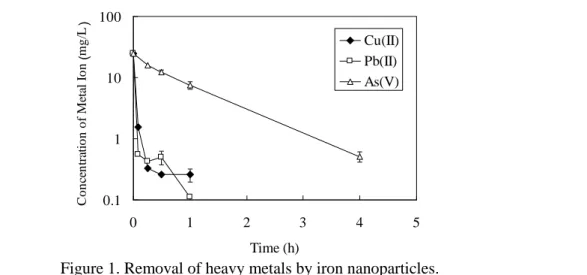
Removal of Cu (II), Pb(II), and As(V) by iron nanoparticles is shown in Fig. 1. Initial concentration of heavy metals was 25 mg/L and the dose of iron was 2.5 g/L. The removal of As(V) can be fitted well by pseudo-first order reaction kinetics (eq. 3). The observed rate constant was 0.94 h-1 (R2 = 0.99). However, a fast initial removal followed by a slow subsequent process was found in the case of both Cu(II) and Pb(II). Disappearance of more than 93% of total Cu(II) and Pb(II) occurred within 5 minutes. The first order reaction kinetics was simply not fitted with the data. This result is consistent with studies conducted by Ponder et al. [11] (2000). They suggested a physical mechanism was involved in this type of removal processes. Overall, the different removal behavior among As(V), Cu(II) and Pb(II) suggests that the removal of these heavy metals involves different mechanisms.
Figure 1. Removal of heavy metals by iron nanoparticles.
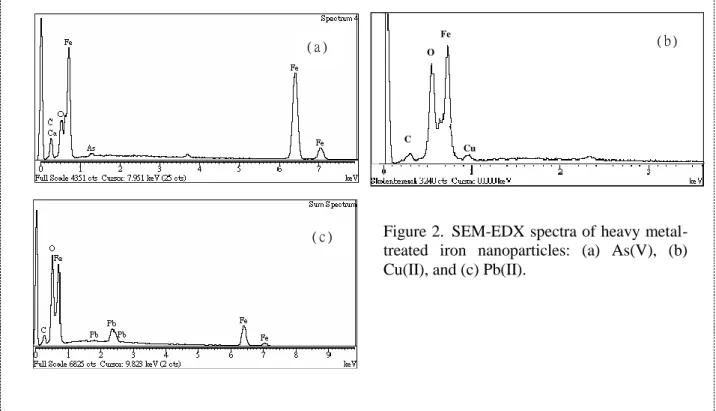
The disappearance of metal ions in the aqueous solution was attributed to the deposition at iron nanoparticle surface confirmed by SEM-EDX analysis. In order to ensure the deposition of heavy metals onto the iron surface, the concentration of heavy metals conducted in surface analysis was ten times higher than that used in batch kinetic experiments. Samples were taken when iron nanoparticles reacted with 250 mg/L of metal ions for a day. As shown in Fig. 2, the EDX spectra indicated the existence of arsenic, copper, and lead at the surface of reacted iron nanoparticles.
0.1 1 10 100 0 1 2 3 4 5 Time (h) C o n ce n tr at io n o f M et al I o n ( m g /L ) Cu(II) Pb(II) As(V)
2006年7月6日 國立中山大學 高雄市 Kaohsiung, Taiwan
XRD analysis was further conducted to better understand the interaction between heavy metals and iron at the nanoparticle surface. Figure 3 shows the XRD pattern for Cu(II)-treated iron nanoparticles taken after reacting with 250 mg/L Cu(II) for 12 hours. Iron corrosion products (magnetite and/or maghemite) were found at the surface. Removal of Cu(II) by iron nanoparticles involved the formation of two copper species, metallic copper (Cu0) and cuprite (Cu2O), that were identified at the iron surface. Because the standard reduction potential of Cu2+/Cu0 and Fe2+/Fe0 couples is +0.34 and -0.44 V, respectively, metallic copper can be formed through the redox reaction:
0 0 2 2 Fe Cu Fe Cu (4)
The overall Eo for this reaction is +0.78 V at 25℃, indicating a strongly favorable reaction from a thermodynamics perspective. As indicated in Fig. 1 that the removal of Cu(II) by iron nanoparticles is a very fact reaction, eq. 4 actually represents a synthetic step for making engineered bimetallic particles (e.g., Pd/Fe, Cu/Al, Ni/Fe) [12-13] . The formation of Cu2O could be attributed to the reaction between Fe(II) and Cu(II) in the aqueous solution [14] :
8H 2Fe(OH) O Cu O 7H 2Cu 2Fe2 2 2 2 3 (5)
Figure 3. XRD patterns of Cu(II)-treated iron nanoparticles.
0 200 400 600 800 1000 Fe Fe Cu2O Cu2O Cu 20 30 40 50 60 70 80 C O Fe Cu C O Fe Cu C O Fe Cu C O Fe Cu C O Fe Cu C O Fe Cu C O Fe Cu C O Fe Cu
Figure 2. SEM-EDX spectra of heavy metal-treated iron nanoparticles: (a) As(V), (b) Cu(II), and (c) Pb(II).
(a) (b)
2006年7月6日 國立中山大學 高雄市 Kaohsiung, Taiwan The XRD analysis for As(V)-treated iron nanoparticles exhibited only iron oxide species such as maghemite and/or magnetite (data not shown) and no crystal phases of arsenic species deposited at the iron surface was found. Reduction of As(V) to metallic arsenic (As0) is unlikely [15] because such reaction is thermodynamically unfavorable under ambient conditions (Eorxn = -0.94 V). However, as shown in Fig. 2, EDX analysis indicated the deposition of arsenic at the iron surface suggesting the removal of As(V) with iron nanoparticles was a complicated process that could involve surface adsorption, precipitation and co-precipitation [16] .
3.2 Effects of heavy metals on carbon tetrachloride dechlorination
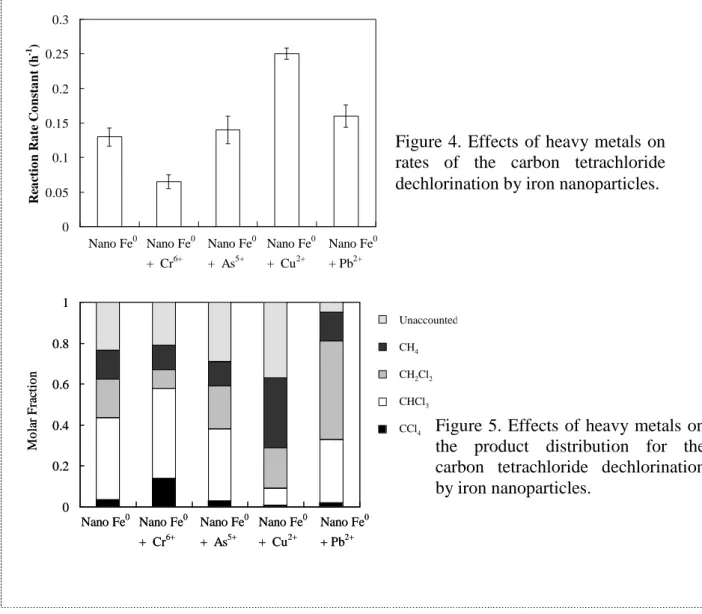
Effects of heavy metals on the degradation of carbon tetrachloride in terms of reaction rates and product distribution are shown in Figs. 4 and 5, respectively. Dechlorination of carbon tetrachloride followed pseudo-first order reaction kinetics, which had R2 values between 0.91-0.98. It was found that both Cu(II), and Pb(II) enhanced the dechlorination rate of carbon tetrachloride by iron nanoparticles while the effect of As(V) on the carbon tetrachloride dechlorination was negligible. Among them, Cu(II) exhibited the best promoting effect, which increased the dechlorination rate by a factor of two compared to the reaction system with iron nanoparticles alone. It is worthy of note that Cr(VI) decreased the degradation rate of carbon tetrachloride by iron nanoparticles. In comparison to the iron reduction system in the absence of heavy metals, dechlorination of carbon tetrachloride was two times slower in the presence of 25 mg/L of Cr(VI). This is consistent with previous studies [10] suggesting a competitive effect between the strong oxidant Cr(VI) and carbon tetrachloride in reaction with zero-valent iron. Although Cr(VI) is readily reduced to Cr(III) (Eorxn = +1.68 V), Cr(III) can not be reduced to Cr0 (Eorxn = -0.75 V). Therefore, the formation of bimetallic Cr/Fe structure onto the iron surface is unlikely.
0 0.05 0.1 0.15 0.2 0.25 0.3 Fe Cr As Cu Pb R ea cti o n R a te C o n sta n t (h -1 ) Nano Fe0 Nano Fe0 + As5+ Nano Fe0 + Cu2+ Nano Fe0 + Pb2+ Nano Fe0 + Cr6+ 0 0.2 0.4 0.6 0.8 1
Fe alone Fe+Cr Fe+As Fe+Cu Fe+Pb
M o la r F ra ct io n Unaccounted-for carbon CH4 CH2Cl2 CHCl3 CCl4 Nano Fe0 Nano Fe0 + As5+ Nano Fe0 + Cu2+ Nano Fe0 + Pb2+ Nano Fe0 + Cr6+ Unaccounted-for Carbon CH4 CH2Cl2 CCl4 CHCl3 0 0.2 0.4 0.6 0.8 1
Fe alone Fe+Cr Fe+As Fe+Cu Fe+Pb
M o la r F ra ct io n Unaccounted-for carbon CH4 CH2Cl2 CHCl3 CCl4 Nano Fe0 Nano Fe0 + As5+ Nano Fe0 + Cu2+ Nano Fe0 + Pb2+ Nano Fe0 + Cr6+ Unaccounted-for Carbon CH4 CH2Cl2 CCl4 CHCl3
Figure 4. Effects of heavy metals on
rates of the carbon tetrachloride
dechlorination by iron nanoparticles.
Figure 5. Effects of heavy metals on
the product distribution for the
carbon tetrachloride dechlorination
by iron nanoparticles.
2006年7月6日 國立中山大學 高雄市 Kaohsiung, Taiwan Figure 5 shows the product distribution from the carbon tetrachloride degradation by iron nanoparticles with various heavy metals. The concentration of carbon tetrachloride and its products were measured when reactions completed during a period of 24 hours. It was found that individual heavy metals had distinctive effects on the product distribution of carbon tetrachloride dechlorination. In the presence of Cu(II), significant amounts of methane (34%) and less amounts of chloroform (8%) were produced although incomplete recovery of carbon still accounted for about 40%. However, the presence of Pb(II) led to the accumulation of dichloromethane (48%). There was no significant difference between the reaction system with iron nanoparticle alone and that with both iron nanoparticles and As(V) for the product distribution. Unlike the above-mentioned metals, Cr(VI) decelerated degradation rates and resulted in a relatively large amount of carbon tetrachloride remaining unreacted (14%). It also caused the accumulation of chloroform (44%) in the reaction system.
Because methane is relatively benign whereas dichloromethane is more toxic than carbon tetrachloride, the presence of Cu(II) in the iron reduction system exhibited a positive effect on the degradation of carbon tetrachloride. Although Pb(II) may enhance the dechlorination rate, the accumulation of significant amounts of dichloromethane limited the benefit of Pb(II) in the iron reduction system.
The enhanced dechlorination of carbon tetrachloride by iron nanoparticles with Cu(II) can be attributed to the formation of bimetallic structure. The XRD analysis indicated metallic copper was deposited at the iron surface (Fig. 3). The bimetallic structure leads a galvanic corrosion taking place readily at the surface to facilitate the electron transfer for the surface-mediated dechlorination of carbon tetrachloride. Moreover, metallic copper is known as a mild hydrogenation catalyst [17]. It is effective for most of the elementary reactions that are required in catalytic dehalogenation [18]. Studies have demonstrated bimetallic Cu/Fe accelerate reduction rates. In addition, the formation of Cu2O at the iron surface may serve as a reductant beneficial to the carbon tetrachloride degradation [14].
3.3 Implication to in situ remediation
Considering the frequent occurrence of both chlorinated organic solvents and heavy metals, the development of technologies for treatment of mixed contaminants at the same site is necessary. The iron nanoparticle has shown its potential for treating both types of contaminants. In this study, we demonstrated that iron nanoparticles can form bimetallic iron nanoparticles in the presence of certain heavy metals such as Cu(II) that resulted in increasing dechlorination rates and producing more benign products. Because Cu(II) is an inorganic contaminant commonly found at a contaminated site, the remediation of chlorinated organic solvents using iron nanoparticles rather than engineered bimetallic iron nanoparticles may be sufficient. However, heavy metals such as Cr(VI) and Pb(II) may cause negative effects that decreased reaction rates and/or produced more toxic intermediates. Careful examination of the effects of heavy metals is necessary before implementation of iron nanoparticles for remediation of mixed contamination.
References
[1] Rammamoorthy, S. and S. Rammamoorthy (1997). Chlorinated organic compounds in the environment: Regulatory and monitoring assessment, CRC Press.
[2] U.S. EPA. (1997). Technology Alternatives for the Remediation of Soils Contaminated with As, Cd, Cr, Hg, and Pb. U. S. Environmental Protection Agency, EPA/540/S-97/500.
[3] Zhang, W-X., C. Wang, and H-L. Lien, “Treatment of chlorinated organic contaminants with nanoscale bimetallic particles,” Catalysis Today 40, 387-395 (1998).
[4] Zhang, W-X. “Iron nanoparticles for Environmental Remediation: an Overview,” J.
Nanoparticle Research 5, 323-332 (2003).
[5] Lien, H-L., and W-X Zhang, “Iron nanoparticles for complete reduction of chlorinated ethenes,” Colloids and Surfaces A: Physicochemical & Eng. Aspects. 191, 97-106 (2001).
2006年7月6日 國立中山大學 高雄市 Kaohsiung, Taiwan [6] Kanel, S.R., B. Manning, L. Charlet, and H. Choi, “Removal of arsenic(III) from groundwater
by nanoscale zero-valent iron,” Environ. Sci. Technol. 39, 1290-1298 (2005).
[7] Cao, J., D.W. Elliott, and W-X. Zhang, “Perchlorate reduction by nanoscale iron particle,” J.
Nanoparticle Res. 7, 499–506 (2005).
[8] Schrick, B., J.L. Blough, A.D. Jones, and T.E. Mallouk, “Hydrodechlorination of trichloroethylene to hydrocarbons using bimetallic nickel-iron nanoparticles,” Chem. Mater. 14, 5140-5147 (2002).
[9] Puls, R.W., D.W. Blowes, and R.W. Gillham, “Long-term performance monitoring for a permeable reactive barrier at the U.S. Coast Guard Support Center, Elizabeth City, North Carolina,” J. Haz. Mat. 68, 109-124 (1999).
[10] Dries, J., L. Bastiaens, D. Springael, S.N. Agathos, and L. Diels, “Combined removal of chlorinated ethenes and heavy metals by zerovalent iron in batch and continuous flow column systems,” Environ. Sci. Technol. 39, 8460-8465 (2005).
[11] Ponder, S.M., J.G. Darab, and T.E. Mallouk, “Remediation of Cr(VI) and Pb(II) aqueous solution using supported nanoscale zero-valent iron,” Environ. Sci. Technol. 34, 2564-2569 (2000).
[12] Lien, H-L., and W-X. Zhang, ”Enhanced Dehalogenation of Halogenated Methanes by Bimetallic Cu/Al,” Chemosphere 49, 371-378 (2002).
[13] Grittini, C., M. Malcomson, Q. Fernando, and N. Korte, “Rapid Dechlorination of Polychlorinated Biphenyls on the Surface of a Pd/Fe Bimetallic System,” Environ. Sci.
Technol. 29, 2898-2900 (1995).
[14] Maithreepala, R.A., and R. Doong, “Synergistic effect of copper ion on the reductive dechlorination of carbon tetrachloride by surface-bound Fe(II) associated with goethite,”
Environ. Sci. Technol. 38, 260-268 (2004).
[15] Melitas, N., M. Conklin, and J. Farrell, “Electrochemical study of arsenate and water reduction on iron media used for arsenic removal from potable water,” Environ Sci Technol. 36, 3188-3193 (2002).
[16] Nikolaidis, N.P., G.M. Dobbs, and J.A. Lackovic, “Arsenic removal by zero-valent iron: field, laboratory and modeling studies,” Wat. Res. 37, 1417-1425 (2003).
[17] Satterfield, C.N. (1991). Heterogeneous Catalysis in Industrial Practice, 2nd Ed., McGraw-Hill Inc, New York, NY.
[18] Yang, M.X., S. Sarkar, and B.E. Bent, “Degradation of multiply-chlorinated hydrocarbons on Cu(100),” Langmuir 13, 229-242 (1997).