Degradation of Lindane by Zero-Valent Iron Nanoparticles
Daniel W. Elliott
1; Hsing-Lung Lien
2; and Wei-Xian Zhang
3Abstract: Thus far, zero-valent iron has been studied mostly for the degradation of structurally simple one- and two-carbon halogenated
organic contaminants such as chlorinated methanes, ethanes, and ethenes. In this research, laboratory synthesized particles of nanoscale iron were explored to degrade lindane, also known as␥-hexachlorocyclohexane, a formerly widely utilized pesticide and well-documented persistent organic pollutant. In general, lindane disappeared from aqueous solution within 24 h in the presence of nanoiron concentrations ranging from 0.015 to 0.39 g/L. By comparison, approximately 40% of the initial lindane dose remained in solution after 24 h in the presence of 0.53 g/L of larger microscale iron particles. However, the surface area normalized first-order rate constants were all within the same order of magnitude regardless of dose or iron type. A key reaction intermediate,␥-3,4,5,6-tetrachlorocyclohexene from diha-loelimination of lindane was identified and quantified. Trace levels of additional degradation products including benzene and biphenyl were detected but only in the high concentration experiments conducted in 50% ethanol. While up to 80% of the chlorine from the lindane molecules ended as chloride in water, only 38% of the expected chloride concentration was observed for the microscale iron experiment. This work together with previous published studies on the degradation of polychlorinated biphenyl, chlorinated benzenes, and phenols suggest that zero-valent iron nanoparticles can be effective in the treatment of more structurally complex and environmentally persistent organic pollutants such as lindane.
DOI: 10.1061/共ASCE兲0733-9372共2009兲135:5共317兲
CE Database subject headings: Iron; Groundwater pollution; Remedial action; Pesticides; Halogen organic compounds.
Introduction
The use of nanoscale zero-valent iron共nZVI兲 for the remediation of groundwater impacted by a variety of contaminants including chlorinated hydrocarbons 共Zhang et al. 1998; Lien and Zhang 2007, 2005, 2001, 1999; Liu et al. 2005; Lowry and Johnson 2004兲, nitrate 共Chen et al. 2004兲, perchlorate 共Xiong et al. 2007; Cao et al. 2005兲, and heavy metals 共Li et al. 2008; 2007; Li and Zhang 2006; Cao and Zhang 2006; Kanel et al. 2005; Ponder et al. 2000兲 has received much research attention over the past decade. For the chlorinated hydrocarbons, most of this research to date has focused on relatively simple one- and two-carbon compounds including the ubiquitous solvents such as carbon tet-rachloride共CCl4兲, chloroform 共CHCl3兲, trichloroethene 共C2HCl3兲,
and tetrachloroethene共C2Cl4兲. This research has yielded
numer-ous valuable insights regarding the mechanisms of dechlorination, kinetics, and the role of the metal surface in the degradation pro-cess. Nevertheless, much fertile research ground remains un-explored in the nZVI remediation field.
One such prospect is the amenability of nZVI to degrade and remediate persistent organic pollutants共POPs兲 in soil and aqueous
environments. POPs, including polychlorinated biphenyls 共PCBs兲, chlorinated benzenes, dioxins, and organochlorine pesti-cides such as dichlorodiphenyltrichloroethane共DDT兲 and lindane represent both a major public health concern and a formidable remediation challenge. By virtue of their polychlorinated struc-tures, these contaminants tend to be only slightly soluble in water, exhibit moderate to strong sorption potentials, and are relatively recalcitrant toward biodegradation. Not surprisingly, few effective technical solutions are available to deal with this vexing problem. The research described in this contribution focuses on the abil-ity of iron nanoparticles to degrade lindane, a well-known orga-nochlorine pesticide in widespread use from the 1940s until the 1990s 共Walker et al. 1999; Kolpin et al. 1998兲. As depicted in Fig. 1, lindane has long been used in technical grade isomeric mixtures of hexachlorocyclohexanes 共HCHs兲 or as purified ␥-HCH product. Lindane and technical grade HCH were used as broad-spectrum insecticide for fruit, grain, and vegetable crops, in seed treatment, and in certain medical applications such as lice and scabies control 共Walker et al. 1999兲. First synthesized by Michael Faraday in 1825, the HCHs apparently garnered little research or commercial attention until the early 1940s when their pesticidinal properties were discovered共Willett et al. 1998兲. The industrial synthesis of ␥-HCH involved treating benzene with chlorine in the presence of ultraviolet light to form a mixture of isomers with a typical composition as follows: alpha 共60–70%兲, gamma共10–12%兲, beta 共5–12%兲, delta 共6–10%兲, and epsilon 共3– 4%兲 共Willett et al. 1998; Slade 1945兲. The technical grade mixture could then be refined to concentrate ␥-HCH, the isomer exhibit-ing the greatest pesticidinal activity, through a series of recrystal-lization steps 共Slade 1945兲. A summary of the major physicochemical properties of lindane is provided in Table 1 共Mackay et al. 1997兲. For comparative purposes, data for trichlo-roethene and benzene are also included.
An estimated 10 million tons of technical grade HCH alone 1
Associate, Geosyntec Consultants, 3131 Princeton Pike, Bldg. 1-B, Stee 205, Lawrenceville, NJ 08648.
2
Associate Professor, Dept. of Civil and Environmental Engineering, National Univ. of Kaohsiung, No. 700 Kaohsiung Univ. Rd., Kaohsiung, Taiwan, ROC.
3
Dept. of Civil and Environmental Engineering, Lehigh Univ., Beth-lehem, PA, 18015共corresponding author兲. E-mail: [email protected]
Note. Discussion open until October 1, 2009. Separate discussions must be submitted for individual papers. The manuscript for this paper was submitted for review and possible publication on October 8, 2007; approved on January 20, 2009. This paper is part of the Journal of Environmental Engineering, Vol. 135, No. 5, May 1, 2009. ©ASCE, ISSN 0733-9372/2009/5-317–324/$25.00.
has been reportedly used on a global basis between 1948 and 1997 共Walker et al. 1999兲. Worldwide usage of lindane over the period from 1950 to 2000 has been estimated to be 450,000 tons with approximately 63% of that total consumed in Europe, ap-proximately 17% in Asia, and about 4.2% by the United States 共Vijgen 2006兲. Although global usage has declined considerably since the peak levels in the 1960s and 1970s, an estimated 1.67 to 1.92 million tons of HCH residuals exist throughout the world in stockpiles, some of which are dumps or poorly constructed warehouses where the potential for soil and groundwater im-pact can be significant共Vijgen 2006兲. Moreover, the HCHs have been detected in virtually every environmental compartment around the globe, even in locales distant from their points of use 共Schwarzenbach et al. 2003兲. Sites impacted by such con-taminants tend to behave like long-term, low level sources as slow desorption from solid matrix and gradual dissolution into percolating rainfall runoff propagate continued groundwater contamination.
Despite considerable lindane-related research in the literature and the burgeoning interest in nanoscale iron, no studies involv-ing the nZVI-mediated degradation of HCHs have, thus, far been published. The small size and large surface area translate into significantly enhanced reactivity given that these nZVI degrada-tion reacdegrada-tions are surface mediated. The nZVI technology has been demonstrated to be suitable for in situ treatment of contami-nant “hot-spots” given its high reactivity and flexible deployment in the field 共Glazier et al. 2003; Zhang 2003; Elliott and Zhang 2001兲.
Herein, laboratory investigation of the dechlorination of lin-dane by iron nanoparticles in batch reactors is presented. Process effectiveness was assessed in terms of the identification of degradation-related intermediates and products as well as the deg-radation kinetics using a simplified pseudo-first order model. Valuable information on the reaction intermediates and final prod-ucts has been obtained. A conceptual model of the process is proposed and the major iron-mediated degradation pathways are discussed.
Materials and Methods
Nanoparticle Synthesis
The nZVI used in this work was prepared using the well-described borohydride method in which ferrous sulfate is reduced in aqueous solution by sodium borohydride
2Fe共aq兲2+ + BH4−共aq兲+ 3H2O共l兲→ 2Fe0共s兲+ H2BO3−共aq兲+ 4H共aq兲+ + 2H2共g兲
共1兲 Detailed procedures on the nZVI synthesis have been previously published 共Zhang et al. 1998; Wang and Zhang 1997兲. The fin-ished nanoparticles were washed with ethanol, purged with nitro-gen, and refrigerated in a sealed polyethylene container under ethanol共⬍5%兲 until use. The residual water content of the nano-particles as used typically varied between 40–50%. The nZVI used in this work was not surface modified and contained no palladium. The average particle diameter of the nanoscale iron was 60 nm, as determined by scanning electron microscopy and an acoustic/electroacoustic spectrometer.
Detailed surface characterizations of nZVI can be found in previous publications共Li and Zhang 2007; Sun et al. 2006兲. Spe-cifically x-ray diffraction共XRD兲 analysis has confirmed the pres-ence of both zero-valent iron and crystalline iron oxide 共FeO兲 phases on freshly synthesized nZVI. After aging the iron for ap-proximately 3 weeks, the x-ray absorption near edge structure 共XANES兲 spectrum revealed the presence of 44% zero-valent iron and 56% oxidized iron 共Sun et al. 2006兲. Thus, the surface composition of the reactive nZVI changes over time. As presented in our previous publications, the x-ray photoelectron spectroscopy 共XPS兲 analysis indicated that other elements or impurities 共borate, sodium, and carbon兲 were enmeshed into the iron nanoparticle matrix as a result of borohydride oxidation共Li and Zhang 2007; Sun et al. 2006兲.
pH/Standard Potential„Eh… Trend Experiments
The objective of these experiments was to evaluate the pH and oxidation-reduction potential共ORP兲 changes as a function of iron dosage, type, lindane concentration, and reaction time. In these experiments, 2,750 mL of nitrogen purged distilled water was added to a Fernbach flask fitted with a customized rubber stopper containing ports for pH and redox potential electrodes and sam-pling. A variable speed mixer 共Heindorf兲 set at 600⫾50 rpm helped to ensure well-mixed conditions. Measured dissolved oxy-gen levels were oxy-generally less than 0.2 mg/L after 60 min of N2 purging. An aliquot of a lindane共97%, Aldrich兲 stock solution in ethanol was then spiked into the flask to yield an aqueous con-centration of approximately 7.5 mg/L. Nanoscale or microscale iron was added to yield a mass concentration ranging from
Table 1. Selected Properties of Lindane, Trichloroethene, and Benzene at 25° C关Some Data from Mackay et al. 共1997兲兴
Contaminant Formula Molecular weight 共g/mol兲 Aqueous solubility 共mg/L兲 Vapor pressure
共Pa兲 log Kow log Koc
Lindane C6H6Cl6 290.82 6–10 0.003–0.004 2.81–3.89 1.63–4.09 Trichloroethene C2HCl3 131.39 1,100 7,700–9,800 2.29 1.60–2.20 Benzene C6H6 78.11 1,780 12,700 2.13 1.26–2.01
H
H
Cl
Cl
Cl
H
H
Cl
Cl
H
Cl
H
6 4 1 35 20.015 to 0.53 g/L. Prior to use, the microscale iron was mixed gently in 0.1 M HCl for approximately 30 min to remove the surface passive layer.
A combination pH electrode共Orion兲 was used in conjunction with a Sension1 共Hach兲 meter and was calibrated prior to each test. A combination Ag/AgCl reference electrode 共Cole-Parmer兲 was used with a Model 420A pH/ORP meter 共Orion兲 to monitor redox potential and was calibrated with fresh ZoBell solution be-fore each test. Measured redox potential readings were converted to the standard potential Eh, the potential relative to the standard hydrogen electrode, as a function of solution temperature by add-ing +199 mV at 25° C共Nordstrom and Wilde 2005兲.
Lindane Degradation Batch Tests
In these experiments, the degradation of lindane was studied as a function of contaminant concentration, iron dosage, and iron type. The specific lindane degradation pathways were also investigated. Two experimental setups were used in this research.
The first set of experiments utilized nonbuffered distilled water containing a spike of lindane 共initial concentration 7.5 mg/L兲 from the stock solution in ethanol; 100 mL of spiked distilled water was added to 120 mL glass amber bottles fitted with screw caps containing Teflon-lined septa. Approximately 10 mg/L of sodium azide共Fisher兲 was added to inhibit possible biodegrada-tion of the contaminants. Relatively low 共⬍1 g/L兲 dosages of nZVI or microscale iron powder 共⬍10 m, Aldrich兲 were then added to the reactors. The sealed reactors were placed on a rotat-ing platform shaker at 325 rpm and 22° C and sampled at regular intervals. At each interval, 2 mL of sample was passed through a 0.20m syringe filter and added to 2 mL of 2,2,4-trimethyl-pentane in a 5 mL vial共Wheaton兲 fitted with an aluminum crimp cap and Teflon-lined septa. Dissolved chloride samples were also collected by adding 2 mL of syringe-filtered共0.20 m兲 sample to a like volume of distilled water in a 5 mL vial.
The second set of experiments were conducted at high initial lindane concentrations 共⬃300–600 mg/L, 1–2 mM兲 to identify degradation products and to elucidate potential degradation path-ways. The solution consisted of 50% ethanol and 50% water to increase the solubility of lindane. The batch reactors were set up in the same manner as described previously. Much larger nZVI doses ranging from 5 – 25 g/L were then added to the reactors. At the desired time interval, 5L aliquots of sample were obtained following a brief solids settling period 共⬍5 min兲 in which the reactor was placed on a circular desk magnet. Chloride samples were collected at periodic intervals as described previously. How-ever, in this case, the matrix for the chloride samples was 50% ethanol and 50% water and the associated quantification standards used were prepared accordingly.
Analytical Procedures
A Hewlett-Packard 5890 gas chromatograph共GC兲 equipped with an electron capture detector and an RTX-5共Restek兲 low polarity capillary column was used to quantify the aqueous concentrations of lindane and its degradation products. The column measure-ments were as follows: 15 m length by 0.25 mm internal diam by 0.25m film thickness. The carrier gas was ultrapure nitrogen flowing at 4.86 mL/min. Injection was carried out in splitless mode. The injector port and detector temperatures were 200 and 250° C, respectively. A progressive three-stage temperature ramp was used as follows: 90° C for 2 min, 90° C to 150° C at a rate of 10° C/min, 150°C to 165°C at a rate of 3°C/min, and finally
165° C to 185° C at 10° C/min. Quantification was facilitated by use of calibration curves for a series of standard solutions of known concentrations. Peak areas were measured in triplicate with relative differences less than 15%. The detection limit was below 1g/L.
A Shimadzu 17A GC with a Shimadzu QP-5000 mass spec-trometer 共MS兲 was used to identify and quantify the concentra-tions of lindane and its degradation products in ethanol. The GC was fitted with a low polarity Econocap EC-5 capillary column 共Alltech兲. The column measurements were as follows: 30 m length by 0.25 mm internal diam by 0.25m film thickness. Ul-trapure nitrogen flowing at 12.6 mL/min was used as the carrier gas and injections were accomplished with a split ratio of 30:1. The injector and interface temperatures were 200° C and 300° C, respectively. A two-stage temperature ramp was used as follows: 110° C for 2 min, 110° C to 200° C at a rate of 15° C/min, and 200° C to 240° C at a rate of 5 ° C/min. The detector sensitivity was set to 1.75 kV. Quantification was accomplished from known initial concentrations and by comparing the peak area at time t to the initial area.
Chloride samples were analyzed using a Dionex DX-120 ion chromatograph. Anion separation was accomplished by an IonPac AS-14 ion exchange column preceded by an AG-14 guard column 共Dionex兲. The eluent consisted of a solution of 3.5 mM sodium carbonate and 1.0 mM sodium bicarbonate in deionized water. An isocratic flow rate of 1.2 mL/min was used for the chloride analy-ses. Quantification was facilitated by use of a calibration curve developed from a series of aqueous solutions containing 50% ethanol and known chloride concentration. Injections were gener-ally performed in triplicate.
Brunauer-Emmett-Teller共BET兲 surface areas of the nanoscale iron were measured using the nitrogen adsorption method at 77 K with a Gemini 2360 surface analyzer. Prior to measurement, samples were acid washed and degassed at 250° C with a flow of N2共Zhang et al. 1998兲.
Results and Discussion
pH / EhTrends in Aqueous Solution
Zero-valent iron Fe0 has long been recognized as an effective
electron donor regardless of its particle size. This is evidenced by the standard reduction potential 共E0兲 of −440 mV for the redox
half-reaction between the Fe2+/Fe0couple. In a groundwater
en-vironment, the predominant electron receptors include residual dissolved oxygen and water
2Fe共s兲0 + 4H共aq兲+ + O2共aq兲→ 2Fe共aq兲2+ + 2H2O共l兲 共2兲
Fe共s兲0 + 2H2O共aq兲→ Fe共aq兲2+ + H2共g兲+ 2OH共aq兲− 共3兲
Given its overwhelming concentration advantage as the solvent, the reduction of water at the iron surface can be expected to be the dominant redox process in groundwater. Accordingly, the iron oxidation reactions should produce a characteristic increase in solution pH and a concomitant decline in the standard potential
Eh.
Table 2 summarizes observed pH and Ehchanges as a function of iron dosage, type, and lindane concentration during the reac-tion. As shown in Table 2, the solution pH typically increased by approximately 2–3 standard units from pH⬃6 to ⬃9. A corre-sponding precipitous decline in solution Eh from +400 mV to
approximately −490 mV was also observed. In addition, the mag-nitude of the pH increase for the microscale iron was fully 0.5 to 1.5 units less than that achieved with nZVI. Similarly, the magnitude of the Eh decline was approximately 100 to 150 mV less for the microscale iron dosage as compared to those with nZVI.
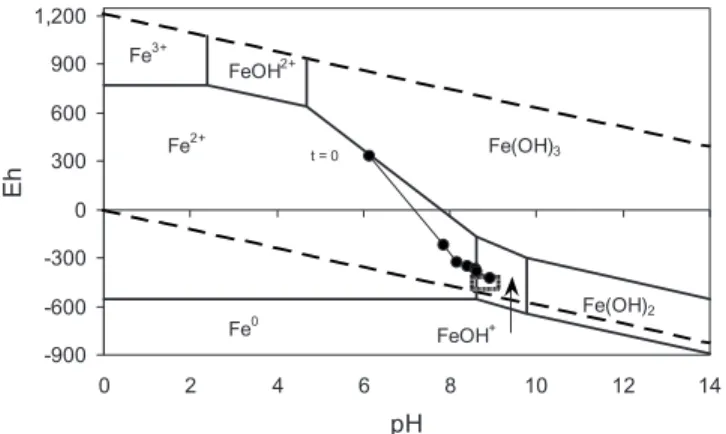
Over a reasonable range of ferrous iron关Fe共II兲兴 concentrations from 0.5 to 10 mg/L, the equilibrium Ehof the system should be on the order of −550 mV to − 520 mV as indicated in the Eh/pH diagram depicted in Fig. 2. These equilibrium values do not differ appreciably from the observed Ehrange of −415 to − 490 mV ob-served after an elapsed time of approximately 115 min. The cir-cular markers in Fig. 2 represent the observed Ehand pH data at elapsed times of 0, 1, 5, 10, 20, 30, and 100 min for a represen-tative dosage 共0.21 g/L兲 of nZVI in distilled water. They lead into the equilibrium Eh/pH stability zone, which is remark-ably small given the range of nZVI dosages共e.g., from 0.015 to 0.39 g/L兲 it encompasses. Interestingly, this area was sufficiently reducing as to be near the lower stability limit of water 共Eh= −532 mV at pH⬃9兲 and favorable for the generation of hydrogen gas. In this context, the addition of iron nanoparticles can stimu-late both chemically and biologically induced dechlorination.
With respect to Fig. 2, a strong thermodynamic driving force exists for the reduction of lindane in the iron-water system. Since the estimated standard reduction potentials vary from +500 to + 1,500 mV for various one-carbon alkyl halides at pH 7, the reduced forms of these species should be expected under equi-librium conditions 共Stumm and Morgan 1996; Gillham and O’Hannesin 1994; Vogel et al. 1987兲. Thus, at equilibrium,
poly-halogenated species such as lindane would be expected to un-dergo rapid facile reduction in the nZVI-water system.
Degradation of Lindane
As depicted in Fig. 3, greater than 95% of the lindane 共initial concentration 7.5 mg/L兲 was removed from aqueous solution within 24 h at relatively low nZVI loadings of 0.10 to 0.39 g/L while 60% was removed at 0.015 g/L. The control reactor con-taining no nZVI 共pH=6.91兲 exhibited an apparent early loss of lindane possibly due to sorption to the glass surface. However, normalized concentrations 共C/C0兲 generally exceeded 0.80–0.85
indicating that abiotic and biotic losses were not significant dur-ing the course of the experiments. Although the extent of lindane removal depended on the iron loading over the initial 10 h of the experiment, the 0.10 and 0.39 g/L doses yielded similar results by its conclusion共⬃24 h兲. This suggests that the extent of con-taminant transformation is largely independent of nZVI dose ex-cept at relatively short共⬍24 h兲 contact times. The nanoscale iron particles proved to be quite effective in degrading lindane. On the other hand, the particle size of the iron strongly influenced the observed extent of lindane degradation as all of the nZVI doses performed significantly better than the 0.53 g/L microscale iron dose. After 24 h, fully 43% of lindane still remained in the aque-ous solution.
Obviously, the loss of lindane from aqueous solution does not necessarily mean that it has been transformed. As demon-strated in Fig. 4, the disappearance of lindane was accom-panied by the observation of one major degradation product identified as␥-3,4,5,6-tetrachlorocyclohexene 共TeCCH兲 using the NIST62 pesticides library. TeCCH has also been reported as the Table 2. Comparison of pH and EhChanges as a Function of Iron Dose, Type, and Presence of␥-HCH
Iron dose 共g/L兲 Irontype 关␥-HCH兴 共mM兲 pHinitial/pHfinal ⌬pH Eh,initial/Eh,final 共mV兲 共mV兲⌬Eh 0.11 Nano 0 5.20/8.66 3.46 +372.0/−438.1 −810.1 0.10 Nano 0.026 5.07/7.97 2.90 +398.6/−417.7 −816.3 0.39 Nano 0 6.21/8.71 2.50 +391.4/−489.7 −881.1 0.39 Nano 0.023 6.31/9.07 2.76 +427.2/−430.4 −857.6 0.53 Micro 0.024 6.50/8.52 2.02 +407.0/−316.1 −723.1 -900 -600 -300 0 300 600 900 1,200 0 2 4 6 8 10 12 14 pH Eh FeOH2+ Fe(OH)3 Fe2+ FeOH+ Fe(OH)2 Fe0 Fe3+ t = 0
Fig. 2. Equilibrium Eh/pH diagram for the aqueous nanoiron system
at 25° C. The total dissolved iron concentration is 0.5 mg/L. The circular markers signify the pH/Ehprofile at elapsed time of 0, 1, 5, 10, 20, 30, and 100 min after addition of 0.21 g/L nFe. The rectan-gular region containing the t = 100 min marker represents the ob-served equilibrium stability zone for the 0.015– 0.39 g/L additions of nFe. 0.000 0.005 0.010 0.015 0.020 0.025 0.030 0.035 0 5 10 15 20 25 30 35 Time (h) Li ndane (mM )
0 g/L nFe 0.015 g/L nFe 0.1 g/L nFe 0.39 g/L nFe 0.53 g/L mFe
Fig. 3.␥-HCH removal from aqueous solution as a function of iron dose and type
major intermediate in the anaerobic biodegradation of lindane 共Middeldorp et al. 1996; Buser and Muller 1995; Ohisa et al. 1980; Jagnow et al. 1977; Beland et al. 1976兲 and in the electro-chemical reduction of lindane共Beland et al. 1976兲. In our experi-ments, the presence of sodium azide in the batch reactors should have inhibited microbial activity such that the reductions ob-served were mediated by the iron surface. TeCCH was also de-tected in a recent study in which the abiotic transformation of lindane by FeS was investigated共Liu et al. 2003兲. Curves depict-ing the observed TeCCH concentration as a function of iron dose and type are presented in Fig. 5. Because TeCCH did not accu-mulate over the course of the experiments, it is likely that it is further degraded. Maximum TeCCH concentrations were ob-served within the initial 5 h of the experiments and were typically on the order of 15% or less of the stoichiometric equivalent of lindane. Beland et al.共1976兲 observed a very similar TeCCH con-centration trend in the electrochemical reduction of lindane in dimethyl sulfoxide under an applied voltage of −1.520 V共versus the standard calomel electrode兲.
Relatively few organic degradation products were observed in the batch reactors. Low levels of benzene and biphenyl were
detected in the high concentration degradation tests conducted in ethanol. Interestingly, benzene was detected as a stable end product in the anaerobic biodegradation of lindane 共Middeldorp et al. 1996; Beland et al. 1976兲; ␥-pentachlorocyclohexene 共PCCH兲 was also identified at trace levels. Several investigators have reported observing PCCH during the base-catalyzed dehy-drohalogenation of lindane to a mixture of base-stable trichlo-robenzenes, particularly the 1,2,4-isomer 共Ngabe et al. 1993; Cristol et al. 1951兲. Secondary alkyl halides such as lindane un-dergo relatively facile nonreductive E2elimination by hydroxide
共Hughes and Ingold 1941兲. Ngabe et al. 共1993兲 reported a half-life for lindane of 6.3 days in a buffered aqueous solution of pH 9.01 and 30° C. The lack of dehydrohalogenation intermediates and end products observed during our experiments suggests that base-catalyzed elimination was not an important transformation mechanism under the conditions studied. Finally, trace levels of a transient cyclohexadiene derivative were periodically observed in the ethanol reactors. While this potential intermediate could not be conclusively identified, its observed GC/MS spectrum showed a major peak at an m/e ratio of 79 and minor peaks at m/e 114 and 149 consistent with a dichlorocyclohexadiene共DCCHD兲.
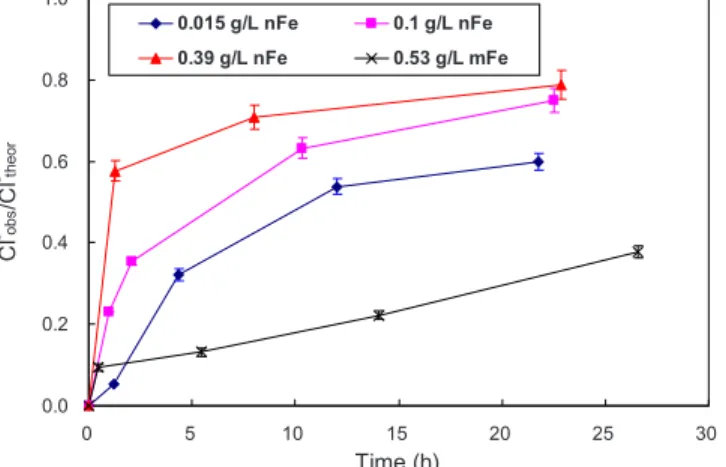
The major inorganic end products of the nZVI-mediated deg-radation of lindane included ferrous iron and chloride. The chlo-ride data are shown in Fig. 6. For the nZVI experiments, the observed chloride concentrations accounted for approximately 80% of the chloride expected from the complete degradation of lindane, assuming 6 moles of chloride evolved per mole of lin-dane. However, less than 38% of the expected chloride concen-tration was observed for the microscale iron experiment. The generation of aqueous chloride provides ultimate evidence of dechlorination. Not surprisingly, the iron nanoparticles produced a higher degree of dechlorination than did the microscale iron. Reaction Kinetics
In previous literature, the pseudo-first-order kinetics model has been most frequently used to characterize the iron-mediated deg-radation of redox-amenable contaminants共Johnson et al. 1996兲. This approach has been used with some success for simple 1- and 2-carbon chlorinated hydrocarbons, particularly in terms of the surface area normalized pseudo-first-order rate constant, kSA. As
applied to lindane, the pseudo-first-order kinetics equation is as follows:
d关␥ − HCH兴
dt = − kobs关␥ − HCH兴 共4兲
Fig. 4. Representative GC and GC/MS chromatograms from the nanoiron mediated degradation of lindane in ethanol at various reaction times. The major intermediate identified was confirmed to be 3,4,5,6-tetrachlorocyclohexene共TeCCH兲 0.00 0.25 0.50 0.75 1.00 1.25 1.50 1.75 2.00 2.25 2.50 0 5 10 15 20 25 30 Time (h) Te CC H (μμ M ) 0.015 g/L nFe 0.10 g/L nFe 0.39 g/L nFe 0.53 g/L mFe
Fig. 5. Concentration profiles of TCCH as a function of iron dose and type
d关␥ − HCH兴
dt = − kSAasFe关␥ − HCH兴 共5兲
where kobs= observed pseudo-first-order rate constant 共1/h兲; kSA
= surface area-normalized reaction rate coefficient 共L/h/m2兲; as= specific surface area of nZVI共m2/g兲, and Fe= nZVI
concen-tration共g/L兲. A specific surface area of 33.5 m2/g determined by
the BET method for dry iron nanoparticles was used in our cal-culations共Zhang et al. 1998; Sun et al. 2006兲.
As expected, the first-order rate constants for the nZVI doses were considerably larger than that for the microscale iron dose. As summarized in Table 3, the two larger nZVI doses, 0.10 and 0.39 g/L, exhibited kobsvalues of 0.149 and 0.138 1/h,
respec-tively. The kobsvalue for the lowest nZVI dose, 0.015 g/L was
lower by a factor of approximately 4, suggesting a rough depen-dence of reaction rate on iron dose. Interestingly, the surface area normalized first-order rate constants, kSA, are somewhat all within
the same order of magnitude regardless of dose or iron type. The observed kSA data ranged from 1.13⫻10−2L/h/m2 for the
0.53 g/L does of microscale iron to 7.20⫻10−2L/h/m2for the
0.015 g/L nZVI dose. Obviously, the data set is not sufficiently large to warrant a detailed investigation of this possible trend.
However, it has been reported that nZVI may not be more reactive than mZVI on a surface area normalized basis for carbon tetrachloride reduction共Nurmi et al. 2005兲. Another compounding factor is the strong tendency of nZVI to aggregate, which can result in a varying and potentially lessening of aS over time, which can further affect calculations of kSA. Lowry et al.共2007兲 recently investigated the effects of aggregation on nZVI sedimen-tation. This issue is of profound importance to nZVI manufactur-ing, deployment in the field, reactivity, and fate and transport within the subsurface.
The first-order model did not adequately describe the degrada-tion of lindane by iron nanoparticles in our batch reactors. The pseudo-first-order model fit was not too far off for the lowest dosage of nZVI共0.015 g/L兲 but the fit grew progressively worse with increasing iron dose and was particularly inadequate for the microscale iron dose. The fits for all iron doses exhibited consid-erable deviation from first-order behavior during the initial several hours of the reactions when the aqueous lindane concen-trations were the highest.
This deviation can be partially explained in terms of the dual removal processes, sorption to the nZVI, and reduction at the surface. Since the concentration of lindane and TeCCH was not evaluated on the surface of iron, the kSAdata can be thought of in
terms of a “lumped” parameter but sorption was generally only a factor during the initial stages of the experiment. This suggests that the sorption of lindane at the iron surface may account for a noticeable potion for the disappearance of lindane in the aqueous solution. It has been reported that the sorption process affects the kinetic analysis for the dechlorination of halogenated ethenes with ZVI共Burris et al. 1995兲.
Proposed Degradation Pathway and Conceptual Model As observed in this study, TeCCH is the principal degradation intermediate produced by the iron-mediated degradation of lin-dane. TeCCH is generated by the dihaloelimination of vicinal chlorides from carbons 1 and 2 of lindane as follows:
C6H6Cl6+ Fe0→ C
6H6Cl4+ Fe2++ 2Cl− 共6兲
Both chlorine atoms occupy axial positions on their respective carbon centers and are oriented antiperiplanar共dihedral angle of 180°兲, which maximizes their propensity toward reduction 共Smith and March 2001兲. Based upon the prolonged observance of TeCCH and the only transient appearance of subsequent potential intermediates, it appears that this initial reduction step is rate controlling. The two subsequent dihaloelimination steps are be-lieved to occur more rapidly ultimately yielding benzene, ferrous iron, and chloride as major end products. The overall pathway for the iron-mediated reduction of lindane to benzene is depicted in Fig. 7.
The reduction sequence is depicted in Fig. 8. Aqueous 共or from ethanol-water solution兲 lindane must first sorb onto the iron surface before any reaction can occur. Once sorbed, the highly electronegative chlorine substituents act as the electron acceptors while Fe0 serves as the electron donor. The reduction product,
TeCCH can then undergo further sequential reductions ultimately yielding benzene, or it can desorb into bulk aqueous solution. However, as has been mentioned previously, besides ␥-TeCCH, no further degradation-related intermediates or products 共e.g., benzene兲 were observed in the aqueous experiments. The reduc-tion of alkyl halides such as lindane typically proceeds via a series of two discrete single electron transfers 共Roberts et al. 1996; Vogel et al. 1987兲. In the first step, an electron from Fe0
is donated to the surface-associated lindane forming a neutral radical as one chloride ion is simultaneously ejected. Another electron is then lost from the transient Fe+species to the reacting
carbon center of the radical, which then undergoes double bond formation and simultaneous loss of chloride from the beta carbon. In this manner, Fe2+ and TeCCH are produced along with the
evolution of two Cl− ions. A similar sequence of single electron
transfers is expected to occur during the generation of the subse-quent degradation products. To some degree, the mechanisms il-Table 3. Summary of Batch Data from the First-Order Kinetics Model
Iron type Iron dose 共g/L兲 共1/h兲kobs 共L/h/mkSA 2兲 Nano 0.015 3.62⫻10−2 7.20⫻10−2 Nano 0.10 1.49⫻10−1 4.46⫻10−2 Nano 0.39 1.38⫻10−1 1.05⫻10−2 Micro 0.53 6.00⫻10−3 1.13⫻10−2 0.0 0.2 0.4 0.6 0.8 1.0 0 5 10 15 20 25 30 Time (h) C l - obs /C l - theo r 0.015 g/L nFe 0.1 g/L nFe 0.39 g/L nFe 0.53 g/L mFe
Fig. 6. Concentration profiles of observed chloride as a function of iron dose and type. The observed chloride data are normalized to the stoichiometric equivalent of chloride produced assuming complete conversion from␥-HCH.
lustrated in Fig. 8 are similar to those proposed by Liu et al. for the FeS-mediated reduction of lindane although the observed deg-radation products differ共Liu et al. 2003兲.
Cost Analysis for Zero-Valent Iron Nanoparticles Prior to 2000, there were no commercial suppliers of iron nano-particles in the United States or elsewhere around the world. Small quantities 共e.g., ⬍10 kg兲 were synthesized in the labora-tory, usually using the now well-described borohydride reduction process for both bench-scale and pilot-scale tests. Given the lack of any economies of scale, the fact that the synthesis was per-formed in a laboratory setting, and the labor-intensive nature of the process, the costs to produce the nZVI was significant 共e.g., ⬎$250/kg兲. Since that time, several vendors have started limited production of iron nanoparticles. As a consequence, the price is decreasing markedly. Data obtained from one nZVI manufacturer indicated that nZVI costs were on the order of $50/kg as of mid-2004. However, even with an increased supply of nZVI
available and a lower price point, the general perception is that the nanoparticle technology is still too expensive for widespread utilization by environmental remediation practitioners. While an analysis of surface area per unit cost could result in a more fa-vorable analysis for nZVI, the fact that particle aggregation can cause the specific surface area to vary, limits the effectiveness of the approach. As surface-modified nZVI products are developed and field evaluated, this alternative costing approach should be revisited.
Conclusions
This work demonstrates that lindane can be effectively degraded with zero valent iron nanoparticles in both aqueous solution and in ethanol-water systems. The extent of lindane transformation was appreciably greater for the nZVI doses as compared with commercially available microscale iron powders 共⬃10 m兲 at similar iron dosages. However, the surface area normalized first order rate constants are somewhat all within the same order of magnitude regardless of dose or iron type. The degradation of lindane proceeded through ␥-3,4,5,6-tetrachlorocyclohexene, a dihaloelimination product in both the aqueous experiments and the “high concentration” studies conducted in ethanol water. No nonhalogenated organic end products were detected in the aque-ous experiments, but trace concentrations of benzene were de-tected in the ethanol-water system. Chloride was dede-tected as a stable end product in both systems, demonstrating the reductive degradation of lindane.
Despite these promising results, additional studies are war-ranted to better characterize the kinetics of the degradation pro-cess, more rigorously investigate and characterize the degradation pathways and intermediates, and evaluate the efficacy of the nZVI technology on sorbed or surface-associated lindane under field conditions.
Acknowledgments
Research described in this work has been supported by the Penn-sylvania Infrastructure Technology Alliance 共PITA兲 and by the U.S. Environmental Protection Agency 共EPA STAR Grant Nos. R829625 and GR832225兲.
References
Beland, F. A., Farwell, S. O., Robocker, A. E., and Geer, R. A.共1976兲. “Electrochemical reduction and anaerobic degradation of lindane.” J. Agric. Food Chem., 24共4兲, 753–756.
Burris, D. R., Campbell, T. J., and Manoranjan, V. S.共1995兲. “Sorption of trichloroethylene and tetrachloroethylene in a batch reactive metallic iron-water system.” Environ. Sci. Technol., 29共11兲, 2850–2855. Buser, H. R., and Muller, M. D.共1995兲. “Isomer and enantioselective
degradation of hexachlorocyclohexane isomers in sewage sludge under anaerobic conditions.” Environ. Sci. Technol., 29共3兲, 664–672. Cao, J., Elliott, D., and Zhang, W. 共2005兲. “Perchlorate reduction by
nanoscale iron particles.” J. Nanopart. Res., 7共4–5兲, 499–506. Cao, J., and Zhang, W. X.共2006兲. “Stabilization of chromium ore
pro-cessing residue 共COPR兲 with nanoscale iron particles.” J. Hazard. Mater., 132共2–3兲, 213–219.
Chen, S.-S., Hsu, H.-D., and Li, C.-W.共2004兲. “A new method to produce nanoscale iron for nitrate removal.” J. Nanopart. Res., 6共6兲, 639–647. Cristol, S. J., Hause, N. L., and Meek, J. S. 共1951兲. “Mechanisms of
H H Cl Cl Cl H H Cl Cl H Cl H Cl Cl H Cl H Cl H H Cl Cl 6 4 1 35 2 2e --2Cl -2e--2Cl -2e --2Cl -lindane (gamma HCH) 3,4,5,6-Tetrachlorocyclohexene (TeCCH) 3,4-Dichlorocyclohexadiene (DCCHD) Benzene
Fig. 7. Dihaloelimination degradation pathway from lindane to benzene; implicit vinyl and aromatic hydrogen atoms are not shown. The structure of TeCCH 共a six-carbon “twisted boat”兲 features two implicit carbon atoms on either side of the double bond; implicit aliphatic hydrogen atoms on DCCHD are not shown to improve clarity. C6H6Cl6 (aq) C6H6Cl6 (ads) C6H6Cl4 (ads) C6H6Cl4 (aq) C6H6Cl2 (ads) C6H6Cl2 (aq) C6H6 (ads) C6H6 (aq) 2e -2Cl -Fe0 Fe2+ +2e -2Cl -+2e -+2e -2Cl
-Fig. 8. Conceptual model of the degradation of lindane by nanoscale iron
elimination reactions. The kinetics of the alkaline dehydrochlorination of the benzene hexachloride isomers.” J. Am. Chem. Soc., 73共2兲, 674–679.
Elliott, D. W., and Zhang, W. X.共2001兲. “Field assessment of nanoscale biometallic particles for groundwater treatment.” Environ. Sci. Tech-nol., 35共24兲, 4922–4926.
Gillham, R. W., and O’Hannesin, S. F.共1994兲. “Enhanced degradation of halogenated aliphtics by zero-valent iron.” Ground Water, 32共6兲, 958–967.
Glazier, R., Venkatakrishnan, R., Gheorghiu, F., Walata, L., Nash, R., and Zhang, W. X.共2003兲. “Nanotechnology takes root.” Civ. Eng. (N.Y.),
73共5兲, 64–69.
Hughes, E. D., and Ingold, C. K.共1941兲. “The mechanism and kinetics of elimination reactions.” Trans. Faraday Soc., 37, 657–685.
Jagnow, G., Haider, K., and Ellwardt, P.共1977兲. “Anaerobic dechlorina-tion and degradadechlorina-tion of hexachlorocyclohexane isomers by anaerobic and facultative anaerobic bacteria.” Arch. Microbiol., 115共3兲, 285– 292.
Johnson, T. L., Scherer, M. M., and Tratnyek, P. G.共1996兲. “Kinetics of halogenated organic compound degradation by iron metal.” Environ. Sci. Technol., 30共8兲, 2634–2640.
Kanel, S. R., Manning, B., Charlet, L., and Choi, H.共2005兲. “Removal of arsenic共III兲 from groundwater by nanoscale zero-valent iron.” Envi-ron. Sci. Technol., 39共5兲, 1290–1298.
Kolpin, D. W., Barbash, J. E., and Gilliom, R. J.共1998兲. “Occurrence of pesticides in shallow groundwater of the United States: Initial results from the national water-quality assessment program.” Environ. Sci. Technol., 32共5兲, 558–566.
Li, X. Q., Cao, J. S., and Zhang, W. X. 共2008兲. “Immobilization of hexavalent chromium with iron nanoparticles: Characterizations with high resolution x-ray photoelectron spectroscopy 共HR-XPS兲.” Ind. Eng. Chem. Res., 47共7兲, 2131–2139.
Li, X. Q., and Zhang, W. X.共2006兲. “Iron nanoparticles: The core-shell structure and unique properties for Ni共II兲 sequestration.” Langmuir,
22共11兲, 4638–4642.
Li, X. Q., and Zhang, W. X.共2007兲. “Sequestration of metal cations with zerovalent iron nanoparticles—A study with high resolution x-ray photoelectron spectroscopy共HR-XPS兲.” J. Phys. Chem. C, 111共19兲, 6939–6946.
Lien, H. L., and Zhang, W. X. 共1999兲. “Transformation of chlorinated methanes by nanoscale iron particles.” J. Environ. Eng., 125共11兲, 1042–1047.
Lien, H. L., and Zhang, W. X. 共2001兲. “Nanoscale iron particles for complete reduction of chlorinated ethenes.” Colloids Surf., A, 191共1– 2兲, 97–105.
Lien, H. L., and Zhang, W. X.共2005兲. “Hydrodechlorination of chlori-nated ethanes by nanoscale Pd/Fe bimetallic particles.” J. Environ. Eng., 131共1兲, 4–10.
Lien, H. L., and Zhang, W. X.共2007兲. “Nanoscale Pd/Fe bimetallic par-ticles: Catalytic effects of palladium on hydrodechlorination.” Appl. Catal., B, 77共1–2兲, 110–116.
Liu, X., Peng, P. A., Fu, J., and Huang, W.共2003兲. “Effects of FeS on the transformation kinetics of ␥-hexachlorocyclohexane.” Environ. Sci. Technol., 37共7兲, 1822–1828.
Liu, Y., Majetich, S. A., Tilton, R. D., Sholl, D. S., and Lowry, G. V. 共2005兲. “TCE dechlorination rates, pathways, and efficiency of nano-scale iron particles with different properties.” Environ. Sci. Technol.,
39共5兲, 1338–1345.
Lowry, G. V., and Johnson, K. M.共2004兲. “Congener-specific dechlori-nation of dissolved PCBs by microscale and nanoscale zerovalent iron in a water/methanol solution.” Environ. Sci. Technol., 38共19兲, 5208– 5216.
Lowry, G. V., Phenrat, T., Saleh, N., Sirk, K., and Tilton, R. 共2007兲. “Aggregation and sedimentation of aqueous nanoscale zerovalent iron
dispersions.” Environ. Sci. Technol., 41共1兲, 284–290.
Mackay, D., Shiu, W.-X., and Ma, K.-C. 共1997兲. “Insecticides.” Illus-trated handbook of physical-chemical properties and environmental fate for organic chemicals, Vol. V, Lewis Publishers, New York, 3898–3915.
Middeldorp, J. M., Jaspers, M., Zehnder, J. B., and Schraa, G.共1996兲. “Biotransformation of␣-, -, ␥-, and ␦-hexachlorocyclohexane under methanogenic conditions.” Environ. Sci. Technol., 30共7兲, 2345–2349. Ngabe, B., Bidleman, T. F., and Falconer, R.共1993兲. “Base hydrolysis of alpha- and gamma-hexachlorocyclohexanes.” Environ. Sci. Technol.,
27共9兲, 1930–1933.
Nordstrom, D. K., and Wilde, F. D.共2005兲. “Reduction-oxidation poten-tial 共electrode method兲.” National field manual for the collection of water-quality data, U.S. Geological Survey.
Nurmi, J. T., et al. 共2005兲. “Characterization and properties of metallic iron nanoparticles: Spectroscopy, electrochemistry, and kinetics.” En-viron. Sci. Technol., 39共5兲, 1221–1230.
Ohisa, N., Yamaguchi, M., and Kurihara, N.共1980兲. “Lindane degrada-tion by cell-free extracts of clostridium rectum.” Arch. Microbiol.,
125共3兲, 221–225.
Ponder, S. M., Darab, J. G., and Mallouk, T. E.共2000兲. “Remediation of Cr共VI兲 and Pb共II兲 aqueous solution using supported nanoscale zero-valent iron.” Environ. Sci. Technol., 34共12兲, 2564–2569.
Roberts, A. L., Totten, L. A., Arnold, W. A., Burris, D. R., and Campbell, T. J.共1996兲. “Reductive elimination of chlorinated ethylenes by zero valent metals.” Environ. Sci. Technol., 30共8兲, 2654–2659.
Schwarzenbach, R. P., Gschwend, P. M., and Imboden, D. M.共2003兲. “An introduction to environmental organic chemicals.” Environmental or-ganic chemistry, 2nd Ed., Wiley, New York, 36–37.
Slade, R. E.共1945兲. “The ␥-isomer of hexachlorocyclohexane 共gammex-ane兲: An insecticide with outstanding properties.” Chem. Ind., 40, 314–319.
Smith, M. B., and March, J.共2001兲. “Eliminations.” March’s advanced organic chemistry, 5th Ed., Wiley, New York, 1299–1376.
Stumm, W., and Morgan, J. J.共1996兲. “Oxidation and reduction: Equilib-ria and microbial mediation.” Aquatic chemistry, 3rd Ed., Wiley, New York, 425–507.
Sun, Y. P., Li, X. Q., Cao, J., Zhang, W. X., and Wang, H. P.共2006兲. “Characterization of zero-valent iron nanoparticles.” Adv. Colloid In-terface Sci., 120共1–3兲, 47–56.
Vijgen, J.共2006兲. “Overview historical HCH/Lindane production and oc-curring HCH-residuals.” The legacy of lindane HCH isomer produc-tion, Main Rep., Int. HCH and Pesticides Association共IHPA兲, 18–19. Vogel, T. M., Criddle, C. S., and McCarty, P. L.共1987兲. “Transformations of halogenated aliphatic compounds.” Environ. Sci. Technol., 21共8兲, 722–736.
Walker, K., Vallero, D. A., and Lewis, R. G.共1999兲. “Factors influencing the distribution of lindane and other hexachlorocyclohexanes in the environment.” Environ. Sci. Technol., 33共24兲, 4373–4378.
Wang, C. B., and Zhang, W. X. 共1997兲. “Synthesizing nanoscale iron particles for rapid and complete dechlorination of TCE and PCBs.” Environ. Sci. Technol., 31共7兲, 2154–2156.
Willett, K. L., Ulrich, E. M., and Hites, R. A.共1998兲. “Differential tox-icity and environmental fates of hexachlorocyclohexane isomers.” En-viron. Sci. Technol., 32共15兲, 2197–2207.
Xiong, Z., Zhao, D., and Pan, G.共2007兲. “Rapid and complete destruction of perchlorate in water and ion-exchange brine using stabilized zero-valent iron nanoparticles.” Water Res., 41共15兲, 3497–3505.
Zhang, W. X.共2003兲. “Nanoscale iron particles for environmental reme-diation: An overview.” J. Nanopart. Res., 5共3–4兲, 323–332. Zhang, W. X., Wang, C. B., and Lien, H. L.共1998兲. “Treatment of
chlo-rinated organic contaminants with nanoscale bimetallic particles.” Catal. Today, 40共4兲, 387–395.