140 IEEE COMMUNICATIONS LETTERS, VOL. 11, NO. 2, FEBRUARY 2007
A Fast Handoff Protocol for Cellular IEEE 802.11e WLAN Systems
Yung-Han Chen, Student Member, IEEE, and Chung-Ju Chang, Fellow, IEEE
Abstract— This letter proposes a fast handoff protocol (FHP)
for cellular IEEE 802.11e wireless local area network (WLAN) systems. The FHP, which is standard compatible, provides a
controlled contention period (CCP) designated for handoff requests
(HO-REQs), arranges these HO-REQs to contend sequentially in CCP, and proposes a fuzzy adjustment method (FAM) to determine a proper length for CCP. Simulation results reveal that the FHP can significantly decrease the forced termination rate of HO-REQs and still enhance the system throughput of contention period for cellular IEEE 802.11e WLAN systems.
Index Terms— Cellular WLAN, handoff, forced termination
rate.
I. INTRODUCTION
I
T is known that some real-time services, such as voice over IP and video-stream, are gaining high momentum in wireless local area network (WLAN) systems. On the other hand, in order to provide wide coverage and mobility, the mobile service area of WLANs would be effectively extended, and the cellularized deployment of WLAN systems is one way to achieve it. However, the nature of the small coverage of a quality-of-service (QoS) basic service set (QBSS) in WLANs would lead frequent handoffs of mobile users in the cellular environments. The handoff delay caused by both the scanning time and the medium access time is a significant index of handoff efficiency. A recent work of IEEE 802.11 Working Group r (IEEE 802.11r) defines a set of high-efficient frames for associations and authentications to shorten the scanning time [1]. But the medium access time of IEEE 802.11e [2] still needs to be improved. It is because the handoff request (HO-REQ) issued by the handoff QoS station (QSTA) has to compete with other packets in the contention period (CP). The medium access delay is uncertain even if the HO-REQ is assigned as the voice access category (AC VO), which represents the highest priority in the enhanced distributed channel access (EDCA) [2]. An enhanced handoff protocol is therefore essential for handoff association in cellular WLAN systems to support inter-cell mobility and seamless services with delay bound guarantee. In this letter, we propose a standard-compatible fast handoff protocol (FHP) for cellular IEEE 802.11e WLAN systems.II. THEFASTHANDOFFPROTOCOL
The fast handoff protocol (FHP) assumes that the QoS access point (QAP) of every QBSS will issue a handoff
Manuscript received September 1, 2006. The associate editor coordinating the review of this letter and approving it for publication was Dr. Christos Douligeris. This work was supported by the National Science Council, Taiwan, under contract number NSC94-2213-E-009-059.
The authors are with the Department of Communication Engineer-ing, National Chiao Tung University, Hsinchu, 300 Taiwan (e-mail: [email protected]).
Digital Object Identifier 10.1109/LCOMM.2007.061420.
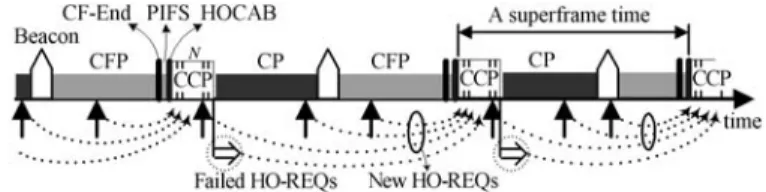
Fig. 1. The CCP in the FHP.
controlled access broadcast (HOCAB) packet in every beacon
interval (BI) right after the CF-End packet of the contention-free period (CFP) and the point coordination function (PCF) interframe space (PIFS), as shown in Fig. 1. The HOCAB packet is designed to indicate a start of the controlled
con-tention period (CCP). Its packet format is similar to the
CF-Poll defined in [2] but further with fields of broadcast destination address (DA) andN, where N denotes the number of time slots in CCP.N is contained in an additional 2-octet field between the Sequence Control field and the Frame Check Sequence field in the HOCAB. The CCP, partitioned from CP, can be regarded as a kind of controlled access phase (CAP) [2]. The network allocation vector (NAV) claimed for the CCP can be calculated by multiplyingN and the slot time. New and failed (retried) HO-REQs will contend for handoff association or authentication in theseN time slots of next CCP. Also, the time interval between two consecutive HOCABs is called a superframe time. Noticeably, the new HO-REQs include those HO-REQs arriving during the previous superframe time, while the retried HO-REQs are the failed HO-REQs due to collisions or packet errors in the previous CCP. In order to minimize the forced termination rate of HO-REQs, the FHP assumes that each new and retried HO-REQ will randomly pick an integer to determine which time slot to contend, and the integer is uniformly distributed over [1, N]. In such a way, HO-REQs are guided to sequentially contend and the collision can be avoided to the utmost.
A fuzzy adjustment method (FAM) is also proposed to adap-tively adjust N, superframe by superframe, to achieve high system utilization. The fuzzy logic system for FAM contains four functional blocks: a fuzzifier, an inference engine, a fuzzy rule base, and a defuzzifier [3]. Two linguistic variables are chosen as inputs for the fuzzifier. One is the ratio of the number of used slots to N in the previous CCP, which is denoted byu; the other is the ratio of successful access power accumulation to the overall access power accumulation in the previous CCP, which is denoted by η. In order to obtain a more accurate adjustment, a simple transmit power control (TPC) [4] for HO-REQs is applied as a premise. Assume that the transmission power of a QAP is known and fixed. Each handoff QSTA can detect the path loss by estimating the power loss of received HOCAB. Therefore the HO-REQ
CHEN and CHANG: A FAST HANDOFF PROTOCOL FOR CELLULAR IEEE 802.11E WLAN SYSTEMS 141
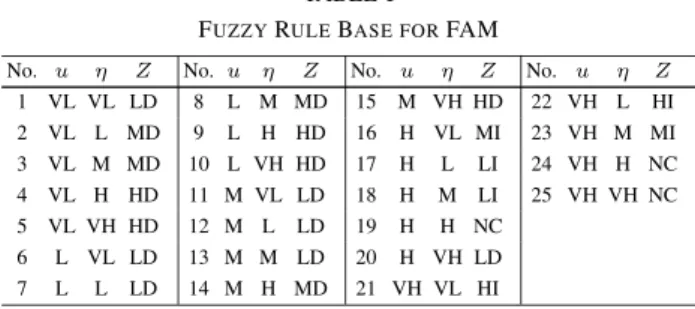
TABLE I
FUZZYRULEBASE FORFAM
No. u η Z No. u η Z No. u η Z No. u η Z 1 VL VL LD 8 L M MD 15 M VH HD 22 VH L HI 2 VL L MD 9 L H HD 16 H VL MI 23 VH M MI 3 VL M MD 10 L VH HD 17 H L LI 24 VH H NC 4 VL H HD 11 M VL LD 18 H M LI 25 VH VH NC 5 VL VH HD 12 M L LD 19 H H NC 6 L VL LD 13 M M LD 20 H VH LD 7 L L LD 14 M H MD 21 VH VL HI
will be transmitted with proper extra power to compensate the path loss. As a result, the power of every HO-REQ received at the QAP would be almost the same.
Term sets for the two input variables,u and η, are defined as
T(u)=T(η)={very low (VL), low (L), medium (M), high (H),
very high (VH)}. Membership functions for the terms adopt the trapezoidal function given by
M(m; m1, m2, m3, m4) = ⎧ ⎪ ⎪ ⎨ ⎪ ⎪ ⎩ m−m1 m2−m1, m1≤ m ≤ m2, 1, m2≤ m ≤ m3, m4−m m4−m3, m3≤ m ≤ m4, 0, otherwise, (1) wherem1andm4(m2andm3) represent two terminals of the lower (upper) parallel side. Thus, membership functions for term X in T(u) and term Y in T(η) are expressed, respectively, as
µX(u; AX) = M(u; aX,1, aX,2, aX,3, aX,4), (2)
µY(η; BY) = M(η; bY,1, bY,2, bY,3, bY,4), (3)
where AX=(aX,1, aX,2, aX,3, aX,4), and BY=(bY,1, bY,2, bY,3,
bY,4), aX,i ∈ [0, 1], bY,i ∈ [0, 1], i=1, 2, 3, 4, are 4-tuple
elements set ranges for the trapezoidal function M. These ranges should be properly designed so that the FAM can response accurately and precisely when adjustingN.
The output linguistic variable from the defuzzifier, Z, defined as the adjustment multiplier of N, has a term set given by T(Z)={high decrement (HD), moderate decrement (MD), light decrement (LD), no change (NC), light increment (LI), moderate increment (MI), high increment (HI)}. Terms of T(Z) are fuzzy singletons [3], which means that the mem-bership function of each term is equal to 1 at a certain crisp value and zero otherwise. With expert domain knowledge, the fuzzy rule base is designed as listed in Table I. Take rule No. 16 for explanation. Ifu is with term H and η is with term VL, it means that lots of slots in CCP are occupied by the collided HO-REQs, thusZ would be moderate increment to relax the congested situation in the coming CCP. The inference engine adopts the max-min inference method according to the fuzzy rule base. Also, the defuzzifier adopts the center of area (COA) method to generate outputZ [3]. Note that the adjusted result ofN will be further rounded off to an integer and limited by a minimum of 1.
III. SIMULATIONRESULTS ANDDISCUSSIONS
In the simulations, the cellular IEEE 802.11e WLAN system contains 7× 7 hexagonal and wrap-around QBSSs, where the radius of coverage of each QAP is 50 meters, and any
Fig. 2. Mean forced termination rate of HO-REQs.
two adjacent QBSSs are assumed to use different physical channels. A two-path Rayleigh fading channel model [5] is also considered. The WLAN system parameters are based on those in [2], [6], where the SIFS, PIFS, and DIFS are assumed to be 10µs, 20µs, and 40µs, respectively; a beacon interval is 20ms; the duration of CFP is fixed to be 10ms; and a slot time (aSlotTime) of PHY is 9µs. The slot time in the CCP is given as 78µs.
The ranges set for AXin the FAM design areAVL=(0, 0,
log 2, log 3), AL=(log 2, log 3, log 4, log 5),AM=(log 4, log 5,
log 6, log 7), AH=(log 6, log 7, log 8, log 9), andAVH=(log 8,
log 9, 1, 1). By such a way, the ranges of trapezoidal functions are wider when measures of u or η are lower, and thus FAM would be more sensitive to the worse conditions in u and η. The same settings are also applied to BY. The crisp values
for the terms HD, MD, LD, NC, LI, MI, and HI ofZ are set at 0.25, 0.5, 0.75, 1, 1.25, 1.5, and 2, respectively.
Two cases are considered in the simulations, where case 1 (2) contains 5 (4) static QSTAs with background access category (AC BK), 5 (4) static QSTAs with best-effort access category (AC BE), 1 (2) static QSTA(s) with video access category (AC VI), and 1 (2) static QSTA(s) with non-handoff voice access category (AC VO) [2]. All static QSTAs are located randomly and activated in a saturation mode, where their access transmissions are always on. The arrival process of the HO-REQ in each QBSS is assumed to be in Poisson distribution. Each HO-REQ has to seek for a successful transmission under the 100ms system delay bound and the 8 times retry limit. Otherwise, the HO-REQ will be forcedly terminated. The FHP will be compared with EDCA method [2], where both HO-REQs and other packets use EDCA to access in CP, but HO-REQs are given with the same highest priority as AC VO.
Fig. 2 shows the mean forced termination rate of HO-REQs. It can be found that the FHP provides an almost zero forced termination rate for HO-REQs, and the performances of FHP are the same in cases 1 and 2. The reasons are that the FHP designs a CCP dedicatedly designated for HO-REQs and provides a uniform separation for access of these HO-REQs, which can prevent HO-REQs from colliding with each other in CCP. The EDCA method, however, attains a larger forced termination rate for HO-REQs. In case 1, its forced termination rate is about 3.6×10⁻² when there are two new HO-REQs arrivals per BI. Performance in case 2 is worse than that in case 1. It is because the HO-REQs have to contend with
142 IEEE COMMUNICATIONS LETTERS, VOL. 11, NO. 2, FEBRUARY 2007
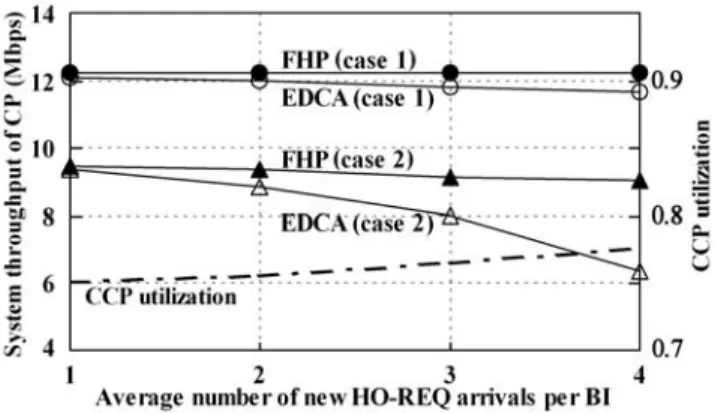
Fig. 3. System throughput of CP and CCP utilization.
static QSTAs in CP and waste time in backoff, and the more high-priority QSTAs such as AC VI and AC VO the system has, the worse the forced termination rate of HO-REQs would be.
Fig. 3 depicts the system throughput of CP (left vertical axis) and the CCP utilization (right vertical axis), where the system throughput of CP by FHP includes those in CCP and CP. It can be seen that FHP can still achieve higher system throughput of CP than EDCA, and the superiority is more significant when the number of high-priority static QSTAs becomes larger (case 2). It is because FHP designs a dedicated CCP for HO-REQs, which will result in a smaller number of high-priority users in CP and thus less collisions and backoff for other contention-based packets. The reason can also explain the phenomenon that the system throughput of CP using the EDCA is affected greatly by the number of
HO-REQs, and it is more deteriorated if more high-priority static QSTAs exist, as in case 2. Moreover, FAM provides a high CCP utilization for HO-REQs, which is over 0.75. This implies that the time duration of CCP partitioned from CP is well-controlled by the proposed FAM.
IV. CONCLUSIONS
In this letter, a standard-compatible fast handoff protocol (FHP) is proposed for cellular IEEE 802.11e WLAN systems. The FHP can decrease the forced termination rate of HO-REQs and still enhance the system throughput of CP. This major advantage brought by FHP, which eliminates the un-certainty of media access delay for HO-REQs, is significant. As a result, the WLAN systems can obtain more accurate time estimations for other pro-active procedures in the entire handoff process. This cannot be achieved by using enhanced distributed channel access (EDCA) method in the standards.
REFERENCES
[1] IEEE 802.11r Amendment 2: Fast BSS Transition, IEEE Std. 802.11r/D2.0, Mar. 2006.
[2] IEEE 802.11e Amendment 8: Medium Access Control (MAC) Quality of Service Enhancements, IEEE Std. 802.11e, Nov. 2005.
[3] C. T. Lin and C. S. G. Lee, Neural Fuzzy Systems. Prentice Hall PTR, 1996.
[4] IEEE 802.11h Amendment 5: Spectrum and Transmit Power Management Extensions in the 5 GHz band in Europe, IEEE Std. 802.11h, 2003. [5] H. Zhu and L. Bouchard, “Performance of OFDM based wireless LAN
system under Doppler over Rayleigh fading,” Proc. ICCT, vol. 2, no. 16, pp. 1234-1237, Apr. 2003.
[6] IEEE 802.11a: High-speed Physical Layer in the 5 GHz Band, IEEE Std. 802.11a, 1999.