Excitation of rotation collective modes in a vortex lattice of clean type-II superconductors
A. Kasatkin
Department of Electrophysics, National Chiao Tung University, Hsinchu, Taiwan 30043, Republic of China and Institute of Metal Physics, Ukrainian Academy of Sciences, Kiev, Ukraine
B. Rosenstein
National Center for Theoretical Sciences and Department of Electrophysics, National Chiao Tung University, Hsinchu, Taiwan 30043, Republic of China
共Received 20 May 1999兲
In a superclean limit the Magnus force on Abrikosov vortices is stronger than friction. Due to this, nondis-sipative force vortex segments rotate around pinning centers. Waves of such rotations under certain conditions are only weakly damped共not overdamped as is usually the case兲 and lead to resonances in the ac response. 共The excitation of such waves by applied ac field near the surface is considered. Surface impedance, ac resistivity, and magnetic permeability are calculated using elasticity theory of the vortex lattice.
关S0163-1829共99兲00442-7兴
I. INTRODUCTION
Abrikosov vortex dynamics in type-II superconductors under magnetic field is usually thought to be overdamped. Due to large vortex viscosity the displacement waves in vor-tex lattice do not propagate. In high-Tc superconductors the situation under certain conditions might be different. The dissipation during the vortex motion is at least to large extent due to excitation of quasiparticles inside the vortex core. At small temperatures this process is frozen and instead of usual Bardeen-Stephen friction forcev one has only a nondissi-pative Magnus force
⬘
zˆ⫻v perpendicular to the vortex ve-locity, where z is the direction of external magnetic field. As evidence to the increasing role of the Magnus force is the famous Hall anomaly.1 In a series of direct experiments2 it was shown that in YBCO single crystals at low temperatures the Hall angle tan(H)⬅⬘
/ diverges as T⫺1 and clearly exceeds 1 below 4 K reaching 2.5 at 3 K. This regime was termed by authors of Ref. 2 ‘‘superclean limit.’’ Theoreti-cally such a behavior was predicted in Ref. 3 . In such a superclean regime vortex dynamics might be nonover-damped and, for example, displacement waves in the vortex lattice can propagate. This type of phenomenon was used recently4 to explain the magnetoabsorption in BSCCO,5 al-though alternative explanations based on the Josephson plasma oscillations exist.6In this paper we consider dynamics of vortices in ‘‘super-clean’’ superconductors under applied ac field. Linear re-sponse to applied field 共microwave impedance, low fre-quency complex resistivity, and permeability兲 and local field profiles are calculated. We find that in the superclean limit the system is not overdamped and point out to several reso-nance effects. Excitation of the nonoverdamped waves by applied ac field modify in an essential way the theory of the linear response developed by Brandt7and Coffey and Clem.8 The basic physics of the vortex response in the superclean limit is very simple. Let us first consider the very small in-ductions case B/⌽0⬍2, where is the magnetic
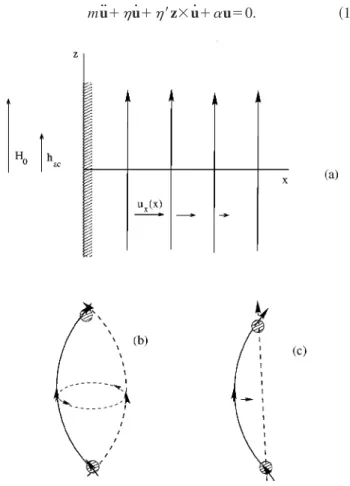
penetra-tion depth and ⌽0⬅hc/2e. In this case we can neglect ex-ponentially small interactions between vortices and consider single vortex dynamics. Assuming that the vortex is pinned 共Fig. 1兲 we describe it by equation of motion for displace-ment u:
mu¨⫹u˙⫹
⬘
z⫻u˙⫹␣u⫽0. 共1兲FIG. 1. 共a兲 Positions and displacements of vortices caused by external Lorentz force.共b兲 Displacement of a vortex segment under influence of ac field in the superclean limit.共c兲 Displacement of a vortex segment under influence of ac field in the conventional over-damped case.
PRB 60
Here ␣ is the Labousch parameter describing restoring pinning force in the x- y plane. As was noted many times9 the Magnus force is mathematically identical to ‘‘Lorentz’’ force on a charged particle when ⌽0 is considered as a
‘‘charge.’’ When the friction coefficient and the dynamical vortex mass m 共Ref. 10兲 are small one obtains 共clockwise and counterclockwise兲 circular motion around the pinning centers 关see Fig. 1共b兲兴 with frequency
M⬅ ␣
⬘
. 共2兲The order of magnitude is the same as the depinning fre-quency ⍀depin⫽␣/ which is of order 10-100 GHz.13 The friction causes damping of the rotations 关see Fig. 1共c兲兴. To excite this mode resonantly one can apply the external Lor-entz force due to ac current in a direction y perpendicular to the dc magnetic field and parallel to the samples surface, see Fig. 1共a兲. We assume Fext(r,t)⫽xˆFext(x)eit, namely, that
the force is independent of y and z. In this case there is no variations in the z direction and the problem becomes two dimensional. When approachesMone obtains resonance in the amplitude of vortex vibrations.
The system of coupled charged oscillators in magnetic field has been considered in various contexts in physics, e.g., in connection with ‘‘magnetophonons’’ in Wigner lat-tice formed out of electron gas.11This is very similar to the situation of interacting fluxons in the superclean limit for fields Hc1ⰆHⰆHc2. In this case the repulsion between vor-tices leading to formation of vortex lattice is logarithmic. The eigenfrequences ⫾M become bands共the positive fre-quency is not necessarily the same as the negative when shear is present in the lattice, see below兲. This medium can be effectively described using the elasticity theory in har-monic approximation. The complex dispersion relation for these waves for arbitrary values of ,
⬘
,␣, and B within London approximation are presented in Sec. II. These modes lead to number of experimentally accessible effects. In Sec. III we discuss the linear response to ac current flowing at the surface layer of the single crystal in direction perpendicular to that of magnetic field. We calculate the penetration depth ac and related to it microwave impedance Z(), lowfre-quency complex resistivity, and magnetic permeability. Compared to standard results7,8 we obtain additional large contribution to ac response near the resonant frequency due to excitation of weakly damped waves. In Sec. IV the
modi-fications due to anisotropy 共important for applications to high-Tcmaterials兲 are made. In Sec. V we conclude by dis-cussing possible destruction of vortex lattice by excitation of such wave and the corresponding shift of the melting line.
II. DISPERSION RELATION FOR WAVES IN VORTEX LATTICE
Neglecting vortex mass in Eq. 共1兲 for single vortex dy-namics one obtains the following periodic solution: ui(t) ⫽ei⍀⫾tu
i, where
⍀⫾⫽␣
i⫾
⬘
2⫹
⬘
2. 共3兲Contribution of interactions between vortices to the vortex dynamics can be taken into account within the harmonic ap-proximation u˙i共Ra兲⫹
⬘
⑀i ju˙j共Ra兲⫹␣ui共Ra兲 ⫹兺
b ⌽i j共R a⫺Rb兲u j共Rb兲⫽0. 共4兲 Here ⌽i j is the dynamical matrix and Ra are locations of vortices usually arranged in the lattice and ⑀i j is the totally antisymmetric tensor. Since we are using elasticity theory the detailed nature of the vortex matter is not very important as long as correct elastic modulii are used and most of the siderations are valid in vortex liquid or glass. We will con-sider only external forces homogeneous in y and z directions, therefore the only nonzero component of momentum is kx ⬅k. When external force is absent displacement vector for frequency⍀ satisfies冉
共i⍀⫹␣兲⫹c11共k兲k2 i⍀⬘
⫺i⍀⬘
共i⍀⫹␣兲⫹c66共k兲k2冊冉
ux共k兲 uy共k兲冊
⬅Ai juj⫽0, 共5兲where c11 and c66are共possibly dispersive兲 elastic moduli of
the vortex matter. In the London limit12
c11共k兲⫽B 2 4 1 1⫹2k2⬅ c11 1⫹2k2, c66⫽ B⌽0 4共4兲2. 共6兲 The eigenfrequences Eq.共3兲 now become branches:
⍀⫾共k兲⫽ i关2␣⫹k2¯c兴 2共2⫹
⬘
2兲 ⫾冑⫺
2关2␣⫹k2¯c兴2⫹4共2⫹⬘
2兲关␣2⫹␣k2¯c⫹k4c 11共k兲c66兴 2共2⫹⬘
2兲 , 共7兲where c¯⬅c11(k)⫹c66. In the superclean limit⫽0 one has
⍀⫾共k兲⫽⫾
冑
␣2⫹␣k2¯c⫹k4c 11共k兲c66
⬘
. 共8兲The condition that there is a nonzero real part of ⍀⫾(k) 共waves兲 is
tan2H⬎
k4共c11共k兲⫺c66兲2
4共␣2⫹␣k2¯c⫹k4c11c66兲
Assuming that moduli have no dispersion, namely, k⬍ ⬍1 one obtains the following condition:
k4关4c11c66tan2H⫺共c11⫺c66兲2兴⫹k2关4␣tan2H¯c兴 ⫹4␣2tan2
H⬎0. 共10兲
It is obviously satisfied for all k if tanH⬎(1/2)(c11
⫺c66)/
冑
c11c66. When this inequality does not hold onlymodes with
k2⬍2␣tanH关tanH共c11⫹c66兲⫹共c11⫺c66兲/cosH兴 共c11⫺c66兲2⫺4tan2Hc11c66
⬅km 2
共11兲 have a nonzero real part of ⍀⫾(k). For BⰇHc1 one has c11Ⰷc66 and the conditions Eqs.共10兲 and 共11兲 simplify into
tanH⬎ 1 2
冑
c11/c66⫽冑
ln(B/Hc1) and k2⬍2␣tanH(1 ⫹sinH)/c11cosH⬅km 2 .A stronger condition that Re⍀/Im ⍀⫽⌫⬎1 can be sat-isfied only when the superconductor is sufficiently ‘‘clean:’’
tanH⬎⌫. 共12兲
Moreover it will be satisfied for all k in the ‘‘superclean’’ limit: cosH⬍ 2
冑
⌫2⫹1冑
c11c66 c11⫹c66 . 共13兲This condition is very restrictive. More relevant case is when only some of the modes k⬍km(⌫) have the imaginary part smaller than the real part. The maximal momentum for a given ration⌫ is km2共⌫兲⬅ 2␣⌬ c11⫺c66⫺⌬共c11⫹c66兲 ⯝ 2␣⌬ c11共1⫺⌬兲 共14兲 where ⌬2⬅1⫺(⌫2⫹1)cos2H关always positive due to Eq. 共12兲兴.
Polarization of the waves关which follows from Eq. 共5兲兴 is the following: uy共k兲 ux共k兲⫽⫺tan ⫺1 H⫹i ␣⫹c11k 2 ⍀⫾共k兲
⬘
. 共15兲The fact that the ratio is imaginary means that vortices move on elliptic trajectories.
III. LINEAR RESPONSE UNDER APPLIED ac FIELD
In this section we consider the pinned vortex system re-sponse to surface ac current caused by alternating field haceit in direction parallel to dc field H and to the surface of the superconducting half space, see Fig. 1共a兲. The linear response for such geometry for the case
⬘
⫽0 was consid-ered by Brandt7 and Coffey and Clem8 also taking into ac-count pinning, viscosity and creep. Since we are interested mostly in the low temperature regime flux creep can be ne-glected while the Magnus force term is important共creep can be taken into account in a similar manner as in 共Refs. 7,8兲. When one performs similar calculation for⬘
⬎0 new reso-nant phenomena are readily seen. We impose properbound-ary conditions using the ‘‘bulk concept’’ methods of Ref. 7 which allows to refer the problem to an equivalent problem in whole space.
The external force is
Fext共x,t兲⫽ Bhac 4e ⫺兩x兩/eit, 共16兲 Fext共k,兲⫽ Bhac 2共1⫹2k2兲. 共17兲 The displacement in momentum space is obtained from Eq. 共5兲 with external force
ux共k,兲⫽ Bhac关共i⫹␣兲⫹c66k2兴 2共1⫹2k2兲D共k,兲 , 共18兲 uy共k,兲⫽ iBhac
⬘
2共1⫹2k2兲D共k,兲, 共19兲where D(k,) is the determinant of matrix A: D共k,兲⫽关i⫹␣⫹c11共k兲k2兴关i⫹␣⫹c
66k2兴⫺2
⬘
2.共20兲
A. Small shear modulus approximation
Very often both c66 and k are ‘‘small.’’ If c66k2 is small compared to (⫹␣) one readily reexpresses the result in the form ux共k,兲⫽ Bhac 2␣共兲关1⫹k2„c11/␣共兲⫹2…兴 ⫽ 2hacC 2共 兲 B关1⫹k2ac 2 共兲兴, 共21兲 uy共k,兲⫽ i
⬘
i⫹␣ux共k,兲, 共22兲 where ␣()⬅ i⫹␣⫺2⬘
2/(i⫹␣) and modified Campbell penetration depthC2():C 2共兲⬅ c11 ␣共兲 ⫽ B2共i⫹␣兲 4关共i⫹␣兲2⫺2
⬘
2兴 ⫽ B 2共i⫹tan HM兲 4关共i⫹tanHM兲2⫺2tan2H兴
⫽⫺ B
2共i⫹tan
HM兲cos2H
4关⫺⍀⫹共0兲兴关⫺⍀⫹共0兲兴. 共23兲 The frequency dependent complex ac penetration depth was introduced: ac 2共 兲⬅2⫹ C 2共 兲. 共24兲
As is in the usual case7,8
⬘
⫽0 this quantity determines both the surface impedanceZs共兲⫽ 4i
c2 ac共兲. 共25兲
and the ac resistivity ac()⬅E(x)/J(x)⫽(4i/ c2)ac
2
(). These two quantities exhibit resonance in the clean limit. In Fig. 2 real and imaginary parts of surface impedance for various values of cosH and b⬅B/Hc1⫽10 are shown. When k2c66is not negligible but still small
com-pared to␣ one can correct perturbatively the expression for ac:
⌬ac
2⫽ c662
⬘
2共␣⫹i兲关共␣⫹i兲2⫺2
⬘
2兴. 共26兲The dependence of the resonance peak near c66⫽0 共the
melt-ing of the vortex lattice兲 on c66is quite regular.
B. General case
When the c66k2 term in Eqs. 共18兲–共20兲 is not small one
can, following Ref. 7, calculate ac electric and magnetic field components caused by vortex displacements. One obtains the following expression for this part of the ac magnetic field:
B1共x,兲⫽ 2 b
再
rB共⫺1兲 关1⫹k1 2共兲兴关1⫹k 1 2共兲兴 ⫹ rB共k1兲 关1⫹k1 2共兲兴关k 1 2共兲⫺k 1 2共兲兴 ⫹ rB共k2兲 关1⫹k2 2 共兲兴关k1 2 共兲⫺k1 2 共兲兴冎
, 共27兲 where poles ki 共zeroes of determinant兲 and corresponding residua riare k1,2⫽B⫾冑
B 2⫺AC A , A⬅b⫺␣⫺icosH, B⬅1 2关4 2⫺4␣2⫺8i␣cos H ⫹共a⫹icosH兲共4b⫹1兲兴, C⬅⫺4共2⫺␣2⫺2i␣cos H兲rB共q兲⬅共q/4⫺␣⫺icosH兲exp共iqx兲. 共28兲 Here we use ‘‘natural’’ units. Unit of length is , unit of magnetic field is Hc1:b⬅B/Hc1. Similarly the electric field part caused by the vortex displacements is
E1共x,兲⫽2 b
再
rE共⫺1兲 关1⫹k1 2共兲兴关1⫹k 1 2共兲兴 ⫹ rE共k1兲 关1⫹k1 2共 兲兴关k1 2共 兲⫺k1 2共 兲兴 ⫹ rE共k2兲 关1⫹k2 2共兲兴关k 1 2共兲⫺k 1 2共兲兴冎
, 共29兲where now the residua are
rE共q兲⬅共q/4⫺␣⫺icosH兲
q exp共iqx兲. 共30兲
This should be superimposed with the Meissner field part. Generally the microwave impedance is given by
Z共兲⫽4E1共x⫽0兲 cB1共x⫽0兲
. 共31兲
As an example we compare the exact expression for the real part with the approximate one given by Eq. 共25兲 in Fig. 3 共for b⫽10,cosH⫽0.3). Generally resonance becomes sharper for larger shear moduli.
Similar resonance effects can be seen also in the fre-quency dependences of ac resistivity and magnetic perme-ability of a slab of thickness d. The complex ac resistivity is ac共兲兩x⫽0⫽E1共x⫽0兲/J共x⫽0兲, 共32兲
where the current density on the surface is J(x⫽0) ⫽(c/4)(/x)B1(x)兩x⫽0. The magnetic permeability is calculated from
FIG. 2. Frequency dependance of the surface impedance 共real and imaginary parts兲 for cosH⫽0.1,0.3,0.6,1. Magnetic induction B⫽10 Hc1.
FIG. 3. Comparison of the exact expression for real part of surface impedance共accounting for the effect of shear modulus c66)
with an approximate one given by much simpler Eq. 共26兲 for cosH⫽0.3, B⫽10 Hc1.
⫽
具
B1共x兲/hac典
, 共33兲where
具
•••典
denoted average over the sample.IV. EFFECT OF ANISOTROPY
The ac experiments are rarely carried out on relatively isotropic low-Tc materials such as Nb. Usually one would like to study highly anisotropic materials such as high-Tc superconductors. The results of the previous Secs. II and III can be easily extended to the case of anisotropic three-dimencional共3D兲 superconductor. We will consider the case of the uniaxial anisotropic superconductor 共such as YBCO兲 with the c axis perpendicular to the sample surface and vor-tices parallel to either a or b directions considered equivalent for simplicity, see Fig. 1共a兲. The anisotropy is characterized by the coefficient ⌫⬅
冑
mc/mab⬎1. In this case one should account for anisotropy of the parameters characterizing vor-tex matter elasticity, pinning force, and viscousity for vorvor-tex displacements along and perpendicular to the sample surface 共our y and x directions, respectively兲.Various properties of the mixed state in anisotropic super-conductors were extensively studied in a number of works 共see e.g., reviews 12,15 and references therein兲. For our pur-poses we make use the appropriate expressions for convert-ing scalar quantities appearconvert-ing in the isotropic case into gen-erally tensorial quantities. Using the anisotropy coefficient⌫ we relate them to an equivalent isotropic superconductor共for which all the quantities will be marked with subscript ‘‘0’’兲. Different vortex viscousities along the x and y axes are15,16
x⫽⌫0, y⫽⌫⫺10. 共34兲
As far as Labusch parameter is conserned we assume that vortex pinning is mainly provided by pointlike pins sepa-rated by distances of order L in ab plane. Thus the anisot-ropy of the Labusch parameter ␣x,y is determined by the anisotropy of the vortex line tension Px,y for displacements of a vortex along the c axis and along the ab plane.12,17 Components of Labusch parameters become
␣x⫽⌫␣0, ␣y⫽⌫⫺1␣0, 共35兲
where␣0⫽P0/L2. Changes in elastic properties of the
vor-tex lattices due to anisotropy are as follows. While the com-pression modulus c11remains unchanged in the small k limit
共nondispersive part兲, the shear modulus c66 for
displace-ments along the y axis is significantly reduced.15,18–20
c66兩兩⫽
1 ⌫3c66
(0)⫽ B⌽0
6422⌫3. 共36兲 The off diagonal components of viscousity tensor xy should obey the Onsager principle, thus since it is a phenom-enological parameter at the present time, we write as before
xy⫽⫺y x⫽
⬘
. 共37兲After these modifications the matrix Ai j in Eq.共5兲 takes the form Ai j⫽
冉
共i⍀x⫹␣x兲⫹c11k2 i⍀⬘
⫺i⍀⬘
共i⍀y⫹␣y兲⫹c66兩兩k 2冊
⫽冉
⌫共i⍀0⫹␣0兲⫹ c11 ⌫ k2 i⍀⬘
⫺i⍀⬘
⌫1冉
i⍀0⫹␣0⫹ 1 ⌫2c66 (0) k2冊
冊
. 共38兲From Eq. 共38兲 one can see that eigenfrequiencies deter-mined by the condition det Ai j⫽0 are still described by Eq. 共7兲 with simple replacements c11→c11/⌫ and c66→c66/⌫2.
This means that elasticity now plays a lesser role in govern-ing the vortex oscillations compared to the pinngovern-ing and vis-cousity’s role which has been enhanced. Moreover the role of shear as compared to compression becomes negligible and the approximation made in Sec. IIIA becomes better. Expres-sion共23兲 for the Campbell penetration depth derived in Sec. IIIA after replacement c11→c11/⌫ becomes
C 2⫽ c11
⌫␣0共兲
, 共39兲
where ␣0() corresponds to isotropic superconductor. The
reduction in the Campbell penetration depth leads to corre-sponding modifications in the ac penetration depth ac Eq.
共24兲 in turn influencing the surface impedance and the ac resistivity. The position of the resonace peak however is
un-changed comparatively to equivalent isotropic supercon-ductor 共although the polarization of the displacement wave changes兲.
V. DISCUSSION
In this paper we determined conditions under which a nonoverdamped ‘‘rotation’’ 共around pinning centers兲 waves exist in clean type-II superconductors. There are clear indi-cations that these conditions can be met in untwinned YBCO single crystals.2It is even possible that these conditions can be met in some low-Tc materials such as superclean Nb.14 Excitation of such waves by applied ac field near the surface is considered. The simplest realistic geometry is the super-conducting half space with the dc magnetic field creating vortices parallel to the surface. We considered the direction of the surface ac field parallel to the dc magnetic field. In this case linear response characteristics such as surface
imped-ance, ac resistivity and magnetic permeability were calcu-lated using the elasticity theory of the vortex lattice. The most pronounced effect of the rotation waves is resonance at characteristic frequency of order⍀s⫽␣/
⬘
. It is comparable or larger than the depinning frequency⍀depin⫽␣/ which isof order 10⫺100 GHz.13
In the region of resonance amplitude of vortex displace-ments become quite large and nonlinear effects might show up. Qualitatively one expects the following. Vortex lattice can be at least locally destroyed. Therefore Larkin domains will be smaller leading to increase in critical current and the
melting line on the B-T phase diagram shifts to lower values of the magnetic field.
ACKNOWLEDGMENTS
The authors thank Professor Y.S. Gou and Dr. A. Kni-gavko for helpful discussions. This work was supported by National Science Council, Republic of China through Con-tract No. NSC88-2112-M009-026. One of the authors共A.K.兲 is grateful to the Ministry of Education and National Science Council R.O.C. for support of this work during his stay in Taiwan.
1S.J. Hagen et al., Phys. Rev. B 47, 1064共1993兲; J.M. Graybeal et al., ibid. 49, 12 923共1994兲.
2J.M. Harris et al., Phys. Rev. Lett. 73, 1711共1994兲.
3N.B. Kopnin and V.E. Kravtsov, Pis’ma Zh. E´ ksp. Teor. Fiz. 23, 631共1976兲 关JETP Lett. 23, 578 共1996兲兴; N.B. Kopnin and A.V. Lopatin, Phys. Rev. B 51, 15 291共1995兲; P. Ao and D.J. Thou-less, Phys. Rev. Lett. 70, 2158共1993兲; E.B. Sonin, Phys. Rev. B
55, 485共1997兲.
4N.B. Kopnin et al., Phys. Rev. Lett. 74, 4527共1995兲; E.B. Sonin, ibid. 79, 3732共1997兲.
5O.K.C. Tsui et al., Phys. Rev. Lett. 73, 724 共1994兲; 76, 819 共1996兲; Y. Matsuda et al., ibid. 75, 4512 共1995兲; 78, 1972 共1997兲.
6L.N. Bulaevskii et al., Phys. Rev. B 53, 6634共1996兲; Phys. Rev. Lett. 76, 1719共1996兲.
7E.H. Brandt, Phys. Rev. Lett. 67, 2219共1991兲; Physica C 195, 1 共1992兲.
8M.W. Coffey and J.R. Clem, Phys. Rev. Lett. 67, 386 共1991兲;
Phys. Rev. B 46, 11 757共1992兲. 9
V. Ambegaokar, B.I. Halperin, D.R. Nelson, and E.D. Siggia, Phys. Rev. B 21, 1806共1980兲.
10E.B. Sonin et al., Phys. Rev. B 57, 575共1998兲; N.B. Kopnin and V.M. Vinokur, Phys. Rev. Lett. 81, 3952共1998兲.
11A.V. Chaplik, Sov. Phys. JETP 35, 395共1972兲. 12E.H. Brandt, Rep. Prog. Phys. 58, 1465共1995兲.
13M. Golosovsky, M. Tsindiekht, and D. Davidov, Supercond. Sci. Technol. 9, 1共1996兲.
14A.T. Fiory and B. Serin, Phys. Rev. Lett. 21, 359共1968兲. 15G. Blatter et al., Rev. Mod. Phys. 66, 1125共1994兲. 16Z. Hao and C.-R. Hu, Phys. Rev. B 48, 16 818共1993兲. 17E.H. Brandt, Phys. Rev. Lett. 69, 1105共1992兲.
18A. Sudbo” and E.H. Brandt, Phys. Rev. B 43, 10 482 共1991兲. 19V.G. Kogan and L.J. Campbell, Phys. Rev. Lett. 62, 1552共1989兲. 20A.M. Scho¨nenberger, V.B. Geshkenbein, and G. Blatter, Phys.