High-efficiency blue multilayer polymer light-emitting diode based on
poly(9,9-dioctylfluorene)
Shin-Rong Tseng, Shiuan-Yi Li, Hsin-Fei Meng, Yi-Hsiang Yu, Chia-Ming Yang, Hua-Hsien Liao, Sheng-Fu Horng, and Chian-Shu Hsu
Citation: Journal of Applied Physics 101, 084510 (2007); doi: 10.1063/1.2721830
View online: http://dx.doi.org/10.1063/1.2721830
View Table of Contents: http://scitation.aip.org/content/aip/journal/jap/101/8?ver=pdfcov Published by the AIP Publishing
Articles you may be interested in
Poly(9,9-dioctylfluorene)-based light-emitting diodes with pure -phase emission Appl. Phys. Lett. 90, 201110 (2007); 10.1063/1.2737424
Utilization of water/alcohol-soluble polyelectrolyte as an electron injection layer for fabrication of high-efficiency multilayer saturated red-phosphorescence polymer light-emitting diodes by solution processing
Appl. Phys. Lett. 89, 151115 (2006); 10.1063/1.2358942
High-efficiency inverted top-emitting polymer light-emitting diodes Appl. Phys. Lett. 87, 153509 (2005); 10.1063/1.2099528
Efficient blue organic light-emitting diodes based on an oligoquinoline Appl. Phys. Lett. 86, 061106 (2005); 10.1063/1.1855415
High efficiency low operating voltage polymer light-emitting diodes with aluminum cathode Appl. Phys. Lett. 84, 3522 (2004); 10.1063/1.1739510
High-efficiency blue multilayer polymer light-emitting diode
based on poly
„9,9-dioctylfluorene…
Shin-Rong Tseng, Shiuan-Yi Li, and Hsin-Fei Menga兲
Institute of Physics, National Chiao Tung University, Hsinchu 300, Taiwan, Republic of China
Yi-Hsiang Yu, Chia-Ming Yang, Hua-Hsien Liao, and Sheng-Fu Horng
Department of Electrical Engineering, National Tsing Hua University, Hsinchu 300, Taiwan, Republic of China
Chian-Shu Hsu
Department of Applied Chemistry, National Chiao Tung University, Hsinchu 300, Taiwan, Republic of China
共Received 20 December 2006; accepted 26 February 2007; published online 30 April 2007兲 A highly efficient blue polymer light-emitting diode based exclusively on commercial poly共9,9-dioctylfluorene兲 and poly关共9,9-dioctylfluorenyl-2,7-diyl兲-co-共4,4
⬘
-共N-共4-s-butylphenyl兲兲 diphenylamine兲兴 is demonstrated. High electroluminescent efficiency is achieved by enhancing electron currents and making devices in multilayered structures. CsF/ Al is used as the efficient electron injection cathode, and the fabrication process is in the glove box to enhance electron mobility by reducing oxygen adsorption. The multilayer structure is prepared by the liquid buffer layer technique. The maximum efficiency is 2.5 cd/ A at deep blue with the corresponding external quantum efficiency of 2%. © 2007 American Institute of Physics.关DOI:10.1063/1.2721830兴I. INTRODUCTION
Conjugated polymer light-emitting diodes共PLED兲 have generated a great deal of interest due to their easy solution process, potentially high emission efficiency, and many op-toelectronic applications.1Therefore, they are viewed as the material of light-weight large-area flat panel display for the next generation. One promising method for display applica-tion is using the white PLED combined with color filters. For this purpose highly efficient blue PLED is essential, because one can achieve white PLED through energy transfer by us-ing the blue emitters as the host and red/green emitter as the dopants.2,3Efficient blue PLED still remains a challenge due to their large band gap and difficulty in the charge balance. Much effort has been made to improve PLED efficiency by molecular or device structure designs.4–6 The highest effi-ciency of deep blue PLED until now is approximately 3 cd/ A; however, the materials are of an unusually high mo-lecular weight and purity.7,8 In addition, these proprietary blue polymers are either commercially unavailable or with unknown chemical structures. Commercial blue emitter poly-fluorene 共PF兲 and its derivatives are of great potential be-cause of their high photoluminescence quantum efficiency at deep blue, excellent chemical and thermal stability, and more importantly the ease to synthesize in large volume with mod-erate molecular weight and purity.9–12 However, they still suffer from low electroluminescence 共EL兲 efficiency and poor color stability attributed to the formation of excimer due to liquid crystalline behavior and ketone defect in the presence of oxygen.13,14 Among all the PF derivative poly共9,9-dioctylfluorene兲 共PFO兲 is the archetype. The
effi-ciency of PFO-based PLED achieves 1.96 cd/ A at low lumi-nance by carefully removing the low molecular weight part of the material, which is not easy to apply.15 The low EL efficiency of PFO and other commercial PF derivatives indi-cates the imbalance of charge carriers.16The electron current is more critical than hole current because most blue polymers have a higher hole mobility. It will be a great advance for the large-scale application of PLED if a device structure and fabrication procedure can be discovered to realize high-efficiency and high-luminance blue emission based exclu-sively on commercial PF derivatives by improving the elec-tron current and charge balance. In this work, we significantly enhance the performance of PFO LED using the combination of three approaches to control the charge bal-ance: Cathode with excellent electron injection,17improving the electron mobility by reducing the oxygen adsorption in the glove box,18and the addition of a hole transport layer by the liquid-buffer method.19The resulting deep blue LED has an efficiency of 2.5 cd/ A with external quantum efficiency 共EQE兲 at 2%. Such performance is already close to the re-sults using high molecular weight and high purity proprietary polymers. This paper is organized as follows: Section II dis-cusses the device preparation. In Sec. III we discuss the re-sults. Section IV draws the conclusion.
II. DEVICE STRUCTURES
Six bipolar devices and two electron-only devices are fabricated. The hole transport and emissive polymers are spin-coated in air for some devices and in the glove box for other devices. For bipolar devices made in air, A is 共ITO/PEDOT:PSS/PFO/LiF/Ca/Al兲, B is 共ITO/PEDOT: PSS/ TFB/ PFO/ LiF/ Ca/ Al兲, C is 共ITO/PEDOT:PSS/ PFO/ CsF/ Al兲, and D is 共ITO/PEDOT:PSS/TFB/PFO/
a兲Author to whom correspondence should be addressed; electronic mail: [email protected]
0021-8979/2007/101共8兲/084510/4/$23.00 101, 084510-1 © 2007 American Institute of Physics
CsF/ Al兲. For bipolar devices made in the glove box, E is 共ITO/PEDOT:PSS/PFO/CsF/Al兲. and F is 共ITO/PEDOT: PSS/ TFB/ PFO/ CsF/ Al兲. For electron-only devices, G is 共Ag/PEDOT:PSS/PFO/Ca/Al兲 made in the air and H is 共Ag/PEDOT:PSS/PFO/Ca/Al兲 made in the glove box. ITO is indium tin oxide and PEDOT:PSS is poly-共3,4-ethylenedioxythiophene兲:poly-共styrenesulfonate兲. PFO is chosen to be the emission material due to its high PL quan-tum efficiency共40%兲. TFB is poly关共9,9-dioctylfluorenyl-2,7-diyl兲-co-共4,4
⬘
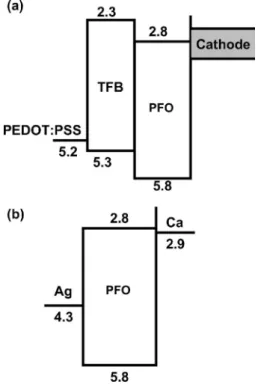
-共N-共4-s-butylphenyl兲兲diphenylamine兲兴 used as the hole-transport layer 共HTL兲, as well as the electron-blocking layer 共EBL兲. TFB 共Mw=197 000兲 and PFO 共Mw = 71 000兲 are both purchased from American Dye Source and used without further purification. Figure1共a兲shows the elec-tronic energy profiles for the bilayer structure as well as the electron affinity 共EA兲 and ionization potential 共IP兲 of the polymers. The electronic energy profile for the electron-only device is shown in Fig.1共b兲. The PEDOT:PSS layer is spin-coated on a patterned ITO substrate and baked at 200 ° C in a vacuum共10−3Torr兲 for 5 min. TFB dissolved in toluene is spin-coated to make a 30 nm thin film and then baked at 180 ° C in a vacuum 共10−3Torr兲 for 40 min to remove the solvent. PFO is also dissolved in toluene and then spin-coated to make a 70 nm thin film for bilayer devices共devices B, D, and F兲 and 90 nm for single layer devices 共devices A, C, E, G, and H兲. To prevent dissolution in the bilayer struc-ture, a liquid buffer 1,2-propylene glycol, is used between TFB and PFO layer.19 For the bilayer structure, the PFO layer is baked in a vacuum共10−3Torr兲 at 120 °C for 1 h to remove the residual glycol and organic solvent. For a single layer structure, the PFO layer is baked for 40 min. Two kinds of cathodes are chosen: LiF/ Ca/ Al and CsF/ Al. The thick-ness is 2 nm for both LiF and CsF, 35 nm for Ca and 100 nm for Al. All the devices are packaged in the glove box. Thefilm thickness is measured by the Kosaka ET4000 Surface Profiler. The EL efficiency is measured by the Photo Re-search PR650 spectrophotometer integrated with Keithley 2400 multimeter. The PL efficiency is measured by an inte-grating sphere system. IP is measured by cyclic voltammetry and EA is calculated by the IP plus band gap determined by the ultraviolet absorption spectrum.
III. PLED PERFORMANCES AND DISCUSSION
Figure 2 shows the results of devices A–D, and com-pares the cathodes LiF/ Ca/ Al and CsF/ Al in single layer and bilayer structures. For single layer devices, the maxi-mum efficiency is 0.96 cd/ A for device A with LiF and 1.29 cd/ A for device C with CsF. Both Cs and Li are be-lieved to be liberated at the organic-metal interface during evaporation.20 The work function of Cs 共2.1 eV兲 is lower than Li共2.5 eV兲 and, therefore, more efficient electron injec-tion is provided by the CsF/ Al cathode. That is why the efficiency and luminance of device A are higher than those of device C. Despite the small electron mobility, the ohmic con-tact at the CsF cathode seems to make the single layer de-vices electron-dominated as the current is largely contributed by the cathode. For TFB/ PFO bilayer devices, a better charge balance compared to single layer devices is achieved. The efficiency of the bilayer PLED are 1.29 cd/ A for device B with LiF and 1.63 cd/ A for device D with CsF. The ad-vantages of adding the TFB layer are fourfold. First, TFB play the role of HTL because of the high hole mobility and the IP of TFB at 5.3 eV between PEDOT:PSS 共5.2 eV兲 and PFO 共5.8 eV兲. Holes can be injected and transported to the PFO layer more easily. Second, TFB is also EBL due to its lower EA共2.3 eV兲 than PFO 共2.8 eV兲. Electrons injected and
FIG. 1. Schematic electronic energy profile for the共a兲 double-layer device structure and共b兲 the electron-only device structure. The numbers are in eV.
FIG. 2. The performances of blue PLED fabricated in air: Device A共open square兲, device B 共solid square兲, device C 共open circle兲, and device D 共solid circle兲. 共a兲 The current efficiency. Inset are the EL spectra. 共b兲 The lumi-nance. Inset is the current density.
084510-2 Tseng et al. J. Appl. Phys. 101, 084510共2007兲
transported in PFO are blocked by the TFB layer instead of reaching the anode. Third, the recombination is shifted away from the cathode and concentrate near the TFB/ PFO inter-face to reduce quenching by liberated Cs atoms. Forth, the TFB layer prevents the degradation of the PFO layer by the acid PEDOT:PSS.21The maximum luminance is 1038 cd/ m2 共8 V兲 for device A and 2001 cd/m2 共10 V兲 for device B, 1377 cd/ m2 共8 V兲 for device C, and 2528 cd/m2共10 V兲 for device D. The currents of bilayer devices are smaller than those of single layer devices because the electron current is blocked by the TFB layer. The spectra of the four devices shown in Fig. 2are similar; a slight difference in the green shoulder may reflect the various recombination zones where the ketone defect levels differ. The CsF/ Al cathode is clearly superior to LiF/ Ca/ Al presumably due to a more efficient electron injection. In addition to injection, electron mobility is also important to the electron current. One way to enhance the electron mobility is to reduce the oxygen adsorption by polymer because oxygen would cause electron traps.16,18For this purpose, we compare the polymer spin-coated in air and in the glove box with the oxygen level about 1 ppm. Figure
3 shows the results of devices C–F, to compare single layer and bilayer structures with a CsF/ Al cathode. Compared with the single-layer device C in air, the maximum efficiency of the device E in the glove box is slightly enhanced from 1.18 cd/ A 共7 V兲 to 1.37 cd/A 共4 V兲. However, the effi-ciency decreases rapidly at higher voltages, probably because without oxygen adsorption the electron current rises too much. Due to the HTL, the bilayer devices are likely to be hole dominated so the enhancement of electron mobility by coating the glove box is expected to have a more pronounced effect than single-layer devices. The current of bilayer device F is smaller than that of single-layer device E, indicating that
electron blocking by TFB. Oxygen reduces the current in single-layer devices 共C vs E兲 but enhances the bilayer de-vices 共D vs F兲. This might be due to another competing effect of electron traps near the anode which cause a dipole layer and help the hole injection through the large barrier.22,23The spectra for the devices made in the glove box are similar to those made in the air, also shown in Fig. 3. Among all devices, the best is F with both bilayer structure and spin-coating in the glove box. Its peak luminance of 1760 cd/ m2 and peak current efficiency 2.5 cd/ A, corre-sponding to EQE of 2% at deep blue with Commission In-ternationale de L’Eclairage共CIE兲 coordinate at 共0.15, 0.14兲. The efficiency is not far from the best proprietary polymers7,8 and is quite remarkable for polyfluorene with low molecular weight 共Mw=71 000兲 and moderate purity 共metal purity=14.2 ppm兲. In fact, such polymers are usually considered as models for scientific inquiry rather than prac-tical applications. These results demonstrate that with the proper design of the device structure and fabrication proce-dure, large-scale application can be realized using commonly available polymers which are easy to synthesize and does not need to satisfy strict material specifications.
Finally, in order to confirm the effect of oxygen on elec-tron mobility, two elecelec-tron-only devices are made, device G in air and device H in the glove box. The result is shown in Fig.4. The electron current of device H is about one order of magnitude higher than that of device G, which is consistent with our assumption of electron trapping effect of oxygen. Electron mobility is fitted using the space-charge-limited cur-rent voltage-curcur-rent relation JSCLC=98e关共V−Vbi兲2/ L3兴. J is the current density, is the permittivity of the polymer,eis the electron mobility, V is driving voltage, Vbiis the built-in voltage, and L is the polymer thickness. The fitted electron mobility is 5⫻10−7cm2/ V s in air and 5⫻10−6cm2/ V s in the glove box, both of them smaller than the hole mobility of around 10−5cm2/ V s.24,25
IV. CONCLUSION
In conclusion, we demonstrate a highly efficient PLED based on commercial easy-to-synthesize PFO in a bilayer structure using the general liquid buffer method. CsF/ Al is used to be the cathode for efficient electron injection. The polymer is spin-coated in the glove box to enhance the elec-tron mobility. The efficiency reaches 2.5 cd/ A共EQE 2%兲 for CIE coordinate 共0.15, 0.14兲 in the deep blue. This
perfor-FIG. 3. The performances of blue PLED with CsF/ Al cathode: Device C 共open circle兲, device D 共solid circle兲, device E 共open triangle兲, and device F 共solid triangle兲. 共a兲 The current efficiency. Inset are the EL spectra. 共b兲 The luminance. Inset is the current density.
FIG. 4. Comparison of electron currents of devices fabricated in air and in the glove box for device G共air, open square兲 and device H 共glove box, solid square兲.
mance is approaching the high-molecular and high-purity proprietary polymers which are difficult to synthesize. Our result suggests that the material cost problem can be solved in large-scale PLED applications.
ACKNOWLEDGMENTS
This work was supported by the National Science Coun-cil and the Excellence Project of the Ministry of Education of the Republic of China.
1R. H. Friend, R. W. Gymer, A. B. Holmes, J. H. Burroughes, R. N. Marks, C. Taliani, D. D. C. Bradley, D. A. D. Santos, J. L. Bredas, M. Logdlund, and W. R. Salaneck, Nature 397, 121共1999兲.
2M. Granström and O. Inganas, Appl. Phys. Lett. 68, 147共1996兲. 3B. Hu and F. Karasz, J. Appl. Phys. 93, 1995共2003兲.
4J. Huang, W. J. Hou, J. H. Li, G. Li, and Y. Yang, Appl. Phys. Lett. 89, 133509共2006兲.
5J. Liu, Q. Zhou, Y. Cheng, Y. Geng, L. Wang, D. Ma, X. Jing, and F. Wang, Adv. Funct. Mater. 16, 957共2006兲.
6T. W. Lee, M. G. Kim, S. Y. Kim, S. H. Park, O. Kwon, T. Noh, and T. S. Oh, Appl. Phys. Lett. 89, 123505共2006兲.
7C. D. Müller, A. Falcou, N. Reckefuss, M. Rojahn, V. Wiederhirn, P. Rudati, H. Frohne, O. Nuyken, H. Becker, and K. Meerholz, Nature 421, 829共2003兲.
8W. Wu, M. Inbasekaran, M. Hudack, D. Welsh, W. Yu, Y. Cheng, C. Wang, S. Kram, M. Tacey, M. Bernius, R. Fletcher, K. Kiszka, S. Munger, and J. O’Brien, Microelectron. J. 35, 343共2004兲.
9U. Scherf and E. J. W. List, Adv. Mater. 14, 477共2002兲.
10M. Gross, D. C. Müller, H. G. Nothofer, U. Scherf, D. Neher, C. Bräuchle, and K. Meerholz, Nature 405, 661共2000兲.
11T. Miteva, A. Meisel, W. Knoll, H. G. Nothofer, U. Scherf, D. C. Müller, K. Meerholz, A. Yasuda, and D. Neher, Adv. Mater. 13, 565共2001兲. 12D. C. Müller, T. Braig, H. G. Nothofer, M. Arnoldi, M. Gross, U. Scherf,
O. Nuyken, and K. Meerholz, ChemPhysChem 1, 207共2000兲.
13D. D. C. Bradley, M. Grell, X. Long H. Mellor, and A. Grice, Proc. SPIE
3145, 254共1998兲.
14E. J. W. List, R. Guentner, P. S. D. Freitas, and U. Scherf, Adv. Mater. 14, 374共2002兲.
15K. H. Weinfurtner, H. Fujikawa, S. Tokito, and Y. Taga, Appl. Phys. Lett.
76, 2502共2000兲.
16H. F. Meng and Y. S. Chen, Phys. Rev. B 70, 115208共2004兲.
17T. M. Brown and F. Cacialli, J. Polym. Sci., Part B: Polym. Phys. 41, 2649 共2003兲.
18C. K. Lu, S. T. Pi, and H. F. Meng共to be published兲.
19S. R. Tseng, S. C. Lin, H. F. Meng, H. H. Liao, C. H. Ye, H. C. Lai, S. F. Horng, and C. S. Hsu, Appl. Phys. Lett. 88, 163501共2006兲.
20T. M. Brown, R. H. Friend, I. S. Millard, D. J. Lacey, T. Butler, J. H. Burroughes, and F. Cacialli, J. Appl. Phys. 93, 6159共2003兲.
21A. Van Dijken, A. Perro, E. A. Meulenkamp, and K. Brunner, Org. Elec-tron. 4, 131共2003兲.
22T. van Woudenbergh, P. W. M. Blom, and J. N. Huiberts, Appl. Phys. Lett.
82, 985共2003兲.
23D. Poplavskyy, J. Nelson, and D. D. C. Bradley, Appl. Phys. Lett. 83, 707 共2003兲.
24D. J. Pinner, R. H. Friend, and N. Tessler, J. Appl. Phys. 86, 5116共1999兲. 25A. J. Campbell and D. D. C. Bradley, J. Appl. Phys. 89, 3343共2001兲.
084510-4 Tseng et al. J. Appl. Phys. 101, 084510共2007兲