Surface and Coatings Technology 113 (1999) 13–16
Gas nitriding of an equiatomic TiNi shape memory alloy
II. Hardness, wear and shape memory ability
S.K. Wu
a,*, H.C. Lin b, C.Y. Lee a
a Institute of Materials Science and Engineering, National Taiwan University, Taipei 106, Taiwan b Department of Materials Science, Feng Chia University, Taichung, 407, Taiwan
Received 7 August 1998; accepted 5 November 1998
Abstract
Ti50Ni50 shape memory alloy was gas nitrided to modify the surface conditions. The surface hardness, wear characteristic, transformation temperature and shape memory ability of gas-nitrided Ti
50Ni50 alloy were investigated. Experimental results indicate that the surface hardness is increased owing to the formation of TiN and Ti2NiH0.5compounds. The Ti50Ni50specimens nitrided at 700–900°C show improved wear characteristics, but those nitrided at 600°C cannot be effectively improved owing to surface cracks appearing in nitrided layers. Martensitic transformation temperatures are depressed slightly owing to the constraining effect originating from the nitrided layers, and/or the penetration of N and H atoms into the Ti50Ni50matrix. The shape recovery is also slightly reduced because the nitrided layers do not exhibit a shape memory effect, and the constraining effect will also depress the shape recovery of the Ti50Ni50matrix. © 1999 Elsevier Science S.A. All rights reserved.
Keywords: Gas nitriding; TiNi shape memory alloy; Wear and shape memory ability
1. Introduction gas nitriding technique has been successfully used to
form nitrided layers on the equiatomic TiNi alloy. The nitriding parameters and microstructural characteriza-Among the many shape memory alloys, TiNi alloys
are the most popular because they possess superior tion of these nitrided layers have been discussed. In the present study, the surface hardness and wear characteris-properties of shape memory effect (SME) [1] and
pseudoelasticity [2,3]. Most of their industrial applica- tics of the nitrided layers will be investigated. Meanwhile, the experimental results of transformation tions may not involve any problems of wear.
Nevertheless, for applications in orthopedic surgery, temperatures and shape memory ability of the gas-nitrided Ti50Ni50 alloy are also reported.
medical guide-wires and artificial bone-joints, wear resis-tance could be a very important property. Several inves-tigations [4–7] have been performed on the wear characteristics of TiNi alloys. These studies concluded
2. Experimental procedures
that the B2 phase (austensite parent phase) of TiNi
alloys can exhibit good wear resistance as a result of its The conventional tungsten arc-melting technique was rapid work hardening and pseudoelastic properties. employed to prepare the equiatomic TiNi alloy. However, the wear resistance of the B19∞ martensite Titanium (purity 99.7%) and nickel (purity 99.98%), phase of TiNi alloys is still too low and requires improve- totalling about 100 g in weight, were melted and ment. It is well known that nitriding techniques are remelted at least six times in an argon atmosphere. The commonly used to improve the fatigue and wear resis- as-melted buttons were homogenized at 1000°C in a tance of metals and alloys [8–10]. Moine et al. [11] 7×10⁻⁶ Torr vacuum furnace for 72 h, and then hot have also tried to increase the wear resistance of TiNi rolled into plates of thickness 1.5 mm. The details of alloys by N+ implantation. In Part I of this study, the the specimen preparation and the gas nitriding process have been described in Part I of this study [12]. The surface hardness was measured with a micro-Vickers
* Corresponding author. Fax: (+886) 2 363 4562;
e-mail: [email protected] tester with a load of 100 gf for 15 s. For each specimen,
0257-8972/99/$ – see front matter © 1999 Elsevier Science S.A. All rights reserved.
14 S.K. Wu et al. / Surface and Coatings Technology 113 (1999) 13–16
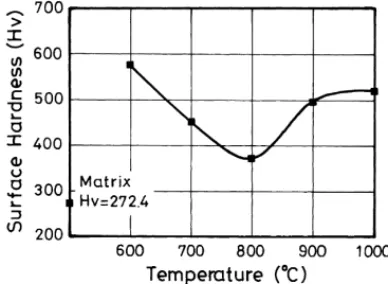
the average hardness value was calculated from at least of Ti
50Ni50 martensite (Hv=272), the surface hardness of gas-nitrided Ti
50Ni50specimens is increased, as shown five test readings. The wear tests were performed using
a TE-53 type unidirectional sliding wear machine made in Fig. 1. However, the maximum surface hardness does not exhibit an expected high value of, say, 600 Hv, as by Plint and Partners Co. in England. JIS SKS-95 steel,
with hardness Hv=700, was used as the wear-resistant shown in Fig. 1. This phenomenon can be explained as follows. For the Ti50Ni50 specimens nitrided at material. The tests were conducted at a constant wear
load of 10 N and a sliding speed of 62.8 cm s−1. The 700–1000°C, the nitrided layers of TiN and Ti2NiH 0.5 compounds are quite thin (only a few microns) and friction coefficient was automatically calculated during
the sliding wear process using a digital computer. hence the indentation of the hardness measurement will reach the soft Ti
50Ni50 martensite. This feature causes Differential scanning calorimetry (DSC) measurement
was conducted to measure the martensitic transforma- the average hardness of the nitrided surface to be not as high as those of the TiN and Ti2NiH0.5 compounds. tion temperatures. A DuPont 2000 thermal analyzer
equipped with a quantitative scanning system 910 DSC The Ti
50Ni50 specimen nitrided at 800°C shows the lowest hardness increment because it has the thinnest cell and a cooling accessory LNCA II were used.
Measurements were carried out at a controlled nitrided layer ( Fig. 3 of Ref. [12]). For the 600°C nit-rided Ti
50Ni50 specimen, the nitrided layer is thick cooling/heating rate of 10°C min−1. Heats of
trans-formation, DH, were automatically calculated from the enough (several tens of microns) and hence the indenta-tion of the hardness measurement cannot reach the soft areas under DSC peaks by means of an equipment
software package. The SME was examined using a Ti
50Ni50martensite. However, owing to the existence of a great deal of Ni-rich phase in the 600°C nitrided bending test [13]. The surface bending strain, e
s, was 6%and the shape recovery, R
SME, was measured after a layers, their surface hardness cannot exhibit an expected high value, either.
complete reverse martensitic transformation.
Fig. 2 shows the friction coefficients of Ti50Ni50 speci-mens after gas nitriding at various temperatures for 24 h. As shown in Fig. 2, the friction coefficients of
3. Results and discussion
700–900°C nitrided Ti50Ni50 specimens are lower than that of specimens without gas nitriding. This result is
3.1. Effects of gas nitriding on the surface hardness and wear characteristics of the Ti
50Ni50alloy due to the fact that wear interfaces are TiN/Ti2NiH0.5 compound layers and SKS-95 steel, and hence, the friction coefficient maintains a low value because of high As discussed in Part I of this study, the Ti
50Ni50
specimens nitrided at temperatures above 700°C consist surface hardness. This indicates that the wear charac-teristic of the Ti50Ni50 shape memory alloy can be of TiN and Ti2NiH0.5 compound layers, and those
nitrided at temperatures below 650°C have two distinc- effectively improved by gas nitriding because TiN/Ti2NiH0.5 compound layers contribute greatly to tive nitrided regions: a random mixture of TiN,
Ti2NiH0.5 and Ni-rich phase and a columnar-like struc- the improvement of wear resistance. However, the wear characteristics of the Ti
50Ni50 shape memory alloy are ture of mixed TiN and Ni-rich phase. We are interested
in understanding the surface hardness and wear charac- hardly improved by gas nitriding at 600°C, because its friction coefficient has nearly the same value as that of teristics of these nitrided layers. Fig. 1 shows the surface
hardness of Ti
50Ni50 specimens after gas nitriding at a specimen without gas nitriding. This phenomenon can be attributed to the surface cracks appearing in the various temperatures for 24 h. Because the hardness of
TiN and Ti
2NiH0.5compounds is much higher than that nitrided layer of the specimen gas nitrided at 600°C
Fig. 1. The surface hardness of Ti
50Ni50specimens after gas nitriding Fig. 2. The friction coefficients of Ti50Ni50specimens after gas nitriding at various temperatures for 24 h.
15
S.K. Wu et al. / Surface and Coatings Technology 113 (1999) 13–16
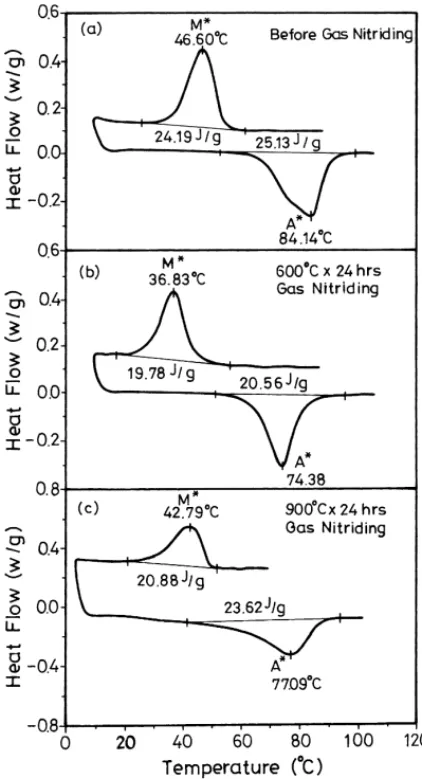
(Fig. 2(a) of Ref. [12]). These surface cracks will propa- tion behaviors. However, the martensitic transformation temperatures are depressed slightly to lower temper-gate rapidly into the subsurface during the wear process,
and then link together to cause fragmentation and atures. This phenomenon can be attributed to two factors. Firstly, the constrained stress on the Ti
50Ni50 pitting on the surface [7]. These pits will increase the
friction coefficient and accelerate the wear rate. Hence, matrix originating from the gas-nitrided layers will depress the martensitic transformation. Secondly, the the Ti50Ni50 specimen gas nitrided at 600°C does not
exhibit excellent wear characteristics although it has a penetration of N and H atoms into the Ti
50Ni50matrix as the interstitial atoms during the gas-nitriding process high surface hardness.
will also potentially depress the transformation temper-atures [14]. On carefully examining Fig. 3(b) and (c),
3.2. Effects of gas nitriding on the martensitic
transformation temperatures and shape recovery ability one can easily find that the transformation temperatures of specimen nitrided at 600°C are more depressed than
of Ti
50Ni50alloy
those of specimen nitrided at 900°C. This feature indi-cates that the specimen nitrided at 600°C has more Fig. 3(a)–(c) shows the DSC curves of Ti50Ni50
speci-mens with and without gas nitriding at 600 and 900°C constrained stress and/or more penetrated N and H atoms.
for 24 h, respectively. Fig. 3(a) represents a typical DSC
curve of a stress-free Ti50Ni50 specimen in which the Fig. 4 shows the measured shape recovery, RSME, after a complete reverse martensitic transformation (by heat-exothermic and endothermic peaks are associated with
the martensitic transformation of B2<B19∞. The DSC ing to 300°C) for the gas-nitrided Ti50Ni
50 specimens. From Fig. 4, the shape recovery is found to decrease curves for the gas-nitrided specimens, as shown in
Fig. 3(b) and (c), exhibit similar martensitic transforma- slightly as a result of gas nitriding. This result is reason-able because the nitrided layers do not exhibit the SME and their constraining effect on the Ti50Ni50 matrix will also depress the shape recovery of the Ti
50Ni50 matrix.
4. Conclusions
In this study, the surface hardness, wear characteris-tics, transformation temperature and SME of gas-nit-rided Ti50Ni50 alloys were investigated. Experimental results indicate that the surface hardness of a gas-nitrided Ti
50Ni50 specimen increases as a result of the formation of TiN and Ti2NiH0.5 compounds. The 700–900°C nitrided Ti50Ni50 specimens, being hardened by TiN and Ti
2NiH0.5 layers, show improved wear characteristics. However, the wear resistance of the Ti
50Ni50specimen cannot be effectively improved by gas nitriding at 600°C owing to the surface cracks appearing in the nitrided layers. Martensitic transformation
tem-Fig. 3. DSC curves of Ti
50Ni50specimens: (a) without gas nitriding; Fig. 4. The shape recovery ability of Ti50Ni50specimens after gas nitrid-ing at various temperatures for 24 h.
16 S.K. Wu et al. / Surface and Coatings Technology 113 (1999) 13–16
[2] S. Miyazaki, Y. Ohmi, K. Otsuka, Y. Suzuki, J. Phys. (Paris),
peratures are depressed slightly owing to the
constrain-Colloq. C4 43 (1982) 255–260.
ing effect originating from the nitrided layers, and/or
[3] S. Miyazaki, T. Imai, Y. Igo, K. Otsuka, Metall. Trans. A 17
the penetration of N and H atoms into the Ti50Ni50 (1986) 115–120.
matrix during the gas nitriding process. At the same [4] J.L. Jin, H.L. Wang, Acta Metall. Sin. 24 (1988) A66–A69. time, the shape recovery of the gas-nitrided Ti
50Ni50 [5] D.Y. Li, Scr. Metall. 34 (1996) 195–200.
alloy is also slightly reduced because the nitrided layers [6 ] P. Clayton, Wear 162–164 (1993) 202–210.
[7] H.C. Lin, H.M. Liao, J.L. He, K.C. Chen, K.M. Lin, Metall.
do not exhibit an SME and the constraining effect will
Mater. Trans. A 28 (1997) 1871–1877.
also depress the shape recovery of the Ti
50Ni50 matrix. [8] ASM Handbook, vol. 4, 9th ed., American Society for Metals, Metals Park, OH, 1991, p. 387.
[9] S.K. Wu, C.L. Chu, H.C. Lin, Surf. Coat. Technol. 92 (1997)
Acknowledgement 197–205.
[10] S.K. Wu, C.L. Chu, H.C. Lin, Surf. Coat. Technol. 92 (1997) 206–211.
The authors are pleased to acknowledge the financial
[11] P. Moine, O. Popoola, J.P. Villain, Scr. Metall. 20 (1986 )
support of this research by the National Science Council
305–310.
(NSC ), Republic of China, under Grant NSC
[12] S.K. Wu, H.C. Lin, C.Y. Lee, Surf. Coat. Technol. 113 (1999)
84-2216-E-002-027.
17–24.
[13] H.C. Lin, S.K. Wu, Scr. Metall. Mater. 26 (1992) 59–62. [14] T. Honma, Shape Memory Alloys, Gordon and Breach,
Amster-References dam, 1987, pp. 89–101.
[1] S. Miyazaki, K. Otsuka, Y. Suzuki, Scr. Metall. 15 (1981) 287–292.