GaN-based two-dimensional surface-emitting photonic crystal lasers with Al N Ga N
distributed Bragg reflector
Tien-Chang Lu, Shih-Wei Chen, Li-Fan Lin, Tsung-Ting Kao, Chih-Chiang Kao, Peichen Yu, Hao-Chung Kuo, Shing-Chung Wang, and Shanhui Fan
Citation: Applied Physics Letters 92, 011129 (2008); doi: 10.1063/1.2831716
View online: http://dx.doi.org/10.1063/1.2831716
View Table of Contents: http://scitation.aip.org/content/aip/journal/apl/92/1?ver=pdfcov Published by the AIP Publishing
Articles you may be interested in
Optical loss and interface morphology in Al Ga As Ga As distributed Bragg reflectors Appl. Phys. Lett. 91, 101101 (2007); 10.1063/1.2779242
Fabrication and performance of blue GaN-based vertical-cavity surface emitting laser employing AlN GaN and Ta 2 O 5 SiO 2 distributed Bragg reflector
Appl. Phys. Lett. 87, 081105 (2005); 10.1063/1.2032598
Ultralow-threshold cryogenic vertical-cavity surface-emitting laser with AlAs oxide – GaAs distributed Bragg reflectors
J. Appl. Phys. 96, 1289 (2004); 10.1063/1.1767983
Micro-Raman studies of vertical-cavity surface-emitting lasers with Al x O y / GaAs distributed Bragg reflectors Appl. Phys. Lett. 81, 2544 (2002); 10.1063/1.1511533
Al x Ga 1x As native-oxide-based distributed Bragg reflectors for vertical cavity surface emitting lasers J. Appl. Phys. 84, 5436 (1998); 10.1063/1.368857
This article is copyrighted as indicated in the article. Reuse of AIP content is subject to the terms at: http://scitation.aip.org/termsconditions. Downloaded to IP: 140.113.38.11 On: Wed, 30 Apr 2014 23:18:01
GaN-based two-dimensional surface-emitting photonic crystal lasers
with AlN / GaN distributed Bragg reflector
Tien-Chang Lu,a兲Shih-Wei Chen, Li-Fan Lin, Tsung-Ting Kao, Chih-Chiang Kao, Peichen Yu, Hao-Chung Kuo, and Shing-Chung Wang
Department of Photonics and Institute of Electro-Optical Engineering, National Chiao-Tung University, 1001 Ta Hsueh Rd., Hsinchu 30050, Taiwan
Shanhui Fan
Department of Electrical Engineering, Stanford University, Stanford, California 94305, USA
共Received 9 August 2007; accepted 14 December 2007; published online 11 January 2008兲 GaN-based two-dimensional 共2D兲 surface-emitting photonic crystal 共PC兲 lasers with AlN/GaN distributed Bragg reflectors are fabricated and demonstrated. The lasing threshold energy density is about 3.5 mJ/cm2 per pulse under optical pumping at room temperature. Only one dominant emission wavelength of 424.3 nm with a narrow linewidth of 1.1 Å above the threshold is observed. The laser emission covers whole circularly 2D PC patterns 共50m in diameter兲 with a small divergence angle. The lasing wavelength emitted from 2D PC lasers with different lattice constants occurs at the calculated band-edges provided by the PC patterns. The characteristics of large area, small divergence angle, and single mode emission from the GaN-based 2D surface-emitting PC lasers should be promising in high power blue-violet emitter applications. © 2008 American
Institute of Physics. 关DOI:10.1063/1.2831716兴
Photonic crystals 共PCs兲 have many advantages for con-trolling light emission and propagations, and have been the basis for various new optical devices.1–3Two kinds of semi-conductor PC lasers have been developed. The first kind uses photonic crystal nanocavity, which has a high Q value and a small modal volume. Such nanocavity laser can achieve strong Purcell effect and low-threshold lasing.4,5The second kind utilizes multidirectional distributed feedback effect near the band edges in two-dimensional共2D兲 PC structures. Such surface emitting lasers have potential to operate as a high-power source producing single-mode lasing over a broad area.6,7
Most works on PC lasers have been done using organic, GaAs, and InP material systems that operate at longer wave-lengths. Nitride-based materials have attracted a great atten-tion in the early 1990s due to the large direct band gap and the promising potential for many optoelectronic devices.8,9 However, few GaN-based PC lasers that have been reported are all of a nanocavity type,10 which is different from what we will report here. In this letter, we demonstrate the fabri-cation and room temperature lasing action of GaN-based 2D surface-emitting PC structures with bottom AlN/GaN dis-tributed Bragg reflector 共DBR兲. For a 50m diameter PC pattern with hexagonal lattice and circle unit cell, the lasing threshold is 3.5 mJ/cm2. Above threshold, a single peak with
wavelength at 424.3 nm and a linewidth of 1.1 Å is ob-served. The laser emits from a broad emission area and the emitted beam has a small divergence angle. By varying the lattice constant of the PC pattern, different normalized lasing frequencies corresponding to different band edges are demonstrated.
The GaN-based 2D surface-emitting PC laser, shown schematically in Fig. 1共a兲, was grown by a metal-organic chemical vapor deposition system on c-face 2 in diameter sapphire. Trimethylindium, trimethylgallium,
trimethylalu-minum, and ammonia were used as the In, Ga, Al, and N sources, respectively. The 35 pairs quarter-wave GaN/AlN DBR grown on a 2m thick undoped GaN buffer layer was crack free and had a flat surface. The detailed growth param-eters were reported elsewhere.11 Then, an active region grown atop the DBR typically composed of ten In0.2Ga0.8N quantum wells 共QWs兲 共LW= 2.5 nm兲 with GaN barriers
共LB= 7.5 nm兲, and was surrounded by a 560 nm thick
Si-doped n-type GaN and a 200 nm thick Mg-Si-doped p-type GaN layer.
The typical photoluminescence 共PL兲 spectrum had a peak centered at a wavelength of 425 nm with a linewidth of 25 nm. At normal incidence at room temperature, the DBR
a兲Electronic mail: [email protected].
FIG. 1. 共Color online兲 共a兲 Schematic layer structure of GaN-based 2D surface-emitting PC lasers with bottom AlN/GaN distributed Bragg reflec-tor and the lowest order calculated mode intensity profile along with the refractive index distribution. 共b兲 Top view scanning electron microscope images of the PC structures with hexagonal lattices and circle unit cells.
APPLIED PHYSICS LETTERS 92, 011129共2008兲
0003-6951/2008/92共1兲/011129/3/$23.00 92, 011129-1 © 2008 American Institute of Physics
This article is copyrighted as indicated in the article. Reuse of AIP content is subject to the terms at: http://scitation.aip.org/termsconditions. Downloaded to IP: 140.113.38.11 On: Wed, 30 Apr 2014 23:18:01
showed the highest reflectivity of 99% at the center wave-length of 430 nm, with a stopband width of about 30 nm, measured by an n & k ultraviolet-visible spectrometer. The as-grown sample was then first deposited with a hard mask consisting of a SiN layer of 200 nm by plasma-enhanced chemical vapor deposition, followed by a soft mask consist-ing of a polymethylmethacrylate共PMMA兲 layer of 150 nm. Using electron-beam lithography, we defined on the soft mask a hexagonal PC pattern with the lattice constant a rang-ing from 190 to 300 nm and the circular hole diameter r cho-sen such that r/a is about 0.28. The whole PC pattern is of a circular shape with a diameter of 50m. Then, the PC pat-tern on soft mask was transferred to SiN film by inductively coupled plasma-reactive ion etching 共ICP-RIE兲. After the PMMA layer was removed by acetone, we used ICP-RIE to etch down the as-grown sample to about 400 nm deep. The etching penetrated the QW active regions and created the PC patterns in the nitride layers. Finally, the SiN hard mask was removed by buffered oxide etch dipping. The top view of the hexagonal PC pattern on the GaN-based structure thus cre-ated was shown in Fig.1共b兲.
The optical pumping was performed using a frequency-tripled Nd: YVO4355 nm pulsed laser with a pulse width of
⬃0.5 ns at a repetition rate of 1 KHz. The pumping laser beam had a spot size of 50m and was normally incident onto the sample surface covering the whole PC pattern area. The light emission from the sample was collected by a 15 ⫻ objective lens through a fiber with a 600m core, and coupled into a spectrometer with a charge-coupled device 共CCD兲. The spectral resolution is about 0.1 nm for spectral output measurement.
Figure2demonstrates the output emission intensity as a function of the pumping energy density from the sample with PC lattice constant of 290 nm. The clear threshold character-istic was observed at the threshold pumping energy density of 3.5 mJ/cm2, with a peak power density of 7 MW/cm2.
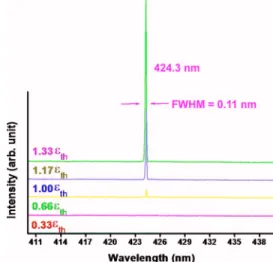
Then the laser output increases abruptly with the excitation energy density beyond the threshold. Figure3shows the ex-citation energy density dependent emission spectra. These spectra clearly show the transition behavior from spontane-ous emission to stimulated emission with a single dominant peak. Above the threshold, we can observe only one domi-nant peak wavelength of 424.3 nm with a full width at half maximum共FWHM兲 of 0.11 nm limited by our measurement resolution.
It is worth noting that the single mode lasing phenom-enon only occurs in the area with PC patterns. On the other hand, multiple lasing peaks were occurred when the area without PC patterns was pumped at the threshold energy density two order of magnitude higher. The normalized fre-quency共lattice constant over wavelength, a/兲 for the lasing wavelength emitted from our PC lasers with different lattice constants were plotted, as shown in Fig. 4共a兲. All the PC lasers have lasing peaks in a range from 401 to 425 nm. It can be seen that the normalized lasing frequency 共dotted points in the figure兲 increased with the lattice constant in a discontinues and steplike fashion. To calculate the band dia-gram of the hexagonal PC patterns in this structure, we em-ploy the plane-wave expansion method in two-dimensions with an effective index approach that took into account the effects of partial modal overlap of electromagnetic fields with the PC structures.12As a starting point, the ratio of light confined within the 2D PC structure to light extended in the entire device ⌫g and the effective refractive index of the
entire device neffwere first estimated by the transfer matrix
method. The calculation shows that the lowest order guided mode has the highest confinement factor for both PC and multiple quantum well regions, as shown in Fig.1共a兲, and the ⌫gand neffare estimated to be 0.563 and 2.495, respectively.
Then, we determine the effective dielectric constants of the two materials in the unit cell,a andb, using neff2 = fa+共1
− f兲b and ⌬=b−a=⌫g共mat−air兲, where, the f
=共2r2/
冑
3a2兲 is a filling factor and matandairaredielec-FIG. 2. 共Color online兲 Measured output intensity versus input excitation energy density from the GaN-based 2D surface-emitting PC lasers with bottom AlN/GaN distributed Bragg reflectors at room temperature.
FIG. 3.共Color online兲 Emission spectra under varied excitation energy den-sity from the GaN-based 2D surface-emitting PC lasers with bottom AlN/GaN distributed Bragg reflectors at room temperature.
FIG. 4.共a兲 Normalized frequency as a function of the lattice constant. The solid circle points are the lasing wavelengths from the different PC struc-tures.共b兲 Calculated band diagram of the 2D hexagonal-lattice structure. The dotted lines are guides for band edges.
011129-2 Lu et al. Appl. Phys. Lett. 92, 011129共2008兲
This article is copyrighted as indicated in the article. Reuse of AIP content is subject to the terms at: http://scitation.aip.org/termsconditions. Downloaded to IP: 140.113.38.11 On: Wed, 30 Apr 2014 23:18:01
tric constants of GaN共=2.52兲 and air 共=12兲, respectively. The values ofa共4.11兲 and b共7.07兲 thus obtained were then put
into the calculation of the band diagram for the 2D hexagonal-lattice structure with r/a=0.28.
Figure4共b兲shows the calculated band diagram of the 2D hexagonal-lattice structure for transverse-electric mode. It can be expected that the lasing occurs at special points such as at Brillouin-zone boundary near the band edges, because the Bragg condition is satisfied and the density of states is higher in these points.12 At these lasing points, wave can propagate in different directions and couple with each other. The dotted lines are guides for band edges calculated in Fig.
4共b兲 and extended horizontally to Fig. 4共a兲 with the same normalized frequency. It can be seen that different groups of the normalized frequency observed in the PC samples with different lattice constants occur exactly at band edges such as ⌫, M, and K points, indicating that the laser operation was provided by multidirectional distributed feedback in the 2D PC structure.13 The characteristics of ⌫, M, and K points lasing can be further identified by the polarization angle of the output emission.14Note that the output intensity is higher when some of the lasing frequencies are in the stopband of DBR, which could be due to that the bottom DBR here could be treated as a high reflectivity reflector, facilitating top-emission efficiency.
The lasing area of the GaN-based 2D surface-emitting PC laser, obtained by a CCD camera is relatively large which covers almost whole area of PC pattern with only one domi-nant lasing wavelength. The measured FWHM of laser emis-sion divergence angle is smaller than 5°, which is limited by our measurement setup, indicating that the surface emission is almost normal to the PC surface. It’s interesting to note that the threshold power density of GaN-based 2D surface-emitting PC laser is in the same order of or even better than the threshold for GaN-based vertical-cavity surface emitting lasers 共VCSELs兲 we demonstrated recently.15 Unlike the small emission spots observed in the GaN-based VCSELs, the large-area emission in 2D surface-emitting PC laser has great potential in applications required high power output operation.
In conclusion, the GaN-based 2D surface-emitting PC lasers with AlN/GaN bottom DBRs are fabricated. The laser action is achieved under the optical pumping at room
tem-perature with a threshold pumping energy density of about 3.5 mJ/cm2 for the sample with PC lattice constant of
290 nm. The laser emits one dominant wavelength of 424.3 nm with a linewidth of about 1.1 Å. All normalized frequency of investigated PC lasing wavelength can corre-spond to the calculated Brillouin-zone boundary provided by 2D hexagonal-lattice PC patterns. The emission images of the laser indicate that the stimulated emission occurs over a large area with a small divergence angle. The GaN-based 2D surface-emitting PC lasers with large area, small divergence angle and single mode emission should be very attractive in high power applications.
The authors would like to gratefully acknowledge A. E. Siegman at Stanford for his fruitful suggestion. The study was supported by the MOE ATU program and, in part, by the National Science Council in Taiwan under Contract Nos. NSC 95-2120-M-009-008, NSC 95-2752-E-009-007-PAE, and NSC 95-2221-E-009-282.
1E. Yablonovitch, Phys. Rev. Lett. 58, 2059共1987兲. 2S. John, Phys. Rev. Lett. 58, 2486共1987兲.
3J. D. Joannopoulos, P. R. Villeneuve, and S. Fan, Nature共London兲 386,
143共1997兲.
4O. Painter, R. K. Lee, A. Scherer, A. Yariv, J. D. O’Brien, P. D. Dapkus,
and I. Kim, Science 284, 1819共1999兲.
5H. G. Park, S. H. Kim, S. H. Kwon, Y. G. Ju, J. K. Yang, J. H. Baek, S. B.
Kim, and Y. H. Lee, Science 305, 1444共2005兲.
6M. Meier, A. Mekis, A. Dodabalapur, A. Timko, R. E. Slusher, J. D.
Joannopoulos, and O. Nalamasu, Appl. Phys. Lett. 74, 7共1999兲.
7D. Ohnishi, T. Okano, M. Imada, and S. Node, Opt. Express 12, 1562
共2004兲.
8S. Nakamura, M. Senoh, N. Iwasa, and S. Nagahama, Jpn. J. Appl. Phys.,
Part 2 34, L797共1995兲.
9S. Nakamura, M. Senoh, S. Nagahama, N. Iwasa, T. Yamada, T.
Matsushita, Y. Sugimoto, and H. Kiyoku, Appl. Phys. Lett. 70, 868 共1997兲.
10C. F. Lai, P. Yu, T. C. Wang, H. C. Kuo, T. C. Lu, S. C. Wang, and C. K.
Lee, Appl. Phys. Lett. 91, 041101共2007兲.
11G. S. Huang, T. C. Lu, H. H. Yao, H. C. Kuo, S. C. Wang, C.-W. Lin, and
Li Chang, Appl. Phys. Lett. 88, 061904共2006兲.
12M. Imada, A. Chutinan, S. Noda, and M. Mochizuki, Phys. Rev. B 65,
195306共2002兲.
13M. Notomia, H. Suzuki, and T. Tamamura, Appl. Phys. Lett. 78, 1325
共2001兲.
14T. C. Lu, S. W. Chen, and T. T. Kao共unpublished兲.
15S. C. Wang, T. C. Lu, C. C. Kao, J. T. Chu, G. S. Huang, H. C. Kuo, S. W.
Chen, T. T. Kao, J. R. Chen, and L. F. Lin, Jpn. J. Appl. Phys., Part 1 46, 5397共2007兲.
011129-3 Lu et al. Appl. Phys. Lett. 92, 011129共2008兲
This article is copyrighted as indicated in the article. Reuse of AIP content is subject to the terms at: http://scitation.aip.org/termsconditions. Downloaded to IP: 140.113.38.11 On: Wed, 30 Apr 2014 23:18:01