科技部補助專題研究計畫成果報告
期末報告
「學習魅力模型」的推薦系統發展
計 畫 類 別 : 個別型計畫 計 畫 編 號 : MOST 102-2511-S-004-002- 執 行 期 間 : 102 年 08 月 01 日至 103 年 11 月 30 日 執 行 單 位 : 國立政治大學資訊管理學系 計 畫 主 持 人 : 傅豐玲 計畫參與人員: 博士班研究生-兼任助理人員:林建良 報 告 附 件 : 出席國際會議研究心得報告及發表論文 處 理 方 式 : 1.公開資訊:本計畫可公開查詢 2.「本研究」是否已有嚴重損及公共利益之發現:否 3.「本報告」是否建議提供政府單位施政參考:否中 華 民 國 104 年 02 月 27 日
中 文 摘 要 : 中文關鍵詞: 英 文 摘 要 : 英文關鍵詞:
科技部補助專題研究計畫成果報告
□
( 期中進度報告
/■期末報告)
「學習魅力模型」的推薦系統發展
■
□
計畫類別: 個別型計畫
整合型計畫
計畫編號:MOST
執行期間:
2013
年
8 月 1
日至
2014
年
11
月
30 日
執行機構及系所: 政治大學資訊管理系
計畫主持人: 傅豐玲
共同主持人:
計畫參與人員:林建良(博士生)
另另 另 另 另 另 另 另 另另
本計畫除繳交成果報告外, 含下列出國報告,共
___ 份:
□執行國際合作與移地研究心得報告
■出席國際學術會議心得報告
期末報告處理方式:
1. 公開方式:
■
非列管計畫亦不具下列情形,立即公開 詢
另另
□
涉及專利或其他智慧財 權,
另 □
一
年
□
二年後可公開 詢
另另
2.
「本研究」是否已有嚴重損及公共利益之發現: 否 是
■ □
3.
「本報告」是否建議提供政府單位施政參考 否 是, (請列舉提供之單位;
■ □
本部不經審議,依勾選逕予轉送)
中 華 民 國
104
年
2
月
26 日
Abstract
Charismatic learning is the power to motivate the students, which is especially important in self-regulated learning. The results of the critical incident technique used in this study indicate that e-learning technologies do provide some good mechanisms to help instructors facilitate students' learning and make collaboration easier.
Just as we assumed, knowledge enhancement by self-regulation of learning is the preferred characteristic of charisma in the e learning classroom. Students mentioned some of the benefits such as the flexibility of the learning schedule, having access to on-line material for review outside of class, and having access to comprehensive supporting material for collaborative learning. Collaboration can happen in an on-line forum. Another characteristic of charismatic learning is the perception of trust in the instructor which is related to the availability and enthusiasm of instructors. The results suggest that in the e-learning classroom context the instructor should work more as facilitators than as the sole source of knowledge.
中文摘要 魅力的學習是一項能激勵學生的力量,這對自主學習的能力是特別重要的。本研究中所使用的關鍵 事件法(CIT)的結果指出: 數位學習科技確實提供了一些很好的機制,可以幫助教師去協助學生的學習, 以及使合作學習變得更加容易。 另另 另 另 另 另 另 就如同我們所假設的,藉由自主學習所造成的知識提升是數位學習課堂 生魅力的主要 特徵。學生們提到的一些好處,如學習進度的靈活性,有機會獲得上線的教材用來複習課之外,並有機會 獲得綜合配套材料做協同合作學習。協同合作學習可以能方生在線上的論壇。魅力學習的 一個特另另 另 另 徵是信任的感受,這是指感受到教師的熱誠以及更多的隨時服務。根據本研究結果建議: 在數位學習的 課堂背景中,教師應該更多扮演知識促進,而不是成為知識的唯一來源。 關鍵詞: 魅力的學習、數位學習、沉迷理論、關鍵事件法
1. Introduction
Why do we still need a new vision of learning charisma, in relation to the effectiveness of e-learning in higher education even though e-learning has been implemented for so many years? Because, although on the surface, new technology provides more resources, channels and opportunities for learning, in actuality, it is not easy to transplant the new digital learning environment into the traditional one and obtain positive synergy. The advantages of e-learning have been well discussed in the literature, for example, students who are shy about talking in public may feel better able to express their ideas in an e-learning environment (Francescato, Porcelli, Mebane, Cuddetta, Klobas, and Renzi, 2006). Students may also be attracted by the multi-media content of the digital classroom (Swan, 2004), and they may also have more opportunities to set their own learning strategies (Scriber and Encouraging, 2013). However, as there is weakness in all human interactions, not mean all students will gain benefits in e-learning classrooms.
Researchers have made efforts to “see” the effects of e-learning. Previous studies have tried to draw a picture of a classroom using the dramaturgy theory, with the teacher as the actor, the students as the audience, and the classroom as a theater (Halliday, Davis, Ward, and Lim, 2008). Halliday discussed the charisma of the teacher and role of the students in the creation of an attractive classroom environment. A charismatic teacher can inspire students to be willing to learn, and willing to cooperate with the teachers. Being able to evaluate and plot their learning experience is also very important.
Charm or charisma can also refer to the whole situation and not merely the leader. Based on ten years of teaching experience related to engagement in action and reflection upon andragogy theory, Raelin (2006) opposed the idea that successful learning is achievable only through reliance upon the charisma of the teacher. He argued that there has been too much focus placed on the teacher's charisma, their skills to excite the students to learn. He insisted that the greatest learning stimulant does not lie in how well prepared the lecturer is or how timely the feedback they give the student. Rather, it has to do with providing an effective-learning environment that encourages students to reflect, to construct, to take responsibility for and to accumulate their own learning. Raelin pointed out the importance of the idea of focusing on learning. The implication is that a teacher in the higher education system should be more a facilitator of knowledge in a community of inquiry. Teaching should thus be the orchestration of learning, rather than simple transmission of knowledge from the teacher to the student. A student should have more autonomy to learn how to learn and to choose the most appropriate path on his or her own. Also peers should help each other to integrate past knowledge, and to accumulate new knowledge.
Raelin’s ideas remind us of what is at the center of learning. Students may be cognizant that a course providing self-regulated learning is much more attractive than one where the teacher is an excellent actor. Raelin's idea of putting the charisma back into learning is actually confirmed by flow theory (Killi, 2005). According to Killi, challenge is like blood pumped from the heart, bringing motivation for the learning process through cooperation with peers, reflection, searching for information, and so on. Learning charisma that comes from the challenge of learning itself may provide further stimulus to motivate and satisfy.
One problem with Raelin’s paper was the lack of empirical investigation. The aim of this current study is to observe and measure learning charisma from the student’s perspective in the e-learning classroom. Scenario-based data are considered suitable because learning performance is determined by the interaction of many factors, such as student background, teacher characteristics, characteristics of the learning content, pedagogical design, and the learning environment (Freitas and Olive, 2006).
Based on Raelin’s (2006) and Halliday's (2006) research, the authors propose that learning charisma may be an effective vision to understanding the benefits of e-learning. The aim of the study is to classify student's satisfaction in the e-learning classroom and find the learning charisma. The study involves refining the elements of learning charisma using the critical incident technique. The purposes are: (1) to find the factors that enhance learning charisma; and (2) make propositions for the strategy of integrating e-learning into the traditional classroom.
2. Charisma and satisfactory factors in e-learning
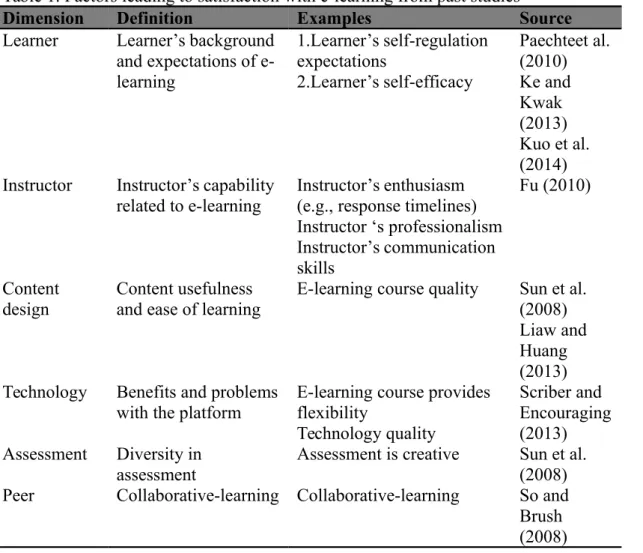
Six important dimensions of the variables influencing students’ satisfaction with e-learning are from previous studies and summarized in Table 1 (e.g., Sun et al., 2008; Fu, 2010; So and Brush, 2008). The first dimension is the learners' character, including students’ self-efficacy and expectations. For example, the learner’s anxiety about the use of computers has a negative impact on his/her satisfaction in e-learning. Student expectations of self-regulation to gain knowledge in e-learning lead to better performance but might
not be related to satisfaction when compared to those who do not have expectations (Swan, 2004). The second dimension is the instructors' professionalism and attitude. The instructor’s enthusiasm, professionalism, and expressive capability all impacted student satisfaction, but there might be a difference between the scenarios in e-learning and those in traditional classes (Sun et al., 2008; Fu, 2010). The third dimension is content design. Based on the technology acceptance model, content that is easy to use and useful is significantly related to students’ satisfaction (Sun et al., 2008). Here the authors use “easy to learn” instead “easy to use” to refer to the learning situation. The technology dimension includes the benefits and problems associated with the e-learning platform, such as the flexibility of the learning schedule and strategy, accessibility and ease of use of the system, and so on (Scriber and Encouraging, 2013). The assessment dimension refers to the diversity and creativity of assessment, such as more personalized assessment (Sun et al., 2008). Last but not least is the very important dimension of students’ satisfaction with e-learning is collaborative learning made possible by the available technology, such as online the chat room (So and Brush, 2008)
Table 1. Factors leading to satisfaction with e-learning from past studies
Dimension Definition Examples Source
Learner Learner’s background and expectations of e-learning 1.Learner’s self-regulation expectations 2.Learner’s self-efficacy Paechteet al. (2010) Ke and Kwak (2013) Kuo et al. (2014) Instructor Instructor’s capability
related to e-learning Instructor’s enthusiasm (e.g., response timelines) Instructor ‘s professionalism Instructor’s communication skills Fu (2010) Content design Content usefulness and ease of learning
E-learning course quality Sun et al. (2008) Liaw and Huang (2013) Technology Benefits and problems
with the platform E-learning course provides flexibility Technology quality
Scriber and Encouraging (2013) Assessment Diversity in
assessment Assessment is creative Sun et al. (2008) Peer Collaborative-learning Collaborative-learning So and
Brush (2008)
However, ignoring the interactive effects and studying factors alone as has been done in previous studies does not reflect real scenarios. As noted by Swan (2004), the influential variables in learning are interactive, not independent. The authors suggest that the reason the interactions have been ignored in most previous studies is because they are so complicated, but overly simplifying satisfaction may cause the results to lose some validity. For example, satisfaction might come from the interactive benefit of learning strategies, schedules, assessment and collaborative-learning provided by using the e-learning technology (e.g., Fu, 2010; So and Brush, 2008; Liaw and Huang, 2013; Ke and Kwak, 2013; Kuo et al., 2014).
Charisma, as defined by the Oxford dictionary, is a kind of attraction which can inspire devotion in other people. Halliday, Davis, Ward, and Lim considered charisma in the classroom to be a deep ideological value shared between the leader and followers (Halliday, Davis, Ward, and Lim, 2008). Usually it is the teacher who plays the role of leader in the classroom. An instructor who can inspire students is considered a charismatic teacher. However, sometimes students can play the role of leader in commending, helping, or supervising the instructor's teaching. Charismatic leadership can also occur among students (friends) who interact frequently, who have similar values or perceptions as their leader (Pastor, Meindl and Mayo, 2002).
Understanding of how charisma is produced is usually context-based, analyzed based on the scene, the symbols, and the means of the interaction (such as speech, movement, and facial expression) between the leader and the follower. Halliday et al. described a classroom in higher education as being like a lecture
theater, with many interactions happening between the instructor and the students, and between the students and their classmates. The task of a charismatic instructor is to provide sufficient challenge, inspiration, motivation, stimulation, confidence, and understanding to motivate students to learn. On the other hand, the willingness of students to cooperate with the teachers and the ability to evaluate and select their own learning strategy, are also very important.
Charisma in learning arises from a scenario of interactions between different factors and is not merely be limited to the leader, Simply preparing a good lecture or giving immediate feedback is not enough. Raelin argued that charismatic learning means that the instructor should provide an effective environment for students to accumulate knowledge. Based on this premise, the teacher is the facilitator to a community of inquiry, and that teaching is the orchestration of learning, not simply handing out knowledge as if feeding the students. It is better for students to be given more autonomy to learn how to learn, to choose the most appropriate way to learn. Peers are better off being able to help each other integrate past knowledge, to accumulate and form new knowledge. Charm in a classroom is not just the responsibility of the teacher, but goes back to the process of learning itself (Raelin, 2006).
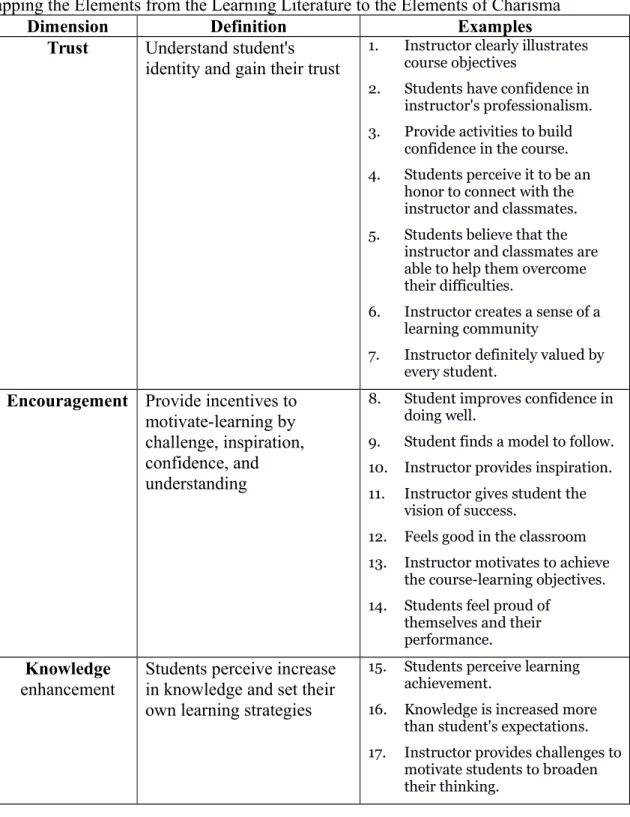
Based on the above discussion of charisma in learning, charismatic learning is divided into three dimensions: trust, encouragement and knowledge enhancement. The definition and examples as list as Table 2.
Table 2 Mapping the Elements from the Learning Literature to the Elements of Charisma
Dimension Definition Examples Trust Understand student's
identity and gain their trust
1. Instructor clearly illustrates course objectives
2. Students have confidence in instructor's professionalism. 3. Provide activities to build
confidence in the course.
4. Students perceive it to be an honor to connect with the instructor and classmates.
5. Students believe that the instructor and classmates are able to help them overcome their difficulties.
6. Instructor creates a sense of a learning community
7. Instructor definitely valued by every student.
Encouragement Provide incentives to
motivate-learning by challenge, inspiration, confidence, and understanding
8. Student improves confidence in doing well.
9. Student finds a model to follow. 10. Instructor provides inspiration. 11. Instructor gives student the
vision of success.
12. Feels good in the classroom 13. Instructor motivates to achieve
the course-learning objectives. 14. Students feel proud of
themselves and their performance.
Knowledge
enhancement
Students perceive increase in knowledge and set their own learning strategies
15. Students perceive learning achievement.
16. Knowledge is increased more than student's expectations. 17. Instructor provides challenges to
motivate students to broaden their thinking.
18. Let students understand the importance of the learning performance.
19. students have opportunities for self-regulated learning
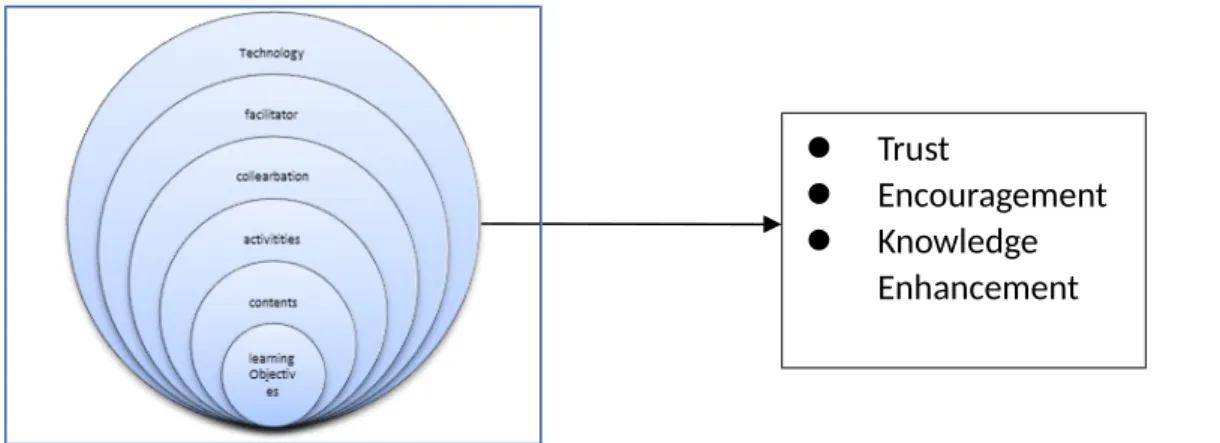
The goal of this study is to discover what interactions between the elements of satisfaction will create a charismatic e-learning environment as shown in Fig 1. One scenario of satisfaction indicated the interaction of some satisfactory factors in e-learning: perceived importance of learning objectives (learner’s expectations), usefulness of the content, good activity design and assessment, collaborative-learning, instructor as facilitator, and effectiveness of technology used. And the authors tried to discover one of charismatic learning: either trust, encouragement or knowledge enhancement from a scenario.
Fig. 1. Relationship between interactions of satisfaction factors and learning charisma
3. Research methodology for the critical incident technique (CIT)
This study utilizes a scenario-based analysis approach, the critical incident technique (CIT) to evaluate students’ impressions. CIT was originally developed by Flanagan (1954) as a form of content analysis, but the set of procedures for gathering specific observations and important behavioural facts has grown in popularity with service-related research over the last three decades, in a large part due to its usefulness in solving practical problems and developing broad psychological principles regarding service encounters (Gremler, 2004).The study used the CIT to collect data for students’ satisfaction with their learning experience in order to determine possible good interactions from different learning contexts.
3.1. Procedures of CIT
CIT is designed to make data collected in the field useful for answering research questions, while sacrificing the least amount of detail and depth possible (Bitner, Booms and Tetreault, 1990). CIT accomplishes this goal through a two stage process -- collection and classification. The first step, collection of behavioral observations, involves accumulation of self-reports from study participants. In the second stage, these collected events, phenomena or occurrences are classified so that the responses become useful for addressing practical problems (Flanagan, 1954). The four-stage CIT procedures used in the study can be summarized as follows: 1) collect learning incident reports regarding satisfaction from students in the target classrooms; 2) categorize the incident reports into categories; 3) make name the categories; 4) examine the distribution of categorized reports to determine how important each category is.
Classified respondent data are referred to as “incidents.” Incidents in the present study are comprised of interactions of learning factors as shown in Fig. 1: learning objectives, content, activities, facilitator, collaboration, and technology. This study probes for critical incidents by asking respondents to recollect especially satisfying e-learning experiences related to the target class they had participated in, including the time of the incident and what had happened, what the instructor had said or done, and what the outcome was. Most participants reported one incident per interview, but in some cases, two or three incidents were recalled, producing a total of 344 valid incidents from a sample of 320 students, surpassing the 433 incident average
Trust
Encouragement Knowledge
obtained in previous CIT studies (Gremler, 2004) and meeting the CIT analysis standard of 50 to 100 incidents for unambiguous activities (Flanagan, 1954).
3.2. Target Courses
There were eight target courses. All were blended courses including e-learning classes and face-to-face classes. Four were basic science classes: Principles of Accounting, Research Methodology, Introduction to Computers, and Management Information Systems; three were more liberal classes: Information Technology and Literacy, Introduction to Software, and Objective-Oriented Programming Language. Some classes were perceived as more important and more difficult because they were required courses, such as Principles of Accounting, Objective-Oriented Programming Language, and Research Methodology. Students are generally willing to spend more time on required courses than elective courses.
4. Results and Discussion
We found four major categories which seemed to satisfactorily describe the important characteristics of charismatic e-learning.
4.1. Knowledge enhancement by the facilitator using technology
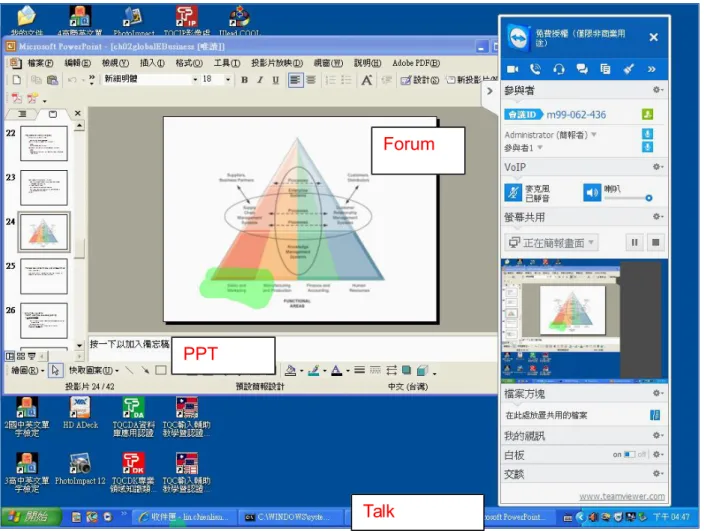
The results indicated that knowledge enhancement was a critical type of charismatic learning in the e-learning environment. Student can control the e-learning process and strategy more in e e-learning environment. In face-to-face classrooms, instructors can more easily become the protagonist. Instead, in the e-learning environment, learning becomes the center of the learning activities and the instructor becomes the facilitator. For example, one incident described how well the instructor designed the discussion activities and provided sufficient material. Modern technology and multi-media material enhanced the level of interest and improved communication capability for e-learning. For example, through information shown in the forum frame, the instructor could know who and how many participants were in the forum and could give instant feedback to any specific student through the "VoIP" function. Students could browse the PPT materials using the Team Viewer e-learning software. All participants (instructor and students) could talk to each other using the "Talk" function.
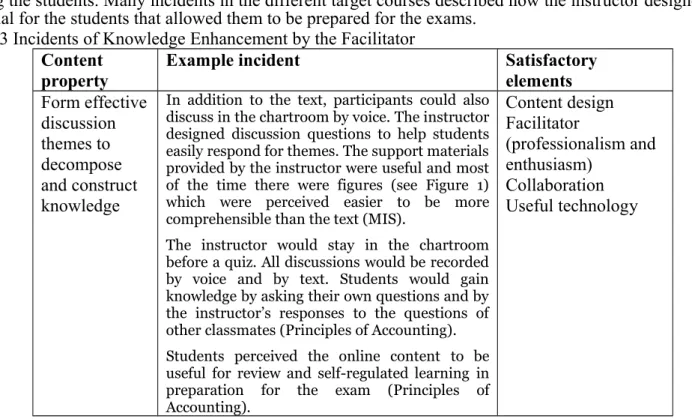
Students usually had questions or encountered problems when they did homework or prepared for a quiz, not immediately after the lecture. Another example of an incident showed this to be the right time for the instructor to facilitate student’s learning, not just by receiving his/her input, but also by enabling collaboration among the students. Many incidents in the different target courses described how the instructor designed good material for the students that allowed them to be prepared for the exams.
Table 3 Incidents of Knowledge Enhancement by the Facilitator
Content property
Example incident Satisfactory elements Form effective discussion themes to decompose and construct knowledge
In addition to the text, participants could also discuss in the chartroom by voice. The instructor designed discussion questions to help students easily respond for themes. The support materials provided by the instructor were useful and most of the time there were figures (see Figure 1) which were perceived easier to be more comprehensible than the text (MIS).
The instructor would stay in the chartroom before a quiz. All discussions would be recorded by voice and by text. Students would gain knowledge by asking their own questions and by the instructor’s responses to the questions of other classmates (Principles of Accounting). Students perceived the online content to be useful for review and self-regulated learning in preparation for the exam (Principles of Accounting). Content design Facilitator (professionalism and enthusiasm) Collaboration Useful technology
Charisma of knowledge enhancement may be an advantage in e-learning. Reflection from students can happen by controlling the learning process. In face-to-face classrooms, instructors can more easily become the
protagonist. Instead, learning becomes the center of the learning activities and the instructor becomes the facilitator. The first incident in Table 6 shows how well the instructor designed the discussion activities and
provided sufficient material. Modern technology and multi-media material enhanced the interest and communication capability for e-learning. For example, through information shown in the forum frame (marked "Forum" in Figure 3), the instructor could know who and how many participants are in the forum and gave instant feedback to any specific student via "VoIP" functions. Students could browse the PPT materials (marked "PPT" in Figure 3) using the TeamViewer e-learning software. All participants (instructor and students) could talk to each other using the "Talk" function.
Figure 2 Example of Android Version of the Forum for TeamViewer
Students usually had questions or problems when they did homework or prepared for a quiz, not immediately after the lecture. The second incident in Table 3 indicates the right time for the instructor to facilitate the learning, not just by him, but also by enabling collaboration among the students. The third incident showed that the instructor designed good material for students to prepare for the exam.
4.2. Knowledge enhancement through collaboration by using social media technology
Social media can provide a mechanism for initiating cooperation. In this category, the students were satisfied with the collaboration initiated with a team member, the convenience of the technology, and their grade. This category was also critical to team work assignments. Many students mentioned the usefulness of the Facebook community.
Table 4 Incidents of the Property of Knowledge enhancement through Collaboration
Content property
Example incident Satisfactory elements
Social media enhanced the collaboration
The final report needed the cooperation of all team members. We developed a community on Facebook. All team members responded to each other and participated in discussions aggressively. Each one was concerned about the quality of the report, and no one ignored his/her contribution or did not participate. (Information
Content provided a challenge Useful technology PPT Forum Talk
Literacy).
4.3. Trust as facilitator in using e-learning technology
Two similar incidents serve as examples illustrating how trust was created in the e-learning classroom. In the first incident, the student perceived anxiety when the instructor announced the content of the exam, because they felt the challenge was too hard. However the student felt better after the instructor strove to remedy their anxiety as to whether they could complete all the assigned questions and how difficult the exam would be. And finally, the student obtained a satisfactory grade. The second incident illustrates how the teaching assistant effectively helped the student to complete their homework by using remote technology. All the incidents in this category indicated that trust in not just the facilitator but also in the e-learning technology provided extra opportunities for convenient communication between the student and the teacher.
Another example, this time for Principles of Accounting, normally a face-to-face class relates how the instructor also provided video tutorials to help students review. The student narrating the incident perceived the provision of online support materials such as video tutorials to be indicative of the enthusiasm of the facilitator. The student appreciated the support from the video.
Table 5 Incidents of the Property of Trust in the Facilitator
Content property Example Satisfactory elements Instructor provided useful ways to solve difficulties with the e-learning platform
Students perceived it as very difficult to prepare for the exam because of huge number of questions (seven to eight hundred). Instructors used several ways to decrease the level of anxiety of the students. First, all the questions could be found on the Internet. Secondly, the instructor provided online discussion time to answer students’ questions. Thirdly, the instructor clearly announced the schedule for the exam, the number of questions and the scope of the exam (guaranteed to be from the database) (MIS course).
I could get the necessary information and submit homework conveniently by using the e-learning platform (Introduction to
Computers).
Once I had a problem following the
operation of the line demo example. I voiced my problem in the discussion room. The teaching assistance helped me by remotely controlling my computer and solving my bug (Introduction to Software).
Content provided a challenge Facilitation by the instructor Illustration of objective of exam Useful technology
4.4. Feel Encouragement (comfortable) due to the flexibility or availability of the technology
Unlike the encouragement received in a face-to-face classroom where most of the praise comes from the instructor, encouragement in the e-learning classroom comes from the usefulness of the technology. The technology provides more flexibility in terms of setting strategies and improving the efficiency of self-regulated learning, such as the selection of the learning schedules and processes to meet individual needs. It is also more convenient to transfer digital information or data than hardcopy information. One example incident ran as follows: “At nine o'clock, I get up in an empty dorm, eat breakfast and browse the materials on the e-learning platform. I felt the pleasure of e-learning”.
Content property
Example incident Satisfactory elements
Flexibility of technology
The information on the e-learning platform is very clear and delivered on time in relation to the issue and topic before the class (MIS Course).
Students perceived that the e-learning platform was practical and convenient in on-line discussions. The instructor didn't need to give out hardcopy, all materials could be download through the platform (MIS Course).
In the week of the mid-term exams, I could ignore the e-learning class, and focus on other courses and then find the remedy after that week (Information Literacy).
At nine o'clock, I get up in an empty dorm, eat breakfast and browse the materials in the e-learning platform. I felt the pleasure of e-learning (Information Literacy).
Useful technology Proper content
design
5. Conclusions
This study tries to determine what scenarios would allow the critical charismatic learning to be created in an e-learning environment. The scenario-based analysis approach (CIT) is used to classify students’ impressions of charismatic learning in incidents of satisfaction. The integrated effect was formed by the interaction of several factors: perceived importance of the learning objective, useful content, good activity design, collaborative learning, instructor as a facilitator, and effectiveness of technology used. Three kinds of learning charisma: trust, encouragement and knowledge enhancement were reviewed.
The results indicate that knowledge enhancement was the most critical type of charismatic learning in e-learning. In some difficult courses, such as Principles of Accounting or Objective-Oriented Programming Language, instructors provided on-line materials for students to review after class or they provided comprehensive supporting material for collaborative learning (discussion). To allow the learning content be the centre of learning, instructors combined efforts with e-learning technology to work as effective facilitators in the e-learning classroom. The findings verify that the charismatic learning proposed by Raelin (2006) .
A convenient communication platform helps collaborative learning and facilitates team work. Students seemed to prefer to use the social media they habitually used, such the Facebook, over chat rooms in the e-learning platform. The satisfactory incidents of collaboration also revealed that the students were satisfied with the final grade they got which they attributed to the facilitation of technology. Technology did act as an important facilitator of knowledge enhancement. Assessments such as homework or quiz were important to motivate students use facilitated materials in e-learning.
Trust usually came from the enthusiasm of the instructor who provided additional (unexpected) help. In situations such as when the students had problems doing homework or preparing for exams they appreciated the additional help received from the instructor or teaching assistant. Availability was increased by usage of e-learning technologies, such as email, chat rooms, or remote access technology. Instructors who provided online supporting material were considered to be more caring teachers, another type of trust by students.
Flexibility of the study schedule or strategy made students feel that the technology was good. For example, for an easy course, such as Information Literacy, students mentioned the flexibility of the class time (no need to get up early or being able to postpone study in the mid-term week) as being satisfactory. The incidents also combined with clear objectives were announced online to help students know how to set their own learning strategy.
The results described the roles of instructors, classmates or technology in the e-learning environment worked more as facilitators. Students perceived content or assessment as the centre of learning. We propose that to create a more charismatic learning environment, the pedagogical design of e-learning is better with a task with a clear objective, and integrated with useful content which has been decomposed and designed to be easily understandable. Multi-media content, selected to combine voice and figures with text, is better than text only. The students appreciated and considered the instructor to be enthusiastic if he/she prepared useful multi-media content. The role of instructor as facilitator is apparent. Collaboration can be either initiated by the instructor or by the students themselves. Activities more appropriate in the e-learning classroom are collaborative and self-regulated and finally the technology of e-learning does provide more opportunities for
collaboration and communication among the instructor and students and among classmates as well as flexibility in setting individual strategies for learning.
References
Antonakis, J. Fenley, M. and Liechti, S. (2012). Learning charisma: Transform yourself into the person others want to follow, Harvard Business Review, 90 (6), 127-130
Bitner, M. J., Booms, B. H., and Tetreault, M. S. (1990). The Service encounter: Diagnosing favorable and unfavorable incidents, Journal of Marketing (54:1), 71-84.
Flanagan, J. C. (1954). The Critical Incident Technique, Psychological Bulletin (51:4), 327-358.
Francescato, D., Porcelli, R., Mebane, M., Cuddetta, M., Klobas, J., and Renzi, P. (2006). Evaluation of efficacy of collaboration learning in face-to-faced and computer-supported university contexts," Computer in Human Behavior (22), 163-176.
Freitas, S. D. and Olive, M. (2006). How can exploratory learning with games and simulations within the curriculum be most effectively evaluated? Computer and Education (46), 249-264.
Fu, F. (2010). Comparison of students’ satisfaction and dissatisfaction factors in different classroom types in higher education, Lecture Notes in Computer Science (LNCS). (6248), 415-426.
Gremler, D. D. (2004). The critical incident technique in Service Research, Journal of Service Research (7:1), 65-89.
Halliday, S. V., Davis, B. J., Ward, P., and Lim, M. (2008). A dramaturgical analysis of the service encounter in higher education, Journal of Marketing Management, 24 (1), 47-68.
Howell, J. M. and Shamir, B. (2005), The Role of Followers in the Charismatic Leadership Process: Relationships and their Consequences, Academy of Management Review (30:1), 96-112.
Liaw, S.-S. and Huang, H.-M. (2013). Perceived satisfaction, perceived usefulness and interactive learning environments as predictors to self-regulation in e-learning environments, Computers & Education (60:1), 14-24.
Ke, F. and Kwak, D., (2013). Online learning across ethnicity and age: A study on learning interaction participation, perception, and learning satisfaction, Computers& Education (61), 43-51.
Kuo, Y.C., Walker, A.E., Schroder, K.E.E., and Belland, B.R., (2014), Interaction, Internet self-efficacy, and self-regulated learning as predictors of student satisfaction in online education courses, The Internet and Higher Education (20), 35-50.
Killi, K. (2005). Digital game-based learning: towards an experiential gaming model, Internet and Higher Education (8), 13-24.
Paechte, M., Maier, B., and Macher, D. (2010). Students’ expectations of, and experiences in e-learning: Their relation to learning achievements and course satisfaction, Computers & Education (51:1), 222-229. Pastor, J., Meindl, J. R., and Mayo, M. C. (2002). A network effects model of charisma attributions, Academy
of Management Journal (45:2), 410-420.
Raelin, A. R. (2006). Taking the charisma out: Teaching as facilitation, Organization Management Journal (3:1), 4-12.
Scriber, K, Encouraging, Gray C. (2013). Students to Develop Their Own Learning Strategies, Athletic Training and Sports Health Care (5:2), 57-58.
So, H.J. and Brush. T. (2008). Student perceptions of collaborative learning, social presence and satisfaction in a blended learning environment: Relationships and critical factors, Computers & Education (51:1), 318-336.
Swan, K. (2004). Learning online: current research on issues of interface, teaching presence and learner characteristics. In J. Bourne and J. C. Moore (Eds) Elements of Quality Online Education, Into the Mainstream. Needham, MA: Sloan Center for Online Education, 63-79.
國科會補助專題研究計畫成果報告自評表
另 另 另 另 另 另 另 另 另 另 另 另 另 另 另 另 另 另
請 就 研 究
容 與 原 計 畫 相 符 程 度 、 達 成 預 期 目 標 情
另 另 另 另 另 另 另 另 另 另 另 另 另
況 、 研 究 成 果 之 學 術 或 應 用 價
( 簡 要 敘 述 成 果 所 代 表 之 意
另 另 另 另 另 另 另 另 另 另 另 另 另 另 另 另 另 另 另
義 、 價
、 影 響 或 進 一 步 發 展 之 可 能 性 ) 、 是 否 適
另另 另另 另 另 另 另 另 另
合在學術期刊發表或申請專利、主要發現或其他有關價 等,作一綜合評估。
1. 請就
研究 容與原計畫相符程度、達成預期目標情況
另另 另 另 另 另 另 另 另 另 另另 另 另 另 另 另 另 另
作一綜合評估
▓達成目標
□
未達成目標(請 明,以
另另 另另
100 字為限)
□ 實驗失敗
□ 因故實驗中斷
□其他原因
另明:本研究原先申請時是一個 2 年計畫,所以目前研究沒有做出一個比較完
整的推薦系統,但是由收集到的資料確實可以推論出有一些
rules
及指標, 可以
幫助教師可以知道如何去增加自己課程的有魅力的學習。
2. 研究成果在學術期刊發表或申請專利等情形:
□
▓
□
□
論文: 已發表 未發表之文稿 撰寫中 無
□
□
□
專利: 已獲得 申請中 無
□
□
□
技轉: 已技轉 洽談中 無
其他:(以
100 字為限)
附件二3. 請依學術成就、技術創新、社會影響等方面,評估
研究成果之學術或應用價
另
另另另 另 另 另 另 另 另 另 另 另 另 另 另另
(簡要敘述成果所代表之意義、價 、影響或進一步發展之可能性)(
以
500 字為
限)
另另另 另 另 另 另 另 另 另 另 本研究已順利完成所有調 ,初步結果寫成論文在2014 年 IETC 研討會發表及在科技 ” ” 部成果發表時,都有學者表示 魅力 對自主學習程度高的數位學習(相較於面授課)的評量, 另 另 另 另 另 另 另 另 另 另 另 另 另 另 另 另 另 應 該 是 一 個 很 好 的 指 標 , 得 深 入 研 究 。 作 者 也 相 信 這 是 一 個 有 意義的研究,正在努力將研究成果寫成期刊論文投稿。 另 另 另 另 另 另 另 另 另 另 另 另 另 另 質 性 研 究 的 敘 述 要 能 讓 讀 者 或 審 人 能 看 對 我 來 是 比 較 困 難 另 另 另 另 另 另 另 另 另 另 另 另 另 的 事 情 ; 這 些 年 來 的 投 稿 都 感 受 到 由 審 人 的 回 應 , 看 來 沒 有 很 了 解 我的研究貢獻。去年投稿中山管理評論,主編蕭教授為初審入圍的作者,安排了2 次面對面 與副主編們討論的機會,我自己由其中獲益很多。 感覺要把一個質性研究的特色及貢獻用 一般讀者能很容易另抓住(catch)⌋的文字陳述表達出來很重要,但也很困難,特別對我來,另 用英文更難。 不過,我個人非常喜歡及相信本研究所發展出來的魅力的學習法則及指標,會是一個 未來非常重要的數位學習設計者應該有的觀念。觀之TED 這樣發達,他強調的演講方式: 另另另 另 另 我的知識能改變世界、抓住聽 、不超過18分鐘 等都是符合本研究另學習的魅力另的指標。… 我需要好好想想如何把這個研究成果包裝好。科技部補助專題研究計畫出席國際學術會議心得報告
日期: 年 月 日
1、 參加會議經過
因為是在暑假期間,所以總共安排了4 個行程:包括先在舊金山停留 2 天,去看當年在博 士班念書的好友: Prof. Cathy Ku,他目前在 California State U. in Monterey Bay 商學院教書, 他們學校牧前想擴大招生,所以需要老師,跟他去看了一下學校及參加了院上一個老師的 Party。正好碰到第二天他們新學期開始,系上老師會有一天的共識會議。感覺他們好認真,下 周一開學,周三老師們就開始預備了,然後Cathy 另因為他教會計,所以周末要先給程度不另 的同學有個補救教學。感覺在美國教授們比較服從學校的指揮在教書的工作上也比較盡心 及謙虛。
接著兩周是去探訪在美國的兩個女兒(University of Missouri and Ruges U.),也跟當地 原先認識的教授稍有互動,正好也都碰到兩個學校的迎新,到美國去讀書的中國大陸學生越 來越多了,Ruges U.今年就有 600 位華人新生,其中 400 位是本科生,台灣學生好像不多,不 知如何描述自己有點失落的心情。順道到紐約請一個相熟的今年剛去紐約大學讀碩士的畢 業生吃飯,鼓勵他不要害怕,台灣經濟不好,用留學貸款及親友借債出國唸書的他,很幸運一 去就找到打工機會,只是紐約房租甚貴,看到為錢擔憂掙扎的學生,卻不放棄夢想,讓我做老 師的很高興。 去芝加哥開會真是出乎我意料之外的收穫豐富,原是因為投稿AMICIS 沒上,才改投 IETC。這個研討會的主辦單位是土耳期的學校,所以參加的黃種人很多,我本來地理就不好, 另另 另 另 有許多國家名我都記不得。選他們的原因是因為他有一個會後的期刊發表,也 有一個SSCI 的期刊,不過我發現這會中的特色就是workshop 辦的非常好,每場一個半小時,是一個很有 系統的lecture,對我很有幫助。
第一天是keynote speech , 第2 天早上有 3 個時段,每個時段 4 場的 paper
presentation,下午有 2 個 workshops , 第3 天就都是 paper presentation.我的論文是在第 三天早上present。 2、 與會心得 另另 另另 另 另 另 另 另 另 另 另 另 另 另 另 這篇論文是國科會計畫的 品,沒有投上我認為最好的研討會:AMICIS 可能是因為題目 太偏教育吧!只好改投 IETC. 這是第二次投稿及參與IETC,好像這個國家(土耳其)很重視教育科計。 這是我碰到最多不同國家人(特別是黃黑種人)的會議吧!有一些人都穿著他們本國的傳 統衣服,英文沒那麼流利,不過人真的很和善,感受到他們很努力的想表達,不過大多時候, 我還是得靠PPT才能知道他們再 甚麼。相對於他們,我的英文好另另 另 另另 另 另 另 另 另另 另 另 另 另 附件四 附件五
計畫編號
MOST
102-2511-S-004-002-計畫名稱
「學習魅力模型」的推薦系統發展
出國人員
姓名
傅豐玲
服務機構
及職稱
政大資管系副教授
會議時間
103 年 9 月 3
日至 103 年 9
月
5 日
會議地點
Chicago, USA
會議名稱
(中文) 2014 國際教育科技研討會
(英文)
IETC 2014 : International Educational Technology Conference發表題目
(中文) 在數位教室中建立魅力: 一個探索性研究
(英文)
Charisma building in the e-learning classroom: an
另另 另 另 另 另 另 另 像比較好一些,所以這也可能是我在發表論文時比較感覺聽 會有興趣會多問 一些的原因吧。再聽別人present 時太需要花力氣看 PPT 好像有些限制住我的思路及吸收, 有些題目感覺蠻有趣的PAPER,聽完卻沒有甚麼心得,有些可惜。 Workshop 讓我很有收穫,有一些在教育科技及方法上的不錯實例,是我之前沒想到的。 另另 另 正好我有教一門資訊科技與素養的課,覺得可以好好拿來運用。這個老師給我一些 發, 我想他在土耳其應該是蠻有知名度的吧!因為看他的 project 好像有些規模,他的英文相較於 另另 另 另 另 另 另 另 美國人當然是不流利的,有些觀念似乎用語言不容易表達清楚,但我看到 很有心的準備的 講義、 個案討論等等,其實對我這也非英語母語的人,學習效果似乎更好。之前也有研討會請 過我當keynote speaker,都被我一口回 了,覺得自己怎麼敢當這麼另另 另另 另 另 另 另 另 另 另 另 另 高的位置,想來我太膽小了。講手機上教育APP 方面的知識也很有創意,不過科目不同,講的 是高中的生物學科,不太確定我的領域:資訊科技,是否也有這麼豐富的手機 APP , 但還是有 開眼界。 第一次去芝加哥,沒有想像中那麼可怕,之前因為一個人去,有點擔心被搶,發現治安還 好,虛驚一場。交通很方便,捷運或計程車都不貴。因為怕治安不好,所以沒有多安排旅遊時 間,停留時間短,都在開會,下次有機會去芝加哥,應該安排一下去旅遊。第一天晚上有一個 之前的政大畢業生來找我敘舊,10 年不見,看到學生的成長很開心。由旅館去會場的路上,計 程車一路經過密西根湖,好大啊。旅館在千禧公園旁邊,所以晚上去走走,好特別的公園及建 築啊!美國真大,感受到美國的豐富,很希望我們的國家能更強壯些。雖然這次只有一個人,比 … 較沒有同儕可以一起討論,只好努力去教外國朋友了。看倒一堆的馬來西亞人、土耳其人 還有我不知他們講甚麼話的國家,都私下用他門的母語交談,我只能多找美國人了。倒是多 知道了一些我以前沒聽過的學校。 3、 發表論文全文或摘要 另另 另 另 另 另 另 另 另 另 另 另 重要 容已經放入本結案報告。 四、建議 另另 另 另 另另 另 我沒有建議,只有感恩。有這個機會到美國開會、訪友、探望家人,只能 是恩典,是政 府對我們大學老師的優惠及鼓勵。不論在研討會及訪友過程中都看到目前的年輕人的特質(千禧年 代的喜歡創意)、現代科技進步,所帶給大學教育的衝擊,覺得自己好像老了,該退休了嗎? 另另 五、攜回資料名稱及 容 這是一個蠻喜歡發證明的研討會,我總共拿了四張證明(certification): 出席會議的證明、發表論 文的證明、及參加兩個研討會的證明。還有研討會的議程。 六、其他 很開心的旅程及研討會。8/18 - 9/7 之所有行程如下:
本次出國,除了參加IETC conference 及發表論文之外,也拜訪了以往博士班的好友Cathy Ku 及 他系上的兩位同事,本人兩個女兒,以及女兒所就讀學校的幾位中國教授及朋友,也去紐約看了一 下畢業學生黃爍雯
科技部補助專題研究計畫出席國際學術會議心得
報告
日期: 年 月 日計畫
編號
MOST
102-2511-S-004-002-計畫
名稱
「學習魅力模型」的推薦系統發展
出國
人員
姓名
傅豐玲
服務
機構
及職
稱
政大資管系副教授
會議
時間
103 年 9 月
3 日至
103 年 9 月
5 日
會議
地點
Chicago, USA
會議
名稱
(中文) 2014 國際教育科技研討會
(英文)
IETC 2014 : International Educational Technology Conference發表
題目
(中文) 在數位教室中建立魅力: 一個探索性研究
(英文)
Charisma building in the e-learning
classroom: an exploratory study
1、 參加會議經過
因為是在暑假期間,所以總共安排了4 個行程:包括先在舊金山停 留2 天,去看當年在博士班念書的好友: Prof. Cathy Ku,他目前在 California State U. in Monterey Bay 商學院教書,他們學校牧前想擴 大招生,所以需要老師,跟他去看了一下學校及參加了院上一個老師 的Party。正好碰到第二天他們新學期開始,系上老師會有一天的共識 會議。感覺他們好認真,下周一開學,周三老師們就開始預備了,然後 Cathy 說因為他教會計,所以周末要先給程度不的同學有個說說 說 說 說 說 補救教學。感覺在美國教授們比較服從學校的指揮在教書的工作上也 比較盡心及謙虛。
接著兩周是去探訪在美國的兩個女兒(University of Missouri and Ruges U.),也跟當地原先認識的教授稍有互動,正好也都碰到兩個學 校的迎新,到美國去讀書的中國大陸學生越來越多了,Ruges U.今年 就有600 位華人新生,其中 400 位是本科生,台灣學生好像不多,不知 如何描述自己有點失落的心情。順道到紐約請一個相熟的今年剛去紐 約大學讀碩士的畢業生吃飯,鼓勵他不要害怕,台灣經濟不好,用留學 貸款及親友借債出國唸書的他,很幸運一去就找到打工機會,只是紐 約房租甚貴,看到為錢擔憂掙扎的學生,卻不放棄夢想,讓我做老師的 很高興。 去芝加哥開會真是出乎我意料之外的收穫豐富,原是因為投稿
AMICIS 沒上,才改投 IETC。這個研討會的主辦單位是土耳期的學校, 所以參加的黃種人很多,我本來地理就不好,有許多國家名我都記不 說說 說 說 得。選他們的原因是因為他有一個會後的期刊發表,也 有一個SSCI 的 期刊,不過我發現這會中的特色就是workshop 辦的非常好,每場一個 半小時,是一個很有系統的lecture,對我很有幫助。 第一天是keynote speech , 第2 天早上有 3 個時段,每個時段 4 場的paper presentation,下午有 2 個 workshops , 第3 天就都是 paper presentation.我的論文是在第三天早上 present。
2、 與會心得 說說 說說 說 說 說 說 說 這篇論文是國科會計畫的 品,沒有投上我認 為最好的研討會:AMICIS 可能是因為題目太偏教育吧!只好改投 IETC. 這是第二次投稿及參與IETC,好像這個國家(土耳其)很重視教育 科計。 這是我碰到最多不同國家人(特別是黃黑種人)的會議吧!有一些 人都穿著他們本國的傳統衣服,英文沒那麼流利,不過人真的很和善, 感受到他們很努力的想表達,不過大多時候,我還是得靠PPT 才能知 說說 說 說說 說 說 說 說 說說 說 說 說 說 道他們再 甚麼。相對於他們,我的英文好 說說 說 像比較好一些,所以這也可能是我在發表論文時比較感覺聽 會有 興趣會多問一些的原因吧。再聽別人present 時太需要花力氣看 PPT 好像有些限制住我的思路及吸收,有些題目感覺蠻有趣的PAPER,聽 完卻沒有甚麼心得,有些可惜。 Workshop 讓我很有收穫,有一些在教育科技及方法上的不錯實 例,是我之前沒想到的。正好我有教一門資訊科技與素養的課,覺得可 說說 說說 說 說 說 說 說 以好好拿來運用。這個老師給我一些 發,我想他在土耳 其應該是蠻有知名度的吧!因為看他的 project 好像有些規模,他的英 文相較於美國人當然是不流利的,有些觀念似乎用語言不容易表達清 說 楚,但我看到 很有心的準備的講義、個 案討論等等,其實對我這也非 英語母語的人,學習效果似乎更好。之前也有研討會請過我當keynote speaker,都被我一口回 了,覺得自己怎麼敢當這說說 說說 說 說 說 說 說 說 說 說 麼高的位置,想來我太膽小了。講手機上教育APP 方面的知識也很有 創意,不過科目不同,講的是高中的生物學科,不太確定我的領域:資訊 科技,是否也有這麼豐富的手機APP , 但還是有開眼界。 第一次去芝加哥,沒有想像中那麼可怕,之前因為一個人去,有點 擔心被搶,發現治安還好,虛驚一場。交通很方便,捷運或計程車都不 貴。因為怕治安不好,所以沒有多安排旅遊時間,停留時間短,都在開 會,下次有機會去芝加哥,應該安排一下去旅遊。第一天晚上有一個之 前的政大畢業生來找我敘舊,10 年不見,看到學生的成長很開心。由旅 館去會場的路上,計程車一路經過密西根湖,好大啊。旅館在千禧公園 旁邊,所以晚上去走走,好特別的公園及建築啊!美國真大,感受到美國 的豐富,很希望我們的國家能更強壯些。雖然這次只有一個人,比較沒 有同儕可以一起討論,只好努力去教外國朋友了。看倒一堆的馬來西 … 亞人、土耳其人 還有我不知他們講甚麼話的國家,都私下用他門的 母語交談,我只能多找美國人了。倒是多知道了一些我以前沒聽過的 學校。 3、 發表論文全文或摘要 說說 說 說 說 說 說 說 說 說 說 說 重要 容已經放入本結案報告。 四、建議 說 我沒有建議,只有感恩。有這個機會到美國開會、訪友、探望家人,只能 是恩典,是政府對我們大學老師的優惠及鼓勵。不論在研討會及訪友過程中
都看到目前的年輕人的特質(千禧年代的喜歡創意)、現代科技進步,所帶給大 學教育的衝擊,覺得自己好像老了,該退休了嗎? 說說 五、攜回資料名稱及 容 這是一個蠻喜歡發證明的研討會,我總共拿了四張證明(certification): 出 席會議的證明、發表論文的證明、及參加兩個研討會的證明。還有研討會的議 程。 六、其他 很開心的旅程及研討會。8/18 - 9/7 之所有行程如下: 本次出國,除了參加IETC conference 及發表論文之外,也拜訪了以往博士 班的好友Cathy Ku 及他系上的兩位同事,本人兩個女兒,以及女兒所就讀學 校的幾位中國教授及朋友,也去紐約看了一下畢業學生黃爍雯
科技部補助計畫衍生研發成果推廣資料表
日期:2015/02/27科技部補助計畫
計畫名稱: 「學習魅力模型」的推薦系統發展 計畫主持人: 傅豐玲 計畫編號: 102-2511-S-004-002- 學門領域: 資訊教育無研發成果推廣資料
102 年度專題研究計畫研究成果彙整表
計畫主持人:傅豐玲 計畫編號: 102-2511-S-004-002-計畫名稱:「學習魅力模型」的推薦系統發展 量化 成果項目 實際已達成 數(被接受 或已發表) 預期總達成 數(含實際已 達成數) 本計畫實 際貢獻百 分比 單位 備 註 ( 質 化 說 明:如 數 個 計 畫 共 同 成 果、成 果 列 為 該 期 刊 之 封 面 故 事 ... 等) 期刊論文 0 0 100% 研究報告/技術報告 0 0 100% 研討會論文 0 0 100% 篇 論文著作 專書 0 0 100% 申請中件數 0 0 100% 專利 已獲得件數 0 0 100% 件 件數 0 0 100% 件 技術移轉 權利金 0 0 100% 千元 碩士生 0 0 100% 博士生 1 1 100% 博士後研究員 0 0 100% 國內 參與計畫人力 (本國籍) 專任助理 0 0 100% 人次 期刊論文 0 1 100% 研究報告/技術報告 0 0 100% 研討會論文 1 1 100% 篇 論文著作 專書 0 0 100% 章/本 申請中件數 0 0 100% 專利 已獲得件數 0 0 100% 件 件數 0 0 100% 件 技術移轉 權利金 0 0 100% 千元 碩士生 0 0 100% 博士生 0 0 100% 博士後研究員 0 0 100% 國外 參與計畫人力 (外國籍) 專任助理 0 0 100% 人次其他成果