Fluorous and Traceless Synthesis of Substituted Indole Alkaloids
Mei-Jung Lin,
†Wei Zhang,
‡and Chung-Ming Sun*
,†Department of Applied Chemistry, National Chiao Tung UniVersity, Hsinchu 300, Taiwan, and Fluorous Technologies, Inc; 970 William Pitt Way, Pittsburgh, PennsylVania 15238
ReceiVed July 27, 2007
The fluorous traceless synthesis of substituted indole alkaloids is carried out first by attaching the 3-(perfluorooctyl)propanol with Boc protected L-tryptophan. The reaction of perfluoroalkyl (Rfh)-tagged tryptophan esters with various aldehydes undergos Pictet-Spengler reaction to give cis and trans stereoisomers of tetrahydro-β-carbolines. The nucleophilic addition of the piperidine nitrogen across various isocyanates is followed by the cyclization of ureas and simultaneous rupture of the fluorous tag to afford the hydantoin ring fused tetrahydro-β-carbolines. All the fluorous-tag compounds are purified by solid-phase extraction (SPE) through Fluoro Flash cartridges.
Fluorous tag strategy1has received widespread attention as an efficient tool to simplify the separation and purification of reaction mixtures in the modern synthetic organic chemistry. The development of fluorous chemistry started in the early of 1990s that Horvath and Rabai introduced the fluorous biphasic catalysis for the recovery of catalysts,2and then Curran group as well as Fluorous Technologies, Inc. (FTI) developed the “light-fluorous” strategy.3,4One of the advantages of fluorous tag reactions is that reactions progress can be monitored by conventional analytical methods such as TLC, HPLC, MS, and NMR. The separation of fluorous reaction mixtures can be achieved by fluorous liquid–liquid extraction (F-LLE) or by fluorous silica gel in solid-phase extraction (F-SPE).5The schematic representation of F-SPE concept was shown in the supporting material. Crude compounds which contain fluorous and nonfluorous com-ponents are charged into fluorous silica gel. It is then followed by elution with fluorphobic solvents such as 80% of MeOH in H2O or 90% of DMF in H2O to remove nonfluorous (organic) compounds and other byproducts. Finally the fluorous fractions were eluted and collected with fluorophilic solvents such as MeOH, CH3CN and THF to deliver clean fluorous intermediates.
Design concept of currently constructed tetrahydro-β-carbolinehydantoin scaffold has originated from the recogni-tion of biological roles of hydantoin and tetrahydro-β-carboline moiety. This generation of a combined tetracyclic skeleton containing two important pharmacophores thus, is a substantial intellectual appeal resembling drug-like mol-ecules. They possess diverse array of biological activities and pharmacological profiles, such as CNS drugs,6 CCK receptor antagonists,7 and inhibitor of cGMP-phosphodi-esterase.8For example, fumitremorgins have been isolated from the fungal species, which are shown to have antiviral9and cell-cycle inhibiting activities.10They are also
acted as topoisomerase ∏ and protein kinase inhibitors11 (Figure 1). Recent evidence has shown that carboline derivative HR22C16 played important roles in inducing mitotic arrest and blocking cell division in taxol-resistant cancer cells.12,13Another interesting molecule–tadalafil is a highly potent and orally active PDE5 inhibitor.14,15Traceless synthesis of tetrahydro-β-carbolinethiohydantoins under mi-crowave irradiation using soluble polymer support as a carrier was reported.19e,g The present paper demonstrated a suc-cessful application of fluorous tag and MW technology to assist rapid synthesis of hydantoin fused tetrahydro-β-carboline small molecules.
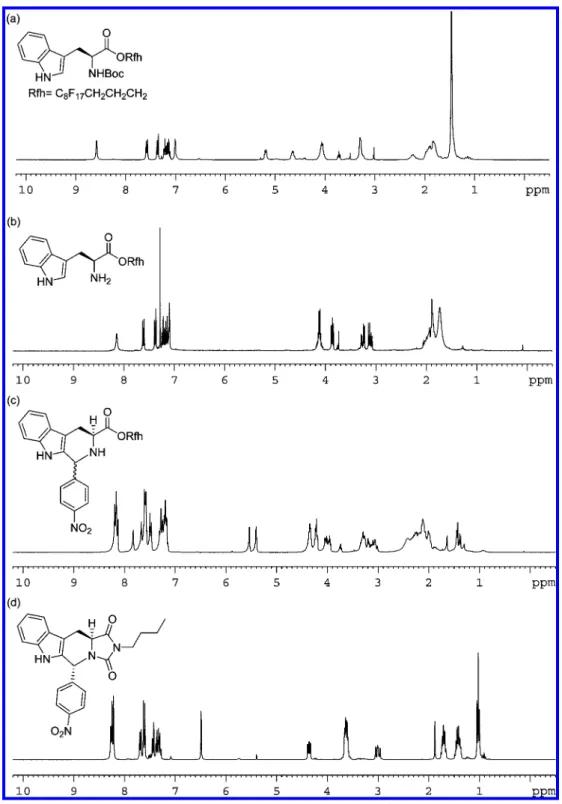
Fluorous and traceless synthesis of various tetrahydro-β-carbolinehydantoins under microwave irradiation is described in Scheme 1. Esterification reaction was performed by using commercially available fluorous alcohol containing C8F17 chain16and Boc protected L-tryptophan 2 with dicyclohexyl carbodiimide (DCC) and DMAP in dichloromethane at room temperature for 3 h. The fluorous tag of perfluoroalkyl portion is distanced from the hydroxyl group by three carbons spacer to decrease the electron-withdrawing effect of fluorous moiety. The perfluoro-tagged component 1 was used as the limiting agent with a slight excess of acid 2 to achieve the best SPE separation. Reaction progress was directly moni-tored by1H-NMR in each intermediate with attached fluorous tag molecule which was found their chemical shift at 1.8∼2.0 and 4.0 ppm, respectively (Figure 2a). After completing reaction, it is followed by solid-phase extraction (SPE) over Fluoro Flash cartridges to remove nonfluorous byproducts by using eluent MeOH/H2O (4:1). The fluorous products were collected in the second fraction by washing cartridge with 100% MeOH.
NH-Boc group in compound 3 was deprotected by using 30% TFA in CH2Cl2for 3 h to obtain the primary free amine. This reaction was confirmed by1H-NMR spectrum for the disappearance of tert-butyl group at 1.4 ppm (Figure 2 b). The in situ generated free amine was directly treated with appropriate aldehydes without any purification. It was
* Corresponding author e-mail: [email protected].
†National Chiao Tung University. ‡Fluorous Technologies, Inc.
10.1021/cc700126t CCC: $37.00 2007 American Chemical Society Published on Web 10/04/2007
performed the intramolecular condensation in acidic condition between an iminium ion and an aromatic C-nucleophile. Same result was obtained to the construction of the six-membered ß-carboline skeletons in one pot by the simultaneous addition of TFA and the aldehydes. This resulted in the sequential deprotection, nucleophilic addition, cyclization and induced the first point of structural diversity through the Pictet–Spengler reaction.17It was required 15 min to reach completion under microwave irradiation in chloroform and resulted in the forma-tion of cis and trans diastereomers in various ratios.19It should be noted that under MW acidic harsh conditions, the fluorous tag-attached site still remains intact. Compared to the conven-tional Pictet–Spengler reaction which usually takes 1–2 days to reach completion in refluxing condition, the fluorous–mi-crowave approach has more favorable reaction condition and has brought down reaction time within 20 min.20Purification of intermediate 4 was then performed by SPE through Fluoro cartridges to remove excess aldehydes and other nonfluorous byproducts (Figure 2c, 4a).
Finally, the β-carboline derivatives 4 were treated with various isocyanates in the presence of triethylamine to promote intramolecular cyclization that flouoro tag molecule cleavage and hydantoin ring formation were performed in one pot. Building up of the terminal hydantoin ring across the N-2/C-3 bond of the tetrahydro-β-carboline skeleton was achieved at room temperature by the reaction ofβ-carboline derivatives 4 with R2–N ) C)O. This nucleophilic addition was achieved without the use of any metal salt or activating agents to reach spontaneous cyclization and to displace fluorous tag in 3 h with base. The reactive urea induced an acyl-oxygen bond cleavage of the ester to remove fluoro tag by a SNi reaction via N–CO bond concomitant formation. It is leading to a traceless and stereoselective synthesis of substituted indole alkaloids 5.
When the extra excess of isocyanates were added (such as 5 eq), the nitrogen of indole ring will further react with isocyanates to generate urea containing indole 6 and the final products were contaminated unreacted isocyanates.
After formation of terminal hydantoin ring, the crude products were purified over a Fluoro Flash cartridge contained fluorous silica gel and the nonfluorous final compounds 5 was collected in the first fraction of CH3OH/ H2O(4/1) (Figure 2d, 5a).
The stepwise formation of tetrahydro-β-carbolinehydantoins 5 was monitored by1H NMR spectra shown in Figure 2a–d. However, the 3-(perfluorooctyl)propan-1-ol was not recovered in the MeOH fraction because the recycled C8F17 chain of fluorous alcohol further reacted with excess of isocyanates which was confirmed by1H NMR and MS. The application of fluorous, microwave-assisted synthesis was demonstrated by the synthesis of tetrahydro-β-carbolinehydantoin derivatives with two points of diversity. The analytical data of cis/trans ratio and Lrms data are shown in Table 1. Assignment of cis/trans stereochemistry of final compounds 5 was identified by13C NMR at Cb and Ca using the method described by Cook’s research group.18These isomers were also determined by 1D NOE analysis after a proper separation. Experiments in which saturation of Ha of 5m′caused the enhancement of the Hb signal, and other protons around indicated cis relationship of Ha and Hb (Figure 3). On the contrary, saturation of Ha of 5m caused no enhancement of Hb signal. Furthermore, in single-crystal X-ray analysis of trans compound 5m (Figure 4) confirms that the rings C and D are trans fused and nonplanar, which shows that the hydrogens of C-9 and C-10 are antiperiplanar.
In Table 1, the results show that thermodynamically more stable trans compounds are obtained in most of cases. However, the detailed mechanism regarding conversion of cis/trans mixtures 4 to only one trans product 5 is still under investigation. The cis/trans intermediates 4 have not been separated during the present work. We have confirmed the formation of stereoisomeric mixtures 4 by the crude proton NMR itself.
In conclusion, we have developed a novel fluorous and traceless synthesis of tetrahydro-β-carbolinehydantoin libraries.
Figure 1. Pharmacologically active of tetrahydro- β-carbolinehy-dantoins.
The key step of Pictet-Spengler reaction was highly accelerated under focused microwave irradiation20in reduced reaction time significantly from days to minutes. It should be noted that fluorous tag intermediates and tag itself are stable during the harsh MW irradiation. The fluorous tag synthesis strategy could enhance the rapid separation and purification of products after SPE cartridges are used. Further work involving biological evaluation of small molecule library is currently underway.
Experimental Section
General Procedure for the Synthesis of Tetracyclic Tetrahydro-β-Carbolines. 5a-5o. The
3-(perfluorooctyl)-propan-1-ol 1 0.2 g (1 eq 0.2 mmol) and Boc-Trp-OH 2 (1.5
eq 0.30 mmol) in 5 mL of dichloromethane was added DCC (2.5 eq 0.5 mmol) and 4-dimethylamino pyridine (DMAP, 0.002 g). The mixture was stirred at room temperature for 3 h and the reaction progress was monitored by TLC and 1
H NMR. After completion, dicyclohexyl urea (DCU) was filtered off and concentrated residue was loaded onto a Fluoro Flash cartridge containing 10 g of fluorous silica gel. The cartridge was eluted with 20 mL of MeOH/H2O (80:20) followed by 20 mL of MeOH. The MeOH fraction was concentrated to give product 3, and subsequently treated with 30% TFA in dichloromethane at room temperature for three hours. After deprotection of Boc-group, aldehyde was added (0.3 mmol) in 10 mL CHCl3under microwave irradiation
(CEM Discover) at 240W for 15 min in open vessel system. Upon completion of the reaction, isocyanate (0.3 mmol) and triethylamine (0.37 mmol) in 8 mL of dichloromethane was added to solution of 4 and resulted in simultaneous release of the fluorous tag with formation of tetracyclic hydantoin 5 in three hours. The reaction mixture was directly loaded on a Fluoro Flash cartridge containing 10 g of fluorous silica gel. The cartridge was eluted with 20 mL of MeOH/H2O(4/
1). The fractions were collected and concentrated to give the analytical pure tetrahydro-β-carbolinehydantoins 5. The crude product was then further purified by silica gel column chromatography using a 1:2 mixture of ethyl acetate and hexane as an eluent.
trans-2-Butyl-10-(4-nitro-phenyl)-3,4,9,10-tetrahydro-2,9,10-triaza-cyclopenta[b]fluorine-1,3-dion (5a).1H NMR (300 MHz, CDCl3): δ 8.26 (s, 1H), 8.23 (d, J ) 8.5 Hz,
2H), 7.68 (d, J ) 7.6 Hz, 1H), 7.61 (d, J ) 8.5 Hz, 2H), 7.43 (d, J ) 7.6 Hz, 1H), 7.38–7.27 (m, 2H), 6.48 (s, 1H), 4.38–4.33 (dd, J ) 11.0, 5.4 Hz, 1H), 3.68–3.59 (m, 3H), 3.04–2.95 (dd, J ) 15.2, 11.0 Hz, 1H), 1.75–1.65 (m, 2H), 1.48–1.36 (m, 2H), 1.02 (t, J ) 7.2 Hz, 3H);13C NMR (75 MHz, CDCl3): δ 172.8, 155.5, 148.2, 146.4, 137.2, 129.6, 129.1, 126.3, 124.6, 123.7, 120.8, 119.0, 111.8, 109.1, 53.5, 51.5, 39.1, 30.5, 23.7, 20.3, 14.0; IR (cm-1, neat): 3337, 2957, 2934, 2870, 1711, 1695, 1453, 1548, 1494; [R]D20) -36.2°(c ) 0.5; CH2Cl2); MS (EI) m/z: 418 (M + ); Hrms: calcd for C23H22N4O4: m/z 418.1641; Found 418.1642.
trans-2-Butyl-10-(4-nitro-phenyl)-1,3-dioxo-1,2,3,3s,4,10- hexahydro-2,9,10a-triaza-cyclopenta[b]fluorine-9-carbox-ylic acid butylamide (6a).
Yield: 5 %;1H NMR (300 MHz, CDCl3):δ 8.10 (d, J ) 8.6 Hz, 2H), 7.58 (t, J ) 9.1 Hz, 2H), 7.41 (d, J ) 8.6 Hz, 2H), 7.33–7.28 (m, 2H), 6.94 (s, 1H), 5.92 (s, 1H), 4.16–4.10 (dd, J ) 10.1, 5.8 Hz, 1H), 3.51 (t, J ) 7.2 Hz, 2H), 3.46–3.39 (dd, J ) 15.5, 5.8 Hz, 1H), 3.30–3.13 (m, 2H), 2.83–2.74 (dd, J ) 15.5, 11.2 Hz, 1H), 1.61–1.57 (m, 2H), 1.35–1.25 (m, 4H), 1.14–1.09 (m, 2H), 0.91 (t, J ) 7.1 Hz, 3H), 0.79 (t, J ) 7.1 Hz, 3H);13C NMR (75 MHz, CDCl3): δ 172.6, 154.7, 151.3, 147.9, 147.0, 135.3, 131.0, 129.0, 128.0, 125.1, 124.3, 122.9, 119.6, 113.2, 112.4, 51.9, 51.8, 41.1, 39.1, 31.8, 30.5, 23.2, 20.3, 20.1, 14.0, 13.9; IR (cm-1, neat): 2960, 2933, 2872, 1712, 1693, 1451, 1548, 1490; [R]D20) -92.0°(c ) 1.1; CH2Cl2); MS (EI) m/z: 517 (M + ); Hrms: calcd for C28H31N5O5: m/z 517.2325; Found 517.2369.
trans-10-Benzo[1,3]dioxol-4-yl-2-butyl-3a,4,9,10-tetrahy-dro-2,9,10a-triaza-cyclopenta[b] fluorene-1,3-dione (5b). 1 H NMR (300 MHz, CDCl3):δ 8.43 (s, 1H), 7.57 (d, J ) 7.2 Hz, 1H), 7.31 (d, J ) 7.2 Hz, 1H), 7.27–7.16 (m, 2H), 6.83–6.71 (m, 3H), 6.17 (s, 1H), 5.89–5.85 (m, 2H), 4.26–4.20 (dd, J ) 11.0, 5.4 Hz, 1H), 3.57–3.42 (m, 3H), 2.89–2.80 (ddd, J ) 15.2, 11.0, 1.7 Hz, 1H), 1.67–1.57 (m, 2H), 1.40–1.30 (m, 2H), 0.92 (t, J ) 7.2 Hz, 3H);13C NMR (75 MHz, CDCl3):δ 173.2, 155.3, 148.5, 148.3, 137.0, 133.5, 130.9, 126.4, 123.2, 122.3, 120.4, 118.8, 111.6, 108.9, 108, 8, 108.3, 101.7, 53.4, 52.1, 38.9, 32.0, 30.6, 20.4, 14.0; IR (cm-1, neat): 3327, 2958, 2932, 2872, 1703, 1622, 1449; [R]D20) -36.3°(c ) 0.3; CH2Cl2); MS (EI) m/z: 417 (M + ); Hrms calcd for C24H23N3O4: m/z 417.1689; Found 417.1661. trans-10-Benzo[1,3]dioxol-4-yl-2-butyl-1,3-dioxo-1,2,3,3a,4,10-hexahydro-2,9,10a-triaza- cyclopenta[b]fluo-rine-9-carboxylic acid butylamide (6b).
Yield: 5 %;1H NMR (300 MHz, CDCl3):δ 7.62 (d, J ) 7.8 Hz, 1H), 7.52 (d, J ) 7.0 Hz, 1H), 7.31–7.25 (m, 2H), 6.79–6.65 (m, 4H), 5.92 (s, 2H), 5.70 (s, 1H), 4.19–4.13 (dd, J ) 11.0, 5.8 Hz, 1H), 3.50 (t, J ) 7.2 Hz, 2H), 3.37–3.17 (m, 3H), 2.83–2.74 (dd, J ) 15.5, 11.0 Hz, 1H), 1.62–1.57 (m, 2H), 1.39–1.26 (m, 4H), 1.17–1.12 (m, 2H), 0.92 (t, J ) 7.2 Hz, 3H), 0.86 (t, J ) 7.2 Hz, 3H); 13 C NMR (75 MHz, CDCl3): δ 173.0, 154.5, 151.4, 148.4, 148.0, 135.6, 133.7, 132.1, 127.8, 124.7, 122.6, 121.6, 119.3, 112.6, 112.5, 108.8, 108.7, 52.0, 51.8, 41.0, 39.0, 31.8, 30.6, 23.3, 20.3, 20.1, 14.1, 14.0; IR (cm-1, neat): 2959, 2933, 2871, 1709, 1629, 1449; [R]D20) -12.1°(c ) 0.4; CH2Cl2); MS (EI) m/z: 516 (M+); Hrms calcd for C29H32N4O5: m/z 516.2373; Found 516.2360. trans-10-Benzo[1,3]dioxol-4-yl-2-(3-fluoro-phenyl)- 3a,4,9,10-tetrahydro-2,9,10a-triaza-cyclopenta[b]fluorene-1,3-dione (5c).1H NMR (300 MHz, DMSO-d6):δ 10.8 (s, 1H), 7.58–7.52 (m, 2H), 7.37–7.26 (m, 4H), 7.14–7.01 (m, 2H), 6.94–6.87 (m, 3H), 6.21 (s, 1H), 6.01 (s, 2H), 4.81–4.75 (dd, J ) 10.9, 5.6 Hz, 1H), 3.54–3.47 (m, 1H), 3.11–3.00 (ddd, J ) 15.0, 10.9, 1.7 Hz, 1H); 13C NMR (75 MHz, DMSO-d6):δ 172.2, 164.1, 160.9, 153.8, 148.3, 148.0, 137.5, 134.5, 134.3, 134.2, 132.0, 131.2, 131.1, 126.6, 123.8, 123.7, 122.6, 122.5, 119.7, 119.1, 115.7, 115.4, 114.9, 114.6, 112.2, 109.1, 106.9, 102.0, 53.8, 52.5, 23.3; IR (cm-1, neat): 3344, 2919, 2852, 1716, 1600, 1492, 1420; [R]D20) -64.8°(c ) 0.2; CH2Cl2); MS (EI) m/z: 455 (M + ); Hrms calcd for C26H18FN3O4: m/z 455.1281; Found 455.1278. trans-10-Benzo[1,3]dioxol-4-yl-2-(3-fluoro-phenyl)- 3a,4,9,10-tetrahydro-2,9,10a-triaza-cyclopenta[b]fluo-rene-1,3-dione (5d).1H NMR (300 MHz, CDCl3):δ 8.6 (s, 1H), 7.88 (d, J ) 2.3, Hz, 1H), 7.67–7.63 (dd, J ) 8.7, 2.3 Hz, 1H), 7.59 (s, 1H), 7.56 (s, 1H), 7.36–7.16 (m, 3H) 6.88–6.76 (m, 3H), 6.31 (s, 1H), 5.93 (s, 2H), 4.51–4.45 (ddd, J ) 11.1, 5.6, 2.8 Hz, 1H), 3.60–3.53 (dd, J ) 15.1, 5.6 Hz,
Figure 3. Some important NOE interactions in cis isomer 5m′.
Figure 4. Single crystal X-ray structural elucidation of compound 5m.
1H), 3.07–2.98 (dd, J ) 15.1, 11.1 Hz, 1H);13C NMR (75 MHz, CDCl3): δ 171.3, 153.1, 148.7, 148.5, 137.1, 132.9, 132.4, 132.2, 131.8, 130.8, 130.5, 130.1, 129.2, 126.3, 125.3, 125.2, 123.3, 122.5, 120.5, 118.7, 111.8, 109.0, 107.9, 101.8, 53.4, 52.5, 23.9; IR (cm-1, neat): 3345, 2924, 2850, 1721, 1605, 1486, 1429, 745; [R]D20) -46.2°(c ) 0.3; CH2Cl2); MS (EI) m/z: 539 (M+); Hrms calcd for C27H17ClN3O4F3: m/z 539.0860; Found 539.0859. trans-10-Butyl-2-m-tolyl-3a,4,9,10-tetrahydro-2,9,10a-triaza-cyclopenta[b]fluorine-1,3-dione (5e).1H NMR (300 MHz, CDCl3): δ 8.59 (s, 1H), 7.51 (d, J ) 8.5 Hz, 1H), 7.41–7.14 (m, 7H), 5.34–5.31 (dd, J ) 6.9, 4.0 Hz, 1H), 4.51–4.45 (dd, J ) 10.8, 5.7 Hz, 1H), 3.52–3.45 (dd, J ) 15.2, 5.7 Hz, 1H), 2.97–2.82 (ddd, J ) 15.2, 10.8, 1.3 Hz, 1H), 2.40 (s, 3H), 2.09–2.00 (m, 1H), 1.90–1.76 (m, 1H), 1.58–1.40 (m, 4H), 0.92 (t, J ) 7.0 Hz, 3H);13C NMR (75 MHz, CDCl3): δ 172.7, 155.0, 139.6, 136.8, 133.0, 129.6, 129.4, 129.1, 127.3, 126.6, 123.8, 122.8, 120.3, 118.5, 111.6, 105.9, 53.3, 49.4, 42.1, 36.0, 28.1, 23.1, 21.8, 14.4; IR (cm-1, neat): 3324,2957, 2932, 2872, 1702, 1608, 1453; [R]D20) -42.6°(c ) 0.9; CH2Cl2); MS (EI) m/z: 387 (M + ); Hrms calcd for C24H25N3O2: m/z 387.1947; Found 387.1985.
trans-10-Butyl-2-(3-fluoro-phenyl)-3a,4,9,10-tetrahydro-2,9,10a-triaza-cyclopenta[b]fluorene-1,3-dione (5f). 1H NMR (300 MHz, CDCl3):δ 8.08 (s, 1H), 7.54–7.39 (m, 2H), 7.35–7.33 (m, 3H), 7.25–7.08 (m, 3H), 5.39–5.35 (dd, J ) 7.4, 4.5 Hz, 1H), 4.52–4.46 (dd, J ) 10.8, 5.7 Hz, 1H), 3.54–3.47 (dd, J ) 15.3, 5.7 Hz, 1H), 2.99–2.90 (ddd, J ) 15.3, 10.8, 1.6 Hz, 1H), 2.08–1.88 (m, 2H), 1.72–1.62 (m, 2H), 1.62–1.60 (m, 2H), 0.96–0.92 (m, 3H);13C NMR (75 MHz, CDCl3): δ 172.0, 164.6, 161.3, 154.3, 136.7, 133.4, 132.7, 130.5, 126.6, 123.1, 120.5, 118.6, 115.6, 115.3, 114.0, 111.5, 106.3, 54.1, 49.3, 36.0, 28.1, 24.1, 23.1, 13.3; IR (cm-1, neat): 3359, 2957, 2929, 2856, 1716, 1597, 1493, 1420; [R]D20) -91.8°(c ) 0.08; CH2Cl2); MS (EI) m/z: 391 (M+); Hrms calcd for C23H22FN3O2: m/z 391.1696; Found 391.1697. trans-2,10-Dibutyl-3a,4,9,10-tetrahydro-2,9,10a-triaza-cyclopenta[b]fluorine-1,3-dione (5g).1H NMR (300 MHz, CDCl3):δ 8.09 (s, 1H), 7.50 (d, J ) 7.8 Hz, 1H), 7.36 (d, J ) 7.8 Hz, 1H), 7.25–7.13 (m, 2H), 5.30–5.26 (dd, J ) 6.4, 4.5 Hz, 1H), 4.32–4.27 (dd, J ) 10.9, 5.7 Hz, 1H), 3.58 (td, J ) 7.1, 1.5 Hz, 2H), 3.44–3.37 (dd, J ) 15.2, 5.7 Hz, 1H), 2.83–2.73 (ddd, J ) 15.2, 10.9, 1.6 Hz, 1H), 2.05–1.99 (m, 1H), 1.84–1.73 (m, 1H), 1.69–1.61 (m, 4H), 1.41–1.33 (m, 4H), 0.97–0.88 (m, 6H);13C NMR (75 MHz, CDCl 3): δ 173.3, 155.7, 136.3, 132.7, 126.3, 122.6, 120.1, 118.3, 111.1, 106.1, 53.8, 48.6, 38.6, 35.8, 30.2, 27.8, 23.6, 22.7, 20.0, 14.0, 13.7; IR (cm-1, neat): 3344, 2958, 2929, 2857, 1705, 1620, 1454; [R]D20) -87.7°(c ) 0.1; CH2Cl2); MS (EI) m/z: 353 (M+). Hrms calcd for C21H27N3O2: m/z 353.2103; Found 353.2109. cis-2,10-Dibutyl-3a,4,9,10-tetrahydro-2,9,10a-triaza-cy-clopenta[b]fluorine-1,3-dione (5g′).1H NMR (300 MHz, CDCl3):δ 8.14 (s, 1H), 7.55 (d, J ) 7.4 Hz, 1H), 7.38 (d, J ) 7.4 Hz, 1H), 7.25–7.15 (m, 2H), 5.09 (d, J ) 1.4 Hz, 1H), 4.20–4.15 (dd, J ) 11.4, 4.3 Hz, 1H), 3.58 (t, J ) 7.2 Hz, 2H), 3.43–3.37 (ddd, J ) 14.8, 4.3, 1.1 Hz, 1H), 2.84–2.75 (ddd, J ) 14.8, 11.4, 1.9 Hz, 1H), 1.93–1.83 (m, 2H), 1.71–1.60 (m, 4H), 1.45–1.39 (m, 4H), 0.96 (t, J ) 7.3 Hz, 3H), 0.80 (t, J ) 7.2 Hz, 3H); 13C NMR (75 MHz, CDCl3):δ 172.3, 155.5, 136.7, 133.4, 126.6, 122.8, 120.4, 118.5, 111.5, 108.5, 58.3, 52.8, 38.8, 32.5, 30.6, 25.0, 22.9, 22.8, 20.3, 14.3, 14.0; IR (cm-1, neat): 3345, 2956, 2929, 2871, 1709, 1622, 1456; [R]D20) -69.0°(c ) 0.2; CH2Cl2); MS (EI) m/z: 353 (M+); Hrms calcd for C21H27N3O2: m/z 353.2103; Found 353.2102. trans-10-Pyridin-3-yl-2-m-tolyl-3a,4,9,10-tetrahydro-2,9,10a-triaza-cyclopenta[b]fluorene-1,3-dione (5h). 1H NMR (300 MHz, CDCl3):δ 9.54 (d, J ) 11.7 Hz, 1H), 8.48 (s, 2H), 7.67–7.60 (m, 2H), 7.38–7.18 (m, 8H), 6.36 (s, 1H), 4.47–4.42 (dd, J ) 10.8, 5.4 Hz, 1H), 3.65–3.58 (dd, J ) 15.2, 5.4 Hz, 1H), 3.11–3.02 (m, 1H), 2.38 (s, 3H);13C NMR (75 MHz, CDCl3):δ 171.7, 154.4, 149.8, 149.5, 139.6, 137.4, 136.7, 135.7, 131.5, 129.6, 129.4, 129.3, 127.1, 126.3, 124.7, 123.6, 123.4, 120.5, 118.8, 111.9, 108.5, 53.6, 50.5, 23.8, 21.7; IR (cm-1, neat): 3326, 2957, 2930, 2871, 1702, 1602, 1453; [R]D20) -19.6°(c ) 0.2; CH2Cl2); MS (EI) m/z: 408 (M+); Hrms calcd for C25H20N4O2: m/z 408.1586; Found 408.1590. trans-2-(3-Fluoro-phenyl)-10-pyridin-3-yl-3a,4,9,10-tet-rahydro-2,9,10a-triaza-cyclopenta [b]fluorene-1,3-dione (5i).1H NMR (300 MHz, DMSO-d6):δ 11.20 (s, 1H), 8.75 (s, 1H), 8.58 (d, J ) 4.3 Hz, 1H), 7.80 (d, J ) 7.9 Hz, 1H), 7.61 (d, J ) 7.6 Hz, 1H), 7.59–7.49 (m, 1H), 7.44–7.39 (m, 4H), 7.29–7.24 (m, 1H), 7.16–7.04 (m, 2H), 6.41 (s, 1H), 4.89–4.84 (dd, J ) 10.7, 5.6 Hz, 1H), 3.50–3.44 (dd, J ) 15.1, 5.6 Hz, 1H), 3.12–3.04 (dd, J ) 13.1, 11.3 Hz, 1H); 13 C NMR (75 MHz, DMSO-d6): δ 172.2, 164.1, 160.9, 154.0, 150.2, 150.1, 137.7, 136.4, 134.3, 131.2, 131.1, 126.6, 124.7, 123.7, 122.7, 119.8, 119.2, 115.6, 114.7, 112.3, 107.3, 54.0, 50.7, 23.2; IR (cm-1, neat): 3352, 2935, 2853, 1715, 1610, 1412, 1257; [R]D20) -36.0°(c ) 0.5; CH2Cl2); MS (EI) m/z: 412 (M+); Hrms calcd for C24H17FN4O2: m/z 412.1336; Found 412.1330. trans-2-Butyl-10-pyridin-3-yl-3a,4,9,10-tetrahydro-2,9,10a-triaza-cyclopenta[b]fluorene-1,3-dione (5j). 1H NMR (300 MHz, DMSO-d6):δ 10.93 (s, 1H), 8.65 (s, 1H), 8.55 (d, J ) 4.6 Hz, 1H), 7.73 (d, J ) 7.8 Hz, 1H), 7.56 (d, J ) 7.8 Hz, 1H), 7.41–7.37 (dd, J ) 7.8, 4.8 Hz, 1H), 7.29 (d, J ) 7.8 Hz, 1H), 7.12–7.00 (m, 2H), 6.29 (s, 1H), 4.71–4.66 (dd, J ) 10.7, 5.5 Hz, 1H), 3.54–3.43 (m, 3H), 2.85–2.76 (dd, J ) 13.5, 11.0 Hz, 1H), 1.55–1.42 (m, 2H), 1.30–1.18 (m, 2H), 0.86 (t, J ) 7.2 Hz, 3H);13C NMR (75 MHz, DMSO-d6):δ 173.5, 155.4, 150.1, 149.9, 137.6, 136.5, 136.2, 131.3, 126.5, 124.7, 122.7, 119.8, 119.1, 112.2, 107.1, 54.0, 50.4, 38.5, 30.4, 23.4, 20.2, 14.3; IR (cm-1, neat): 3347, 2932, 2850, 1707, 1599, 1422; [R]D20) -158.5°(c ) 0.3; CH2Cl2); MS (EI) m/z: 374 (M + ); Hrms calcd for C22H22N4O2: m/z 374.1743; Found 374.1744. cis-2-Butyl-10-pyridin-3-yl-3a,4,9,10-tetrahydro-2,9,10a-triaza-cyclopenta[b]fluorene-1,3-dione (5j′).1H NMR (300 MHz, DMSO-d6):δ 10.84 (s, 1H), 8.64 (d, J ) 1.9 Hz, 1H), 8.47–8.45 (dd, J ) 4.7, 1.5 Hz, 1H), 7.65–7.61 (dd, J ) 7.8, 1.5 Hz, 1H), 7.56 (d, J ) 7.3 Hz, 1H), 7.31–7.22 (m, 2H), 7.06–7.00 (m, 2H), 5.96 (s, 1H), 4.59–4.54 (dd, J ) 11.3, 4.3 Hz, 1H), 3.40–3.30 (m, 3H), 3.11–3.02 (ddd, J ) 14.5, 9.9, 1.5 Hz, 1H), 1.52–1.43 (m, 2H), 1.31–1.23 (m,
2H), 0.86 (t, J ) 7.2 Hz, 3H);13C NMR (75 MHz, DMSO-d6):δ 172.5, 155.2, 149.9, 149.4, 137.6, 137.0, 135.7, 134.7, 126.6, 124.3, 122.4, 119.7, 119.1, 112.1, 106.4, 58.2, 54.2, 38.3, 30.5, 22.5, 20.1, 14.3; IR (cm-1, neat): 3345, 2929, 2864, 1711, 1588, 1424; [R]D20) -44.5°(c ) 0.3; CH2Cl2); MS (EI) m/z: 374 (M+); Hrms calcd for C22H22N4O2: m/z 374.1743; Found 374.1737. trans-2-(4-Chloro-3-trifluoromethyl-phenyl)-10-pyridin- 3-yl-3a,4,9,10-tetrahydro-2,9,10a-triaza-cyclopenta[b]fluo-rene-1,3-dione (5k).1H NMR (300 MHz, CDCl3):δ 9.0 (s, 1H), 8.58 (s, 1H), 8.51 (d, J ) 4.3 Hz, 1H), 7.89 (s, 1H), 7.69–7.58 (m, 4H), 7.36–7.21 (m, 4H), 6.42 (s, 1H), 4.51–4.45 (dd, J ) 10.8, 5.4 Hz, 1H), 3.66–3.59 (dd, J ) 15.3, 5.4 Hz, 1H), 3.12–3.03 (dd, J ) 14.9, 11.5 Hz, 1H); 13 C NMR (75 MHz, CDCl3):δ 170.9, 153.4, 150.1, 149.5, 137.5, 136.7, 135.2, 132.5, 132.1, 130.6, 130.1, 129.8, 139.3, 128.9, 126.3, 125.2, 124.6, 123.7, 120.8, 118.9, 112.0, 108.6, 53.8, 50.7, 23.8; IR (cm-1, neat): 3342, 2922, 2852, 1720, 1602, 1484, 1429, 748; [R]D20) -163.4°(c ) 0.3; CH2Cl2); MS (EI) m/z: 496 (M+); Hrms calcd for C25H16ClF3N4O2: m/z 496.0914; Found 496.0911. trans-2-(4-Methoxy-phenyl)-10-pyridin-3-yl-3a,4,9,10- tetrahydro-2,9,10a-triaza-cyclopenta[b]fluo-rene-1,3-di-one (5l).1H NMR (300 MHz, CDCl3):δ 9.55 (s, 1H), 8.55 (s, 1H), 7.64–7.58 (m, 2H), 7.38–7.17 (m, 6H), 7.02–6.90 (m, 3H), 6.37 (s, 1H), 4.44–4.39 (dd, J ) 10.9, 5.4 Hz, 1H), 3.79 (s, 3H), 3.60–3.53 (dd, J ) 15.1, 5.4 Hz, 1H), 3.05–2.96 (dd, J ) 15.1, 11.2 Hz, 1H); 13C NMR (75 MHz, CDCl3): δ 171.6, 160.4, 154.3, 149.6, 149.4, 137.5, 136.8, 135.8, 132.6, 130.2, 124.6, 123.4, 120.5, 118.8, 118.6, 114.6, 112.2, 111.9, 108.4, 55.8, 53.6, 50.4, 23.7; IR (cm-1, neat): 3338, 2936, 2836, 1716, 1605, 1421; [R]D20) -126.1°(c ) 0.3; CH2Cl2); MS (EI) m/z: 424 (M + ); Hrms calcd for C25H20N4O3: m/z 424.1535; Found 424.1534. trans-10-Cyclohexyl-2-m-tolyl-3a,4,9,10-tetrahydro-2,9,10a-triaza-cyclopenta[b]fluorine-1,3-dione (5m). 1H NMR (300 MHz, CDCl3):δ 8.08 (s, 1H), 7.52 (d, J ) 7.6 Hz, 1H), 7.38–7.34 (m, 2H), 7.29–7.26 (m, 2H), 7.24–7.14 (m, 3H), 5.22 (d, J ) 2.8 Hz, 1H), 4.55–4.49 (dd, J ) 10.7, 6.0 Hz, 1H), 3.54–3.47 (dd, J ) 15.4, 6.0 Hz, 1H), 2.98–2.89 (ddd, J ) 15.4, 10.7, 1.7 Hz, 1H), 2.42 (s, 3H), 2.07–2.02 (m, 1H), 1.97–1.85 (m, 2H), 1.76–1.70 (m, 2H), 1.40–1.33 (m, 2H), 1.22–1.08 (m, 4H);13C NMR (75 MHz, CDCl 3): δ 172.7, 155.6, 139.5, 136.7, 131.8, 131.7, 129.5, 129.3, 127.2, 126.6, 123.7, 122.9, 120.4, 118.5, 111.4, 106.9, 55.6, 54.1, 45.4, 31.1, 29.0, 26.4, 24.2, 21.7; IR (cm-1, neat): 3349, 2925, 2851, 1711, 1591, 1415; [R]D20) -2.3°(c ) 0.3; CH2Cl2); MS (EI) m/z: 413 (M + ); Hrms calcd for C26H27N3O2: m/z 413.2103; Found 413.2105. cis-10-Cyclohexyl-2-m-tolyl-3a,4,9,10-tetrahydro-2,9,10a-triaza-cyclopenta[b]fluorine-1,3-dione (5m′). 1H NMR (300 MHz, CDCl3): δ 8.14 (s, 1H), 7.59 (d, J ) 7.3 Hz, 1H), 7.41–7.37 (m, 2H), 7.29–7.18 (m, 5H), 4.99 (d, J ) 2.5 Hz, 1H), 4.29–4.24 (dd, J ) 11.4, 3.9 Hz, 1H), 3.55–3.49 (dd, J ) 14.4, 3.9 Hz, 1H), 3.27–3.19 (m, 1H), 2.97–2.88 (dd, J ) 14.4, 11.6 Hz, 1H), 2.42 (s, 3H), 1.97–1.80 (m, 2H), 1.66–1.56 (m, 4H), 1.40–1.23 (m, 4H);13C NMR (75 MHz, CDCl3): δ 170.9, 154.4, 139.5, 136.2, 132.0, 131.8, 129.4, 129.3, 127.2, 126.3, 123.7, 122.8, 120.5, 118.5, 111.5, 109.5, 59.2, 58.2, 39.7, 30.9, 27.1, 26.6, 26.1, 21.7; IR (cm-1, neat): 3353, 2927, 2852, 1712, 1590, 1410; [R]D20 ) -35.1°(c ) 0.2; CH2Cl2); MS (EI) m/z: 413 (M + ); Hrms calcd for C26H27N3O2: m/z 413.2103; Found 413.2103.
trans-2-Butyl-10-cyclohexyl-3a,4,9,10-tetrahydro-2,9,10a-triaza-cyclopenta[b]fluorine-1,3-dione (5n).1H NMR (300 MHz, CDCl3): δ 8.29 (s, 1H), 7.49 (d, J ) 7.5 Hz, 1H), 7.37–7.35 (m, 1H), 7.28–7.12 (m, 2H), 5.14 (s, 1H), 4.38–4.32 (dd, J ) 10.6, 5.9 Hz, 1H), 3.63–3.58 (m, 2H), 3.45–3.38 (dd, J ) 15.3, 5.9 Hz, 1H), 2.81–2.72 (m, 1H), 1.99 (m, 1H), 1.85 (m, 2H), 1.70–1.62 (m, 4H), 1.52–1.49 (m, 1H), 1.41–1.28 (m, 5H), 1.18–1.12 (m, 2H), 0.96 (t, J ) 7.2 Hz, 3H);13 C NMR (75 MHz, CDCl3):δ 174.0, 156.7, 136.7, 131.9, 126.6, 122.8, 120.3, 118.5, 111.4, 106.8, 55.6, 53.8, 45.3, 39.0, 31.1, 28.9, 26.7, 26.4, 24.0, 20.3, 14.0; IR (cm-1, neat): 3340, 2928, 2853, 1699, 1623, 1454; [R]D20) -50.5°(c ) 0.8; CH2Cl2); MS (EI) m/z: 379 (M + ); Hrms calcd for C23H29N3O2: m/z 379.2260; Found 379.2273.
cis-2-Butyl-10-cyclohexyl-3a,4,9,10-tetrahydro-2,9,10a-triaza-cyclopenta[b]fluorine-1,3-dione (5n′).1H NMR (300 MHz, CDCl3): δ 8.15 (s, 1H), 7.56 (d, J ) 7.5 Hz, 1H), 7.41–7.39 (m, 1H), 7.28–7.15 (d, J ) 2.8 Hz, 2H), 4.93 (d, J ) 2.8 Hz, 1H), 4.12–4.06 (dd, J ) 11.5, 4.0 Hz, 1H), 3.59 (t, J ) 7.2 Hz, 2H), 3.45–3.39 (dd, J ) 14.4, 3.8 Hz, 1H), 3.23–3.18 (m, 1H), 2.82–2.73 (ddd, J ) 14.4, 11.8, 1.1 Hz, 1H), 1.97–1.79 (m, 2H), 1.70–1.61 (m, 4H), 1.44–1.25 (m, 8H), 0.97 (t, J ) 7.2 Hz, 3H);13C NMR (75 MHz, CDCl 3): δ 172.1, 155.5, 136.2, 132.1, 126.3, 122.7, 120.4, 118.4, 111.5, 109.5, 59.2, 58.0, 39.7, 38.8, 30.6, 27.1, 26.6, 26.3, 22.7, 20.3, 14.0; IR (cm-1, neat): 3354, 2931, 2853, 1702, 1622, 1452; [R]D20) -42.8°(c ) 0.3; CH2Cl2); MS (EI) m/z: 379 (M+); Hrms calcd for C23H29N3O2: m/z 379.2260; Found 379.2273. trans-10-Cyclohexyl-2-(3-fluoro-phenyl)-3a,4,9,10-tet-rahydro-2,9,10a-triaza-cyclopenta[b]fluorine-1,3-dione (5o). 1H NMR (300 MHz, CDCl 3):δ 8.52 (s, 1H), 7.53–7.08 (m, 7H), 6.79–6.74 (m, 1H), 5.20 (d, J ) 3.5 Hz, 1H), 4.58–4.52 (dd, J ) 10.8, 6.0 Hz, 1H), 3.52–3.44 (dd, J ) 15.4, 6.0 Hz, 1H), 2.94–2.85 (dd, J ) 14.2, 10.8 Hz, 1H), 2.03–1.04 (m, 11H);13C NMR (75 MHz, CDCl3):δ 172.5, 164.6, 161.3, 155.1, 140.0, 136.8, 133.4, 133.3, 130.6, 130.4, 126.5, 122.9, 120.3, 118.5, 115.7, 115.4, 114.1, 113.8, 111.5, 110.5, 110.2, 106.4, 55.6, 54.3, 45.2, 31.2, 28.9, 26.4, 23.8; IR (cm-1, neat): 3345, 2929, 2852, 1713, 1608, 1494, 1420; [R]D20) +7.2°(c ) 1.5; CH2Cl2); MS (EI) m/z: 417 (M + ); Hrms calcd for C25H24FN3O2: m/z 417.1853; Found 417.1854.
Acknowledgment. We thank the National Science Council of Taiwan for the financial assistance and the authorities of the National Chiao Tung University for providing the laboratory facilities.
Supporting Information Available. Representative 1H NMR and13C NMR spectrum of compounds 5a–5o and the schematic representation of F-SPE concept are enclosed herewith. 1D NOE experiment of 5m and 5m′are included. This material is available free of charge via the internet at http://pubs.acs.org.
References and Notes
(1) (a) Studer, A.; Hadida, S.; Ferritto, R.; Kim, S. Y.; Jeger, P.; Wipf, P.; Curran, D. P. Science. 1997, 275, 823–826. (b) Curran, D. P. Angew. Chem., Int. Ed. 1998, 37, 1175–1196. (c) Gladysz, J. A.; Curran, D. P. Tetrahedron 2002, 58, 3823– 3825. (d) Zhang, W. Chem. ReV. 2004, 104, 2531–2556. (e) Zhang, W.; Curran, D. P. Tetrahedron 2006, 62, 11837–11865. (2) Horvath, I. T.; Rabai, J. Science 1994, 266, 72–75. (3) Curran, D. P.; Hadida, S.; HeM., J. Org. Chem. 1997, 62,
6714–6715.
(4) Zhang, W. Tetrahedron 2003, 59, 4475–4489.
(5) (a) Curran, D. P. Synlett 2001, 1488–1496. (b) Curran, D. P.; Oderaotoshi, Y. Tetrahedron 2001, 57, 5243–5253. (6) (a) Brana, M. F.; Garrido, M.; Lopez, M. L.; Miguel, P.;
Morcillo, M. J.; Riano, A J. Heterocycl. Chem. 1990, 27, 703– 706. (b) Brana, M. F.; Garrido, M.; Lopez, M. L.; de Miguel, P.; Riano, A. Synth. Commun. 1990, 20, 1793–1810. (c) Garrido, M.; Lopez-Rodriguez, M. L.; Morcillo, M. J.; Garrido, M.; Benhamu, B.; Perez, V.; de la Campa, J. G. J. Org. Chem. 1994, 59, 1583–1585.
(7) De la Figuera, N.; Garcia-Lopez, M. T.; Herranz, R.; Gonza-lez-Muniz, R. Heterocycles 1999, 51, 265–280.
(8) Daugan, A. C. M.; Labaudiniere, R. F. U.S. Patent 6,143,757,
2000.
(9) van Maarseveen, J. H.; Scheeren, H. W.; De Clereq, E.; Balzarini, J.; Kruse, C. G. Biorg. Med. Chem. 1997, 5, 955– 970.
(10) Deveau, A. M.; Labroli, M. C.; Dieckhans, C. M.; Barthen, M. T.; Smith, K. S. Bioorg. Med. Chem. Lett. 2001, 11, 1251– 1255.
(11) Osda, H.; Gui, C. B.; Onose, R.; Hanaka, F. Bioorg. Med. Chem. 1997, 5, 193–203.
(12) Hotha, S.; Yarrow, J. C.; Yang, J. G.; Garrett, S.; Renduch-intala, K. V.; Mayer, T. U.; Kapoor, T. M. Angew. Chem. Int. Ed. 2003, 42, 2379–2382.
(13) Marcus, A. I.; Peters, U.; Thomas, S. L.; Garrett, S.; Zelnak, A.; Kapoor, T.; Giannakakou, P. J. Biol. Chem. 2005, 10, 1074–1081.
(14) Elgoyhen, B.; Lorenzo, P. S.; Tellez-Inon, M. T.; Adler-Graschin-sky, E. J. Pharmacol. Exp. Ther. 1992, 261, 534– 539.
(15) Daugan, A.; Grondin, P.; Ruault, C.; Gouville, A.-C.; Le, M.; Coste, H.; Linget, J. M.; Kirilovsky, J.; Hyafil, F.; Labaudi-niere, R. J. Med. Chem. 2003, 46, 4533–4542.
(16) FluoroFlash cartridges and C8F17CH2CH2CH2OH are available from Fluorous Technologies, Inc.:www.fluorous.com. (17) (a) Sauerbrei, B.; Jungmann, V.; Waldmann, H. Angew. Chem.
Int. Ed. 1998, 37, 1143–1146. (b) Connors, R. V.; Zhang, A. J.; Shuttleworth, S. J. Tetrahedron Lett. 2002, 43, 6661– 6663. (c) Kuo, F. M.; Tseng, M. C.; Yen, Y. H.; Chu, Y. H. Tetrahedron 2004, 60, 12075–12084.
(18) Ungemach, F.; Soerens, D.; Weber, R.; DiPierro, M.; Campos, O.; Morkry, P.; Cook, J. M.; Silverton, J. V. J. Am. Chem. Soc. 1980, 102, 6976–6984.
(19) (a) Yeh, C. M.; Tung, C. L.; Sun, C. M. J. Comb. Chem.
2000, 2, 341–348. (b) Wu, C. Y.; Sun, C. M. Synlett 2002,
10, 1709–1711. (c) Lin, M. J.; Sun, C. M. Synlett 2004, 663– 666. (d) Su, Y. S.; Lin, M. J.; Sun, C. M. Tetrahedron Lett.
2005, 46, 177–180. (e) Chang, W. J.; Kulkarni, M. V.; Sun,
C. M. J. Comb. Chem. 2006, 8, 141–144. (f) Lin, M. J.; Sun, C. M. J. Comb. Chem. 2006, 8, 455–458. (g) Chen, C. H.; Chang, C. M.; Chen, H. Y.; Lai, J. J.; Sun, C. M. J. Comb. Chem. 2007, 9, 618–626.
(20) (a) Microwave-assisted combinatorial synthesis: (a) Stadler, A.; Kappe, C. O. J. Comb. Chem. 2001, 3, 624–630. (b) Lew, A.; Krutzik, P. O.; Hart, M. E.; Chamberlin, A. R. J. Comb. Chem. 2002, 4, 95–105. (c) Wilson, N. S.; Roth, G. P. Curr. Opin. Drug DicoVery. DeV. 2002, 5, 620–629. (d) Al-Obeidi, F.; Austin, R. E.; Okonya, J. F.; Bond, D. R. S. Mini. ReV. Med. Chem. 2003, 3, 459–470. (e) Swamy, K. M. K.; Lin, M. J.; Yeh, W. B.; Sun, C. M. Curr. Med. Chem. 2003, 10, 2403–2424. (f) Kappe, C. O. Angew. Chem. Int. Ed. 2004, 43, 6250–6284.