Stable Q-switched mode-locked Nd
3+
:LuVO
4
laser by Cr
4+
:YAG crystal
Ja-Hon Lin,(1) Hou-Ren Chen,(2) Hsin-Han Hsu,(2) Ming-Dar Wei,(3) Kuei-Huei Lin,(4) and Wen-Feng Hsieh(2)
1Department of Electro-Optical Engineering & Institute of Electro-Optical Engineering
National Taipei University of Technology Taipei 10608, Taiwan
2Department of Photonics & Institute of Electro-Optical Engineering
National Chiao Tung University, 1001 Tahsueh Rd., Hsinchu 300, Taiwan
3Department of Photonics, Feng Chia University
100, Wenhwa Rd., Seatwen, Taichung 407, Taiwan
4Department of Science, Taipei Municipal University of Education
1, Ai-Kuo West Rd., Taipei 100, Taiwan
Abstract: In use of saturable Cr4+:YAG crystals, we have demonstrated the stable Q-switched and mode-locked (QML) operation of the Nd:LuVO4 laser. The operation range of QML in use of the Cr4+:YAG is larger than that use of SESAM and NLM. The obtained shape of Q-switched envelope, repetition rate and pulse energy are demonstrated to depend on the initial transmittance of the Cr4+:YAG and reflectivity of the output coupler. Using R = 60% and T0 = 40%, the highest pulse energy of 77 μJ of each Q-switched envelope, and the highest peak power about 200 kW of Q-switched mode-locked pulses can be obtained at 15 W pump power. It demonstrate the superior characteristic of the Nd:LuVO4 crystal.
©2008 Optical Society of America
OCIS codes: (140.4050) Mode locked laser; (140.3580) Lasers, solid state; (140.3480) Lasers,
diode pumped; (190.0190) Nonlinear optics
References and Links:
1. J.-H. Lin, K.-H. Lin, C.-C. Hsu, W.-H. Yang, and Wen Feng Hsieh, “Supercontinuum generation in a microstructured optical fiber by picosecond self Q-switched mode-locked Nd:GdVO4 laser,” Laser Phys. Lett.
4,413-417 (2007).
2. J.-H. Lin, W.-H. Yang, W.-F. Hsieh, and Kuei-Huei Lin, “Low threshold and high power output of a diode-pumped nonlinear mirror mode-locked Nd:GdVO4 laser,” Opt. Express 13, 6323-6329 (2005).
3. S.L. Schieffer, D. Brajkovic, A.I. Cornea, and W. Andreas Schroeder, “Low-threshold, dual-passive mode locking of a large mode area Nd:GdVO4 laser,” Opt. Express 14, 6694-6706 (2006).
4. A. Minassian, B. A. Thompson, G. Smith, and M. J.Damzen, "High-Power Scaling (>100 W) of a Diode-Pumped TEM00 Nd:GdVO4 Laser System," IEEE J. Sel. top. Quantum Electron., 11, 621-625 (2005). 5. H. Zhang, J. Liu, J. Wang, C. Wang, Li Zhu, Z. Shao, X. Meng, X. Hu, and M. Jiang, “Characterization of the
laser crystal Nd:GdVO4,” J. Opt. Soc. Am. B 19, 18-27 (2002).
6. C. Maunier, J. L. Doualan, R. Moncorge, A. Speghini, M. Bettinelli, E. Cavalli, “Growth, spectroscopic characterization, and laser performance of Nd:LuVO4, a new infrared laser material that is suitable for diode pumping,” J. Opt. Soc. Am. B, 19, 1794-1800 (2002).
7. S. Zhao, H. Zhang, J. Liu, J. Wang, X. Xu, Z. Zhao, J. Xu, M. Jianga, “Growth of excellent-quality Nd:LuVO4 single crystal and laser properties,” J. Crystal Growth, 279, 146-153 (2005).
8. J.-H. Lin, K.-H. Lin, H.-H. Hsu, and W.-F. Hsieh, “Q-switched and mode-locked pulses generation in Nd:GdVO4 laser with dual loss-modulation mechanism,” Laser Phys. Lett. 5, 276-280 (2008).
9. Y.-F. Chen, and S. W. Tsai, “Simultaneous Q-Switching and Mode-Locking in a Diode-Pumped Nd :YVO4–Cr4+ :YAG Laser,” IEEE J. Quantum Electron. 37, 580-586 (2001).
10. S. Zhang, E. Wu, H. Pan, H. Zeng, “Q-switched mode-locking with Cr4+: YAG in a diode pumped Nd :GdVO4 laser,” Appl. Phys. B 78, 335-338 (2004).
11. S. P. Ng, D.Y. Tang, J. Kong, L.J. Qin, X.L. Meng, Z.J. Xiong, “Q-switched and continuous-wave mode-locking of a diode-pumped Nd:Gd0.64Y0.36VO4–Cr4+:YAG laser,” Appl. Phys. B 78, 511-515 (2005). 12. S. Pan, L. Xue, X. Fan, H. Huang, J. He, “Diode-pumped passively Q-switched mode-locked Nd:YLF laser
with uncoated GaAs saturable absorber,” Opt. Commun. 272, 178-181 (2007).
13. H. Yu, H. Zhang, Z. Wang, J. Wang, Y. Yu, M. Jiang, D. Tang, G. Xie, and H. Luo, “Passively mode-locked Nd:LuVO4 laser with a GaAs wafer,” Opt. Lett. 33, 225-227 (2008).
14. J. Liu, H. Zhang, Z. Wang, J. Wang, Z. Shao, and M. Jiang, H. Weber, “ Continuous-wave and pulsed laser performance of Nd:LuVO4 crystal,” Opt. Lett. 29, 168-170 (2004).
15. H. Yu, H. Zhang, Z. Wang, J. Wang, Z. Shao, and M. Jiang, X. Zhang, “’CW and Q-switched laser output of LD-end-pumped 1.06µm c-cut Nd:LuVO4 laser,” Opt. Express 15, 3206-3211 (2007).
16. J. Liu, D. Shen, S.-C. Tam, and Y.-L. Lam, “Modeling Pulse Shape of Q-Switched Lasers,” IEEE J. Quantun Electron. 37, 888-896 (2001).
1. Introduction
High-peak power and short-pulse lasers are continuously interested in laser physicist because they have various practical applications. Generally, continuous wave mode-locking (CWML) is widely used technique in generating ultra short optical pulses. However, its repetition rate is restricted by the cavity length and is in tens of MHz. Due to these characteristics, the CW-ML pulses have various advantages such as such as wavelength conversion, supercontinuum generation [1], optical communication, optical switching, optical clocking, and nonlinear optical measurement. Nevertheless, high repletion rate pulses will accumulate heat in materials, leading to thermal lensing in optical nonlinearity measurements such as Z scan measurement. On the contrary, the Q-switched can generate lower repletion rates and higher pulse energies output. However, the generated Q-switched pulsewidth is comparative longer relative to the CW-ML pulses so that they have lower peak powers.
Simultaneously Q-switched and mode-locked (QML) lasers possess the superior property of high peak power over the CW mode-locked lasers but retain almost the same pulsewidth. The power of central ML peak pulse in the Q-switched envelope can be greatly enhanced and the repletion rate of pulses is greatly reduced. Especially for picosecond (ps) mode-locked laser, which may not have enough peak intensity for achieving efficient wavelength conversion and supercontinuum generation, the QML provides a solution for these problems. Some methods like cavity dumping and regenerative amplifier have similar effect but their configurations are more complicated than the QML system.
Recently, the QML pulses generated from diode-pumped solid-state lasers (DPSSL) have been widely reported because they possess several advantages, e.g., compactness, high reliability, high efficiency, and high output peak power. Neodymium-doped orthovanadate crystals have been one of the widely used gain media for DPSSL due to their high gain, superior thermal properties and chemical stability. The representative neodymium-doped orthovanadate crystal, Nd:YVO4, has become an industrially and commercially used laser crystal in DPSSL. Other crystal, such as Nd:GdVO4, is also widely reported to produce low threshold and high peak power pulses [2-4] due to its relatively high thermal conductivity [5]. Recently, Nd:LuVO4 [6-7], a new member of the orthovanadate family, has been paid much attention as a promising candidate of excellent DPSSL crystal due to its highabsorption and emission cross sections over other reported crystals.
With the semiconductor saturable absorber mirror (SESAM) or nonlinear mirror (NLM) technique [1-2], the QML pulses can be obtained prior to the complete CW mode-locking state while increasing the pump power. However, the pump power for stable QML operation with regular QML pulses is limited in a small range. By integrating the techniques of NLM and SESAM [8], the range of QML state can be extended to the higher pump power to generate regular stable high output power QML pulses with fixed period and Q-switched envelope.
Generally, the Cr4+:YAG crystal is an effective slow saturable absorber for Q-switching but not for mode-locking. However, the simultaneously Q-switching and mode locking had been observed due to the excite-state absorption (ESA) while the intracavity intensity is high enough[9]. With Cr4+:YAG as saturable absorber, stable and high peak power QML pulses have been generated in Nd:YVO4, Nd:GdVO4, Nd:Gd0.64Y0.36VO4 and Nd:YLF lasers [9-12]. In Nd:LuVO4 laser, CW-mode locking has been demonstrated with a GaAs wafer [13] to generate short pulses; and with an acousto-optical modulator [14] and a Cr4+:YAG as saturable absorber [15] Q-switching were also reported in Nd:LuVO4 laser to produce high pulse energy. However, it is still lack of reports on simultaneously Q-switched and mode-locked Nd:LuVO4 laser using a Cr:YAG saturable absorber.
In this paper, instead of using the plano-concave cavity [15], we use the z-type cavity resonator to achieve smaller cavity beam size for enhancing intracavity intensity inside Cr4+:YAG. We successfully demonstrated low repetition rate and high peak power Q-switched and mode-locked pulses in diode-pumped a-cut Nd:LuVO4 laser by the Cr4+:YAG crystal. In use of the different permutation of the initial transmittance T0 of the Cr4+:YAG and the reflectance of the output coupler R, the output characteristics including the repetition rates, pulse energies and shape of the Q-switched envelopes will be investigated.
2. Experiments
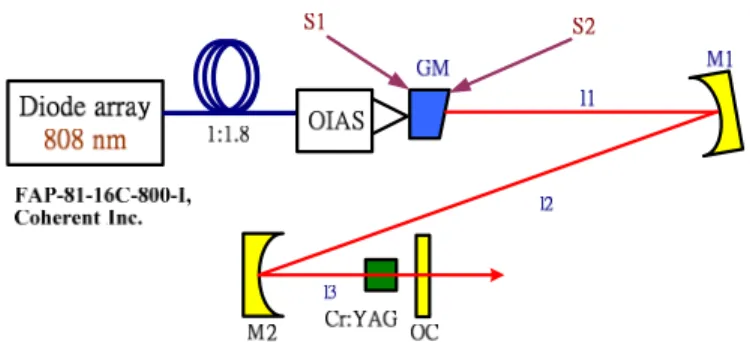
The schematic setup of our laser with folded z-configuration is shown in Fig. 1. A fiber-coupled diode-array laser (FAP-81-16C-800-I, Coherent Inc.) with center wavelength of 809 nm was used as the pump source. The output beam from the fiber was imaged on the laser crystal, which is a 3x3x8 mm3 a-cut Nd:LuVO4 crystal (with 0.5-at.% Nd3+ concentration), through an 1:1.8 optical imaging accessory (OIA's, Coherent Inc.). One side of laser crystal (S1) is high reflection (HR) coated at 1064 nm and anti-reflection (AR) coated at 808 nm as an end mirror of the resonator; while the other side (S2) with 2 degree wedge is AR coated at 1064 nm. Two curved mirrors M1 and M2, with radii of curvatures of 500 and 200 mm, were used as folding mirrors to conduct cavity beam through a Cr4+ :YAG to the output coupler (OC). The distance between the gain medium and M1 is 30 cm, that from M1 to M2 is 80 cm and from M2 to OC is 13.5 cm. We put Cr4+ :YAG about 10.5 cm in front of the output coupler. We therefore can estimated the beam diameter at Cr4+ :YAG to be about 150 μm. We chose different combinations of OC with reflectivity of 60% and 80% at 1064 nm and Cr4+:YAG saturable absorber with initial transmittance T0 of 80%, 55% and 40% to optimize the generated QML pulses.
The output of the Nd:LuVO4 laser from either OC or the wedged facet of the laser crystal was measured by a power meter (Ophir Inc.) or detected by a high speed InGaAs detector (Electro-Physics Technology, ET 3000) that was connected to the oscilloscope (LeCroy LT372, bandwidth 500 MHz) or an optical spectrum analyzer (Ando-AQ6315A) with resolution of 0.01 nm. A noncollinear autocorrelator containing a 2-mm thick type-I BBO was used to measure the width of mode-locked pulse.
Fig. 1. Schematic diagram of diode-pumped Q-switched mode-locked Nd:LuVO4 laser. GM is gain medium (Nd:LuVO4), M1 and M2 are the folding mirrors and OC is the output coupler.
3. Results and discussion
The output powers versus pump power (Pp) at the CW states (black squares) and the QML states in use of T0 = 80% ((blue diamonds), 55% (green triangles) and 40% (red circles) were shown in Fig. 2(a). As expected, the QML state can be operated provided that lasing threshold is achieved after the saturable absorbing Cr4+:YAG crystal having been inserted into the laser cavity. Besides, the lasing threshold increases, the output power becomes lower as increasing the cavity loss via lowering R and T0. With the same T0, the output power using R = 80% [solid symbols] are generally higher than that of using R = 60% (open symbols). Although the non-saturable absorbing and even the thermal induced loss of the saturable absorber also influence the threshold
,
due to the cavity beam passing twice through the absorber and beingreflected once by the OC in a round trip, more influence of the threshold and the output power on T0 (dependence of T02) than on R. In Fig. 2(a), we obtained the larger stable range of QML operation using Cr4+:YAG than that in use of SESAM [1] or NLM [2], in which the QML state can usually be observed before entering completely CW-ML state as increasing the pump power but the operation range is very small. The QML state can only be observed as the pump powers increased from 1.7 W to 2.6 W for SESAM [1] and 2 W to 2.3W for NLM [2].Similar effects of T0 and R can be found in the repetition rates (Rep) of the Q-switched envelope which were revealed in Fig. 2(b), the values show increase tendency as increasing the pump power. With the same T0 and pump power, the value of Rep for R = 80% is slightly higher than R = 60%. In use of R = 60%, the highest value of Rep for T0 = 80% is about 68 kHz that is relatively higher than the 23 kHz and 14 kHz as T0 = 55%, and 40%, respectively.
0 2 4 6 8 10 12 14 16 0.0 0.5 1.0 1.5 2.0 2.5 3.0 3.5 4.0 A v e rag e po we r(W) Pump power (W) CW @ R=80% CW @ R=60% QML @ R=80%, T0=80% QML @ R=60%, T0=80% QML @ R=80%, T0=55% QML @ R=60%, T 0=55% R=80%, T0=80% QML @ R=80%, T0=40% QML @ R=60%, T0=40% 0 2 4 6 8 10 12 14 16 0 20 40 60 80 R=60%, T0=80% R=80%, T0=55% R=60%, T0=55% R=80%, T0=40% R=60%, T0=40% Rep e tion ra te (k H z ) Pump power (W)
(a)
(b)
Fig. 2. (a). The average output powers, and (b) the repetition rates versus the pump power at the CW state (black squares) and QML states with the T0=80% (blue diamonds), 55% (green triangles), and 40% (red circles).
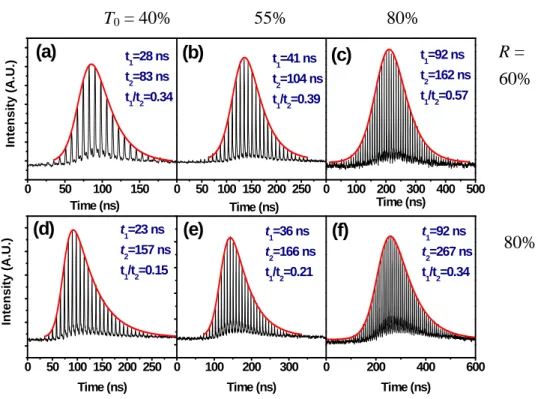
The expanded Q-switching envelopes in use of the pump power of 13.5 W are shown in Fig. 3. Inside the envelope, a number of discrete and periodic mode-locking (ML) pulses with time interval about ~ 8 ns can obviously be seen. The width of the stable ML pulse was measured using an autocorrelator and shown in Fig. 4 (black squares) that reveals the pulsewidth t0 about 56 ps by fitting to the Sech2 shape (red curve). In this experiment, three different initial transmittance of Cr4+:YAG, T0 = 40%, 55%, and 80% as three columns in Fig. 3, were used to match with reflectance of OC, R = 60% and 80%, as two rows in Fig. 3. By fitting the envelopes with the formula
( ) {exp[( . * / ] exp[ . * / ]} = + − 2 1 1 76 1 76 a P t t t t t2
,
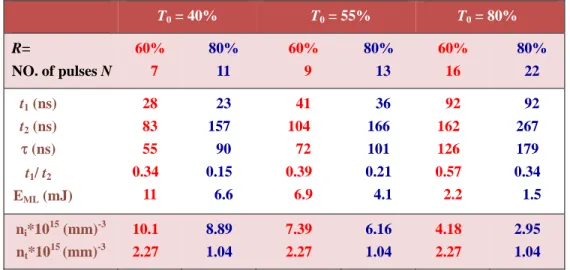
(1) in which a is the scaling factor, we could obtain the rising time t1 and the falling time t2 of the Q-switched envelopes, respectively. Therefere, the widths and asymmetric factors of these Q-swithced envelopes can be estimated by the definition of τ = (t1+t2)/2 and t1/t2. Together with the numbers of ML pulses (N) in each Q-switched envelopes, the energies of the highest ML pulses (EML), and the the calculated initial inversion (ni) and the threshold inversion (nt) for different R and T0 were listed in Table I. These listed parameters can also be theoretically calculated using the model proposed by J. Liu et al. [16] if the laser parameters including the stimulated emission cross section of gain medium and the absorption cross section of saturable absorber are given.Table I T0 = 40% T0 = 55% T0 = 80% R= NO. of pulses N 60% 7 80% 11 60% 9 80% 13 60% 16 80% 22 t1 (ns) t2 (ns) τ (ns) t1/ t2 EML (mJ) 28 83 55 0.34 11 23 157 90 0.15 6.6 41 104 72 0.39 6.9 36 166 101 0.21 4.1 92 162 126 0.57 2.2 92 267 179 0.34 1.5 ni*1015 (mm)-3 nt*1015 (mm)-3 10.1 2.27 8.89 1.04 7.39 2.27 6.16 1.04 4.18 2.27 2.95 1.04
Generally, t1, t2 and τ decreases as T0 decreases, no matter what reflectance of OC were used. However, the rising time t1 strongly depends upon T0 but it has a little effect on change ofR. In contrast, the falling time t2 increases as both T0 and R increase. It may be due to that the rising time t1 is mainly determined by the initial inversion ni, in which the initial spontaneously emitted photons (ni) begin to experience positive net gain. The initial inversion is defined as 2 0
ln(1/
) ln(1 / )
2
iT
R
n
l
σ
L
+
+
=
, (2) where L is nonsabturable intracavity round-trip optical loss, σ and l are the stimulated emission cross section and the length of gain medium. The larger initial emitted photons ni,the faster is to extract energy stored in gain medium so as to bleach the saturable absorber and to reach the threshold inversion nt with T0 ~ 1. This results in the smaller t1. Because ni quadraticlly depends on T0 but only linearly on R in Eq. (2), the calculated ni (also listed in Table I) using σ = 1.46x10⁻¹⁸ cm2 for the used a-cut Nd:LuVO
4 crystal and L = 2% reveal consistent dependence of t1. On the other hand, the falling time t2 measures the decay time of cavity photons after the absorber being completely bleached, and therefore, is related to the photon lifetime according to
(1 ) f nl t c R ≈ − , (3) Here, n is the index of the gain medium and c is the velocity of the light. Thus, the longer t2 is expected for the larger R no matter what T0 is used. Nevertheless, it is not the case in Fig. 3 and Table I, in which the laser with the lower T0 experiences the shorter decay time t2. The dependence of t2 on T0 could be due to temporal shaping via the recovered absorption of the absorber with lower T0 or larger absorption which possesses the higher concentration of
absorptionions to raise the cavity loss in the falling tail of the QML pulse. 0 50 100 150 t1=28 ns t2=83 ns t1/t2=0.34 t1=41 ns t2=104 ns t1/t2=0.39 In ten s it y (A.U.) Time (ns)
(a)
0 50 100 150 200 250 Time (ns)(b)
0 100 200 300 400 500 t1=92 ns t2=162 ns t1/t2=0.57 Time (ns)(c)
0 50 100 150 200 250 t1=23 ns t2=157 ns t1/t2=0.15 In te n s ity (A. U .)(d)
0 100 200 300T
0= 40%
55%
80%
R
=
60%
Time (ns) t1=36 ns t2=166 ns t1/t2=0.21(e)
0 200 400 600 Time (ns) t1=92 ns t2=267 ns t1/t2=0.34(f)
80%
Time (ns)Fig. 3. Expanded temporal shape of a single Q-switched & mode-locked pulse trains at 13.5W pumping for R = 60% with T0 =40% (a), 55% (b), and 80% (c); and R =80% with T0 =40% (d), 55% (e), and 80% (f).
-80 -60 -40 -20 0 20 40 60 80
Experimental measured data Fitting results Inte ns ity (A .U ) Time (ps)
Fig. 4. The measured autocorrelation trace (solid squares) and fitting curve by Sech2 function.
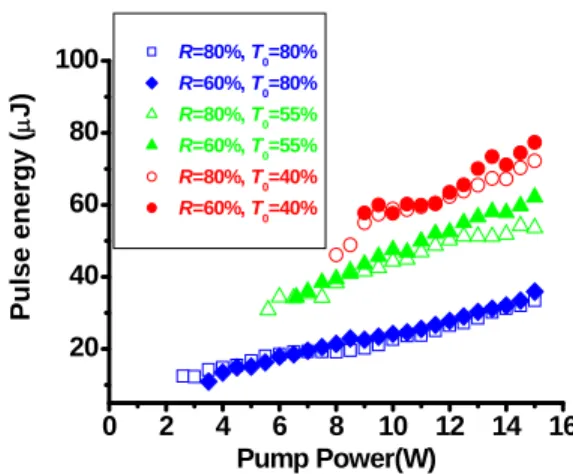
In Fig. 5, the pulse energies EJ of the Q-switching envelope were estimated by dividing the average output power P0 into the repetition rate Rep of the envelope. EJ shows increase tendency as the pump power increases. Due to apparently decrease of Rep for the lower T0 (Fig. 2(b)), EJ for T0 =40% are higher than those of T0 =55% and 80% in Fig. 5. At 15 W pumped power, the highest pulse energies of about 77 μJ can be obtained for R = 60% and T0 = 40%. With the same T0,the obtained pulse energies have no much difference for R = 80% and 60% due to similar average output power and repetition rate. However, the pulse
energy and peak power for single ML pulse for R = 60% are higher than R = 80% due to less number of pulses in each Q-switched envelope or shorter Q-switched pulse width. The estimated pulse energy for each ML pulse is calculated by EJ/N that was presented in Table I. At 15W pump power, the highest peak power of ML pulses calculated by 0
0 p ep P P NR t = is
about 200 kW for R=60% and T0=40%, where P0 is the average output power, Rep is the repetition rate of the Q-switched envelope, N is the number of pulses within a Q-switched envelope, and t0 is the pulsewidth of the mode locking pulses.
0 2 4 6 8 10 12 14 16 20 40 60 80 100 Pulse energy ( μ J) Pump Power(W) R=80%, T 0=80% R=60%, T0=80% R=80%, T 0=55% R=60%, T0=55% R=80%, T 0=40% R=60%, T 0=40%
Fig. 5. The estimated pulse energy versus the pump power at the QML states with the T0=80% (blue diamonds), 55% (green triangles), and 40% (red circles).
4. Conclusion
We have demonstrated the stable Q-switched and mode-locked operation of the Nd:LuVO4 laser in use of the Cr4+:YAG as the saturable absorber. The operation range of QML in use of the Cr4+:YAG is larger than that use of SESAM and NLM. The obtained shape of Q-switched envelope, repetition rate and pulse energy are demonstrated to depend on the initial transmittance of the Cr4+:YAG and reflectivity of the output coupler. Using R = 60% and T0 = 40%, the highest pulse energy of 77 μJ of each Q-switched envelope, and the highest peak power about 200 kW of Q-switched mode-locked pulses can be obtained at 15 W pump power. It demonstrate the superior characteristic of the Nd:LuVO4 crystal.
Acknowledgments
This work is supported by the Natural Science Council of Taiwan, Republic of China, under grant NSC 96-2112-M-027-002-MY3, NSC 96-2112-M-035-001 and NSC