I
中文摘要
本計畫擬採用Colburn 類比理論解析飽和蒸汽流經一變溫壁的水平橢圓管上的紊流
膜狀凝結熱傳。主要研究壓力梯度,汽體界面剪應力,渦流熱擴散度效應以及表面不均
勻溫度等效應對局部凝結液流動分析,並探討凝結液脫離表面的臨界角度,進而探討對
局部熱傳以及平均熱傳的影響。
本計畫將針對不同的蒸汽流速,給予不同的雷諾參數之冪次方值,採用數值階數法並
搭配相關實驗參數加以分析,同時採用Kato 渦流理論探討研究凝結液由層流發展至紊
流之流動,以及發生凝結液脫離表面的臨界角度;於表面不均勻溫度分佈則採用大渦流
假設模擬,並且將研究成果與前人的圓管(特例)實驗數據相比較。最後本計畫將與前人
所做的特例圓管等溫壁情況的結果以及申請人先前強制對流模型結果比較。本計畫亦將
使膜狀凝結熱傳理論,由自然對流、強制對流到紊流,推導一個完整的凝結熱傳分析,
提供冷凝器相關設計業者參考。
關鍵詞:紊流,膜狀凝結,橢圓管,渦流擴散效應,變溫壁效應,壓力梯度。
英文摘要
The turbulent film condensation of pure vapor flowing onto a horizontal elliptical tube with
variable wall temperature is studied theoretically by employing Colburn analogy. The effects
of the pressure gradient, the interfacial vapor shear stress, the eddy thermal diffusivity and the
tube wall temperature non-uniformity on the local condensate film flow are investigated here.
The critical angle for the local condensate film flow is considered too. Further, the above
effects on local and mean heat transfer coefficients are then studied.
The values of power of "Re" are specified respectively for the various corresponding region of
steam velocities. The order of magnitude is adopted for the related experimental parameters in
the present study. Meanwhile, the Kato eddy theory is used in studying that the condensate
film flow developed from laminar zone to turbulent zone, and the critical angle for the
condensate film separated from the tube wall. The present project employs the large eddy to
simulate the profile of the wall temperature non-uniformity .The present result is compared
with the experimental data in the former study for the case of circular tube. Finally, the
present result is also compared with that for the isothermal circular tube and that for forced
convection film condensation by the applicant et al. The present project will make the film
condensation study form a complete heat transfer analysis including in the fields of natural
convection, forced convection and turbulent flow. Besides, it will offer the condenser
designer a reference data in the future.
Keyword:Turbulent, Film condensation, Elliptical tube, Eddy diffusivity effect, Variable
II
1.
Turbulent Film Condensation on a Horizontal Elliptical Tube with Variable Wall
Temperature,已發表至 Journal of Marine Science and Technology, Vol. 12, No. 4, pp.
300~308(2004).
2.
Turbulent Film Condensation on a Horizontal Elliptical Tube 已發表至 Heat and Mass
Transfer, Accepted : 5 October 2004.
300 Journal of Marine Science and Technology, Vol. 12, No. 4, pp. 300-308 (2004)
TURBULENT FILM CONDENSATION ON A
HORIZONTAL ELLIPTICAL TUBE WITH
VARIABLE WALL TEMPERATURE
Yan-Ting Lin* and Sheng-An Yang**
Paper Submitted 08/09/04, Accepted 10/14/04. Author for Correspondence: Sheng-An Yang. E-mail: [email protected].
*Postgraduate student, Department of Mold and Die Engineering, National Kaohsiung University of Applied Sciences, Kaohsiung, Taiwan 807. **Professor, Department of Mold and Die Engineering, National Kaohsiung
University of Applied Sciences, Kaohsiung, Taiwan 807.
Key words: turbulent, tube, ellipticity, film condensation, variable wall temperature.
ABSTRACT
An analytical model has been developed for the study of turbu-lent film condensation from downward flowing vapors onto a horizon-tal elliptical tube with variable wall temperature. The interfacial shear at the vapor condensate film is evaluated with the help of Colburn analogy. The condensate film flow and local/or mean heat transfer characteristics from a horizontal elliptical tube with non-uniform temperature variation under the effect of Froude number, sub-cooling parameter and system pressure parameter has been conducted. Although the non-uniform wall temperature variation has an appreciable influence on the local film flow and heat transfer; however, the dependence of mean heat transfer on the non-uniform wall temperature variation is almost negligible.
INTRODUCTION
Film-wise condensation heat transfer is widely used in power plant system, air-conditioning equipment, and much other chemical industrial process equipment. For laminar film condensation with constant properties and ignoring the vapor velocity, the assumption of the simple Nusselt theory (Nusselt 1916) have been pro-vided in later and more complete studies to be basically accurate. Shekriladze and Gomelauri (1966) first con-sidered forced convection film condensation from a vapor flowing downward to a horizontal circular tube, and obtained numerical solutions by utilizing the as-ymptotic shear stress at the interface. Rose (1984), Memory et al. (1993; 1995) and Michael et al. (1989) investigated the forced convection laminar condensa-tion on a horizontal tube in experimental data and theoretical analysis. They found the agreement
be-tween the two to be very satisfactory.
As far as enhancing film condensation is concerned, a horizontal elliptical tube with its major axis aligned in a gravitational direction can serve to thin the conden-sate film not only through surface tension (manifested by the curvature of surface) but also through an in-creased effect of gravity as a result of placing a larger proportion of the condensing surface in line with the vertical. Yang and Hsu (1997, 1999) further studied the gravity effect, pressure gradient effect, and vapor shear effect on film flow and heat transfer, due to curvature of mixed convection laminar film condensation on a hori-zontal elliptical tube for variable ellipticities, e. They found that for fixed conditions, the mean Nusselt num-ber increases as the value of e increases. However, these works for horizontal configuration do not deal with flow regimes involving wavy condensate or turbu-lent vapor.
For the condensate film of high velocity vapor flow around a cylinder tube, Michael et al. (1989) presented that the condensate film can be under a turbu-lent regime. Sarma et al. (1998) used Kato’s model (Kato et al., 1968) of eddy diffusivity in the condensate film and assumed that the friction coefficient at liquid vapor interface is identical to that in vapor flow, and found that their results were in good agreement with experimental data relating to the condensation of steam flowing under a turbulent regime. More recently, Homescu and Panday (1999) used an implicit scheme to solve the film condensation on an isothermal horizontal tube under pure vapors flowing vertically and obtained the numerical solution of coupled liquid-vapor inter-face for Kato’s model (Kato et al., 1968) in liquid phase and Pletcher’s model in vapor phase.
There are several studies concerning the effect of the non-uniform wall temperature variation on laminar forced convection film condensation, like in circular tube by Memory et al. (1993) and Hsu and Yang (1999), in elliptical tube by Yang and Hsu (1999). But, few studies on turbulent film condensation concerning the effect of wall temperature variation have been
pre-Y.T. Lin & S.A. Yang: Turbulent Film Condensation on a Horizontal Elliptical Tube with Variable Wall Temperature 301
sented so far.
To consider more general wall temperature condi-tion other than the isothermal wall case presented by Lin and Yang (2004), the present paper investigates in more detail the effect of the wall temperature variation on the turbulent film condensation from downward flowing vapors onto a horizontal elliptical tube. Our major aim is to extend the work of Sarma et al. (1998), which regarding turbulent convection film condensa-tion on a circular tube into that on an elliptical tube by further inclusion of the non-uniform wall temperature variation effect. Besides, instead of a fixed n (power of Reynolds) value in Sarma et al. (1998), the appropriate
n for various vapor velocities has been adopted for
analysis in the present study.
ANALYSIS
Consider a pure saturated vapor at temperature Tsat
and at uniform velocity u∞, flowing downward over a
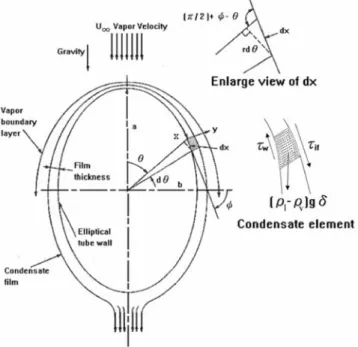
horizontal elliptical tube with its major axis “2a” ori-ented in the direction of gravity, as seen in Fig. 1. The non-uniform wall surface temperature Tw is below the
saturation temperature. Thus, condensation occurs on the wall and a continuous film of liquid condensate runs downward over the tube under the combined effects of gravity and interfacial vapor shear. Similar to Sarma et
al. (1998), one may assume that condensate film can be
under turbulent regime for very high velocity of vapor flow.
As seen in Yang and Hsu’s studies (Yang and Hsu, 1997a, b, 1999), the physical model under consideration
is also shown in Fig. 1, where the curvilinear coordinate (x, y) are aligned along the elliptical wall surface and its normal and ϕ(x) is the angle between the normal to
gravity and which tangent to the outer tube wall at the position (r, θ). The boundary layer approximated
en-ergy equation for the steady condensate film flow gives
u ∂ T
∂x + v ∂ T∂y = ddy (α + εH) d Tdy (1)
The momentum equation in conjunction with force balance can be arranged as
τw = gδ(ρl− ρv) Sinφ + τδ (2)
At the interface the phase transformation is given by the condition. d dx 0 ρl δ udy = kl hfg d T dy y = 0 (3) It is noted here, Eq. (2), reflects a force balance of gravity, wall shear and interfacial vapor shear effects. Eq. (3) is the energy balance between the latent heat released at the interface through conduction of conden-sate film to the wall surface.
Introducing a parameter e = a2– b2
/ a , called an ellipticity of the ellipse, as seen in Yang and Hsu’s studies (1997a, b; 1999), one may derive the differential stream wise length in terms of e in following relation-ship
dx = a(1 − e2
)dφ/(1 − e2
sin2φ)3/2
(4) Thus, inserting Eq. (4) into Eq. (3) yields
(1 – e2sin2 φ)3 / 2 (1 – e2) ∂ ∂φ ρl 0 δ udy = kl hfg a ∂ T∂y y = 0 (5) For a circular cylinder in external flow, the mean Nusselt number can be stated in terms of Prandtl and Reynolds number by using a semi-empirical equation, as seen in Incropera and DeWitt (1990).
Nu = CRev Pr
1 / 3
n
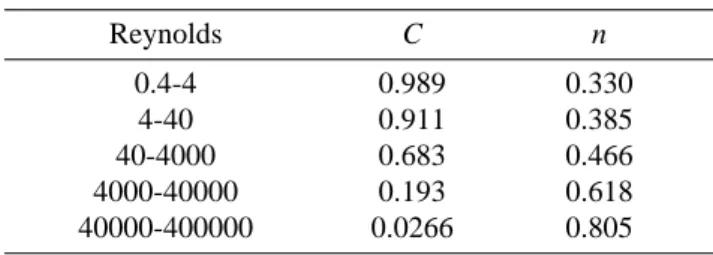
(6) where the constants C and n are listed in Table1.
According to Yang and Hsu’s works for forced convection film condensation (Yang and Hsu, 1997ab, 1999), the semi-empirical equation for the heat transfer in the flow parallel to a moderately curved surface may also apply to that in the flow on a horizontal elliptical tube.
Further, using Colburn’s analogy, one has
Journal of Marine Science and Technology, Vol. 12, No. 4 (2004) 302 Nu RevPr Pr2 / 3= f / 2 (7)
From Eq. (6) and Eq. (7), we have the mean fric-tion coefficient as
f = 2CRevn − 1 (8)
As mentioned in the result calculated by Homescu and Panday (1999) and Sarma et al. (1998) assumption, they define local friction coefficient in terms of a sinu-soid function for a circular tube. Since a circular tube is a special kind of elliptical tubes, we may assume the similar frictional coefficient profile as follows:
fφ = Cπ(Revn − 1) sinφ (9)
The local skin shear stress is defined as
τδ= 1 2(ρv) (ue
2) f
φ (10)
Using potential flow theory for a uniform flow with velocity u∞ past an elliptical tube, one may derive
the vapor velocity at the edge of boundary layer as
ue= u∞(1 + 1 – e2) Sinφ (11)
From the Eqs. (9), (10) and (11) the liquid-vapor interfacial shear stress can be obtained as.
τδ= 2– 1(C)(π)(ρv)(u∞2)(1 + 1 – e2) 2 (Rev n – 1 ) Sin3φ (12) Finally, Eq. (2) is rewritten as follows
τw= gδ (ρl–ρv) Sinφ + 2 – 1 (C)(π)(ρv)(u∞2)(1 + 1 – e2)2(Re v n – 1 ) Sin3φ (13) Since the condensate film is sufficiently close to the solid wall, the turbulent conduction across the
con-densate film is more significant than the convective component. As mentioned in Bejan (1995), the energy equation (Eq. (1)) reduces to.
d
dy (α + εH) d Tdy = 0 (14)
subjected to the following boundary conditions
T = Tw at y = 0 (15) T = Tsat at y = δ (16)
Assuming the turbulent Prandtl number (Prt = εM/
εH) equals unity in Eq. (14) yields.
d dy 1 +
εM
vl Pr d Tdy = 0 (17)
By introducing the dimensionless groupings, Eqs. (5), (13) and (17) can be restated as follows.
d dy+ 1 + εM vl Pr dT + dy+ = 0 (18) (1 – e2Sin2 φ)3 / 2 (1 – e2) ∂ ∂φ 0 ( δ + u+) dy+ = (S)(Re*)(Gr1 / 3dT + dy+ y + = 0 (19)
(Re*) =δ+Sinφ + (Re*)(ϕ) (Fr)(n + 1) / 2(1 + 1 – e
2)2 4 Sin
3
φ
(20) with dimensionless boundary conditions for Eq. (18) as follows: T+ = 0 at y+ = 0 (21) T+ = 1 at y+ = δ+ (22) In order to obtain the temperature gradient in the close vicinity of the tube, we refer to the Kato’s expres-sion (Kato et al., 1968) for eddy diffusivity,
εM vl = 0.4y
+[1 – exp ( – 0.0017y+ 2)]
(24) Then, specifying or fitting the wall temperature distribution from measured data, one can then calculate the mean wall temperature, as reviewed in Yang and Hsu (1999);
Table 1. Values of C and n in equation (6)
Reynolds C n 0.4-4 0.989 0.330 4-40 0.911 0.385 40-4000 0.683 0.466 4000-40000 0.193 0.618 40000-400000 0.0266 0.805
Y.T. Lin & S.A. Yang: Turbulent Film Condensation on a Horizontal Elliptical Tube with Variable Wall Temperature 303 T w= Tw 0 π (φ) dφ / π (25)
and derive the temperature difference across the film in the usual manner ,as reviewed in Hsu and Yang’s model (Hsu and Yang, 1999) ; Memory et al. (1993)
∆T = ( T sat– Tw) (1 – A cosφ) = ∆T (1 – A cos φ)
(26) where, A is a constant (0 ≤ A ≤ 1) and denotes the wall
temperature variation amplitude. Combining Eqs. (18), (24), (25) and (26) to eliminate the temperature gradient for situation at the elliptical tube closed to the wall yields ∂T+ ∂y y + = 0= (1 – A cosφ) 1 + Pr εM vl 0 δ + dy+ 1 + Pr εM vl – 1 (27) Before proceeding to obtain the solution of Eq. (19) and thence to calculate the velocity profile in condensate film, according to the Sarma et al.’s study (1998), the universal velocity distribution is being used in the estimation of discharge rate of the condensate at any angular location. So we may assume that τδ is of the
same order as τw and be considered as a valid
ap-proximation. As seen in Bejan (1995), the velocity profile of condensate film can be obtained from
∂u+
∂y+= (1 +εM/ vl)
– 1
(28) with the boundary condition at
u+
= 0 at y+
= 0 (29)
Since the temperature distribution of condensation film is linear, Fourier’s law may be used to express the surface heat flux as
kl dT
dy y = 0= h( T sat– Tw) (30)
As in Nusselt’s theory, the dimensionless local heat transfer coefficient may be expressed as
Nu = Re+dT+ dy+ y + = 0 (31) and Nu Rel 1 / 2= ∂T + ∂y+ y + = 0 (Re*) Gr1 / 3 Fr 1 4 2 (32)
We are also interested in an expression for the
overall mean heat transfer coefficient. The Integrals of Eqs. (31) and (32) become.
Nu = Nu 0 π (1 – e2sin2 φ) – 3 2dφ / ( 0 π 1 – e2sin2 φ) – 3 2dφ (33) and Nu Rel 1 / 2= 2 Gr1 / 3 Fr 1 4 0 π ∂T+ ∂y+ y + = 0 (Re*) (1 – e2sin2 φ) – 3 2dφ 0 π (1 – e2sin2φ) – 3 2dφ (34) NUMERICAL METHOD
To start the calculation, we assume that the dimen-sionless condensate film thickness and the liquid film velocity at the upper stagnation point of elliptical tube to be zero, initially. Then, the next liquid film thickness and velocity are obtained by using the dimensionless governing equations (18), (19) and (20).
For a given condition, a brief outline of the solu-tion procedure is given as follows:
(1) Indicate the fixed physically environment param-eters of S, Fr, Gr, A and e.
(2) The dimensionless film thickness and velocity pro-files are assumed to be zero (δ+
= 0, u+
= 0) for the node i = 1 at the upper stagnation point.
(3) Substituting ∆φ = π/500 and ∂T+
/∂y+
)y+ = 0 into Eq.
(19) and Eq. (20).
Then using the Newton’s method for different ∆δ+
to iterate till the following convergence criteria are satisfied. (Re*)3–δ+ Sinφ – (Re*)(ϕ)(Fr)(n + 1) / 2(1 + 1 – e2) 2 4 Sin 3 φ ≤ 10e – 6 and Re*= (1 – e2Sin 2 φ)3 / 2 (1 – e2) (Gr1 / 3 )(S) ∂T + ∂y+ y + = 0 ∂ ∂φ (u +) 0 δ + dy+ where ∂ ∂φ (u +) 0 δ + dy+= ∆δ + ∆φ ui++ ui+ 2 ∂u+ ∂y+ y + =δ +
Journal of Marine Science and Technology, Vol. 12, No. 4 (2004)
304
(4) W h e n t h e i n c r e m e n t o f d i m e n s i o n l e s s f i l m thickness (∆δ+
) for node i = i + 1 is convergent, the next film thickness for node i = 2 is expressed as δi + 1
+ =δi
+
+ ∆δ+ and its corresponding angle
φi + 1=φi+ π 500π500 .
(5) Repeating above calculations from step-3 to step-4 to find out all the needed values up to φ = π. Finally,
both the dimensionless local and mean Nusselt num-bers are determined from Eq. (32) and Eq. (34).
RESULTS AND DISCUSSION
Two parts: hydrodynamics of condensate film flows and characteristics of condensation heat transfer are presented and discussed in this section.
1. Flow hydrodynamics of condensate film
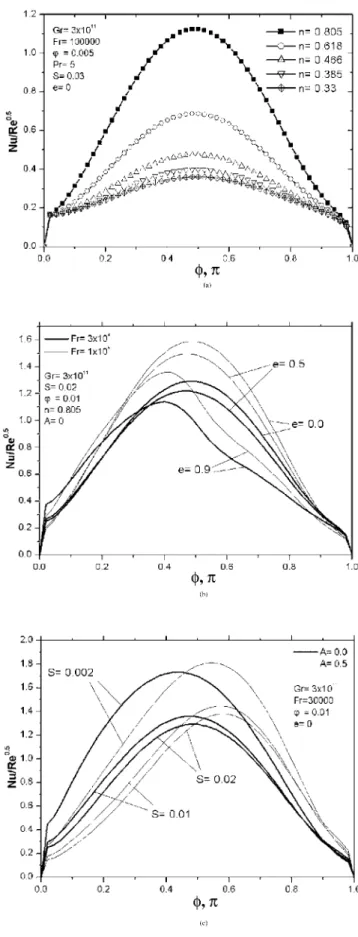
Figures 2a, 2b and 2c show the dimensionless film thickness profiles around the periphery of elliptical tube for different parameters including non-uniformity varia-tion amplitude A, n (power of Reynolds), ellipticity e, and Froude number.
When e = 0 (circular tube) and A = 0 (isothermal wall), the dimensionless local film thickness profile coincides with Sarma et al. (1998) in Fig. 2a and b. We take the wall temperature variation amplitude as “1 − A
cosφ“ instead of “1” (isothermal case) to evaluate ∂T+
/
∂y+
)y+ = 0 in Eq. (27). This leads to a smaller δ+ for A ≠
0 cases on Eq. (19). Hence, the local film thickness profile for A ≠ 0 is smaller than that for A = 0, as seen in
Figs. 2a and 2b.
Since the larger value of sub-cooling parameters “S” will enhance the larger condensate mass flow occurring, hence, the condensate film thickness δ+
in-creases with the value of S in Eq. (19), as seen in Fig. 2a. A larger value of Fr i.e. a higher velocity of vapor flow will lead to a higher condensate mass flow rate. Hence, the condensate film thickness increases with Fr, as seen in Fig. 2c.
As e approaches unity, δ+
becomes thinner due to the more favorable pressure gradient effect for a larger
e, as seen in Fig. 2b. For different values of n, Fig. 2c
shows that the condensate film thickness for laminar vapor flow zone (with low value of n) is smaller than that for turbulent vapor flow zone (with high value of n).
2. Characteristics of heat transfer
(1) Profile of the local heat transfer
From the thermal point of view, Figs. 3a, 3b and 3c show the influences of S, Fr, e, A, and n upon the local
Y.T. Lin & S.A. Yang: Turbulent Film Condensation on a Horizontal Elliptical Tube with Variable Wall Temperature 305
to Eq. (19) and Eq. (32), one may see that when φ = π/
2 around; Nu reaches a maximum value. When n = 0.805 in Fig. 3a, e = 0 in Fig. 3b, and A = 0 in Fig. 3c, the corresponding result agrees with Sarma et al. (1998). Further, as n is increasing, the local heat transfer coef-ficient is decreasing due to its film thickness increasing as in Fig. 3a.
According to Asbik et al. (2003), the transition angle usually occurs around 35 ± 20 degrees; depending
on the value of Fr. This point can be easily seen in Fig. 3b. Before the critical transition angle φc = 0.2π, the
film flow belongs to the laminar flow zone. Hence, the local Nusselt number is increasing with e due to δ+
decreasing with e. beyond the critical transition angle
φc (= 0.2π), the condensate film flow usually locates
within the turbulent flow zone. From Eq. (32), Nu is proportional to Re+
in terms of shear velocity u*
. Shear stress τw decreases with increase in e in Eq. (13),
be-cause the skin friction coefficient Cf of elliptical body
decreases with an increasing e. Further Re+
decreases with u*
. Beside, ∂T+
/∂y+
)y+ = 0 can be proved to be
insignificant variation with e. Thus, Nu decreases with
e, as seen in Fig. 3b.
From Eq. (32), one may see the ∂T+
/∂y+
)y+ = 0
depends on “1 − Acosφ”. As 1 − Acosφ decreases with
A before φ = π/2, the local dimensionless heat transfer
coefficient becomes smaller than that for A = 0. When
φ exceeds π/2, this situation becomes upside-down, as
seen in Fig. 3c.
(2) Performance of the mean heat transfer
In Fig. 4, as the interfacial shear parameter ϕ
increases, i.e. the system operating pressure increases, the mean heat transfer coefficient increases for e = 0 (Sarma’s case), e = 0.5 and e = 0.9. It is to be noted that the mean heat transfer coefficient is much more depen-dant on the system pressure in the vapor velocity region due to the onset of turbulent in the condensate film. Meanwhile, for a given value of S, increase in Fr will lead to increase in the mean heat transfer coefficient, which apply to e = 0, 0.5 and 0.9.
In Fig. 5, it is obviously seen that the mean heat transfer coefficient decreases with increase in S for e = 0 (Sarma case) and e = 0.5. This trend can be explained from Fig. 3b and 3c, i.e. because the local heat transfer coefficient decreases with increase in S around the periphery of tube.
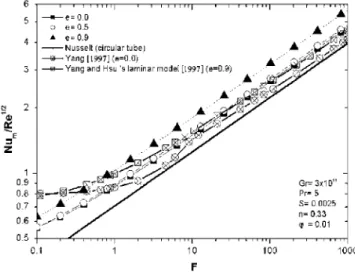
In Fig. 6, for fixed values of Fr and S, when order of F is greater than 1.0, Yang and Hsu’s solutions (Yang and Hsu, 1999) solutions from e = 0 to 0.9 tend to blend with Nusselt-type condensation. As F is increasing (lower velocity of vapor), the present result using turbu-lent model (n = 0.33) at e = 0, is larger than Yang and
Fig. 3. Dimensionless the local Nusselt number around periphery of ellipse.
Journal of Marine Science and Technology, Vol. 12, No. 4 (2004)
306
Hsu’s solution by 8.6% around. This difference is caused by eddy thermal effect. However, both models show a similar uptrend with an increase in F.
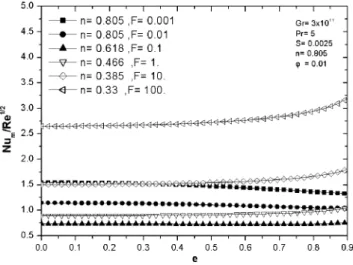
In Fig.7, for the range F < 1.0, i.e. higher velocity of vapor flow, it is obviously seen that the present result shows a downtrend with increase in F instead of nearly constant values for laminar model by Yang and Hsu’s solution (Yang and Hsu, 1999). For a circular tube (e = 0), the present result also shows in a good agreement with Michael et al.’s experimental data (Michael et al., 1989) as Sarma et al. (1998) did.
Figure 8 shows that, in general, the mean Nusselt number increases insignificantly with A regardless the values of F. For an elliptical tube with e = 0.5, as A increases to unity, the mean heat transfer coefficient decreases to 3.96% for F = 10, 3.04% for F = 1.0 and
Fig. 4. Effect of on the mean Nusselt number.
Fig. 5. Effect of S on the mean Nusselt number.
Fig. 6. Effect of F on the mean Nusselt number.
Fig. 7. Effect of F on the mean Nusselt number.
2.78% for F = 0.1, respectively.
In Fig. 9, as e increases to 0.9, the mean heat transfer coefficient decreases to 13.9% for F = 0.001 and 8.01% for F = 0.01, respectively. But for F = 0.1, it increases to 4.63%. Next, for natural film condensa-tion dominated case, the mean heat transfer coefficient increases to 18.6% for F = 1, 21.7% for F = 10, and 22.2% for F = 100, respectively. In practical applica-tions, for lower velocity of vapor flow (or higher F), the mean heat transfer coefficients for elliptical tubes (with major axis oriented in gravity) are lager than that for a circular tube, as seen in Fig. 9. However, for higher velocity of vapor flow (or lower F), the mean heat transfer characteristics for a circular tube is better than that for an elliptical tube (with major axis oriented in gravity).
Y.T. Lin & S.A. Yang: Turbulent Film Condensation on a Horizontal Elliptical Tube with Variable Wall Temperature 307
CONCLUDING REMARKS
The analytical study of turbulent film condensa-tion on a horizontal elliptical tube has been conducted by using potential flow theory and Colburn analogy for interfacial shear at the interface for high velocity vapors. The following conclusions have been drawn from the present results.
(1) Instead of a fixed value of n (power of Reynolds) in Sarma (1998), we adopt the appropriate values n for the various film flow velocity (or F). For lower velocities of vapor flow, the present results coin-cides with pure laminar model’s results or Nusselt-type solution better than that in Sarma (1998). (2) For very high velocities of vapor flow, the present
turbulent model also coincides with Michael’s ex-perimental data (Michael et al., 1989) better than laminar model’s result by Yang and Hsu (1999) and Yang (1997).
(3) The present turbulent model shows a significant downtrend in the mean heat transfer coefficient as increase in F (up to F = 1.0), instead of insignificant variation with F in Yang and Hsu (1999).
(4) The effect of the non-uniform wall temperature variation A on the mean heat transfer coefficient can be ignored regardless the values of F.
ACKNOWLEDGEMENT
Funding for this study was provided by National Science Foundation, Taiwan, R.O.C. under the grant number NSC93-2212-E-151-002.
NOMENCLATURE
A the wall temperature variation amplitude
a, b semi-major and semi-minor axis of ellipse
CP specific heat of condensate at constant
pressure
e ellipticity of ellipse, 1 – (b / a) 2
F dimensionless inverse vapor velocities, 2/ (Fr S)
Fr Froude number, u∞2 / ga
f average friction coefficient
fφ local friction coefficient
Gr Grashof number, ga 3
vl2
ρl–ρv
ρl g acceleration due to gravity
h local heat transfer coefficient
hfg latent heat of condensate
k thermal conductivity of condensate
Nu Nusselt number, h(2a)/kl n the power of Reynolds
Pr Prandtl number, v/α
Rel, Rev Reynolds number, u•2a/vl, u•2a/vv Re*
shear Reynolds, Re+
/Gr1/3
Re+
shear Reynolds parameter, au*
/vl
S sub-cooling parameter, CP ( Tsat– T w) /
(hfgPr ) T temperature
T+
dimensionless temperature, ( T – T w) /
( Tsat– T w)
u velocity component in x-direction
ue the tangential vapor velocity at the edge of
the boundary layer,
u*
shear velocity, (τw/ρl)1/2
y coordinate normal to the elliptical wall
y+
dimensionless distance normal to the elliptical wall, yu*
/vl
Fig. 8. Dependence of mean Nusselt number on the non-uniform wall temperature variation A.
Journal of Marine Science and Technology, Vol. 12, No. 4 (2004)
308
Greek symbols
δ local condensate film thickness
δ+
dimensionless film thickness, δu*
/vl
ϕ interfacial shear parameter, 2nπC ρv ρl vl vv n – 1 Gr(3n – 1) / 6
φ the angle between the tangent to tube sur-face and normal to direction of gravity
∞ in the free stream
τ shear stress
v kinematic viscosity
ρ density
εM momentum eddy diffusivity
εH thermal eddy diffusivity
θ angle measuring from top to tube
α thermal diffusivity
Subscripts
l condensate film
v vapor
δ vapor-liquid interface
w elliptical tube wall
c critical condition
sat saturation
Superscripts
− mean values
REFERENCES
1. Asbik, M., Boushaba, H., Chaynane, R., Zeghmati, B., and Khmou, A., “Prediction of Onset of Boundary Layer Transition in Film Condensation on a Horizontal Ellip-tical Cylinder,” Numer. Heat Transf. Part A: Appl., Vol. 43, pp. 83-109 (2003).
2. Bejan, A., “Turbulent Boundary Layer Flow,”
Convec-tion Heat Transfer, Vol. 7, 2nd ed., Wiley, New York,
pp. 293-324 (1995).
3. Homescu D. and Panday, P.K., “Forced Convection Condensation on a Horizontal Tube: Influence of Turbu-lence in the Vapor and Liquid Phases,” Trans. ASME, Vol. 121, pp. 874-885 (1999).
4. Hsu, C.H. and Yang, S.A., “Pressure Gradient and Variable Wall Temperature Effects during Filmwise Condensation from Downward Flowing Vapors onto a Horizontal Tube,” Int .J. Heat Mass Transf., Vol. 42, pp. 2419-2426 (1999).
5. Incropera, F.P. and DeWitt, D.P., “The Cylinder in
Cross Flow,” Introduction to Heat Transfer, 2nd ed., Wiley, New York, Vol. 7, pp. 380-381 (1990). 6. Kato, H., Shiwaki, N.N., and Hirota, M., “On the
Turbulent Heat Transfer by Free Convection from a Vertical Plate,” Int. J. Heat Mass Transf., Vol. 11, pp. 1117-1125 (1968).
7. Lin, Y.T. and Yang, S.A., “Turbulent Film Condensa-tion on a Horizontal Elliptical Tube,” Heat Mass Transf., (accepted in 2004).
8. Memory, S.B., Lee, W.C., and Rose, J.W., “Forced Convection Film Condensation on a Horizontal Tube-Effect of Surface Temperature Variation,” Int. J. Heat
Mass Transf., Vol. 36, pp. 1671-1676 (1993).
9. Memory, S.B., Lee, W.C., and Rose, J.W., “Forced Convection Film Condensation on a Horizontal Tube-Influence of Vapor Boundary-Layer Separation,” J. Heat
Transf., Vol. 117, pp. 529-533 (1995).
10. Michael, A.G., Rose, J.W., and Daniels, L.C., “Forced Convection Condensation on a Horizontal Tube-Experiments with Vertical Down-flow of Steam,” ASME
J. Heat Transf., Vol. 111, pp. 792-797 (1989).
11. Nusselt, W., “Die Oberflachen Kondensation Des Wasserdampers,” Zeitsehrift Desvereines Eutsher
Ingenieure, Vol. 60, pp. 541-546 (1916).
12. Rose, J.W., “Effect of Pressure Gradient in Forced Film Condensation on a Horizontal Tube-Effect of Surface Temperature Variation,” Int. J. Heat Mass Transf., Vol. 27, pp. 39-47 (1984).
13. Sarma, P.K., Vijayalakshmi, B., Mayinger, F., and Kakac, S., “Turbulent Film Condensation on a Horizon-tal Tube with External Flow of Pure Vapor,” Int. J. Heat
Mass Transf., Vol. 41, pp. 537-545 (1998).
14. Shekriladze, I.G. and Gomelauri, V.I., “Theoretical Study of Laminar Film Condensation of Flowing Vapor,” Int.
J. Heat Mass Transf., Vol. 9, pp. 581-591 (1966).
15. Yang, S.A., “Superheated Laminar Film Condensation on a Nonisothermal Horizontal Tube,” J. Thermophys.
Heat Transf., Vol. 11, No. 4, pp. 526-532 (1997).
16. Yang, S.A. and Hsu, C.H., “Mixed-Convection Film Condensation on a Horizontal Elliptical Tube with Variable Wall Temperature,” J. CSME, Vol. 20, No. 4, pp. 373-384 (1999).
17. Yang, S.A. and Hsu, C.H., “Mixed-convection Film Condensation on a Horizontal Elliptical Tube with Uniform Surface Heat Flux,” Numer. Heat Transf. Part
A, Vol. 32, pp. 85-95 (1997a).
18. Yang, S.A. and Hsu, C.H., “Free and Forced Convection Film Condensation form a Horizontal Elliptical Tube with a Vertical Plate and Horizontal Tube as Special Cases,” Int. J. Heat Fluid Flow, Vol. 18, pp. 567-574 (1997b).
✉
1
行政院國家科學委員會工程處九十四年度計畫主持人研究成果自評表
姓名:楊勝安 職稱:教授
服務單位:國立高雄應用科技大學模具工程系
一、近五年內研究成果發表統計:
年度
種類
2000
2001
2002
2003
2004
SCI 篇數
1
SCI Impact Factor
總計
1EI 篇數
21
期
刊
論
文
非 SCI or EI 篇數
國外研討會論文篇數
國內研討會論文篇數
3
國外專利獲得件數
國內專利獲得件數
技術移轉件數
技術移轉金總計(千元)
衍生利益金總計(千元)
技術報告篇數
電腦軟體件數
專書項數
其他
註:1.SCI Impact Factor 以
2003
年 ISI 資料庫之資料為準。
(對尚未公佈資訊之欄位可不
用填寫)
2.同時收錄於 SCI 及 EI 之論文,以 SCI 篇數計,EI 部分請勿重複計算。
2
二、近五年內(2000~2004)已發表論文被引用次數統計(至多 20 篇)
論文資料:請依發表時間之先後順序填寫,內容依序包括
作者姓名(依原出版順序,主要作者請加註*)、題目、期刊
名稱、卷數、起訖頁數及出版年。如為 SCI 論文請加註該
期刊所屬研究領域
1。
SCI Rank
Factor
2N / M
SCI
Impact
Factor
3SCI
Cited
Number
41
/
2
/
3
/
4
/
5
/
6
/
7
/
8
/
9
/
10
/
11
/
12
/
13
/
14
/
15
/
16
/
17
/
18
/
19
/
20
/
註:1.SCI 論文所屬研究領域,請參照 ISI Essential Science Indicators 之劃分。
2.SCI Rank Factor:N 為期刊在所屬研究領域之 Impact Factor 排序名次;M 為該期刊
所屬研究領域之總期刊數。
3.Impact Factor 以
2003
年 ISI 資料庫之資料為準。
4.Cited Number(SCI、SSCI 論文被引用次數)統計期間截至 2004 年 12 月。該資料可透
過 Web of Science 會員,利用網路資料庫查詢,Web of Science 2005 會員名單詳下
列網頁:
http://www.stic.gov.tw/fdb/wos/wosmem.html
,或至相關單位檢索光碟資料。
3
三、近五年內(2000~2004)已出版最具代表性著作重要成果概述:
(至多五篇,全部概述內容請勿過三頁)
代表性著作重要成果概述應包括代表作名稱、著作摘要、重要創見、主要
貢獻等。並請簡述國內外相關研究領域之科技發展現況。
1.
TURBULENT FILM CONDENSATION ON A HORIZONTAL ELLIPTICAL TUBE
WITH VARIABLE WALL TEMPERATURE
Abstract
An analytical model has been developed for the study of turbulent film condensation from
downward flowing vapors onto a horizontal elliptical tube with variable wall temperature. The
interfacial shear at the vapor condensate film is evaluated with the help of Colburn analogy.
The condensate film flow and local /or mean heat transfer characteristics from a horizontal
elliptical tube with non-uniform temperature variation under the effect of Froude number,
sub-cooling parameter and system pressure parameter has been conducted. Although the
non-uniform wall temperature variation has an appreciable influence on the local film flow
and heat transfer; however, the dependence of mean heat transfer on the non- uniform wall
temperature variation is almost negligible.
2.
Turbulent film condensation on a horizontal elliptical tube
Abstract
An investigation has been made of turbulent film condensation on a horizontal elliptical tube.
The present study is based on Colburn analogy [1] and potential flow theory to determine the
high tangential velocity of vapor flow at the boundary layer and to define the local interfacial
shear owing to high velocity vapor flow across the tube surface. The condensate film flow and
local/or mean heat transfer characteristics from a horizontal elliptical tube with variable
ellipticities, e, under the influence of Froude number, sub-cooling parameter and system
pressure have been performed. The present result for dimensionless mean heat transfer
coefficient reduces to the same result obtained by Sarma et al.’s [2] e=0 (circular tube).
Compared with laminar model by Yang and Hsu [3], the present turbulent model shows in
better agreement with Michael’s experimental data [4] (for e=0). The dependence of mean
Nusselt coefficient on the effect of n (power of Reynolds) [1] is also discussed.
3.
Free Convection Turbulent Film Boiling on a Horizontal Cylinder including Eddy
Diffusivity Effect
Abstract
The eddy diffusivity effect on turbulent film boiling heat transfer from a horizontal cylinder in
a quiescent or very slow saturated liquid is investigated. In the analysis the cylindrical surface
is maintained isothermally and this study is conducted on the thermophysical property
variation with the steep temperature gradient in the vapor boundary layer. Both effects of
thermal radiation and eddy diffusivity on the vapor film thickness and heat transfer coefficient
are also studied. Besides, the heat capacity parameter is further accounted in analyzing the
vapor film thickness and heat transfer coefficient. Finally, the analytical results are compared
with formerly experimental data and the agreement between the two is found to be
satisfactory.
4.
EFFECT OF EDDY DIFFUSIVITY ON TURBULENT FILM CONDENSATION
OUTSIDE A HORIZONTAL TUBE
ABSTRACT
The effect of eddy diffusivity upon the turbulent film condensation of saturated vapor flowing
downward onto a horizontal isothermal circular tube is performed theoretically by employing
the Hilpert semi-empirical model. The interfacial shear of the vapor from laminar flow to
turbulent flow is evaluated with help of potential flow theory. The transition region or the
4
separation point of condensate film is also studied for the following different dominant
parameters, including Prandtl number, Reynolds number, sub-cooling parameters and system
pressure parameter. The condensate film flow and the heat transfer characteristics under the
effects of eddy diffusivity and the above mentioned parameters are investigated. The present
result shows in better agreement with the experimental data than the previous theoretical
modes do.
本計畫分析方法中的渦流擴散效應,採用 Kato 所建立的渦流擴散率經驗式;至於
外部的紊流蒸汽流場採用類比方法,並以勢流理論描述冷凝管外的蒸汽流速,且採用較
簡化的力平衡模式預估熱傳的紊流凝結現象,以利工程上的應用。最後與 Michael 和
Honda 實驗數據比較發現,本文之理論趨勢與結果較前人更加合理。總結得到下列共同
相似討論與各別不同特性討論:
(1) 共同類似結論
i.
次冷參數、系統壓力與福祿參數為決定凝結液厚度大小、分離角度與局部熱傳劇降
的重要參數。
ii. 普朗達值為決定凝結液分離與局部熱傳劇降位置的重要參數,但與凝結液厚度較無
關聯。
iii. 較快的外界飽和紊流蒸汽流動,並不一定會造成凝結液的紊流流動,另須搭配相當
的物理參數,方可產生紊流效果。
iv. 凝結液進入紊流流動的指標,在於凝結液是否發生分離與局部熱傳係數發生劇降現
象;凝結液膜愈早進入紊流,則愈容易造成平均熱傳係數的下降。
v.
在各類平均熱傳係數的比較圖中,當次冷參數、系統壓力與蒸汽流速增量到一定值
後,其局部熱傳係數將發生劇降抑或是保持常數,可藉以判定凝結液流是否進入紊
流模式的參考。
(2) 各類情況下之結論
i.
水平橢圓管,具重力方向為直立長軸者,其離心率越高,則凝結液膜分離位置越往
重力方向移動並使得凝結液更薄。
ii. 離心率越高之橢圓其平均紊流凝結熱傳係數高於一般圓管,且隨著離心率愈趨於
1.0,則提升效果愈加明顯。
iii. 具非均勻壁溫效應之冷凝管,若採用餘弦函數型態分佈變化,其局部凝就液膜厚度
與局部熱傳係數變化,均有明顯的影響;然而,對於圓管而言,此效應對平均熱傳
係數幾乎可以忽略。
iv. 但針對較高的離心率而言,採用餘弦函數的管壁溫度變化下,在平均熱傳係數而言
有極明顯的差異;因此在高橢圓離心率的冷凝管外熱傳係數,不論是高或低的蒸汽
流場下,忽略變溫壁效應,將造成高估平均熱傳係數。
將相變化方程式考慮渦流擴散效應,在極高速蒸汽流下,平均熱傳係數比 Sarma 理論更
低,更符合實驗數據趨勢。
國內外相關研究領域之科技發展現況
1.
水平橢圓管外自然對流之膜狀凝結熱傳;國內外大部分文獻係由成大陳朝光教授
(指導教授)與申請人所發表計有數十篇刊載在國際SCI 期刊上。
2.
水平橢圓管外強制對流膜狀凝結熱傳;大部分由申請人與同事許博士所發表計三
篇,另外美國也有Memory,與Panday等人發表。
3.水平橢圓管外紊流膜狀凝結熱傳,目前只有一篇成大陳朝光教授指導其博士班學生
胡海平的論文中第二章屬於等溫壁情況的”水平橢圓管外之紊流薄膜凝結熱
傳”,不過其論文在紊流半經驗公式中,參數Re的冪次方採用固定”0.805”,並無
5
法層流流場合紊流流場的差別;且其並未考慮凝結液向下流動的渦流效應以及凝結
液流的壓力梯度效應,而將凝結液假設層流流動,造成其所建立的液膜厚度方程式
在整體平均熱傳的展現與實驗數據相比有些許誤差;本計畫將依此問題點加以考
慮,並設定不同的參數Re 的冪次方以配合中、高等不同流速的熱傳效果。
6
四、近五年研究成果概述:
(至多二頁)
研究成果概述包括:學理之創新和突破、應用技術之創見與成果、技術移
轉、著作授權、協助產業發展以及實作研究上之成果與貢獻等。
1.
本計畫研究幾何座標採用計畫主持人首次訂定橢圓曲線座標配合離心率表示,取代
早期三段式橢圓表示法,可降低方程式的複雜度,便於應用分析。離心橢圓法採用
不同的離心率搭配圓上任一點切線與水平夾角,構成各類橢圓形管的設計。此類座
標,可設定離心率=0 時,退化為圓管;離心率=1 時,成為垂直平板。故可知此類
座標系可達到橢圓管、圓管、與垂直平板的解析研究。
2.
強制對流下橢圓管外膜狀凝結熱傳解析研究,早期由計畫主持人與本系教授 Hsu 所
貢獻,由於這些解析分析皆建構在層流理論模式之下,並未考慮在紊流蒸汽流場
下。最近 Chen 與 Hu 則探討紊流凝結熱傳議題,但理論並不周全。因此本章節亦延
續使用 Sarma 提出使用 Hilpert 半經驗 Colburn 類比關係,模擬紊流蒸汽流場流過水
平橢圓管的凝結熱傳分析,並修正 Sarma 假設上的缺失及錯誤,使其可精確預測在
紊流蒸汽流動下的膜狀凝結熱傳。也因此本章節著重於不同的橢圓離心率下橢圓管
外的凝結液膜厚度的影響及局部與平均熱傳的效率,並討論和早期文獻的差異。
3.
均勻壁溫下水平橢圓管紊流凝結熱傳特性
在固定的熱傳參數下較高的離心率橢圓造成較薄的凝結液厚度,可以了解因較高的
橢圓離心率其管壁曲率與重力方向較貼合,可促使凝結液往重力方向流動與延後凝結液
分離的角度,此結果亦與 Yang 的強制對流模式相符。普朗達值對於凝結液的分離位置(紊
流模式)有極大的影響,當外界蒸汽流處於層流模式時(n=0.33),Pr 值較高時則引發凝結
液的分離現象,但較高的 Pr 值則對凝結液厚度無影響。其次,在凝結液引發紊流分離
後,對於局部熱傳係數的增減並無顯著的變動。得知較高的 Pr 值,改變橢圓離心率時,
較高的離心率則提早發生紊流,並隨著 Pr 值的提高,離心率造成的影響更加明顯。
對於平均熱傳係數變化,分別以系統壓力、次冷參數及蒸汽流速為變化表示。當系
統壓力 φ 低於 0.01 且福祿數為 10
4時,由於橢圓管的長軸與重力方向較貼合,使凝結液
厚度較薄造成熱傳係數低於圓管,隨者系統壓力的升高,局部熱傳開始出現劇降的現
象,更加上橢圓離心率的推波助瀾,使得橢圓管較圓管延後進入紊流模式,因此於 φ
大於 0.01 後,橢圓管的凝結熱傳係數高於圓管,並且也顯示出,較高的福祿數亦增加圓
管(e=0.0)與橢圓管(e=0.5)平均熱傳係數的落差。每條曲線的彎曲點亦表示為進入紊流模
式的關鍵,由結果可知較高的 Pr 值提供較易發生紊流的關鍵,即使 S 值只增至 0.02 也
使的凝結液發生紊流,並根據橢圓率的判斷,吾人可得知,當凝結環境符合提供凝結液
提早紊流模式,則其平均熱傳係數會降低(因局部熱傳劇降關係)。紊流凝結熱傳與早期
強制對流下紊流凝結熱傳數據比較圖,分別提出橢圓率為 0.0、0.9 與 Yang 的研究相比
對,可發現當平均熱傳係數(Nusselt)隨著蒸汽的流速增快(F
→
0)而下降,Yang 的熱傳係
數值下降至 F=0.1 則保持常數不再變動;而本文研究則提出不同的結果,當蒸汽流速加
快至 F>0.02,凝結熱傳係數保持一段常數後又會開始下降,而此時原本數據靠近的各式
橢圓冷凝管外型,亦開始逐漸擴大,由此可知,在此物理條件下,凝結液實際發生紊流
流動狀況應發生在 F=0.02 附近。
4.
非均勻壁溫下水平橢圓管紊流凝結熱傳特性
根據 Lee 等人的實驗結果,將非均勻壁溫之變動大小 A=0.0 與 A=1.0 分別代入
( )
φ
1
A
cos
φ
F
t=
−
式中,再根據數值運算結果,分別獲得各種變動溫度下不同橢圓管壁
角度時,凝結液的厚度與熱傳係數變化,不論是圓管(e=0)或橢圓管(e=0.5),均發現局部
凝結液厚度隨著 A 值增加而減少,而局部凝結液熱傳係數隨著 A 值增加而向右偏移。
然後,考慮非均勻壁溫下受到不同系統壓力作用,即不同 φ 值輸入時,對平均熱
傳係數的影響。結果發現在變溫係數為 1.0 時,有較低的熱傳係數,可理解的原因是 A=1.0
7
時,局部熱傳係數分佈在上起始點係由 0 值(
∆T=0)向上遞增,因而造成積分後的結果
低於等溫壁平均熱傳係數。再者,檢視橢圓離心率對熱傳係數的影響,理由如同前一節
所闡述一樣。但更發現在 A=1.0 時,橢圓離心率變動對平均熱傳係數的影響,幾乎可以
忽略。其次,檢視變溫參數與次冷參數對平均熱傳之影響,各種不同 S 值對平均熱傳係
數的影響。結果發現,當 A 值較大時,影響甚巨,其原因可歸咎於 S 值在局部熱傳係數,
會有極明顯的劇降影響,再加上 A 值得變溫效應加成下,而造成此結果。不同無因次蒸
汽流速變動大小與橢圓離心率對平均熱傳係數的影響。依照 Yang 針對不同橢圓及不同
的變溫係數影響,其提出變溫參數的影響,在工程上幾乎可以忽略不記。而本研究則發
現只有在凝結液發生紊流的情況下(
F
≤
0
.
03
)
,圓管的非均溫效應才可忽略不記。而
隨著橢圓離心率的增加,變溫係數對凝結熱傳的影響也趨於顯巨,並且顯示出在變化的
蒸汽流速下,亦有增減不一的熱傳係數差異。
8
五、未來三年的學術研究發展規劃:(至多一頁)
1. 渦流效應在軸對稱物體上紊流膜狀沸騰熱傳之影響研究
2. 超級橢圓模擬各種幾何截面之外延表面上膜狀凝結熱傳
3. 軸對稱物體凝結熱傳之熱力學第二定律分析
4. 微流道內相變化熱傳研究
5. 風扇外殼模流分析
9