
國 立 交 通 大 學
電控工程研究所
碩士論文
利用垂直梳狀致動器驅動之抬起式微掃描鏡之設計、
製作及組裝
Design, Fabrication and Assembly of a Flip-Up Micro
Scanning Mirror with Vertical Comb Drive
研究生 :陳政安
指導教授:邱一 博士
利用垂直梳狀致動器驅動之抬起式微掃描鏡之設計、
製作及組裝
Design, Fabrication and Assembly of a Flip-Up Micro
Scanning Mirror with Vertical Comb Drive
研 究 生:陳政安 Student: Cheng-An Chen
指導教授:邱一 Advisor:Yi Chiu
國立交通大學 電機學院
電控工程研究所
碩士論文
A Thesis
Submitted to Institute of Electrical Control Engineering
College of Electrical Engineering
National Chiao Tung University
In Partial Fulfillment of the Requirement
For the Degree of
Master
In
Electrical Control Engineering
October 2010
Hsinchu, Taiwan, R.O. C
中華民國九十九年十月
中文摘要
近年來隨著半導體產業的發展,微機電製程技術有許多重大的發展。微光機 電技術(Micro-Opto-Electro-Mechanical System)提供了一個實現微型光學系統的 好方法。在自由空間的光學平台應用上,三維抬起式微結構的角色也更加重要。 我們的最終目標為設計一微光學資訊儲存平台,採用 SOI (Silicon on Insulator)基板上的單晶矽作為鏡面結構,因為它的低應力可以避免其他材料製作 時可能發生的翹曲現象。SU-8 光阻可用簡單微影製程製作高深寬比結構,所以 使用它來製作結構層。 本實驗室之前已提出利用簡單下壓動作進行任意角度斜面鏡的組裝,成功驗 證了不同角度的組裝,並將135˚斜面鏡應用在微光學讀取頭的架構。本論文提出 一構想,在以下壓方法的組裝基礎上,在斜面鏡上製作垂直梳狀致動的微掃描 鏡,並將之應用在微光學讀取頭的架構當中實現循軌伺服的功能。 本論文已成功量測到組裝前靜態與動態掃描特性。具有直線形扭力彈簧的微 掃描鏡在110V 的直流電壓驅動下有 0.57˚的機械掃描角。具有彎曲式彈簧的微掃 描鏡在5V 直流電壓±5V 交流電壓的驅動下,在共振頻率下具有 0.8˚的光學掃描 角。由於梳指間隙受限於曝光機的誤差約±2μm,所以限制了微掃描鏡的效能, 本論文也提出了一新式的製程,可將梳指間隙縮小至3μm,提升效能。Abstract
Recently, Micro Electro Mechanical System (MEMS) technology has many important developments with the rapid progress in the semiconductor industry. Micro-Opto-Electro-Mechanical System (MOEMS) technology provides a method to realize miniaturized optical systems. Three-dimensional (3-D) flip-up MEMS structures are important components in applications such as free-space optical bench. In this thesis, low-stress silicon on insulator (SOI) wafers are used to avoid stress-induced curvature for optical applications. SU-8 can be processed by simple lithography with high aspect ratio, making it suitable for another structural layer. In our previous study, flip-up structures with arbitrary angles were assembled using a simple push operation. The design and assembly of 135˚ mirrors were verified and used in the proposed optical pickup head. A flip-up micro scanning mirrors assembled by the simple push operation were proposed in this thesis. It can be integrated on the proposed optical pickup head as the tracking servo actuator. The characteristics of the micro scanning mirror before assembly were measured. The maximum static scanning angle of the beam type mirror was 0.57˚ with 110 V applied voltage. The maximum dynamic scanning angle of the meander type mirror was 0.80˚ with ±5 V sinusoidal and 5 V DC applied voltage at 413.6 Hz. The performance was strongly related to the finger gaps. The large finger gaps were limited by the accuracy of the aligner. The vertical comb fingers fabricated by the new fabrication process are proposed to improve the performance.
致謝
歷經了無數個充滿淚水與歡笑的日子後,兩年多的碩班生涯集結踏上句點, 遙想當年懵懂的加入實驗室依舊像是昨天一樣。最欣慰的是這段時間以來能有所 成長,讓自己更加茁壯。 在交大求學的日子裡,最感謝的是我的指導老師邱一老師,不論是大學時期 修電磁學或是研究所的指導,都讓我學到了寶貴的知識與實驗上的經驗,最重要 的是老師不斷灌輸追求學問所需的嚴謹態度,更讓我獲益良多。而在撰寫論文時 老師也不厭其煩的修改,讓這本論文更加完美,謝謝! 感謝我的口試委員方維倫老師以及洪國永老師,在忙碌之餘還能給予我研究 上的建議。方老師點出的問題讓我找出量測數據盲點所在,而洪老師也提供了許 多我製程上所不能解決的寶貴意見,非常的感謝! 感謝 PSOC 實驗室的夥伴,健安學長以及經富學長,尤其是健安學長在製程 上的經驗傳承使我在做實驗碰到問題也能迎刃而解。同時也感謝鴻智、姿穎、哲 明、俊宏,在心情煩悶時可以互相打氣。感謝學弟彥霆以及彥杰,總是叫你們幫 忙許多雜事,祝你們研究順利。 感謝奈米中心的技術員們,幫助我實驗所遇到的問題。邱俊誠老師實驗室詠 鋒、宗穎及彥期,還有一同接 PSOC 計畫的岳正以及冠州學長,在製程上能互相 幫忙。感謝方老師實驗室的信瑀學長,在最後的量測上幫助我許多技巧以及研究 的心態。還有許許多多幫助過我的人,我會銘記在心,謝謝! 還有交大棒球隊的黃教練還有各位隊友,六年來帶給我太多美好的回憶,謝 謝! 最後要感謝的是家人的支持,能讓我在異鄉能毫無牽掛的求學,不用擔心經 濟上的問題,養育之恩無從報答!謝謝大家,謝謝培育我的交通大學。珍重再見!Table of Content
中文摘要...i Abstract………..ii 致謝………...iii Table of Content………iv List of Figures………...vi List of Table……….xii Chapter 1 Introduction………...………..1 1-1 Motivation……….………1 1-2 Literature survey………..….51-2-1 Micro scanning mirrors………...………5
1-2-1-1 Electrostatic actuation………..……….……….5
1-2-1-2 Thermal actuation………..……….7
1-2-1-3 Magnetic actuation……….………9
1-2-1-4 Summary……….…...13
1-2-2 Micro scanning mirror with vertical comb actuator……..……....14
1-2-2-1 Wafer bonding………..………14
1-2-2-2 Multi-mask etching………..………20
1-2-2-3 Offset by self assembly………23
1-2-2-4 Multiple structure layers………...25
1-2-2-5 Summary………..29
1-2-3 Micro assembly……….….30
1-3 Objective and organization of the thesis……….33
Chapter 2 Principle and Design………...34
2-1 Introduction ………...….34
2-3 Static analysis………40
2-4 Dynamic analysis………..………43
2-5 Torsional spring analysis………...………49
2-5-1 Lateral spring constant k……..……….…………..….50
2-5-2 Torsional spring constant
k
s………..512-6 Summary………...54
Chapter 3 Fabrication Process………..………….55
3-1 Introduction………...55
3-2 Fabrication flow………...….55
3-3 Fabrication issues………..……66
3-3-1 SU-8 patterning………..…..66
3-3-2 RIE lag phenomenon………...…………69
3-3-3 Thermal release tape problem………..…70
3-3-4 Release problem……….….….71
3-4 Summary………...74
Chapter 4 Measurement and Results………..……..76
4-1 Surface profile measurement………76
4-2 Static scanning measurement………85
4-3 Dynamic scanning measurement………..89
4-3-1 Optical scanning measurement………94
4-4 Gold deposition measurement………...…96
4-5 Summary……….100
Chapter 5 Conclusions and Future Work………...101
5-1 Future work……….…101
List of Figures
Figure 1-1. Schematic of an optical switch [1]………..2 Figure 1-2. Schematic of a barcode reader [2]………...…2 Figure 1-3. Schematic of the digital light processer (DLP) by Texas Instruments [3]...3 Figure 1-4. Pickup head system on a 3-D optical bench [4]………..3Figure 1-5. Schematic of the optical pickup with incorporated flip-up micro scanning mirror for tracking…..………..…………4
Figure 1-6. Schematic of micro mirror actuated by parallel plate electrostatic force [6]………...…………6 Figure 1-7. SEM micrographs of the mirror array actuated by parallel plate
electrostatic force [6]……….………..……….6 Figure 1-8. SEM micrographs of vertical and horizontal micro scanning mirrors [2]...7 Figure 1-9. Schematic of the thermal actuator, (a) device top view, (b) cross-section of the device before release, (c) cross-section of the device after releasing the long beam, (c’) cross-section of the device after releasing the short beam [7]………...………..8 Figure 1-10. SEM micrographs of thermally actuated micro scanning mirror [7]…….8 Figure 1-11. SEM micrographs of the thermally actuated micro scanning mirror [8]...9 Figure 1-12. Schematic and side views of two types of magnetic scanning mirrors: (a) mirror with permalloy only and (b) mirror with permalloy and copper coils [9]……….10 Figure 1-13. Micrographs of two types of magnetic scanning mirrors: (a) mirror with permalloy and (b) mirror with permalloy and copper coils [9]…………10 Figure 1-14. SEM micrographs of the fabricated mirror, (a) overall view, (b) enlarged view of the mirror plate, (c) electrical connection between two points and (d) torsion bar [10]………11
Figure 1-15. Operation principle of the magnetic scanning micro scanning mirror: (a) y-axis rotational actuation, (b) x-axis rotational actuation and (c) z-axis linear actuation [10]………..12 Figure 1-16. Actuation concepts of the magnetostatic mirror, (a) schematic and (b) cross-section view [11]……….13 Figure 1-17. SEM micrographs of the magnetostatic mirror: (a) front side and (b) back side [11]………....13 Figure 1-18. SEM micrograph of the STEC micro scanning mirror [12]………15 Figure 1-19. Fabrication flow of the STEC micro scanning mirror [12]……….15 Figure 1-20. Fabrication flow of the self-aligned micro scanning mirror [13]………16 Figure 1-21. SEM micrographs of the dual-mode and double-stacked device: (a) self-aligned combteeth and (b) top view of the mirror [13]………..…...17 Figure 1-22. Schematic and SEM of the two dimensional self-aligned scanning mirror, (a) cross-section schematic and (b) SEM micrograph [14]………..……17 Figure 1-23. Basic structure of the two-structure bonded scanning mirror [15]……..18 Figure 1-24. Assemble processes of the two-structure scanning mirror: (a) alignment and (b) eutectic bonding [15]………...19 Figure 1-25. SEM micrograph of the upper structure with a bonded glass plate[15]..19 Figure 1-26. SEM micrographs of the eye-type micro scanning mirror, (a) upper view and (b) enlarged view of the combteeth [16]………...…20 Figure 1-27. Concept of the delay-mask process [17]……….21 Figure 1-28. SEM micrographs of a micro scanning mirror fabricated by DMP …....21 Figure 1-29. Schematic view of the micro scanning mirror with high fill-factor…....22 Figure 1-30. SEM micrographs of the scanning mirror with high fill-factor, (a) mirror array, (b) vertical comb actuator [18]………...22 Figure 1-31. Fabrication processes of the self assembly vertical comb actuator [19].23 Figure 1-32. SEM micrograph of a scanning mirror with self assembly vertical comb
drive [19]………..24
Figure 1-33. SEM micrograph and schematic of the vertical comb actuator achieved by the bimorph cantilever [20]……….25
Figure 1-34. Schematic view of two types of mirrors, (a) type I device has one level of comb-drives and (b) type II device has two levels [21]………...26
Figure 1.35. SEM micrographs of the mirror, (a) type I device has one level of comb-drives (b) type II device has two levels [21]………..27
Figure 1-36. Schematic diagram of the dual mode micro scanning mirror [22]……..28
Figure 1-37. Principle of the vertical combdrive actuator, (a) upward actuation and (b) downward actuation [22]………..28
Figure 1-38. SEM micrograph of the dual mode micro scanning mirror [22]……….29
Figure 1-39. Schematic of the simple push assembly flow [5]………...….31
Figure 1-40. An assembled 45° device, (a) top view, (b) side view, (c) interlock, (d) torsonal beam of the mirror plate with mechanical stop………..31
Figure 2-1 (a) 3D model of the proposed scanning mirror, (b) vertical comb fingers.35 Figure 2-2. Illustrations of electrical isolation and mechanical connection, (a) front side view, (b) back side view and (c) cross-section view along A-B…….36
Figure 2-3. Assembly processes of the flip-up micro scanning mirror………38
Figure 2-4. Dimensions of the torsional beam……….39
Figure 2-5. Cross section profile of the finger……….40
Figure 2-6. Simulated rotation angle versus applied voltage………...41
Figure 2-7. Illustration of the mirror dimensions……….43
Figure 2-8. Model for modal analysis………..44
Figure 2-9. Mode 1 of the beam type mirror: rotation around the spring…………....45
Figure 2-10. Mode 2 of the beam type mirror: piston motion along z-axis……….…45
Figure 2-12. Mode 4 of the beam type mirror: rotation around y-axis………46
Figure 2-13. Mode 1 of the meander type mirror: rotation around the spring……….47
Figure 2-14. Mode 2 of the meander type mirror: piston motion along z-axis………47
Figure 2-15. Mode 3 of the meander type mirror: rotation around x-axis………...…47
Figure 2-16. Mode 4 of the meander type mirror: rotation around x-axis…………...48
Figure 2-17. Three types of the springs, (a) beam type, (b) meander type and (c) box type………...49
Figure 2-18. Dimensions of the springs………...50
Figure 2-19. Displacement versus applied pressure of three types of springs……….50
Figure 2-20. Rotation angle versus applied pressure of three types of springs………52
Figure 2-21. Layout of the flip-up micro scanning mirror………...…54
Figure 3-1. Fabrication flow……….56
Figure 3-2. Schematic of the HF vapor release setup [39]………...65
Figure 3-3. Schematic of the gold deposition………...66
Figure 3-4. Optical micrograph of SU-8 patterned on the silicon substrate………….67
Figure 3-5. Optical micrographs of SU-8 patterns on nitride, (a) without HMDS and (b) with HMDS………...67
Figure 3-6. SU-8 patterns with different exposure dose, (a) 1 X, (b) 1.25 X, (c) 1.5 X, (d) 1.75 X and (e) 2 X………68
Figure 3-7. Back side patterns, (a) pattern without RIE lag prevention, (b) pattern with constant feature width………69
Figure 3-8. Optical micrographs of the device, (a) with RIE lag phenomenon, (b) without RIE lag phenomenon………70
Figure 3-9. Optical micrographs of the devices, (a) with good thermal conductivity and (b) with poor thermal conductivity……….70
Figure 3-11. Optical micrograph of the peeled-off SU-8………72 Figure 3-12. Optical micrographs of the mirror plate, (a) unreleased, (b) released for 2 hours, (c) gold coating on the 2 hours released mirror and (d) released for 6 hours……….73 Figure 3-13. SEM micrograph of the devices, (a) top view of the mirror before back side ICP, (b) fabricated mirror and frame with broken torsional beam, (c) vertical comb actuator and (d) electrical isolation………...74 Figure 3-14. SEM micrographs of the assembled mirror, (a) mirror with peeled-off SU-8, (b) side view of the mirror, (c) mislocked interlock and (d) torsional beam of the flip-up frame………..75 Figure 4-1. Surface profile of the mirror plate of sample A, (a) 3-D profile, (b) cross section schematic of the mirror plate, (c) 2-D profile, (d) 2D profile of the flat area along A-B and (e) 2D profile of the flat area along C-D……....77 Figure 4-2. Roughness measurement of sample A………...79 Figure 4-3. Surface profile of the torsional spring of sample A………...79 Figure 4-4. Optical micrograph of the micro scanning mirror after 2 hour releasing..80 Figure 4-5. Surface profile of the mirror plate of sample B, (a) 3-D profile and (b) 2-D analysis………...80 Figure 4-6. Surface profile of the torsional spring of sample B………...81 Figure 4-7. Optical micrograph of the micro scanning mirror with gold coating……82 Figure 4-8. Surface profile of the mirror plate of sample C, (a) 3-D profile, (b) 2-D profile……….82 Figure 4-9. Surface profile of the torsional spring of sample C………...83 Figure 4-10. Setup of the static scanning measurement………...86 Figure 4-11. Static scanning measurements by WYKO optical profiler, (a) unactuated, (b) 110V actuation and (c) difference between unactuated and 110V
actuation profiles………….………...86 Figure 4-12. Measured and simulated static scanning angle versus applied voltage...87 Figure 4-13. Surface profile of the spring………88 Figure 4-14. Static scanning angle of the beam type and the meander type scanning mirror………88 Figure 4-15. Setup of the dynamic scanning measurement………..90 Figure 4-16. Frequency response of a meander type scanning mirror……….90 Figure 4-17. Illustration of the resonant modes, (a) schematic of four modes ,(b) mode 1, (c) mode 2, (d) mode 3 and (e) mode 4………..………..91 Figure 4-18. Setup of the optical measurement………94 Figure 4-19. Images of the reflected laser on the screen: (a) without actuating and (b) with actuating………...95 Figure 4-20. Measurement of sidewall of SU-8, (a) SEM micrograph and (b) EDS result……….97 Figure 4-21. Measurement of the joint between SU-8 and the substrate, (a) SEM micrograph and (b) EDS result……….98 Figure 4-22. Gold connection of the electrical isolation, (a) SEM micrograph and (b) EDS result………99 Figure 5-1. New fabrication flow………...103
List of Tables
Table 2-1. Dimensions of the micro scanning mirror………...42 Table 2-2. Result of the modal analysis………...44 Table 2-3. Result of the modal analysis of the meander type micromirror…….…….46 Table 2-4. Summary of spring simulation………53 Table 3-1. Roughness comparison………73 Table 4-1. Comparison of three samples………..84 Table 4-2. Comparison between the simulation and measurement results of a meander type scanning mirror………...………..90 Table 4-3. Optical scanning measurement………...95Chapter 1
Introduction
1-1
Motivation
Micro-electro-mechanical systems, also written as MEMS, are very small
electro-mechanical systems fabricated by semiconductor fabrication technologies. It integrates many microcomponent into a microsystem. MEMS devices generally range in size from ten micrometers to millimeters. At these size scales, the behaviors may not be the same as macro devices, because of the large surface area to volume ratio of MEMS. Surface effects such as electrostatics and wetting dominate volume effect such as inertia. By decreasing area, MEMS can lower power consumption, save materials, improve performance, and lower cost. Due to these advantages, MEMS have been widely studied and become one of the most potential industries.
MEMS devices can be classified as microstructures, microsensors and microactuators according to the fields of application. Microstructures include microlens, microgear, inkjet printer head, etc.. Microsensors measure physical and chemical quantities such as pressure and acceleration. Many microsensors have been commercialized. Microactuators have various driving mechanisms, such as electrostatic, electromagnetic, and electrothermal actuators. These forms of energy can be changed to movement by the actuators. We can integrate numerous MEMS devices together with circuits to realize a micro system.
Microactuators fabricated by MEMS technologies have been widely used for optical applications and telecommunications networks such as optical switches (Figure 1-1) [1], variable optical attenuators, tunable filters and micro scanning
mirrors. Micro scanning mirrors are particularly used in barcode readers (Figure1-2) [2], micro displays (Figure 1-3) [3], and so on. Recently, much research has been carried out to make micro scanning mirrors using MEMS technology for a compact size, low cost, low power consumption, and light weight.
Figure 1-1. Schematic of an optical switch [1].
Figure 1-3. Schematic of the digital light processer (DLP) by Texas Instruments [3].
Three-dimensional (3-D) flip-up MEMS structures are important components in applications such as free-space optical benches (Figure 1-4) [4]. MEMS-based optical bench can be batch fabrication. Furthermore, flip-up microstructures assembled by simple operation can reduce production time and cost.
Figure 1-4. Pickup head system on a 3-D optical bench [4].
Micro-Fresnel lens
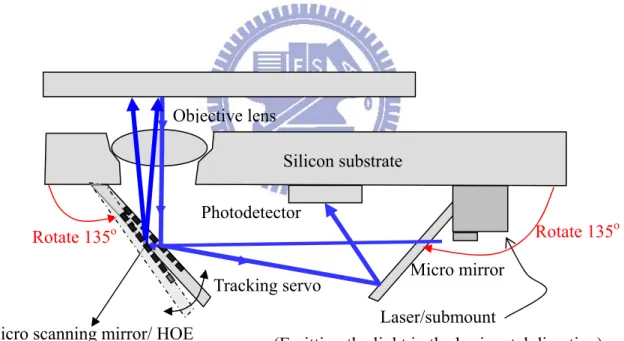
In our previous research [5], a MEMS-based optical pickup unit (OPU) assembled by simple push operation on SOI wafers was proposed. The optical pickup is composed of two 135˚ MEMS mirrors. In this optical pickup unit, a micro scanner can be integrated on the mirrors for tracking as Figure1-5 shows. In order to realize the tracking function, a micro scanning mirror actuated by a vertical comb actuator is proposed based on the flip-up plate of our previous research. Therefore, the main objective of this thesis is to fabricate flip-up micro scanning mirrors assembled by the novel simple push method. The DC optical scan angle must be larger than 0.03˚ and the torsional resonant frequency must be much higher than the disc rotation frequency 150 Hz.
Figure 1-5. Schematic of the optical pickup with incorporated flip-up micro scanning mirror for tracking.
Photodetector Objective lens Silicon substrate Micro mirror Rotate 135o Rotate 135o Tracking servo Laser/submount
(Emitting the light in the horizontal direction) Micro scanning mirror/ HOE
1-2
Literature survey
Micro scanning mirrors based on various actuation principles had been demonstrated in the literature. In the past years, many assembly methods for 3-D structures were demonstrated. In this section, micro scanning mirrors with different actuation methods are reviewed first. Then different kinds of assembly methods are reviewed .
1-2-1 Micro scanning mirrors
Various actuation methods had been applied to actuate micro scanning mirrors. In this section, micro scanning mirrors actuated by electrostatic actuators, thermal actuators and magnetic actuators are reviewed.
1-2-1-1 Electrostatic actuation
Electrostatic force can be used to actuate micro scanning mirrors by applying a voltage difference between fixed and movable electrodes. Many micro scanning mirrors reported to date employ electrostatic actuators. It offers fast speed with low power consumption and is relatively simple to design and fabricate. However, this method may suffer from the pull-in phenomenon, which limits its useful scan range. The digital light processing (DLP) technology (Figure 1-3) developed by Texas Instruments (TI) is an example that employs this actuation method [3].
Ford et al. presented a micro scanning mirror actuated by electrostatic force generated by a parallel plate actuator [6]. The operation principle is shown in Figure 1-6. When the voltage is applied to the bottom electrode, the electrostatic attraction force between the electrode and grounded mirror plate actuates the mirror. Figure 1-7 shows the SEM micrograph of the mirror array actuated by the parallel plate electrostatic force. The mirrors use an 80 V peak-to-peak 300 KHz sinusoidal signal
to switch between ±10˚ with a 20 μs response.
Figure 1-6. Schematic of micro mirror actuated by parallel plate electrostatic force [6].
Figure 1-7. SEM micrographs of the mirror array actuated by parallel plate electrostatic force [6].
Kiang et al. presented an out-of-plane, lateral electrostatic combdrive-actuated micro scanning mirror [2]. Two types of scanning mirrors with horizontal and vertical scan were fabricated with two or three structural layers of polysilicon. As shown in Figure 1-8, the out-of-plane micro scanning mirror is suspended by the frame connected to a hinged slider in the back. Scanning is achieved by the linkage of the lateral combdrive to the mirror structure through a hinge that allows the linear motion Grounded mirror
of the comb to be translated into the angular motion of the micro mirror. Maximum optical scan angles were up to ±14˚ for the vertical scanning mirror and ±9˚ for the horizontal scanning mirror by a 40 V ac voltage at resonant frequencies in the kilohertz range.
Figure 1-8. SEM micrographs of vertical and horizontal micro scanning mirrors [2].
1-2-1-2 Thermal actuation
Thermal actuator can be used to actuate micro scanning mirrors due to the difference in the coefficients of thermal expansion of the bimorph beam. When the current passes through the bimorph actuator, the generated heat can actuate the actuator. Compared to electrostatic or magnetic actuators, thermal actuator has relatively higher power consumption and lower switching speed.
Schweizer et al. presented a monolithic integrated thermal micro scanning mirror [7]. The device consists of a mirror located on the tip of a thermal bimorph actuator beam that is made of silicon dioxide and a thin film conductor. The residual stress in the two layers is used to achieve an out-of-plane rest position of the mirror, as shown in Figure 1-7. The device is excited electrothermally at its resonance frequency, enabling large angular deflections at low power consumption. Different length of the beams would generate different rest positions. The SEM micrographs are shown in Figure 1-9. Mirrors with resonant frequencies varying from 100 to 600 Hz were
realized. Mechanical scan angles of above 90˚ were achieved.
Figure 1-9. Schematic of the thermal actuator, (a) device top view, (b) cross-section of the device before release, (c) cross-section of the device after releasing the long beam, (c’) cross-section of the device after releasing the short beam [7].
Singh et al. presented a two-axes thermally actuated SOI scanning mirror that consisted of a mirror plate, four flexural springs and four thermal actuators as shown in Figure 1-11 [8]. The thermal actuators were formed by using single crystal silicon and aluminum composite beams. When the beam was heated, it bent due to the difference in the coefficients of thermal expansion of the two materials. The SEM micrographs of the device are shown in the Figure 1-11. The measured maximum angular deflection was 17˚ at an applied voltage of less than 2 V.
Figure 1-11. SEM micrographs of the thermally actuated micro scanning mirror [8].
1-2-1-3 Magnetic actuation
Magnetic forces can be applied to actuate microstructures by passing a current to generate the Lorentz forces or by coating magnetic materials like Permalloy on the structures. The magnetostatic force can be induced by the interaction of magnetic material and the magnetic field to drive the micro scanning mirror. Generally speaking, magnetic actuation provides higher switching speed, both attractive and repulsive forces, and large deflection angles, but the assembly of external magnets and coils is a big problem.
Miller et al. presented two types of magnetic scanning mirrors which combined magnetic thin films and silicon bulk micromachining [9]: (1) mirrors with permalloy
coating could only be controlled by an external magnetic field but did not experience thermal heating effects and (2) mirrors with both permalloy and copper coils also required an external field and could be operated by applying a current to the on-plate coils. The schematic and the micrographs of the mirrors are shown in Figure1-12 and Figure1-13. The 60˚ deflection range of both types of mirrors in an external field (H = 23.9 kA/m) was achieved.
(a) (b)
Figure 1-12. Schematic and side views of two types of magnetic scanning mirrors: (a) mirror with permalloy only and (b) mirror with permalloy and copper coils [9].
(a) (b)
Figure 1-13. Micrographs of two types of magnetic scanning mirrors: (a) mirror with permalloy and (b) mirror with permalloy and copper coils [9].
Cho et al. presented a three-axis micro scanning mirror with large static angular and vertical displacements [10] as shown in Figure1-14. The micro scanning mirror has z-axis linear motion as well as x-axis and the y-axis rotation as the schematic shows in Figure 1-15. The micro mirror consists of a gold coated mirror plate, incorporated actuation coils, frame and cantilever-type actuators with actuation coils. The actuator coils integrated on the mirror plate is used for the y-axis actuation and the other coil actuators integrated on the cantilevers are used for the x-axis and z-axis actuation. The maximum static deflection angles were measured as ±4.2˚ for x-axis actuation and ±9.2˚ for y-axis actuation, respectively. The maximum static vertical displacement was measured as ±42 μm for z-axis actuation. The actuation voltages were below 3 V for all actuation.
Figure 1-14. SEM micrographs of the fabricated mirror, (a) overall view, (b) enlarged view of the mirror plate, (c) electrical connection between two points and (d) torsion bar [10].
(a) (b)
(c)
Figure 1-15. Operation principle of the magnetic scanning micro scanning mirror: (a) y-axis rotational actuation, (b) x-axis rotational actuation and (c) z-axis linear actuation [10].
Tang et al. presented a 2-axis magnetostatic SOI micro scanning mirror driven by a double-side electroplated ferromagnetic film [11]. The fabrication processes enabled simultaneous double-side electroplating to increase the volume of the ferromagnetic materials and enhance the force on the mirror. As shown in Figure 1-16, the magnetostatic force can be induced by the interaction of the ferromagnetic material and the magnetic field provided by the solenoid to drive the micro mirror. Figure 1-17 shows the SEM micrographs of a fabricated micro scanning mirror. The front side of the supporting frame contains the electroplated Ni with tilt-pattern design. The back side of mirror and supporting frame contains the electroplated Ni film. The outer scan Cantilever-type actuators
Mirror plate and incorporated actuation coils
and inner scan of this 2-axis scanning mirror were respectively operated at 584 Hz with an optical scan angle of ±6.6˚ and 11149 Hz with an optical scan angle of ±5.5˚.
(a) (b)
Figure 1-16. Actuation concepts of the magnetostatic mirror, (a) schematic and (b) cross-section view [11].
Figure 1-17. SEM micrographs of the magnetostatic mirror: (a) front side and (b) back side [11].
1-2-1-4 Summary
In many applications, electrostatic actuation is preferred due to its low power consumption. The power issue is important particularly in large array systems. But the parallel-plate electrostatic actuation suffers from the pull-in phenomenon. Thermal actuators have advantages of large deflection angles and simple fabrication processes. However, the switch speed is lower than other methods due to the thermal conduction.
Electromagnetic actuation can generate a relatively large force with lower voltage and provide good dynamic performance. Nevertheless, magnetic materials are not compatible with standard IC manufacturing and packaging the external magnetic may be an issue.
In addition to the above methods, another popular method is the vertical comb drive actuators. It has advantages over traditional electrostatic actuators. In the next section, various kinds of vertical comb micro scanning mirrors are reviewed.
1-2-2 Micro scanning mirror with vertical comb actuator
Many micro scanning mirrors driven by vertical comb actuators have been studied. They have large force density and can be utilized to reduce the actuation voltage. The pull-in phenomenon can also be eliminated if the comb geometries are chosen adequately. Besides, the switching speed is excellent. Micro scanning mirrors with vertical comb actuation are classified according to the fabrication processes in the following review.
1-2-2-1 Wafer bonding
This method starts with a silicon wafer or a SOI wafer. Deep reactive-ion etching (DRIE) is applied to make a comb finger set. Then another silicon wafer is bonded on the original wafer and etched back to make the other comb finger set.
Conant et al. presented a staggered torsional electrostatic combdrive (STEC) micromirror made of two layers of single-crystal silicon separated by a silicon dioxide layer [12]. The mirror, torsion hinge, and moving comb teeth are in the top silicon layer, and the fixed comb teeth are in the bottom silicon layer, as shown in Figure 1-18. The STEC micromirrors were fabricated using DRIE and a bond-and-etchback process, as shown in Figure 1-19. The micro scanning mirror has advantages of high
scan speed, small size, and low cost with diffraction-limited optical performance. The optical scan angle of ±12.45˚ at 34 kHz resonant frequency with 0.18mW power consumption can be achieved.
Figure 1-18. SEM micrograph of the STEC micro scanning mirror [12].
Lee et al. presented a micro mirror actuated by self-aligned vertical electrostatic combdrives with multi-level electrical isolation that allows bi-directional and dual-mode (independent rotation and piston motion) operation [13]. The fabrication flow is shown in Figure 1-20. The process starts with the coarse patterning of the bottom combteeth in SOI wafers. An unpatterned wafer is then bonded by thermal fusion bonding to the patterned SOI wafer. Next, two mask layers are deposited and patterned to define the contact area and the upper combteeth. The final steps are the DRIE of the upper and the lower combteeth. Figure 1-21 shows the SEM micrographs of the device. The micro scanning mirror with ±9˚ optical scanning with 155 V actuated voltage and 7.5 μm of piston motion with 110V actuated voltage were achieved. The resonant scanning has optical scan angles up to ±25˚ with a 96 V dc bias and 40V ac voltage at 13.5 KHz.
(a) (b)
Figure 1-21. SEM micrographs of the dual-mode and double-stacked device: (a) self-aligned combteeth and (b) top view of the mirror [13].
Ra et al. presented a two-dimensional micro scanning mirror for dual-axes confocal microscopy [14]. The fabrication process of the mirror is the same as [13]. The cross-section schematic and SEM micrograph are shown in Figure 1-22. Maximum optical deflections of ±4.8˚ at 160 V and ±5.5˚ at 170 V are achieved in static mode for the outer and inner axes, respectively. The dynamic characterization was measured with a 77 V dc bias and a 58 V ac voltage. Torsional resonant frequencies are at 500 Hz with ±12.4˚ optical deflection and at 2.9 kHz with ±7.2˚ optical deflection for the outer and inner axes, respectively.
(a) (b)
Figure 1-22. Schematic and SEM of the two dimensional self-aligned scanning mirror: (a) cross-section schematic and (b) SEM micrograph [14].
The upper and lower comb fingers of the micro scanning mirror can also be fabricated individually on two substrates by the front side and back side DRIE, bonding, polishing, metal coating, electroplating, and releasing processes. And then the upper and the lower finger were bonded with each other with a fine flip chip bonder. The whole fabrication processes are too complicated in spite of the good performance. The complicated flow was applied in the following two works.
Lee et al. presented a micro scanning mirror for laser display systems [15]. Figure 1-23 and Figure 1-24 show the basic structure and the assembly process of the scanning mirror. It is composed of two structures. The upper structure is composed of a scanning mirror plate, two torsion bars, a supporting frame and upper comb fingers. The lower structure is composed of lower comb fingers, a supporting frame, gold signal lines and pads on a Pyrex glass substrate. The comb fingers are beneath the mirror to increase the fill factor. Figure 1-25 shows the upper structure with a bonded glass plate. The ±6˚ optical scan angle was obtained when driven by a 28V ac control voltage at 60 Hz with a 35 V dc bias voltages.
(a) (b)
Figure 1-24. Assemble processes of the two-structure scanning mirror: (a) alignment and (b) eutectic bonding [15].
Figure 1-25. SEM micrograph of the upper structure with a bonded glass plate [15].
Ko et al. demonstrated an eye-type micro scanning mirror for laser display [16]. The micro scanning mirror consists of a circular mirror plate and an elliptic outer frame with vertical combs to increase the number of fingers. This eye-type mirror showed larger deflection angle compared to the traditional works using rectangular mirrors. But the fabrication flow is complicated. Figure 1-26 shows the SEM micrographs of the structure. The ±16˚ optical scanning angle was achieved when driven by the 65-75 V sinusoidal control voltage and a 100 V dc bias at resonant frequency of 22.1-24.5 kHz.
(a) (b)
Figure 1-26. SEM micrographs of the eye-type micro scanning mirror: (a) upper view and (b) enlarged view of the combteeth [16].
1-2-2-2 Multi-mask etching
This method employs a delay-mask process (DMP) in the fabrication process. The concept is shown in Figure 1-27. After multiple mask layers are patterned, the main layer is etched to a certain depth with all masking layers and then the topmost mask 1 is removed. Then, the main layer is etched again and the next masking layer is removed. This procedure is repeatedly until all the masking layers are removed. The vertical offset between the upper and the lower comb fingers can be achieved by applying the DMP. The comb fingers made by DMP are self-aligned. Self-alignment between moving and fixed fingers is important in order to avoid lateral instability
leading to an in-plane pull-in during actuation.
Figure 1-27. Concept of the delay-mask process [17].
Hah et al. presented a self-aligned vertical comb-drive actuator for a two-axis micro scanning mirror [17]. This work applied DMP to achieve self alignment between the moving and the fixed fingers. This method was also useful to fabricate comb fingers with narrow gap spacing and reduce the operation voltage. Figure 1-28 shows the SEM micrographs of the mirror. The DC mechanical scan angles of the micro scanning mirror were measured as ±2.1˚ at 48V around the inner axis and ±1.8˚ at 44 V around the outer axis, respectively. The mechanical resonant frequencies of 1.2 kHz around the inner axis and 0.9 kHz around the outer axis were measured, respectively.
Kim et al. presented a two-axis micro scanning mirror array with high fill-factor [18]. In order to achieve high fill-factor, the mirror plate is mounted on a self-aligned vertical comb drive actuator achieved by the DMP. The schematic of the micro scanning mirror is shown in Figure 1-29. Figure 1-30 shows the SEM micrographs of the mirror array. The maximum static optical deflections are ±2.16˚ at 60 V bias for the outer axis and ±1.41˚ at 96 V bias, respectively. The torsion resonant frequencies along the outer and inner axes were 1.94 kHz and 0.95 kHz, respectively.
Figure 1-29. Schematic view of the micro scanning mirror with high fill-factor [18].
(a) (b)
Figure 1-30. SEM micrographs of the scanning mirror with high fill-factor: (a) mirror array, (b) vertical comb actuator [18].
1-2-2-3 Offset by self assembly
Vertical offset between the upper and the lower comb fingers can be achieved by self assembly. Since the upper and lower comb fingers are fabricated on the same layer, they are self-aligned and the gap can be minimized.
Patterson et al. presented a micro scanning mirror with self-aligned comb fingers patterned in a single etching process [19]. In the fabrication processes shown in Figure 1-31, the self-aligned comb fingers are rotated out of the wafer plane by the surface tension of the reflown photoresist. The fabrication processes are relatively simple compared to other methods. Figure 1-31 shows the SEM micrograph of the micro scanning mirror. The resonant optical scan angle of ±18˚ was measured with a 21 V sinusoidal input at 1.4 kHz.
Figure 1-32. SEM micrograph of a scanning mirror with self assembly vertical comb drive [19].
Jeong et al. presented a self-aligned vertical comb drive fabricated in the device layer of a SOI wafer [20]. As Figure 1-33 shows, the fixed combs are anchored to bimorph cantilevers made of two materials with dissimilar thermal coefficients of expansion. The cantilevers, which provide the vertical offset between the fixed combs and the moving combs, are deflected by the residual stress during cooling down from the oxidation temperature to the room temperature. The deflection of the bimorph cantilever provides the initial offset between the moving and the fixed comb fingers. The fabrication processes are relatively simple. However, the fill-factor is low due to the large areas of the cantilever beam and the comb fingers. Figure 1-32 shows the SEM micrograph and schematic diagram of self-aligned vertical comb fingers. The optical deflection angle was ±3.25˚ by a 5.5 V dc bias and 10 V ac voltage at the resonant frequency of 830 Hz.
Figure 1-33. SEM micrograph and schematic of the vertical comb actuator achieved by the bimorph cantilever [20].
1-2-2-4 Multiple structure layers
The standard processes like Sandia’s ultraplanar multilevel MEMS technology-V (SUMMiT-V) processes, which provide well-understood and documented properties, can be applied to fabricate the scanning mirror. The SUMMiT-V fabrication process is a five-layer polycrystalline silicon surface micromachining process. In this section, a micro scanning mirror using the standard processes is reviewed.
Hah et al. presented a surface-micromachined scanning mirror array with hidden vertical comb actuators [21]. The fixed fingers consist of poly1 and poly2 layers, and the movable fingers are made of the poly3 layer. The mirror plate is fabricated on the top polysilicon layer. The mirror, moving fingers, and torsion springs are connected to a ground plane. The actuation voltage is applied to the fixed fingers. The micro
mirrors provide large DC scan angle, low-operating voltage and high fill factor by the underneath vertical comb actuator. In spite of the good performance, it might suffer from the pull-in phenomenon between the mirror plate and the underneath comb fingers. Figure 1-34 shows the schematic of two types of mirrors. Type I has one set of vertical combs underneath the mirror. Type II has two sets of vertical comb-drives at two different levels; one underneath the mirror and the other attached to the edges of the mirror. Figure 1-35 shows the SEM micrographs. A ±11.8˚ DC optical scan angle with 6 V actuating was achieved. The measured resonant frequency of the mirror ranges from 3.4 to 8.1 KHz.
(a)
(b)
Figure 1-34. Schematic view of two types of mirrors, (a) type I device has one level of comb-drives and (b) type II device has two levels [21]
(a)
(b)
Figure 1.35. SEM micrographs of the mirror, (a) type I device has one level of comb-drives (b) type II device has two levels [21].
Multiple structure layers can be formed by deposited thin films. The small thickness of commonly-used thin films such as polysilicon limit the static rotation angle.
Tsou et al. presented a multi-layer process to fabricate micro scanning mirrors with self-aligned electrostatics dual combdrives [22]. The schematic of the structure is shown in Figure 1-36. The deposited silicon nitride and polysilicon are used as the insulation layer and the upper comb fingers, respectively. The device layer of the SOI wafer forms the lower comb fingers. The moving and the fixed comb fingers are
divided into six individual electrodes that can be used to produce bi-directional rotation and both upward and downward vertical piston motions. The working principle is illustrated in Figure 1-37. Figure 1-38 shows the SEM micrograph of the micro scanning mirror. The mechanical tilt angle of ±1˚ at 100 V dc bias was achieved. The micro scanning mirror can scan an angle of 62˚ at the resonant frequency of 10.46 kHz with a 60 V sinusoidal input.
Figure 1-36. Schematic diagram of the dual mode micro scanning mirror [22].
Figure 1-37. Principle of the vertical combdrive actuator, (a) upward actuation and (b) downward actuation [22].
Figure 1-38. SEM micrograph of the dual mode micro scanning mirror [22].
1-2-2-5 Summary
Many kinds of vertical comb actuators were reviewed. The wafer bonding method provides good performance but needs fine aligned bonder. The multi-mask etching method provides a relatively simple fabrication process and compatible with the IC manufacturing but the performance would be worst than other methods. Offset by self assembly also provides a relatively simple fabrication process, but the assembly must be well controlled or it would fail during the assembly process. The standard process with multi structure layers provides good performance but the design flexibility is limited by the fixed fabrication process. Multiple structure layers formed by deposited thin films provide a simple fabrication process but the performance is limited by the thickness of the deposited layer. Furthermore, all these vertical comb actuated micro scanning mirrors are assembled in the plane of the wafer. In order to fabricate a flip-up micro scanning mirror, various out-of-plane assembly methods are reviewed in the next section.
1-2-3
Micro assembly
Micro structures fabricated by surface micromachining have to be flipped up to form 3-D structures. Scratch drive actuators [23], thermal actuators [24], electrostatic force generated by the parallel plate [25] or ultrasonic waves [26], magnetic force [27], centrifugal force [28], residual stress [29], and surface tension [30] have been used for self-assembly. In addition, manual assembly by the microprobes [31] and robot-assisted assembly [32] have been proposed.
In our previous work [5], flip-up micromirrors with arbitrary angles had been fabricated and assembled by the simple push method. The push method has large probe positioning tolerance in both vertical and lateral directions to reduce assembly failure. Figure 1-39 shows the assembly process of a 45˚ micromirror. Two push operations are needed in the assembly process. First, Probe 1 pushes the support to over 60˚ and hold in this position (Figure 1-39 (a)). Then Probe 2 pushes the mirror plate to 40˚ to 50˚ (Figure 1-39 (b)). Subsequently Probe 1 is removed and the torque from the torsional beams drives the support to lie on the mirror plate (Figure 1-39 (c)). After Probe 2 is removed, the torque of the torsional beams connected tio the mirror plate also drives the mirror plate to lie on the support. Finally, the support and the mirror plate are interlocked (Figure 1-39 (d)). Figure 1-40 shows the SEM micrographs of our previous work.
Figure 1-39. Schematic of the simple push assembly flow [5].
(a) (b)
Figure 1-40. An assembled 45° device, (a) top view, (b) side view. Support (a) (b) (c) (d) Probe 1 Probe 2 Interlock Mirror
(c) (d)
Figure 1-40. An assembled 45° device (continued), (c) interlock, (d) torsonal beam of the mirror plate with mechanical stop.
1-3
Objective and organization of the thesis
Many micro scanning mirrors assembled in-plane have been demonstrated. They provide good performance and have been commercialized. But flip-up micro scanning mirrors are rare and still have room for improvement. MEMS-based flip-up microstructures can be integrated on a bench to realize the miniaturized optical system. The proposed MEMS-based optical pickup is a good example [5]. Therefore, the main objective in the thesis is to develop flip-up micro scanning mirrors assembled by the simple push operation. The flip-up micro scanning mirror can be integrated in the optical pickup unit to realize tracking.
The basic principle and simulation of the proposed flip-up micro scanning mirror are depicted in Chapter 2. The fabrication processes and issues are discussed in Chapter 3. The experiment and measurement results are shown in Chapter 4. Conclusion and future work are discussed in Chapter 5.
Chapter 2
Principle and Design
2-1
Introduction
The proposed flip-up micro scanning mirror is actuated by vertical comb actuators and assembled by the simple push assembly method [5]. The mirror is fabricated on the SOI wafer, whose single-crystalline-silicon device layer has good surface smoothness suitable for optical mirrors. The buried oxide layer of the SOI wafer is the etching stop for the deep reactive-ion etching process. Therefore, the thickness of the torsional spring is uniform in the SOI-based fabrication processes. SU-8 photoresist is used for the vertical offset between the moving and fixed combs due to its high aspect ratio and vertical sidewalls [33].
As shown in Figure 2-1, the devices consist of mirror supports, torsional beams, and plates with vertical comb drives. The moving comb fingers are made of the device layer of the SOI wafer; the fixed comb fingers are made of the SU-8 photoresist stacked on the device layer. It is easy to modify the thickness of the SU-8 photoresist between 1 μm to 100 μm to control the rotational angle. The moving comb fingers attached to the mirror are electrically grounded. The fixed comb fingers are the driven electrodes. The mirror plate is actuated by the induced strong fringe field between the fingers. The electrical isolation is realized by dividing the moving and fixed combs into two parts. The isolated parts are connected mechanically by the substrate of the SOI wafer. The topside, backside and cross-section views are shown in Figure 2-2.
(a)
(b)
Figure 2-1 (a) 3D model of the proposed scanning mirror, (b) vertical comb fingers. Support Push pad Mirror with vertical comb
Interlock Push pad
Totsional beam
Electrical pad SU-8 photoresist
(a)
(b)
(c)
Figure 2-2. Illustrations of electrical isolation and mechanical connection, (a) front side view, (b) back side view and (c) cross-section view along A-B.
Mechanical connection Electrical isolation Vertical comb actuator Torsional beam Mirror plate Interlock Torsional spring Push pad Mechanical connection Interlock Mass block A B B A Electrical isolation Frame
2-2
Push assembly process
Figure 2-3 shows the assembly process by the simple push operation [5]. The mirror plate and the support are in the device layer of the SOI wafer. The substrate underneath the push pad needs to be etched by ICP DRIE to provide space for the push operation. The assembly processes need two microprobes and two push operations. First, Probe 1 pushes the support to about 60˚ and holds in position (Figure 2-3 (b)). Then Probe 2 pushes the mirror to about 45˚ and holds in position (Figure 2-3 (c)). Then Probe 1 is removed and the restoring forces of the torsional beams make the support lie on the mirror (Figure 2-3 (d)). Finally Probe 2 is removed and the mirror and the support are interlocked by the lock mechanism (Figure 2-3 (e)). The large area of the push pad provides large probe positioning tolerance that can reduce the assembly time.
Torsional beam
The torsional beams provide the restoring force to interlock the mirror in position. The torsional beam must be long enough or it would break during pushing. However, extending the length of the torsional beams reduces the fill factor. Therefore, an appropriate length of the torsional beam needs to be chosen. In addition, the restoring forces of the mirror plate and the support may cause lateral displacement of the torsional beams. Therefore a mechanical stop mechanism was designed on both sides of the torsional beam in the same SOI device layer to prevent the lateral displacement which would cause angular error, as shown in Figure 2-3 (f).
Figure 2-3. Assembly processes of the flip-up micro scanning mirror. Probe 1 Probe 1 Probe 2 Probe 2 (a) (b) (c) (d) (e) Mechanical stop (f)
For a 45˚ mirror plate, the maximum twist angle is approximate 80˚ during the assembly process. The length of the torsional beams can be found from the torsional formula of a beam with a rectangular cross section as follows [34],
a TL KG, (2-1) 4 3 4 16 [ 3.36 (1 )], for > 3 12 b b K ab a b a a , (2-2) 2 3 4 max 2 3 [1 0.6095 0.8865( ) 1.8023( ) 0.9100( ) ], for , 8 T b b b b a b ab a a a a (2-3)
where a is the angle of twist in radius, T is the applied torque, L is the torsional
beam length, K is the cross-section shape-dependant factor, G is the shear modulus of the material, max is the maximum shear stress in the beam with the applied torque,
a is the half of the longer side of the cross section and b is the shorter side of the
torsional beam (figure 2-4).
Figure 2-4. Dimensions of the torsional beam
The thickness of the device layer of the SOI wafer is 5 μm therefore b is 2.5 μm. The width of the torsional beam is 25 μm therefore a is 12.5 μm. The shear modulus of the single-crystal silicon is 79.9 GPa [35]. The yield stress is 7 GPa at room temperature [36] but the yield stress of the manufactured silicon would be lower to 2 GPa. The maximum shear stress must be lower than the yield strength, therefore max= 0.7 GPa is used for a safety factor of 3. By substituting the values into Equations 2-2 and 2-3, we can get K and T as 9.1 10 m -22 4 and 1.27 10 N m 7 , respectively. The length of the torsional beam can be found to be approximatly 800 μm from Equation 2-1.
2b 2a
2-3
Static analysis
As Figure 2-2 (a) shows, the mirror plate is connected to the frame by torsional springs. A DC bias is applied to the fixed comb electrodes to provide an electrical torque (
e) to rotate the mirror around the torsional springs. The mechanical restoring torque (
m) from the torsional springs is induced during rotation and is directly proportional to the rotation angle (scan ). The maximum rotational angle is proportional to the vertical finger offset (TSU8) but is inversely proportional to thefinger length (Lf). The cross section profile of the finger is shown in Figure 2-5. Lf
is the length from rotation axis to the tip of the moving comb finger, and Lf0 is the length from rotation axis to the tip of the fixed comb finger.
When a voltage is applied, the mechanical restoring torque increases as the rotation angle increases. The rotation angle can be calculated when the mechanical restoring torque equals to the electrical torque. The electrical torque can be approximated as [17]: 2 2 0 2 2 0 ( ) 1 1 2 2
t f f e f scan L L C V N V g , (2-4)where C Vt, , , 0 Nf and g are the total capacitance of the comb fingers, applied DC
bias voltage, permittivity of air, number of fingers and lateral finger gap, respectively.
Figure 2-5. Cross section profile of the finger.
.
Moving comb attached to the mirror plate Fixed comb with SU-80 f L f L 8 SU T scan Rotational axis
The mechanical restoring torque can be expressed as [37]: 2 2 3(1 1925 tanh( )) , for > 3 2 m s scan scan Gwt t w k w t l w t (2-5)
where k is the torsional spring constant, G is the shear modulus, l is the length of s
the torsional spring, w and t are the cross-section geometry with w > t. Note that 2k s is due to the parallel connection of the two torsional springs on both sides of the mirror. The rotation angle can be obtained by solving
e=
m as,2 2 0 2 0 ( ) 1 2 2 f f scan f s L L N V k g . (2-6)
As the rotation angle approaches the maximum angle, Equation 2-6 can not depict the rotation angle precisely. Because the electrical torque decreases as the rotation angle increases. The rotation angle is saturated at a maximum angle. Dimensions of the micro scanning mirror are described in Table 2-1.
CoventorWare MEMS design software was applied to calculate the rotational angle versus the applied voltage as shown in Figure 2-6. It can be found that the saturation angle is about 0.5˚.
Figure 2-6. Simulated rotation angle versus applied voltage Applied voltage (V)
Table 2-1. Dimensions of the micro scanning mirror.
Description Symbol Value (μm)
Mirror size - 400 360
Number of fingers
f
N 24
Vertical finger offset TSU8 10
Finger gap g 7
Finger length - 100
Finger width of the moving comb (silicon) - 10
Finger width of the fixed comb (SU-8) - 6
Torsional spring width w 20
Torsional spring thickness t 5
Torsional spring length l 220
Length from rotation axis to the tip of the fixed comb finger
0
f
L 205
Length from rotation axis to the tip of the moving comb finger
f
2-4
Dynamic analysis
The resonant frequency of a rotational system can be calculated as follow:
1 2 2 s R m k f I ,. (2-7) 2 2 ( ) 12 3 m m m m m m w t I t w l , (2-8)
where I is the total mass moment of inertia, m is the density of mass; tm, lm and m
w are the dimensions of the rotational mirrors as shown in Figure 2-7. Note that 2k s
represents the parallel connection of torsional springs. The calculation of I is m shown below. The thin nitride and oxide layers are ignored during the calculation.
2
m V I R dV 2 2 2 0 2 = ( )
m m w t m m m m m w w t l dt dw 2 2 = ( ) 12 3 m m m m m w t t w l (2-9)By substituting the values in Table 2-1 into Equations 2-7 and 2-8, the resonant frequency is about 1362 Hz.
Figure 2-7. Illustration of the mirror dimensions Rotational axis m l m w m t
Figure 2-8 shows the solid model of the beam type micro scanning mirror for modal analysis by using CoventorWare. The first four resonant modes are summarized in the Table 2-2. Mode 1 is the rotational motion around the y-axis along the torsional spring as shown in Figure 2-9. Mode 2 is the piston motion along the z-axis as shown in Figure 2-10. Mode 3 shows the rotational motion around the x-axis as shown in Figure 2-11. Mode 4 is the rotational motion around a y-axis at the bottom of the substrate as shown in Figure 2-12. The simulated resonant frequency of the first mode is 1380 Hz, which is very close to the theoretical calculation of 1362 Hz.
Figure 2-8. Model for modal analysis
Table 2-2. Result of the modal analysis of the beam type micro mirror.
Mode Frequency Description
1 1.38KHz Rotation around y-axis
2 4.65KHz Piston motion along z-axis
3 5.34KHz Rotation around x-axis
(a) (b)
Figure 2-9. Mode 1 of the beam type mirror: rotation around the spring.
(a) (b)
Figure 2-10. Mode 2 of the beam type mirror: piston motion along z-axis.
(a) (b)
Figure 2-11. Mode 3 of the beam type mirror: rotation around x-axis.
Rotation axis Rotation axis
(a) (b)
Figure 2-12. Mode 4 of the beam type mirror: rotation around y-axis.
The modal analysis of the meander spring type micro scanning mirror was also simulated by using CoventotWare. Table 2-3 shows the first four resonant modes. Mode 1 is the rotational motion around the y-axis along the torsional spring as shown in Figure 2-13. Mode 2 is the piston motion along the z-axis as shown in Figure 2-14. Mode 3 shows the rotational motion around the x-axis as shown in Figure 2-15. Mode 4 is the rotational motion around a x-axis at the bottom of the substrate as shown in Figure 2-16.
Table 2-3. Result of the modal analysis of the meander type micro mirror.
Mode Frequency Description
1 0.496 KHz Rotation around y-axis
2 1.483 KHz Piston motion along z-axis
3 1.728 KHz Rotation around x-axis
4 10.978 KHz Rotation around x-axis
(a) (b)
Figure 2-13. Mode 1 of the meander type mirror: rotation around the spring.
(a) (b)
Figure 2-14. Mode 2 of the meander type mirror: piston motion along z-axis.
(a) (b)
Figure 2-15. Mode 3 of the meander type mirror: rotation around x-axis.
Rotation axis Rotation axis
(a) (b)
Figure 2-16. Mode 4 of the meander type mirror: rotation around x-axis.
2-5
Torsional spring analysis
Three types of springs as shown in Figure 2-17 are connected to the mirror plate for comparison. The torsional spring constant should be as small as possible to provide larger rotational angle. But the imperfection of the fabrication process such as lithography misalignment would cause side instability and lead to pull-in effect. The pull-in effect occurs when the applied electrostatic lateral force overcomes the spring restoring force. For this reason, the lateral spring constant is an important parameter. The lateral and torsional spring constants of the three type springs were simulated and compared by CoventorWare MEMS design software. The dimensions of the three types of springs are shown in Figure 2-18.
(a) (b) (c)
Figure 2-17. Three types of the springs, (a) beam type, (b) meander type and (c) box type.
Figure 2-18. Dimensions of the springs
2-5-1 Lateral spring constant k
The spring was fixed in one side and a y-direction pressure was applied on the other side (20 μm × 5μm) as shown in Figure 2-19. The simulated displacements versus applied pressure for three types of springs are plotted in Figure 2-19. From the simulation, the calculated spring constants are8.06 10 (N/m) 4 , 8.26 10 (N/m) and
3
1.52 10 (N/m) respectively.
(a) beam type
Figure 2-19. Displacement versus applied pressure of three types of springs. 20 m 260 m 220 m 260 m 20 m 30 m 20 m 20 m 35m Fixed F 35 m
(b) meander type
(c) box type
Figure 2-19. Displacement versus applied pressure of three types of springs (continued).
2-5-2 Torsional spring constant
k
sThis simulation of torsional spring constants contained two springs and a mirror plate. Both sides of the springs were fixed, and the pressure was applied on the edge of the mirror plate as shown in Figure 2-20. The simulated rotation angle versus the applied pressure results are shown in Figure 2-20. The calculated torsional spring constants from the simulation are 6.1 10 (N m/rad) 7 , 9.7 10 (N m/rad) 8 and
7 8.0 10 (N m/rad) respectively. Fixed Fixed F F
(a) beam type
(b) meander type.
(c) box type
Figure 2-20. Rotation angle versus applied pressure of three types of springs. fixed F fixed fixed F F fixed fixed fixed
To summarize, the parameter Z which represents the ratio of lateral spring constant and torsional spring constant is presented in Table 2-4. The Z parameter can determine the best solution for the spring design of the vertical comb-drive scanning mirror. Larger Z implies that the mirror can rotate more easily and without lateral displacement. The best spring design is the beam type.
Table 2-4. Summary of spring simulation.
Parameter (I) beam type (II) meander type (III) box type
k 8.06 10 (N/m) 4 8.26 10 (N/m) 1.52 10 (N/m) 3
s
k 6.06 10 (N m/rad) 7 9.70 10 (N m/rad) 8 8.03 10 (N m/rad) 7 Z 1.33 10 (rad/m ) 11 2 8.52 10 (rad/m ) 8 2 1.90 10 (rad/m ) 9 2
2-6
Summary
From the static, dynamic and spring analyses, a flip-up micro scanning mirror is designed. The layout is shown in Figure 2-21. In Chapter 3, the fabrication is discussed.
Figure 2-21. Layout of the flip-up micro scanning mirror.
800 μm Push pad (200 μm × 200 μm) Electrical pad (120 μm × 170 μm) 755 μm 755 μm Mirror plate (400 μm x 400 μm) Torsional spring (220 μm × 20 μm) 1055 μm 1160 μm Torsional beam Torsional beam Vertical comb drive
Locking mechanism
![Figure 1-7. SEM micrographs of the mirror array actuated by parallel plate electrostatic force [6]](https://thumb-ap.123doks.com/thumbv2/9libinfo/8242003.171366/20.892.162.732.532.765/figure-micrographs-mirror-array-actuated-parallel-plate-electrostatic.webp)
![Figure 1-8. SEM micrographs of vertical and horizontal micro scanning mirrors [2].](https://thumb-ap.123doks.com/thumbv2/9libinfo/8242003.171366/21.892.139.756.282.502/figure-sem-micrographs-vertical-horizontal-micro-scanning-mirrors.webp)
![Figure 1-11. SEM micrographs of the thermally actuated micro scanning mirror [8].](https://thumb-ap.123doks.com/thumbv2/9libinfo/8242003.171366/23.892.152.737.388.675/figure-sem-micrographs-thermally-actuated-micro-scanning-mirror.webp)
![Figure 1-12. Schematic and side views of two types of magnetic scanning mirrors: (a) mirror with permalloy only and (b) mirror with permalloy and copper coils [9]](https://thumb-ap.123doks.com/thumbv2/9libinfo/8242003.171366/24.892.157.750.361.709/figure-schematic-magnetic-scanning-mirrors-mirror-permalloy-permalloy.webp)
![Figure 1-15. Operation principle of the magnetic scanning micro scanning mirror: (a) y-axis rotational actuation, (b) x-axis rotational actuation and (c) z-axis linear actuation [10]](https://thumb-ap.123doks.com/thumbv2/9libinfo/8242003.171366/26.892.152.771.120.683/operation-principle-magnetic-rotational-actuation-rotational-actuation-actuation.webp)
![Figure 1-20. Fabrication flow of the self-aligned micro scanning mirror [13].](https://thumb-ap.123doks.com/thumbv2/9libinfo/8242003.171366/30.892.181.694.519.1101/figure-fabrication-flow-self-aligned-micro-scanning-mirror.webp)
![Figure 1-23. Basic structure of the two-structure bonded scanning mirror [15].](https://thumb-ap.123doks.com/thumbv2/9libinfo/8242003.171366/32.892.208.683.769.1038/figure-basic-structure-structure-bonded-scanning-mirror.webp)
![Figure 1-25. SEM micrograph of the upper structure with a bonded glass plate [15].](https://thumb-ap.123doks.com/thumbv2/9libinfo/8242003.171366/33.892.309.612.532.961/figure-sem-micrograph-upper-structure-bonded-glass-plate.webp)
![Figure 1-26. SEM micrographs of the eye-type micro scanning mirror: (a) upper view and (b) enlarged view of the combteeth [16]](https://thumb-ap.123doks.com/thumbv2/9libinfo/8242003.171366/34.892.191.708.438.681/figure-micrographs-micro-scanning-mirror-upper-enlarged-combteeth.webp)
