Task Formats and Ambiguity Aversion
Abstract
This article proposes that task format (choosing or rejecting) moderates the effect of ambiguity aversion. Specifically, an ambiguous option is more attractive in a choosing task than in a rejecting task compared with a risky option. The author performed three experiments to test the propositions. In the first experiment, participants showed less ambiguity aversion when they had to choose a preferred option (risky or ambiguous) compared with when they had to reject an option they preferred less. In the second experiment with a monetary incentive, participants had to form a cash-equivalent estimate for both a risky gamble and an ambiguous gamble in a traditional Ellsberg scenario. The ambiguous option emerged as more attractive than the risky option in the choosing task compared with the rejecting task. The third experiment showed that the participants’ decision rationale mediated the effect of the task format on choice. These three experiments support the proposition that task formats moderate the effect of ambiguity aversion. On the basis of the findings, the author provides suggestions for practice and further research.
Introduction
Ambiguity was first distinguished from risk by Knight (1921). According to Knight’s
terminology, a risky decision is one in which the decision maker knows the outcome probabilities but not which outcome will occur. However, when the decision maker is ignorant of the
probabilities, the decision occurs under uncertainty. Knight therefore distinguishes uncertainty from risk using the example of two people drawing balls from an urn: “One man knows that there are red and black balls, but is ignorant of the numbers of each; another knows that the numbers are three of the former to one of the latter” (Knight, 1921, pp. 218–219). The first person makes a decision under uncertainty, whereas the second makes the decision under risk. Yates and Stone (1992) also assert a continuum of uncertainty levels. At one extreme is “ignorance,” in which state a person has no basis whatsoever for assigning loss chances. At the other extreme of the continuum is prescience, which means the outcomes are well established. Risk, or “objectivity” in Yates and Stone’s
terminology, means that the chances of outcomes are sometimes known in certain circumstances, such as actuarial or aleatory probabilities. Ambiguity is an intermediate state between risk (all but one distribution is ruled out) and ignorance (the decision maker cannot rule out any distributions).
In the real world, decision makers know the precise probabilities of potential outcomes in certain conditions (e.g., tossing a coin, drawing a card in a poker game), but most risky decisions suffer from uncertain or ambiguous information about the probabilities of the events. For example, a manager often cannot establish a clear idea of the likelihood of success of a business venture. Similarly, a patient might have to decide whether to undergo new medical treatment even when uncertain about the probability of success. Therefore, exploring the ambiguity effect is meaningful in a range of applications.
Ellsberg (1961) has demonstrated that people prefer a gamble with known probability to a gamble with unknown probability, a notion often deemed “ambiguity aversion” (for a review, see Keren & Gerritsen, 1999). Other studies have concluded that subjects will even pay an ambiguity premium to avoid betting on an ambiguous event (Becker & Brownson, 1964; MacCrimmon & Larsson, 1979; Yates & Zukowski, 1976), and many investigations have argued that various factors
can influence the effects of ambiguity aversion.
This article investigates whether task formats might moderate the effect of ambiguity aversion. Shafir (1993, 1995) proposes that because people tend to offer justifications for their choices, they weigh advantageous (disadvantageous) attributes more heavily in choosing (rejecting) tasks; that is, people choose (reject) the option they prefer (like least). Moreover, because risk refers to the
distribution of outcomes, whereas ambiguity often is associated with the distribution of
probabilities (Bernasconi & Loomes, 1992; Camerer & Weber, 1992), an ambiguous option may “own” more potential positive and negative aspects than a risky option. Therefore, the relative attractiveness of the ambiguous option should increase in the choosing task compared with the rejecting task, because decision makers in the former situation focus more on the positive aspects of the ambiguous option (e.g., “I may have more chances to win if I choose the ambiguous option rather than the risky option”). In contrast, those in the latter situation likely focus more on the negative aspects (“I may have less chance of winning if I choose the ambiguous option rather than the risky option”). Three experiments serve to test these propositions.
The following section reviews relevant research, including that pertaining to task compatibility and ambiguity aversion. Using this review as a basis, the author proposes several hypotheses
regarding how task formats compatible with the ambiguous option may influence relative preferences. Experiment 1 determines how task formats influence relative preferences for the ambiguous option in the modified Ellsberg gamble and marketing decision tasks. In Experiment 2, participants who were randomly selected to play the Ellsberg gamble with a monetary incentive reveal either the highest price they are willing to pay (i.e., they indicate, “The highest price you are willing to pay for the (risky/ambiguous) gamble is ”) in the choosing task or the lowest price they would reject to play (i.e., “When the price of the (risky/ambiguous) gamble is higher than , you will not play”) in the rejecting task for both risky and ambiguous gambles. Experiments 1 and 2 thus use different methods, yet the results from both experiments can be used to analyze the proposition that the ambiguous option is more attractive in the choosing task than in the rejecting task. Experiment 3 involves participants who must justify their choices. Their rationales mediate
the effects of the task formats on the ambiguous options. Finally, this article concludes with a discussion of its contribution to the literature and applications of the resultant theory, a comparison of the results with prior research, and an outline of directions for further research.
Theoretical Background Ambiguity Aversion
In general, risk refers to the distribution of outcomes, whereas ambiguity tends to be associated with the distribution of probabilities, though no acceptable operational definition currently exists for ambiguity (Bernasconi & Loomes, 1992). Because most researchers regard ambiguity as uncertainty pertaining to estimated probabilities rather than outcomes, it may entail a second-order probability, though the distribution of that second-order probability is often unknown (see Camerer & Weber, 1992). In this manner, ambiguity might be defined as the lack of precise knowledge about the likelihood of events (Hogarth, 1987).
Ellsberg (1961) proposes that people generally prefer to bet on gambles with known
probabilities rather than unknown probabilities. In Ellsberg’s study, a simple demonstration of this effect involves two urns: Urn 1 contained 50 red balls and 50 green balls (i.e., a risky gamble), and urn 2 contained 100 red and green balls in unknown proportion (i.e., an ambiguous gamble). Participants bet the color of the ball before blindly drawing a ball from an urn; they won a prize if their bet was correct, and they got nothing if they bet incorrectly. Ellsberg shows that people prefer to bet on the risky gamble rather than the ambiguous gamble.
Since Ellsberg’s work, many other researchers have extended the original experiments by varying or adding study parameters. Some articles show that participants are willing to pay a premium to avoid betting on an ambiguous gamble (Becker & Brownson, 1964; MacCrimmon & Larsson, 1979; Yates & Zukowski, 1976). On the whole, the dominant propensity for ambiguity aversion has been well established, though some factors moderate its effect, such as the extremity of expected probabilities (Du & Budescu, 2005; Einhorn & Hogarth, 1985; Hogarth & Einhorn, 1990; Kahn & Sarin, 1988; Keren & Gerritsen, 1999; Tversky & Fox, 1995), the framing of options (Kuhn, 1997), decision formats (single versus repeated) (Liu & Colman, 2009), the decision
maker’s perceived competence in specific tasks (Heath & Tversky, 1991), an omission bias (Ritov & Baron, 1990), the status quo bias (Roca, Hogarth, & Maule, 2006), and the decision maker’s state of relative or comparative ignorance (Chow & Sarin, 2001; Fox & Tversky, 1995; Fox & Weber, 2002).
Task Compatibility
One of the most well-known compatibility effects is task compatibility. Task compatibility (Shafir, 1993, 1995) suggests that because people tend to justify their decisions, the relative weights assigned to the advantageous and disadvantageous attributes are different between choosing (i.e., participants choose the option they prefer) and rejecting (i.e., reject the option they like least) tasks. That is, when people are asked to choose among the options, they likely think about their reasons for choosing one option and attribute less weight to its disadvantages, because they prefer that option according to its advantages rather than its disadvantages. In contrast, when people must reject among the options, they think about the reasons for rejecting an option and give less weight to the advantages, because they dislike the option in relation to its disadvantages, not its advantages. Shafir (1993) further proposes that because people weight disadvantageous attributes more heavily in the rejecting task, they consider an impoverished option (i.e., all attributes rated common, traditional, or average) more attractive than an enriched option (i.e., more advantageous and more disadvantageous attributes), because it contains fewer disadvantageous attributes. In contrast, people tend to give advantage attributes greater weight in choosing tasks, so the enriched alternative becomes more attractive.
For example, Shafir (1993) conducted an experiment in which participants imagined they were judges awarding custody of a child to a parent. One parent had both more positive and more
negative qualities (i.e., above-average income, very close relationship with the child, extremely active social life, lots of work-related travel, and minor health problems), whereas the other parent reflected average qualities (i.e., average income, average health, average working hours, reasonable rapport with the child, and relatively stable social life). He demonstrated that most of the subjects (64%) rejected the enriched parent in the rejecting task, because the enriched parent had more
disadvantageous attributes, whereas most of the subjects (55%) selected this enriched parent in the choosing task, because the enriched parent had more advantageous attributes.1
Task compatibility also has received support from Chang and Liu (2008), who investigate the compromise effect. In one of their experiments, participants imagined a hypothetical digital camera choice in a store that displayed three options rated on two dimensions, such that options M (e.g., which earned 60 and 60 scores on “reliability” and “picture clarity” scales) and T (40 and 80 scores) dominated one dimension and were dominated on the other dimension. Option X fell between
options M and T on both attributes (e.g., 50 and 70 scores on the scales), so it represented the compromise option, because its two attribute values fell between the values of other alternatives. Chang and Liu (2008) propose that when consumers choose among three non-dominant options, they consider their disadvantageous attributes more heavily during a rejecting task than in a choosing task. Therefore, the relative attractiveness of the middle compromise option increases in the rejecting task because it owns fewer disadvantages. In contrast, in the choosing task, the relative attractiveness of the middle compromise option decreases, because it owns fewer advantages. Chang and Liu’s (2008) results are consistent with their proposition that the relative share of the middle option is higher in a rejecting task than in a choosing task.
Although previous studies (e.g., Houston, Sherman, & Baker, 1991) have shown that a difficult decision is a function of the alternative valence (e.g., unique good features versus unique bad features between two options), Nagpal and Krishnamurthy (2008) indicate that decision conflict is a function not only of the alternative valence but also the interaction between the alternative valence and task formats. Because a choosing task requires an attractiveness judgment, it may be compatible with making a decision between attractive options (e.g., with unique good features) but is incompatible with unattractive options (e.g., with unique bad features). In contrast, because a rejecting task requires an unattractiveness judgment, it is compatible with making a choice between unattractive options but incompatible with attractive options. They confirm that decision making is easier and quicker for subjects who choose between attractive rather than unattractive options in a choosing task and between unattractive options in a rejecting task.
Extending this perspective, Chernev (2001) demonstrates that if consumers make a decision after finishing a rejecting task, the addition of a new common negative feature to both the rejected and the unrejected options enhances their existing preferences, whereas a new common positive feature has no impact. In contrast, when participants focus on positive attributes during a choosing task, a new common positive feature increases their existing preference, but a common negative feature has no influence.
On the whole, previous task compatibility studies confirm that consumers weight advantages (disadvantages) more heavily in a choosing (rejecting) task than in a rejecting (choosing) task.
Task Formats and the Relative Attractiveness of Ambiguity Options
Consider a modified Ellsberg gamble, as follows:
[Modified Ellsberg Task: Choosing (Rejecting)] Imagine you have a ticket to
participate in one of two bets: urn 1 contains 50 red balls and 50 green balls, whereas urn 2 contains 100 red and green balls in unknown proportions. The proportions of red and green balls in urn 2 are governed by computer manipulations and the probabilities of 0, 1, 2, … 100 red balls are equally likely. Draw a ball blindly from an urn and guess its color. If you choose urn 1 and your guess is correct, you win NT$500 (about US$16.5). If you choose urn 2 and your guess is correct, you win NT$600 (about US$20). Which urn would you choose (reject)?
In this scenario, the 50/50 urn (urn 1) represents the risky option, and the 0–100 urn (urn 2) represents the premium ambiguous option. The premium of the ambiguous gamble is set to 20% of the outcome, which coincides with previous studies (Yates & Zukowski, 1976) that show that the ambiguity premium is approximately 20% of the outcome or probability. This modification makes the two urns equally attractive, avoiding the ceiling effect. That is, because fewer participants would choose the ambiguous option in the choosing task if there were no premium, it would be difficult to achieve a significant decrease in choices of the ambiguous option in the rejecting task. Moreover, subjects in this experiment know that the proportion of red and green balls in the ambiguous bet is governed by computer manipulation, which avoids any “bias against the person”
(Keren & Gerritsen, 1999; Kühberger & Perner, 2003) or concern that, in ambiguous situations, a hostile opponent could exploit the context to disadvantage participants. Without this modification, participants might suspect the experimenter is trying to “trick” them.
Do consumers’ preferences differ between choosing and rejecting tasks? This study posits that they do. Because the premium ambiguous option owns more possible positive aspects (“I may have a greater than 50% chance to guess the right color if I choose the ambiguous urn, and the payoff is higher”) and more possible negative aspects (“I may have a greater than 50% chance to guess the wrong color if I choose the ambiguous urn”), and because participants in a choosing (rejecting) task weight the advantages (disadvantages) of the ambiguous options more heavily, the premium
ambiguous option should be more attractive in the choosing than in the rejecting task.
This inference conceptually coincides with the anchoring-and-adjustment process proposed by Einhorn and Hogarth (1985), whereby initial estimates of decision makers provide the anchor (i.e., a starting point for future adjustments), and an adjustment results from a mental simulation process. The anchoring-and-adjustment process explains the ambiguity effect according to a procedure for assessing probabilities. Einhorn and Hogarth (1985) also indicate that the initial estimate may reflect the best guess of experts or the subject’s previous information about the task. The mental simulation process then might depend on the amount of ambiguity, such as the absolute amount of evidence available, the unreliability of the sources of the evidence, and attitudes toward ambiguity (e.g., optimism versus pessimism). Einhorn and Hogarth particularly emphasize the effects of situational factors on attitudes toward ambiguity, including the sign and size of the payoffs, which are contingent on the ambiguous probability. The impact of task formats also appears conceptually associated with the simulation process, such that even if participants in both choosing and rejecting conditions set the same anchor for the ambiguous gamble (e.g., 50% probability of winning), their adjustment strategies might differ. Because participants focus on the negative aspects of the
ambiguous option (i.e., 0–50% probability of winning) in the rejecting task, they likely adjust their expectations about the winning probability downward (e.g., 40%). In contrast, because participants focus on the positive aspects of the ambiguous option (i.e., 50–100% probability) in the choosing
task, they should adjust the winning probability expectation upward (e.g., 60%). Thus, participants in the choosing task should show less ambiguity aversion than they would in a rejecting task:
H1: The ambiguous premium option is more attractive in a choosing task than in a rejecting task.
Experiment 1: Task Compatibility on Ambiguity Aversion Participants
To fulfill course requirements, 242 Taiwanese college students (162 women, 80 men) were invited to join this experiment, without receiving additional rewards or credits.
Design
The hypothesis tests employed a 2 (task scenarios: Ellsberg scenario versus marketing strategy scenario) × 2 (task formats: choosing versus rejecting) between-subjects design. Participants in the Ellsberg scenario considered the modified Ellsberg gamble, as previously described. Participants in the marketing decision scenario saw the task described as follows:
[Marketing Strategy Scenario: Choosing (Rejecting)] Imagine you are the CEO of a Taiwanese company. The marketing manager recently planned two new service programs for Taiwanese customers based on the company’s strengths: program M and program Z. You believe both programs might create advantages and bring huge profits for the company. However, you have to choose (reject) one of them because of your limited resources. Based on previous experience and the ability of competitors, the advisors of your company all agree the successful probability of option M would be 50%. However, they argue the successful probability of option Z might be 30–70% because they are unsure whether competitors will be able to offer the same service. If you choose program M and the program is successful, you would make NT$50 million (about US$1.67 million) for your company. If you choose program Z and the program is successful, you would make NT$60 million (about US$2 million) for your company. Which program would you choose (reject)? This marketing strategy scenario, modified from Liu and Colman (2009), serves in this study as a means to examine the generality of the proposition.
Procedure
Participants were randomly assigned to one of four experimental conditions, with 44 to 69 participants in each condition. Participants answered a one-page questionnaire in which the
instructions indicated that the purpose of the study was to explore consumers’ preferences, so there were no existing “right” answers. After reading the instructions, participants read the task and chose the option they preferred (in the choosing task) or rejected the option they preferred less (in the rejecting task) between the risky and ambiguous options presented on the same page.
To avoid any time pressure effect, participants answered the questionnaire at their own pace. After finishing the questionnaire, the participants were thanked and debriefed.
Results
In Table 1, the percentages for the choosing task represent the relative shares of the ambiguous options in each scenario, whereas the percentages for the rejecting task represent the relative
non-rejection shares. Taking the Ellsberg task as an example, 35 of 69 participants in the choosing condition selected the ambiguous option, with a relative share of 50.7%. In the rejecting condition, 48 of 68 participants rejected this option, so the non-rejection count is 20, with a relative share of 29.4% (20/68). That is, participants are more likely to choose the ambiguous option in the choosing task than in the rejecting task (χ2 (1, N = 137) = 6.47, p < .05).
Similar results emerge from the marketing strategy scenario, in which 72.1% of participants (44/61) chose the ambiguous option in the choosing task, whereas only 47.7% of participants (21/44) did not reject it in the rejecting condition (χ2 (1, N = 105) = 6.46, p < .05). Thus, on the whole, H1 received support, because the ambiguous option was more attractive in the choosing task than in the rejecting task.
Insert Table 1 around here
Discussion
Experiment 1 explores how task formats influence the relative attractiveness of ambiguous options. Because the ambiguous option connotes a greater possibility of both positive and negative aspects, the relative attractiveness of the ambiguous option increases in a choosing task more than
in a rejecting task. Experiment 1 confirms this proposition.
In the Ellsberg scenario, no ambiguity aversion appears in the choosing task, perhaps because the design is not the same as the standard urns task, and the higher expected mean outcome of the ambiguous gamble (compared with the risky gamble) influences participants’ willingness to accept the ambiguous options (Rode et al., 1999). Nevertheless, ambiguity aversion appears when
participants make their decision in the rejecting task. Participants also exhibit fewer ambiguity aversion choices in the marketing strategy scenario than in the Ellsberg scenario, perhaps because of the smaller range of probabilities of success in the ambiguous marketing strategy context (range 30–70%) compared with the ambiguous urn context (range 0–100%). The smaller range may diminish the effect of ambiguity aversion (MacCrimmon & Larsson, 1979; Yates & Zukowski, 1976).
The results of Experiment 1 also may apply to organizational communication. For example, if one CEO believes a risky business venture (e.g., investing in high-tech innovations with higher expected mean profit but more ambiguous success probabilities) will be of more benefit to the company than a conservative investment (e.g., investing in a familiar industry with certain risk but lower expected profit), he or she might communicate with the board of directors and other relevant staff by framing the decision task as a choosing rather than a rejecting task. The findings also apply to selling procedures that aim to increase the attractiveness of certain products. For example, if one fund seller discovers that the expected profit of his or her fund is lower but its performance is less ambiguous than that of a competing fund, he or she could ask customers to reject one of the funds rather than choosing between the two options.
Experiment 2: Ambiguity Aversion in Different Task Formats: Matching Price Method
Experiment 2 serves several purposes. First, it examines the hypothesis with a cash-equivalent method. In the choosing task, participants indicated their responses to the following prompt: “The highest price you are willing to pay for the (risky/ambiguous) gamble is ” in the traditional Ellsberg scenario. In the rejecting task, they indicated their response to “When the price of the (risky/ambiguous) gamble is higher than , you will not play”). Although the method is not
exactly consistent with previous studies of task formats, its concept is similar. If the choosing (rejecting) task is compatible with advantageous (disadvantageous) attributes, because those advantageous (disadvantageous) attributes enable participants to justify their reasons for choosing (rejecting) the option more easily, then related experimentation should not be limited to task formats that only entail choosing versus rejecting. Rather, in a different experiment based on the main concept, when they must state the highest amount of money they would be willing to pay for a gamble (i.e., accept one option), people should focus more on the positive aspects of the option, because the task makes them justify their reasons for accepting the gamble. In contrast, when asked to state the lowest amount of money they would reject to play (i.e., reject one option), people should focus more on the negative aspects, because the task forces them think about why they should reject this gamble. Examining the proposition with a different method increases our confidence in the proposition.
Second, to increase the level of motivation, the participants in this experiment understood that some of them would be selected randomly to play the gamble and had a chance to win the prize. With this monetary motivation, participants should make more careful choices. The method in Experiment 2 is similar to that used in many studies of uncertainty, such as Chow and Sarin (2001), Curley, Yates, and Abrams (1986), Fox and Tversky (1995), and Yates and Zukowski (1976).
If the results in Experiment 1 occurred because the participants focused more on the positive (negative) aspects of the ambiguous option in the choosing (rejecting) task, then in Experiment 2, they should be willing to pay more for the ambiguous gamble in the choosing task than in the rejecting task compared with the risky gamble. Therefore, H2 posits:
H2: Participants are willing to pay a relatively higher price for the ambiguous option in the choosing task than in the rejecting task compared with the risky option.
Participants
To fulfill course requirements, 178 Taiwanese college students from six classes joined this experiment.
Several differences mark Experiment 2 compared with Experiment 1. First, to reduce the complexity of the task, Experiment 2 includes only the Ellsberg scenario, not the marketing strategy scenario. Second, participants priced both the risky and the ambiguous gambles in the Ellsberg scenario, rather than choosing or rejecting between two options. Third, the winning prize in both the risky and ambiguous gambles is the same (NT$100, or about US$3.5).
To examine H2, a 2 (task formats: choosing versus reject) × 2 (pricing task: risky versus ambiguous) mixed design was employed. The task formats used a between-subjects design, whereas the pricing task employed a within-subject design.
Participants in three of six classes were assigned to choosing tasks, and participants in the other three classes were assigned to rejecting tasks. To avoid divergence between the different classes, similar participants were assigned to the two task format conditions as closely as possible. That is, one of two first-year classes was assigned to the choosing task and the other to the rejecting task. Similarly, one of two second-year classes was assigned to the choosing task and the other to the rejecting task. Finally, one third-year class was assigned to the choosing task, and one
fourth-year class was assigned to the rejecting task.
Materials
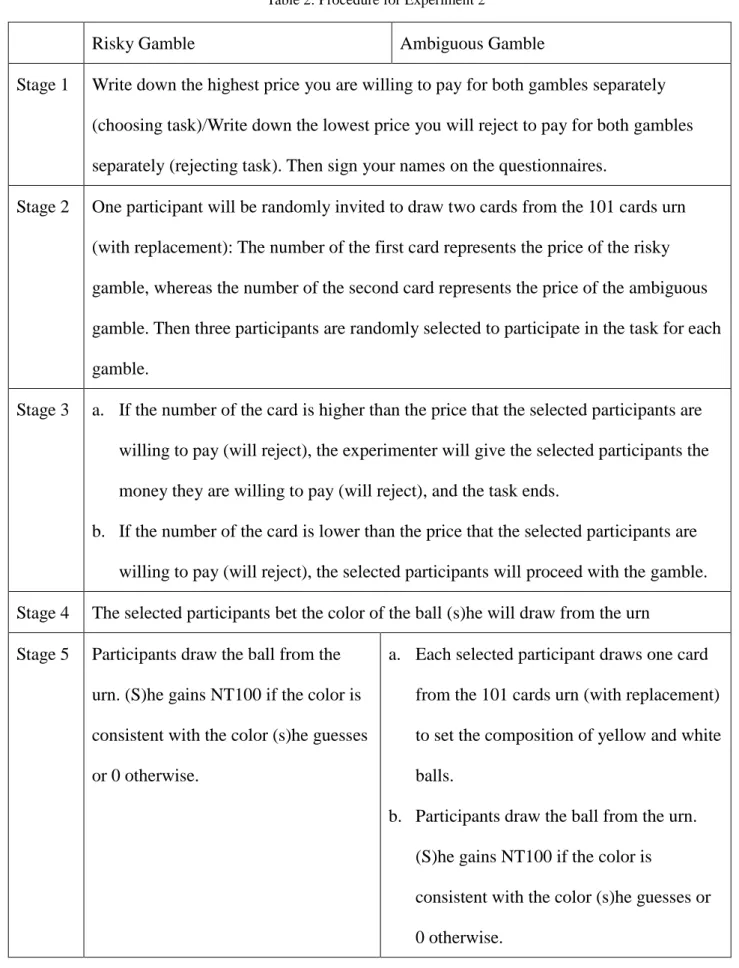
Participants viewed a display board explaining the procedure (Table 2), then looked at three urns set in front of them. The experimenter indicated that the first urn (risky urn) included 50 yellow and 50 white ping-pong balls; the second urn (ambiguous urn) included 100 yellow and white ping-pong balls of unknown proportion to be determined later; and the final urn (101 cards urn) included 101 cards, marked 0 through 100. Because the participants could see the urns filled with yellow and white balls and the 101 cards, they had a visual aid and should believe in the presence of the gamble.
Insert Table 2 about here
Procedure
Participants in each group were informed at the beginning of the experiment that six of them would be selected randomly after the experiment as potential winners of the prize (three for the
ambiguous gamble and three for the risky gamble), depending on whether the gamble price was higher or lower than the price they stated they were willing (would reject) to pay. In Taiwan, the wage for a part-time job for a college student averages around US$3 per hour, so the motivation of winning US$3.5 in Experiment 2 should be sufficient to encourage them to take the experiment seriously.
The experimenters told participants in the choosing (rejecting) task that they first had to determine the highest price they would pay (lowest amount they would reject to pay) for both gambles. After the participants had completed the questionnaires and signed their names, the experimenters invited one of them to draw two cards from the 101 cards urn (with replacement). The number of the first drawn card represented the price of the risky gamble, and the number of the second card represented the price of the ambiguous one. Three other participants were then
randomly selected to undertake the task for each gamble. If the number of the card was higher than the price that the selected participants stated they were willing (would reject) to pay, the
experimenter would give those participants the money they were willing (would reject) to pay, and the task ended. If the number was lower than the price the selected participants stated they were willing (would reject) to pay, they would play the gamble.
Thus, the procedures were the same for both gambles, but the final stage (Stage 5 in Table 2) differed slightly. In the risky gamble, participants first bet the color of the ball they would draw (valuable ball) and then drew one ball from the risky urn. Participants earned NT$100 if the color of the ball they drew was consistent with the color they bet and otherwise earned nothing. In the ambiguous gamble, participants first bet the color of the ball they would draw, and then drew one card at random from the 101 cards urn to establish the valuable versus non-valuable ball
composition before drawing a ball from the ambiguous urn. Participants received NT$100 if the color they drew was consistent with the color they bet and otherwise received nothing.
After the experimenter ensured all participants understood the procedure and had no questions, the experiment started. Participants responded to three-page questionnaires. The first page featured instructions about the tasks; the second and third pages were the task response pages. To avoid an
order effect, the order of the two gambles was counterbalanced. Due to the monetary motivations and clear explanations, participants likely made their choices carefully. After they completed the questionnaire, participants signed their names to receive a chance to be selected for the subsequent experiment. The other details were similar to those in Experiment 1.
Results
Twelve of the 178 participants were eliminated from the analysis because they violated dominance (i.e., reported a price less than or equal to NT$0 or greater than or equal to NT$100). From the remaining sample size of 166 (114 women and 52 men; aged 18 to 46 years, mean age 26.26 years), 83 respondents were assigned to the choosing task and 83 to the rejecting task.
Because the task order task format interaction had no impact on either risky or ambiguous gambles (F (1, 162) = .72; F (1, 162) = .67, respectively; both p > .1), the data could be pooled across the two task orders. Differences between the classes were also examined under both task format conditions. The results show no significant differences between the classes in terms of whether they were willing (would reject) to pay for a risky gamble or ambiguous gamble in the choosing condition (F (2, 80) = .08; F (2, 80) = 2.36, respectively; both p > .1) or in the rejecting condition ((F (2, 80) = .13; F (2, 80) = 0.20, respectively; both p > .1). The differences between the classes can therefore be ignored, and the data for the same task format can be pooled.
The results in Table 3a reveal that, as expected, compared with the risky option, the ambiguous option was more attractive in the choosing task than in the rejecting task. Although participants were willing to pay more money for the risky gamble than for the ambiguous one in both task formats, the price difference was more pronounced in the rejecting task than in the choosing task. In the choosing task, participants expressed their willingness to pay an average of NT$47.88 for the risky gamble and NT$44.60 for the ambiguous gamble (t (1, 81) = 15.14, p < .01, Cohen's d = .23, small size effect). In the rejecting task, they were willing to pay an average of NT$50.13 for the risky gamble and NT$41.05 for the ambiguous gamble (t (1, 81) = 13.69, p < .01, Cohen's d = .65, medium size effect). The difference between the two gambles in the choosing task was 3.28, which was statistically significantly smaller than the difference in the rejecting task, or
NT$9.08 (F (1, 164) = 6.72, p = .01). On the whole, H2 received support; participants were willing to pay a relatively higher price for the ambiguous option in the choosing task than in the rejecting task compared with the risky option.
Insert Table 3a about here
Further evidence derives from the comparison of the relative within-subject preferences across the two task formats. If participants were willing to pay more money for the ambiguous (risky) gamble than for the risky (ambiguous) gamble, they expressed a preference for the ambiguous (risky) gamble (labeled “AmbiMore” and “RiskyMore,” respectively). If participants indicated they would pay the same money for both the risky and ambiguous gambles, they had no relative
preference, and their data take the label “NoDiff.” As the results in Table 3b reveal, 49.4% of participants in the rejecting task preferred the risky gamble to the ambiguous gamble, whereas only 33.7% of participants in the choosing task expressed a preference for the risky gamble. In contrast, 16.9% of participants preferred the ambiguous gamble in the choosing task, and only 7.2% of them did so in the rejecting task. This difference was statistically significant (χ2(2, N = 166) = 5.97, p = .05). If we ignore subjects who expressed no relative preference, the result was even more pronounced (χ2
(1, N = 89) = 5.39, p = .02).
Insert Table 3b about here
Discussion
Experiment 2 involves a different method, yet the results are similar to those of Experiment 1. On the whole, Experiments 1 and 2 support the study propositions: Compared with the ambiguous option, the risky gamble is preferable in a choosing task compared with in a rejecting task.
More than 40% of the participants express indifference about pricing between the ambiguous and risky gambles for both the choosing and rejecting tasks. This result might occur because the pricing task (risky versus ambiguous) in Experiment 2 uses a within-subjects design, such that participants had to price two gambles at the same time, and the payoffs of the gambles were not very large (US$3.5). Therefore, the participants may not have discerned much difference between the two gambles with such minimal motivation. Keren and Gerritsen (1999) note a similar result; in
their study, 46.1% participants were willing to pay the same price for the risky and ambiguous gambles in the standard Ellsberg scenario. Although many participants exhibit this pricing indifference between the two gambles, the result is still consistent with H2, because overall, the participants are willing to pay a relatively higher price for the ambiguous option in the choosing task than in the rejecting task compared with the risky option.
Using the different experimental method in Experiment 2 improves confidence in the results and monetary incentives help motivate participants make their choices more carefully. Moreover, as in Experiment 1, framing using a rejecting task appears to increase the relative attractiveness of the risky option compared with the ambiguous option.
Experiment 3: Participants’ Rationales for Choices between Task Formats
Although Experiments 1 and 2 both confirm that the ambiguous option is more attractive in the choosing task than in the rejecting task compared with the risky option, no direct evidence confirms that participants in the choosing task focus more on the positive aspects of the ambiguous option or that in the rejecting task they concentrate on the negative aspects.
In Experiment 3, participants wrote down the rationales for their decisions after they expressed their preferences between the two options. If the previous results have occurred because
participants focused more on the positive (negative) aspects of the ambiguous option in the
choosing (rejecting) task, then it is reasonable to expect that the rationale in the choosing (rejecting) task would include more positive (negative) evaluations of the selected (rejected) option. That is, though participants might note the positive aspects of the chosen option in the choosing task and those of the non-rejected option in the rejecting task, the effect of the positive rationale should be more pronounced in the choosing task than in the rejecting task. We should not expect that the participants’ rationale in the choosing (rejecting) task is because the non-chosen (rejected) option is seen as better, otherwise the rationale would contradict their decision. Similarly, participants might note the negative aspects of the non-chosen option in the choosing task and that of the rejected option in the rejecting task, but the effect of the negative rationale should be more pronounced in the rejecting task than in the choosing task. Here again, their rationale in the choosing (rejecting)
task is not because the chosen (non-rejected) option is regarded as worse, which would contradict their decision. The participants’ rationale therefore should mediate the effect of the task format on choice:
H3a: Participants in the choosing task note more positive aspects of the
selected/non-rejected option than they do in the rejecting task. Participants in the rejecting task note more negative aspects of the non-chosen/rejected option than they do in the choosing task.
H3b: A participant’s rationale for his or her choice mediates the effect of task format on the choice.
Participants
To fulfill course requirements, 207 Taiwanese college students were invited to join this experiment, without receiving additional rewards or credits.
Design
The design of Experiment 3 is similar to that of Experiment 1, with three exceptions. First, to reduce the complexity of the task, only the Ellsberg scenario is presented, without the marketing strategy scenario. Second, participants wrote down the rationale for their choice after making their decision. Third, the prize in the two gambles is the same (NT$500). Although the same prize might produce a ceiling effect, this modification excludes an alternative possibility, namely, that
participants in the choosing task note more positive aspects of the ambiguous option because it possesses one extra advantage (e.g., premium payoffs) that the risky option does not have.
Procedure
Participants responded to a two-page questionnaire. The first page provided instructions about the task, and the second page outlined the Ellsberg scenario. After participants made their decision, they wrote down their most important rationale for their choice on the same page.
Results
Twelve of 207 participants were excluded from the analysis: 10 because they did not complete the questionnaires (e.g., provided no rationales), and 2 because the rationales they provided
contradicted their decisions (e.g., one subject in the rejecting task rejected the ambiguous option but in his rationale claimed he had chosen the ambiguous gamble because it was more exciting). Of the remaining 195 participants (150 women and 45 men; participant ages from 17 to 32 years, mean age 20.07 years), 91 participated in the rejecting task and 104 in the choosing task.
As the second column in Table 4 illustrates, the results are similar to those from Experiment 1, in that 34.6% of the participants in the choosing task preferred the ambiguous gamble, whereas only 23.1% of the participants did so in the rejecting task (χ2 (1, N = 195) = 3.09, p = .08). The result was marginally significant.
Insert Table 4 about here
Rationales for Decisions
Because this experiment was designed to explore whether participants in the choosing (rejecting) task focus more on the positive (negative) aspects of the ambiguous option, the rationales that participants stated for their decisions can be classified into three groupings, depending on the positive or negative outcomes of the chosen or non-chosen (non-rejected or rejected) options. First, in the presence of positive outcomes for the chosen or non-rejected options (“PosiRele”), participants might choose (in the choosing task) or not reject (in the rejecting task) an option because it offers better performance, such as greater success probability, higher expected mean value, or better outcomes. For example, one participant chose the ambiguous gamble rather than the risky gamble in the choosing task because it seemed to offer a greater possible success probability. Second, in the presence of negative outcomes for the rejected (in the rejecting task) or non-chosen (in the choosing task) options (“NegaRele”), participants may reject or not choose the gamble, because it offers worse performance on some feature, such as poor success probability, lower expected mean value, or lower outcomes. According to one rationale in this subgroup, the participant rejected the ambiguous rather than the risky option in the rejecting task because it had a lower probability of success. Third, the last category (“Others”) consists of other rationales for participants’ decisions, such as the participant who chose the ambiguous option rather than the risky one in the choosing task “just for fun.” Two independent judges, unaware of the purpose of
Experiment 3, categorized each written rationale into these three categories (PosiRele, NegaRele, and Others). The interjudge reliability was 89.7%, and any disagreements were resolved through discussion.
As the right three columns of Table 4 show, the results support H3a, in that participants’ rationales in the choosing task reflected more positive outcomes about the selected/non-rejected option than they did in the rejecting task (66.3% versus 31.9%), whereas those rationales reflected more negative outcomes about the non-chosen/rejected option in the rejecting task compared with the choosing task (51.6% versus 13.5%). The goodness-of-fit test was statistically significant (χ2 (2, N = 195) = 34.47, p < .01).
To explore whether participants’ rationales may mediate the effect of the task format on their choices, three categorical method (CATMOD) analyses provide further insights. The first
CATMOD used choice as the dummy dependent variable (1 = choosing the ambiguous option; 0 = choosing the risky option) and the task format (choosing versus rejecting) as the dummy
independent variable. Task format had a marginal influence on participants’ choices (χ2 (1, N = 195) = 3.09, p = .08). The second CATMOD, with consumers’ rationales as the dummy dependent
variable (2 = PosiRele; 1 = NegaRele; 0 = Others) and task format as the dummy independent variable, shows that the task format had a significant influence on participants’ rationales (χ2 (2, N = 195) = 30.72, p < .01). The third CATMOD, which included participants’ rationales, reveals that the impact of the rationales on choice remained significant (χ2 (2, N = 195) = 31.46, p < .01), but the task format had no impact on consumers’ choice (χ2 (1, N = 195) = 0.23, p > .1). Therefore, participants’ rationales mediated the impacts of the task format on their choice (Baron & Kenny, 1986), in support of H3b.
Discussion
Experiment 3 again supports the proposition that the ambiguous option is more attractive in the choosing task than in the rejecting task. More important, the mediation analysis reveals that the result is due to participants’ greater focus on the positive aspects of the ambiguous option in the choosing task versus their increased focus on the negative aspects in the rejecting task.
It is not surprising that the impact of task format on choice in Experiment 3 is not as
significant as that in Experiment 1. As previously noted, this divergence might be because of the ceiling effect in Experiment 3. That is, the payoff of the ambiguous option is higher than that of the risky option in Experiment 1, but they are the same in Experiment 3. Therefore, more participants in the choosing task may be likely to choose the ambiguous option in Experiment 1 than in Experiment 3 (50.7% versus 34.6%). Accordingly, it should be easier to produce a greater decline in the rejecting task, which can even acquire statistical significance, in Experiment 1 than in Experiment 3. Even if a difference exists, the impact of task format on the choice remains marginally significant. More importantly, this design excludes the alternative possibility that participants note more positive rationales for the ambiguous option in the choosing task because it owns a payoff premium. The results indicate that participants’ rationales mediate the effect of task format on ambiguity aversion.
By examining participants’ rationales, Experiment 3 offers more direct evidence that the ambiguous option owns more advantageous and disadvantageous attributes than does the risky option; therefore, the framing of the task format influences the relative attractiveness of the ambiguous option.
GENERAL DISCUSSION
Although many previous studies have demonstrated that participants prefer a risky option to an ambiguous one in a traditional Ellsberg gamble (Camerer & Weber, 1992; Curley & Yates, 1989; Pulford & Colman, 2008; Rode et al., 1999), this study is the first to demonstrate the influence of task formats on ambiguity aversion. Three experiments confirm that the ambiguous option is more attractive in a choosing task than in a rejecting task compared with the risky option. Moreover, the result occurs because participants focus more on the positive aspects of the ambiguous option in the choosing task and on the negative aspects in the rejecting task.
In turn, this study offers several contributions. First, the results indicate a more comprehensive conceptualization of ambiguity aversion and imply that researchers should control for task formats when conducting research on ambiguity aversion. Second, these findings are helpful in practice, in
that they offer suggestions to managers about how to communicate with relevant staff to achieve certain decisions by framing the decision tasks in a specific way.
Comparison with Previous Studies
This article contributes to literature on ambiguity aversion, especially research that uses to individual mental simulation to infer the probability of an option, by incorporating the impact of task formats on ambiguity aversion into the anchoring-and-adjustment process proposed by Einhorn and Hogarth (1985).
The ambiguous option owns more possible successful and failure probabilities than does the risky option. Therefore, task formats are able to influence participants’ ambiguity aversion. An interesting question is whether other factors, such as a person’s personality or motivation, may influence ambiguity aversion in the same way. Recently, Pulford (2009) has demonstrated that compared with less optimistic people, highly optimistic participants exhibit less ambiguity aversion in a traditional Ellsberg task, because “many of the optimists must have judged the probability of winning to be greater in the ambiguous urn than in the known-risk one” (p. 1086). In this manner, the result in the Pulford study implies that optimistic participants focus more on the positive aspects of an ambiguous option compared with less optimistic people.
Suggestions for Further Research
One interesting research direction to explore is the impact of people’s motivations, especially their self-regulatory focus, on their ambiguity aversion. According to regulatory focus theory (Higgins, 1998), a person’s self-regulation involves two systems: one for promotion and one for prevention. A promotion focus originates in the regulation of nurturance needs and centers on the acquisition of positive goals, whereas a prevention focus originates in the regulation of security needs and centers on preserving the absence of unwanted occurrences. Previous studies (Crowe & Higgins, 1997; Higgins, 1998; Higgins et al., 1994) have shown that people with a promotion focus are more sensitive to the presence or absence of positive outcomes, are eager to attain their
accomplishments and gains, and make their decisions with a strategic inclination to match the desired end state. In contrast, people with a prevention focus are more sensitive to the presence or
absence of negative outcomes, are in a state of vigilance to ensure their safety and avoid losses, and make their decisions with a strategic inclination to avoid the undesired state. Therefore, people with a promotion (prevention) focus should tend to focus more on the positive (negative) aspects of an ambiguous option. In line with the core concept of this article, promotion-focused people should be more likely to choose the ambiguous option and exhibit less ambiguity aversion than do
prevention-focused people.
Acknowledgments
The research reported in this article was supported by research grant NSC 98-2410-H-390-033 from the National Science Council of Taiwan. The author acknowledges the editor and anonymous reviewers for their helpful suggestions.
REFERENCES
Baron, R. M., & Kenny, D. (1986). The moderator-mediator variable distinction in social psychological research: Conceptual, strategic, and statistical considerations. Journal of
Personality and Social Psychology, 51 (6), 1173-1182.
Becker, S. W., & Brownson, F. O. (1964). What price ambiguity? Or the role of ambiguity in decision-making, Journal of Political Economy, 72, 62-73.
Bernasconi, M., & Loomes, G. (1992). Failures of the reduction principle in an Ellsberg-type problem. Theory and Decision, 32 (1), 77-100.
Camerer, C., & Weber, M. (1992). Recent developments in modeling preference: Uncertainty and ambiguity. Journal of Risk and Uncertainty, 5 (4), 325-370.
Chang, C.-C., & Liu, H.-H. (2008). Which is the compromise option? Information format and task format as determinants. Journal of Behavioral Decision Making, 21 (1), 59-75.
Chernev, A. (2001). The impact of common features on consumer preferences: A case of confirmatory reasoning. Journal of Consumer Research, 27 (4), 475-488.
Chow, C. C., & Sarin, R. K. (2001). Comparative ignorance and the Ellsberg paradox. Journal of
Risk and Uncertainty, 22 (2), 129-19.
Crowe, E., & Higgins, E. T. (1997). Regulatory focus and strategic inclinations: Promotion and prevention in decision making. Organizational Behavior and Human Decision Processes, 69 (2), 117-132.
Curley, S. P., & Yates, J. F. (1989). An empirical evaluation of descriptive models of ambiguity reactions in choice situations. Journal of Mathematical Psychology, 33 (4), 397-427.
Curley, S. P., Yates, J. F., & Abrams, R. A. (1986). Psychological sources of ambiguity avoidance,
Organizational Behavior and Human Decision Processes, 38 (2), 230-256.
Du, N., & Budescu, D. (2005), The effects of imprecise probabilities and outcomes in evaluating investment options. Management Science, 51 (12), 1791-1803.
Einhorn, H. J., & Hogarth, R. M. (1985). Ambiguity and uncertainty in probabilistic inference,
Psychological Review. 92 (2), 433-461
Ellsberg, D. (1961). Risk ambiguity and the Savage axioms. Quarterly Journal of Economics, 75 (4), 643-649.
Fox, C. R., & Tversky, A. (1995). Ambiguity aversion and comparative ignorance. Quarterly
Journal of Economics, 110 (3), 585-603.
Fox, C. R., & Weber, M. (2002). Ambiguity aversion, comparative ignorance, and decision context.
Organizational Behavior and Human Decision Making, 88 (1), 476- 498.
Heath, C., & Tversky, A. (1991). Preference and belief: Ambiguity aversion and competence in choice under uncertainty. Journal of Risk and Uncertainty, 4 (1), 5-28.
Higgins, E. T. (1998), Promotion and prevention: Regulatory focus as a motivational principle. In M. P. Zanna (Ed.), Advances in Experimental Social Psychology, (Vol. 51, pp.1280-1300). New York: Academic Press.
Higgins, E. T., Roney, C. J. R., Crowe, E., & Hymes, C. (1994). Ideal versus ought predilections for approach and avoidance: Distinct self-regulatory systems. Journal of Personality and Social
Psychology, 66 (Feburary), 276-286.
Hogarth, R. M. (1987). The Psychology of Judgment and Choice (2nd Ed.). San Francisco. CA: Jossey Bass.
Hogarth, R. M., & Einhorn, H. J. (1990). Venture theory: A model of decision weights.
Management Science, 36 (7), 780-803.
Houston, D. A., Sherman, S. J., & Baker, S. M. (1991). Feature Matching, Unique Features, and the Dynamics of the Choice Process: Predicision Conflict and Postdecision Satisfaction. Journal
of Experimental Social Psychology, 27 (September), 411-430.
Kahn, B. E., & Sarin, R. K. (1988). Modeling ambiguity in decisions under uncertainty. Journal of
Consumer Research, 15 (2), 265-272.
Keren, G., & Gerritsen, L. E. M. (1999). On the robustness and possible accounts for ambiguity aversion. Acta Psychology, 103 (1), 149-172.
Knight, F. H. (1921). Risk, uncertainty and profit. Boston: Houghton Mifflin.
Kuhn, K. M. (1997). Communicating uncertainty: Framing effects on responses to vague probabilities. Organizational Behavior and Human Decision Processes, 71 (1), 55-83. Kühberger, A., & Perner, J. (2003). The role of competition and knowledge in the Ellsberg task.
Journal of Behavioral Decision Making, 16 (3), 181-191.
Liu, H.-H., & Colman, A. M. (2009). Ambiguity aversion in the long run: Repeated decisions under risk and uncertainty. Journal of Economic Psychology, 30 (June), 277-284.
MacCrimmon, K. R., & Larsson, S. (1979). Utility theory: Axioms versus ‘paradoxes.’ In M. Allais and O. Hagen (eds.), Expected Utility and the Allais Paradox. Holland: D. Reidel, 333-409. Nagpal, A., & Krishnamurthy, P. (2008). Attribute conflict in consumer decision making: The role
of task compatibility. Journal of Consumer Research, 34 (February), 696-705.
Pulford, B. D. (2009). Is luck on my side? Optimism, pessimism, and ambiguity aversion. The
Quarterly Journal of Experimental Psychology, 62 (6), 1079-1087.
Pulford, B. D., & Colman, A. M. (2008). Size doesn’t really matter: Ambiguity aversion in Ellsberg urns with few balls. Experimental Psychology, 55 (1), 31-37.
Ritov, I., & Baron, J. (1990). Reluctance to vaccinate: omission bias and ambiguity. Journal of
Behavioral Decision Making, 3 (4), 263-277
Roca, M., Hogarth, R. M., & Maule, A. J. (2006). Ambiguity seeking as a result of the status quo bias. Journal of Risk and Uncertainty, 32 (3), 175-194.
Rode, C., Cosmides, L., Hell, W., & Tooby, J. (1999). When and why do people avoid unknown probabilities in decisions under uncertainty? Testing some predictions from optimal foraging theory. Cognition, 72 (3), 269-304.
Shafir, E. (1993). Choosing versus rejecting: Why some options are both better and worse than others. Memory and Cognition, 21 (4), 546-556.
Shafir, E. (1995). Compatibility in cognition and decision. The Psychology of Learning and
Tversky, A., & Fox, C. R. (1995), Weighing risk and uncertainty, Psychological Review, 102 (2), 269-283.
Tversky, A., & Gati, I. (1978). Studies of similarity. In E. Rosch & B. Lloyd (Eds.), Cognition and
categorization (pp. 79-98). Hilisdale, NJ: Erlbaum.
Yates, J. F., & Stone, E. R. (1992). The risk construct. In J. F. Yates (Ed.), Risk-Taking Behavior (pp. 1-25). New York: John Wiley & Sons.
Yates, J. F., & Zukowski, L. G. (1976). Characterization of ambiguity in decision making.
Footnotes
1
In Shafir’s (1993) study, he proposes that if choosing and rejecting are complementary, the sum of the percentages of subjects who choose and who reject a particular option should equal 100.
However, the sum of the percentages for choosing and rejecting an enriching option is significantly greater than 100 (z = 2.48, p < .02). Tversky and Gati (1978) use a similar method in their study.
Tables
Table 1: Relative Attractiveness of the Ambiguous Option among Task Formats
Ellsberg Scenario Marketing Strategy Scenario
Choosing Task 50.7% (35/69) 72.1% (44/61)
Rejecting Task 29.4% (20/68) 47.7% (21/44)
Notes: The percentages in the choosing task row represent the relative shares of the ambiguous options in that condition. The percentages in the rejecting task row represent the relative non-rejection shares of the ambiguous options. The numbers in parentheses indicate the number of participants out of total participants for each scenario in that task format.
Table 2: Procedure for Experiment 2
Risky Gamble Ambiguous Gamble
Stage 1 Write down the highest price you are willing to pay for both gambles separately (choosing task)/Write down the lowest price you will reject to pay for both gambles separately (rejecting task). Then sign your names on the questionnaires.
Stage 2 One participant will be randomly invited to draw two cards from the 101 cards urn (with replacement): The number of the first card represents the price of the risky gamble, whereas the number of the second card represents the price of the ambiguous gamble. Then three participants are randomly selected to participate in the task for each gamble.
Stage 3 a. If the number of the card is higher than the price that the selected participants are willing to pay (will reject), the experimenter will give the selected participants the money they are willing to pay (will reject), and the task ends.
b. If the number of the card is lower than the price that the selected participants are willing to pay (will reject), the selected participants will proceed with the gamble. Stage 4 The selected participants bet the color of the ball (s)he will draw from the urn
Stage 5 Participants draw the ball from the urn. (S)he gains NT100 if the color is consistent with the color (s)he guesses or 0 otherwise.
a. Each selected participant draws one card from the 101 cards urn (with replacement) to set the composition of yellow and white balls.
b. Participants draw the ball from the urn. (S)he gains NT100 if the color is
consistent with the color (s)he guesses or 0 otherwise.
Table 3a: Prices for Risky and Ambiguous Gambles in the Choosing and Rejecting Tasks. Task Format Risky Gamble Ambiguous Gamble Difference
Choosing task (N = 83) NT$47.88 NT$44.60 NT$3.28
Rejecting task (N = 83) NT$50.13 NT$41.05 NT$9.08
Notes. The amounts in the choosing task row represent the mean highest price participants are willing to pay for the gambles. The amounts in the rejecting task row represent the mean lowest price participants would reject to pay for the gambles.
Table 3b: Relative Preferences between Two Task Formats.
Task Format RiskyMore AmbiMore NoDiff
Choosing task (N = 83) 33.7% 16.9% 49.4%
Rejecting task (N = 83) 49.4% 7.2% 43.3%
Notes. The percentages in each cell represent the percentage of participants’ relative preference in each condition. “AmbiMore” (“RiskyMore”) indicates that participants are willing to pay more money for the ambiguous (risky) gamble than for the risky (ambiguous) gamble, “NoDiff” indicates that participants would pay the same money for both the risky and ambiguous gambles.
Table 4: Participants’ Rationales among Task Formats
Task Format Choice Participants’ Rationales
PosiRele NegaRele Others
Choosing Task (N = 104) 34.6% 66.3% 13.5% 20.2%
Rejecting Task (N = 91) 23.1% 31.9% 51.6% 16.5% Notes. The percentages in the Choice column represent the relative shares of the ambiguous options in that condition. “PosiRele” represents the presence of positive outcomes for the chosen or non-rejected option; “NegaRele” represents the presence of negative outcomes for the rejected or non-chosen option; and “Others” indicates that the participant’s decision reflects some other rationale.
Cover Letter
Dear Professor Wright,
I deeply appreciate your suggestions regarding my manuscript, “Task Formats and Ambiguity Aversion” (BDM-09-0089.R2). I accept your suggestion to hire a copy editor to review this
manuscript (though I asked a native speaker to edit my manuscript for the last revision R2, it seems that the person I hired did not do a good job). I believe that the new copy editor, who has extensive professional experience with scholarly journals, has been more effective in her editing of this revised manuscript.
I hope you agree that the revisions in this revised manuscript are sufficient to make it
acceptable for publication in the Journal of Behavioral Decision Making. Thank you again for your helpful suggestions.
Best Regards,
Hsin-Hsien Liu