Ammonium ion, ethylene, and NaCl-induced senescence of detached rice
leaves
Chuan Chi Lin, Yi Ting Hsu and Ching Huei Kao*
Department of Agronomy, National Taiwan University, Taipei, Taiwan, Republic of China; *Author for correspondence (e-mail: [email protected])
Received 7 August 2001; accepted in revised form 10 October 2001
Key words: Ammonium ion, Leaf senescence, NaCl, Oryza sativa
Abstract
The possibility that NH4
+accumulation is linked to the senescence of detached rice (Oryza sativa) leaves induced
by NaCl was investigated. NaCl was effective in promoting senescence and in increasing NH4
+ content of
de-tached rice leaves. NaCl-promoted senescence is mainly due to the effect of both Na+and Cl-ions. NaCl had no
or slight effect on relative water content, suggesting that an osmotic effect is unlikely to be a major factor con-tributing to senescence of these leaves. NaCl-induced NH4
+accumulation was due to enhanced nitrate reduction
and decreased glutamine synthetase activity. Exogenous NH4Cl, which caused an accumulation of NH4 + in
de-tached rice leaves, also promoted senescence. It was found that an increase in NH4
+content preceded the
occur-rence of senescence caused by NaCl. Results also show that NaCl-promoted senescence is unlikely to be due to the lack of glutamate, glutamine, aspartate, and asparagine. The current results suggest that NH4
+accumulation is
linked to NaCl-induced rice leaf senescence. Since ethylene is known to be a potent promoter of leaf senescence, we also investigated the role of ethylene in the regulation of NH4
+-promoted senescence of detached rice leaves.
NaCl or NH4Cl treatment resulted in a decrease of ethylene production. Evidence was presented to show that
NH4
+accumulation in detached rice leaves does not change tissue sensitivity to ethylene. Clearly, the possible
involvement of ethylene in NH4
+-promoted senescence is excluded.
Abbreviations: Chl – Chlorophyll, DIDS – 4,4⬘-diisothiocyano-2,2⬘-disulfonic acid, FW – fresh weight, GS –
glutamine synthetase, RWC – relative water content, STS – silver thiosulfate
Introduction
Leaf senescence is an integral part of leaf develop-ment. Ammonium ion (NH4
+) assimilation changes
considerably with the onset of senescence (Feller and Fischer 1994). Glutamine synthetase (GS, EC 6.3.1.2) plays a crucial role in the assimilation of NH4
+
(Mif-lin and Lea 1976) and its activity is known to de-crease during either natural or dark-induced senes-cence of leaves (Feller and Fischer 1994). Decline in GS activity in leaves during senescence may result, at least in part, in an accumulation of NH4
+. Recently,
we reported that NH4
+ accumulation was associated
with senescence of detached leaves of rice (Oryza
sa-tiva) induced by methyl jasmonate, under dark
con-dition, and by water stress (Chen and Kao 1998; Chen et al. 1997; Lin and Kao 1998).
Ethylene is a potent promoter of leaf senescence. In oat and rice leaf segments an increase in ethylene production preceded the occurrence of leaf senes-cence (Gepstein and Thimann 1981; Kao and Yang 1983). Other studies using inhibitors of ethylene bio-synthesis and action are supportive of the hypothesis that ethylene is an important plant hormone involved in leaf senescence (Gepstein and Thimann 1981; Kao and Yang 1983).
NaCl has been shown to induce leaf senescence (Kang and Titus 1989; Lutts et al. 1996a; Yeo and Flowers 1983). The accumulation of NH4
+due to
re-ported (Feng and Barker 1992; Lazcano-Ferrat and Lovatt 1998). Salinity has been shown to increase, decrease or have no effect on ethylene production (Chrominski et al. 1986; Helmy et al. 1994; Khan et al. 1987; Lutts et al. 1996b).
In the present investigation, the relationship be-tween NH4
+, ethylene and NaCl-promoted senescence
of detached rice leaves was examined.
Materials and methods
Rice (Oryza sativa cv. Taichung native 1) was cul-tured as described previously (Chen et al. 1997). Briefly, rice seedlings were planted on a stainless net floating on half-strength Johnson’s modified nutrient solution (pH 4.2, Johnson et al. (1957)) in a 500 mL beaker. The nutrient solution was replaced every three days. The rice plants were then grown for 12 days in a greenhouse, where natural light was provided and the temperature was controlled at 30 °C during the day and 25 °C at night. The apical 3-cm segments excised from the third leaves of 12-day-old seedlings were used. A group of 10 segments was floated in a Petri dish containing 10 mL of test solutions. Incuba-tion was carried out at 27 °C in the light (40
mol m−2s−1).
The senescence of detached rice leaves was fol-lowed by measuring the decrease in chlorophyll (Ch1) and protein. Ch1 was determined according to Wintermans and De Mots (1965) after extraction in 96% (v/v) ethanol. For protein extraction, leaf seg-ments were homogenised in 50 mM sodium phos-phate buffer (pH 6.8). The extracts were centrifuged at 17,600 g for 20 min, and the supernatants were used for determination of protein by the method of Bradford (1976).
RWC, defined as water content of leaf tissue as a percentage of that of the fully turgid tissue, was de-termined by the method of Weatherley (1950). For Na+ determination, harvested leaf segments were
washed three times (one minute each) with distilled water, dried at 65 °C for 2 days, extracted in 1 N HCl at room temperature (Hunt 1982) and analysed with a flame photometer (Evans, Electroselenium Ltd, En-gland). Chloride ion was estimated in a separate ex-tract made according to the method described by Hodson et al. (1985) and estimated using an ion meter (Mittler Delta 350, UK).
Ammonium ions were extracted by homogenising leaf segments in 0.3 mM sulphuric acid (pH 3.5). The
homogenate was centrifuged for 10 min at 39,000 g, and the supernatant was used for determination of NH4
+as described by Lin and Kao (1996). For nitrate
determination, leaf segments were homogenised in double distilled water. The homogenate was centri-fuged for 25 mn at 17,600 g. The supernatant was used for determination of nitrate by the method de-scribed by Hecht and Mohr (1990).
For determination of glutamate, glutamine, aspar-tate, and asparagine, leaf samples were extracted with 2% sulfosalicylic acid and the homogenate centri-fuged at 15,000 g for 20 min. The supernatant was used directly for amino acid analysis. Amino acid analysis was carried out by an amino acid analyser (Beckman 6300, California, USA) and contents of amino acids are expressed as nmol g−1FW ormol
g−1FW.
For extraction of GS, leaf segments were homoge-nised with 10 mM Tris-HCl buffer (pH 7.6, contain-ing 1 mM MgCl2, 1 mM EDTA and 1 mM
2-mercap-toethanol) in a chilled pestle and mortar. The homo-genate was centrifuged at 15,000 g for 30 mn and the resulting supernatant was used for determination of GS activity. The whole extraction procedure was car-ried out at 4 °C. GS was assayed by the method of Oaks et al. (1980). One unit of GS activity is defined as 1 mol L-glutamate␥-monohydroxamate formed per min.
For ethylene production, leaf segments were trans-ferred to test tubes sealed with serum caps. After 2 h of incubation in the dark at 27 °C, a 1-ml gas sample was withdrawn from the headspace of the test tube. Ethylene was then assayed as described previously (Kao and Yang 1983). In experiments with silver thio-sulfate (STS), a stock solution of STS was prepared by mixing equal volumes of 0.01 M AgNO3and 0.04
M Na2S2O3(Liu et al. 1990).
For all measurements, all treatments were repeated four times. All experiments described here were re-peated four times. Similar results and identical trends were obtained each time. The data reported here are from a single experiment.
Results and discussion
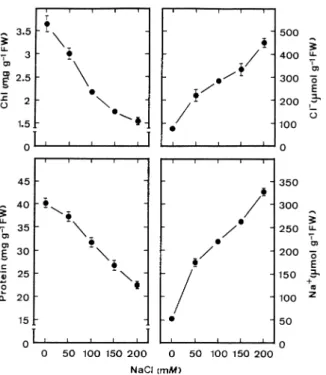
In the present paper, NaCl-induced senescence of de-tached rice leaves was assessed by the decrease in Chl and protein content. Increasing the concentration of NaCl from 50 to 200 mM progressively decreased Chl and protein contents and increased both Na+and
Cl−contents in detached rice leaves in the light
(Fig-ure 1). Clearly, the promotion of leaf senescence by NaCl is closely correlated with the increase of Na+
and Cl−contents in detached leaves.
The effect of NaCl on the induction of senescence in detached rice leaves could be attributed to Na+,
Cl−or both. Previously, we have reported that NaCl
treatment results in an inhibition of root growth of rice seedlings (Lin and Kao 1999). We also observed that NaCl-inhibited root growth of rice seedlings was mainly due to Na+
, rather than Cl−
(unpublished data). Thus it is of great interest to know whether se-nescence induction caused by NaCl in detached rice leaves is also due to Na+, rather than Cl−. To test this
possibility, we determined the effect of 4,4 ⬘-diisothio-cyano-2,2⬘-disulfonic acid (DIDS), a nonpermeating amino-reactive disulfonic acid known to inhibit the uptake of Cl− (Lin 1981), on NaCl-induced
senes-cence in detached rice leaves. If Cl−plays no role in
promoting senescence in detached rice leaves treated with NaCl, then addition of DIDS is expected to lower Cl−content and to have no effect on senescence
promotion. Results presented in Figure 2 show that DIDS was found to decrease Cl−content without
af-fecting Na+ content, and also increase Chl and
pro-tein content in NaCl-treated detached rice leaves. It appears that both Na+and Cl−are involved in
senes-cence induced by NaCl in detached rice leaves. No or only a slight difference in RWC was ob-served between NaCl-Treated leaves and control leaves (Table 1), suggesting that an osmotic effect is unlikely to be a major factor contributing to senes-cence promotion in detached rice leaves treated with NaCl. This suggestion is supported further by the ob-servations that detached rice leaves treated with sor-bitol at a concentration iso-osmotic with 200 mM NaCl had much higher Chl and protein contents than those treated with 200 mM NaCl and significant changes in Chl and protein in leaves treated with 200 mM NaCl were due to the presence of NaCl (Table 2). The lack of effect of NaCl on RWC seems to result from a certain amount of osmotic adjustment, due to the accumulation of Na+and Cl−(Figure 1).
Ammonium ion content in detached rice leaves in-creased with the increase of NaCl concentration (data not shown). NH4
+ content increased about 2-fold in
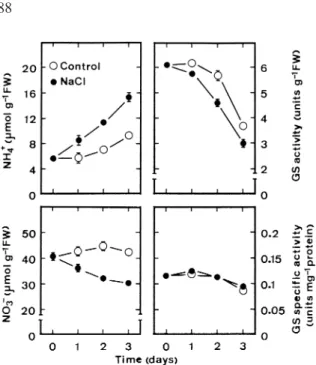
detached leaves treated with 200 mM NaCl for 3 days in the light (Figure 3). NH4
+content in control leaves
remained unchanged during the first day of
incuba-Figure 1. Effect of NaCl on Chl, protein, Na+and Cl−contents in detached rice leaves. Detached rice leaves were incubated in 5 mM sodium phosphate buffer (pH 7.0) in the presence of NaCl (0–200 mM). Measurements were made 3 days after treatment in the light. Vertical bars represent standard errors (n = 4).
Figure 2. Effect of NaCl and 4, 4⬘- diisothiocyano – 2, 2⬘-
disul-fonic acid (DIDS) on Chl, protein, Na+, and Cl−in detached rice leaves. Detached rice leaves were incubated in 5 mM sodium phos-phate buffer (pH 7.0) in the presence or absence of NaCl (200 mM) or DIDS (0.1 mM). Measurements were made 3 days after treat-ment in the light. Vertical bars represent standard errors (n = 4).
tion and increased subsequently (Figure 3). It is clear that NH4
+ content in leaves treated with NaCl was
higher than that in controls and the accumulation of NH4
+ induced by NaCl was evident at 1 day after
treatment (Figure 3).
Ammonium ion is a central intermediate in the metabolism of nitrogen in plants. NH4
+
is produced during nitrate assimilation, deamination of amino ac-ids and photorespiration (Miflin and Lea 1976). Fig-ure 3 shows that NaCl treatment resulted in a decrease in nitrate content. This result suggests that NaCl-in-duced NH4
+accumulation may have resulted from the
promotion of nitrate reduction. If nitrate is assumed to be the source of NH4
+, the detached rice leaves
ought to accumulate more NH4
+when fed with
addi-tional nitrate. In our study the exact result was ob-served. Detached rice leaves pretreated with 50 mM KNO3 for 12 h in the light, following by treatment
with NaCl for 24 h in the light contained more NH4 +
than those pretreated with water or KCl (Table 3). GS is the primary enzyme responsible for NH4
+
as-similation in plants (Miflin and Lea 1976). We ob-served that GS activity in control leaves remained al-most unchanged during the first 2 days of incubation and subsequently decreased (Figure 3). NaCl-treated rice leaves had lower GS activity than the control leaves (Figure 3). However, no decrease in specific activity of GS was observed in detached rice leaves treated with NaCl (Figure 3). It appears that NaCl-in-duced NH4
+accumulation is attributed to the decrease
in GS activity.
A high content of NH4
+is known to have a toxic
effect on plant cells (Givan 1979). Recently, we re-ported that NH4
+accumulation is associated with
wa-ter stress-, methyl jasmonate- and dark-promoted se-nescence of detached rice leaves (Chen and Kao 1998; Chen et al. 1997; Lin and Kao 1998). If NH4 +
accumulation plays a regulatory role in NaCl-induced senescence of detached rice leaves, it is expected that treatment of NH4Cl would increase endogenous NH4 +
content and consequently promote senescence. As in-dicated in Figure 4, this is indeed the case. The ob-servations that detached rice leaves treated with NH4Cl, which resulted in a promotion of senescence
and an increase in NH4
+content in the same way that
NaCl did, further support our suggestion that NH4 +
accumulation is likely to participate in the regulation of senescence of detached rice leaves under saline conditions.
To test the causal relationship between NH4 +
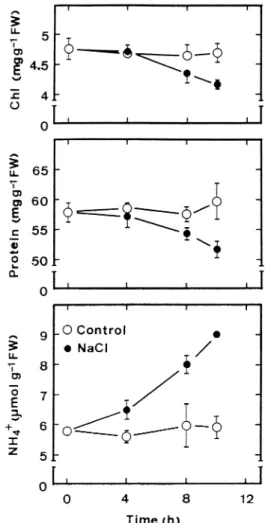
accu-mulation and senescence promotion in detached leaves caused by NaCl, detached rice leaves were in-cubated in the presence or absence of NaCl for 4, 8, and 10 h. Changes in Chl, protein, and NH4
+
were then monitored. As indicated in Figure 5, an increase in NH4
+ content preceded the decrease in Chl and
pro-tein contents in detached rice leaves caused by NaCl. Thus, NH4
+accumulation may play a regulatory role
in leaf senescence induced by NaCl.
Kylin and Quatrano (1975) suggested that a pri-mary plant response to salinity is in amino acid bolism, specifically key reactions involved with meta-bolic regulation of NH4
+ assimilation. Pulich (1986)
reported that amides decreased with increasing salin-ity in leaves of Halodule wrightii and Thalassia
testudinum. Hurst et al. (1993) demonstrated that
Figure 3. Time courses of NaCl effect on the contents of NH4+and nitrate, and activity and specific activity of GS in detached rice leaves. Detached rice leaves were incubated in 5 mM sodium phos-phate buffer (pH 7.0) with or without NaCl (200 mM) in the light. Vertical bars represent standard errors (n = 4).
Table 1. Effect of NaCl on relative water content (RWC) in
de-tached rice leaves
Time (days) RWC (%) Control NaCl 0 98.9 ± 0.2 1 98.2 ± 0.4 97.0 ± 0.7 2 98.3 ± 0.7 94.3 ± 1.1 3 96.6 ± 0.9 93.5 ± 0.8
Detached rice leaves were incubated in sodium phosphate buffer (5 mM, pH 7.0) with or without NaCl (200 mM). Means ± standard errors (n = 4).
glutamine depletion rather than NH4
+ accumulation
could be the reason for the reduced shelf-life of as-paragus treated with phosphinothricin, an inhibitor of
GS. In our work, we found that the contents of glutamate, glutamine, aspartate, and asparagine in NaCl-treated rice leaves were higher than those in control leaves (Figure 6). It appears unlikely that lack of glutamate, glutamine aspartate or asparagine is the
Table 2. Effect of the concentration of NaCl and sorbitol on the contents of Chl and protein in detached rice leaves
Treatment Chl (mg g−1FW) Protein (mg g−1FW) Control 3.5 ± 0.10 42.9 ± 1.3 Sorbitol, 400 mM 2.6 ± 0.04 36.8 ± 0.82 Sorbitol, 300 mM + NaCl, 50 mM 2.3 ± 0.03 34.2 ± 0.51 Sorbitol, 200 mM + NaCl, 100 mM 2.1 ± 0.03 33.0 ± 0.71 NaCl, 200 mM 1.2 ± 0.14 29.6 ± 1.0
The osmotic potential was kept equivalent to that of medium with 200 mM NaCl by replacing NaCl by sorbitol. Sorbitol and NaCl were dissolved in sodium phosphate buffer (5 mM, pH 7.0). Chl and protein were determined 3 days after treatment in the light. Means ± standard errors (n = 4).
Table 3. Effect of KNO3pretreatment on NaCl-induced NH4+ ac-cumulation in detached rice leaves
Treatment NH4+(mol g−1FW) H2O → Control 8.4 ± 0.48 H2O → NaCl 12.2 ± 0.18 KCl → Control 9.1 ± 0.46 KCl → NaCl 12.5 ± 0.31 KNO3 → Control 9.7 ± 0.54 KNO3 → NaCl 14.5 ± 0.48
Detached rice leaves were pretreated with either H2O, 50 mM KCl or KNO3for 12 h in the light and then treated with sodium phos-phate buffer (5 mM, pH 7.0) in the presence or absence of NaCl (200 mM) for 24 h in the light. Means ± standard errors (n = 4).
Figure 4. Effect of NH4Cl on Chl, protein and NH4+contents, and ethylene production in the detached rice leaves. Detached rice leaves were incubated in 5 mM sodium phosphate buffer (pH 7.0) in the presence of NaCl (0–200 mM). Measurements were made 3 days after treatment in the light. Vertical bars represent standard errors (n = 4).
Figure 5. Time courses of NaCl effect on the contents of Chl,
pro-tein, and NH4+in detached rice leaves. Detached rice leaves were incubated in 5 mM sodium phosphate buffer (pH 7.0) with or with-out NaCl (200 mM) in the light. Vertical bars represent standard errors (n = 4).
reason for the senescence of detached rice leaves in-duced by NaCl.
Ethylene is known to be the promoter of leaf se-nescence (Gepstein and Thimann 1981; Kao and Yang 1983). It is of great interest to known whether senes-cence of detached rice leaves induced by NaCl or NH4Cl is mediated through an increase in ethylene
production. Ethylene production in control leaf seg-ments increased significantly during the first day and decreased subsequently (Figure 7). This result is con-sistent with our early findings that ethylene produc-tion precedes the senescence of detached rice leaves (Kao and Yang 1983), indicating that ethylene pro-duction participates in the regulation of rice leaf se-nescence. If NaCl-promoted senescence of detached rice leaves is mediated though ethylene production, then ethylene production in NaCl-treated leaf seg-ments is expected to be higher than that in control leaf segments. However, as indicated in Figure 7, this does not seem to be the case. Figure 4 also shows that increasing concentration of NH4Cl from 50 to 200
mM progressively decreased ethylene production in rice leaf segments.
If a change in ethylene production is excluded as an explanation for the NaCl- or NH4Cl-promoted
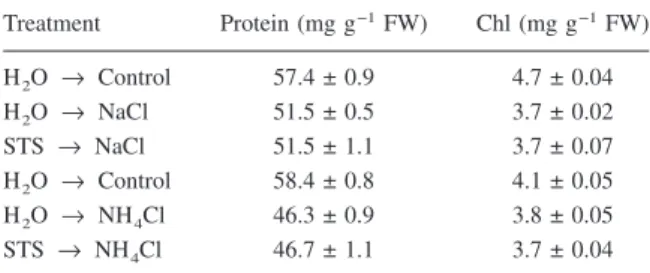
se-nescence of detached rice leaves, a change in sensi-tivity to ethylene is an alternative possibility. This possibility was tested by using the inhibitor of ethyl-ene action, STS (Liu et al. 1990). STS was ineffec-tive in inhibiting NaCl- or NH4Cl-promoted
senes-cence of detached rice leaves (Table 4). It seems that ethylene is not involved in regulating senescence of detached rice leaves caused by NaCl or NH4Cl.
Although the present investigation provides evi-dence to show that NH4
+ accumulation is associated
with senescence of detached rice leaves caused by NaCl stress, the actual mechanism of NH4
+-induced
senescence is still unclear. Therefore, further research
Figure 6. Time course of NaCl effect on the contents of aspartate
(Asp), asparagines (Asn), glutamate (Glu), and glutamine (Gln) in detached rice leaves. Detached rice leaves were incubated in 5 mM sodium phosphate buffer (pH 7.0) with or without NaCl (200 mM) in the light. Vertical bars represent standard errors (n = 4).
Figure 7. Time courses of NaCl effect on Chl and protein contents,
and ethylene production in detached rice leaves. Detached rice leaves were incubated in 5 mM sodium phosphate buffer (pH 7.0) with or without NaCl (200 mM) in the light. Vertical bars repre-sent standard errors (n = 4).
is necessary for a better understanding of the mecha-nism of NH4
+-induced senescence.
Acknowledgements
This work was supported by the National Science Council of the Republic of China, grant 90-2313-B-002-266.
References
Bradford M.M. 1976. A rapid and sensitive method for the quan-titation of microgram quantities of protein utilizing the princi-ple of protein-dye binding. Anal. Biochem. 72: 248–254. Chen S.J. and Kao C.H. 1998. Methyl jasmonate, ammonium, and
leaf senescence in rice. J. Plant Physiol. 152: 353–357. Chen S.J., Hung K.T. and Kao C.H. 1997. Ammonium
accumula-tion is associated with senescence of rice leaves. Plant Growth Regul. 21: 195–201.
Chrominski A., Khan A.M., Weber D.J. and Smith B.N. 1986. NaCl-salinity-dependent conversion of ACC to ethylene in the halophyte, Allenrolfea occidentalis. Naturwissenschaften 73: 274–275.
Feller U. and Fischer A. 1994. Nitrogen metabolism in senescing leaves. Crit. Rev. Plant Sci. 13: 241–273.
Feng J. and Barker A.V. 1992. Ethylene evolution and ammonium accumulation by tomato plants under water and salinity stress. J. Plant Nutr. 15: 2471–2490.
Gepstein S. and Thimann K.V. 1981. The role of ethylene in the senescence of oat leaves. Plant Physiol. 68: 349–354. Givan C.V. 1979. Metabolic detoxification of ammonia in tissues
of higher plants. Phytochemistry 18: 375–382.
Hecht R.L. and Mohr H. 1990. Factors controlling nitrate and am-monium accumulation in mustard (Sinapis alba) seedlings. Physiol. Plant. 78: 379–387.
Helmy Y.H., El Abd S.O., Abou Hadid A.F., El Beltag U. and El Betagy A.S. 1994. Ethylene production from tomato and cuc-mber plants under saline conditions. Egypt J. Hortic. 21: 153– 160.
Hodson M.J., Opik H. and Wainwright S.J. 1985. Changes in ion and water content of individual shoot organs in salt-tolerent and a salt-sensitive clone of Agrostis stolonifera L. during and sub-sequent to treatment with sodium chloride. Plant Cell Environ. 8: 657–658.
Hunt J. 1982. Dilute hydrochloric acid extraction of plant material for routine cation analysis. Commun. Soil Sci. Plant Analysis 13: 49–55.
Hurst P.L., King G.A. and Bort W.M. 1993. Postharvest inhibition of glutamine synthetase activity with phosphinothricin reduces the shelf-life asparagus. Postharvest Biol. Technol. 3: 327–334. Johnson C.M., Stout P.R., Broyer T.C. and Carlton A.B. 1957. Comparative chloline requirements of different plant species. Plant Soil 8: 337–353.
Kang S.M. and Titus J.S. 1989. Increased proteolysis of senescing rice leaves in the presence of NaCl and KCl. Plant Physiol. 91: 1232–1237.
Kao C.H. and Yang S.F. 1983. Role of ethylene in the senescence of detached rice leaves. Plant Physiol. 73: 881–885. Kefu Z., Munns R. and King R.W. 1991. Abscisic acid levels in
NaCl-treated barley, cotton and saltbush. Aust. J. Plant Physiol. 18: 17–24.
Khan A.A., Akbar M. and Seshu D.V. 1987. Ethylene as an indi-catior of salt tolerance in rice. Crop Sci. 27: 1242–1247. Kylin A. and Quatrano R.S. 1975. Metabolic and biochemical
as-pects of salt tolerance. In: Poljakoff-Mayber A. and Gale J. (eds), Plant in Saline Environment. Springer-Verlag, New York, pp. 147–162.
Lazcano-Ferrat I. and Lovatt C.J. 1998. Salt stress results in am-monia detoxification of Phaseolus spp. HortScience 23: 720. Lin C.C. and Kao C.H. 1996. Disturbed ammonium assimilation is
associated with growth inhibition of roots in rice seedlings caused by NaCl. Plant Growth Regul. 18: 133–138.
Lin C.C. and Kao C.H. 1999. NaCl induced changes in ionically bound peroxidase activity in roots of rice seedlings. Plant Soil 216: 147–153.
Lin J.-N. and Kao C.H. 1998. Water stress, ammonium, and leaf senescence in detached rice leaves. Plant Growth Regul. 26: 165–169.
Lin W. 1981. Inhibition of anion transport in corn root protoplast. Plant Physiol. 68: 435–438.
Liu J., Mukherjee I. and Reid D.M. 1990. Adventitious rooting in hypocotyls of sunflower (Helianthus annuus) seedlings. III. The role of ethylene. Physiol. Plant. 78: 268–276.
Lutts S., Kinet J.M. and Bouharmont J. 1996a. NaCl-induced se-nescence in leaves of rice (Oryza sativa L.) cultivars differing in salinity resistance. Ann. Bot. 78: 389–398.
Lutts S., Kinet J.M. and Bouharmont J. 1996b. Ethylene produc-tion by leaves of rice (Oryza sativa L.) in relaproduc-tion to salinity tolerance and exogenous putrscine application. Plant Sci. 116: 15–25.
Miflin B.J. and Lea P.J. 1976. The pathway of nitrogen assimila-tion in plants. Phytochemistry 15: 873–885.
Oaks A., Stulen J., Jones K., Winspear M.J. and Boesel I.L. 1980. Enzymes of nitrogen assimilation in maize roots. Planta 148: 477–484.
Table 4. Effect of STS on NaCl- or NH4Cl-promoted senescence of detached rice leaves
Treatment Protein (mg g−1FW) Chl (mg g−1FW) H2O → Control 57.4 ± 0.9 4.7 ± 0.04 H2O → NaCl 51.5 ± 0.5 3.7 ± 0.02 STS → NaCl 51.5 ± 1.1 3.7 ± 0.07 H2O → Control 58.4 ± 0.8 4.1 ± 0.05 H2O → NH4Cl 46.3 ± 0.9 3.8 ± 0.05 STS → NH4Cl 46.7 ± 1.1 3.7 ± 0.04 Detached rice leaves were pretreated with either H2O or 0.4 mM STS for 12 h in the dark and then treated with sodium phosphate buffer (5 mM, pH 7.0) in the presence or absence of NaCl (200 mM) or NH4Cl (100 mM) for 24 h in the light. Means ± standard errors (n = 4).
Pulich W.M. 1986. Variations in leaf soluble amino acids and am-monium content in subtropical seagrasses related to salinity stress. Plant Physiol. 80: 283–286.
Weatherley P.E. 1950. Studies in the water relation of cotton plant. I. The field measurement of water deficits in leaves. New Phy-tol. 49: 81–97.
Wintermans J.F.G.M. and De Mots A. 1965. Spectrophotometric characteristics of chlorophyll a and b and thrir pheophytins in ethanol. Biochem. Biophys. Acta 109: 448–453.
Yeo A.R. and Flowers T.J. 1983. Varietal differences in the toxicity of sodium ions in rice leaves. Physiol. Plant. 59: 189–195.