行政院國家科學委員會專題研究計畫 成果報告
奈米複材積層板之研製及承受高溫疲勞作用其機械性能之
量測與探討
計畫類別: 個別型計畫 計畫編號: NSC92-2212-E-110-021- 執行期間: 92 年 08 月 01 日至 93 年 07 月 31 日 執行單位: 國立中山大學機械與機電工程學系(所) 計畫主持人: 任明華 計畫參與人員: 曾育鍾,吳俊憲 報告類型: 精簡報告 報告附件: 出席國際會議研究心得報告及發表論文 處理方式: 本計畫可公開查詢中 華 民 國 93 年 10 月 8 日
行政院國家科學委員會專題研究計畫成果報告
奈米複材積層板之研製及承受高溫疲勞作用其機械性能之量測與探討
Manufacturing of Nano-Composite Laminate and Measurement of
Laminate Mechanical Properties due to Fatigue Loading at Elevated
Temperature
計畫編號:NSC 92-2212-E-110-021
執行期限:92 年 8 月 1 日至 93 年 7 月 31 日
主持人:任明華 國立中山大學機械與機電系
參與人員:曾育鍾,吳俊憲 國立中山大學機械與機電系所
E-mail address:[email protected]
ABSTRACTA newly developed methodology is proposed first to manufacture AS-4/PEEK APC-2 nano-composite laminates. The improvement of mechanical properties of nano-laminates is verified by a series of testings systematically. The achievement of empirical results is highlighted as follows. From tensile tests it is found that the optimal content of nanoparticles (SiO2) is 1% by total
wt. The ultimate strength increases about 12.48 % and elastic modulus 19.93 % in quasi-isotropic nano-laminates. Whilst, the improvement of cross-ply nano-composite laminates is less than that of quasi-isotropic laminates. At elevated temperatures the ultimate strength decreases slightly below 75℃ and the elastic modulus reduces slightly below 125℃, however, both properties degrade highly at 150 ℃ (≈Tg) for two layups generally. Finally, after the constant stress amplitude tension-tension (T-T) cyclic testing, it is found that both the stress-cycles (S-N) curves are very close below 104 cycles for cross-ply laminates w/wo nanoparticles, and the S-N curve of nano-laminates slightly bent down after 105
cycles. Whilst in quasi-isotropic laminates, the S-N curve of nano-laminates is always slightly below that of APC-2 laminates through the life. Keywords: Nanoparticles, composite, laminate, mechanical properties, elevated temperature, tensile test, strength, elastic modulus, fatigue, S-N curve, life.
INTRODUCTION
Composite materials have been applied widely, such as civil, defense and aerospace industries, due to their low specific density, high specific strength, stiffness, easy manufacturing, high resistance to fatigue loading and sustaining most mechanical properties at elevated temperature. However, “lighter, thinner, stronger and cheaper” are the goal of materials science and engineering nowadays. With the advent of nano science and technology many developed and powerful countries have made efforts vigorously in related R&D recently. Engineering materials at the atomic and molecular levels are creating a revolution in the field of materials and processing. The discovery of new nanoscaled materials such as nanoclays, carbon nanotubes,
and others offer the promise of a variety of new composite, adhesive, coating and sealant materials with specific properties. Thus, we intend to make nanocomposites by using the peculiar physical, chemical and mechanical characteristics of nanoparticles based on the long-term experience in making and testing composite laminates. Also, our lab has been supported by our National Science Council (NSC) for many years, and the research work on the tensile tests, notched effects and T-T fatigue tests of APC-2 composite laminates at room and elevated temperatures is fruitful. The superiority of the APC-2 composite laminates is quite understood, herein, we spread uniformly the nanoparticles into the interfaces of APC-2 composite laminates to produce a new nanocomposite. The focus of this work is to assure the improvement of nanocomposite laminates through mechanical tests. It is a stepping stone to the engineering applications of APC-2 nanocomposites.
The rapid development of nano science and technology not only stimulates the research work rigorously at universities and institutes, but also accelerates the potential applications in many fields. However, in this study we are only concerned with a small part of engineering application, i.e., adding nanoparticles in APC-2 composite laminates to make a significant improvement in mechanical properties due to static and fatigue loadings. Thus, the survey of literature will be limited to the related research in various nanoparticles, composite materials, and their corresponding properties. Some papers are cited for references. Hussain et. al. found the mechanical properties are highly increased in Carbon/Epoxy composites by
adding Al2O3 particles [1-2]. Kim revealed the
improvement of interface properties by spreading SiC nanoparticles [3]. Lin studied the effect on wear and friction by adding SiC nanoparticles in PEEK [4]. More specially, Refs. [5-7] investigated the phase transition and interfacial phenomena. For practical purpose, PEEK matrix mixed with nano carbon fibers of 15% by wt. can reach the optimal strength and stiffness as shown in Wang [8]. To be diversified, the micromechanical model of dynamic fracture was established in heterogeneous materials by Zhai [9]. Qi investigated the synthesis of polymer colloids, hollow nanoparticles and nanofibers in [10]. Li presented the manufacturing and processing methods in nano composites, nanometals and semi-conductor particles [11]. Finally, the study of surface adhesion and contact mechanics in micro- and nano-particles was found by Yan [12]. In short, the vision of the development of nanocomposite increases more challenges and potentials, there is still a lot of space to advance in the integration of nano science and technology, e.g., in the combination of research and application.
EXPERIMENTS
The nanoparticles SiO2 (Wah-Li Co.)
possessed the average diameter 15 ± 5 nm, specific surface area 160±20 m2/g, spherical crystallographic and amorphous powder. The prepregs of Graphite/PEEK (ICI Fiberite Co., USA) unidirectional plies were cut, stacked and cured to form APC-2 laminates with fiber volume fraction vf =61%, Tg=143 ℃ and
Tm=343 ℃ . Our work was to spread
about totally 1-10% by wt. of laminate. From the tensile tests of cross-ply and quasi-isotropic specimens at room and elevated temperatures we received their mechanical properties of strength and stiffness via stress-strain curves and found the optimal % by wt of SiO2 in
comparison with the original APC-2 laminates. The experimental procedure and proposed methods are: (a) to dilute nanoparticles in alcohol (50ml alcohol: 2g SiO2) and stir
uniformly, (b) cut 16 plies of
[
0/90]
4s cross-ply and[
0/±45/90]
2s quasi-isotropic prepregs, (c) spread SiO2 solution on the prepreg in atemperature-controlled box, (d) weigh the nanoparticles after evaporation of alcohol in the range of 111-148mg/ply, (e) repeat spreading for 5,8,10,15 plies, (f) cure the stacked plies in a hot press to form a laminate of 2 mm thick, and the curing process is shown in Fig. 1[13], (g) cut the laminate into specimens with the dimensions as shown in Fig. 2, (h) test the specimen according to ASTM D3039M at RT, (i) repeat the tensile tests at 50, 75, 100, 125, 150℃ to receive respective stress-strain curve , strength and stiffness, (j) compare the obtained data with the original APC-2 laminate (no SiO2
nanoparticles) to find the optimal SiO2 % by wt.
and the improvement of mechanical properties. Since many books and articles have suggested that between 50 and 90 percent of all mechanical failures are fatigue failures, fatigue test of nanocomposite laminates becomes necessarily important. In this work an MTS (810 UH-1000kNA) servohydraulic computer-controlled dynamic material testing machine was used to perform the constant stress amplitude T-T cyclic testing with stress
ratio=0.1, frequency=5Hz and sinusoidal wave under load-controlled mode at room temperature for both lay-ups with and without adding nanoparticles [14].
RESULTS AND DISCUSSION
After a series of mechanical testing systematically we narrowed the limit(1-10% by wt.)and obtained the stress-strain curves of spreading nanoparticles in 5, 8 and 10 plies (1,2,3% by wt. of PEEK) in cross-ply as shown in Fig. 3 and quasi-isotropic specimens in Fig. 4, respectively. The data listed in Table I were the average value of three specimens. It is found that no matter what the stacking sequence the nanocomposite specimen of spreading 10 plies nanoparticles SiO2 1% by wt.
(3% by wt. of PEEK) possesses the highest strength and stiffness. That indicates adding SiO2 1% by wt. is an optimal choice and our
assumption of improving mechanical properties really works. From Table I, we see that in cross-ply specimens the ultimate strength increases 10.91 % and stiffness 6.70 %; while in quasi-isotropic specimens the ultimate strength increases 12.48 % and stiffness 19.93 %. The improvement is significant in quasi-isotropic laminates. Nevertheless, the adding of nanoparticles should be controlled under optimal % by wt. after a series of trials. Otherwise, the adding of more nanoparticles may result in more degraded mechanical properties due to the inclusions of more voids, micro-cracking and defects.
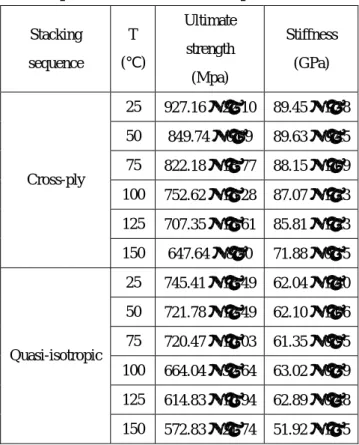
Thus, we adopted this optimal specimen to do the following mechanical testing at elevated temperature as listed in Table II for cross-ply and quasi-isotropic specimens, respectively. We
find that ultimate strength is the highest at RT and lowest at 150℃, and the strength reduces at 75℃, 125℃ and 150℃ by 3 steps for both type specimens. Needless to say, at 150 ℃ (slightly over Tg) the PEEK matrix is almost
fully softened and only the graphite fibers resist loading. The reduction of strength is 30.15 % and 23.15 % for cross-ply and quasi-isotropic specimens, respectively. However, the stiffness reduction only occurs at 150 ℃ both about 19.64 % and 16.31 %. From RT to 125℃ the stiffness decreases slightly for both type specimens. That tells us the adding of nanoparticles can not change the chemical structure of PEEK, they can be considered as filler for the long polymer chains that plays a role of increasing the rigidity of matrix in laminate.
As for fatigue tests, the received S-N curves of normalized stress vs. cycles in semi-log coordinates were plotted in Figs. 5 and 6 for cross-ply and quasi-isotropic specimens, respectively. The polynomial curve fitting method was adopted, the solid curve represents the data without nanoparticles, whilst, the dotted curve for data with nanoparticles in both figures. Apparently, both curves are very close from the beginning to 104 cycles in Fig. 5, after 105 cycles the dotted curve bend down significantly. However, it must be borne in mind that the ultimate strength of the laminate with nanoparticles was significantly higher than that of original APC-2 laminate. Hence, at the same normalized stress level(σmax/σult), the
laminate with nanoparticles is subjected to a higher absolute applied stress level. Similarly, we can explain the phenomenon in Fig. 6. Hence, the laminate of optimal weight percent
of nanoparticles can obviously improve the fatigue behavior.
CONCLUSION
Our work and findings can be summarized as follows pertinently. The nanocomposite laminates were made by sol-gel method and modified diaphragm method. Adding nanoparticles 1 % by wt. is the optimal choice. The ultimate strength and stiffness increase for both lay-ups and the quasi-isotropic is stronger. As the temperature increasing the strength and stiffness reduce for both lay-ups and the worst at 150℃.The constant stress fatigue testing was performed at room temperature, it is found a little improvement in fatigue behavior in nanoparticle laminates apparently.
ACKNOWLEDGEMENT
The authors would like to gratefully acknowledge the sponsorship from National Science Council under the project no. NSC 92-2212-E-110-021, and kind suggestion and discussion with Profs. J. C. Huang and M. Chen at the Institute of Materials Science and Engineering, National Sun Yat-sen University.
REFERENCES
1. Hussain M, Nakahira A and Niihara K, Mechanical Property Improvement of Carbon Fiber Reinforced Epoxy Composites by Al2O3 Filler Dispersion,
Materials Letters, Vol.26, (1996), 185-191. 2. Hussain M, and Niihara K, Control of
Water Absorption and its Effect on Interlaminar Shear Strength of CFRC with Al2O3 Dispersion, Material Science &
Engineering, A, 272 (1999) 264-268.
3. Kim K H, Study of Fiber/Matrix Interface in SiC Fiber Reinforced Calcium Aluminosilicate Matrix Composites, Ph.D.
Dissertation, Stevens Institute of Technology, 1993.
4. Lin J, In Situ Syntheses and Phase Behavior Investigations of Inorganic Materials in Orgamic Polymer Solid Matrices, Ph.D. Dissertation, Dept, of Chemistry, The Pennsylvania State University, 1992.
5. Schmidt H, Multifunctional Inorganic-Orgamic Composite Sol-Gel Coating for Glass Surfaces, J. of Non-Crystalline Solids, Vol. 178 (1994) 302-312.
6. Raming T, The Synthesis of Nano-Nano Dual-Phase Ceramic Composites, Ph.D. Dissertation, Dept. of Chem. Engr., University Twente, the Netherlands, 2000. 7. Sandler J, Werner P, Shaffer S P, Demchuk
V, Altstadt V and Windle A H, Carbon-Nanofibre-Reinforced Poly (ether ether ketone) Composites, COMPOSITES: Part A, Vol. 33 (2002) 1033-1039.
8. Wang Q H, Xue Q J, Liu W M and Chen J M, The Friction and Wear Characteristics of Nanometer SiC and Polytetrafluoroethylene Filled Polyetheretherketone, Wear, Vol. 243 (2000), 140-146.
9. Zhai T, Micromechanical Modeling of Dynamic Fracture in Heterogeneous Materials, Ph.D. Dissertation, Dept. of M. E., GIT, 2000.
10. Qi Z, Synthesis of Conducting Polymer Colloids, Hollow Nanoparticles, and Nanofibers, Ph.D. Dissertation, Dept. of Chemistry, McGill University, Canada, 1993.
11. Li T., Fabrication and Characterization of Nanometer-Sized Metal and Semiconductor Particles and Nano-Sized Composites, Ph.D. Dissertation, Dept. of Materials Science Engr., University of Florida, 1996.
12. Yan W, Micro- and Nano-Scale Surface Adhesion and Contact Mechanics Studies, Ph.D. Dissertation, Dept. of M.E., U C, Berkeley, 1997.
13. Lee C H, Jen M H R, Strength and Life in Thermoplastic Composite Laminate under Static and Fatigue Loadings, Part II : Formulation, Int. J. of Fatigue, Vol. 20, No.9 (1998) 617-629.
14. Lee C H, Jen M H R, Fatigue Response and Modeling of Variable Stress Amplitude and Frequence in AS-4/PEEK Composite
Laminates, Part I: Experiments, J. of Comp. Matls. Vol. 34, No.11 (2000) 906-929.
Table I Mechanical properties of cross-ply and quasi-isotropic specimens of
different spreading plies
Stacking sequence Spreading ply No. Ultimate strength (Mpa) Stiffness (GPa) 0 835.96±6.50 83.83±0.91 5 885.17±18.28 83.39±1.32 8 900.92±10.70 84.63±1.14 Cross-ply 10 927.16±22.10 89.45±1.38 0 662.73±4.91 51.73±0.40 5 687.66±17.78 51.31±1.00 8 725.07±6.09 52.69±1.31 Quasi-isotropic 10 745.41±18.49 62.04±1.40
Table II The mechanical properties of optimal nano-composite cross-ply and quasi-isotropic
specimens at elevated temperatures
Stacking sequence T (℃) Ultimate strength (Mpa) Stiffness (GPa) 25 927.16±22.10 89.45±1.38 50 849.74±6.69 89.63±0.45 75 822.18±18.77 88.15±1.09 100 752.62±15.28 87.07±1.23 125 707.35±15.61 85.81±1.23 Cross-ply 150 647.64±8.50 71.88±0.15 25 745.41±18.49 62.04±1.40 50 721.78±12.49 62.10±1.06 75 720.47±10.03 61.35±0.95 100 664.04±32.64 63.02±0.39 125 614.83±10.94 62.89±0.48 Quasi-isotropic 150 572.83±21.74 51.92±1.15
0 50 Time ( min )100 150 200 0 100 200 300 400 0 2 4 6 P re ssu re ( k g /m m 2) 15 min Pressure Temperature Vacuum
Fig.1 Curing process
unit: mm Fig.2 Dimensions of a specimen
0 0.004 0.008 0.012 STRAIN 0 200 400 600 800 1000 ST RE SS( M P a ) APC-2 nano-APC-2-5 nano-APC-2-8 nano-APC-2-10
Fig.3 The stress-strain curve of cross-ply specimen of different spreading plies.
0 0.004 0.008 0.012 0.016 STRAIN 0 200 400 600 800 ST R E SS( M P a) APC-2 nano-APC-2-5 nano-APC-2-8 nano-APC-2-10
Fig.4 The stress-strain curve of quasi-isotropic specimen of different spreading plies
0 1 2 3 4 5 6 7 Cycles (Log N) 0 0.1 0.2 0.3 0.4 0.5 0.6 0.7 0.8 0.9 1 1.1 N orm a li zed S tres s ( σ ma x / σ ul t )
:Data point of cross-ply :Data point of cross-ply with SiO2 :Data point of cross-ply (>106cycles) :Data point of cross-ply with SiO2 (>106 cycles)
---:Fitting curve of data of cross-ply:Fitting curve of data of cross-ply with SiO2
:F(X)=-0.0111X2-0.0247X+1.0039
:G(X)=-0.0163X2-0.0069X+0.9945
Fig.5 Normalized stress vs. cycles for both w and w/0 SiO2 in cross-ply laminates
0 1 2 3 4 5 6 7 Cycles (Log N) 0 0.1 0.2 0.3 0.4 0.5 0.6 0.7 0.8 0.9 1 1.1 N o rm a li zed S tres s ( σ ma x / σ ul t)
:Data point of quasi-isotropy :Data point of quasi-isotropy (>106 cycles) :Data point of quasi-isotropy with SiO2 :Data point of quasi-isotropy with SiO2(>106 cycles)
---:Fitting curve of data of quasi-isotropy:Fitting curve of data of quasi-isotropy with SiO2 :F(X)=-0.0079X2-0.0293X+1.0009 :G(X)=0.0014X2-0.0897X+1.0042
Fig.6 Normalized stress vs. cycles for both w and w/0 SiO2 in quasi-isotropic laminates
Te m p erat ure ( 0 C )