
An Internet-Radio Receiver and Real-Time Recorder on SBC-2410x Embedded System
6
0
0
全文
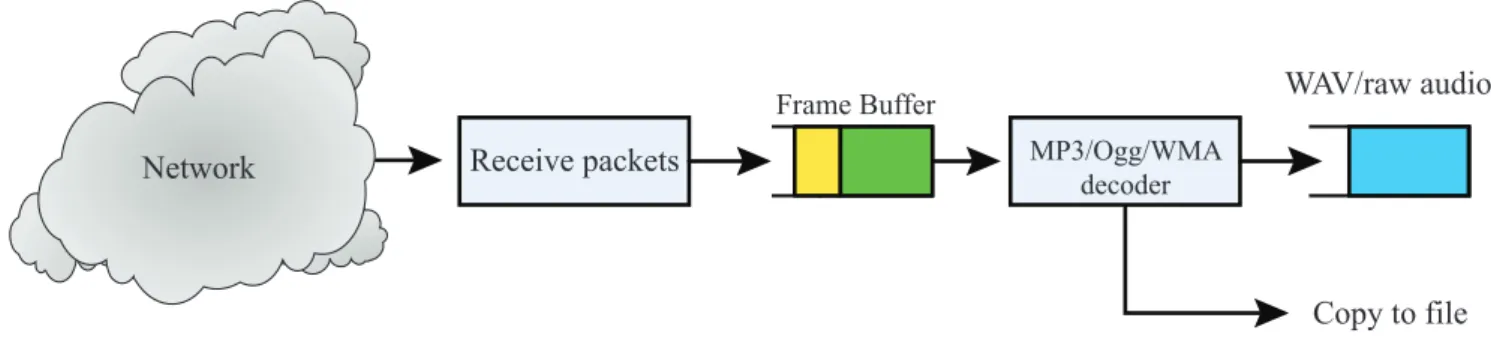
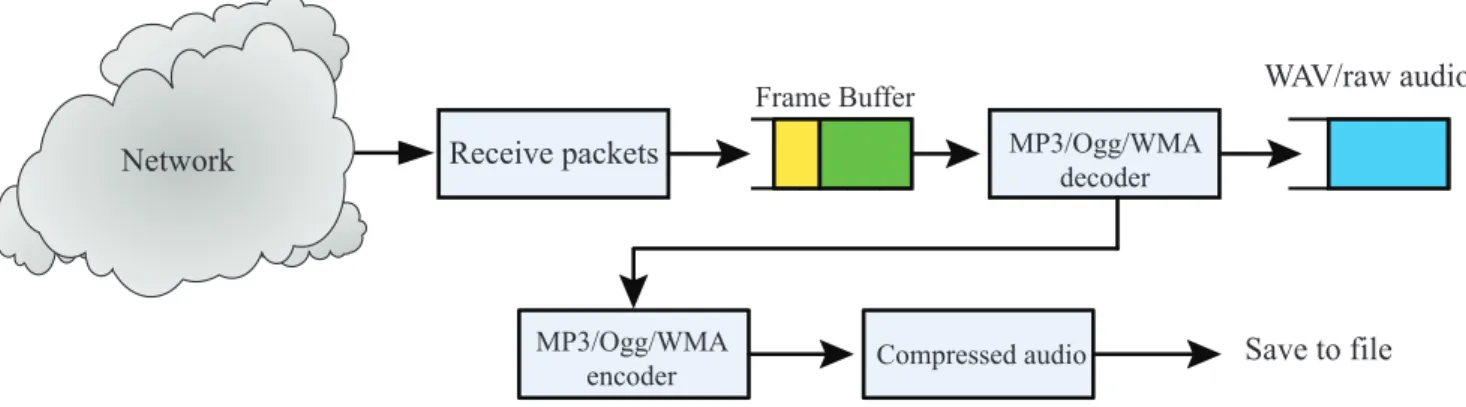
(2) WAV/raw audio Frame Buffer. Network. MP3/Ogg/WMA. Receive packets. decoder. Copy to file. Figure 1: Recording with WAV Format work, passing through a succession of processing, decoded audio file is the WAV format. When media player playing, the method directly will output to the WAV format file and copy extra output file for recording, one for output and the other one for recording. The advantage of recording for this method, certainly does not need to make the extra compression, but uses direct copy to the file. Saving the time to handling to file which decoded, because WAV audio format belongs to the lossless, therefore in capacity, far ratio other compressions audio format (for example: MP3 [9], Ogg [10]) come greatly very many, if does not have the extra storage equipment, then possibly stores up the WAV audio file quite is possibly limited. For a 4 minute song, the 44.1KHz sampling frequency, the file size which WAV occupies as follow: Size = 44100 ∗ 2 ∗ 2 ∗ 4 ∗ 60 = 42, 336, 000Bytes = 40.37MB. way, the file size can differ above 10 times ( 2 ). By using Real-time audio recording, the program (player) must decode and encode at the same time, the computing power of the processor needs to be high. In embedded system (SBC-2410x), although this method could save spaces, it will cause situation which CPU is overloaded, or impossible to achieve. For digital audio format file which is CD acoustic fidelity, as the example, its bit rate (the data for 2-channel audio stream each second bit stream), the sampling frequency is 44.1KHz: Bit rate = 44.1 ∗ 1000 ∗ 16 ∗ 2 = 1411.2kbps A supposition choice position bit rate is 128kbps makes the format compression for MP3 audio, its compressed rate:. (1). Compressed rate = 1411.2/128 = 11.025. Because it just copy raw data, it doesn’t need extra CPU computing power for encoding compressed format audio. Although it can work on SBC-2410x embedded system, the record file size of this method is too large. So it’s not suitable for embedded system.. For a 4 minutes song, selects this compression method, its occupies the size is, makes the compression by the ( 1 ) calculation size:. 2.2 Recording with Compressed Format. Compare the size reduced % with record with WAV format by (1), (2):. Size = 42, 336, 000Bytes/11.025 = 3, 840, 000Bytes = 3.66MB. Common audio compresses format, for example: WMA [8], Ogg, MP3, RM, RAM, RA [11]... etc, on network as a result of the bandwidth question, transmit audio format file which is lossless file, it is consumption cost. Therefore, almost all the streaming media uses the compression audio format for transmit. After receives the compressed audio, the client decode it to WAV format. This way not only saves file size on both side, but also reduce transmission time. As mentions in section 2.1, recording uncompressed WAV data will have question in the capacity. Therefore, we must compress the audio data. One method for recording compressed audio is shown in Figure 2 . After decode the compressed audio, the player encode it to a pre-define format, then save the compressed data to file. Recording audio this. (2). Size reduced% = (40.37 − 3.66)MB/40.37MB = 90.93% This method saves the storage for compressed audio format, but its complexity which needs to decode and encode at the same time is too high. Its complexity is too high for SBC-2410x embedded system, so that it can’t work on this embedded system and it’s not suitable.. 3 New Method for Recording Above the recording methods it will produce different results, if player uses recording with WAV format, it will 2. - 40 -.
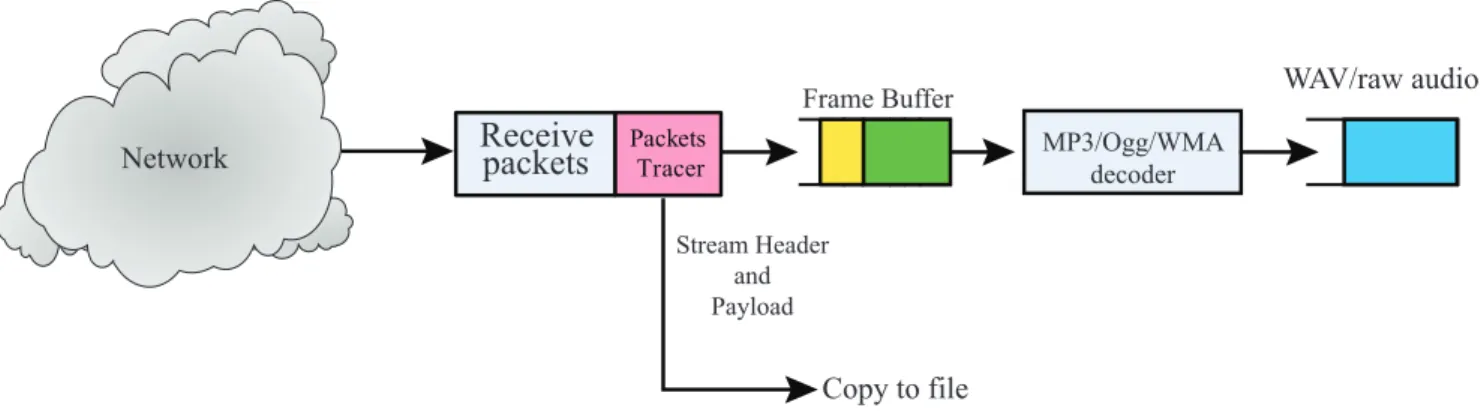
(3) WAV/raw audio Frame Buffer. Network. MP3/Ogg/WMA. Receive packets. decoder. MP3/Ogg/WMA. Compressed audio. Save to file. encoder. Figure 2: Recording with Compressed Format Algorithm 1 Code for the method “Streaming Packet Tracer” (SPT). Require: buffer : array[0..MAXBUFFER] of char; {array for stream buffer (data)} rfp : FILE Pointer; {File pointer for record file.} len : integer; {Stream Buffer Length.} rf : bool; {Record flag.} fn : array[0..40] of char; {Char array for file name.} Ensure: Find the packet header and payload to record. 1: {Init to record} 2: if Need to Record then 3: r f = true; 4: f n = Get now time f or record name; 5: r f p = open( f n, O CREAT |O W RONLY ); 6: ..... 7: end if 8: ..... 9: {Start to record} 10: while Get network stream do 11: ..... 12: do Fill stream bu f f er; 13: ..... 14: bu f f er = Get the packet header and payload; 15: len = length[bu f f er]; {Get length for stream buffer} 16: if r f == true then 17: if write(write(r f p, bu f f er, len) ! = len)) then 18: do Record f ile f or write Error. 19: end if 20: end if 21: ..... 22: end while 23: ..... 24: {Terminate to record} 25: if Don′t want Record then 26: r f = f lase; 27: close(r f p); 28: ..... 29: end if. consume extra huge storage space. If player uses with compressed format, it will need extra CPU computing power. Because the hardware resources will be limited for embedded system, these method are not suitable for real-time recording on embedded system. So we design a method which can play and record at the same time, it doesn’t need to spend the extra space to store file with WAV audio format, it also does not need extra encoder for recording.. 3.1 Method for Streaming Packet Tracer (SPT) If we must recording with compressed format on embedded system and play at the same time, we need extra computing power, causing the situation which CPU overloaded and will make the overall system paralysis. Therefore, we design a method which called “Streaming Packet Tracer” for real-time recording which can reduce the computing power, play and record at then same time. Algorithm 1 gives the tracing procedure for real-time recording, when user wants to record the streaming, the record flag will be set true, then the player will get local time to be the record-file name and open the record-file for recording (Algorithm 1 line 1-7). In receiving network stream, when player fills stream buffer, we find corresponding packet header and payload in the streaming buffer (data) from network stream (Figure 3) before the streaming media audio decodedd and get its length for the buffer. If user wants to record, then it will copy the buffer and write it to record-file for real-time recording(Algorithm 1 line 10-23). Finally, when user stops to record, then the record flag will be false and close the record-file(Algorithm 1 line 26-31). We modify the source code for Mplayer, finding the position for streaming data (buffer). We copy the data which receives from network streaming and needs to record. This must complete before fill frame buffer, avoiding the packet of audio file its header and payload is cut, causing file incompletely, is unable to play for recording failure.. 3. - 41 -.
(4) WAV/raw audio Frame Buffer. Network. Receive. Packets. MP3/Ogg/WMA. packets. Tracer. decoder. Stream Header and Payload. Copy to file. Figure 3: Real-Time Recording with SPT Algorithm. 3.2 Advantages for SPT. ceive. This protocol use the method which transmitting for best effort. If this method needs to do have to rely on the upper layer (Application) for handling. Because certainly does not need to confirm weather it receives or not, therefore compares with TCP [13], [15], its transmitted speed is faster than TCP. When transmitting massive file, this characteristic is more obvious, like video media data, using UDP to transmit is better than TCP (if you need speed for transmitting). When player receives network streaming, if has not received the packets, all may accept in a threshold limit, as shown in Figure 4. When the times which packet loses are larger than threshold value, it will have the failure for opening streaming.. Compares Real-Time recording(SPT) way which above mentions, certainly does not need to encode for compresses audio format, if the audio data transmitted is compressed, the record file is also compressed format (ex:MP3, OGG), therefore we only need to do copy the streaming buffer(data) to the file(also need find packet header and payload), does not need to spend the extra CPU computation, in the same time, the system can calculate other task more than the method of record with compressed format. Because from streaming material already for compressed format (if audio data form network streaming is compressed), therefore we make time the above recording method, the record audio file all for compressed format, its size after the compression size for saving the space (Table 1).. Method of Recording. WAV format. compressed format. SPT. Time Comparability. No. High. Low. Storage. Huge. Small. Small. Select Audio Format. No. Yes. No. No. Yes. Encode and Pplay at the same time. Start. Get Packet ?. Yes. Yes. No. Counter + 1. Do other thing. Counter > Threshold?. Table 1: Compare with Recording Methods. Yes Failure Open Stream. 4. Packet Loss Handling for UDP Figure 4: Packet Loss Detection. UDP [12], [13], [14] has Connectionless the service, so it’s uses directly transmit data to other side, if other side has receives the data, namely receives, otherwise, it does not re-. If UDP must do packet loss handling, the server and client may make a appointment with a new packet format, 4. - 42 -.
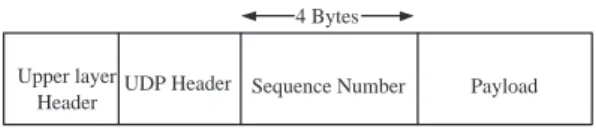
(5) 6 Experimental Results. 4 Bytes Upper layer UDP Header Sequence Number Header. Payload. We have implemented our algorithm (SPT) and carried experiments to examine the recording method. The experimetal platform which we built by Table 2 , 3 .. Figure 5: Sequence Number Section like to append a 4-byte sequence number before UDP payload as shown in Figure 5, then its can judge on Application layer, whether receives the correct sequence of streaming packet, decided whether requests server to transmit again, but really does, must consider the packet section which server must increase to make handling, also needs to judge in the client for handling.. Platform. SBC-2410x. CPU. S3C2410@200MHz 100MIPS. Memory. 64MB SDRAM 64MB NAND Flash 1MB NOR Flash. Table 2: Hardware Platform. 5. Format-Change Detection. It will transmit header to advise client side which file format for transmitting in the streaming process. If the streaming file by file to transmit, it will occur present file format as well as next file format has the possibility to be different. In other words, when player receive packet header, according to its content, it will opens different decoders for corresponding audio format. If file audio format is changed when streaming transmits, using the method of record with WAV format to record. The complete audio file can transfer WAV format to make the sound recording, it cannot have on format the question. The supposition by the method of record with compressed format sound recording, because it encode the audio file after decoding for corresponding format compression, if uses same compression format, also cannot have on format the question. By method of SPT, because we are directly find streaming data (Figure 3 , Algorithm 1 ) and copy it, in other words, at present streaming audio format, as well as the audio for copy (record), their audio format will be same. If between two file formats from the same streaming different, then the audio file for recording format is also different. Because it’s has two or more file formats in one file, so it will cause the problem which file format damages, perhaps is unable to play. Our method for solve this problem in SPT is that if identical streaming has many audio file, the period can transmit header the way to advise (when changing audio file). We close the record file for previous recording, and opens next to new record file, take a file as the unit, we separate the files when changing. In other words, if the network streaming has two or more file for streaming, SPT will has the same number record file with the same format for network streaming.. Linux Kernel. Kernel 2.4.18 [16]. Basic Commands. Busybox 1.2.0 [17]. Network Login. SSH (Dropbear 0.48.1 [18]). FTP Server. vsFTPd 2.0.5 [19]. Web Server. thttpd 2.21b [20]. Media Player. Mplayer-CVS-20060517. Table 3: Software Platform User can use the web browser to control the media player (Mplayer) on SBC-2410x, we see that in Figure 6.. Figure 6: Actual Environment We choice two network streaming (one is MP3 format (Figure 7(a)), the other is Ogg format (Figure 7(b))) for playing three minutes to test the record methods on SBC2410x, we show the computing power and record-file size as follow (Figure 7, Table 4): 5. - 43 -.
(6) Play and Record with MP3 Format. Play and Record with Ogg Format. Record with Compressed Format. Record with Compressed Format. Overload. CPU Utilization(%). CPU Utilization(%). Overload. 100. 80. 60. 100. 80. Record with WAV Format. 60. Record with WAV Format. 40. 40. SPT Record 20. 20. SPT Record 0. 0. 2. 4. 6. 8. 10. 12. 14. 16. t = 0 to 22. 18. 20. 0. 22. 0. 2. 4. 6. 8. 10. 12. 14. 16. 18. t = 0 to 22. Time (Sec). (a). 20. 22. Time (Sec). (b). Figure 7: CPU Utilization. (a) Record with MP3 Format (b) Record with Ogg Format. Method. Format. Utilization. File Size. Record with WAV Format. MP3 Ogg. 25% ∼ 35% 55% ∼ 65%. 30.28 MB 30.28 MB. Record with Compressed Format. MP3 Ogg. Overload. 2.746 MB 2.727 MB. SPT. MP3 Ogg. 25% ∼ 35% 55% ∼ 65%. 2.746 MB 2.727 MB. [6] “Mplayer: The Movie Player.” http://www.mplayerhq. hu. [7] “Samsung.” http://www.samsung.com/tw. [8] “Microsoft Window Media.” http://www.microsoft. com.. Table 4: Compare with Utilization and File Size. 7. [5] V. Hilt, M. Mauve, J. Vogel, and W. Effelsberg, “Recording and playing back interactive media streams,” IEEE Trans. Multimedia, vol. 7, pp. 960–971, Oct 2005.. [9] “MP3: MPEG-1 Audio Layer3.” http://www.thomson. com.. Conclusion. In this paper, we proposed an Real-Time Internet-Radio recording approach on SBC-2410x embedded system, which can tolerate packet-loss, format-change. Our approach is based on the SPT method to record, it just find the packet header and payload for copying. It is useful and efficiency on embedded system which has limited hardware resources.. [10] “Xiph Ogg.” http://www.xiph.org/ogg.. References. [14] P.P.-K Lam and S.C Liew, “UDP-Liter: an improved UDP protocol for real-time multimedia applications over wireless links,” in Proc. IEEE Int. Symp. Wireless Communication Systems, pp. 314–318, Sep 2004.. [1] A. Ganz, Z. Ganz, and K. Wongthavarawa, Multimedia wireless networks Technologies, standards, and QoS. Prentice-Hall, 2004. [2] K. Jonas, P. Kanzow, and M. Kretchmer, “Audio streaming on the Internet. Experiences with real-time streaming of audio streams,” in Proc. IEEE Int. Symp. Industrial Electronics, vol. 1, pp. SS71–SS76, Jul 1997.. [11] “RealNetworks.” http://www.realnetworks.com. [12] J. B. Postel, “UDP: User Datagram Protocol.” http:// www.faqs.org/rfcs, Aug. 1980. RFC 768. [13] D. E. Comer, Computer Networks and internets with internet applications. Prentice-Hall, 4th ed., 2003.. [15] J. B. Postel, “TCP: Transmission Control Protocol.” http://www.faqs.org/rfcs, Sep. 1981. RFC 793. [16] “Linux Kernel.” http://www.kernel.org. [17] “Busybox.” http://www.busybox.net.. [18] “Dropbear.” http://matt.ucc.asn.au/dropbear/dropbear. html. [3] C. Perkins, RTP Audio and Video for the internet. Addison-Wesley, 2003. [19] “VSftpd.” http://vsftpd.beasts.org. [4] H.Schulzrinne, “RTP: A Transport Protocol for Real-Time Application.” http://www.faqs.org/rfcs, Jan. [20] “thttpd.” http://www.acme.com/software/thttpd. 1996. RFC 1889. 6. - 44 -.
(7)
數據
+2

相關文件
In this way, we can take these bits and by using the IFFT, we can create an output signal which is actually a time-domain OFDM signal.. The IFFT is a mathematical concept and does
– Each time a file is opened, the content of the directory entry of the file is moved into the table.. • File Handle (file descriptor, file control block): an index into the table
The performance guarantees of real-time garbage collectors and the free-page replenishment mechanism are based on a constant α, i.e., a lower-bound on the number of free pages that
* All rights reserved, Tei-Wei Kuo, National Taiwan University,
Tei-Wei Kuo, Embedded System and Wireless Networking Lab, National Taiwan University.. Real-Time
– if an unmasked exception occurs, the current FPU instruction is interrupted and the FPU signals an exception. – But the main CPU does not check for pending FPU
• Consider an algorithm that runs C for time kT (n) and rejects the input if C does not stop within the time bound.. • By Markov’s inequality, this new algorithm runs in time kT (n)
• Suppose, instead, we run the algorithm for the same running time mkT (n) once and rejects the input if it does not stop within the time bound.. • By Markov’s inequality, this
