台大農藝系 遺傳學 601 20000 Chapter 3 slide 1
CHAPTER 3
DNA Replication
Peter J. Russell
edited by Yue-Wen Wang Ph. D. Dept. of Agronomy, NTU
台大農藝系 遺傳學 601 20000 Chapter 3 slide 2
Semiconservative DNA Replication
•
1. Watson and Crick DNA model implies a
mechanism for replication:
•
a. Unwind the DNA molecule.
•
b. Separate the two strands.
台大農藝系 遺傳學 601 20000 Chapter 3 slide 3
•
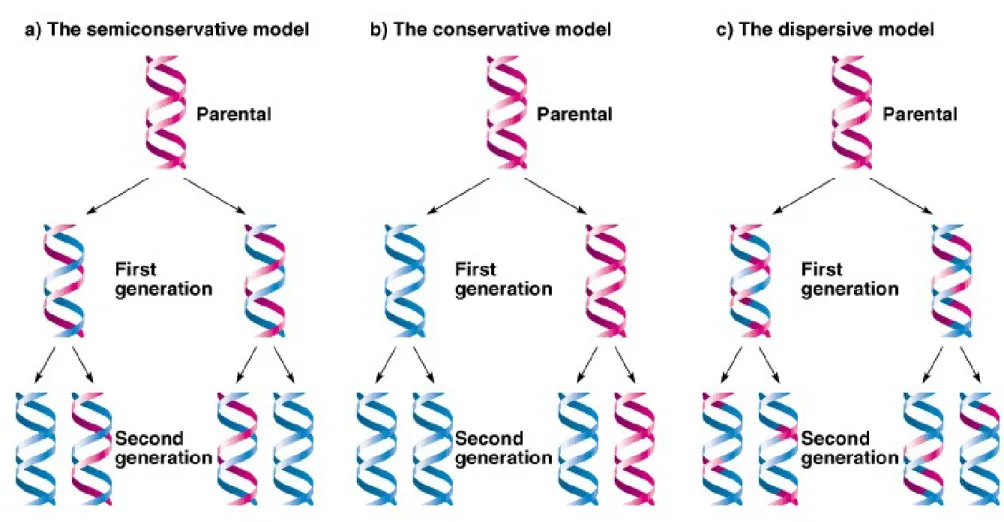
2 .Three possible models were proposed for DNA
replication:
•
a. Conservative model proposed both strands of one copy would
be entirely old DNA, while the other copy would have both
strands of new DNA.
•
b. Dispersive model was that dsDNA might fragment, replicate
dsDNA, and then reassemble, creating a mosaic of old and new
dsDNA regions in each new chromosome.
•
c. Semiconservative model is that DNA strands separate, and a
complementary strand is synthesized for each, so that sibling
chromatids have one old and one new strand. This model was the
winner in the Meselson and Stahl experiment.
台大農藝系 遺傳學 601 20000 Chapter 3 slide 4
Peter J. Russell, iGenetics: Copyright © Pearson Education, Inc., publishing as Benjamin Cummings.
台大農藝系 遺傳學 601 20000 Chapter 3 slide 5
The Meselson-Stahl Experiment
•
Animation: The Meselson-Stahl Experiment
•
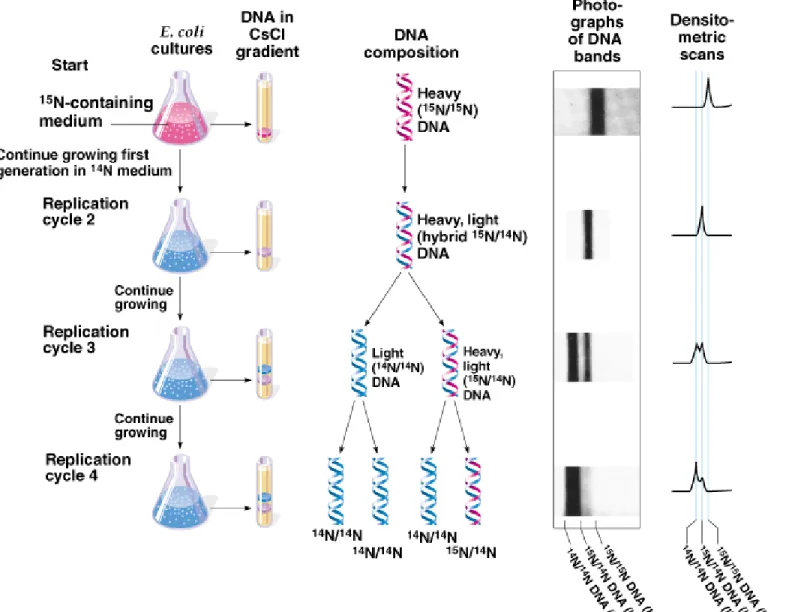
1. Meselson and Stahl (1958) grew E. coli in a heavy
(not radioactive) isotope of nitrogen,
15N in the form of
15NH
4Cl. Because it is heavier, DNA containing
15N is
more dense than DNA with normal
14N, and so can be
separated by CsCl density gradient centrifugation (Box
3.1).
•
2. Once the E. coli were labeled with heavy
15N, the
researchers shifted the cells to medium containing normal
14
N, and took samples at time points. DNA was extracted
from each sample and analyzed in CsCl density gradients
(Figure 3.2).
台大農藝系 遺傳學 601 20000 Chapter 3 slide 6
Peter J. Russell, iGenetics: Copyright © Pearson Education, Inc., publishing as Benjamin Cummings.
Fig. 3.2 The Meselson-Stahl experiment, which showed that DNA replicates semiconservatively
台大農藝系 遺傳學 601 20000 Chapter 3 slide 7
Peter J. Russell, iGenetics: Copyright © Pearson Education, Inc., publishing as Benjamin Cummings.
Box Fig. 3.1 Equilibrium centrifugation of DNA of different densities in a cesium chloride
台大農藝系 遺傳學 601 20000 Chapter 3 slide 8 • 3. After one replication cycle in normal 14N medium, all DNA had
density intermediate between heavy and normal. After two replication cycles, there were two bands in the density gradient, one at the
intermediate position, and one at the position for DNA containing entirely 14N.
• 4. Results compared with the three proposed models:
• a. Does not fit conservative model, because after one generation there is a single intermediate band, rather than one with entirely 15N DNA
and another with entirely 14N DNA.
• b. The dispersive model predicted that a single band of DNA of intermediate density would be present in each generation, gradually becoming less dense as increasing amounts of 14N were incorporated
with each round of replication. Instead, Meselson and Stahl observed two bands of DNA, with the intermediate form decreasing over time. • c. The semiconservative model fits the data very well.
台大農藝系 遺傳學 601 20000 Chapter 3 slide 9
Semiconservative DNA Replication in
Eukaryotes
•
1. To visualize DNA of
eukaryotic chromosomes
replicating, CHO
(Chinese hamster ovary)
cells are grown in
5-bromodeoxyuridine
(BUdR), a base analog for
thymine. After two rounds
of replication, mitotic
chromosomes are stained
with fluorescent dye and
Giemsa stain (Figure 3.3).
台大農藝系 遺傳學 601 20000 Chapter 3 slide 10
•
2. DNA containing T stains darkly, while DNA
containing two BUdR strands stains lightly. Observed
that after one generation, both chromatids stain the same,
each with one BUdR strand and one T strand. After two
generations, they stain differently and are called harlequin
chromosomes, one light (both strands have BUdR) and
one dark (one strand has BUdR and other strand has T).
•
3. Showed that eukaryotes also use semiconservative
DNA replication.
台大農藝系 遺傳學 601 20000 Chapter 3 slide 11
Enzymes Involved in DNA Synthesis
•
1. First isolation of an enzyme involved in DNA
replication was in 1955. Arthur Kornberg won the
1959 Nobel Prize in Physiology or Medicine for
this work.
台大農藝系 遺傳學 601 20000 Chapter 3 slide 12
DNA Polymerase I
•
1. Accomplished in vitro synthesis of E. coli DNA. His
reaction mixture included:
•
a. DNA fragments (template).
•
b. Radioactively labeled dNTPs (dATP, dGTP, dTTP and
dCTP).
•
c. E. coli lysate.
•
2. Enzyme originally called the Kornberg enzyme, now
known as DNA Polymerase I. Once isolated, could
characterize its activity, showing that the above
components are required, along with Mg
21ions for
台大農藝系 遺傳學 601 20000 Chapter 3 slide 13
Roles of DNA Polymerases
• Animation: DNA Biosynthesis: How a New DNA Strand is Made
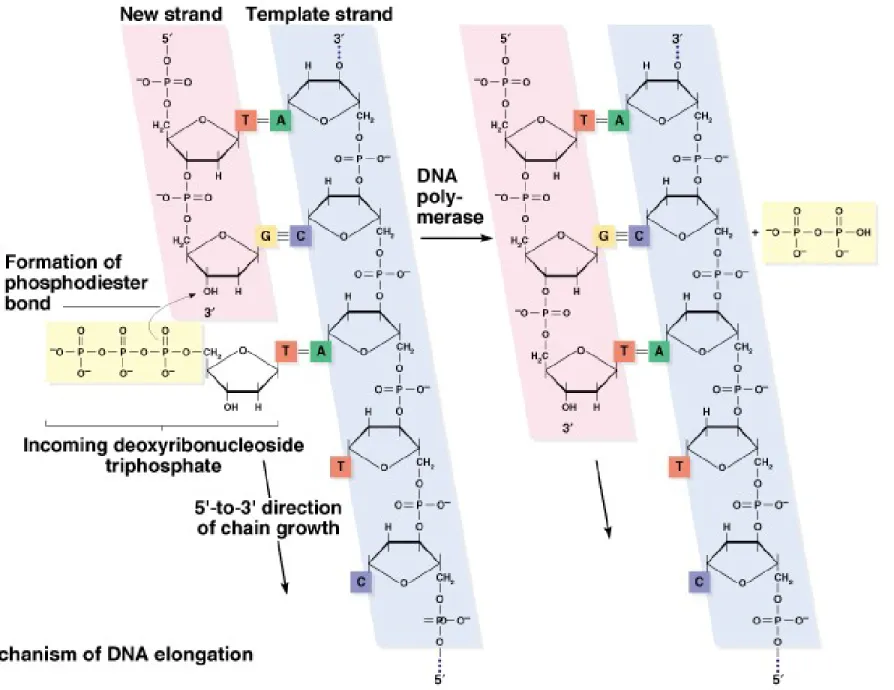
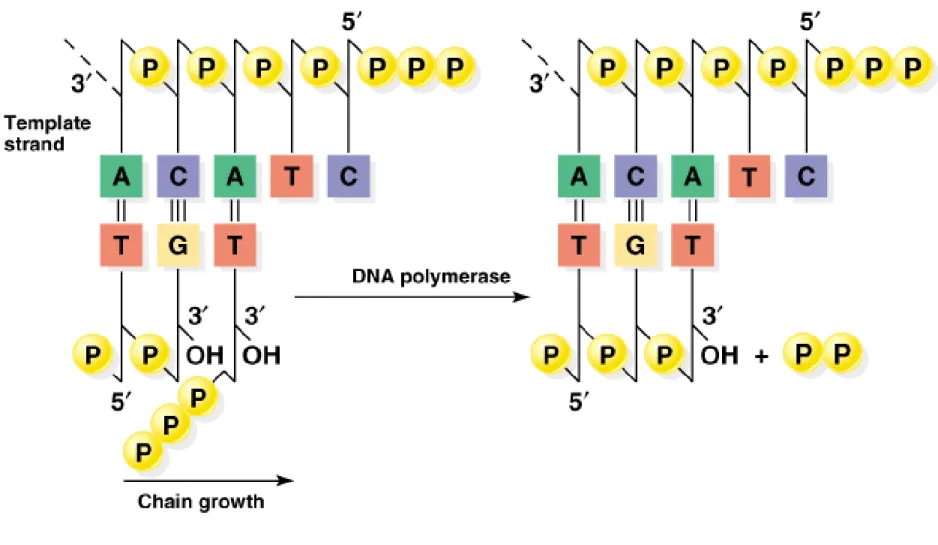
• 1. All DNA polymerases link dNTPs into DNA chains (Figure 3.4). Main features of the reaction:
• a. An incoming nucleotide is attached by its 5’-phosphate group to the 3’-OH of the growing DNA chain. Energy comes from the dNTP
releasing two phosphates. The DNA chain acts as a primer for the reaction.
• b. The incoming nucleotide is selected by its ability to hydrogen bond with the complementary base in the template strand. The process is fast and accurate.
• c. DNA polymerases synthesize only from 5’ to 3’.
• 2. Two additional DNA polymerases were later isolated, DNA Pol II in 1970 and DNA Pol III in 1971.
台大農藝系 遺傳學 601 20000 Chapter 3 slide 14
Peter J. Russell, iGenetics: Copyright © Pearson Education, Inc., publishing as Benjamin Cummings.
台大農藝系 遺傳學 601 20000 Chapter 3 slide 15
Peter J. Russell, iGenetics: Copyright © Pearson Education, Inc., publishing as Benjamin Cummings.
台大農藝系 遺傳學 601 20000 Chapter 3 slide 16
The properties of DNA polymerases
• 3. The properties of these enzymes are (Table 3.1):
• a. DNA polymerase I is a single peptide encoded by polA. There are about 400 molecules in an E. coli cell. Replicates DNA in the 5’ →3’ direction. Has 5’ →3’ exonuclease activity to remove nucleotides from 5’ end of DNA or from RNA primer.
• b. DNA polymerase II is a single peptide encoded by polB. Number of molecules per E. coli cell isn’t known for certain, but probably around 10–20. Role in the cell is unknown.
• c. DNA polymerase III has 10 polypeptide subunits encoded by 10 different genes. The catalytic core of the enzyme is composed of three subunits, α (encoded by the dnaE gene), ε (dnaQ) and θ (holE). There are 10–20 molecules of this enzyme in an E. coli cell. Replicates DNA in the 5’ →3’ direction.
• 4. All three E. coli DNA polymerases have 3’ →5’ exonuclease (proofreading) activity.
台大農藝系 遺傳學 601 20000 Chapter 3 slide 17
Molecular Model of DNA Replication
•
1. Table 3.2 shows key genes and DNA
台大農藝系 遺傳學 601 20000 Chapter 3 slide 18
Initiation o Molecular Model of DNA
Replication
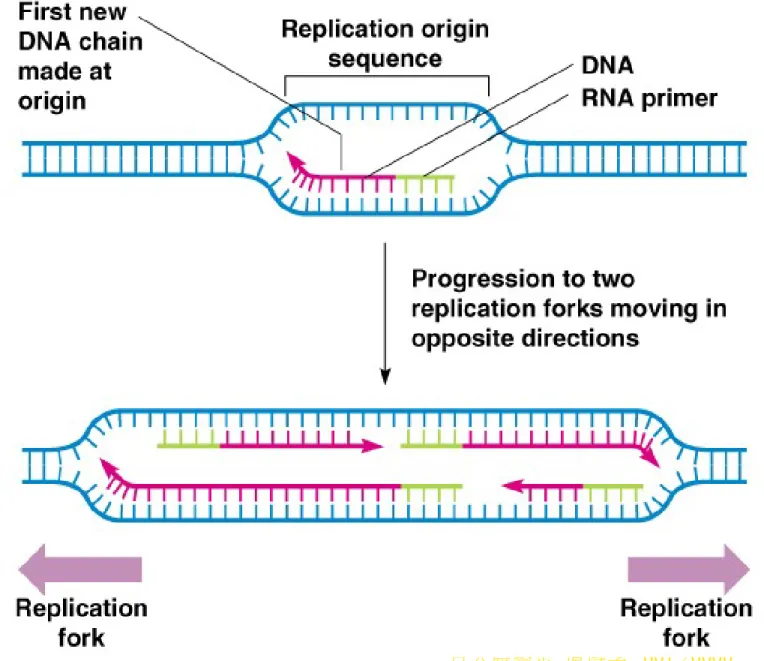
• 1. Replication starts at origin of replication, with denaturation to
expose the bases and create a bi-directional replication bubble. E. coli has one origin, oriC, which has a minimal sequence of about 245 bp required for initiation.
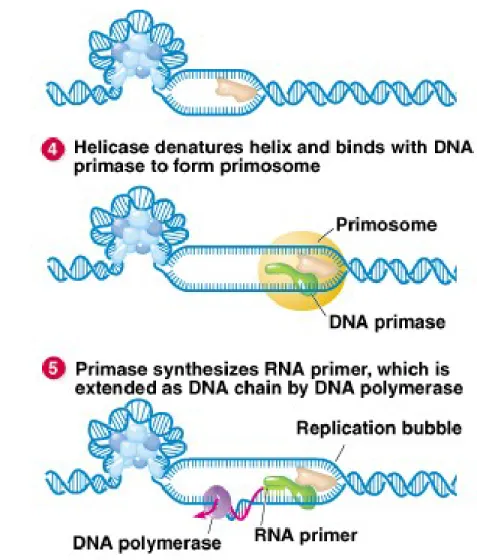
• 2. Events in initiating DNA synthesis, derived from in vitro studies (Figure 3.5):
• a. Gyrase (a type of topoisomerase) relaxes supercoils in the region. • b. Initiator proteins attach.
• c. DNA helicase (from dnaB) binds initiator proteins on the DNA, and denatures the region using ATP as an energy source.
• d. DNA primase (from dnaG) binds helicase to form a primosome, which synthesizes a short (11 6 1 nt) RNA primer. Primers begin with two purines, typically AG.
台大農藝系 遺傳學 601 20000 Chapter 3 slide 19
Peter J. Russell, iGenetics: Copyright © Pearson Education, Inc., publishing as Benjamin Cummings.
Fig. 3.5 Model for the formation of a replication bubble at a replication origin in
台大農藝系 遺傳學 601 20000 Chapter 3 slide 20
Semidiscontinuous DNA Replication
台大農藝系 遺傳學 601 20000 Chapter 3 slide 21
Peter J. Russell, iGenetics: Copyright © Pearson Education, Inc., publishing as Benjamin Cummings.
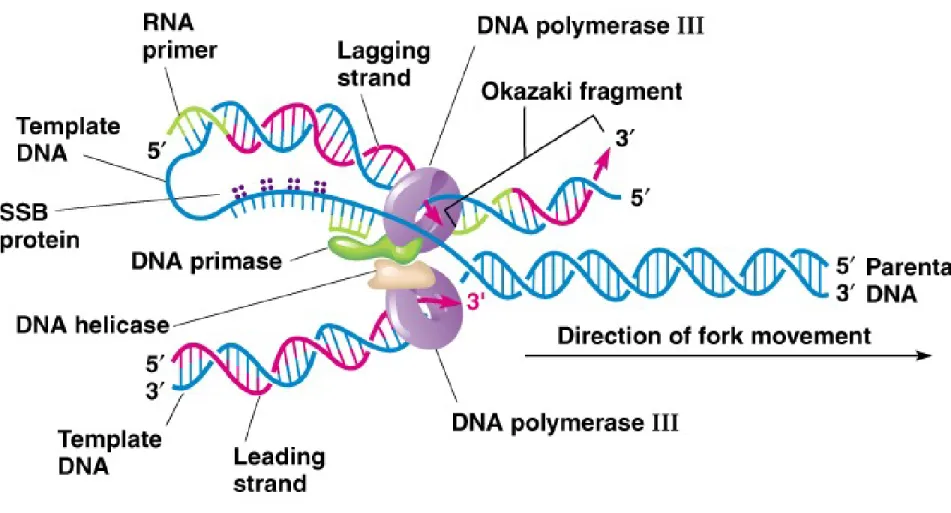
Fig. 3.6a, b Model for the events occurring around a single replication fork of the
台大農藝系 遺傳學 601 20000 Chapter 3 slide 22
Peter J. Russell, iGenetics: Copyright © Pearson Education, Inc., publishing as Benjamin Cummings.
Fig. 3.6c-e Model for the events occurring around a single replication fork of the
台大農藝系 遺傳學 601 20000 Chapter 3 slide 23
•
1. When DNA denatures at the oriC, replication forks are
formed. DNA replication is usually bi-directional, but will
consider events at just one replication fork (Figure 3.6):
• a. Single-strand DNA-binding proteins (SSBs) bind the ssDNA formed by helicase, preventing reannealing.
• b. Primase synthesizes a primer on each template strand.
• c. DNA polymerase III adds nucleotides to the 3’ end of the
primer, synthesizing a new strand complementary to the template, and displacing the SSBs. DNA is made in opposite directions on the two template strands.
• d. New strand made 5’ → 3’ in same direction as movement of
the replication fork is leading strand, while new strand made in opposite direction is lagging strand. Leading strand needs only one primer, while lagging needs a series of primers.
台大農藝系 遺傳學 601 20000 Chapter 3 slide 24
•
2. Helicase denaturing DNA causes tighter winding in other
parts of the circular chromosome. Gyrase relieves this
tension.
•
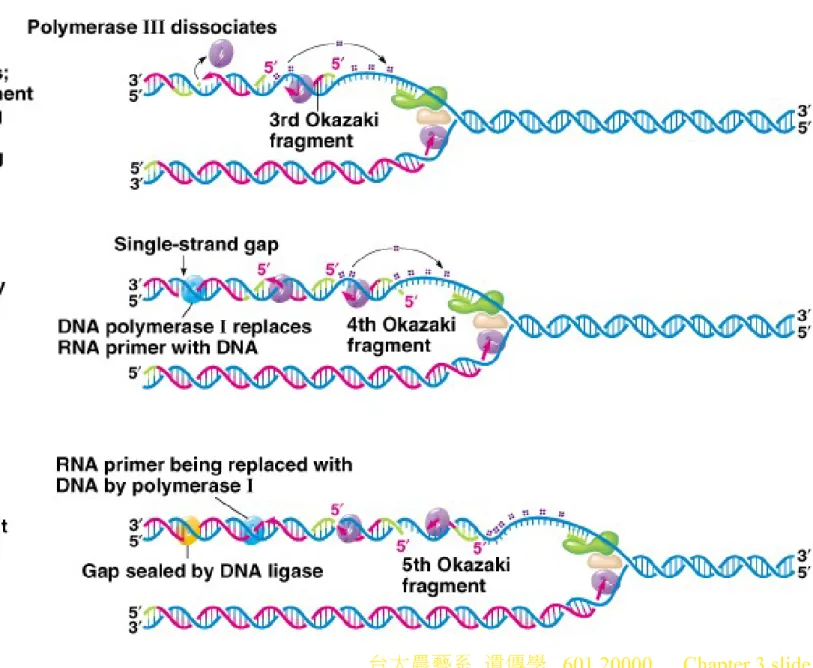
3. Leading strand is synthesized continuously, while lagging
strand is synthesized discontinuously, in the form of
Okazaki fragments. DNA replication is therefore
semidiscontinuous.
•
4. Each fragment requires a primer to begin, and is extended
by DNA polymerase III.
•
5. Okazaki data show that these fragments are gradually
joined together to make a full-length dsDNA chromosome.
DNA polymerase I uses the 3’-OH of the adjacent DNA
fragment as a primer, and simultaneously removes the RNA
primer while resynthesizing the primer region in the form of
DNA. The nick remaining between the two fragments is
台大農藝系 遺傳學 601 20000 Chapter 3 slide 25
Peter J. Russell, iGenetics: Copyright © Pearson Education, Inc., publishing as Benjamin Cummings.
Fig. 3.7 Action of DNA ligase in sealing the gap between adjacent DNA fragments to
台大農藝系 遺傳學 601 20000 Chapter 3 slide 26
•
6. Key proteins are associated to form a replisome.
Template DNA probably bends to allow synthesis
of both leading and lagging strands at the
replication fork (Fig. 3.8)
•
7. Early stages of bidirectional replication are
台大農藝系 遺傳學 601 20000 Chapter 3 slide 27
Peter J. Russell, iGenetics: Copyright © Pearson Education, Inc., publishing as Benjamin Cummings.
Fig. 3.8 Model for the “replication machine,” or replisome, the complex of key
台大農藝系 遺傳學 601 20000 Chapter 3 slide 28
台大農藝系 遺傳學 601 20000 Chapter 3 slide 29
Peter J. Russell, iGenetics: Copyright © Pearson Education, Inc., publishing as Benjamin Cummings.
Fig. 3.9 Diagram of the formation at a replication origin sequence of two replication
台大農藝系 遺傳學 601 20000 Chapter 3 slide 30
Peter J. Russell, iGenetics: Copyright © Pearson Education, Inc., publishing as Benjamin Cummings.
台大農藝系 遺傳學 601 20000 Chapter 3 slide 31
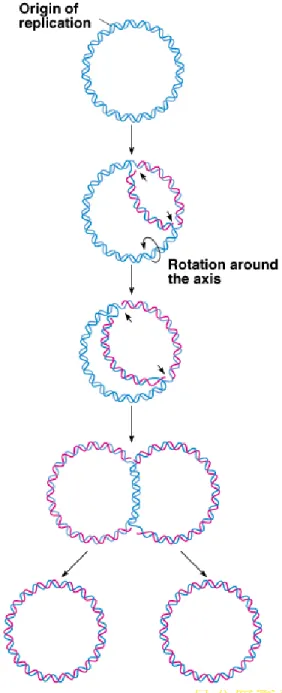
Replication of circular DNA and the
supercoiling problem
•
1. Some circular chromosomes (e.g., E. coli) are
circular throughout replication, creating a
theta-like (θ) shape (Fig. 3.10). As the strands separate
on one side of the circle, positive supercoils form
elsewhere in the molecule. Replication fork
moves about 500 nt/ second, so at 10 bp/turn,
replication fork rotates at 3,000 rpm.
•
2. Topoisomerases relieve the supercoils,
allowing the DNA strands to continue separating
as the replication forks advance. (Fig. 3.11)
台大農藝系 遺傳學 601 20000 Chapter 3 slide 32
Peter J. Russell, iGenetics: Copyright © Pearson Education, Inc., publishing as Benjamin Cummings.
Fig. 3.11 Diagram showing the unreplicated, supercoiled parent strands and the
台大農藝系 遺傳學 601 20000 Chapter 3 slide 33
Rolling Circle Replication
•
1. Another model for replication is rolling circle, which is
used by several bacteriophages, including ΦX174 (after a
complement is made for the genomic ssDNA) and λ (after
circularization by base pairing between the “sticky”
ssDNA cos ends)
•
2. Rolling circle replication begins with a nick
(single-stranded break) at the origin of replication. The 5’ end is
displaced from the strand, and the 3’ end acts as a primer
for DNA polymerase III, which synthesizes a continuous
strand using the intact DNA molecule as a template.
•
3. The 5’ end continues to be displaced as the circle
“rolls”, and is protected by SSBs until discontinuous
DNA synthesis makes it a dsDNA again.
台大農藝系 遺傳學 601 20000 Chapter 3 slide 34
Peter J. Russell, iGenetics: Copyright © Pearson Education, Inc., publishing as Benjamin Cummings.
Fig. 3.12 The replication process of double-stranded circular DNA molecules through
台大農藝系 遺傳學 601 20000 Chapter 3 slide 35
•
4. A DNA molecule many genomes in length can be made
by rolling circle replication. During viral assembly it is
cut into individual viral chromosomes and packaged into
phage head.
•
5. Bacteriophage λ, regardless of whether entering the
lytic or lysogenic pathway, circularizes its chromosome
immediately after infection.
• a. In a lysogenic infection, the circular DNA integrated into a
specific site in the E. coli chromosome by a crossover event.
• b. In a lytic infection, rolling circle replication produces a long concatamer of λ DNA, and the a viral endonuclease (product of the ter gene) recognize the cos sites and makes the staggered cuts that used to assemble new virus particles.
台大農藝系 遺傳學 601 20000 Chapter 3 slide 36
Peter J. Russell, iGenetics: Copyright © Pearson Education, Inc., publishing as Benjamin Cummings.
台大農藝系 遺傳學 601 20000 Chapter 3 slide 37
Peter J. Russell, iGenetics: Copyright © Pearson Education, Inc., publishing as Benjamin Cummings.
Fig. 3.14 chromosome structure varies at stages of lytic infection of E.
台大農藝系 遺傳學 601 20000 Chapter 3 slide 38
DNA Replication in Eukaryotes
•
1. DNA replication is very similar in both
prokaryotes and eukaryotes, except that
台大農藝系 遺傳學 601 20000 Chapter 3 slide 39
DNA Replication and the Cell Cycle
• 1. Each eukaryotic chromosome must be copied, so both DNA and histones must be doubled in each cell cycle. Chromosome duplication occurs during the S phase of the cell cycle, and segregation of progeny chromosomes during the M phase.
• 2. Details of cell cycle control are beyond the scope of this discussion. Yeasts, in which chromosomal replication is well studied, serve as a eukaryotic model organism.
• 3. Many genes are involved in the system of checks and balances that controls the cell cycle (Figure 3.15). Some major checkpoints in the system:
• a. To move from G1 into S phase, cells must be large enough, and the environment favorable. This checkpoint is called START in yeasts and G1 checkpoint in mammalian cells.
• b. The G2 checkpoint controls entry into M phase, assessing whether DNA has been duplicated, the cell is large enough and the environment is favorable.
• c. Attachment of chromosomes to the mitotic spindle during M phase functions as another checkpoint, triggering separation of the
台大農藝系 遺傳學 601 20000 Chapter 3 slide 40 • 4. Checkpoints use cyclin proteins and cyclin-dependent kinases
(Cdks). Yeasts use a single Cdk for both the G1 and G2 checkpoints, while mammals use at least two Cdks for each checkpoint. In the yeast system, for example:
• a. At the START (G1) checkpoint, one or more G1 cyclins bind and activate the Cdk. The activated Cdk phosphorylates proteins needed to initiate S phase. Cyclin levels then decrease by proteolysis.
• b. At the G2 checkpoint, mitotic cyclin(s) bind to Cdk, forming the M-phase promoting factor (MPF). Dephosphorylation of MPF by other enzymes activates it, and it then catalyzes phosphorylation of proteins that move the cell into M phase. Mitotic cyclin is degraded after
metaphase, causing MPF inactivation so that mitosis can be completed. • 5. Cell cycle control is very complex, and will be discussed more fully
台大農藝系 遺傳學 601 20000 Chapter 3 slide 41
Peter J. Russell, iGenetics: Copyright © Pearson Education, Inc., publishing as Benjamin Cummings.
Fig. 3.15 Some of the molecular events that control progression through the cell cycle
台大農藝系 遺傳學 601 20000 Chapter 3 slide 42
Eukaryotic Replication Enzymes
• 1. Enzymes of eukaryotic DNA replication aren’t as well characterized as their prokaryotic counterparts. The replication process is similar in both groups—DNA denatures, replication is semiconservative and semidiscontinuous and primers are required.
• 2. Five DNA polymerases are known in mammalian cells:
• a. α (alpha) is nuclear, uses RNA primers, is involved in nuclear DNA
replication and has not been shown to proofread.
• b. β (beta) is nuclear, serves in DNA repair and does not show
proofreading activity.
• c. δ (delta) is nuclear, uses RNA primers, is involved in nuclear DNA
replication and is capable of proofreading.
• d. γ (gamma) is mitochondrial, replicating the mitochondrial DNA using
RNA primers and proofreading.
• e. ε (epsilon) is nuclear, has proofreading activity and may be used for
台大農藝系 遺傳學 601 20000 Chapter 3 slide 43
Replicons
•
1. Eukaryotic chromosomes generally contain much more
DNA than those of prokaryotes, and their replication
forks move much more slowly. If they were like typical
prokaryotes, with only one origin of replication per
chromosome, DNA replication would take a very long
time.
•
2. Instead, eukaryotic chromosomes contain multiple
origins, at which DNA denatures and replication then
proceeds bidirectionally until an adjacent replication fork
is encountered. The DNA replicated from a single origin
is called a replicon, or replication unit (Figure 3.16).
台大農藝系 遺傳學 601 20000 Chapter 3 slide 44
Peter J. Russell, iGenetics: Copyright © Pearson Education, Inc., publishing as Benjamin Cummings.
台大農藝系 遺傳學 601 20000 Chapter 3 slide 45
•
3. Replicon size is smaller in eukaryotes than
prokaryotes, and each chromosome contains many
replicons. Number and size of replicons may vary
with cell type.
•
4. Not all origins within a genome initiate DNA
synthesis simultaneously. Cell-specific patterns of
origin activation are observed, so that
chromosomal regions are replicated in a
predictable order in each cell cycle.
台大農藝系 遺傳學 601 20000 Chapter 3 slide 46
Peter J. Russell, iGenetics: Copyright © Pearson Education, Inc., publishing as Benjamin Cummings.
Fig. 3.17 Temporal ordering of DNA replication initiation events in replication units
台大農藝系 遺傳學 601 20000 Chapter 3 slide 47
Origins of Replication
• 1. Eukaryotic origins are generally not well characterized; those of the yeast Saccharomyces cerevisiae are among the best understood.
• 2. Chromosomal DNA fragments that are able to replicate
autonomously when introduced into yeast as extracellular, circular DNA are known as ARSs (autonomously replicating sequences).
• 3. Some ARSs appear to be yeast origins of replication, but others probably are not.
• 4. Four sequence elements have been identified in ARSs. The A
element is essential to the ARS, and combines with B1 and/or B2
elements to form the core of the ARS to which the multiprotein origin recognition complex (ORC) binds. The B3 element binds a protein called Abf1 (ARS-binding factor) to enhance replication.
台大農藝系 遺傳學 601 20000 Chapter 3 slide 48
Replicating the Ends of Chromosomes
•
1. When the ends of chromosomes are replicated
and the primers are removed from the 5’ ends,
there is no adjacent DNA strand to serve as a
primer, and so a single-stranded region is left at
the 5’ end of the new strand. If the gap is not
addressed, chromosomes would become shorter
with each round of replication (Figure 3.18).
台大農藝系 遺傳學 601 20000 Chapter 3 slide 49
Peter J. Russell, iGenetics: Copyright © Pearson Education, Inc., publishing as Benjamin Cummings.
Fig. 3.18 The problem of replicating completely a linear chromosome in eukaryotes
台大農藝系 遺傳學 601 20000 Chapter 3 slide 50 • 2. Most eukaryotic chromosomes have short, species-specific
sequences tandemly repeated at their telomeres. Blackburn and Greider have shown that chromosome lengths are maintained by telomerase, which adds telomere repeats without using the cell’s regular replication machinery.
• 3. In the ciliate Tetrahymena, the telomere repeat sequence is 5’-TTGGGG-3’. Telomerase, an enzyme containing both protein and RNA, binds to the terminal telomere repeat when it is single-stranded, synthesizing a 3-nt sequence, TTG. The 3’ end of the telomerase RNA contains the sequence AAC, which binds the TTG positioning
telomerase to complete its synthesis of the TTGGGG telomere repeat. Additional rounds of telomerase activity lengthen the chromosome by adding telomere repeats.
• 4. After telomerase adds telomere sequences, chromosomal replication
proceeds in the usual way. Any shortening of the chromosome ends is compensated by the addition of the telomere repeats.
• 5. Telomere length may vary, but organisms and cell types have
characteristic telomere lengths. Mutants affecting telomere length have been identified, and data indicate that telomere length is genetically controlled. Shortening of telomeres eventually leads to cell death, and this may be a factor in the regulation of normal cell death.
台大農藝系 遺傳學 601 20000 Chapter 3 slide 51
Peter J. Russell, iGenetics: Copyright © Pearson Education, Inc., publishing as Benjamin Cummings.
台大農藝系 遺傳學 601 20000 Chapter 3 slide 52
Assembling New DNA into Nucleosomes
• 1. When eukaryotic DNA is replicated, it complexes with histones. This requires synthesis of histone proteins and assembly of new nucleosomes.
• 2. Transcription of histone genes is initiated near the end of G1 phase, and translation of histone proteins occurs throughout S phase.
• 3. Newly replicated DNA is organized into nucleosomes very quickly. DNA synthesis requires nucleosomes to disassemble so the DNA can be denatured, but only 200–300 bp will be nucleosome-free around the replication forks.
• 4. Data strongly suggest that new nucleosomes are composed of
entirely new histones, and existing nucleosomes are conserved. Old and new nucleosomes bind randomly to the sibling chromatids after