DISCRETE MATHEMATICS
ELSBVIER Discrete Mathematics 199 (1999) I l-25
Characterizations of bipartite Steinhaus graphs
Gerard J. Chang”‘, Bhaskar DasGuptab.2, Wayne M. DymBEekc,*.3,
Martin Fiirer
d,4 Matthew Koerlin’> 5, Yueh-Shin Leea,‘T6,
,
Tom Whaley e,3
a Department of Applied Mathematics, National Chiao Tung University, Hsinchu 30050. Taiwan b Department of Computer Science, Rutgers University, Camden, NJ 08102, USA ‘Department of Mathematics, Washington and Lee University, Lexington, VA 24450, USA ‘Department of Computer Science & Engineering, The Pennsylvania State University, Unrversity Park,
PA 16802, USA
‘Department of Computer Science, Washington and Lee University, Leuinyton, VA 24450, USA
Received 23 April 1998; accepted 4 May 1998
Abstract
We characterize bipartite Steinhaus graphs in three ways by partitioning them into four classes and we describe the color sets for each of these classes. An interesting recursion had previ- ously been given for the number of bipartite Steinhaus graphs and we give two fascinating closed forms for this recursion. Also, we exhibit a lower bound, which is achieved infinitely often, for the number of bipartite Steinhaus graphs. @ 1999 Elsevier Science B.V. All rights reserved
Keywords: Steinhaus graph; Bipartite Steinhaus graph; Recursive sequence
1. Introduction
Let T = a0.0~~.~ . . . a~,~-t be an n-long string of OS and 1s beginning with 0. The
Steinhaus graph generated by T has as its adjacency matrix the Steinhaus matrix
* Corresponding author. E-mail: [email protected].
’ Supported in part by the National Science Council under grant NSC83-0208-M009-050. ’ Research supported in part by NSF grant CCR-92-00270.
’ Research supported in part by a Washington and Lee University Glenn Grant. 4 Research supported in part by NSF grants CCR-92-18309, CCR-9700053.
’ Research supported in part by a Council on Undergraduate Research Summer Opportunities for Research Fellowship Award.
‘This paper contains parts of Y.S. Lee’s master thesis,
0012-365X/991$-see front matter @ 1999 Elsevier Science B.V. All rights reserved PII: SOOl2-365X(98)00282-9
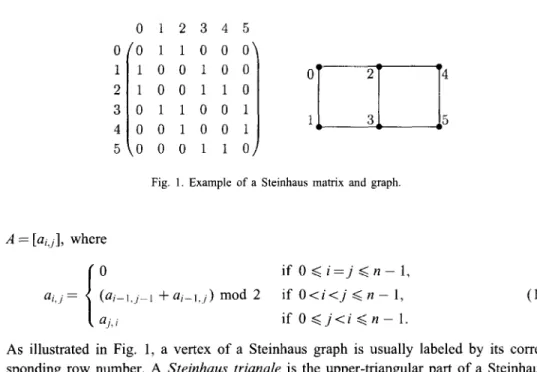
12 G.J. Chany et al. I Discrete Mathematics 199 (1999) II-25 A = [Q], where 012345 011000 100100 100110 011001 001001 000110 \ 0 1 IrIII 2 4 3 5 /
Fig. 1. Example of a Steinhaus matrix and graph.
if O<i=j<n-1,
ai,j= (~;-l,j-l +ai-l,j) mod 2 if O<i<j <n - 1, (1)
0.j. i if 0 < j<i < n - 1.
As illustrated in Fig. 1, a vertex of a Steinhaus graph is usually labeled by its corre- sponding row number. A Steinhaus triangle is the upper-triangular part of a Steinhaus matrix (excluding the diagonal); hence, it is generated by a string of length n - 1. Throughout this paper, iz will always be the size of the vertex sets of the graphs under discussion and thus there are exactly 2”-’ Steinhaus graphs of size n.
We say that ao,oao,l . a~,~- I is a (row) generator of the corresponding Steinhaus graph. This definition violates a fundamental principle in doing mathematics. If a prob- lem has any kind of symmetry, the mathematical structures defined to handle that prob- lem should reflect that symmetry. In our case, there is just one symmetry. The vertices are ordered 0,. . . ,n - 1, but the reverse order n - 1,. . . ,O is equally good. There is no reason to distinguish the first vertex from the last vertex of the graph by starting with the first row rather than the last column of the adjacency matrix. Selecting the string ao,lu1,2.. . an-2,,,-1 as the ‘name’ of a Steinhaus graph and defining the matrix in (2) gives a symmetric way of creating a Steinhaus graph. We say that the string
ao,1a1,2 . . . an-2,n-, diagonally generates its graph and so the graph in Fig. 1 is diag-
onally generated by 10101. A diagonal generator reflects the structural properties of its graph. In particular, bipartite Steinhaus graphs are characterized by some simple patterns in their diagonal generators.
a;,j = 1
0 if O<i=j<n-1,
(a,,j-1 + a,+l,j) mod 2 if O<i<j-l<n-1, (2)
aj, i if O<j<i<n-1.
Another way to describe a Steinhaus graph is to let minAdj(0) be the vertex with the
smallest label that is adjacent to vertex 0 and Adj’(u) be the set of all vertices with
labels larger than the vertex labeled v that are adjacent to v. In Fig. 1, minAdj(0) = 1 and Adj+( 1) = (3). It is easy to show
G.J. Chung et al. IDiscrete Mathematic 199 (1999) 11-25 13
Proposition 1. A Steinhaus graph is determined uniquely
if
u =minAdj(O) and theset Adj’(v) are given.
Steinhaus graphs and triangles are named after Hugo Steinhaus who asked in [ 181 if there are Steinhaus triangles containing the same number of OS and 1s. Harborth [ 131 answered this in the affirmative by showing that for each n congruent to 0 or 1 mod 4, there are at least four strings of length n - 1 that generate such triangles. Wang [ 191 named these triangles after Steinhaus (see also [ 141) and Chang [6] investigated the possible number of 1s in these triangles. Molluzzo [ 171 was the first to form graphs from Steinhaus triangles, but he examined the complements of what we call Steinhaus graphs. For a survey of Steinhaus graphs see [9] which also announces some of the results in this paper.
Steinhaus graphs form a ‘large’ enough class of graphs to be interesting. Brigham and Dutton [5] conjectured that almost all Steinhaus graphs have diameter two. Brand [l] verified this for both Steinhaus graphs and their complements and his results were generalized in [2]. Brigham et al. [4] have shown the following result.
Fact 1. Ever?, graph is an induced subgraph of a Steinhaus graph
Steinhaus graphs are also ‘large’ in the sense that they mimic the behavior of all graphs (at least in terms of first-order properties).
Fact 2. For a given jirst-order property, almost all Steinhaus graphs have the prop-
erty {f and only,
(f
almost all graphs have the propert?,.Using this fact, the authors of [3] show that almost all Steinhaus graphs have the following properties: They are k-connected for any fixed k, they contain any fixed graph as a subgraph, and they are not planar.
2. Notation and bipartite Steinhaus graphs
In this paper we use the following notation and definitions. (1) For b<a, let (2) =O.
(2) Let P,,, be {(i) rnod2}:16 which is a j-long string of OS and 1s. Note that P,,;-1
is the ith row (O-origin) of Pascal’s triangle modulo 2. We use the name Pascal’s rectangle (see Fig. 2) for a zero-padded version of Pascal’s triangle modulo 2. (3) If T is a string of OS and Is, then T‘ is the string repeated s times. For example,
o(P1.3)~ =0110110110. Also, T” is an infinite repetition of T.
(4) Denote the set of integers by Z and if A C Z, then Ai = {x E A: x 3 i}. For example, W = Z,J is the set of non-negative integers, Z+ = Z, is the set of positive integers, and if a3, is the set of odd positive integers, then 03 is the set of odd positive integers larger than 1.
14 G.J. Chany et al. I Discrete Mathematics 199 (1999) II-25 100000000... 110000000... 101000000... 111100000... 100010000:.. 110011000... 101010100... 111111110... 100000001... : : : : : : . . . : : : ..I . . Fig. 2. Pascal’s rectangle.
(5) As is usual, 1x1 is the floor of x and 1x1 is the ceiling of x. (6) We denote log,(x) by lg(x).
(7) If a variable is a positive integer, we will use the capital of that variable to be the
next larger power of two. If k E Z+, then K = 2r’ack)l. For example, if k = 5, then
K=8 and if v=4, then V=4.
(8) Letni-n-l andnz-n-2.
(9) If u is odd and DE N, then
(3) There are two facts concerning Pascal’s rectangle that we need and which are corol- laries of Lucas’s theorem. See [lo] for a proof of these facts and [ 1 l] for a short proof of Lucas’s theorem.
Fact 3 (Lucas’s Theorem). Let p be prime and m = mo + ml p + m2p2 + . + m,pr
andk=ko+klp+kzp2+.. .+k,.p’ with O<mi<p andO<ki<pfor OdiGr. Then
Fact 4. For m E N and k d 2m, P2”,-l.k = lk and P2”,,2m+l = 1(02m-‘)1
Fact 5. If 2m-’ <k < 2”, then P2m+j,k =fi,k and so,
for
k jixed, Pj,k iS periodicof
period 2”.
In [8], it was shown that a bipartite Steinhaus graph has a perfect matching if and only if the sizes of the two color sets are equal and that a Steinhaus graph is bipartite if and only if the graph contains no triangles. This is another example of how Steinhaus graphs mimic the behavior of all graphs since Gyori et al. [12] showed that graphs without short odd cycles are nearly bipartite. [They proved that for every constant E > 0
G. J. Chang et al. I Discrete Mathematics 199 (1999) 1 I- 25 15
En, G can be made bipartite by removing (15/a) log( 10/s) vertices (this is the natural
log).1
In a follow-up to [8], Dymacek and Whaley [lo] characterized the generating strings of bipartite graphs (called bipartite strings) by showing that all Steinhaus graphs are generated by the strings described in Facts 6 and 7 below. If T is a bipartite string but TO and Tl are both non-bipartite strings, then T is called a maximal bipartite string. They also gave the following recurrence for the number b(n) of n-long bipartite strings: b(2) = 2, b(3) = 4, and for k b 2,
b(2k+1)=2b(k+l)+l and b(2k)=b(k)+b(ki-1). (4)
Furthermore, they proved that b(n) f (5n - 7)/2 with equality occurring when n is one more than a power of 2.
Fact 6 (Periodic characterization). For s E ;Z+ and for t, L’ E N, any string of the f&-m O”(P~-y.~)‘LOt is a bipartite string.
Fact 7 (Maximal length characterization). For s E L?, u E 03, and v E N, a string of the form O,(PS-,,S)~~’ OS” is a maximal bipartite string.
3. Diagonal generators, adjacency list, and color sets
In this section we give a simple characterization of the diagonal generators and adjacency lists, an alternative description of the row generators, and lists of the possible color sets of bipartite Steinhaus graphs. To do this, we separate the bipartite Steinhaus graphs into four classes which are listed in Definition 2. Classes 1 and 2 are associated with the infinite bipartite graphs that are diagonally generated by sequences of the form
(PO.2’ )” where r E N. Class 3 is derived from the diagonal strings which cannot be
infinitely extended. Since all Steinhaus graphs are connected except for the null graph, see [7], the color sets for a given bipartite graph are unique. In the following definition, we use our convention that S = 2r’P(‘)l and the row generators are from Facts 6 and 7. Note that basically all bipartite strings have the form OS(P~-,Y,V)U2’Or.
Definition 2 (The four classes). Let s, t E Z+, v E N, and u E 03. Class 0 (The null graph). The row generator is 0”.
Class 1 (t=O). A row generator for a graph in Class 1 is an n-long prefix of Os(P,-,,~)“. Class 2 (t >O). A row generator for a graph in Class 2 is an n-long prefix of
O.‘(PS-,~,S)~’ O’, where we require that s + S2” <n.
Class 3 (The maximal bipartite strings). A row generator for a graph in Class 3 is an
n-long prefix of Os(P~~,~)u2’ Os2’, where we require that s + USES <n.
In Theorems 3-6, we give for each class other than Class 0 another description of the row generator, a characterization of the diagonal generators and adjacency lists, and the color sets for the graphs.
16 G.J. Chang et al. I Discrete Mathematics 199 (1999) II-25
~0&00110?0000L?
~01010101000000 QllllllllOOOOO 0 10000 4. 0 :Yx 0 11110 Q 10001 0 11001 Q 10101 011111 QOOOO 0000 000 00 Q Fig. 3. s=3: Class 1, nl = 10; Class 2, nr = 15Theorem 3 (Class 0). The graph in Class 0 is also described by the following:
l Row generator: 0”.
a Diagonal generator: On-‘.
l Adjacency list: minAdj(0) is undejined and Adj+(O) = 0.
a Color sets: Any will do.
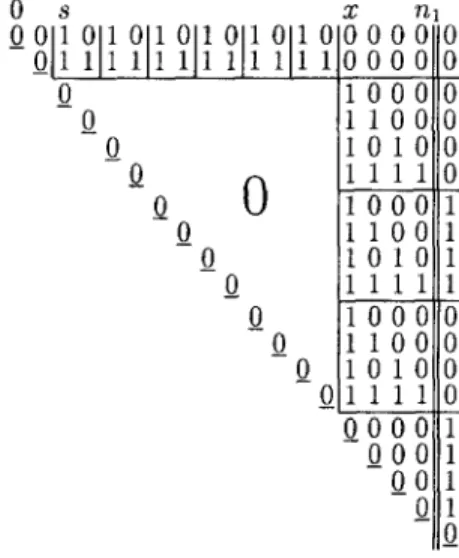
For Theorems 4 and 5, please refer to Fig. 3 where the matrix before the double vertical line represents a typical matrix in Class 1 and the entire matrix represents a typical matrix in Class 2. Note that the diagonal elements are underlined. Whenever we describe a row of a Steinhaus matrix, we list only the diagonal element and the elements to the right of the diagonal.
Theorem 4 (Class 1). Let s E Z+ and v E N. The graphs in Class 1 are also described
by the following:
l Alternative description of row generator: O”PN-~,~-~.
l Diagonal generator: OS-’ lo”-“-‘.
l Adjacency lists: minAdj(0) = s, Adj+(s) = 0.
0 Color sets: {{O,l,..., s- l},{s,s+ l,..., n- 1)).
Proof. If OS(Ps-S,s)21 is a row generator, then by Fact 4, row s-l is Q(Ps-1,s)” =Qls2’.
If OsP~~-,,,,-, is an alternative row generator, then again by Fact 4, row s - 1 is QPN-~.~-~ = QlnPs. For each of these generators, row s - 1 is all 1s (from the diagonal right) and so row s is all OS. Hence minAdj(s) = 0 and Adj+(s) = 8 for both generators. Thus these generators produce the same matrix and are therefore the same string. Also, note that if minAdj(s) = 0 and Adj+(s) = 0, then the matrix is generated by O’PN-,~,~-~.
Now these generators give exactly one 1 on the diagonal generator because a;,S = 1 for 0 < i<s and a,-I,;= 1 for s < j <n. Conversely, it is easy to see that if there is
G. J. Chany et al. I Discrete Mathematics I99 i 1999) 1 l-2.5 17
just one 1 in the diagonal generator at position ~,+t.,~, then row s - 1 is Ql”+’ and hence row 0 is O-‘P~~~-,,,r~s.
Since Adj+(s)= 8 and vertex s is adjacent to each of the vertices in the set
(0, 1,. , s - 1 }, the color classes are as given in the statement of the theorem. 7
Theorem 5 is illustrated in Fig. 3 with n = 16, L’ = 1, and Y = s = 3. Note that if the matrix were larger, the period of the diagonal generator would be 8.
Theorem 5 (Class 2). Let s, t E Z- and r, v E N. Ij 1 d s < 2” und s + 2’ <n. then the graphs in Class 2 are also described by the jollow!ing:
l Alternative description of row generator: O”Pz# --).,,-,,,
l Diugonal generator: A sequence with two or more 1s separated by exactly (2’ - 1)
OS; i.e., un (n - 1)-long prejix of O’-‘(PO.J~ )” containing more than one I.
l Adjucency lists: minAdj(0) =s, Adj’(s) = {s + 2”).
l Color sets: Let v be a vertex, so 0 < v<n. Compute q1 by v - s=q12’ + w ulith
0 < w’<2’.. Then the color sets are {v: q,. is even} und {c: ql. is odd}.
Proof. Consider row s - 1 of the matrices generated by both the known and the
alternative generators. For the known generator, row s - 1 is Qls2’O’ = ~ls”O”~‘ “’
and for the alternative generator row s - 1 is Q12’ 0”-‘-“.
Let s, t, and r be as given in the definition of Class 2 and let r = [lg(s)l + c. So
.s < S < S2“ = 2”. Since Ols2“O”-“p “’ - = O12”O”-‘p”, - Adj+(s) = {.s + .Q’} = {s + 2”}
for both generators and hence the matrices are the same.
Given 7 and s with 1 < s < 2” and s + 2’ <n, consider the alternative generator
O’Pz! -,,,,-,. Note that the condition s + 2” c,n guarantees that Adj’(s) is not empty,
which distinguishes Class 2 generators from Class 1 generators. Let c = r - [lg(s)l. So 2” = S2”. For the matrix generated by the alternative generator, row s- 1 is Q12’ O”-‘+” which is the same as row s- 1 in the matrix generated by o\(Ps~,,~~)2’O”~‘-~s~‘. Hence. this generator generates the same matrix as the alternative generator.
By the previous paragraph, deleting the first s rows of the matrix generated by O’Pz, -,s.,l --\ gives a matrix with first row 0” lo”-‘ --“. Hence, the part of the matrix bounded by columns s + 2” to s + 2”” ~- 1 and rows s to s + 2’ - 1 is the first 2’ rows and columns of Pascal’s rectangle. As is easily seen, this propagates endlessly giving a diagonal generator that is the first n -- 1 entries of o”-’ (PQ )“.
Conversely, using the first n - s terms of (Po,~~ )” as a diagonal generator gives the
matrix whose first row is 012’ O”-‘-*’ Adding s rows above this row with minAdj(0) = s
gives the generator O’Pl, --I,,l-,s and therefore, using the first n - 1 terms of O‘-’ (PO,: )” as a diagonal generator gives the row generator O’Pz, -,,,,-,
The color sets are determined easiest by considering the periodic nature of the di- agonal generators. Clearly, { 0,. . . , s - 1 } must be in one set since each is adjacent to the vertex labeled s. The periodic nature of the generator gives alternating sets of 2” vertices in each color set. q
18 G.J. Chang et al. IDiscrete Mathematics I99 (1999) II-25
Fig. 4. Class 3: nl =17, s=2, u=3, u= 1.
The remaining class of bipartite Steinhaus graphs is generated by prefixes of max- imal length bipartite strings. These are maximal because if n = s + uS2” + S2”, then
T = OS(Ps-s,s)U21’OS2r 1s a bipartite string but neither ’ TO nor Tl are bipartite. In Fig. 4, s =2, U= 3, and u= 1 and note that if n = 19, then vertices 6, 14, and 18 form a
triangle. In general, the vertices labeled s + S2”, s + uS2’, and n form a triangle in TO
and the vertices labeled 0, s, and n form a triangle in T 1. The strings in Class 3 are
not difficult to describe, but are difficult to count. The number of such strings satis- fies a recursion that has two closed forms which are somewhat bizarre. Theorem 6 is illustrated in Fig. 4 where w = 2 and x = s + ~2” = 14.
Theorem 6 (Class 3). Let s E Z+, v, w E N, and u E 03.
Ifs,
u, and w are such that1 <sd2”, x=s+u~~, and O<n -xd2”, then the graphs in Class 3 are also described by the following:
l Alternative description of row generator: An n-long prefix of OS(P2~~~-s,2~~)UOn-x.
l Diagonal generator: An (n - l)-long prejx of OS-‘10u2”‘-’ 102”-’ containing two
1s.
l Adjacency lists: minAdj(0) = s, Adj+(s) = {x}.
0 Colorsets: {{O,l..., s-l}U{x,x+l,..., n-l},{s,s+l,..., x-l}}.
Proof. If s = 1, then Ps-~,s = 1 and so the row generator Ol”-‘0 is in Class 3, unless
n = 21’ + 2 for u E Z+ in which case it is in Class 2.
As in the proof of Theorem 5, the known and the alternative generators each give
G. J. Chang et al. I Discrete Mathematics 199 (1999) 1 l-25 19
alternative generator to have at least one trailing 0, but not enough trailing OS to cease being a bipartite string. Therefore, each of these generators generates the same matrix. Neither is in Class 1 or Class 2 because u E 03.
For the matrix generated by the diagonal generator, consider the triangle of OS formed by the OS between the two 1s in the diagonal generator. Note that the top border of this triangle consists of ~2“ S-size blocks of Pascal’s rectangle and the right border consists of u 2”‘-size blocks of Pascal’s rectangle (see Fig. 4). Hence for the diagonal generator, Adj+(s) = {x}.
For either the alternative row generator or the diagonal generator, row s - 1 is
Qlrr2” lo”-’ and so there are no edges in the graph induced by the vertices {s, s + 1,
. . ,X - l}. Columns x to IZ - 1, starting with row s, is Pascal’s rectangle. By Fact 5 and the hypothesis n - x d 2’“, row x is all OS to the right of the diagonal. Because of this
and minAdj(O)=s, the graph induced by the vertices (0, l,...,s- 1.x,x+ l,....n- 1)
has no edges. 0
Theorems 7, 8, and 10 restate some of the results from Theorems 3-6. Theorem 9 is a corollary of the diagonal characterizations found in the same theorems. A different proof of Theorem 10 can be found in [ 15,161.
Theorem 7 (Diagonal generators). Let u E cD3, s E Z+, and z: E N. A Steinhaus graph is bipartite if and only if its diagonal generator is either a substring of (Po.2, )”
(Class 0, 1, or 2) or an (n - 1)-long substring of O’-‘10U2’-‘102’-* containing ut
least two 1s (Class 3).
Theorem 8 (Number of 1s on diagonal generators). For u E 03, s E Z?. and r E N, a diagonal generator of a bipartite Steinhaus graph has
0 no Is for Class 0,
l exactly one 1 for Class 1,
l two or more 1s separated by (2’ - 1) OS for Class 2,
l exactly two 1s separated by (242” - 1) OS for Class 3.
Theorem 9 (Forbidden substrings in diagonal generators). Let u E N and u E QP,. A Steinhaus graph is bipartite if and on!v if the diagonal generator does not contain a substring of the form 02”10LL2’-‘l or 10”2’~-‘102’.
Theorem 10 (Characterization by adjacency lists). If u E N, uE&, and s =
minAdj(O), then a Steinhaus graph (except for the null graph) is bipartite (f and only (f either
l Adj+(s) = 0 (Class l),
l Adj+(s) = {s + 2”) where S < 2” (Class 2) or
20 G.J. Chang et al. IDiscrete Mathematics I99 (1999) II-25
4. The size of each class
In this section the size of Classes O-2 are found and a recursion is given for the size of Class 3, along with two of its bizarre closed forms. Let b(n) be the number of bipartite Steinhaus graphs with n vertices and bk(n) be the number of such graphs in Class k. The recursion for b(n) is given in (4). We show that b(n) =2n - 2 + b3(n) where bs(n) also satisfies (4).
Theorem 11 (The size of Class 1). There are n - 1 graphs in Cluss 1.
Proof. Fixing s determines an alternative generator for Class 1 and since there are n - 1 choices for s, there are n - 1 graphs described by the alternative generators. Note also that for Class 1, there are n - 1 positions on the diagonal generator to place the
1 and so there are IZ - 1 graphs described by the diagonal generators. Likewise, there are n - 1 vertices to choose that could be adjacent to vertex 0 and so the adjacency lists also describe n - 1 graphs. 0
Theorem 12 (The size of Class 2). There are n - 2 gruphs in Class 2.
Proof. Let ,u be the integer such that 2” <M <2 I’+‘. By Theorem 5, the alternative generators of the Class 2 graphs can be described by choosing r such that 1 dr < ,u and further choosing 1 <s < 2’. If r = /J and s is too large, then this describes a graph from Class 1. To avoid this, we need n = s + S2” + t where t > 0 and S2’ = 2’ (from the known generator description). So if r = p, then s <n - 2” + 1. Hence there are
L,- I
n-y-1+ C2k=n-2”-1+2”-1=n-2
k=O
generators of Class 2 graphs.
To count the diagonal generators directly, note that a diagonal generator has the
form O”-‘(Po.Jl.)” where 1 <s 62’. Given r, there are 2’ diagonal generators with
period 2” unless r = ,u and then there are n - 2” - 1 generators. Hence the total is the left-most side of (5).
The number of Class 2 graphs also can be counted by considering the number of adjacency lists. This is the number of ordered pairs (s,x) such that s + x dn - 1 and x = 2 ‘, where v is a non-negative integer such that 1 ds <2 I. Note that for any integer i with 2 <i < n - 1, there is exactly one pair (s,x) with s +x = i satisfying the above property; i.e., x = 2 I’&- ’ )J and s = i - x. Therefore, there are n - 2 graphs in
Class 2. 0
Theorem 13 (Recursion for the size of Class 3). A recursion fir bj(n) is b3(2) = 0,
b3(3) = 0, and jbr ka2,
G.J. Chany et al. IDiscrete Mathematics 199 11999) 11-25 21
Proof. Since b(n) satisfies (4) and bj(n)=h(n) - 2n + 2, hi(n) also satisfies (4). 3
Summary 1. Class 0 contains 1 graph, Class 1 contains n - 1 graphs, and Class 2 contains n - 2 graphs. Thus Class 3 contains b(n) - 2n + 2 graphs.
We now give two quite different expressions for hi(n). First, we introduce the fimc- tions from R into R’ defined by
tooth /. (x) = 2“ if x=0 (mod2’-‘),
0 if x=2’ (mod2”‘),
and by linear interpolation between these values. We can also write these functions as
tooth,.(x)= ((xmod2”“) - 2”(.
Theorem 14 (Expression for b(n): tooth version). For n>2. Llg((tl-I ).3)]
b(n)=2n-2+ C tooth,. (n - 1).
r=O
Proof. From Summary 1, we only need to compute b,(n). For those bipartite Steinhaus graphs which are not subgraphs of infinite bipartite Steinhaus graphs, each is diagonally generated by a sequence of the form 0” 10” 10’ for some non-negative integers s, t, u,
II, and 12: with $2‘ = ~2” - 1, u E 03, r 3 1 and s, t < 2 ‘. (Those graphs with u = 1 are
already counted since they are subgraphs of infinite Steinhaus graphs.) We count the
number of such sequences for given values of u and u. As before, let ~11 = n - 1 be the
lengthofsuchasequence.Thenn~=u2”+1+s+tands+t=(n~-1-2”)mod2”’. For a given sum x = s + t, we distinguish two cases.
First, if 0 <x < 2 ‘, then we have x + 1 sequences with 0 <s <x and 0 d t = I - s <.Y.
Second, if 2”<~<2’.-~‘, then we have 2”’ -1-xsequenceswithx--2”+l<s<2-1
ands-2’+l<t=x-~62”-1.
Hence there are tooth,-(nl) sequences of length nl for a given value of ~1 with
O<f?d lgl?]. q
Theorem 15 (Expression for b(n): binary expansion of n - 2 version). Let nz =
(a~a~-~ . ao)l be the binary expunsion
qf
n - 2 with ah = 1. Zf c, (respectivel?S, d, )is the number qf 00 (respectiveluv, 11) in u~-luk~z . a,,., , then
k-l
b(n)=2n-2+ao+(ak-lak-2...al)2+ c(c,(l -a,)+d,a;)2’+dPI. (7)
;=o
Proof. Again, we only need to compute b3(n) to prove (7). Denote by B,, the set of all (s,x’) which satisfies the adjacency list conditions in Theorem 6; i.e., x = s + cr2’,
~~03, 1<.~<2~, O<n-x62’, andx’=u2“. Note that bs(n)= lB,,I. Let m=2L’““‘:‘!
22 G.J Chang et al. IDiscrete Mathematics 199 (1999) II-25
x’ < $m. If f is defined by (3) in the notation section, then f(x’) = f(u2 “) = 2 and since 2L.<lm ‘8 ’
Hence,
a contradiction.
Since 2m>x’> irn and x’ # m, x’ - irn is not a power of 2 except when x’= irn
or x’= lrn. So if x’ @ {im, im}, then 2” = f( x’ - $m) and 2” an -x if and only if
f(x’ - im)a(n - $m) -s - (x’ - irn). Hence (s,x’) EB, if and only if
(s,x’ - $)EB,-;,,,, where x’ $! {im, im}. When x’= irn, f (x’) = irn; and so
(s,x’)EB~ if and only if O<n --s - $rn<irn and l<s<im; i.e., irn>s>n -m=
n2 - m + 2. There are irn - (n2 -m) - 1 (respectively, 0) s satisfying the above inequal- ities when m <n2 < irn (respectively, otherwise). When x’ = irn, f (x’) = irn; and so
(s,x’)~B” ifandonlyifO<n-s-;rndlrn and l<s<im; i.e.,nz-im+l>s>l.
There are n2 - irn + 1 (respectively, 0) s satisfying the above inequalities when irn <n2 <2m (respectively, otherwise). Thus,
f -(n2-m)- 1 if m<nz<$m, b3(n) = bx(n - 5) + 0 if im<nz<irn, nz-irnfl if irndn2 c2m. Then f I I, m b3(n- 1) + i T-(nz-m)-1 if m<nz<irn, 0 b3(n) = if irn<n2 < irn, { m
’ ‘u-m)+ 4 if irnbn2 < irn,
nz-im+l if irn<n2 <2m.
(8)
Let (akuk-i . . . a0)2 be the binary representation of n2 with ak = 1 and if ai is a bit, then a, = 1 - a;. For n 3 4, (8) is the same as
b3((lak-I . ..aO)2+2)=b3((lUk_2...UO)2+2)
(ak-3ak-4...a0)2 if ak- I a&2 = 00,
0
+ pk-2 if a&Jak-2 = 01,
3 if ak-iak-2 = 10,
zke2 + (ok-3ak-4.. .aO>2 + 1 if Czk-Jak-2 = 11.
G.J. Chang et ul. IDiscre~e Mathematics 199 11999) 11-25 23
Also, h3((10)2 + 2) = 0 and h3(( ll)~ + 2) = 1. Repeatedly applying (9) gives
k-l h-l
b3(n)=ao+ c 2’-?+ cci(l -u,)2’+ Cd,a,2’+d-,
(,,-,=I /-0 I = 0
?<l<h
which can be rewritten as (7). 0
5. Lower bound for b(n)
To find a lower bound for b(n), consider formula (7). Let m be a positive inte- ger for which the binary expansion of rn2 = m - 2 is a substring of ( 10)kO. Then
in (7) c; =d, =0 for all i. Hence, if ml = (lO)‘O, then &(m)=(lO)i-’ = $(4” - l),
m = f(4h+’ + 2) and b3(m) = i(rn - 6). We now show that I(n) = i(n - 6) is a lower bound for b3(n) for all positive integers n.
Lemma 16 (Lower bound for b3(n)). A lower bound Jbr bj(n) is
bj(n) 3 $(n - 6). (10)
Proof. We induct on n. By inspection, the lemma is true for n <32. Express n as
16q + r, O<r d 15, and consider four cases: r odd; r E {0,2,4.6,12,14}; q even.
r t (8.10); and q odd, r E {&lo}. Since b3(8q + k) is an integer, if bJ(8q + k)3
I(8q + k) = q + i(k - 6) then
bd8q + k)> ’
qfl if 06k66, if k=7. (11)Case 1 (n= 16q+r, r odd). Let r=2k+- 1, O<k<7. Using (6) and (11) we have
b3(16q+2k+ 1)=2b3(8q+k+ I)+- 13 2q+ 1 if 06k66, 2q+2 if k=7. (12)
Now,
2(16q+2k+1)=$(16q+2k-5)< 2q+ 1 if OGk66,
2q+ 2 if k = 7.
and hence b3(16q+2k+ 1)>1(16q+2k+ 1) for O<k<7.
Cuse2(n=16q+r,r~{0,2,4,6,12.14}‘).Letr=2kwithk~{0.1,2,3,6,7}.Using (6) and ( 11) we have Ml6q + 2k + 1) = b3(8q + k) + bj(8q + k + 1) + 1 2q if O<k<d, 3 2qfl if k=6, 2q+2 if k==7. (13)
24 G. J. Chang et al. IDiscrete Mathematics 199 (1999) II-25
NOW,
1(16q+2k)=+(16q+2k-6)< 2q if O<k<3,
2q+ 1 if 4<k<7,
and hence b3(16q+2k)>l(16q+2k) for kE{O,1,2,3,6,7}
Before proceeding to Cases 3 and 4, note that
j(32q + 2k) = $(32q + 2k - 6) < 4q+ 1 if 46kG5,
4q+3 if 12<k<13.
Case 3 (n= 16q + Y, q even, YE (8,lO)). So n =32q + 2k, 4<k<5. Using (6)
(12) (13) and noting that one of k and k + 1 is odd, gives
b3(324+2k)=b3(16q+k)+b3(16q+k+ 1)32q+(2q+ 1)=4q+ 1.
By (14) b3(32q+2k)>Z(32q+2k) for 4<k65.
Case 4 (n = 16q + r, q odd, Y E (8,lO)). S o n=32q+16+2k, 46k<5. Using (6)
(12), (13) and noting that 8 + k is either 12 or 13, gives b3(32q+16+2k)=b3(16q+8+k)+b3(16q+8+k+1)
>, (2q + 1) + (2q + 2) =4q+3.
By (14) b3(32q+ 16+2k)>Z(32q+ 16+2k) for 46kd5. 0
Theorem 17 (Tight bounds for b(n)). For n>4,
;(17n - 22)<b(n)<;(5n - 7).
The lower bound is achieved for n = 4(qki’ + 2) and the upper bound is achieved for
n=2k+ 1.
Proof. The upper bound has already been given and since $(17n-22) = 2n-2+$(n-6) and b(n) = 2n - 2 + b3(n), the inequality follows from Lemma 16. In the introduction to this section, we showed that the lower bound is achieved for n = i(qkf’ + 2). 0 Since b(n) is an integer for all n, we can replace the lower and upper bounds in the previous theorem with the ceiling and floor, respectively.
Theorem 18 (Tighter bounds for b(n)). For n>4,
C.J. Chary et al. IDiscvrte Mathematics 199 (1999) 11.-25 25
References
[l] N. Brand, Almost all Steinhaus graphs have diameter 2, J. Graph Theory 16 (1992) 213219. [2] N. Brand. S. Curran, S. Das. T. Jacob, Probability of diameter two for Steinhaus graphs, Discrete Appl.
Math. 41 (1993) 165-171.
[3] N. Brand. S. Jackson, Properties of classes of random graphs. Combin. Probab. Comput. 3 (1994) 435-454.
[4] R.C. Brigham, J.R. Carrington, R.D. Dutton. Embedding in Steinhaus graphs. J. Combin. fnform. System Sci. 17 (1992) 257-270.
[5] R.C. Brigham. R.D. Dutton, Distances and diameters in Steinhaus graphs. Congr. Numer. 76 (1990) 7-14.
[6] G.J. Chang, Binary triangles, Bull. Inst. Math. Acad. Sinica 11 (1983) 209-225. [7] W.M. Dymacek. Steinhaus graphs, Congr. Numer. XXIII&XXIV (1979) 3999412. [E] W.M. Dymafek, Bipartite Steinhaus graphs, Discrete Math. 59 (1986) 9-20.
[9] W.M. Dymhcek, M. Koerlin, T. Whaley, A survey of Steinhaus graphs, Proc. 8th Quadrennial Intemat. Conf. on Graph Theory, Combinatorics. Algorithms and Applications Kalamazoo. Michigan. 1996. Vol I, 313.-323.
[IO] W.M. Dymafek. T. Whaley. Generating strings for bipartite Steinhaus graphs. Discrete Math. 141 ( 1995 ) 95-107.
[I l] N.J. Fine, Binomial coefficients module a prime, Amer. Math. Monthly 54 (1947) 589-592.
[12] E. Gyori, A.V. Kostochka, T. tuczak, Graphs without short odd cycles are nearly bipartite. Discrete Math. 163 (1997) 279-284.
[13] H. Harborth. Solution of Steinhaus’s problem with plus and minus signs, J. Combin. Theory. Ser A 12 (1972) 253-259.
[II] H. Harborth. Aufgabe 785, Elem. Math. 33 (1978) 49-50; solution by O.P. Lossers.
[ 151 Y.S. Lee. Counting bipartite Steinhaus graphs, Master Thesis, Department of Applied Math.. National Chiao Tung University, Hsinchu 30050, Taiwan, June 1994.
[16] Y.S. Lee, G.J. Chang. Bipartite Steinhaus graphs, Taiwanese J. Math., to appear.
[I 71 J.C. Molluzro, Steinhaus graphs, in: Y. Alavi, D.R. Lick (Eds.), Theory and Applications of Graphs, Kalamazoo. Michigan, 1976, Lecture Notes in Math., vol. 642. Western Michigan University Springer, Berlin. 1978. pp. 394-402.
[I 81 H. Steinhaus, One Hundred Problems in Elementary Mathematics, Dover. New York, 1979. Thts is a republication of the English translation first published in 1964 by Basic Books, Inc.. IO E 53rd St.. New York. NY 10022.
[19] E.T.H. Wang, Problem E 2541, Amer. Math. Monthly 82 (1975) 6599660: solution by M. Joseph in same journal 83 (1976) 660-661.