Synthesis and Luminescence Properties of Intensely
Red-Emitting M
5Eu
„WO
4…
4−x„MoO
4…x
„M = Li, Na, K…
Phosphors
Chuang-Hung Chiu,a Chih-Hsuan Liu,b Sheng-Bang Huang,b and Teng-Ming Chena,z
a
Phosphors Research Laboratory, Department of Applied Chemistry, National Chiao Tung University, Hsinchu 30010, Taiwan
b
Electronics and Opto-electronics Research Laboratories, Industrial Technology Research Institute, Hsinchu 30010, Taiwan
We have investigated the luminescence of a series of M5Eu共WO4兲4−x共MoO4兲x共M = Li, Na, K兲 phosphors and discovered that Na5Eu共WO4兲4−x共MoO4兲x 共0 ⱕ x ⱕ 4.0兲 exhibit the most intense red emission among the three investigated. Powder X-ray diffraction investigations show that a complete solid solution can be formed in the indicated composition range. The effect of chemical compositions on the luminescence properties of Na5Eu共WO4兲4−x共MoO4兲xhas been investigated and discussed. The Commission International de l’Eclairage chromaticity coordinates were found to be 共0.66,0.33兲 for Na5Eu共WO4兲4−x共MoO4兲x, which reaches the same level as that of the Y2O2S:Eu3+commodity. The color-rendering index共Ra兲 of a typical white-light–light emitting diode共WL-LED兲 based on Na5Eu共WO4兲2共MoO4兲2was found to be 82.3, higher than that共i.e., Ra ⬃ 70.8兲 obtained for the WL-LED fabricated using the commodity of La2O2S:Eu3+when the WL-LEDs were operated at a forward-bias current共I
f兲 of 20 mA at room temperature. Na5Eu共WO4兲4−x共MoO4兲xis therefore suggested to be a potential red-emitting phosphor for WL-LED. © 2008 The Electrochemical Society. 关DOI: 10.1149/1.2825178兴 All rights reserved.
Manuscript submitted August 31, 2007; revised manuscript received November 12, 2007. Available electronically January 8, 2008.
Light emitting diodes共LEDs兲 have received much attention for their potentiality of being used as general lighting devices. The development of white color is extremely significant to expand LED applications toward general lighting.1White-light共WL兲 LEDs offer benefits in accordance with stability, energy savings, perpetuation, and safety. There are three important methods for a
single-chip WL-LED.2 The most predominant WL-LED uses a
450–470 nm blue-emitting LED that excites a yellow-emitting Y3Al5O12:Ce3+共YAG:Ce3+兲 phosphor dispersed in the epoxy resin
on a blue LED chip.3 This method is presently the most efficient technique. However, the light color is not truely white due to the deficient red component. Therefore, the importance of blue-excitable red-emitting phosphor is increasing. The second method is to com-bine a blue chip with the blue-excitable red- and green-emitting phosphors. The third option is to set three phosphors共red-, green-, and blue-emitting兲 that down-convert the near-UV/blue light into visible light on LED chip. Notably, the red light-emitting phosphors for WL-LED based on near-UV/blue chip is still limited commer-cially to sulfide-based materials, such as CaS:Eu2+, SrY
2S4:Eu2+,
and ZnCdS:Cu,Al.4,5 However, there are certain disadvantages to use those sulfide-based materials, such as chemical instability, large spectral full width at half maximum, and low efficiency.6
Hence, there has been a widespread and growing interest in de-veloping new families of red-emitting phosphors with high absorp-tion in the near UV to blue region. The luminescence properties of rare-earth molybdates and tungstates have long attracted the atten-tion of investigators.7A number of patents represent almost all com-binations between rare-earth oxides and molybdenum and tungsten trioxides activated by Eu3+and Tb3+, including compositions that
are not in accord with the stoichiometry of presently known compounds.8-11 Trunov et al. reported the synthesis and crystallo-graphic data of Na5Ln共MoO4兲4and Na5Ln共WO4兲4, where Ln
repre-sents the rare-earth ions in 3+ oxidation state, and the same group of researchers also studied the luminescence spectra of Na5Ln共MoO4兲4
and Na5Ln共WO4兲4in 1978.12The luminescence properties of double
molybdates and tungstates of rare earths and alkali metals were de-scribed by Dzhurinskii et al.7In addition, fluorescence spectra for polycrystalline Na5Eu共MO4兲4共M = Mo, W兲 samples have been
measured and analyzed at 4.2, 77, and 300 K, respectively, and their crystal field calculations have also been performed by Huang et al.13 The crystal structure of Na5Y共MoO4兲4, isostructural with Na5Ln共MoO4兲4and reported to be scheelite related with all the tet-rahedral sites occupied by an ordered arrangement of Mo and Na in 4:1 ratio,14have been determined from single-crystal X-ray diffrac-tion 共XRD兲 data 关space group I41/a, Z = 4, a = 11.374共3兲 Å, c
= 11.440共5兲 Å兴 Recently, Wang et al. investigated the
photolumi-nescence 共PL兲 properties of Na5La共MoO4兲4:xEu3+ and
NaEu共MoO4兲2.15Bright red-light emitting diodes were fabricated by
coating the phosphors onto near-UV-emitting InGaN chips, respec-tively, and the diodes prepared with phosphor Na5Eu共MoO4兲4show good Commission International de l’Eclairage 共CIE兲 chromaticity and exhibit more intense red emission than that fabricated with NaEu共MoO4兲2. Neeraj et al. reported a series of intensely
lumines-cent red-emitting NaM共MoO4兲2−x共WO4兲x共M = Gd, Y, Bi兲
phos-phors that can be excited at⬃394 nm attributed to the sharp7F0-5L6 absorption of Eu3+.16
Motivated by the above-stated investigations and the attempts to develop phosphors excitable by near-UV and/or blue radiation for the applications of WL-LED, we have systematically investigated and reported herein the preparation, PL, and color chromaticity
properties of a series of phosphors with composition
Na5Eu共WO4兲4−x共MoO4兲x 共0 ⱕ x ⱕ 4.0兲, whose compositions are
different from those reported by Sivakumar et al.,6Wang et al.,15
and Neeraj et al.16 By using the composition-optimized
Na5Eu共WO4兲2共MoO4兲2 phosphor, we have also fabricated a
WL-LED whose performance was compared to that of a WL-WL-LED fab-ricated based on the commonly used commodity of La2O2S:Eu3+.
Experimental
The phosphors of the compositions M5Eu共WO4兲4−x共MoO4兲x were synthesized by high-temperature solid-state reactions. The starting materials used were M2MoO4 共99.9%; M⫽Li, Na, K兲
共Strem Chemicals, Newburyport, MA, USA兲, M2WO4 共99.9%;
M⫽Li, Na, K兲, MoO3 共99.95%兲, WO3 共99.9%兲, 共all from Cerac Chemicals, Milwaukee, Wisconsin, USA兲 and Eu2O3共99.99%, Ald-rich Chemicals, Milwaukee, Wisconsin, USA兲. Stoichiometric amounts of reactants were ground by ballmilling and then heated at 600°C for 6 h. The XRD profiles were recorded by using a Bruker D8 Advanced diffractometer equipped with Cu K␣ radiation 共
z
Diffuse reflectance spectra of phosphor samples were measured with a Hitachi 3010 double-beam UV-visible共vis兲 spectrometer 共Hi-tachi Co., Tokyo, Japan兲 equipped with a ø60 mm integrating sphere
whose inner face was coated with BaSO4 or Spectralon, and
␣-Al2O3 was used as a standard in the measurements. The CIE
chromaticity coordinates for all samples were determined by a Laiko DT-100 color analyzer equipped with a charge coupled device 共CCD兲 detector 共Laiko Co., Tokyo, Japan兲. The scanning electron microscope 共SEM兲 images were measured with a Hitachi S-4000 field-emission-type SEM with operation voltage in the range of 0.5–30 kV.
To compare the performance of composition-optimized
phosphor Na5Eu共WO4兲2共MoO4兲2 and that of commodity
phosphor La2O2S:Eu3+共Kasei Optonix KX-681B兲 in the fabrication
of WL-LEDs, phosphor-converted WL-LEDs were fabricated. Based on the standard LED technology, one WL-LED was
achieved by using an n-UV LED chip 共average em= 392 nm,
Cree catalog no. C395MB290-S0100兲 in pumping
blue-emitting BaMgAl10O17:Eu2+ 共Kasei optonix KX-661兲,
green-emitting 共Ba,Sr兲-Si-Al-O:Eu2+,Dy3+ 共Nantex RU-G534兲,
and our red-emitting Na5Eu共WO4兲2共MoO4兲2 phosphors
simulta-neously. The above-mentioned BaMgAl10O17:Eu2+ and
共Ba,Sr兲-Si-Al-O:Eu2+,Dy3+phosphors were excellent commodities
because of their nonoxicity, thermal stability, and intense lumines-cence properties. The phosphors were encapsulated in a transparent
epoxy resin 共KBIN A2015兲. The second WL-LED, based on
La2O2S:Eu3+ commodity, was also fabricated at the same
collocation for comparison. The optimal weight ratio of
R共Na5Eu共WO4兲2共MoO4兲2兲-G-B phosphors was 0.93:0.06:0.01,
whereas that for R共La2O2S:Eu3+兲-G-B phosphors combination was
0.69:0.23:0.08. This ratio changes depended on the target color of white region. The relative emission spectra of n-UV chip WL-LED based on Na5Eu共WO4兲2共MoO4兲2 and La2O2S:Eu3+ at room
tem-perature and a If of 20 mA were measured using a 50 cm single-grating monochromator.
Results and Discussion
The XRD investigation results and comparison of the powder XRD profiles of M5Eu共MoO4兲4共M = Li, Na, K兲 phases are
repre-sented in Fig. 1. All of the as-prepared compounds were found to be single phased. The XRD profiles of M5Eu共MoO4兲4共M = Na, K兲 were discovered to be in good agreement with those studied earlier and reported in JCPDS 82-2368关Na5Y共MoO4兲4兴 and JCPDS
45-0340 关K5Eu共MoO4兲4兴. The two kinds of alkali-metal
rare-earth-meta1 molybdates described above were found to crystallize in the tetragonal and hexagonal crystal systems, respectively. For Li5Eu共MoO4兲4, no similar structural data of the compound can be found for comparison despite the high level of interest in the optical properties of the material. We therefore undertook a study on the luminescence of M5Eu共WO4兲4−x共MoO4兲x共M = Li, Na, K兲 phos-phors, beginning our work at a time when no M5Eu共MoO4兲4
com-pounds had been fully characterized.
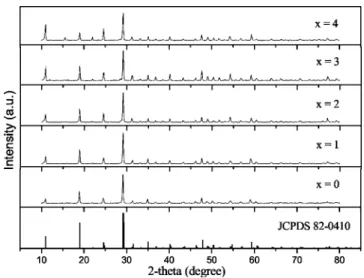
Figure 2 shows the powder XRD patterns of
Na5Eu共WO4兲4−x共MoO4兲x共x = 0, 1, 2, 3, 4兲 phases as a function of
substituted Mo content. The crystal structure of all single-phased samples were found to be similar to that of Na5Y共WO4兲4 关JCPDS
82-0410, space group I41/a, Z = 4, a = 11.447共7兲 Å, c
= 11.336共1兲 Å兴.17When the tungstate group is substituted by mo-lybdate group, the XRD profiles were found to be similar without showing discernible shifting, which can be rationalized by the al-most identical ionic radius of Mo6+and W6+. We have also carried
out an XRD cell parameter refinement based on the diffraction peaks obtained from the XRD profiles of Na5Eu共WO4兲4−x共MoO4兲x using the scheelite-related structure of Na5Y共WO4兲4,17and the results are
summarized in Fig. 3. Our data show that as x increases, the cell parameters a and b decreases marginally, whereas c increases systematically, indicating that a solid solution is very likely to form between end members Na5Eu共WO4兲4 and Na5Eu共MoO4兲4 in
the series of Na5Eu共WO4兲4−x共MoO4兲x. Similar research results have
also been witnessed by Sivakumar and Varadaraju in the AgLa0.95Eu0.05共WO4兲2−x共MoO4兲x 共x = 0–2兲 system, and they con-firmed that minor distortions in the crystal structure play a crucial role in determining the luminescence properties in these systems.18 To investigate and optimize the effect of alkali-metal ion doping on the luminescence of M5Eu共WO4兲4−x共MoO4兲x共M = Li, Na, K兲,
we have made an attempt to synthesize, study, and compare the PL spectra of M5Eu共MoO4兲4with M being isovalent Li+, Na+, and K+
Figure 1. Powder XRD patterns of M5Eu共MoO4兲4共M = Li, Na, K兲.
Figure 2. Powder XRD patterns of Na5Eu共WO4兲4−x共MoO4兲x 共x
cations, respectively. The PLE and PL spectra of selected composi-tions of M5Eu共MoO4兲4共M = Li, Na, K兲 were shown in Fig. 4 and
5, respectively. In Fig. 4, the excitation intensity of PLE spectra was found to reach a maximum by isovalent substitution with Na+,
re-gardless of the size of alkali cations. Similarly, a condition in the variation of PL spectra of three phosphors has also been observed. We were incapable of organizing the relation between luminescence properties of the compounds and the type of the alkali cation within a given type of double salts because changing the cation usually causes a concomitant change in the structure of the compound.7The relation between luminescence properties and crystal structure of the compounds 共the degree of ordering of cation in lattice兲 is not solitary.19
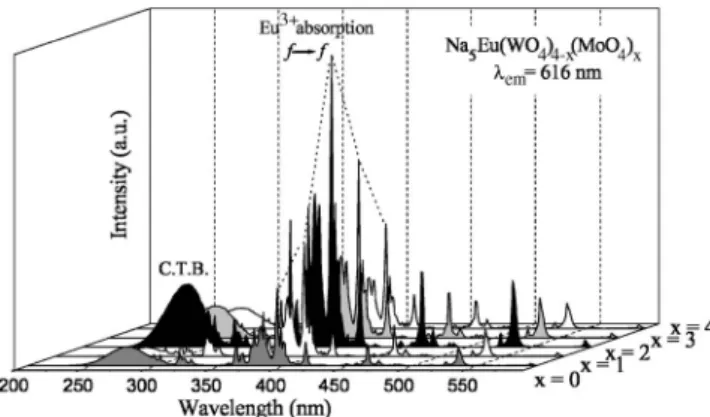
As shown in Fig. 6, the PLE spectra of five molybdotungstate samples with selected compositions of Na5Eu共WO4兲4−x共MoO4兲x
共x = 0,1, 2, 3, 4兲 were measured in the spectral range from 200 to 590 nm by monitoring the emission at 616 nm that is attributed to
5
D0→ 7F2transition of Eu3+ions. The intense broadband appears at 280 nm and is assigned as the charge-transfer 共CT兲 transition between oxygen and tungsten or molybdenum共i.e., ligand to metal charge-transfer兲.6 Nevertheless, the charge-transfer band of Eu3+–O2− was not definitely observed in the PLE spectra, which
could presumably be due to possible overlap of the CT band with that of tungstate or molybdate group. In the spectral region from 350 to 550 nm, all five Na5Eu共WO4兲4−x共MoO4兲x samples show
charac-teristic intraconfigurational 4f–4f emissive transitions of Eu3+: sharp 7F 0→ 5L 6transition for 394 nm, 7F 0→ 5D 2transition for 465 nm,
and the7F1→ 5D1transition for 535 nm. As compared to the CT band, remarkable changes were observed in the intensity of charac-teristic absorptions of Eu3+ion in the PLE spectra shown in Fig. 6, and the maximum absorption peak attributed to Eu3+ 7F
0→5L6
becomes stronger when the occupancies of W/Mo sites were found at 50%/50%.
Figure 7 shows the emission spectra of Na5Eu共WO4兲4−x共MoO4兲x 共x = 0, 1, 2, 3, 4兲 under near-UV excitation at 394 nm. The spectra essentially consist of sharp lines with wavelength ranging from 580 to 720 nm, which are associated with the5D0→7FJ共J = 1, 2, 3, 4兲 transitions from the excited levels of Eu3+to the ground state, but no
emission corresponding to tungstate or molybdate is observed. Not-withstanding the presence of an absorption band from the tungstate or molybdate group in the excitation spectra of Eu3+by monitoring
the emission at 616 nm, it clearly suggests that the energy absorbed by the WO42−/MoO42−group is transferred to Eu3+levels
nonradia-tively. This process has been known as “host-sensitized”20,21energy transfer. However, the intensity of Eu3+emission is weaker with CT
band excitation when compared to that due to Eu3+excitation.6This
reveals that the energy transfer from the W/Mo–O CT states to 4f levels of Eu3+is not efficient.
As indicated in Fig. 7, the strongest emission peak located at 616 nm, which is due to that Eu3+ ion occupying the lattice site
without inversion symmetry. The result agrees with the data of its crystal structure.14,15 The presence of multiplets in the emission
spectra are attributed to the 共2J + 1兲 Stark components of
J-degeneracy splitting. The5D0is the unsplitted singlet band, sim-plifying in a significant way the application of the group theory and of electronic transition selection rules. Without inversion symmetry at Eu3+lattice site, the electric-dipole transition would be dominant.
Figure 3. Cell parameters as a function of x for Na5Eu共WO4兲4−x共MoO4兲x
phosphors.
Figure 4. Comparison of PLE spectra for
phosphors of M5Eu共WO4兲4−x共MoO4兲x 共M = Li, Na, K兲.
Figure 5. Comparison of PL spectra for phosphors of
For this reason, the intensity of5D0→ 7F2,4共electric-dipole transi-tion兲 was found to be much stronger than that of 5D0→7F1,3
共magnetic-dipole transition兲. The major emission of
Na5Eu共WO4兲4−x共MoO4兲xwas found at 616 nm共5D0→7F2兲, which corresponds to red emission. Other transitions of Eu3+from the5D
J
excited levels to7FJ ground states, for instance, 5D0→7FJis lo-cated at 570–720 nm and the 5D1→7FJ transitions located at 520–570 nm are both very weak, and therefore, the more saturated CIE chromaticity benefited greatly by the reasoning. In addition, the intensity of5D0→7F2transition reaches a maximum when the rela-tive ratio of W/Mo is 1:1. The reason for this interesting observation may be due to the advent of ion pair interaction between Eu3+ions,
which is expected to be much stronger when W/Mo occupied bisec-tion of the lattice sites separately. Similar observabisec-tion to change W/Mo relative ratio has also been witnessed by Sivakumar and Varadaraju in the AgLa0.95Eu0.05共WO4兲2−x共MoO4兲x 共x = 0–2兲 system.18
To research whether concentration quenching has existed or not, the variation of the PL intensity with Y3+-concentration
has been investigated for Na5Eu1−yYy共WO4兲2共MoO4兲2 共y
= 0, 0.2, 0.4, 0.6, 0.8兲. The PLE and PL spectra of the compounds Na5Eu1−yYy共WO4兲2共MoO4兲2with different Y3+-concentrations were
shown in Fig. 8 and 9, respectively. The compound
Na5Eu共WO4兲2共MoO4兲2共i.e., y = 0兲 shows the maximum PL
inten-sity under 394 nm excitation. There is no concentration quenching of luminescence for our study. In 1988, Pan et al. reported that the compound Na5Eu共WO4兲4 did not exhibit concentration quenching because of the special structure of it.22The bond angles of O–W–O and Eu–O–W are 105 and 100°, respectively, which reveal great difficulty for energy transfer between Eu3+ions to occur. Our results
are in good agreement with that reported by Pan et al.,22and thus, Na5Eu共WO4兲2共MoO4兲2has also been proved to be a good phosphor showing no concentration quenching.
To investigate the optical properties of Na5Eu共WO4兲4−x共MoO4兲x phosphors, we have also measured their DR spectra as a function of
x and the results are represented in Fig. 10. From the evolution of
the DR spectra, the observed absorption band centering at 270 nm tends to shift toward longer wavelengths with increasing doped Mo content or x value. Furthermore, in almost all of the phosphors with varied x values, we have observed several absorptions at 270–330
Figure 6. PLE spectra monitored at 616 nm for Na5Eu共WO4兲4−x共MoO4兲x
phosphors with x = 0, 1, 2, 3, and 4.
Figure 7. PL spectra of Na5Eu共WO4兲4−x共MoO4兲x共x = 0, 1, 2, 3, 4兲 under
394 nm near-UV excitation.
Figure 8. PLE spectra of the Na5Eu1−yYy共WO4兲2共MoO4兲2system by varying the Y3+-diluting concentration.
Figure 9. PL spectra of the Na5Eu1−yYy共WO4兲2共MoO4兲2system by varying the Y3+-diluting concentration under 394 nm excitation wavelength.
Figure 10. Diffuse reflectance spectra of Na5Eu共WO4兲4−x共MoO4兲x
关attributed to charge-transfer transition O 2p → Mo共W兲共4d共5d兲兲兴, 394 共7F0→ 5L6兲, 465 共7F0→5D2兲, and 535 共7F1→5D1兲 nm, which were found to be consistent with those observed in the PLE spectra共shown in Fig. 6兲 and discussed previously.
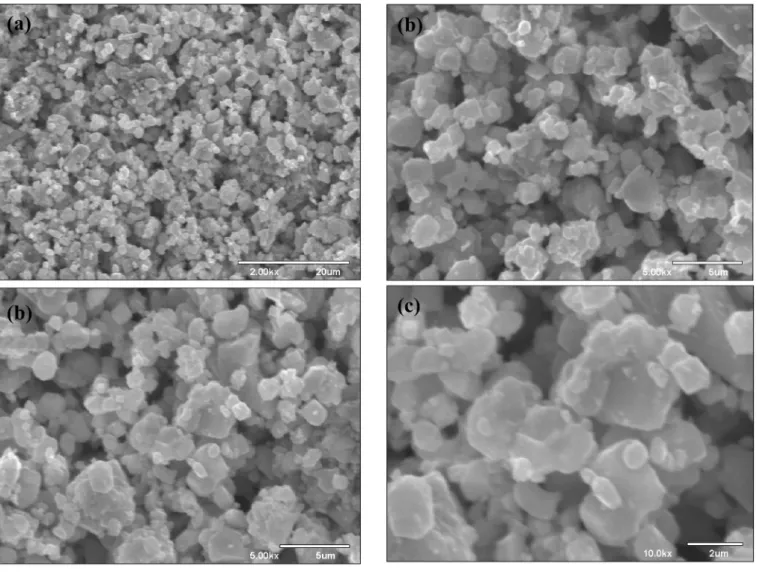
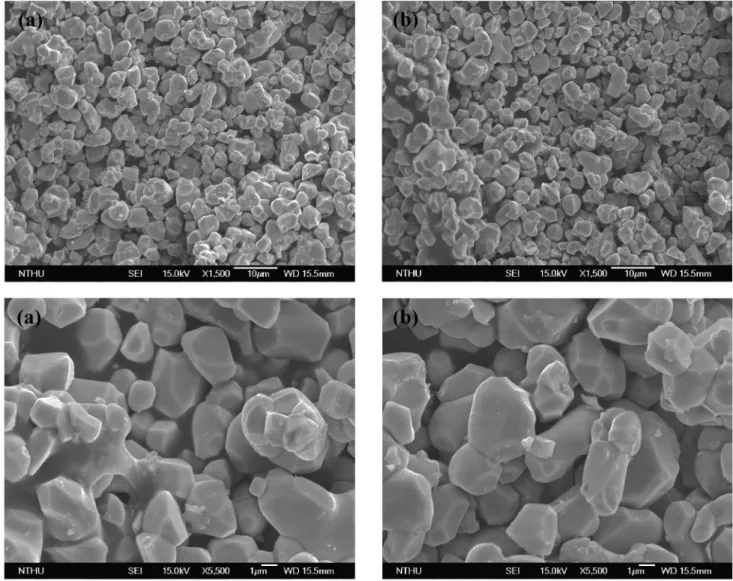
In addition, from the SEM image analysis, we have observed that the M5Eu共WO4兲2共MoO4兲2共M = Li, Na, K兲 phosphors prepared
show well-defined aggregated but irregular grains with dimension of ⬍10 m. The irregular particle morphology observed reveals the inherent characteristics of the adopted solid-state method共see Fig. 11 and 12兲.
From a practical application point of view, the color chromaticity of phosphors is considered to be critical parameters for evaluating the performance of LED phosphors. The CIE color coordinates共x,y兲 and relative luminance of the our red-emitting phosphors investi-gated in this work are reported and compared against those of the commodity Y2O2S:Eu3+ 共Kasei Optonix P22-RE3, ex= 342 nm,
PLE and PL spectra were illustrated in Fig. 13兲 and La2O2S:Eu3+
共Kasei Optonix KX-681B, ex= 394 nm, PLE and PL spectra were
illustrated in Fig. 14兲 in Table I. For the series of
Na5Eu共WO4兲4−x共MoO4兲xphosphors with different W/Mo ratios, the
experimental CIE共x,y兲 coordinates were found to be 共0.66, 0.33兲 for all compounds with different x’s and it has reached the same level as the Kasei’s commodity of Y2O2S:Eu3+. The CIE
chroma-ticity coordinates of Na5Eu共WO4兲4−x共MoO4兲xapproach that of the NTSC red关i.e., 共0.67,0.33兲兴. In addition, we also found that with changing the relative ratio of W/Mo the relative luminance changes
from 1.8共x = 0兲 to 1.3 共x = 4兲 and the optimal luminance was
ob-served to be 2.5 共x = 2兲. The relative luminance value of
Na5Eu共WO4兲4−x共MoO4兲x was found to be larger than either
Y2O2S:Eu3+or La2O2S:Eu3+. Accordingly, our investigation results
indicate that Na5Eu共WO4兲4−x共MoO4兲xis exceptionally attractive as a near-UV convertible phosphor as compared to the conventional Y2O2S:Eu3+and La2O2S:Eu3+in the application as a red-emitting
phosphor for LEDs.
WL-LEDs were fabricated by precoating blue, green, and red phosphors onto n-UV LED chips, previously packaging them into LED lamps. Figure 15 shows the comparison of emission spectra of the WL-LEDs based on an n-UV chip, Na5Eu共WO4兲2共MoO4兲2, and
La2O2S:Eu3+and corresponding blue- and green-emitting phosphors
at a If of 20 mA, respectively, where La2O2S:Eu3+is a commonly
used commercial red phosphor for WL-LED application today. Es-sentially, three bands were observed in the LED emission spectra and the strong sharp peak located at 392 nm came from the n-UV LED chip directly. The broad EL band located at 430–575 nm was originated from the blue and green phosphors, and the sharp emis-sion peaks located at 580–720 nm originated from the red phosphor, respectively. The phenomenon of a short-wavelength emission peak shows that near-UV light emitted from the LED chips was not com-pletely absorbed by the precoated phosphors in LED lamps. It is also well known that down-conversion efficiency depends strongly on phosphor composition and phosphor grain size.23
For the WL-LED based on Na5Eu共WO4兲2共MoO4兲2, color
perature 共Tcp兲 and the luminous efficacy 共L兲 were found to be
7491 K and 10 lm/W when the WL-LED was operated at a If of
20 mA at room temperature. For the other WL-LED based on La2O2S:Eu3+, T
cpandLwere found to be 6782 K and 10 lm/W,
Figure 12. SEM micrographs of共a兲 Li5Eu共WO4兲2共MoO4兲2and共b兲 K5Eu共WO4兲2共MoO4兲2phosphors.
respectively. The CIE chromaticity of WL-LED based on Na5Eu共WO4兲2共MoO4兲2and that based on La2O2S:Eu3+were found
to be共0.29, 0.35兲 and 共0.31, 0.34兲, respectively. Our results show that both WL-LEDs based on Na5Eu共WO4兲2共MoO4兲2 and
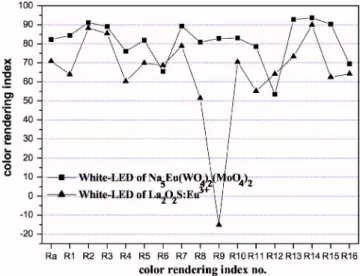
La2O2S:Eu3+ show similar luminous efficacy value. Figure 16
shows the color-rendering index variation for WL-LEDs based on n-UV chip, Na5Eu共WO4兲2共MoO4兲2, and La2O2S:Eu3+operated at a
If of 20 mA, respectively. The CRI value of the WL-LED of
Na5Eu共WO4兲2共MoO4兲2 共Ra ⬃ 82.3兲 was found to be larger than
that of the other WL-LED fabricated with commodity of La2O2S:Eu3+共Ra ⬃ 70.8兲 because most of the CRI values for
WL-LED based on Na5Eu共WO4兲2共MoO4兲2 is larger than those of
WL-LED based on La2O2S:Eu3+, as indicated by Fig. 16. In particular,
the CRI no. 9 value of Na5Eu共WO4兲2共MoO4兲2 was found to be 82.89, which is apparently much higher and more improved than that using La2O2S:Eu3+共−15.20兲 as a red-emitting phosphor. This
CRI no. 9 shows color reproduction quality in the red region. There-fore, Na5Eu共WO4兲2共MoO4兲2was demonstrated to be more suitable
for general illumination than La2O2S:Eu3+. Here, the Ra value of
82.3 observed for our WL-LED is slightly lower than that of the
commodity blue/YAG:Ce3+WL-LED共CRI ⬃85兲, presumably
be-cause of inherently weak absorption of Eu3+ f-f transition and the
deficient selection of blue or green phosphor. Further improvement is needed to promote the efficiency of our n-UV+blue/green/red WL-LED. In addition, Na5Eu共WO4兲2共MoO4兲2also emit light in the
red spectral region under 465 nm blue light excitation共see Fig. 6兲. For this reason, the red-emitting phosphor can also be combined with the blue chip and YAG phosphor to form one WL-LED with high Ra value.
Conclusions
We have prepared a series of red-emitting
M5Eu共WO4兲4−x共MoO4兲x共M = Li, Na, K兲 phosphors by high-temperature solid-state reactions. The CIE color coordinates and comparative luminance for the Na5Eu共WO4兲4−x共MoO4兲x phosphors
have been measured and compared with commodity phosphors of Y2O2S:Eu3+and La2O2S:Eu3+. We have investigated its
lumines-cence properties by integrating an n-UV LED chip, the
Na5Eu共WO4兲2共MoO4兲2phosphor and the matching green- and blue-emitting phosphors. The Ra value of the WL-LED based on Na5Eu共WO4兲2共MoO4兲2 was found to be 82.3, higher than that
共Ra ⬃ 70.8兲 of the other WL-LED fabricated using the commodity of La2O2S:Eu3+. Particularly, the CRI no. 9 value, showing color
reproduction in the red region, has been improved from −15.20 to
82.89. In addition, it has also been found that
Na5Eu共WO4兲2共MoO4兲2 exhibits PL under excitation with a blue-LED chip. Consequently, our research has demonstrated that Na5Eu共WO4兲4−x共MoO4兲xexhibits a great potential as a red-emitting phosphor in fabrication of WL-LEDs.
Acknowledgments
This research was supported by funding from National Science Council of Taiwan, under contract no. NSC 95-2113-M-024-MY3.
National Chiao Tung University assisted in meeting the publication costs of this article.
References
1. K. S. Sohn, B. I. Kim, and N. Shin, J. Electrochem. Soc., 151, H243共2004兲. 2. K. Toda, Y. Kawakami, and S. I. Kousaka, IEICE Trans. Electron., E89–C10,
1406共2006兲.
3. Y. Q. Li, C. A. Delsing, G. de With, and H. T. Hintzen, Chem. Mater., 17, 3242 共2005兲.
4. Y. Huh, J. Shim, Y. Kim, and Y. Do, J. Electrochem. Soc., 150, H57共2003兲. 5. Y. Huh, J. Park, S. Kweon, J. Kim, J. Kim, and Y. R. Do, Bull. Korean Chem. Soc.,
25, 1585共2004兲.
6. V. Sivakumar and U. V. Varadaraju, J. Electrochem. Soc., 152, H168共2005兲. 7. B. F. Dzhurinskii, L. N. Zorina, G. V. Lysanova, M. G. Komova, N. P. Soshchin, I.
V. Tananaev, and E. M. Reznik, Inorg. Mater., 16, 86共1980兲. 8. R. R. Soden, U.S. Pat. 3,183,193共1965兲.
9. H. J. Borchardt, U.S. Pat. 32,07,573共1965兲. 10. W. H. Dungan, U.S. Pat. 318,095共1965兲. 11. H. J. Borchardt, U.S. Pat. 3,328,311共1967兲.
Table I. Comparison of CIE chromaticity coordinates of
phos-phors investigated in the work (ex= 394 nm for
Na5Eu„WO4…4−x„MoO4…x and La2O2S:Eu3+; ex= 342 nm for
Y2O2S:Eu3+).
Phosphor compositions
CIE color coordinates
共x,y兲 luminanceRelative共a.u.兲
Na5Eu共WO4兲4 共0.66,0.33兲 1.8 Na5Eu共WO4兲3共MoO4兲1 共0.66,0.33兲 1.8 Na5Eu共WO4兲2共MoO4兲2 共0.66,0.33兲 2.5 Na5Eu共WO4兲1共MoO4兲3 共0.66,0.33兲 2.2 Na5Eu共MoO4兲4 共0.66,0.33兲 1.3 Li5Eu共MoO4兲4 共0.67,0.32兲 1.2 K5Eu共MoO4兲4 共0.66,0.33兲 1.1 Y2O2S:Eu3+ 共0.66,0.33兲 1.0 La2O2S:Eu3+ 共0.67,0.32兲 1.3
Figure 15. EL spectra of n-UV chip-based WL-LED with
Na5Eu共WO4兲2共MoO4兲2and La2O2S:Eu3+phosphors and a forward-bias cur-rent of 20 mA, respectively.
Figure 16.共Color online兲 CRI variation of WL-LEDs based on n-UV chip,
Na5Eu共WO4兲2共MoO4兲2and the commodity of La2O2S:Eu3+at a Ifof 20 mA, respectively.