Synthesis and Characterization of New Polyquinolines
Containing 9,9
′
-Spirobifluorene Units
Chi-Long Chiang and Ching-Fong Shu*
Department of Applied Chemistry, National Chiao Tung University, Hsin-Chu, Taiwan, 30035 Republic of China
Received July 5, 2001. Revised Manuscript Received October 24, 2001
Polyquinolines, which contain 9,9′-spirobifluorene units in the main chain, were synthesized via the acid-catalyzed Friedla¨nder condensation reactions of bis(o-aminoketone) with bisacetyl monomers. In the spiro-fused bifluorene moiety, the two mutually perpendicular fluorene rings were connected via a common tetracoordinated carbon atom. This structural feature leads to polymers that possess high thermal stability and good solubility in common organic solvents. The polyquinolines have similar lowest energy transitions that can be attributed to a π-π* transition with λmaxvalues in the 363-385 nm range and exhibit blue emission. A model compound was synthesized to demonstrate that the tetrahedral bonding carbon at the center of the spiro moiety could serve as a conjugation interrupt to effectively control the conjugation length of the polymers. The electrochemical behaviors of these polymers were investigated by cyclic voltammetry. The reversible reduction and low-lying LUMO energy level suggest that some of the polyquinolines might have potential for use as materials for electron injection and transport in polymer LEDs.
Introduction
Polyquinolines, which were developed by Stille et al. in the 1970s,1 are synthesized by the acid-catalyzed Friedla¨nder condensation reaction between monomers containing bis(o-aminoketone) and bis(ketomethylene) functional moieties.2 The high thermal and oxidative stability, good mechanical and electrical properties, and eminent processability of such polymers make them useful as high-performance polymer materials.1,3Based on their optical and electronic properties,4 these poly-mers have recently been investigated as potentially useful materials in optoelectronic applications such as electroluminescent5-8and nonlinear optical devices.9,10 Although rigid-rod polyquinolines generally exhibit high strength and possess excellent thermal properties,
they have limited solubility in organic solvents, thus making fabrication difficult.11,12 Attempts have been made to enhance the solubility of polyquinolines by incorporating flexible ether linkages or cardo units into the polymer backbone.13In this paper, we report on the synthesis of polyquinolines containing 9,9′ -spirobifluo-rene in the polymer main chain via the acid-catalyzed Friedla¨nder quinoline synthesis. In the spiro-segment, the bifluorene rings are orthogonally arranged and connected via a common tetracoordinated carbon.14,15 This structural feature would be expected to reduce the probability of interchain interactions and prevent the close packing of the polymer chains, resulting in good solubility of polymers. In addition, the spiro-annulated segment would be expected to enhance the rigidity of the polymer backbone, leading to a significant increase in both Tgvalues and thermal stability. Moreover, the tetrahedral bonding carbon at the center connects conjugated moieties via a σ-bonded network, which serves as a spacer and a conjugation interrupt, thus effectively controlling the conjugation length of the polymers. Polyquinolines and copolymers have been * To whom correspondence should be addressed.
(1) Stille, J. K. Macromolecules 1981, 14, 870.
(2) (a) Imai, Y.; Johnson, E. P.; Katto, T.; Kurihara, M.; Stille, J. K. J. Polym. Sci., Polym. Chem. Ed. 1975, 13, 2233. (b) Wolfe, J. F.; Stille, J. K. Macromolecules 1976, 9, 489. (c) Norris, S. O.; Stille, J. K. Macromolecules 1976, 9, 496.
(3) (a) Wrasidlo, W.; Stille, J. K. Macromolecules 1976, 9, 505. (b) Wrasidlo, W.; Norris, S. O.; Wolfe, J. F.; Katto, T.; Stille, J. K. Macromolecules 1976, 9, 512
(4) (a) Agrawal, A. K.; Jenekhe, S. A. Chem. Mater. 1996, 8, 579. (b) Zhang, X.; Shetty, A. S.; Jenekhe, S. A. Macromolecules 1999, 32, 7422.
(5) Parker, I. D.; Pei, Q.; Marrocco, M. Appl. Phys. Lett. 1994, 65, 1272.
(6) (a) Jenekhe, S. A.; Zhang, X.; Chen, X. L. Chem. Mater. 1997, 9, 409. (b) Zhang, X.; Shetty, A. S.; Jenekhe, S. A. Acta Polym. 1998, 49, 52. (c) Zhang, X.; Jenekhe, S. A. Macromolecules 2000, 33, 2069. (7) (a) Liu, Y.; Ma, H.; Jen, A. K.-Y. Chem. Mater. 1999, 11, 27. (b) Liu, M. S.; Liu, Y.; Urian, R. C.; Ma, H.; Jen, A. K.-Y. J. Mater. Chem. 1999, 9, 2201.
(8) (a) Kim, J. L.; Cho, H. N.; Kim, J. K.; Hong, S. I. Macromolecules 1999, 32, 2065. (b) Kim, J. L.; Kim, J. K.; Cho, H. N.; Kim, D. Y.; Kim, C. Y.; Hong, S. I. Macromolecules 2000, 33, 5880.
(9) (a) Agrawal, A. K.; Jenekhe, S. A.; Vanherzeele, H.; Meth, J. S. Chem. Mater. 1991, 3, 765. (b) Agrawal, A. K.; Jenekhe, S. A.; Vanherzeele, H.; Meth, J. S. J. Phys. Chem. 1992, 96, 2837. (c) Agrawal, A. K.; Jenekhe, S. A. Macromolecules 1993, 26, 895
(10) (a) Chen, T.-A.; Jen, A. K.-Y.; Cai, Y. M. Chem. Mater. 1996, 8, 607. (b) Jen, A. K.-Y.; Wu, X.-M.; Ma, H. Chem. Mater. 1998, 10, 471. (c) Ma, H.; Jen, A. K.-Y.; Wu, J.; Wu, X.; Liu, S.; Shu, C.-F.; Dalton, L. R.; Marder, S. R.; Thayumanavan, S. Chem. Mater. 1999, 11, 2218. (11) Sutherlin, D. M.; Stille, J. K. Macromolecules 1985, 18, 2669. (12) Agrawal, A. K.; Jenekhe, S. A. Chem. Mater. 1992, 4, 95. (13) (a) Stille, J. K.; Harris, R. M.; Padaki, S. M. Macromolecules 1981, 14, 486. (b) Concilio, S.; Pfister, P. M.; Tirelli, N.; Kocher, C.; Suter, U. W. Macromolecules 2001, 34, 3607.
(14) Wu, R.; Schumm, J. S.; Pearson, D. L.; Tour, J. M. J. Org. Chem. 1996, 61, 6906.
(15) (a) Salbeck, J.; Yu, N.; Bauer, J.; Weisso¨rtel, F.; Bestgen, H. Synth. Met. 1997, 91, 209. (b) Johansson, N.; Salbeck, J.; Bauer, J.; Weisso¨rtel, F.; Bro¨ms, P.; Andersson, A.; Salaneck, W. R. Adv. Mater. 1998, 10, 1136. (c) Steuber, F.; Staudigel, J. Sto¨ssel, M.; Simmerer, J.; Winnacker, A.; Spreitzer, H.; Weisso¨rtel, F.; Salbeck, J. Adv. Mater. 2000, 12, 130.
10.1021/cm010665f CCC: $22.00 © 2002 American Chemical Society Published on Web 01/11/2002
proposed as electron transport materials (or emitters) for LED devices5-8 because of the electron-deficient nature of the quinoline ring.16In light of these observa-tions, we also studied the optical, luminescent, and electrochemical properties of these new polyquinolines.
Experimental Section
Materials. Compounds 1,172,185,196,20, 7,2cand 921were
prepared as described in the literature. Compound 8 was prepared from 9,9-dipropyl-2-nitrofluorene21according to
re-ported procedures.2cTetrahydrofuran (THF) was distilled from
sodium benzophenone ketyl, and m-cresol was purified by distillation under reduced pressure. Tetrabutylammonium hexafluorophosphate was purified by recrystallization from ethyl acetate and dried in vacuo at 60 °C. All other chemicals were used as received unless otherwise stated.
9,9-Spirobifluoreno-bis-3-phenyl[2,3-c]isoxazole (3). To an ice-cooled mixture of sodium hydroxide (4.93 g, 122 mmol), methanol (20 mL), and tetrahydrofuran (30 mL), benzyl nitrile (2.85 mL, 24.6 mmol) was added dropwise. After stirring for 5 min, 2,2′-dinitro-9,9′-spirobifluorene (2) (5.00 g, 12.3 mmol) was slowly added and the mixture was then heated at 80 °C for 20 h. The reaction mixture was then cooled in an ice-bath, and the resulting precipitate was isolated by filtration and washed with cold methanol until the methanol washings were clear. The crude product was purified by column chromatog-raphy (CH2Cl2) to give 3 (5.00 g, 73.8%).1H NMR (CDCl3): δ 6.85 (d, 2 H, J ) 7.6 Hz), 7.01 (d, 2 H, J ) 1.1 Hz), 7.22 (dd, 2 H, J ) 7.5, 7.5 Hz), 7.43 (dd, 2 H, J ) 7.5, 7.5 Hz), 7.51 (t, 2 H, J ) 7.1 Hz), 7.60 (dd, 4 H, J ) 7.0, 7.0 Hz), 7.98 (d, 2 H, J ) 7.7 Hz), 8.08 (d, 4 H, J ) 7.1 Hz), 8.21 (d, 2 H, J ) 1.1 Hz). 13C NMR (CDCl 3): δ 63.8, 109.9, 110.8, 115.1, 120.7, 124.8, 126.6, 128.5, 128.6, 129.3, 129.6, 130.2, 139.1, 139.5, 149.5, 154.7, 158.5, 164.2. HRMS [M+]: 550.1665. Calcd for C39H22N2O2: 550.1681.
2,2′-Diammo-3,3′-dibenzoyl-9,9′-spirobifluorene (4). Iron powder (0.38 g, 6.7 mmol) and water (0.5 mL) was added to a stirred suspension of compound 3 (0.50 g, 0.90 mmol) in acetic acid (15 mL) at 95 °C. The reaction mixture was heated at 95 °C for 1 h, cooled, and filtered to remove the iron powder. The filtrate was poured into water (100 mL). The resulting precipitate was collected by filtration and purified by column chromatography (EtOAc/hexane/CHCl31:5:45) to give 4 (0.48
g, 95.7%).1H NMR (CDCl 3): δ 6.08 (s, 2 H), 6.15 (s, 2 H), 6.73 (d, 2 H, J ) 7.5 Hz), 7.03 (dd, 2 H, J ) 7.5, 7.5 Hz), 7.27 (dd, 2 H, J ) 7.5, 7.5 Hz), 7.47-7.61 (m, 4 H), 7.73 (d, 4 H, J ) 6.6 Hz), 7.87 (s, 2 H).13C NMR (CDCl 3): δ 65.4, 112.3, 117.6, 118.9, 124.1, 125.5, 126.8, 128.0, 128.2, 129.2, 129.8, 131.2, 140.2, 147.1, 147.5, 151.5, 156.1, 198.7. HRMS [M+]: 554.1999. Calcd for C39H26N2O2: 554.1994.
Preparation of Polyquinoline (PQ1). A mixture of 4 (1.000 g, 1.804 mmol), 6 (0.458 g, 1.804 mmol), diphenyl phosphate (DPP) (11.3 g, 45.2 mmol), and freshly distilled
m-cresol (3.0 mL) was flushed with nitrogen with stirring for
about 20 min and heated in an oil bath from room temperature to 140 °C over about a 30 min period. It was maintained at this temperature for 72 h under a nitrogen atmosphere. After cooling, the resulting viscous solution was diluted with chloro-form (10 mL) and added dropwise into an agitated solution of 330 mL of methanol containing 10% v/v of triethylamine. The collected polymer was purified by precipitating from chloroform (15 mL) into a solution of 330 mL of methanol containing 10% v/v of triethylamine three times. The polymer was then continuously extracted in a Soxhlet extractor for 24 h with a
methanol solution containing 10% v/v of triethylamine and then dried at 100 °C under vacuum to give PQ1 (1.25 g, 94.0%).1H NMR (CDCl 3): δ 6.83 (d, 2 H, J ) 7.4 Hz), 7.00 (d, 4 H, J ) 8.2 Hz), 7.11 (dd, 2 H, J ) 7.5, 7.5 Hz), 7.34 (dd, 2 H, J ) 7.5, 7.5 Hz), 7.49-7.68 (m, 14 H), 7.85 (d, 2 H, J ) 7.5 Hz), 7.99(d, 4 H,.J ) 8.1 Hz), 8.27 (s, 2 H).13C NMR (CDCl 3): δ 65.0, 115.7, 118.7, 119.0, 121.0, 124.7, 125.0, 125.9, 128.2, 128.5, 128.7, 128.8, 128.9, 129.6, 134.8, 138.7,140.3, 140.7, 149.0, 149.2, 149.5, 152.0, 155.2, 157.9.
Preparation of Polyquinoline (PQ2). PQ2 was synthe-sized using a procedure similar to that described for polymer PQ1 (yield: 92.4%).1H NMR (CDCl 3): δ 6.74 (d, 2 H, J ) 7.5 Hz), 7.09 (dd, 2 H, J ) 7.5 Hz), 7.24-7.42 (m, 16 H), 7.49 (s, 2 H), 7.54 (s, 2 H), 7.88 (d, 2 H, J ) 7.5 Hz), 8.00 (d, 2 H, J ) 8.0 Hz), 8.07 (d, 2 H, J ) 7.8 Hz), 8.30 (d, 2 H, J ) 7.8 Hz). 13C NMR (CDCl 3): δ 66.3, 112.3, 119.8, 120.6, 120.7, 122.8, 123.2, 124.2, 126.5, 127.90, 127.98, 128.50, 128.51, 128.6, 129.3,131.9, 137.8, 139.1, 141.2, 143.4, 145.5, 148.4, 149.0, 149.5, 154.5, 155.5.
Preparation of Polyquinoline (PQ3). PQ3 was synthe-sized using a procedure similar to that described for polymer PQ1 (yield: 90.0%).1H NMR (CDCl 3): δ 6.50-6.80 (br, 4 H), 6.85-6.71 (br, 4 H), 7.15-7.33 (br, 4 H), 7.34-7.60 (br, 14 H), 7.63-7.90 (br, 8H), 8.00-8.23 (br, 4 H).13C NMR (CDCl 3): δ 65.0, 66.1, 115.6, 119.1, 120.1, 120.3, 120.8, 122.9, 123.1, 124.0, 124.2, 124.6, 125.1, 126.0, 127.7, 128.1, 128.3, 128.6, 128.8, 129.6, 138.6, 139.1, 140.3, 140.6, 141.0, 143.1, 148.7, 148.8, 148.9, 149.4, 149.7, 151.6, 155.7.
Synthesis of Model Compound 10. A mixture of 8 (0.150 g, 0.406 mmol), 9 (0.119 g, 0.406 mmol), DPP (2.10 g, 8.16 mmol), and freshly distilled m-cresol (0.3 mL) was flushed with nitrogen with stirring for about 20 min and heated at 140 °C for 12 h under nitrogen. After cooling, the reaction mixture was added dropwise into an agitated solution containing methanol (30 mL), triethylamine (3 mL), and water (15 mL). The precipitate was collected by filtration and purified by column chromatography (EtOAc/hexane 1:10) to give 10 (0.23 g, 90.5%).1H NMR (CDC1 3): δ 0.67 (br, 20 H), 1.99-2.20 (m, 8 H), 7.28-7.40 (m, 6 H), 7.56-7.72 (m, 6 H), 7.74-7.78 (m, 1 H), 7.83 (d, 1 H, J ) 7.9 Hz), 7.84 (s, 1 H), 8.10 (s, 1 H), 8.16 (d, 1 H, J ) 1.1 Hz), 8.18 (d, 1 H, J ) 0.4 Hz), 8.23 (dd, 1 H, J ) 1.6, 7.9 Hz).13C NMR (CDCl 3): δ 14.40, 14.45, 17.2, 17.3, 42.8, 43.6, 55.2, 55.5, 114.9, 119.1, 120.00, 120.02, 120.5, 121.7, 122.9, 123.1, 123.5, 125.5, 126.6, 126.8, 127.0, 127.3, 128.2, 128.4, 128.6, 129.7, 138.7, 139.0, 140.0, 140.5, 140.6, 142.3, 149.06, 149.10,151.2, 151.33, 151.34, 153.1, 156.4. HRMS [M+]: 625.3693. Calcd for C47H47N: 625.3708.
Characterization.1H and13C NMR spectra were recorded
on a Varian Unity 300 MHz or a Bruker-DRX 300 MHz spectrometer using CDCl3 as solvent. Mass spectra were
obtained on a JEOL JMS-SX/SX 102A mass spectrometer. Size exclusion chromatography (SEC) was carried out on a Waters chromatography unit interfaced to a Waters 410 differential refractometer. Three 5-µm Waters styragel columns (300× 7.8 mm) connected in series in the decreasing order of pore size (104, 103, and 102Å) were used with THF as eluent, and
stand-ard polystyrene samples were used for calibration. Wide-angle X-ray diffraction patterns were obtained at room temperature on a Material Analysis and Characterization M18XHF using Ni filtered Cu KR1 radiation (50 kV, 200 mA) with a sampling step of 0.02° and a scan rate of 4° min-1. Differential scanning calorimetry (DSC) was performed on a SEIKO SSC 5200 DSC unit using a heating/cooling rate of 20 °C min-1. Samples
were scanned from 30 to 400 °C and then cooled to 30 °C and scanned for second time from 30 to 400 °C. Glass transition temperatures (Tg) were determined from the second
heating scan. Thermogravimetric analysis (TGA) was made on a Du Pont TGA2950 instrument. The thermal stability of the samples was determined in nitrogen, by measuring weight loss while heating at a rate of 10 °C min-1. UV-vis spectra were measured with a HP 8453 diode array spectro-photometer. Photoluminescence spectra were obtained on an Acton Research Spectra Pro-150 luminescence spectrometer. Cyclic voltammetry measurements of the polymer films were performed on a BAS 100 B/W electrochemical analyzer in
(16) Gilchrist, T. L. Heterocyclic Chemistry; John Wiley & Sons Inc.: New York, 1985.
(17) Clarkson, R. G.; Gomberg, M. J. Am. Chem. Soc. 1930, 52, 2881. (18) Weisburger, J. H.; Weisburger, E. K.; Ray, F. E. J. Am. Chem. Soc. 1950, 72, 4253.
(19) Haas, G.; Prolog, V. Helv. Chim. Acta 1969, 52, 1202. (20) Royles, B. J. L.; Smith, D. M. J. Chem. Soc., Perkin Trans. 1 1994, 355.
(21) Kelley, C. J.; Chiorghis, A.; Kauffman, J. M. J. Chem. Res. Miniprint 1997, 2701.
acetonitrile with 0.1 M tetrabutylammonium hexafluorophos-phate (TBAPF6) as the supporting electrolyte at a scan rate
of 100 mV/s. The potentials were measured against an Ag/AgCl reference electrode with ferrocene as the internal standard. The onset potentials were determined from the intersection of two tangents drawn at the rising current and background current of the cyclic voltammogram.
Results and Discussion
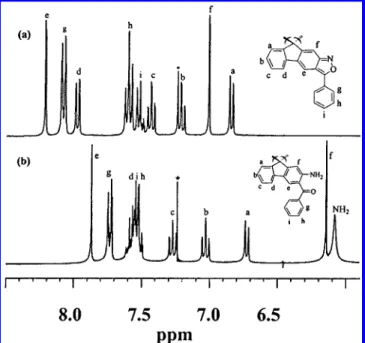
Synthesis of Monomer. To introduce 9,9′ -spiro-bifluorene units into the polyquinoline backbone, bis-(o-aminoketone) and bisacetyl monomers containing 9,9′-spirobifluorene moiety were synthesized. The pre-cursor, 9,9′-spirobifluorene (1), was prepared by follow-ing the Clarkson and Gomberg method,17which involves coupling of a Grignard reagent prepared from 2-iodo-biphenyl with 9-fluorenone, followed by dehydrative ring closure of the resulting carbinol in acetic acid. The conversion of compound 1 to the bis(o-aminoketone) monomer 4 and the bisacetyl monomer 5 is shown in Scheme 1. The nitration of 1 with nitric acid in an acetic acid medium gave the dinitro derivative 2.18The reac-tion of compound 2 with benzyl nitrile in the presence of base yielded the bisbenzisoxazole 3, which was then transformed into the bis(o-aminoketone) monomer 4 by hydrogenation with an iron powder/acetic acid mixture. The structures of compounds 3 and 4 were verified by 1H and 13C NMR spectroscopy as well as mass spectroscopy. Figure 1 shows the1H NMR spectra of compounds 3 and 4. Based on the reported1H NMR data of 2,2′-disubstituted-9,9′-spirobifluorene19 and supplementing these data with 2D (H,H)-correlated NMR spectroscopy, the positions of the chemical shift for protons of compounds 3 and 4 could be readily assigned as shown in Figure 1. The bisacetyl monomer 5 was synthesized according to a reported procedure via the Friedel-Crafts acylation of compound 1 with acetyl chloride in CS2.19The other two monomers, which have an ether linkage and contain no spirobifluorene moiety, bisacetyl 620and bis(o-aminoketone) 72cwere prepared using previously described literature methods.
Synthesis of Polyquinolines. PQ1-3 were synthe-sized using a condensation scheme based on the acid-catalyzed Friedla¨nder reaction,10as shown in Scheme
2. An equimolar mixture of the appropriate bisacetyl monomer and the bis(o-aminoketone) monomer was reacted in an acidic medium of diphenyl phosphate and
m-cresol at 140 °C for 72 h under nitrogen. The resulting
viscous polymer solution was diluted with CHCl3 and precipitated into methanol containing 10% triethyl-amine, followed by Soxhlet extraction with the same solution to give the polyquinolines PQ1-3 in high yields. The structures of these polymers were character-ized by1H and13C NMR spectroscopy. The molecular weights of the polyquinolines were determined by SEC analysis in a THF solution calibrated against poly-styrene standards and the results are listed in Table 1. These values, however, should be taken as being only indicative, since the backbone rigidity of the polymers studied may deviate strongly from that of polystyrene.22 Scheme 1a
aReagents: (i) HNO
3/CH3COOH; (ii) NaOH/CH3OH/THF, benzyl
cyanide; (iii) Fe, CH3COOH/H2O; (iv) CH3COCl, AlCl3/CS2.
Figure 1. 1H NMR spectra of compounds (a) 3 and (b) 4 in
CDCl3. * indicates a signal arising from CHCl3.
Scheme 2a
The crystallinity of the polyquinolines was evaluated by wide-angle X-ray diffraction experiments. All the polymers display amorphous diffraction patterns owing to the kinked 9,9′-spirobifluorene structure. In the spiro-segment, the two fluorene rings were orthogonally arranged and connected via a common tetracoordinated carbon. This structural feature minimizes the inter-molecular interaction between the polymer chains and prohibits chain packing, leading to a reduction in crystal-linity. The amorphous character of the polyquinolines was also reflected in their high solubility.
Properties of Polyquinolines. The solubility of these polyquinolines was tested in a variety of organic solvents and the results are summarized in Table 2. All of the polyquinolines exhibited good solubility in a variety of solvents such as chloroform, pyridine, tetra-hydrofuran, and m-cresol. PQ1 is only partially soluble in methylene chloride and N-methyl-2-pyrrolidinone, whereas PQ2 and PQ3 are soluble. In the case of cyclohexanone, PQ1 and PQ3 are soluble, while PQ2 is soluble at elevated temperature. The good solubility nature of polyquinolines PQ1 and PQ2 can be attrib-uted to the presence of the spiro-fused, orthogonal bi-fluorene units, along with flexible ether linkages in the polymer backbone. It is noteworthy that PQ3 is soluble in a wider variety of organic solvents than PQ1 and PQ2. The solubility of PQ3 is significant in that it does not arise from flexible main linkages or flexible side chains; but rather, its solubility appears to result from the incorporation of rigid 9,9′-spirobifluorene groups. This result demonstrates that the introduction of the orthogonal spirobifluorene unit into the polymer main chain is highly effective in enhancing the solubility of the polyquinolines.
The thermal properties of the polyquinolines were investigated by differential scanning calorimetry (DSC) and thermogravimetric analysis (TGA), and the results are tabulated in Table 1. DSC was performed in the temperature range from 30 to 400 °C. Phase transitions were not observed for either PQ1 or PQ3. This is probably due to the chain stiffness of these polymers. However, a distinct glass transition temperature was observed for PQ2 at 342 °C, which is higher than that of a similar polymer, PQ4 (Tg) 310 °C) which contains fluorene cardo units.13a
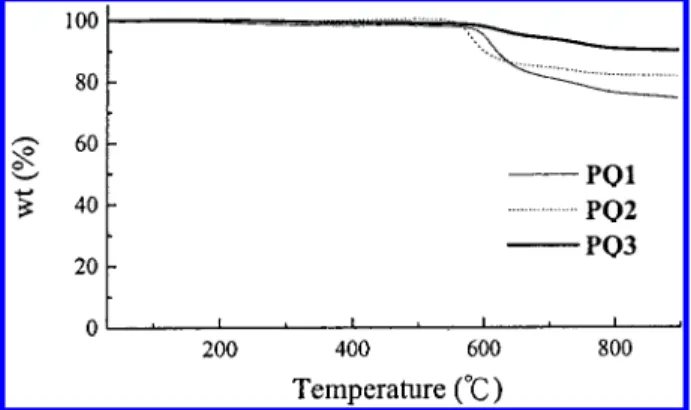
Thus, the incorporation of rigid 9,9′-spirobifluorene units into the polymer backbone increased the chain stiffness and resulted in a higher glass transition temperature (Tg). All the polyquinolines that contain spirobifluorene units have excellent thermal stability, as evidenced by thermogravimetric analysis. Figure 2 shows typical TGA curves for these polyquinolines. Their 5% and 10% weight loss temperatures in nitrogen were in the range of 577-657 and 599-859 °C, respec-tively. PQ3, which contains two spirobifluorene units in each polymer repeating unit, exhibits the highest thermal stability of the three polyquinolines synthe-sized. These results reflect the high thermal stability of the spirobifluorene unit in the polymer backbone.
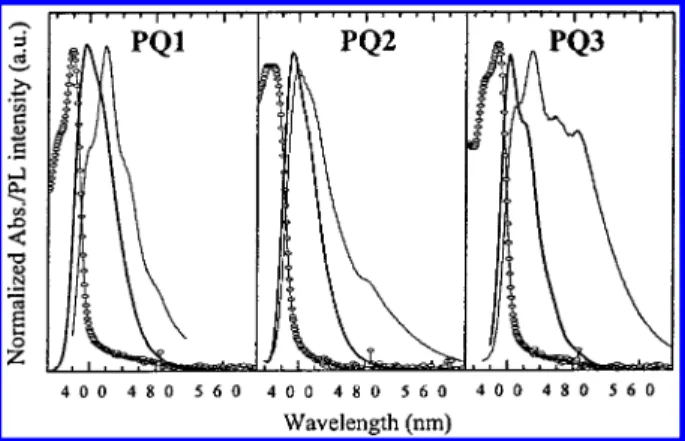
Figure 3 presents the absorption and emission spectra of PQ1-3 and the spectral properties are summarized in Table 3. The polyquinolines have similar lowest energy transitions attributed to a π-π* transition with a λmax at 363-385 nm. The absorption spectra of solutions and corresponding films are nearly identical, while the emission from films is red-shifted compared to diluted solutions, which is due to the π-π interaction (22) Kreyenschmidt, M.; Uckert, F.; Mu¨llen, K. Macromolecules
1995, 28, 4577.
Table 1. Molecular Weight and Thermal Properties of Polyquinolines PQ1-3 DSC (°C) TGAc(°C) polymer Mna× 104 Mwa× 104 Tgb 5% 10% PQ1 1.5 2.0 d 600 (534)e 618 (558)e PQ2 2.1 3.8 342 577 (529)e 599 (560)e PQ3 1.8 2.8 d 657 (546)e 859 (562)e aMolecular weight was determined by GPC in THF based on polystyrene standards.bT
gwas determined by DSC at a heating
rate of 20 °C min-1under nitrogen.cTemperature at which 5% and 10% weight loss was determined at a heating rate of 10 °C min-1under nitrogen.dPhase transitions were not observed in the temperature range of 30 to 400 °C.eWeight loss was deter-mined at a heating rate of 10 °C min-1in air.
Table 2. Solubility of Polyquinolinesa solventb
polymer CH2Cl2CHCl3 Py THF m-cresol DMF NMP Cyho DMSO
PQ1 - + + + + + + + + + - + + - + + -PQ2 + + + + + + + + + + - + + + + - -PQ3 + + + + + + + + + + - + + + + + -aSolubility: (+ +) soluble at room temperature; (+ -) soluble on heating; (- +) partially soluble on heating; (- -) insoluble.
bCH
2Cl2, methylene chloride; CHCl3, chloroform; Py, pyridine;
THF, tetrahydrofuran; DMF, N,N-dimethylformamide; NMP, N-methyl-2-pyrrolidinone; Cyho, cyclohexanone; DMSD, dimethyl sulfoxide.
Figure 2. TGA curves for polyquinolines PQ1-3 with a heating rate of 10 °C min-1in N2.
Table 3. Optical Properties of Polyquinolines PQ1-3
photoluminescence, λmax(nm)
polymer
absorptiona
λmax(nm) solutionb filmc
PQ1 378 398 420
PQ2 363 395 401
PQ3 385 403 432 (485)
aIn CHCl
3.bIn CHCl3, excited at 350 nm.cSpin-coating from
their CHCl3solution, excited at 350 nm.
of the chromophores in the solid state.23The absorption maximum of PQ2 appears at 363 nm, which is blue-shifted by 15 nm compared to PQ1, probably resulting from the decrease in chain rigidity and a reduction in electron delocalization. PQ3 showed an absorption maximum at 385 nm, which is red-shift by 7 nm, compared to PQ1 because of the increase in conjugation length. The PL spectrum of a dilute solution of PQ3 has an emission maximum at 403 nm, while that for the thin film shows an emission maximum at 432 nm with a broad shoulder around 485 nm, which probably results from the interchain excimer emission.24 These data reveal that chain stacking in the film of PQ3 was not sufficiently suppressed by the spiro groups because of the rigid main-chain structure. For PQ1 and PQ2, the problem of excimer emission in the thin film state is less serious, since the flexible ether linkage may aid in suppressing the chain stacking in the solid state.
To demonstrate that the tetrahedral bonding carbon at the center of the spiro moiety could serve as a conjugation interrupt to control the conjugation length of the polymers, a model compound 10 was synthesized (Scheme 3) as the repetitive conjugated unit of polymer PQ3. As shown in Figure 4, the solution UV-vis absorption and PL spectra of compound 10 in CHCl3and those obtained from PQ3 are almost superimposable.
This result implies that the effective conjugation length of PQ3 is the same as that of compound 10 and that the tetrahedral bonding carbon at the center of the spiro moiety is efficient for interrupting the conjugation length of the polymer.
The electrochemical behaviors of the polyquinolines were investigated by cyclic voltammetry and the data are tabulated in Table 4. Upon cathodic sweep, PQ1 and PQ3 exhibited a reversible reduction with a formal reduction potential (E°′) at -2.22 and -2.12 V vs Fc/ Fc+(FOC) couple, respectively, while the reduction of PQ2 is irreversible and occurred in a more negative region with a peak potential at -2.36 V vs FOC couple. The shift of the reduction potential of PQ2 toward a more negative value could be the result of the push-pull structure25of the quinoline ring presented in the polymer backbone. The oxidation processes of all three polymers were irreversible. Based on the onset poten-tials for the oxidation and reduction, the HOMO and LUMO energy levels of the polyquinolines were esti-mated regarding the energy level of the FOC reference (4.8 eV below the vacuum level).26The LUMO energy levels of the polymers are similar to those reported for other polyquinolines.4a,6bIt is likely that the low-lying LUMO level of polyquinolines may originate from the electron-deficient nature of the quinoline ring. The band gaps of the polymers were estimated from electrochemi-cal measurements, which are in good agreement with the results determined from the threshold of the optical absorption. From the reversible reduction and high electron affinity, it would appear that PQ1 and PQ3 have potential for use in electron-transporting materials in polymer LEDs.27,28
(23) Yamamoto, T.; Sugiyama, K.; Kushida, T.; Inoue, T.; Kanbara, T. J. Am. Chem. Soc. 1996, 118, 3930.
(24) Pei, Q.; Yang, Y. J. Am. Chem. Soc. 1996, 118, 7416.
(25) Wang, Y.-K.; Shu, C.-F.; Breitung, E. M.; McMahon, R. J. J. Mater. Chem. 1999, 9, 1449.
(26) Pommerehne, J.; Vestweber, H.; Guss, W.; Mahrt, R. F.; Ba¨ssler, H.; Porsch, M.; Daub, J. Adv. Mater. 1995, 7, 551.
(27) Kraft, A.; Grimsdale, A. C.; Holmes, A. B. Angew. Chem., Int. Ed. 1998, 37, 402.
Table 4. Electrochemical Properties of Polyquinolines PQ1-3
polymer Eonsetox(V)a Eonsetred(V)a HOMOb(eV) LUMOc(eV) Egel(eV)d Egopt(eV)e
PQ1 1.10 -2.08 -5.90 -2.72 3.18 3.13
PQ2 0.98 -2.24 -5.78 -2.56 3.22 3.16
PQ3 1.05 -2.01 -5.85 -2.79 3.06 3.04
aPotential values are versus Fc/Fc+.bDetermined from the onset oxidation potential.cDetermined from the onset reduction potential. dElectrochemical band gap estimated using E
gel) Eonsetox- Eonsetred.eOptical band gap, calculated from the absorption edge of the
UV-vis spectrum.
Figure 3. UV-vis absorption spectra of a film (circle), PL spectra of solution in CHCl3excited at 350 nm (bold line), and
PL spectra of a film excited at 350 nm (solid line) for polyquinolines PQ1-3.
Scheme 3a
aReagents: (i) DPP/m-cresol.
Figure 4. UV-vis absorption and PL spectra in CHCl3of
model compound 10 (solid lines) and polyquinolines PQ3 (dashed lines).
Summary
A series of polyquinolines containing 9,9′ -spirobifluo-rene moieties in the main chain have been synthesized via the acid-catalyzed Friedla¨nder quinoline synthesis and their properties investigated. In the case of the spiro-segment, the two fluorene rings were orthogonally arranged and are connected via a common tetracoordi-nated carbon. The incorporation of the 9,9′ -spirobifluo-rene unit provides good solubility due to a decrease in the degree of molecular packing and crystallinity, while imparting a significant increase in both Tgand thermal stability by restricting segmental mobility. The optical,
and electrochemical properties of these polyquinolines were also examined. As revealed from the PL spectra, the spiro segment is insufficient to completely suppress chain stacking in the solid state. The low-lying HOMO energy level and reversible electrochemical reduction of PQ1 and PQ3 suggest that they have potential for use as materials for electron injection and transport in polymer LEDS.
Acknowledgment. We wish to thank the National Science Council of the Republic of China for financial support.
CM010665F
(28) Mitschke, U.; Bau¨ erle, P. J. Mater. Chem. 2000, 10, 1471.