This content has been downloaded from IOPscience. Please scroll down to see the full text.
Download details:
IP Address: 140.113.38.11
This content was downloaded on 25/04/2014 at 06:36
Please note that terms and conditions apply.
Optical response of quantum dot multilayer structures
View the table of contents for this issue, or go to the journal homepage for more 2010 J. Phys.: Conf. Ser. 245 012070
(http://iopscience.iop.org/1742-6596/245/1/012070)
Optical response of quantum dot multilayer structures
L. M. Thu and O. VoskoboynikovDepartment of Electronics Engineering, National Chiao Tung University, 1001 Ta Hsueh Rd., Hsinchu 300, Taiwan, R.O.C.
Email: [email protected]
Abstract. We theoretically study optical response of InAs/GaAs quantum dot multilayered
structures. Based on the multi-scale hybrid discrete-continuum description the optical response of an isolated layer of embedded quantum dots has been determined. Using the propagation-matrix approach we express the amplitudes of incident, reflected and transmitted electromagnetic waves in a multilayered structure by the reflection and transmission coefficients of the isolated layers. We study the overall reflectance and transmittance dependencies on the number of layers and distance between consecutive layers. The increase of the number of the layers considerably enhances the overall reflectance of the structures. Interference effects become significant for certain distances between layers in the structures.
1. Introduction
In the past years progress in modern technology makes it possible to fabricate semiconductor nano objects such as quantum dots within wide ranges of shapes and sizes. Those nano objects become very promising elements in constructing small building blocks for integrated photonics and nano-structured metamaterials [1,2,3]. Generally the metamaterials are designed as artificial multilayered structures. Optics of isolated layers of semiconductor quantum dots, quantum rings and quantum dot molecules was studied in details recently (see [4,5,6] and references therein). Therefore a proper modeling of the optical response from multilayered structures is on demand. In this study we performed simulations of multilayered structures made from InAs lens-shaped quantum dots embedded in infinite GaAs matrix. In our model each layer is characterized by the reflection and transmission coefficients obtained in [5, 6]. Based on the propagation-matrix approach [7] the overall reflection and transmission coefficients of multilayered structures are derived. We study the overall optical coefficients as functions on the optical transition's energy and distance between consecutive layers.
2. Theoretical approach
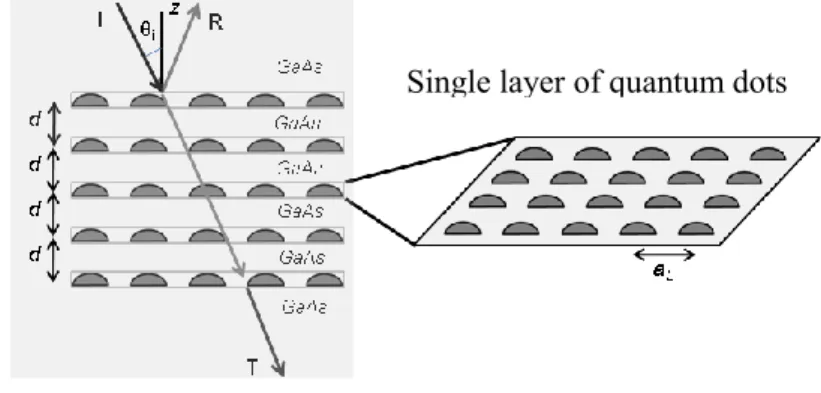
The structure to be investigated consists of consecutive layers of quantum dots composed of InAs/GaAs with interlayer distance d, (as it is shown in figure 1). In our consideration the electromagnetic plane wave is incident to the first layer, propagates through the structure and emerges at the last layer. We assume that the consecutive incident angles of the wave on each layer are identical. Therefore all layers in the multilayered structure are described by the same reflection and transmission coefficients. Using the propagation-matrix approach [7] for the following amplitudes of the incident (Ai, Ai+1) and reflected (Bi, Bi+1) waves at ith and (i +1)th layers we can write
Quantum Dots 2010 IOP Publishing
1 1 i i i i i B A P B A (1)
The propagation matrix Pi is commonly written as [7]
i i i i i i i i i i i i e e r e r e t P 1
where ri and ti present the reflection and transmission coefficients of the ith layer respectively, i = ikzd, kz is the perpendicular to the layer component of the wave vector k = n/c (n is the semiconductor matrix refractive index, is the wave frequency, and c is the light speed in the vacuum).
By iteratively carrying out equation (1) we can obtain the overall propagation matrix P which connects the amplitudes of the incident, reflected and transmitted waves for the structure of finite number of layers N: 0 0 22 21 12 11 0 0 tE P P P P rE E (2)
where E0 is amplitude of incident wave at the first layer, r and t are the total reflection and transmission coefficients, respectively. From (2) we obtain the reflectance and transmittance of the multilayered structure: 2 11 2 2 11 21 2
1
P
t
T
,
P
P
r
R
(3)To simulate the overall optical response (reflectance and transmittance) of multilayered structures the reflection and transmission coefficients of each ith layer are required. We use the Vlieger's expressions from [8] to obtain them:
, sin cos sin cos cos , 1 , ) cos ( 2 2 ) ( ) ( ) ( 1 ) ( i i z i i x i pp i ss i ss i i y ss i f A f f A f r r t f A f r
Figure 1. Scheme of the quantum dot multilayer structure. Single layer of quantum dots
Quantum Dots 2010 IOP Publishing
Journal of Physics: Conference Series 245 (2010) 012070 doi:10.1088/1742-6596/245/1/012070
, sin cos cos cos cos 2 ) ( i i z i z i x i pp i f A A f A f t
(4)where subscripts “ss” and “pp” refer to the light polarization, i is the incidence angle, , 2 ), ( ) ( 1 0 1 , 0 f t f ia k Au
BE uu
m
u
L . , 4 , 6 2 2 0 0 0 3 0 n a ik V N t u L m u
In the last equations: Nu {u = x, y, z} and V denote the depolarization factor and the volume of the quantum dot, respectively. The inter-planar transfer tensor f is defined for two dimensional lattice of the quantum dots as: fx = fy = - fz/2, fz = 9.03362 [4], EB,uu() is the polarizability of an isolated quantum dot defined in [4, 5]. The polarizability includes the static and dynamic parts and the last one depends on the optical transition energies (E = ħ) [4, 5, 6].
3. Simulation results and discussion
For all numerical simulations to determine the polarizability of isolated quantum dots we use the COMSOL MultiPhysics package (www.comsol.com). We accept realistic semiconductor material parameters from [6, 9, 10]. The dimensions of a single InAs/GaAs lens-shaped quantum dot are taken as 2 nm in height and 15 nm in radius. The lattice constant in a layer is aL = 100 nm. The reflection and transmission coefficients of a layer of the dots are calculated by using equation (4). Finally we used computed coefficients to simulate the overall reflectance and transmittance of multilayered structures. The reflectance of the structures including several layers for s-polarized light is shown in figure 2. The peaks in the reflectance relate to the allowed optical transitions in the quantum dots. Clearly, for a single layer the reflectance is weak. However the reflectance still reproduces important information on quantum mechanics of individual quantum dots.
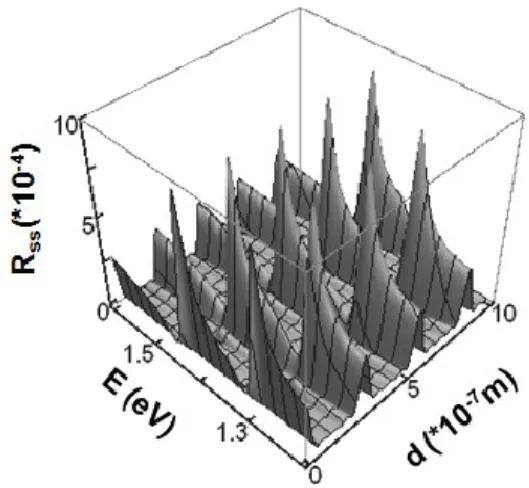
For structures with small kd, the electromagnetic wave phase change formed between consecutive layers can be neglected and no interference effects can be seen in the total reflectance. When the number of the layers in the structure increases the overall reflectance of the structure considerably enhances (see figure 2). For large enough d the interference becomes significant and this leads to the appearance of the periodical peaks in the reflectance. The dependence of the overall reflectance on the transition energy and distance d (incident angle i =600)for the structure consisting of five layers is
Figure 2. Reflectance of the quantum dot multilayered structures as a function on the transition energy and angle of incidence: (a) d = 10nm and (b) d = 50nm.
Quantum Dots 2010 IOP Publishing
presented in figure 3. Clearly at some specific distances the peaks related to the allowed optical transitions in the quantum dots can be intensified or vanished because of the interference.
In short conclusion, using the propagation matrix approach we theoretically study magneto-optical response of the quantum dot multilayered structures. Our simulation results show that when the distance between layers is comprehensively small the overall reflectance of the structures increases with increasing number of layers. The interference effects appear for the appropriate distances between the layers. Our approach to model semiconductor multilayered nano structures is useful for simulations optical properties of semiconductor metamaterials.
Acknowledgements
This work is supported by the National Science Council of the Republic of China under Contracts no. 97-2112-M-009-012-MY3 and NSC 97-2120-M-009-004 and by the Aim for the Top University Plan of the National Chiao Tung University and Ministry of Education of Taiwan, ROC.
References
[1] Shalaev M 2007 Nature Photonics 1 41
[2] Smith D R, Pendry J B, Wiltshire M C K 2004 Science 305 788 [3] Ramakrishna S A 2005 Rep. Prog. Phys. 68 449
[4] Voskoboynikov O, Wijers C M J, Liu J L, and Lee C P 2005 Phy. Rev. B 71 245332 [5] Wijers C M J, Chu J-H, Liu J L, and Voskoboynikov O 2006 Phys. Rev. B 74 035323 [6] Thu L M and Voskoboynikov O 2009 Phys. Rev. B 80 155442
[7] Chuang S L 1995 Physics of Optoelectronics Devices (Wiley, New York) chapter 5. [8] Vlieger J 1973 Physica 64 63
[9] Vurgaftman I, Meyer J R, and Ram-Mohan L R (2001) J. Appl. Phys. 89 5815 [10] Pryor C E and Pistol M E (2005) Phys. Rev. B 72 205311
Figure 3. Reflectance of the quantum dot multilayered structure consisting of five layers as a function on the transition energy and distance between the consecutive layers.
Quantum Dots 2010 IOP Publishing
Journal of Physics: Conference Series 245 (2010) 012070 doi:10.1088/1742-6596/245/1/012070