
增強立方體之容錯泛圈性質研究
30
0
0
全文
(2) 增強立方體之容錯泛圈性質研究 Fault-Tolerant Pancyclicity of Augmented Cubes. 研 究 生:史偉華. Student:Wei-Hua Shih. 指導教授:徐力行. Advisor:Lih-Hsing Hsu. 國 立 交 通 大 學 資 訊 科 學 研 究 所 碩 士 論 文. A Thesis Submitted to Institute of Computer and Information Science College of Electrical Engineering and Computer Science National Chiao Tung University in partial Fulfillment of the Requirements for the Degree of Master in. Computer and Information Science June 2004 Hsinchu, Taiwan, Republic of China. 中華民國九十三年六月.
(3) 增強立方體之容錯泛圈性質研究 研究生:史偉華. 指導教授:徐力行. 博士. 國 立 交 通 大 學 資 訊 科 學 研 究 所. 摘要 增強立方體,AQn 是利用超立方體 Qn 加上額外的連線而得到原本超立方體所沒有的性 質,在本篇中我們將研究增強立方體在維度大於等於 4 時的容錯泛圈性質,假設當 n ≥ 4 時 F ⊆ V(AQn) Υ E(AQn),若|F| ≤ 2n-3,我們可以證明 AQn - F 是泛圈圖. 關鍵字:容錯,泛圈圖,增強立方體.
(4) Fault-Tolerant Pancyclicity of Augmented Cubes Student : Wei-Hua Shih. Advisor : Lih-Hsing Hsu. Institute of Computer and Information Science National Chiao Tung University. Abstract Augmented cubes, AQn is a graph which adding some edges to hypercube Qn to improve some properties according to some rule. In this thesis, we consider the fault-tolerant pancyclicity of the augmented cubes AQn for n ≥ 4. Assume that F ⊆ V(AQn) ∪ E(AQn) for n ≥ 4. We prove that AQn - F is pancyclic if |F| ≤ 2n-3.. Keywords:fault-tolerant, pancyclicity, augmented cubes..
(5) 感謝 衷心地感謝我的指導老師徐力行教授以及譚建民教授在這兩年來的教誨,以及對 這篇論文幫助最大的陳玉專學長,沒有他們我無法完成這篇論文,感謝在平時給 我許多建議與幫忙的學長姐們,李增奎學長、賴寶蓮學姊、楊明堅學長、許弘駿 學長、鄭斐文學長,江良志學長、張晉學長、陳永穆學長;一起研究課業甘苦與 共的同學們,力中、岳倫、哲維、國晃、元翔;以及有話直說毫不保留的學弟倫 閔。 此外,我更要感謝我的父母,因為他們的支持我才能完成我的學業 史偉華 06/09/2004.
(6) Contents 1 Introduction. 3. 2 Some definitions and notations. 6. 3 Augmented cubes. 9. 3.1. Definition and notation . . . . . . . . . . . . . . . . . . . . . . . . . . . . .. 9. 3.2. Some basic properties of augmented cubes . . . . . . . . . . . . . . . . . . 10. 4 Fault-tolerant pancyclicity of augmented cubes. 13. 5 Conclusion. 21. 1.
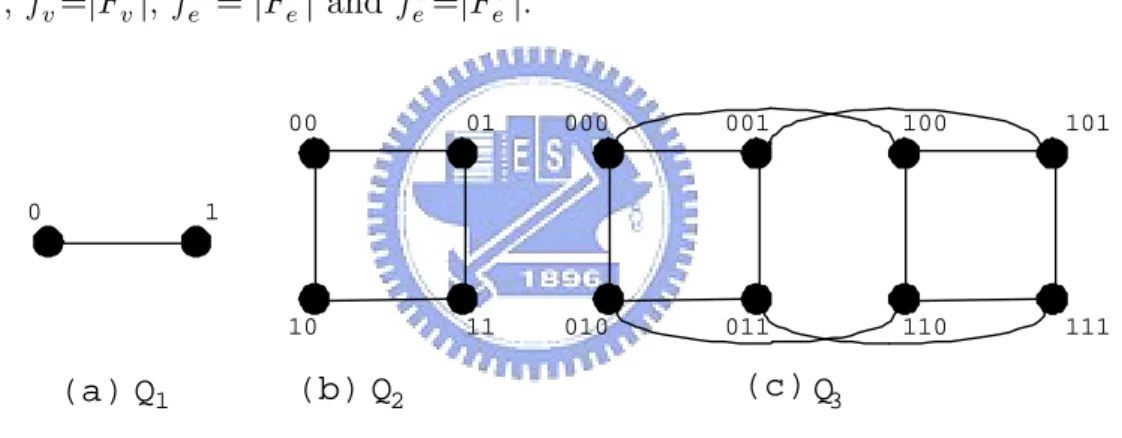
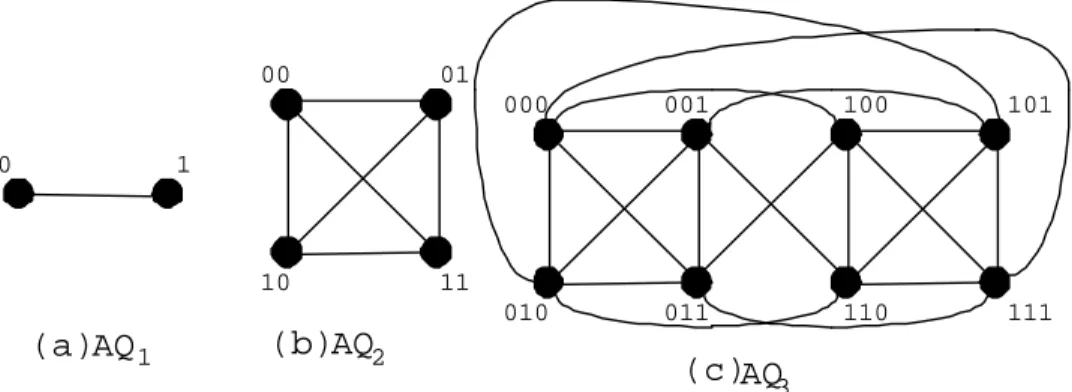
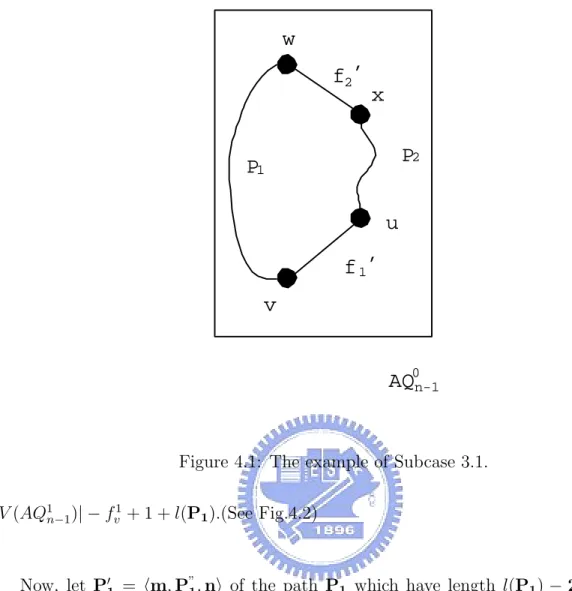
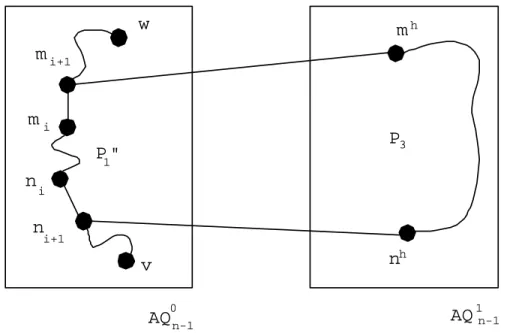
(7) List of Figures 3.1. The hypercubes Q1 , Q2 , and Q3 . . . . . . . . . . . . . . . . . . . . . . . . . 11. 3.2. The augmented cubes AQ1 , AQ2 , and AQ3 . . . . . . . . . . . . . . . . . . 12. 4.1. The example of Subcase 3.1. . . . . . . . . . . . . . . . . . . . . . . . . . . 16. 4.2. The cycles of lengths from |V (AQ1n−1 )|−fv1 +2 to |V (AQ1n−1 )|−fv1 +1+l(P1 ). 17. 4.3. The cycles of lengths from |V (AQ1n−1 )| − fv1 + 2 + l(P1 ) . . . . . . . . . . . 18. 4.4. The cycles of lengths from |V (AQ1n−1 )| − fv1 + 2 to |V (AQn )| − fv − 1. . . . 19. 4.5. The example of Subcase 3.3. . . . . . . . . . . . . . . . . . . . . . . . . . . 20. 2.
(8) Chapter 1 Introduction Network topology is a crucial factor for the interconnection networks since it determines the performance of the networks. Many interconnection network topologies have been proposed in the literature for the purpose of connecting thousands of processing elements. When we design the topology of a interconnection network, there are a lot of requirements which affect the characteristics of network. Network topology is usually represented by a graph where vertices represent processors and edges represent links between processors.. There are a lot of literature to propose the interconnection network topologies. The hamiltonian properties of a network are important aspects of designing a network. A lot of related works have appeared in the following literature. D.Barth et al. proved that there are two disjoint hamiltonian cycles in the butterfly graph [2]. J.C. et al. showed that Caley graphs of degree 4 can be decomposed to disjoint hamiltonian cycles [3]. The hypercube is one of the most popular network since it has a simple structure and is easy to implement. The n-dimensional hypercube [19, 25], denoted by Qn , is a popular. 3.
(9) one. Several variations of the hypercubes have been investigated to improve the efficiency of the hypercubes, such as twisted N-cubes [10], twisted cubes [1, 12], crossed cubes [8, 9], M¨obius cubes [7]. The augmented cubes AQn , recently proposed by Choudum and Sunitha [6], is one of such variations. For any positive integer n, AQn is a vertex transitive, (2n − 1)-regular, and (2n − 1)-connected graph with 2n vertices. The pancycle problem asks if a cycle of length l is a subgraph of a given graph with a given positive integer l. Hwang [16] and Fan [11] et al. studied this problem on butterfly graphs and M¨obius cubes, respectively. But they did not consider the possibilities of failures of vertices and/or edges. Fault tolerant ability is also desirable on network which have relatively high probability of failure. There are many researches related to fault-tolerant hamiltonian properties of networks [15, 13, 17, 18, 20, 21, 22, 23, 24, 26, 27].. In this thesis, we consider the important property fault-tolerant pancyclicity of the augmented cubes.. A graph G is pancyclic if and only if there are cycles of length from 3 to N in G where N is the vertex number of G. A pancyclic graph G is k-fault pancyclic if G − F remains pancyclic for every F ⊂ V (G) ∪ E(G) with |F | ≤ k. The fault pancyclicity, P f (G), is defined to be the maximum interger k such that G is k-fault pancyclic. In this thesis, we prove that the fault pancyclicity of the augmented cube AQn is exactly 2n − 3 for n ≥ 4.. The rest of this thesis is organized as follows. In Chapter 2, we give some definitions. 4.
(10) and notations. In Chapter 3, we give the definition of the augmented cubes and discuss some properties of them. In Charpter 4, we prove the fault pancyclicity of the augmented cubes. Finally, we make some concluding remarks in Chapter 5.. 5.
(11) Chapter 2 Some definitions and notations In this chapter, we introduce several definitions and notations.. For the graph definitions and notations we follow [4]. G=(V, E) is a graph if V is a finite set and E is a subset of {(u, v) | (u, v) is an unordered pair of V }. We say that V is the vertex set and E is the edge set. For any vertex x of V , degG (x) denotes its degree in G. We use δ(G) to denote min{degG (x) | x ∈ V (G)}. Two vertices u and v are adjacent if (u, v) ∈ E. A path, denoted by hv0 , v1 , v2 , ..., vk i, is a sequence of distinct vertices where vi and vi+1 are adjacent for all 0 ≤ i ≤ k − 1. The length of a path P , l(P ), is the number of edges in P . We also write the path hv0 , v1 , v2 , ..., vk i as hv0 , P1 , vi , vi+1 , ..., vj , P2 , vt , ..., vk i, where P1 is the subpath hv0 , v1 , ..., vi i and P2 is the subpath hvj , vj+1 , ..., vt i. In this thesis, it is possible to write a path as hv0 , v1 , P, v1 , v2 , ..., vk i if l(P ) is 0. Sometime, a path can also be represented by hv0 , v1 , ..., vi , e, vi+1 , ..., vn i to emphasize that e is the edge (vi , vi+1 ). We use d(u, v) to denote the distance between u and v. That is the length of the shortest path joining u and v. Let a path be a hamiltonian path if its vertices are distinct and. 6.
(12) included the whole V . Let a path be named a cycle with at least three vertices if the first vertex is the same as the last vertex. Let the cycle be denoted Cn with length n for n ≥ 3.. A graph G is pancyclic if and only if there are cycles of length from 3 to N in G where N is the vertex number of G. A pancyclic graph G is k-fault pancyclic if G − F remains pancyclic for every F ⊂ V (G) ∪ E(G) with |F | ≤ k. The fault-tolerant pancyclicity, P f (G), is defined to be the maximum interger k such that G is k-fault pancyclic. In this thesis, we abbreviate k-fault-tolerant pancyclicity as k − f aultpancyclicity.. A hamiltonian cycle of G is a cycle that traverses every vertex of G exactly once. A graph is hamiltonian if it has a hamiltonian cycle. A hamiltonian graph G is k-fault hamiltonian if G − F remain hamiltonian for every F ⊂ V (G) ∪ E(G) with |F | ≤ k. The fault hamiltonianicity, H(G), is define to be the maximum integer k such that G is k-fault hamiltonian if G is hamiltonian.. For a set S ⊂ V (G), the notation G − S represents the graph obtained by removing the vertices in S from G and deleting those edges with at least one end vertex in S simultaneously. In graph G, the connectivity κ is the minimum number of a set S of G such that G − S is disconnected or trivial.. A graph G is hamiltonian connected if there exists a hamiltonian path joining any two vertices of G. All hamiltonian connected graphs except K1 and K2 are hamiltonian. A graph G is k-fault hamiltonian connected if G − F remains hamiltonian connected for 7.
(13) every F ⊂ V (G) ∪ E(G) with |F | ≤ k. The fault hamiltonian connectivity, Hkf (G), is defined to be the maximum integer k such that G is k-fault hamiltonian connected if G is hamiltonian connected.. 8.
(14) Chapter 3 Augmented cubes 3.1. Definition and notation. First, we shows the define of hypercube and several examples of hypercube which are illustrated in Fig.3.1.. Definition 1 Let n > 1 be an integer. The Hypercube Qn of dimension n has 2n nodes. Q1 is a complete graph with two nodes labeled by 0 and 1, respectively. For n ≥ 2, an n-dimensional Hypercube Qn is obtained by taking two copies of (n − 1)-dimensional subcubes Qn−1 , denoted by Q0n−1 and Q1n−1 . For each v ∈ V (Qn ), insert a 0 to the front of (n − 1)-bit binary string for v in Q0n−1 and a 1 to the front of (n − 1)-bit binary string for v in Q1n−1 . There are 2n−1 edge between Q0n−1 and Q1n−1 as follows: Let V (Q0n−1 ) = {0un−2 un−3 ...u0 : ui = 0 or 1} and V (Q1n−1 ) = {1vn−2 vn−3 ...v0 : vi = 0 or 1}, where 0 ≤ i ≤ n − 2. A node u = 0un−2 un−3 ...u0 of V (Q0n−1 is joined to a node v = 1vn−2 vn−3 ...v0 of V (Q1n−1 ) if and only if ui = vi for 0 ≤ i ≤ n − 2.. 9.
(15) Let n ≥ 1 be an integer. The n-dimensional augmented cube [6], denoted by AQn , has 2n vertices, each labeled by an n-bit binary string V (AQn ) = {u1 u2 ...un | ui ∈ {0, 1}}. AQ1 is the complete graph K2 with vertex set {0, 1}. For n ≥ 2, we write this recursive construction of AQn symbolically as AQn = AQ0n−1 ♦AQ1n−1 and by adding 2n edges between AQ0n−1 and AQ1n−1 as follows:. Let V (AQ0n−1 ) = {(0u2 u3 ...un ) | ui = 0 or 1 for 2 ≤ i ≤ n} and V (AQ1n−1 ) = {(1v2 v3 ...vn ) | vi = 0 or 1 for 2 ≤ i ≤ n}. A vertex u = (0u2 u3 ...un ) of AQ0n−1 is joined to a vertex v = (1v2 v3 ...vn ) of AQ1n−1 if and only if either. (i) ui =vi for 2 ≤ i ≤ n; in this case, (u, v) is called a hypercube edge and we denote v=uh ,or (ii) ui =v¯i for 2 ≤ i ≤ n; in this case, (u, v) is called a complement edge and we denote v=uc .. 3.2. Some basic properties of augmented cubes. There are several augmented cubes (ex:AQ1 , AQ2 , and AQ3 ) that are illustrated in Fig.3.2 By definition, AQn is a vertex transitive, (2n − 1)-regular, and (2n − 1)-connected graph 0 )} and with 2n vertices for any positive integer n. Let Enh = {(u, uh )| u ∈ V(AQn−1 0 )}. Obviously, Enh and Enc are two perfect matchings between Enc = {(u, uc )| u ∈ V(AQn−1. the vertices of AQ0n−1 and AQ1n−1 . Then, |Enh | and |Enc | are both equal to 2n−1 . Let Cn∗ =. 10.
(16) {(u, v) | u = 0u1 ...un and v = 0u¯1 ...u¯n }. In other words, Cn∗ is the set of all complement edges in AQ0n−1 . Let F ⊆ V (AQn ) ∪ E(AQn ) be the set of faults. We divide F into five parts:. (1)Fv0 =F ∩ V (AQ0n−1 ), (2)Fe0 =F ∩ E(AQ0n−1 ), (3)Fv1 =F ∩ V (AQ1n−1 ), (4)Fe1 =F ∩ E(AQ1n−1 ), (5)Fex =F − F (AQ0n−1 ) ∪ F (AQ1n−1 ). By the way, we let Fv = Fv0 ∪ Fv1 and Fe = Fe0 ∪ Fe1 ∪ Fex . Let f =|F |, fv =|Fv |, fv0 =|Fv0 |, fe0 =|Fe0 |, fv1 =|Fv1 |, fe1 = |Fe1 | and fex =|Fex |.. 0. 00. 01. 000. 001. 100. 101. 10. 11. 010. 011. 110. 111. 1. (a) Q1. (c)3Q. (b) Q 2. Figure 3.1: The hypercubes Q1 , Q2 , and Q3 . The folowing lemmas are derived directly from the definition.. Lemma 1 Given a graph AQn for n ≥ 4, let u and v be two distinct vertices in which are both in AQ0n−1 or both in AQ1n−1 . Then uh , uc , vh , and vc are distinct if and only if (u, v) ∈ / C∗n .. 11.
(17) 00. 0. 01 000. 001. 100. 101. 010. 011. 110. 111. 1. 10. (a)AQ 1. 11. (b)AQ 2. (c)AQ3. Figure 3.2: The augmented cubes AQ1 , AQ2 , and AQ3 . Lemma 2 Assume that (u, v) ∈ AQ0n−1 . Then (uh , vh ) ∈ AQ1n−1 and (uc , vc ) ∈ AQ1n−1 .. Lemma 3 Given a vertex u ∈ AQ0n−1 . Let A = {v|(u, v) ∈ E(AQ0n−1 )} and B = {vh , vc |v ∈ A}. Then |A| = 2n − 3 and |B| = 4n − 8.. For example, given a vertex 00000 in AQ05 . Let A = {00001, 00010, 00100, 01000, 00011, 00111, 01111} and B = {10001, 11110, 10010, 11101, 10100, 11011, 11000, 10111, 10011, 11100, 11111, 10000}. Hence, only two vertices in A which are in Cn∗ .. 12.
(18) Chapter 4 Fault-tolerant pancyclicity of augmented cubes To discuss the fault-tolerant pancyclicity of augmented cubes, we need to introduce the following term for graphs. A graph G has property 2H if it satisfies the following conditions: Let {w, x} and {y, z} be two pairs of four distinct vertices of G. There exist two disjoint paths P1 and P2 of G such that (1) P1 joins w to x, (2) P2 joins y to z, and (3) every vertex of G is either on path P1 or on P2 .. Lemma 4 [5] Let n ≥ 4. AQn is (2n − 3)-fault hamiltonian, (2n − 4)-fault hamiltonian connected and has property 2H.. Property 1 Given a path P. P has i + 1 subpaths of length l(P) − i for 0 ≤ i ≤ l(P) − 1.. Now, we are going to discuss the fault-tolerant pancyclicity of augmented cube. We can find that AQ3 is not fault-tolerant pancyclicity with our computer programs. The base case is AQn for n = 4. We translated the proof to computer programs and we put 13.
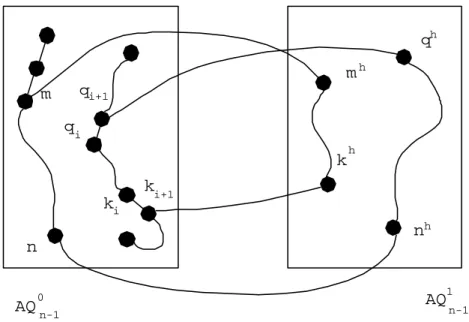
(19) these programs and their outputs on the web site ”http://140.113.167.44/aq4.html”. Let F ⊂ V (AQn ) ∪ E(AQn ) be any faulty set of AQn . An edge (u, v) is called F-fault free if (u, v) ∈ / F, u ∈ / F , and v ∈ / F ; otherwise it is called F -fault. Let H = (V 0 , E 0 ) be a subgraph of AQn . We use F (H) to denote the set (V 0 ∪ E 0 ) ∩ F. Theorem 1 Let n ≥ 5. Suppose AQn−1 is (2n − 5)-fault pancyclic. Then, AQn is (2n − 3)-fault pancyclic. Proof. Let F be any subset of V (AQn ) ∪ E(AQn ) with |F | ≤ 2n − 3. Without loss of generality, we assume that |F (AQ0n−1 )| ≥ |F (AQ1n−1 )|. We discuss this problem with |F | = 2n − 3. If the fault of augmented cubes is less then 2n − 3, we can add some edges into fault set which are fault free . To show that AQn is (2n − 3)-fault pancyclic, we shall find cycles of lengths from 3 to |V (AQn )| − |Fv (AQn )|. We divide the proof into three cases. Because we suppose augmented cubes is (2n − 3)-fault pancyclic, AQn−1 is (2n − 5)-fault pancyclic.. Case 1: Cycles of lengths from 3 to |V (AQ1n−1 )| − fv1 .. Since AQn−1 is (2n−5)-fault pancyclic, AQ1n−1 contains of lengths from 3 to |V (AQ1n−1 )|− fv1 for n ≥ 5. Clearly, AQn − F also contains cycles of these lengths.. Case 2: A cycle of length |V (AQ1n−1 )| − fv1 +1.. 14.
(20) We shall claim that there exists a vertex u in AQ0n−1 such that both (u, uh ) and (u, uc ) are F-fault free. Suppose it is not exist, |F | = 2n − 3 ≥ 2n−1 /2 = 2n−2 , which is a contradiction for n ≥ 5. In addition, AQ1n−1 is (2n − 6)-fault hamiltonian connected, AQ1n−1 − (Fv1 ∪ Fe1 ) has a hamiltonian path huh , P, uc i. Thus, hu, uh , P, uc , ui is a cycle of length |V (AQ1n−1 )| − fv1 + 1.. We follow [5] to construct cycles of lengths from |V (AQ1n−1 )|−fv1 +2 to |V (AQn )|−fv .. Case 3: Cycles of lengths from |V (AQ1n−1 )| − fv1 + 2 to |V (AQn )| − fv. Subcase 3.1: |F (AQ0n−1 )| = 2n − 3. Thus, |F − F (AQ0n−1 )| = 0. Let f1 and f2 be any two elements in F (AQ0n−1 ). Since AQn−1 is (2n − 5)-fault hamiltonian, there exists a hamiltonian cycle C = hu, f10 , v, P1 , w, f20 , x, P2 , ui in AQ0n−1 − (F (AQ0n−1 ) − {f1 , f2 }) where f10 = f1 if f1 is on C or f10 is an arbitrary edge of C otherwise and f20 = f2 if f2 is on C or f20 is an arbitrary edge of C otherwise. Without loss of generality, we assume that l(P2 ) ≤ l (P1 ).(See Fig.4.1). Subcase 3.1.1: l(P2 ) ≥1. First, we take P1 to construct the cycles of lengths from |V (AQ1n−1 )| − fv1 + 2 to |V (AQ1n−1 )| − fv1 + 1 + l(P1 ). Let P01 = hm, P”1 , ni be the subpaths of the path P1 have lengths from 1 to l(P1 ) by Property 1. Since vertices m and n are distinct in AQ0n−1 , there are two vertices mh and nh which are distinct in AQ1n−1 by Lemma 1. By Lemma 4, there exists one hamiltonian path H = hmh , P3 , nh i in AQ1n−1 . Thus, hm, P1 ”, n, nh , P3 , m, mh i forms cycles of lengths from |V (AQ1n−1 )| − fv1 + 2 to 15.
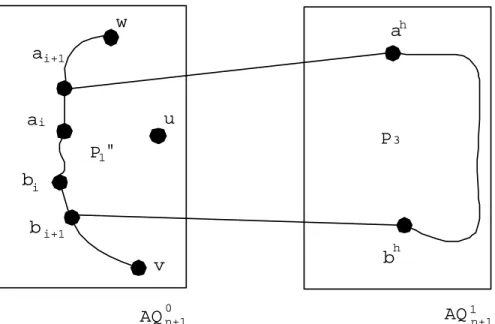
(21) w f2’. x P2. P1 u f 1’ v. AQ0n-1. Figure 4.1: The example of Subcase 3.1. |V (AQ1n−1 )| − fv1 + 1 + l(P1 ).(See Fig.4.2). Now, let P01 = hm, P”1 , ni of the path P1 which have length l(P1 ) − 2 and the set of subpaths P02 = hk, P”2 , qi of P2 which have lengths from 1 to l(P2 ) by Property 1. Since AQn−1 has property 2H, there exist two disjoint spanning paths hkh , P3 , mh i and hnh , P4 , qh i in AQ1n−1 . Thus, the set of cycles = hn, P”1 , m, mh , P3 , kh , k, P”2 , q, qh , P4 , nh , ni which have lengths from |V (AQ1n−1 )| − fv1 + 2 + l(P1 ) to |V (AQn )| − fv − 2.(See Fig.4.3) Finally, we take the two kind of subpaths P10 which have lengths l(P1 ) − 1 to l(P1 ). Thus, the set of cycles = hn, P”1 , m, mh , P3 , kh , k, P”2 , q, qh , P4 , nh , ni are results of Subcase 3.1.1. 16.
(22) w. mh. m i+1 mi. P3. P1" ni n. i+1. nh. v 0. AQ 1n-1. AQ n-1. Figure 4.2: The cycles of lengths from |V (AQ1n−1 )|−fv1 +2 to |V (AQ1n−1 )|−fv1 +1+l(P1 ). Subcase 3.1.2: l(P2 ) = 0. Then u = x. By Property 1, we use the set of subpaths P01 = ha, P”1 , bi of path P1 have lengths from 1 to l(P1 ) by Property 1 with the hamiltonian path P2 = hah , P02 , bh i of AQ1n−1 to construct the cycles= ha, P”1 , b, bh , P02 , ah , ai of lengths from |V (AQ1n−1 )| − fv1 + 2 to |V (AQn )| − fv − 1.(See Fig.4.4) Since the hamiltonian cycle is constructed in Lemma 4, this completes the proof of Subcase 3.1.. Subcase 3.2: |F (AQ0n−1 )| = 2n−4. Thus, |F −F (AQ0n−1 )| = 1. Since AQn−1 is (2n−5)fault hamiltonian, there exists a hamiltonian cycle Ci of AQ0n−1 − (F (AQ0n−1 ) − {fi }) for every fi ∈ F (AQ0n−1 ). We can write Ci as hui , Pi , vi , fi , ui i. Since |F (AQ0n−1 )| ≥ 6 and |F − F (AQ0n−1 )| ≤ 1, there exists an index i such that (ui , uhi ) and (vi , vih ) are Ffault free. Since AQn−1 is (2n − 6)-fault hamiltonian connected, there is a hamiltonian 17.
(23) qh mh qi+1. m. qi k ki. h. ki+1 nh. n 1. AQ. 0. AQ n-1. n-1. Figure 4.3: The cycles of lengths from |V (AQ1n−1 )| − fv1 + 2 + l(P1 ) to |V (AQn )| − fv − 2. path Q1 in AQ1n−1 −F (AQ1n−1 ) joining uhi and vih . Thus, hui , uhi , Q1 , vih , vi , Pi , ui i forms a hamiltonian cycle in AQn −F . By Property 1, we can find out the necessary set of subpaths P0i = ha, P”i , bi of Pi . We claim that edges (a, ah ) and (b, bh ) are F-fault free, too. Since AQn−1 is (2n − 6)-fault hamiltonian connected for n ≥ 5, there is a hamiltonian paths hah , P2 , bh i of AQ1n−1 − F (AQ1n−1 ). Then the cycles ha, ah , P2 , bh , b, P”1 , ai are cycles of length from |V (AQ1n−1 )| − fv1 + 2 to |V (AQn )| − fv − 1 of AQn − F . This completes the proof of Subcase 3.2.. Subcase 3.3: |F (AQ0n−1 )| ≤ 2n−5. Thus, |F (AQn )−F (AQ0n−1 )| is 2n−3−|F (AQ0n−1 )|. Since AQn−1 is (2n − 5)-fault hamiltonian, there is a hamiltonian cycle C in AQ0n−1 − F (AQ0n−1 ). We want to select a path P1 which has lengths from 1 to |V (AQ0n−1 )| − fv0 − 1. 18.
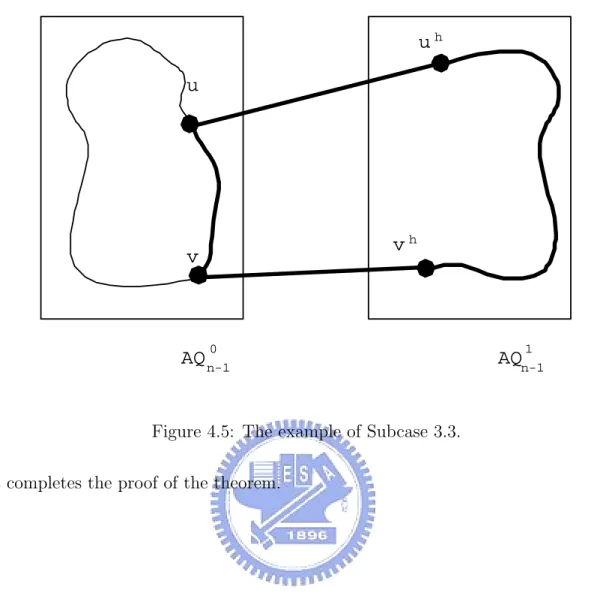
(24) w. ah. ai+1. u. ai. P3. P1" bi b i+1. h. b. v 0. AQ 1n+1. AQ n+1. Figure 4.4: The cycles of lengths from |V (AQ1n−1 )| − fv1 + 2 to |V (AQn )| − fv − 1. in AQ0n−1 . We wish that there exists the set of subpath P1 = hu, P01 , vi in C such that both (u, uh ) and (v, vh ) are fault free. We can find out b(2n−1 − fv0 )/2c pairs of vertices to construct the subpaths of lengths from 1 to |V (AQ0n−1 )| − fv0 − 1 in this hamiltonian cycle. Because |F (AQn )−F (AQ0n−1 )| is at most 2n−3−|F (AQ0n−1 )|, we can find out that b(2n−1 − fv0 )/2c > 2n − 3 − |F (AQ0n−1 )| for n ≥ 5. We decide that there exist two vertices {u, v} which construct necessary subpaths of lengths from 1 to |V (AQ0n−1 )| − fv0 − 1 in C such that both (u, uh ) and (v, vh ) are fault free. Since AQn−1 is (2n − 6)-fault hamiltonian connected, there is a hamiltonian path huh , P2 , vh i of AQ1n−1 − F (AQ1n−1 ). Then hu, uh , P2 , vh , v, P01 , ui can construct subpaths of lengths from |V (AQ1n−1 )| − fv1 + 2 to |V (AQn )| − fv . This completes the proof of Subcase 3.3(See Fig.4.5).. 19.
(25) uh u. vh. v. 0. 1. AQ n-1. AQn-1. Figure 4.5: The example of Subcase 3.3. This completes the proof of the theorem.. 2. Corollary 1 By Theorem 1 and our computer programs, AQn is (2n − 3)-fault pancyclic for n ≥ 4.. 20.
(26) Chapter 5 Conclusion There are a lot of good properties in hamiltonian cubes. Various hamiltonian properties of hypercube-based graphs have been proposed in literature. In addition, fault tolerance is also considered. The augmented cubes is introduced as an alternative to hypercubes. In this thesis, we discuss the fault-tolerant pancyclicity of the augmented cubes. We proved that AQ4 is 5-fault pancyclic for induction base by computer programs, then by induction, we proved that AQn is (2n − 3)-fault pancyclic for n ≥ 4.. 21.
(27) Bibliography [1] S. Abraham and K. Padmanabhan, ”The twisted cube topology for multiprocessors: A study in network asymmetry”, Journal of Parallel and Distributed Computing, vol. 13, pp. 104-110, 1991. [2] D. Barth, and A. Raspaud, ”Two disjoint Hamiltionian cycles in the butterfly graph”, Information Processing Letters, vol. 51, pp.175-179, 1994. [3] J.C. Bermond, O. Favaron, and M. Maheo, ”Hamiltonian decomposition of caley graphs of degree 4”, Journal of Combinatorial Theory, vol. B 46, pp. 142-153, 1989. [4] J.A. Bondy and U.S.R. Murty, Graph theory with applications, North Holland, New York, 1980. [5] L.C. Chiang, ”Fault hamiltonicity of augmented cubes” A Thesis submitted to N.C.T.U in Taiwan for the Degree of Master, 2003. [6] S.A. Choudum and V.Sunitha, ”Augmented cubes”, Networks, vol. 40(2), pp. 71-84, 2002.. 22.
(28) [7] P. Cull and S.M. Larson, ”The M¨obius cubes”, IEEE Transactions on Computers, vol. 44, no. 5, pp. 647-659, 1995. [8] K. Efe, ”A variation on the hypercube with lower diameter”, IEEE Transactions on Computers, vol. 40, no. 11, pp. 312-316, 1991. [9] K. Efe, ”The crossed cube architecture for parallel computing”, IEEE Transations on Parallel and Distributed System, vol. 3, no. 5, pp. 513-524, 1992. [10] A. Estafahanian, L. Ni. and B. Sagan, ”The twisted n-cube with application to multiprocessing”, IEEE Transactions on Computers, vol. 40, no. 1, pp.88-93, 1991. [11] J. Fan, ”Hamiltonian-connectivity and cycle-embedding of the M¨obius cubes”, Information Processing Letters vol. 82, pp.113-117, 2002. [12] P.A, J. Hilbers, M.R.J. Koopman, and J.L.A. van de Snepscheut, ”The twisted cube, in parallel architectures and languages europe”, Lecture Notes in Computer Science, pp. 591-604, 1987. [13] S.Y. Hsieh, G.H. Chen, and C.W. Ho, ”Fault-tolerant ring embedding in faulty arrangement graph”, IEEE Tranactions on Parallel Distributed Systems, vol. 10, pp. 223-237, 1999. [14] W.T. Huang, J.M. Tan, C.N. Hung, and L.H. Hsu, ”Fault-tolerant hamiltonicity of twisted cubes”, Jounal of Parallel and Distributed Computing, vol. 62, pp. 591-604, 2002.. 23.
(29) [15] W.T. Huang, Y.C. Chuang, Jimmy J.M. Tan, and L.H. Hsu, ”Fault-free hamiltonian cycle in faulty M¨obius cubes”, Journal of Computing and Systems, vol. 4, pp. 106-114, 2000. [16] S.C. Hwang and Y.C. G.H. Chen, ”Cycles in butterfly graphs”, Network, vol.35(2) pp.161-171, 2000. [17] H.C. Keh and J.C. Lin, ”On fault-tolerant embedding of Hamiltonian cycles, linear arrays and rings in a Flexible Hypercube”, Parallel Computing, vol. 26, pp. 769-781, 2000. [18] S. Latifi, S.Q. Zheng, and N. Bagherzadeh, ”Optimal ring embedding in hypercubes with faulty link”, Proceedings of the IEEE Symposium on Fault-Tolerant Computing, vol. 42, pp. 178-184, 1992. [19] F.T. Leighton, ”Introduction to parallel algorithms and architectures: arrays, trees, hypercubes”, San Mateo, Chalif., Morgan Kaufmann, 1992. [20] Y.R. Leu and S.Y. Kuo, ”Distributed fault-tolerant ring embedding reconfiguration in hypercubes”, IEEE Transactions on Computers, vol. 48, no. 1, pp. 81-88, 1999. [21] R.S. Lo and G.H. Chen, ”Embedding hamiltonian paths in faulty arrangement graphs with the backtracking method”, IEEE Tranactions on Parallel and Distributed Systems, vol. 12, No. 2, pp. 209-221, 2001. [22] R.S. Lo and G.H. Chen, ”Embedding longest fault-free paths in arrangement graph with faulty vertices”, Networks, vol. 37(2), pp. 84-93, 2001. 24.
(30) [23] G.M. Megson, X. Liu, and X. Yang, ”Fault-tolerant ring embedding in a honeycom torus with node failures”, Parallel Processing Letters, vol. 9, No. 4, pp. 551-561, 1997. [24] R.A. Rowley and B. Bose, ”Fault-tolerant ring embedding in de-Bruijn networks”, Proceedings of the IEEE Symposium on Fault-Tolerant Computing, vol 42, pp. 178184, 1992. [25] Y. Saad and M.H. Schultz, ”Topological properties of hypercubes”, IEEE Transactions on Computers, vol. 34, pp. 867-872, 1988. [26] C.H. Tsai, T. Liang, and L.H. Hsu, ”Fault-free ring embedding in faulty wrapped butterfly graphs”, Proceedings of the ICS2000 Workshop on Algorithms and Theory of Computation, pp. 70-73, 2000. [27] C.H. Tsai, Jimmy J.M. Tan, Y.C. Chuang, and L.H. Hsu, ”Fault-free cycles and links in faulty recursive circulant graphs”, Proceedings of the ICS2000 Workshop on Algorithms and Theory of Computation, pp. 74-77, 2000. [28] M.C. Yang ”Fault-tolerant cycle-embedding of crossed cubes” ELSEVIER, Information Processing Letters 88 pp. 149-154, 2003.. 25.
(31)
數據
+4
相關文件
Soille, “Watershed in Digital Spaces: An Efficient Algorithm Based on Immersion Simulations,” IEEE Transactions on Pattern Analysis and Machine Intelligence,
For better efficiency of parallel and distributed computing, Apache Hadoop distributes the imported data randomly on data nodes.. This mechanism provides some advantages
Selcuk Candan, ”GMP: Distributed Geographic Multicast Routing in Wireless Sensor Networks,” IEEE International Conference on Distributed Computing Systems,
Kalker, “Speed-Change Resistant Audio Fingerprinting Using Auto-Correlation,” in IEEE International Conference on Acoustics, Speech, and Signal Processing, vol. Kalker,
Kaneko, “An algorithm for node-to-set disjoint paths problem in burnt pancake graphs”, IEICE Trans. and
Chen, “Adjustable gamma correction circuit for TFT LCD,” IEEE International Symposium on Circuits and Systems, vol. Kan, “Implementation of the Gamma (γ) Line System Similar
Li, The application of Bayesian optimization and classifier systems in nurse scheduling, in: Proceedings of the 8th International Conference on Parallel Problem Solving
Plumbley, “Beat Tracking with a Two State Model,” IEEE International Conference on Acoustics, Speech and Signal Processing (ICASSP 2005), vol. Honing, “Computational
