國 立 交 通 大 學
應用數學系
碩 士 論 文
多重完全圖之混合設計
H
H
y
y
br
b
r
i
i
d
d
De
D
es
si
ig
gn
n
o
of
f
th
t
he
e
λ
λ-
-f
fo
ol
l
d
d
Co
C
om
mp
pl
le
e
t
t
e
e
G
G
ra
r
ap
ph
h
研 究 生:劉
啟 賢
指導老師:傅
恆 霖 教 授
中 華 民 國 九 十 三 年 六 月
多重完全圖之混合設計
H
Hy
yb
br
ri
id
d
De
D
e
si
s
i
g
g
n
n
of
o
f
t
th
he
e
λ-
λ
-
f
f
o
o
l
l
d
d
Co
C
o
mp
m
pl
l
e
e
te
t
e
Gr
G
r
a
a
ph
p
h
研 究 生:劉啟賢
Student:
Qi-Xian Liu
指 導 老 師:傅恆霖
教授
Advisor: Dr.
Hung-Lin Fu
國 立 交 通 大 學
應用數學系
碩
士
論
文
A Thesis
Submitted to Department of Applied Mathematics
College of Science
National Chiao Tung University
In partial Fulfillment of Requirement
For the Degree of Master
In
Applied Mathematics
June 2004
Hsinchu, Taiwan, Republic of China
多
多
重
重
完
完
全
全
圖
圖
之
之
混
混
合
合
設
設
計
計
學
學
生
生
:
:
劉
劉
啟
啟
賢
賢
指
指
導
導
教
教
授
授
:
:
傅
傅
恆
恆
霖
霖
國
國
立
立
交
交
通
通
大
大
學
學
應
應
用
用
數
數
學
學
系
系
摘
摘
要
要
(
(
中
中
文
文
)
)
所謂的
k 點的圖對
是指不同構的兩個
k 點圖,它們滿足
(1)
G 與 H 中都不具有孤立點,及(2) G 與 H 的圖聯集恰為 k 點
的完全圖。如果我們可以把
n 點的完全圖用 G 與 H 的組合來表示,
每一個至少出現一次,我們稱這樣的分割為雙重圖設計。更進一
步,如果對於所有的
s 與 t,只要滿足
,就
可以用
s 個圖 G 與 t 個圖 H 來組合成
,則我們稱這樣的一個分
割為 倍的混合設計,或多重混合設計。
) , (G H | ) ( | | ) ( | ) (n2 =s⋅ EG +t⋅ E H λ n K λ λ在這篇論文中,我們針對一個 5 點的圖對(各有 5 邊)
,分別
建構出多重混合設計,多重混合裝填及多重混合覆蓋;後兩者是
在
λ(n2)不為 5 的倍數時分別討論最大裝填及最小覆蓋。
Hybrid Design of the λ-fold Complete Graph
Student: Qi-Xian Liu
Advisor: Hung-Lin Fu
Department of Applied mathematics
National Chiao Tung University
June 28, 2004
Abstract
By a graph-pair of order t, we mean two non-isomorphic graphs G and H on
t non-isolated vertices for which G ∪ H ∼= Kt for some integer t ≥ 4. Given a
graph-pair (G, H), if the edges of λKn can be partitioned into s copies of G and t
copies of H with λ(n2) = s · |E(G)| + t · |E(H)|, ∀s, t ∈ N ∪ {0}, then we refer to this partition as a (G, H)-hybrid decomposition.
In this thesis, we consider the existence of hybrid design of λKn for the
graph-pairs of order 5 (each has 5 edges). For this graph-pair, we will also consider the maximum hybrid packings and the minimum hybrid coverings of λKn.
致
致
謝
謝
首
首
先
先
感
感
謝
謝
指
指
導
導
教
教
授
授
傅
傅
恆
恆
霖
霖
老
老
師
師
,
,
這
這
兩
兩
年
年
來
來
悉
悉
心
心
指
指
導
導
。
。
老
老
師
師
很
很
有
有
耐
耐
心
心
的
的
與
與
我
我
討
討
論
論
問
問
題
題
,
,
協
協
助
助
我
我
解
解
決
決
問
問
題
題
,
,
讓
讓
我
我
在
在
學
學
習
習
研
研
究
究
的
的
過
過
程
程
中
中
受
受
益
益
良
良
多
多
。
。
其
其
次
次
,
,
感
感
謝
謝
交
交
大
大
應
應
數
數
有
有
一
一
個
個
好
好
的
的
環
環
境
境
供
供
我
我
研
研
習
習
。
。
感
感
謝
謝
黃
黃
光
光
明
明
老
老
師
師
、
、
黃
黃
大
大
原
原
老
老
師
師
、
、
陳
陳
秋
秋
媛
媛
老
老
師
師
與
與
翁
翁
志
志
文
文
老
老
師
師
等
等
,
,
在
在
課
課
業
業
上
上
的
的
熱
熱
心
心
幫
幫
忙
忙
與
與
關
關
心
心
。
。
也
也
要
要
感
感
謝
謝
嚴
嚴
志
志
弘
弘
學
學
長
長
、
、
張
張
嘉
嘉
芬
芬
學
學
姊
姊
、
、
郭
郭
志
志
銘
銘
學
學
長
長
、
、
許
許
弘
弘
松
松
學
學
長
長
、
、
張
張
飛
飛
黃
黃
學
學
長
長
、
、
郭
郭
君
君
逸
逸
學
學
長
長
、
、
陳
陳
宏
宏
賓
賓
學
學
長
長
的
的
許
許
多
多
幫
幫
助
助
,
,
以
以
及
及
棨
棨
丰
丰
、
、
昭
昭
芳
芳
、
、
抮
抮
君
君
、
、
正
正
傑
傑
、
、
喻
喻
培
培
、
、
宏
宏
嘉
嘉
、
、
嘉
嘉
文
文
、
、
致
致
維
維
、
、
建
建
瑋
瑋
、
、
貴
貴
弘
弘
和
和
文
文
祥
祥
這
這
些
些
同
同
學
學
,
,
和
和
他
他
們
們
一
一
起
起
遊
遊
玩
玩
、
、
一
一
起
起
討
討
論
論
課
課
業
業
,
,
讓
讓
我
我
在
在
交
交
大
大
的
的
這
這
兩
兩
年
年
留
留
下
下
美
美
好
好
的
的
回
回
憶
憶
。
。
最
最
後
後
要
要
感
感
謝
謝
我
我
的
的
父
父
母
母
,
,
總
總
是
是
掛
掛
念
念
我
我
的
的
生
生
活
活
、
、
學
學
業
業
,
,
感
感
謝
謝
他
他
們
們
的
的
支
支
持
持
,
,
陪
陪
伴
伴
我
我
一
一
起
起
走
走
過
過
這
這
充
充
實
實
的
的
研
研
究
究
所
所
生
生
涯
涯
。
。
Contents
Abstract(in Chinese) I Abstract(in English) II Acknowledgment III Contents IV List of figures V1 Introduction and Preliminaries 1
1.1 Preliminaries . . . 1
1.2 The Known Results . . . 5
1.3 The Idea of ”Proof” . . . 7
2 The Main Results 10
2.1 (G2, H2)-Hybrid Design of Kn . . . 10
2.2 Maximum (G2, H2)-Hybrid Packing of Kn and Minimum (G2, H2)-Hybrid
Covering of Kn . . . 20
2.3 (G2, H2)-Hybrid Decomposition of λKn . . . 37
Conclusion 39
References 40
List of Figures
1 Graph lexicographic product. . . 4
2 Graph-pairs of order 5. . . 5
3 A graph-pair (G2, H2) of order 5. . . 10
1
Introduction and Preliminaries
Graph decomposition is one of the most important topic in the study of graph theory and combinatorial design. There are quite a few results in the literatures which are concerned with the decomposition of a graph G into isomorphic copies of H, denoted by
H|G. If G = λKn, then the decomposition is known as a λ-fold H-design of order n.
Furthermore, if G = λKn and H = Kk, then the decomposition H|G is also known as a
λ-fold balanced incomplete block design (BIBD) of order n with block size k, denoted by
(n, k, λ)-design, see [7] for a reference.
In [2], Abueida and Daven started the research of multidesigns, i.e., decomposing λKn
into two or more different graphs, especially two non-isomorphic subgraphs H1 and H2
of K5 such that H1∪ H2 = K5. They obtained the decomposition by requiring that each
one of the two subgraphs occur at least once. In this thesis, we extend the study of multidesign by asking the number of each subgraphs being prescribed, i.e., as long as the number of edges is correct, λKn can be decomposed into s copies of Gi and t copies of Hi
where (Gi, Hi) is a graph pair. We call such a design hybrid in what follows.
Before presenting the main results, we explain the notations and ideas which we use in the proof.
1.1
Preliminaries
A path is a sequence of distinct vertices <x1, x2, . . . , xn> such that consecutive vertices
are adjacent, that is, there is an edge from each vertex xi to the next vertex xi+1 in the
path sequence. A cycle is a path that ends where it starts, that is, xn= x1. And we write
respectively. A complete graph is a simple graph whose vertices are pairwise adjacent; the complete graph with n vertices and n(n-1)/2 edges is denoted by Kn.
A graph G is bipartite if V (G) is the union of two disjoint (possibly empty) independent sets called partite sets of G. A complete bipartite graph or bicligue is a bipartite graph such that two vertices are adjacent if and only if they are in different partite sets. When the sets have size r and s, the biclique is denoted Kr,s.
An isolated vertex is a vertex of degree 0. A subgraph of a graph G is a graph H such that V (H) ⊆ V (G) and E(H) ⊆ E(G) and the assignment of endpoints to edges in H is the same as in G. We then write H ⊆ G and say that ”G contains H”. A decomposition of a graph is a list of subgraphs such that each edge appears in exactly one subgraph in the list. An isomorphism from a simple graph G to a simple graph H is a bijection
f : V (G) → V (H) such that uv ∈ E(G) if and only if f (u)f (v) ∈ E(H). We say ”G is
isomorphic to H”, written G ∼= H, if there is an isomorphism from G to H.
A cut-edge or cut-vertex of a graph is an edge or vertex whose deletion increases the number of components. We write G − e or G − M for the subgraph of G obtained by deleting an edge e or set of edges M. We write G − v or G − S for the subgraph obtained by deleting a vertex v or set of vertices S. An induced subgraph is a subgraph obtained by deleting a set of vertices. We write G[T ] for G − T , where T = V (G) − T ; this is the subgraph of G induced by T . An add-edge of a simple graph G is an edge whose addition let G have multiple edges. We write G+e or G+M for the new graph obtained by adding an edge e or set of edges M.
Let S be an n-set. A Latin square of order n based on S is an n × n array with entries form S such that in each row and each column every element of S occurs exactly once.
The graphs we consider will be simple graphs. Let V (Kn) = Znand V (Kr,s) = Zr+s. If
R ⊆ Zn, then Kn[R] is the subgraph of Kn induced by the vertices in R, and if R, S ⊆ Zn,
then Kn[R; S] is the bipartite subgraph of Kn on the vertices R ∪ S. When r = |R| and
s = |S|, it is clear that Kn[R] ∼= Kr and Kn[R; S] = Kr,s. Define [a, b] = t ∈ Zn|a ≤ t ≤ b.
If R = [a, b] and S = [c, d], then we write Kn[a, b] and Kn[a, b; c, d] rather than Kn[R] and
Kn[R; S].
The λ-fold complete graph λKn is the graph with n vertices in which each pair of
vertices is joined by exactly λ edges. A partition of the edges of λKn into copies of G
is called a G-decomposition or G-design. This situation is denoted by λKn → G. A
graph-pair of order t consists of two non-isomorphic graphs G and H on t non-isolated
vertices for which G ∪ H ∼= Kt for some integer t ≥ 4. Given a graph-pair (G, H), we
say (G, H) divides λKn if the edges of λKn can be partitioned into copies of G and H
with at least one copy of G and at least one copy of H. We will refer to this partition as a (G, H)-multidecomposition. When λKn does not admit a multidecomposition for a
certain pair of subgraphs, it is natural to ask how closely we may decompose it. With a maximum multipacking of λKn, we hope to obtain a leave with as few edges as possible.
For a minimum multicovering, we will introduce a few extra (multiple) edges in order to cover the original edges of λKn; necessarily, we will seek a padding that has as few edges
as possible.
A multidesign is a multidecomposition, a maximum multipacking, or a minimum mul-ticovering.
A (G, H)−hybrid decomposition of the λ-fold complete graph means that if the edges of λKn can be partitioned into s copies of G and t copies of H, where s · e(G) + t · e(H) =
e(λKn), ∀s, t ∈ Z+. When λKndoes not admit a (G, H)-hybrid decomposition, we instead
find a maximum hybrid packing and a minimum hybrid covering. A hybrid design is a hybrid decomposition, a maximum hybrid packing, or a minimum hybrid covering.
The composition G = G1[G2] of graphs G1 and G2 with disjoint point sets V1 and V2
and edge sets X1 and X2 is the graph with point vertex V1× V2 and u = (u1, u2) adjacent
with v = (v1, v2) whenever u1 is adjacent to v1 in G1 or u1 = v1 and u2 is adjacent to v2
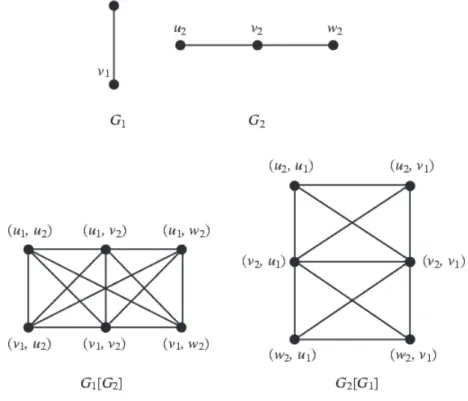
in G2. It is also called the graph lexicographic product. For example, if V (G1) = {u1, v1},
and V (G2) = {u2, v2, w2}, then G1[G2] and G2[G1] are listed below.
Figure 1: Graph lexicographic product.
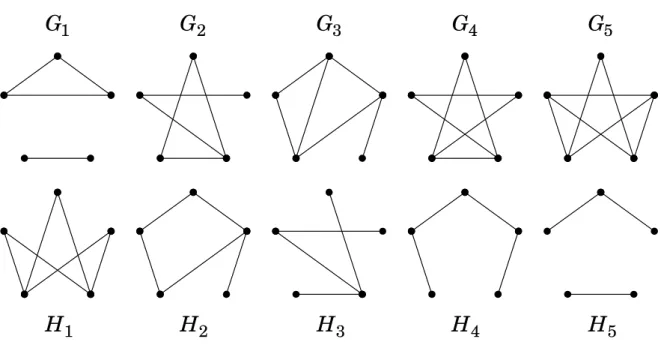
The focus of our decomposition will be on the graph-pairs (Gi, Hi) of order 5. Figure
1
G
1H
2G
G
3G
4G
5 2H
H
3H
4H
5Figure 2: Graph-pairs of order 5.
In this thesis, we completely solve the Hybrid design of the λ-fold complete graph for graph-pair (G2, H2).
1.2
The Known Results
In [2], Abueida and Daven completely determined the values of n for which Kn admits
a (G, H)-multidesign, when (G, H) is a graph-pair of order 5. The results they obtained may be summarized as follows:
Theorem 1.2.1. [2] There is a (Gi, Hi)-multidecomposition of Kn if and only if
(a) when i ∈ {1, 3, 4}, n ≡ 0, 1 (mod 4), n ≥ 5 (except for i = 1 and n = 8); (b) when i = 2, n ≡ 0, 1 (mod 5); and
Theorem 1.2.2. [2] Let L be the leave from a maximum (G, H)-multipacking, and let P
be the padding from a minimum (G, H)-multicovering of Kn. Then, the follows are true:
(a) If (Gi, Hi) ∼= (G1, H1) and n ≡ 2, 3 (mod 4) (n ≥ 7), then L ∼= P ∼= K2;
(b) If (Gi, Hi) ∼= (G2, H2) and n ≡ 2, 4 (mod 5) (n ≥ 7), then L ∼= K2 and e(P ) = 4;
(c) If (Gi, Hi) ∼= (G2, H2) and n ≡ 3 (mod 5) (n ≥ 7), then L ∼= K3 and P ∼= K2; and
(d) If (Gi, Hi) ∼= (G5, H5), then e(L(K6) = 2, P (K6) ∼= L(K7) ∼= P (K7) ∼= K2.
Theorem 1.2.3. [3] There is a (G2, H2)-multidesign of λKn. Let 1 ≤ λ∗ ≤ 5. If
n ≡ 2, 4 mod 5, then e(L(λKn)) = λ∗ and e(P (λKn)) = 5 − λ∗. If n ≡ 3 (mod 5), then
e(L(λKn)) = 3λ∗ (mod 5) and e(P (λKn)) = 2λ∗ (mod 5).
In order to prove the main result, we also need the followings.
Theorem 1.2.4. [6] For each positive integer n 6= 1, 2 and 6, there exists a pair of
orthogonal Latin squares.
Theorem 1.2.5. [4] G2|Kn if and only if n ≡ 0 or 1 (mod 5) and n ≥ 6. H2|Kn if and
only if n ≡ 0 or 1 (mod 5) and n > 6.
Theorem 1.2.6. [4] K3|Kn,n,n for each positive integer n and K4|Kn,n,n,n for each n 6= 2
or 6.
Corollary 1.2.7. Let 1 ≤ m ≤ n and n 6= 2 or 6. Then, Kn,n,n,m can be decomposed
into subgraphs such that each subgraph is either a K3 or a K4.
Proof. First, by Theorem 1.2.6, K4|Kn,n,n,n. Then, we delete n − m vertices from one
of the four partite sets. Clearly, if a K4 contains a vertex which is deleted, then exactly
Now, we are ready for the idea of our proof.
1.3
The Idea of ”Proof”
Keep in mind that we plan to decompose a graph into a combination of s G2’s and t H2’s
for all possible s and t. In what follows, (s, t) is called an admissible (ordered) pair of
λKn if 0 ≤ s, t ≤ λ5(n2) and 5(s + t) = λ(n2). Therefore, our constructions are not just
only one. So, the strategy is to decompose λKn into a collection of t subgraphs, L1, L2,
· · · , Lt, such that each Li can be decomposed into si G2’s and ti H2’s where (si, ti) is an
admissible pair of Li (hybrid (G2, H2)-decomposition of Li). Now, it is not difficult to see
that by combining the decompositions of the Li’s, we can construct a decomposition of
λKn into s G2’s and t H2’s for each admissible pair.
Therefore, it remains to prove that each Li mentioned above has a hybrid (G2, H2
)-decomposition. In case that λ(n
2) is not a multiple of 5, then we can delete some edges
from λKnand then do the same job. So, we need the ingredients and they are constructed
in Chapter 2.
The proof will be by recursive constructions, hence we need a couple of recurrence rela-tions. ( Let H be the collection of subgraphs which has a hybrid (G2, H2)-decomposition.)
Lemma 1.3.1. If Kni and Kn1,n2,··· ,nh have an H-decomposition for 1 ≤ i ≤ h, then Kn
has an H-decomposition where n =
h
X
i=1
ni.
Proof. The proof follows by the fact that (∪h
i=1Kni)∪ Kn1,n2,··· ,nh = Kn and the combi-nation of hybrid decompositions of Kni and Kn1,n2,··· ,nh.
Lemma 1.3.2. If Kni+1 and Kn1,n2,··· ,nh have an H-decomposition for 1 ≤ i ≤ h, then
Kn+1 has an H-decomposition where n = ( h
X
i=1
ni) + 1.
Proof. Let V (Kni+1) = Xi∪{∞} such that Xi∩Xj = φ and |Xi| = ni. Then V (Kn+1) = (∪h
i=1Xi)∪ {∞}. Now, by combining the H-decompositions of Kni+1 for 1 ≤ i ≤ h and
Kn1,n2,··· ,nh we have the proof.
Lemma 1.3.3. If (Kni+2 − K2) has an H-decomposition for 1 ≤ i ≤ h and Kn1,n2,...,nh has an H-decomposition, then (Kn− K2) has an H-decomposition where n = (
h
X
i=1
ni) + 2.
Proof. Let V (Kni+2) = Xi ∪ {v1, v2} such that Xi ∩ Xj = φ and |Xi| = ni. Then
V (Kn+2) = (∪hi=1Xi)∪ {v1, v2}. Now, by combining the H-decompositions of Kni+2 −
K|{v1,v2}| for 1 ≤ i ≤ h and Kn1,n2,··· ,nh we have the proof.
Lemma 1.3.4. If (Kni+3 − K3) has an H-decomposition for 1 ≤ i ≤ h and Kn1,n2,...,nh has an H-decomposition, then (Kn− K3) has an H-decomposition where n = (
h
X
i=1
ni) + 3.
Proof. Let V (Kni+3) = Xi ∪ S where S = {v1, v2, v3} such that Xi ∩ Xj = φ and
|Xi| = ni. Then V (Kn+3) = (∪hi=1Xi) ∪ S . Now, by combining the H-decompositions of
Kni+3− K|S| for 1 ≤ i ≤ h and Kn1,n2,··· ,nh we have the proof.
Lemma 1.3.5. If (Kni+4 − K4) has an H-decomposition for 1 ≤ i ≤ h and Kn1,n2,...,nh has an H-decomposition, then (Kn− K4) has an H-decomposition where n = (
h
X
i=1
ni) + 4.
Proof. Let V (Kni+4) = Xi ∪ S where S = {v1, v2, v3, v4} such that Xi ∩ Xj = φ and
|Xi| = ni. Then V (Kn+4) = (∪hi=1Xi) ∪ S . Now, by combining the H-decompositions of
Lemma 1.3.6. If (Kni+4− K4) has an H-decomposition for 1 ≤ i < h , (Knh+4 − K2) has an H-decomposition and Kn1,n2,...,nh has an H-decomposition, then (Kn− K2) has an
H-decomposition where n = (
h
X
i=1
ni) + 4.
Proof. Let V (Kni+4) = Xi ∪ S where S = {v1, v2, v3, v4} such that Xi ∩ Xj = φ and
|Xi| = ni. Then V (Kn+4) = (∪h−1i=1Xh) ∪ S. Now, by combining the H-decompositions of
2
The Main Results
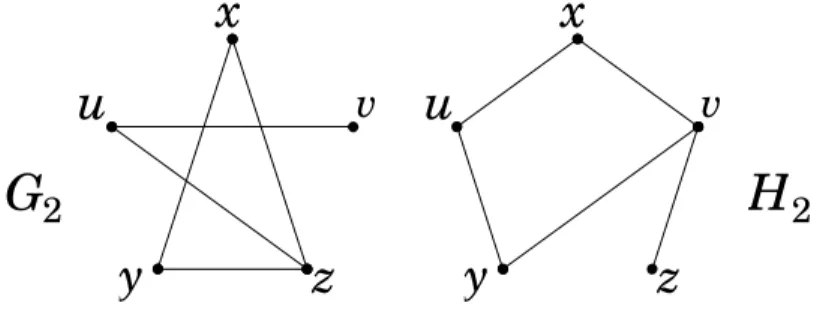
We adopt a notation similar to that used in [4]. Given the labelling below, we denote
G2 by [x, y, z; u, v] and H2 by [x, u, y, v; z] throughout of this chapter.
x
y
z
u
v
2G
H
2x
y
z
u
v
Figure 3: A graph-pair (G2, H2) of order 5.
2.1
(G
2, H
2)-Hybrid Design of K
nLemma 2.1.1. If Kr,r,r has a hybrid (G2, H2)-decomposition, then Kar,ar,ar has a hybrid
(G2, H2)-decomposition for a > 0.
Proof. Let G be a graph with vertex set {1, 2, · · · , t} and let G⊗Onbe the lexicographic
product of G by an independent set of n elements, i.e., a graph with vertex set the disjoint union of t independent sets Xi, where |Xi| = n such that two vertices are joined by an
edge if and only if they belong to two different sets Xi, Xj and {i, j} is an edge in G.
It is easy to see that Kar,ar,ar = Ka,a,a⊗ Or, which can be decomposed into subgraphs
isomorphic to K3 ⊗ Or (by Theorem 1.2.6). Since K3⊗ Or = Kr,r,r which by hypothesis
Lemma 2.1.2. If Kr,r,r has a hybrid (G2, H2)-decomposition and Kr,r,r,r has a hybrid
(G2, H2)-decomposition, then Kpr,pr,pr,qr has a hybrid (G2, H2)-decomposition for integer
p 6= 2, 6, 0 ≤ q ≤ p.
Proof. Let G be a graph with vertex set {1, 2, · · · , t} and let G⊗Onbe the lexicographic
product of G by an independent set of n elements.
It is easy to see that Kpr,pr,pr,qr = Kp,p,p,q⊗Or, which can be decomposed into subgraphs
isomorphic to K4⊗ Or or K3⊗ Or for p 6= 2, 6, 0 ≤ q ≤ p (by Corollary 1.2.7). Since both
K3⊗ Or= Kr,r,r and K4⊗ Or = Kr,r,r,r have a hybrid (G2, H2)-decomposition, the proof
follows.
Lemma 2.1.3. K5,5,5 has a hybrid (G2, H2)-decomposition.
Proof. Let (s, t) be an admissible pair of K5,5,5 and let V (K5,5,5) = X = {xi,j|i ∈
Z5, j ∈ Z3}. We start with G2|K5,5,5 and H2|K5,5,5 and then make trades from G2’s to
H2’s.
(i) K5,5,5 = 15G2. G2,(i,1)= [xi+1,1, xi+1,2, xi+0,0; xi+3,1, xi+1,0], G2,(i,2) = [xi+1,2, xi+1,0,
xi+0,1; xi+3,2, xi+1,1], G2,(i,3) = [xi+1,0, xi+1,1, xi+0,2; xi+3,0, xi+1,2], ∀i ∈ Z5.
(ii) K5,5,5= 15H2. H2,(i,1) = [xi+1,1, xi+0,0, xi+3,1, xi+1,0; xi+0,1], H2,(i,2) = [xi+1,2, xi+0,1,
xi+3,2, xi+1,1; xi+0,2], H2,(i,3)= [xi+1,0, xi+0,2, xi+3,0, xi+1,2; xi+0,0], ∀i ∈ Z5.
(iii) ∀i ∈ Z5. We can trade G2,(i,1)∪ G2,(i,2)∪ G2,(i,3) for H2,(i,1)∪ H2,(i,2)∪ H2,(i,3), ∀i ∈ Z5.
(iv) ∀i ∈ Z5. Let H2,(i,4) = [xi+1,2, xi+0,0, xi+3,1, xi+1,0; xi+0,1], H2,(i,5) = [xi+1,2, xi+0,1,
xi+3,2, xi+1,1; xi+0,0]. Then we can trade G2,(i,1)∪ G2,(i,2)∪ G2,(i,3)for G2,(i,3)∪ H2,(i,4)∪
By (i), (ii), (iii), and (iv), we have {(s, t)|s + t = 15, s, t ∈ N ∪ {0}, t 6= 1}.
(v) Let G2,4 = [x2,1, x2,2, x1,0; x3,1, x0,0], G2,5 = [x1,2, x2,1, x2,0; x4,1, x1,0], G2,6 = [x2,2,
x3,0, x3,1; x0,2, x2,1], G2,7 = [x2,1, x3,0, x3,2; x0,0, x1,1], H2,8 = [x0,0, x2,2, x4,0, x1,2;
x1,1]. Then we can trade G2,(0,1)∪ G2,(1,1)∪ G2,(1,3)∪ G2,(2,3)∪ G2,(2,2) for G2,4∪ G2,5∪
G2,6∪ G2,7∪ H2,8. Hence, (s, t) = (14, 1) case is done.
The result for K5,5,5,5 follows by a similar idea. But, it is more complicate.
Lemma 2.1.4. K5,5,5,5 has a hybrid (G2, H2)-decomposition.
Proof. Let (s, t) be an admissible pair of K5,5,5,5 and let V (K5,5,5) = X = {xi,j|i ∈
Z5, j ∈ Z4}.
(i) K5,5,5,5= 30G2. G2,(i,1)= [xi+0,1, xi+2,2, xi+2,0; xi+1,3, xi+3,1], G2,(i,2) = [xi+0,1, xi+1,3,
xi+1,0; xi+3,3, xi+3,0], G2,(i,3) = [xi+0,2, xi+2,1, xi+2,3; xi+0,1, xi+1,2], G2,(i,4) = [xi+1,3,
xi+2,1, xi+2,2; xi+3,3, xi+0,2], G2,(i,5) = [xi+1,2, xi+1,3, xi+0,0; xi+2,1, xi+1,1], G2,(i,6) =
[xi+0,2, xi+1,1, xi+1,0; xi+3,2, xi+0,0], ∀i ∈ Z5
(ii) For all i ∈ Z5, let G2,(i,7) = [xi+0,1, xi+2,2, xi+2,0; xi+1,3, xi+3,1], G2,(i,8) = [xi+0,2,
xi+2,1, xi+2,3; xi+0,1, xi+1,2], G2,(i,9) = [xi+1,1, xi+2,3, xi+2,0; xi+1,2, xi+2,1], G2,(i,10) =
[xi+1,3, xi+2,1, xi+2,2; xi+3,3, xi+0,2], G2,(i,11) = [xi+2,2, xi+2,3, xi+1,0; xi+3,1, xi+2,0],
H2,(i,12) = [xi+4,2, xi+1,0, xi+4,3, xi+2,0; xi+2,1]. Then for all i ∈ Z5, we can trade
G2,(i,1)∪ G2,(i,2)∪ G2,(i,3)∪ G2,(i,4)∪ G2,(i,5)∪ G2,(i,6) for G2,(i,7)∪ G2,(i,8)∪ G2,(i,9)∪
G2,(i,10)∪ G2,(i,11)∪ H2,(i,12).
(iii) For all i ∈ Z5, let G2,(i,13) = [xi+0,1, xi+2,0, xi+2,2; xi+3,3, xi+0,2], G2,(i,14) = [xi+1,1,
[xi+0,2, xi+2,1, xi+2,3; xi+0,1, xi+1,2], H2,(i,17) = [xi+1,3, xi+3,1, xi+2,0, xi+2,1; xi+2,2],
H2,(i,18) = [xi+4,2, xi+2,0, xi+4,3, xi+1,0; xi+3,1]. Then for all i ∈ Z5, we can trade
G2,(i,1)∪ G2,(i,2)∪ G2,(i,3)∪ G2,(i,4)∪ G2,(i,5)∪ G2,(i,6) for G2,(i,13)∪ G2,(i,14)∪ G2,(i,15)∪
G2,(i,16)∪ H2,(i,17)∪ H2,(i,18).
(iv) For all i ∈ Z5, let G2,(i,19) = [xi+0,1, xi+2,0, xi+2,2; xi+3,3, xi+0,2], G2,(i,20) = [xi+0,2,
xi+2,1, xi+2,3; xi+1,1, xi+2,0], G2,(i,21) = [xi+1,0, xi+2,3, xi+2,2; xi+1,3, xi+2,0], H2,(i,22) =
[xi+0,1, xi+2,3, xi+2,0, xi+1,2; xi+2,1], H2,(i,23) = [xi+1,3, xi+3,1, xi+2,0, xi+2,1; xi+2,2],
H2,(i,24) = [xi+4,2, xi+2,0, xi+4,3, xi+1,0; xi+3,1]. Then for all i ∈ Z5, we can trade
G2,(i,1)∪ G2,(i,2)∪ G2,(i,3)∪ G2,(i,4)∪ G2,(i,5)∪ G2,(i,6) for G2,(i,19)∪ G2,(i,20)∪ G2,(i,21)∪
H2,(i,22)∪ H2,(i,23)∪ H2,(i,24).
(v) For all i ∈ Z5, let G2,(i,25) = [xi+1,0, xi+2,3, xi+2,2; xi+3,3, xi+0,2], G2,(i,26) = [xi+0,2,
xi+2,1, xi+2,3; xi+1,1, xi+2,0], H2,(i,27) = [xi+0,1, xi+2,0, xi+1,3, xi+2,2; xi+2,1], H2,(i,28) =
[xi+0,1, xi+2,3, xi+2,0, xi+1,2; xi+2,1], H2,(i,29) = [xi+2,1, xi+1,3, xi+3,1, xi+2,0; xi+2,2],
H2,(i,30) = [xi+4,2, xi+2,0, xi+4,3, xi+1,0; xi+3,1]. Then for all i ∈ Z5, we can trade
G2,(i,1)∪ G2,(i,2)∪ G2,(i,3)∪ G2,(i,4)∪ G2,(i,5)∪ G2,(i,6) for G2,(i,25)∪ G2,(i,26)∪ H2,(i,27)∪
H2,(i,28)∪ H2,(i,29)∪ H2,(i,30).
(vi) For all i ∈ Z5, let G2,(i,31) = [xi+1,0, xi+2,2, xi+2,3; xi+2,1, xi+1,2], H2,(i,32) = [xi+0,1,
xi+1,2, xi+2,0, xi+2,3; xi+1,1], H2,(i,33) = [xi+0,2, xi+2,2, xi+1,3, xi+2,0; xi+1,1], H2,(i,34) =
[xi+2,1, xi+2,2, xi+3,3, xi+1,2; xi+2,3], H2,(i,35) = [xi+2,1, xi+1,3, xi+3,1, xi+2,0; xi+2,2],
H2,(i,36) = [xi+4,2, xi+2,0, xi+4,3, xi+1,0; xi+3,1]. Then for all i ∈ Z5, we can trade
G2,(i,1)∪ G2,(i,2)∪ G2,(i,3)∪ G2,(i,4)∪ G2,(i,5)∪ G2,(i,6) for G2,(i,31)∪ H2,(i,32)∪ H2,(i,33)∪
(vii) For all i ∈ Z5, let H2,(i,37) = [xi+2,2, xi+1,0, xi+2,3, xi+2,1; xi+1,2], H2,(i,38) = [xi+0,1,
xi+1,2, xi+2,0, xi+2,3; xi+1,1], H2,(i,39) = [xi+0,1, xi+2,2, xi+1,3, xi+2,0; xi+1,1], H2,(i,40) =
[xi+2,3, xi+2,2, xi+3,3, xi+0,2; xi+2,1], H2,(i,41) = [xi+2,1, xi+1,3, xi+3,1, xi+2,0; xi+2,2],
H2,(i,42) = [xi+4,2, xi+2,0, xi+4,3, xi+1,0; xi+3,1]. Then for all i ∈ Z5, we can trade
G2,(i,1)∪ G2,(i,2)∪ G2,(i,3)∪ G2,(i,4)∪ G2,(i,5)∪ G2,(i,6) for H2,(i,37)∪ H2,(i,38)∪ H2,(i,39)∪
H2,(i,40)∪ H2,(i,41)∪ H2,(i,42).
Hence, by (i), (ii), (iii), (iv), (v), (vi), and (vii), we have an admissible pair of
K5,5,5,5.
We also need a couple of special decompositions.
Lemma 2.1.5. K10− K5 has a hybrid (G2, H2)-decomposition.
Proof. Let (s, t) be an admissible pair of K10− K5 and let V (K10) = Z10.
(i) K5,5 can be decomposed into 5 H20s
H2,1 = [1, 9, 3, 8; 0], H2,2 = [2, 8, 4, 7; 1], H2,3 = [3, 7, 0, 6; 2], H2,4 = [1, 6, 4, 5; 3],
H2,5 = [2, 5, 0, 9; 4].
By assumption (observation), K5 = G2+ H2. Hence, ”(1, 6)-case” is done.
(ii) Let G2,1 = [1, 2, 3; 4, 0], H2,6 = [4, 0, 8, 3; 1], H2,7 = [2, 3, 9, 1; 8]. From (i), we can
trade G2,1∪ H2,1 for H2,6∪ H2,7. Hence, ”(0, 7)-case” is done.
(iii) Let H2,8 = [2, 4, 3, 1; 0], G2,2 = [0, 1, 8; 3, 4], G2,3 = [3, 9, 1; 2, 4]. From (i), we can
trade H2,1∪ H2,8 for G2,2∪ G2,3. Hence, ”(3, 4)-case” is done.
(iv) Let G2,4 = [2, 4, 3; 1, 0], G2,5 = [1, 9, 3; 2, 4]. From (i), we can trade H2,1∪ G2,4 for
(v) Let H2,9 = [1, 4, 0, 3; 2], G2,6 = [1, 3, 8; 2, 7], G2,7 = [4, 7, 1; 9, 3], G2,8 = [4, 8, 0; 3, 2].
From (i), we can trade H2,9∪ H2,1∪ H2,2 for G2,6∪ G2,7∪ G2,8. Hence, ”(4, 3)-case”
is done.
(vi) K10− K5 can be decomposed into 7G2’. G2,9 = [1, 0, 7; 3, 6], G2,10 = [2, 1, 6; 4, 5],
G2,11 = [5, 2, 3; 0, 6], G2,12 = [4, 3, 9; 1, 8], G2,13 = [8, 4, 0; 5, 1], G2,14 = [7, 2, 4; 1, 3],
G2,15 = [9, 0, 2; 8, 3].
(vii) Let H2,10 = [7, 4, 1, 3; 6], G2,16 = [1, 0, 7; 2, 4]. From (vi), we can trade G2,9∪ G2,14
for H2,10∪ G2,16. Hence, ”(6, 1)-case” is done.
(viii) Let H2,11= [2, 1, 6, 4; 5], H2,12 = [1, 4, 7, 3; 6], G2,17 = [0, 1, 7; 2, 6]. From (vi), we can
trade G2,9∪ G2,10∪ G2,14 for H2,11∪ H2,12∪ G2,17. Hence, ”(5, 2)-case” is done.
Lemma 2.1.6. K11− K6 has a hybrid (G2, H2)-decomposition.
Proof. Let (s, t) be an admissible pair of K11− K6 and let V (K11) = Z11.
(i) K5,6 can be decomposed into 6 H2’s. H2,1 = [6, 2, 7, 0; 10], H2,2 = [8, 0, 9, 3; 7],
H2,3 = [6, 3, 10, 1; 9], H2,4 = [1, 8, 5, 7; 4], H2,5 = [8, 4, 10, 2; 9], H2,6 = [6, 4, 9, 5; 10].
By assumption (observation) K5 = G2 + H2. Hence, ”(1, 7)-case” is done.
(ii) Let G2,1 = [9, 10, 8; 7, 6], H2,7 = [0, 9, 10, 8; 3], H2,8 = [3, 9, 8, 7; 6]. From (i), we can
trade H2,2∪, G2,1 for H2,7∪ H2,8. Hence, ”(0, 8)-case” is done.
(iii) Let H2,9 = [6, 10, 9, 8; 7], G2,2 [7, 8, 3; 9, 0], H2,10 = [6, 10, 9, 8; 0]. From (i), we can
(iv) Let G2,3 = [0, 9, 8; 6, 10]. From (i), we can trade H2,2∪ H2,9 for G2,2∪ G2,3. Hence,
”(3, 5)-case” is done.
(v) Let H2,11= [7, 7, 9, 10; 8], G2,4 = [0, 10, 6; 2, 7], G2,5 = [7, 8, 0; 9, 10], G2,6 = [8, 9, 3; 7, 10].
From (i), we can trade H2,2∪ H2,1∪ H2,11 for G2,4∪G2,5∪ G2,6. Hence, ”(4, 4)-case”
is done.
(vi) K11− K6 can be decomposed into 8 G2’s. G2,7 = [1, 9, 8; 3, 10], G2,8 = [0, 10, 9; 4, 8],
G2,9 = [2, 8, 10; 5, 9], G2,10 = [6, 10, 4; 7, 0], G2,11 = [7, 10, 1; 6, 5], G2,12 = [0, 8, 6; 9, 7],
G2,13 =[5, 8, 7; 2, 6], G2,14=[6, 7, 3; 9, 2]. Hence, ”(8, 0)-case” is done.
(vii) Let G2,15 = [5, 8, 7; 6, 3], H2,12 = [7, 3, 9, 2; 6]. From (vi), we can trade G2,13∪ G2,14
for G2,15∪ H2,12. Hence, ”(7, 1)-case” is done.
(viii) Let H2,13= [5, 10, 8, 9; 1], H2,14= [2, 10, 3, 8; 1]. From (vi), we can trade G2,7∪ G2,9
for H2,13∪ H2,14. Hence, ”(6, 2)-case” is done.
(ix) Let H2,15= [4, 8, 10, 9, 1], H2,16= [0, 10, 5, 9, 8]. From (vi), we can trade G2,7∪ G2,8∪
G2,9 for H2,14∪ H2,15∪ H2,16. Hence, ”(5, 3)-case” is done.
Theorem 2.1.7. There exists a hybrid (G2, H2)-decomposition of Knfor n ≡ 0, 1 (mod 5).
Proof. By Theorem 1.2.5, we will consider only the unsolved cases for s, t ≥ 1. Let H be the collection of subgraphs which has a hybrid (G2, H2)-decomposition. First, we show
that Kni has an H-decomposition and also Kn1,n2,··· ,nh has an H-decomposition for some small values of ni.
In the Appendix, we list the hybrid (G2, H2)-decompositions for K10, K11, K15, K16,
K20, K21, K25, K26. Therefore, for the remainder of the proof, assume n ≥ 30.
• K35
Let (s, t) be an admissible pair of K35. Let V (K35) = {xi,j|∀i ∈ Z5, j ∈ Z7}, and let
Vj = {xi,j−1|i ∈ Z5}, where j = 1, 2, · · · , 7.
Since K7(5) can be partitioned into 7 K5,5,5’s (K|V1|,|V3|,|V4|, K|V1|,|V2|,|V6|, K|V1|,|V5|,|V7|,
K|V2|,|V4|,|V5|, K|V2|,|V3|,|V7|, K|V3|,|V5|,|V6|, K|V4|,|V6|,|V7|), K35 can be partitioned into 7
(K15 − K5 − K5)’s (K|V1|,|V3|,|V4| ∪ K|V1|, K|V1|,|V2|,|V6| ∪ K|V2|, K|V1|,|V5|,|V7| ∪ K|V7|,
K|V2|,|V4|,|V5|∪K|V4|, K|V2|,|V3|,|V7|∪K|V3|, K|V3|,|V5|,|V6|∪K|V5|, K|V4|,|V6|,|V7|∪K|V6|). From
the proof of hybrid (G2, H2)-decomposition of K15, (K15− K5− K5) has a hybrid
(G2, H2)-decomposition. Thus, K35 has a hybrid (G2, H2)-decomposition.
• K36
Let (s, t) be an admissible pair of K36. Let V (K36) = {xi,j|∀i ∈ Z5, j ∈ Z7}∪ {∞},
and let Vj = {xi,j−1|i ∈ Z5}, j = 1, 2, · · · , 7.
Since K7(5) can be partitioned into 7 K5,5,5’s (K|V1|,|V3|,|V4|, K|V1|,|V2|,|V6|, K|V1|,|V5|,|V7|,
K|V2|,|V4|,|V5|, K|V2|,|V3|,|V7|, K|V3|,|V5|,|V6|, K|V4|,|V6|,|V7|), and K|V1|,|V3|,|V4|∪K|V1∪{∞}|, K|V1|,|V2|,|V6|∪
K|V2∪{∞}|, K|V1|,|V5|,|V7|∪ K|V7∪{∞}|, K|V2|,|V4|,|V5|∪ K|V4∪{∞}|, K|V2|,|V3|,|V7|∪ K|V3∪{∞}|,
K|V3|,|V5|,|V6|∪K|V5∪{∞}|, and K|V4|,|V6|,|V7|∪K|V6∪{∞}|have a hybrid (G2, H2)-decomposition
(from proof of K16), K35 has a hybrid (G2, H2)-decomposition.
• K40
Use a hybrid (G2, H2)-decomposition of K5,5,5as given in Lemma 2.1.3 for each of the
following subgraphs: K|V1|,|V3|,|V4|, K|V1|,|V2|,|V6|, K|V1|,|V5|,|V7|, K|V2|,|V4|,|V5|, K|V2|,|V3|,|V7|,
K|V3|,|V5|,|V6|, K|V4|,|V6|,|V7|. Use a hybrid (G2, H2)-decomposition of K10 for the
sub-graph K|V1∪V8|. Use a hybrid (G2, H2)-decomposition of K10 − K5 as given in
Lemma 2.1.5 for each of the following subgraphs: K|V2∪V8|− K|V8|, K|V3∪V8|− K|V8|,
K|V4∪V8|− K|V8|, K|V5∪V8|− K|V8|, K|V6∪V8|− K|V8|, K|V7∪V8|− K|V8|.
• K41
Let V (K41) = {xi,j|∀i ∈ Z5, j ∈ Z8}∪ {∞}, and let Vj = {xi,j−1|i ∈ Z5}, j =
1, 2, · · · , 8.
Use a hybrid (G2, H2)-decomposition of K5,5,5as given in Lemma 2.1.3 for each of the
following subgraphs: K|V1|,|V3|,|V4|, K|V1|,|V2|,|V6|, K|V1|,|V5|,|V7|, K|V2|,|V4|,|V5|, K|V2|,|V3|,|V7|,
K|V3|,|V5|,|V6|, K|V4|,|V6|,|V7|. Use a hybrid (G2, H2)-decomposition of K11 for the
sub-graph K|V1∪V8∪{∞}|. Use a hybrid (G2, H2)-decomposition of K11 − K6 as given
in Lemma 2.1.6 for each of the following subgraphs: K|V2∪V8∪{∞}| − K|V8∪{∞}|,
K|V3∪V8∪{∞}|−K|V8∪{∞}|, K|V4∪V8∪{∞}|−K|V8∪{∞}|, K|V5∪V8∪{∞}|−K|V8∪{∞}|, K|V6∪V8∪{∞}|−
K|V8∪{∞}|, K|V7∪V8∪{∞}|− K|V8∪{∞}|.
• K95
By Theorem 2.1.2 with r = 5, p = 5, q = 4, K25,25,25,20 has a hybrid (G2, H2
)-decomposition. Since K25, and K20 have a hybrid (G2, H2)-decomposition, by
The-orem 1.3.1, K95 has a hybrid (G2, H2)-decomposition.
By Theorem 2.1.2 with r = 5, p = 5, q = 4, K25,25,25,20 has a hybrid (G2, H2
)-decomposition. Since K26, and K21 have a hybrid (G2, H2)-decomposition, by
The-orem 1.3.2, K96 has a hybrid (G2, H2)-decomposition.
• K100
By Theorem 2.1.2 with r = 5, p = q = 5, K25,25,25,25 has a hybrid (G2, H2
)-decomposition. Since K25 has a hybrid (G2, H2)-decomposition, by Theorem 1.3.1,
K100 has a hybrid (G2, H2)-decomposition.
• K101= sG2+ tH2, where s · e(G2) + t · e(H2) = e(K101), ∀s, t ∈ N ∪ {0}.
By Theorem 2.1.2 with r = 5, p = q = 5, K25,25,25,25 has a hybrid (G2, H2
)-decomposition. Since K26 has a hybrid (G2, H2)-decomposition, by Theorem 1.3.2,
K101 has a hybrid (G2, H2)-decomposition.
Now, we are ready for the proof. As mentioned above, it suffices to decompose Kn into
a collection of subgraphs which have a hybrid (G2, H2)-decomposition, and this can be
done recursively.
Case 1. n ≡ 0 (mod 5)
Let n ≡ 0, 5, 10, 15, 20, 25 (mod 30). Therefore n = 30t, 30t+5, 30t+10, 30t+15, 30t+ 20, and 30t + 25 respectively. Since 30t = 3 · (10t) and 30t + 15 = 3 · (10t + 5), Kn can
be decomposed into three copies of K10t (respectively K10t+5) and K10t,10t,10t(respectively
K10t+5,10t+5,10t+5). Hence, by the fact that both K10t and K5,5,5 have a hybrid (G2, H2
)-decomposition, we have a hybrid (G2, H2)-decomposition of K30t and K30t+15 respectively.
Now, if n = 30t+5 (the other cases are similar), then K30t+5can be decomposed into three
the proof of this case follows. (Note that K10t,10t,10t,5 can be decomposed into K5,5,5,5’s
and K5,5,5’s as long as t 6= 1 and 3. But, the cases K35 and K95 have been treated as
special cases earlier.) Case 2. n ≡ 1 (mod 5)
Let n = 30t + 1, 30t + 6, 30t + 11, 30t + 16, 30t + 21, and 30t + 26. For the case
n = 30t + 1 and n = 30t + 16, we can decompose K30t+1 (respectively K30t+16) into
K10t+1’s (respectively K10t+6’s) with one vertex in common and a K10t,10t,10t
(respec-tively K10t+5,10t+5,10t+5). Then, the proof follows by combining the hybrid (G2, H2
)-decompositions of these subgraphs together. Now, consider n = 30t + 6 and the other cases are similar. Clearly, K30t+6 can be decomposed into three K10t+1’s and one K6 (in
which they have one vertex in common), and one K10t,10t,10t,5. Since each of them has a
hybrid (G2, H2)-decomposition, the proof of this case follows. Again, K10t,10t,10t,5 can be
decomposed into K5,5,5,5’s and K5,5,5’s only if t 6= 1 or 3. Hence we have to deal with
n = 36 and n = 96 independently, and then the ”proof” follows.
2.2
Maximum (G
2, H
2)-Hybrid Packing of K
nand Minimum (G
2, H
2)-Hybrid Covering of K
nIn this section, we consider the cases n ≡ 2, 3, 4 (mod 5) in which there are no (G2, H2
)-Hybrid designs of order n. Therefore, the best we can get is the maximum (G2, H2
)-Hybrid packing, i.e., by removing the minimum leave L, Kn− L has a (G2, H2)-Hybrid
decomposition.
Lemma 2.2.1. K7− K2 has a hybrid (G2, H2)-decomposition.
(i) Use the following copies of G2:
G2 ∼= [2, 5, 1; 4, 0], [2, 4, 6; 3, 1], [3, 4, 5; 0, 2], [1, 6, 0; 3, 2].
What remains is the edge {5, 6}. Hence, ”(4, 0)-case” is done.
(ii) Use the following copies of G2 and H2:
G2 ∼= [0, 1, 6; 5, 4], [2, 4, 6; 3, 1], [2, 5, 1; 4, 0]; H2 ∼= [2, 0, 5, 3; 4].
What remains is the edge {0, 3}. Hence, ”(3, 1)-case” is done.
(iii) Use the following copies of G2 and H2:
G2 ∼= [2, 5, 1; 4, 0], [2, 6, 4; 3, 0]; H2 ∼= [0, 1, 3, 6; 5], [0, 2, 3, 5; 4].
What remains is the edge {1, 6}. Hence, ”(2, 2)-case” is done.
(iv) Use the following copies of G2 and H2:
G2 ∼= [2, 5, 1; 4, 0]; H2 ∼= [0, 1, 3, 6; 4], [2, 4, 5, 6; 1], [2, 0, 5, 3; 4].
What remains is the edge {0, 3}. Hence, ”(1, 3)-case” is done.
(v) Use the following copies of H2:
H2 ∼= [1, 5, 6, 0; 3], [1, 3, 4, 6; 2], [1, 2, 5, 4; 0], [2, 0, 5, 3; 6].
What remains is the edge {0, 3}.Hence, ”(0, 4)-case” is done.
Lemma 2.2.2. K12− K7 has a hybrid (G2, H2)-decomposition.
Proof. Let (s, t) be an admissible pair of (K12− K7). Let V (K12) = Z12, and let V1 =
{0, 1, 2, 3, 4}, V2 = {5, 6, 7, 8, 9}, V3 = {10, 11}.
(i) Use the following copies of H2 on K|V1|,|V2|:
H2,1 = [8, 0, 6, 1; 9], H2,2 = [7, 1, 5, 2; 8], H2,3 = [6, 2, 9, 3; 7], H2,4 = [5, 3, 8, 4; 6],
(ii) Let G2,1 = [0, 8, 6; 1, 9], G2,2 = [8, 9, 11; 5, 6], G2,3 = [7, 9, 10; 8, 1], G2,4= [7, 11, 6; 9, 5],
G2,5 = [6, 10, 5; 8, 7]. From (i), we can trade H2,1∪ (KV2∪V3−{10, 11}) for G2,1∪ G2,2∪
G2,3∪ G2,4∪ G2,5. Hence, ”(5, 4)-case” is done.
(iii) Let G2,6 = [8, 9, 11; 5, 2], G2,7 = [1, 5, 7; 2, 8]. From (i), we can trade H2,1∪ H2,2∪
(KV2∪V3 − {10, 11}) for G2,1∪ G2,3∪ G2,4∪ G2,5∪ G2,6∪ G2,7. Hence, ”(6, 3)-case” is
done.
(iv) Let G2,8 = [2, 9, 6; 3, 7], G2,9 = [6, 11, 7; 8, 5], G2,10 = [6, 10, 5; 9, 3]. From (i), we
can trade H2,1∪ H2,2∪ H2,3∪ (KV2∪V3− {10, 11}) for G2,1∪ G2,3∪ G2,6∪ G2,7∪ G2,8∪
G2,9∪ G2,10. Hence, ”(7, 2)-case” is done.
(v) Let G2,11 = [6, 11, 7; 8, 4], G2,12 = [3, 7, 6; 2, 9], G2,13 = [3, 8, 5; 4, 6]. From (i), we
can trade H2,1∪ H2,2∪ H2,3∪ H2,4∪ (KV2∪V3 − {10, 11}) for G2,1∪ G2,3∪ G2,6∪ G2,7∪
G2,10∪ G2,11∪ G2,12∪ G2,13. Hence, ”(8, 1)-case” is done.
(vi) Let G2,14= [7, 9, 10; 8, 0], G2,15= [6, 10, 5; 4, 7], G2,16= [0, 5, 9; 4, 6], G2,17= [1, 8, 6; 0, 7],
G2,18 = [5, 8, 3; 9, 1]. From (i)., we can trade H2,1∪ H2,2∪ H2,3∪ H2,4∪ H2,5∪
(KV2∪V3 − {10, 11}) for G2,6∪ G2,7∪ G2,8∪ G2,11∪ G2,14∪ G2,15∪ G2,16∪ G2,17∪ G2,18.
Hence, ”(9, 0)-case” is done.
Now, we are ready to consider the case n ≡ 2 (mod 5).
Theorem 2.2.3. If n ≡ 2 (mod 5), then there exists a maximum (G2, H2)-hybrid packing
of Kn with leave L ∼= K2, and a minimum (G2, H2)-hybrid covering of Kn with padding
Proof. By Theorem 1.2.5, we will consider only the unsolved cases for s, t ≥ 1. Let H be the collection of subgraphs which has a hybrid (G2, H2)-decomposition. First, we show
that Kni has an H-decomposition and also Kn1,n2,··· ,nh has an H-decomposition for some small values of ni.
In the Appendix, we list the maximum (G2, H2)-hybrid packing for K7, K12, K17, K22,
and K27. Therefore, for the remainder of the proof, assume n ≥ 30.
• K37
Let V (K37) = {xi,j|∀i ∈ Z5, j ∈ Z7}∪ {v1, v2}, and let Vj = {xi,j−1|i ∈ Z5} where
j = 1, 2, · · · , 7, and V8 = {v1, v2}.
Since K7(5) can be partitioned into 7 K5,5,5’s (K|V1|,|V3|,|V4|, K|V1|,|V2|,|V6|, K|V1|,|V5|,|V7|,
K|V2|,|V4|,|V5|, K|V2|,|V3|,|V7|, K|V3|,|V5|,|V6|, K|V4|,|V6|,|V7|), K37can be partitioned into K|V1|,|V3|,|V4|∪
(K|V1∪V8|− K|V8|), K|V1|,|V2|,|V6|∪ (K|V2∪V8|− K|V8|), K|V1|,|V5|,|V7|∪ (K|V7∪V8|− K|V8|),
K|V2|,|V4|,|V5|∪(K|V4∪V8|−K|V8|), K|V2|,|V3|,|V7|∪(K|V3∪V8|−K|V8|), K|V3|,|V5|,|V6|∪(K|V5∪V8|−
K|V8|), K|V4|,|V6|,|V7|∪ (K|V6∪V8|− K|V8|), and K|V8|. Each of the above has a
decompo-sition into K5,5,5 and K12− K7. (except K|V8|) Use a hybrid (G2, H2)-decomposition
of K5,5,5 as given in Lemma 2.1.3 and a hybrid (G2, H2)-decomposition of K12− K7
as given in Lemma 2.2.2 for each of the above subgraphs. What remains is K2.
Cover this edge by using a copy of G2, or H2, then we have the proof.
• K42
Let V (K42) = {xi,j|∀i ∈ Z5, j ∈ Z8}∪ {v1, v2}, and let Vj = {xi,j−1|i ∈ Z5} where
j = 1, 2, · · · , 8, and V9 = {v1, v2}.
following subgraphs: K|V1|,|V3|,|V4|, K|V1|,|V2|,|V6|, K|V1|,|V5|,|V7|, K|V2|,|V4|,|V5|, K|V2|,|V3|,|V7|,
K|V3|,|V5|,|V6|, K|V4|,|V6|,|V7|.
Use a hybrid (G2, H2)-decomposition of K12−K7as given in Lemma 2.2.2 for each of
the following subgraphs: K|V2∪V8∪V9|− K|V8∪V9|, K|V3∪V8∪V9|− K|V8∪V9|, K|V4∪V8∪V9|−
K|V8∪V9|, K|V5∪V8∪V9|− K|V8∪V9|, K|V6∪V8∪V9|− K|V8∪V9|, K|V7∪V8∪V9|− K|V8∪V9|. Use
a maximum (G2, H2)-hybrid packing of K12 for the subgraph K|V1∪V8∪V9|. What
remains is K2. Cover this edge by using a copy of G2, or H2, then we have the
proof.
• K97
By Theorem 2.1.2 with r = 5, p = 5, q = 4, K25,25,25,20 has a hybrid (G2, H2
)-decomposition. Since K22−K2, and K27−K2have a hybrid (G2, H2)-decomposition,
by Theorem 1.3.3, K97− K2 has a hybrid (G2, H2)-decomposition. What remains
is K2. Cover this edge by using a copy of G2, or H2, then we have the proof.
• K102
By Theorem 2.1.2 with r = 5, p = q = 5, K25,25,25,25 has a hybrid (G2, H2
)-decomposition. Since K27 − K2 has a hybrid (G2, H2)-decomposition, by
Theo-rem 1.3.3, K102 − K2 has a hybrid (G2, H2)-decomposition. What remains is K2.
Cover this edge by using a copy of G2, or H2, then we have the proof.
Now, we are ready for the proof. As mentioned above, it suffices to decompose Kn− K2
into a collection of subgraphs which have a hybrid (G2, H2)-decomposition, and this can
Let n = 30t + 2, 30t + 7, 30t + 12, 30t + 17, 30t + 22, and 30t + 27. For the case
n = 30t + 2 and n = 30t + 17, we can decompose K30t+2 (respectively K30t+17) into
K10t+2’s (respectively K10t+7’s) with two vertices in common and a K10t,10t,10t(respectively
K10t+5,10t+5,10t+5). Since K10t+2 (respectively K10t+7) exists a maximum (G2, H2)-hybrid
packing with leave L ∼= K2 (or a minimum (G2, H2)-hybrid covering with padding P
having 4 edges), and K10t,10t,10t (respectively K10t+5,10t+5,10t+5) has a hybrid (G2, H2
)-decomposition, by Lemma 1.3.3, we have a maximum (G2, H2)-hybrid packing of K30t+2
(respectively K30t+17) with leave L ∼= K2, and a minimum (G2, H2)-hybrid covering of
K30t+2 (respectively K30t+17) with padding P having 4 edges. Now, consider n = 30t + 7
and the other cases are similar. Clearly, K30t+7 can be decomposed into three K10t+2’s
and one K7 (in which they have two vertices in common), and one K10t,10t,10t,5. Since
K10t+2− K2 has a hybrid (G2, H2)-decomposition, and K7 exists a maximum (G2, H2
)-hybrid packing with leave L ∼= K2 (or a minimum (G2, H2)-hybrid covering with padding
P having 4 edges), the proof of this case follows. Again, K10t,10t,10t,5 can be decomposed
into K5,5,5,5’s and K5,5,5’s only if t 6= 1 or 3. Hence we have to deal with n = 37 and
n = 97 independently as above, and then the proof follows.
Next, we consider the case n ≡ 3 (mod 5).
Lemma 2.2.4. K8− K3 has a hybrid (G2, H2)-decomposition.
Proof. Let (s, t) be an admissible pair of (K8− K3). Let V (K8) = Z8.
(i) Use the following copies of G2:
What remains is the complete graph K|V1| where V1 = {0, 1, 2}. Hence, ”(5, 0)-case”
is done.
(ii) Use the following copies of G2 and H2:
G2 ∼= [6, 7, 3; 4, 5], [1, 6, 4; 0, 5], [1, 3, 5; 2, 6], [4, 7, 2; 3, 0]; H2 ∼= [0, 6, 5, 7; 1].
What remains is the complete graph K|V1| where V1 = {0, 1, 2}. Hence, ”(4, 1)-case”
is done.
(iii) Use the following copies of G2 and H2:
G2 ∼= [6, 7, 3; 4, 5], [1, 6, 4; 7, 2], [1, 3, 5; 2, 6]; H2 ∼= [0, 6, 5, 7; 1], [3, 2, 4, 0; 5].
What remains is the complete graph K|V1| where V1 = {0, 1, 2}. Hence, ”(3, 2)-case”
is done.
(iv) Use the following copies of G2 and H2:
G2 ∼= [6, 7, 3; 4, 5], [3, 5, 1; 6, 0]; H2 ∼= [0, 4, 1, 7; 5], [2, 7, 4, 6; 5], [3, 0, 5, 2; 4].
What remains is the complete graph K|V1| where V1 = {0, 1, 2}. Hence, ”(2, 3)-case”
is done.
(v) Use the following copies of G2 and H2:
G2 ∼= [5, 7, 3; 6, 0]; H2 ∼= [0, 4, 1, 7; 6], [2, 7, 4, 6; 5], [3, 0, 5, 2; 4], [3, 4, 5, 1; 6].
What remains is the complete graph K|V1| where V1 = {0, 1, 2}. Hence, ”(1, 4)-case”
is done.
(vi) Use the following copies of H2:
H2 ∼= [0, 4, 1, 7; 6], [2, 7, 5, 6; 0], [3, 0, 5, 2; 4], [3, 4, 5, 1; 6], [6, 4, 7, 3; 5].
is done.
Lemma 2.2.5. K13− K8 has a hybrid (G2, H2)-decomposition.
Proof. Let (s, t) be an admissible pair of (K13− K8). Let V (K13) = Z13, and let V1 =
{0, 1, 2, 3, 4}, V2 = {5, 6, 7, 8, 9}, V3 = {10, 11, 12}.
(i) Use the following copies of H2 on K|V1|,|V2|:
H2,1 = [6, 0, 8, 1; 5], H2,2 = [7, 1, 9, 2; 6], H2,3 = [8, 2, 5, 3; 7], H2,4 = [9, 3, 6, 4; 8],
H2,5 = [5, 4, 7, 0; 9]. And by Lemma 2.2.4, we have {(s, t)-case |s + t = 10, s ≤ 5}.
(ii) Let G2,1 = [1, 5, 8; 0, 6], G2,2 = [5, 6, 12; 9, 7], G2,3 = [5, 10, 9; 6, 1], G2,4= [5, 7, 11; 9, 8],
G2,5 = [8, 11, 6; 7, 10], G2,6 = [7, 12, 8; 10, 6]. From (i), we can trade H2,1∪ (K|V2∪V3|−
K|V3|) for G2,1∪ G2,2∪ G2,3∪ G2,4∪ G2,5∪ G2,6. Hence, ”(6, 4)-case” is done.
(iii) Let G2,7 = [9, 10, 5; 6, 0], G2,8 = [5, 7, 1; 8, 10], G2,9 = [6, 9, 2; 7, 11], G2,10 = [6, 10, 7; 8, 0],
G2,11 = [6, 11, 8; 9, 1], G2,12= [8, 12, 5; 11, 9], G2,13= [7, 9, 12; 6, 1]. From (i), we can
trade H2,1∪ H2,2∪ (K|V2∪V3| − K|V3|) for G2,7∪ G2,8∪ G2,9∪ G2,10∪ G2,11∪ G2,12∪
G2,13. Hence, ”(7, 3)-case” is done.
(iv) Let G2,14 = [5, 10, 6; 7, 3], G2,15 = [6, 11, 8; 9, 10], G2,16 = [9, 11, 5; 2, 8], G2,17 =
[5, 8, 12; 6, 0], G2,18= [5, 7, 1; 8, 0], G2,19= [7, 12, 9; 1, 6], G2,20 = [7, 10, 8; 3, 5], G2,21=
[6, 9, 2; 7, 11]. From (i), we can trade H2,1∪ H2,2∪ H2,3∪ (K|V2∪V3|− K|V3|) for G2,14∪
G2,15∪ G2,16∪ G2,17∪ G2,18∪ G2,19∪ G2,20∪ G2,21. Hence, ”(8, 2)-case” is done.
(v) Let G2,22= [2, 8, 5; 3, 7], G2,23= [8, 11, 6; 1, 9], G2,24= [5, 11, 9; 3, 6], G2,25= [6, 7, 10; 8, 3],
trade H2,1∪ H2,2∪ H2,3∪ H2,4∪ (K|V2∪V3|− K|V3|) for G2,18∪ G2,21∪ G2,22∪ G2,23∪
G2,24∪ G2,25∪ G2,26∪ G2,27∪ G2,28. Hence, ”(9, 1)-case” is done.
(vi) Let G2,29= [7, 8, 0; 9, 3], G2,30= [5, 7, 1; 8, 2], G2,31= [5, 9, 11; 7, 2], G2,32= [3, 6, 5; 2, 7],
G2,33 = [8, 9, 4; 5, 0], G2,34= [2, 9, 6; 4, 7]. From (i), we can trade H2,1∪ H2,2∪ H2,3∪
H2,4∪ H2,5∪ (K|V2∪V3|− K|V3|) for G2,17∪ G2,23∪ G2,25∪ G2,28∪ G2,29 G2,30∪ G2,31∪
G2,32∪ G2,33∪ G2,34. Hence, ”(10, 0)-case” is done.
Theorem 2.2.6. If n ≡ 3 (mod 5), then there exists a maximum (G2, H2)-hybrid packing
of Kn with leave L ∼= K3, and a minimum (G2, H2)-hybrid covering of Kn with padding
P having 2 edges.
Proof. By Theorem 1.2.5, we will consider only the unsolved cases for s, t ≥ 1. Let H be the collection of subgraphs which has a hybrid (G2, H2)-decomposition. First, we show
that Kni has an H-decomposition and also Kn1,n2,··· ,nh has an H-decomposition for some small values of ni.
In the Appendix, we list the maximum (G2, H2)-hybrid packing for K8, K13, K18, K23,
and K28. Therefore, for the remainder of the proof, assume n ≥ 30.
• K38
Let V (K38) = {xi,j|∀i ∈ Z5, j ∈ Z7}∪ {v1, v2, v3}, and let Vj = {xi,j−1|i ∈ Z5} where
j = 1, 2, · · · , 7, V8 = {v1, v2, v3}.
Since K7(5) can be partitioned into 7 K5,5,5’s (K|V1|,|V3|,|V4|, K|V1|,|V2|,|V6|, K|V1|,|V5|,|V7|,
K|V2|,|V4|,|V5|, K|V2|,|V3|,|V7|, K|V3|,|V5|,|V6|, K|V4|,|V6|,|V7|), K38can be partitioned into K|V1|,|V3|,|V4|∪
K|V2|,|V4|,|V5|∪(K|V4∪V8|−K|V8|), K|V2|,|V3|,|V7|∪(K|V3∪V8|−K|V8|), K|V3|,|V5|,|V6|∪(K|V5∪V8|−
K|V8|), K|V4|,|V6|,|V7|∪ (K|V6∪V8|− K|V8|), and K|V8|. Each of the above has a
decompo-sition into K5,5,5 and K13− K8. (except K|V8|) Use a hybrid (G2, H2)-decomposition
of K5,5,5 as given in Lemma 2.1.3 and a hybrid (G2, H2)-decomposition of K13− K8
as given in Lemma 2.2.5 for each of the above subgraphs. What remains is K3.
Cover this edge by using a copy of G2, then we have the proof.
• K43
Let V (K43) = {xi,j|∀i ∈ Z5, j ∈ Z8}∪ {v1, v2, v3}, and let Vj = {xi,j−1|i ∈ Z5} where
j = 1, 2, · · · , 8, V9 = {v1, v2, v3}.
Use a hybrid (G2, H2)-decomposition of K5,5,5as given in Lemma 2.1.3 for each of the
following subgraphs: K|V1|,|V3|,|V4|, K|V1|,|V2|,|V6|, K|V1|,|V5|,|V7|, K|V2|,|V4|,|V5|, K|V2|,|V3|,|V7|,
K|V3|,|V5|,|V6|, K|V4|,|V6|,|V7|. Use a hybrid (G2, H2)-decomposition of K13 − K8 as
given in Lemma 2.2.5 for each of the following subgraphs: K|V1∪V8∪V9| − K|V8∪V9|,
K|V2∪V8∪V9| − K|V8∪V9|, K|V3∪V8∪V9| − K|V8∪V9|, K|V4∪V8∪V9| − K|V8∪V9|, K|V5∪V8∪V9| −
K|V8∪V9|, K|V6∪V8∪V9|− K|V8∪V9|, K|V7∪V8∪V9|− K|V8∪V9|. What remains is K3. Cover
this edge by using a copy of G2, then we have the proof.
• K98
By Theorem 2.1.2 with r = 5, p = 5, q = 4, K25,25,25,20 has a hybrid (G2, H2
)-decomposition. Since K23−K3, and K28−K3have a hybrid (G2, H2)-decomposition,
by Theorem 1.3.4, K98− K3 has a hybrid (G2, H2)-decomposition. What remains
• K103
By Theorem 2.1.2 with r = 5, p = q = 5, K25,25,25,25 has a hybrid (G2, H2
)-decomposition. Since K28 − K3 has a hybrid (G2, H2)-decomposition, by
Theo-rem 1.3.4, K103 has hybrid (G2, H2)-decomposition. What remains is K3. Cover
this edge by using a copy of G2, then we have the proof.
Now, we are ready for the proof. As mentioned above, it suffices to decompose Kn− K3
into a collection of subgraphs which have a hybrid (G2, H2)-decomposition, and this can
be done recursively.
Let n = 30t + 3, 30t + 8, 30t + 13, 30t + 18, 30t + 23, and 30t + 28. For the case
n = 30t + 3 and n = 30t + 18, we can decompose K30t+3 (respectively K30t+18) into
K10t+3’s (respectively K10t+8’s) with three vertices in common and a K10t,10t,10t
(respec-tively K10t+5,10t+5,10t+5). Since K10t+3 (respectively K10t+8) exists a maximum (G2, H2
)-hybrid packing with leave L ∼= K3 (or a minimum (G2, H2)-hybrid covering with padding
P having 2 edges), and K10t,10t,10t (respectively K10t+5,10t+5,10t+5) has a hybrid (G2, H2
)-decomposition, by Lemma 1.3.3, we have a maximum (G2, H2)-hybrid packing of K30t+3
(respectively K30t+18) with leave L ∼= K3, and a minimum (G2, H2)-hybrid covering of
K30t+3 (respectively K30t+18) with padding P having 2 edges. Now, consider n = 30t + 8
and the other cases are similar. Clearly, K30t+8 can be decomposed into three K10t+3’s
and one K8 (in which they have three vertices in common), and one K10t,10t,10t,5. Since
K10t+3− K3 has a hybrid (G2, H2)-decomposition, and K8 exists a maximum (G2, H2
)-hybrid packing with leave L ∼= K3 (or a minimum (G2, H2)-hybrid covering with padding