
Ant Colony System for Real-time Multimedia Communications
5
0
0
全文
(2) 2: PROBLEM DEFINITION A network can be modeled as an directed graph G = (V , E ) comprising a set of nodes V = {v1 , v2 ,K, vn } and a set of edges E = {(i, j ) | vi , v j ∈ V } . Each edge. (i, j ) is associated a delay dij , a bandwidth bij , and a cost cij , where dij represents the data transmission delay from vi and v j , which might include queuing, transmission and propagation delays. bij represents the residual bandwidth of the edge. Meanwhile,. cij. represents the cost of transmitting a packet from vi to. v j , and can measure monetary cost or resource requirements. Let vs ∈ V denote the multicast source and D ⊆ V − {vs } be a set of destination nodes. A Steiner tree T = (V ′, E ′) ⊂ G is a tree rooted at vs and spanning all the members of D . The cost of T is given by,. C (T ) =. ∑c. ij. .. (1). ( i , j )∈E′. A path P(t ) ⊂ T represents the set of nodes and edges that constitute that path from vs to vt . Let λ t denote the accumulated delay along P(t ) , i.e.,. λt =. ∑d. ij ( i , j )∈P ( t ). .. (2). The bottleneck bandwidth of the path P(t ) is defined as the minimum residual bandwidth among edges along the path, i.e.,. θ t = min{b(e), e ∈ P (t )}. (3). Let δ be the delay constraint and B be the bandwidth constraint. The bandwidth-delay-constrained multicast routing problem is to find a Steiner tree T * = (V * , E * ) , which has the least tree cost among all possible Steiner trees of constraints.. G and satisfies the following. λt ≤ δ , ∀t ∈ D θ t ≥ B , ∀t ∈ D. (4). proposed the first ACO algorithm called ant system [19] to solve the well-known traveling salesman problem (TSP), and proposed the ant colony system (ACS) [20], an enhanced version of AS, to effectively solve larger problems. The proposed algorithm, name ABDMR, is based on the ACS and consists of three primary mechanisms, including the Steiner tree construction, the local updating rule and the global updating rule. Before solving the problem, the network edges with bandwidths less than the requirement are removed first. If the remained sub-network contains the source and all destination nodes, the proposed algorithm can proceed with the refined network. Otherwise, the network does not meet the bandwidth requirement and no solution will be created. With the refining process, the BDCMR problem can be reduced to the DCMR problem.. 3.1: Steiner tree construction Steiner tree construction is fundamental to the proposed algorithm. An approach called APrim was proposed to incorporate Prim’s algorithm [21] with the ACS to construct random Steiner trees. Let V ′ represent the nodes of the temporarily constructed tree, and Ec = {(i, j ) | vi ∈ V ′, v j ∈ V − V ' , λi + d ij ≤ δ } represent the set of candidate edges from which an edge is selected to expand the tree under construction. The construction process starts from adding the source node to V ′ , which is originally empty, to initialize Ec . During the construction process, edges are randomly selected from Ec by a selection rule revised from the ACS’s pseudo-random-proportional rule. Each selected edge is added to the partially constructed tree and removed from Ec before Ec is updated. The APrim stops when Ec becomes empty or when the constructed tree has included all the destination nodes. all non-destination terminals and their connected edges are then pruned from the constructed tree. Since the original pseudo-random-proportional rule of the ACS is for constructing a linear route rather than a tree, the rule was revised to be suitable for tree construction. According to the revised rule, when q ≤ q0 , ant k selects edge ( x, y ) from Ec to expand the tree if. [τ ( x, y )][η ( x, y )]β = max {[τ (i, j )][η (i, j )]β } ( i , j )∈E c. 3: PROPOSED ALGORITHM. (5). q is a random number uniformly distributed in interval. ACO algorithm mimics the behavior of ants in establishing paths from their net to food sources. Each ant selects a path based on the information from the pheromone trails laid by other ants. The pheromone level deposited on a particular path increases with the number of ants passing through that path. Ants use pheromones to communicate and cooperate with each another to identify shorter paths to the food source. Dorigo et al.. [0,1], and 0 ≤ q0 ≤ 1 is an predetermined parameter that determines the relative importance of exploitation versus exploration. τ (i, j ) denotes the pheromone level on edge ( i , j ) . If q > q0 , edge ( x, y ) is randomly selected from Ec using roulette wheel selection based on the probability distribution given as follows.. - 492 -.
(3) [τ ( x, y )][η ( x, y )]β , if ( x, y ) ∈ Ec , β [τ (i, j )][η (i, j )] pk ( x, y ) = (i , j )∈Ec otherwise. 0,. ∑. The heuristic definitions,. function η (i, j ) has. (6). ′. alternative. 1 η (i , j ) = cij. (7). or. η (i , j ) =. 1. (8). λ + dij cij i δ. The definition of η (i, j ) switches to the other one when one ant has completed its tree construction. Both Eqns. (7) and (8) penalize edges that have large costs, while the second η (i, j ) also penalizes edges that would lead to long delays. Equation (7) aims to find low cost solutions, while Eqn. (8) aims to find feasible ones. The alternative use of these two definitions is a compromise between the conflicting goals of finding low-cost and feasible solutions. The APrim algorithm is summarized as follows.. Procedure APrim V ′ ← φ , E′ ← φ ; V ′ ← V ′ + {vs } and update Ec ; While Ec ≠ φ and D ⊄ V ′. V ← V − {v y } ;. ∑c ) , ij. (10). ( i , j )∈E k′. Parameter γ controls the degree of penalty and was set to 2 in this study When all the ants have found their respective Steiner trees, the pheromone levels on the edges of the globally best Steiner tree T * = (V * , E * ) are updated using the global updating rules (11) and (12).. τ (i, j ) ← (1 − α )τ (i, j ) + ατ gb (i, j ). (11). where 0 < α < 1 is a parameter representing the global pheromone evaporation rate, and. | V | , if (i, j ) ∈ E * . τ gb (i, j ) = Lgb 0, . (12). otherwise. Lgb represents the cost of the up-to-now best Steiner tree from the beginning of the trial.. 3.3: Algorithm of ABDMR. Procedure ABDMR While the stop condition is not met For each ant k Use APrim to construct a Steiner tree Tk = (Vk′, Ek′ ) ; Apply the penalty technique to evaluate Tk ;. terminals. and. their. 3.2: Pheromone updates and cost evaluation After an ant has found a Steiner tree Tk = (Vk′, Ek′ ) , the pheromone levels on the edges of that Steiner tree are updated using the local updating rule (9).. τ (i, j ) ← (1 − ρ )τ (i, j ) + ρ∆τ (i, j ). C (Tk ) = γ | D| −|Vk | (. The ABDMR algorithm repeatedly constructs Steiner trees and updates pheromones locally and globally until the stop condition is met. The algorithm is summarized as follows.. Select an edge ( x, y ) from Ec according the revised pseudo-random-proportional rule; E ′ ← E ′ + {( x, y )} ; V ′ ← V ′ + {v y } ; Update Ec ; End while Prune all non-destination connected edges from T Return T = [V ′, E ′] End. infeasible trees might have smaller costs than feasible trees, the constructed trees are evaluated with a penalty technique like that of [3]. The cost function is defined as follows.. (9). where 0 < ρ < 1 is a parameter representing the local pheromone evaporation rate, and ∆τ (i, j ) = τ 0 , the initial pheromone level. The Steiner tree might not include all of the destination nodes such that | Vk′ |≤| D | . For avoiding that. Update the pheromones on the edges of Tk using the local updating rule; End for Update the pheromones on the edges of the up-to-now best Steiner tree T * using the global updating rule; End while End.. 4: EXPERIMENAL RESULTS A series of simulations were conducted to compare the ABDMR with the WGA. The test problems were generated using the random graph generator of Waxman [21]. Graphs of four sizes, 50, 100, 200 and 500 nodes were generated. The source node was set to node 1, and the destination nodes were randomly selected. The number of destination nodes was set to 20% of the node. - 493 -.
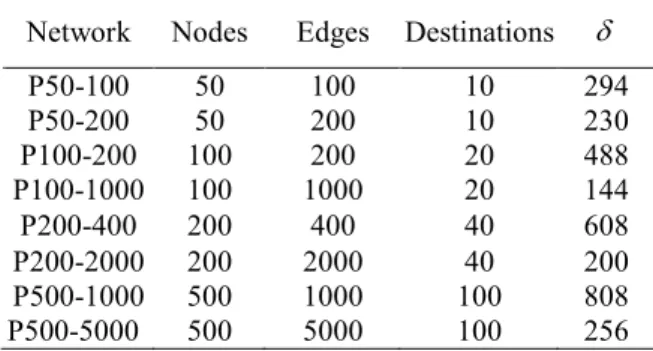
(4) and 2, respectively. The initial pheromone level τ 0 was set to 1 / g 0 . In this study g0 was initially set to 1 before being replaced with the best cost found in the first iteration. The ABDMR stops after 20,000 evaluations, and the WGA stops after 1,000,000 evaluations, because the WGA converges very slowly on dense networks. The population size and mutation rate for the WGA were set to 50 and 0.005, respectively, as in [17]. The simulations were conducted on a PC with a P4 3.0 GHz CPU. Thirty trials were performed on each test problem, and the best solution, average run time, the success rate, and average cost of each 30 trials were recorded. A trial that found no feasible solution was reckoned as failed. The success rate means the percentage of success trials. The results in table 2 show that the ABDMR performed stably on both sparse and dense networks. However, the WGA is very unstably on large and dense networks for its low success rates on some problems. The ABDMRA achieved 100% success rates on all the test problems. Meanwhile, the average and best costs obtained by the ABDMR for the problems were better than those by the WGA. Moreover, the computation times of the ABDMR were significantly shorter than those of the WGA. Figure 1 shows the ratio of the cost achieved by the WGA over that by the proposed algorithm on sparse and dense networks. The proposed algorithm achieved a smaller average cost than the WGA. The performance. Network P50-100 P50-200 P100-200 P100-1000 P200-400 P200-2000 P500-1000 P500-5000. Average cost 666.5 709.5 921.8 1585.2 1794.1 2822.6 5556.6 9693. Best cost 661 650 878 1453 1719 2637 5382 9467. difference between the ABDMR and WGA became more significant on dense and large networks.. Network. Nodes. Edges. Destinations. δ. P50-100 P50-200 P100-200 P100-1000 P200-400 P200-2000 P500-1000 P500-5000. 50 50 100 100 200 200 500 500. 100 200 200 1000 400 2000 1000 5000. 10 10 20 20 40 40 100 100. 294 230 488 144 608 200 808 256. Table 1 Characteristics of test networks. sparse networks. 3. dense networks Cost ratio. number. Table 1 shows some characteristics of the test problems. Pilot experiments were conducted to optimize the parameters α , q0 and ρ for the proposed ABDMR before applying the algorithm to solve the test problems. The pilot experiments indicated that α = 0.06 , q0 = 0.3 and ρ = 0.06 were the best setting. Moreover, the number of ants and β were set to 30. 2. 1. 0 50. This study investigates the bandwidth-delayconstrained multicast routing (BDCMR) problem, and proposes an ant colony-based algorithm (ABDMR) to. 200. 500. Nodes Fig. 1 Ratio between the costs achieved by the WGA and ABDMRA. WGA Runtime Success Average (sec) rate(%) cost 2.48 100 661 3.57 100 575 877.7 6.05 100 11.73 100 968.6 15.59 100 1701.1 32.94 70 1339.1 128.8 100 5037.8 215.67 20 3467.7 Table 2 Simulation results. 5: CONCLUSIONS. 100. ABDMR Best Runtime cost (sec) 661 0.01 575 0.11 875 0.32 964 1.25 1694 3.26 1325 11.72 4997 36.05 3400 77.24. Success rate(%) 100 100 100 100 100 100 100 100. solve it. Simulations were conducted to compare the ABDMR with the methods of Wang et al. (WGA) The ABDMR found better solutions to the test problems than those by WGA, with much shorter computation time than does the WGA. The simulation results suggested. - 494 -.
(5) that the ABDMR algorithm is an efficient and effective approach to the BDCMR problem.. REFERENCES J.W. Ding, S.Y. Tseng, Y.M. Huang, Packet Permutation: A Robust Transmission Scheme for Continuous Media Streams over the Internet, Multimedia Tools and Applications, 21(3) (1993) 281-305. [2] B.M. Waxman, Routing of Multipoint Connections, IEEE Journal of Selected Area in Communications, 6(9) (1988) 1617-1622. Wang, B. Shi, E. Zhao, [3] Z. Bandwidth-delay-constrained least-cost multicast routing based on heuristic genetic algorithm, Computer Communications 24 (2001) 685-692. [4] L. Kou, G. Markowsky and L. Berman, A fast algorithm for Steiner trees, Acta Informatica, 15(2) (1981) 141-145. [5] V. Rayward-Smith, The computation of nearly minimal Steiner trees in graphs, International Journal of Mathematical Education in Science and Technology, 14(1) (1983) 15-23. [6] H. Takahashi and A. Matsuyama, An approximate solution for the Steiner problem in graphs, Mathematica Japonica, 22( 6) (1980) 573-577. [7] E. Gelenbe, A. Ghanwani and V. Srinivasan, Improved neural heuristics for multicast routing, IEEE Journal on Selected Area of Communications, 15(2) (1997) 147-155. [8] P.Chotipat, C. Goutam, S. Norio, Neural network approach to multicast routing in real-time communication networks, Proc. ICNP, (1995) 332-339. [9] A. Kapsalis, V.J. Rayward-Smith and G.D. Smith, Solving the graphical Steiner tree problem using genetic algorithms, Journal of the Operational Research Society, (44) (1993) 397-406. [10] H. Esbensen, Computing near-optimal solutions to the Steiner problem in a graph using a genetic algorithm, Networks, 26 (1995) 173-185.. [1]. [11] Y. Leung, G. Li, Z. Xu, A genetic algorithm for the multiple destination routing problems, IEEE Transaction on Evolutionary Computation, 2(4) (1998) 150-161. [12] Vachaspathi P. Kompella, Joseph C. Pasquale, and George C. Polyzos. Multicast Routing for Multimedia Communication. IEEE/ACM Transactions on Networking, 1(3) (1993) 286-292. [13] M. Parsa , Q. Zhu, J.J. Garcia-Luna-Aceves , An Iterative Algorithm for Delay-Constrained Minimum Cost Multicasting, IEEE/ACM Trans. on Networking, 6(4) (1998) 461-474. [14] Quan Sun, Horst Langendörfer, An efficient delay-constrained multicast routing algorithm, Journal of High Speed Networks, 7(1) (1998) 43-55. [15] F. Xiang, L. Junzhou, W. Jieyi, G. Guanqun, QoS routing based on genetic algorithm, Computer Communications 22 (1999) 1394-1399. [16] Q. Zhang, Y.W. Lenug, An orthogonal genetic algorithm for multimedia multicast routing, IEEE Transaction on Evolutionary Computation 3 (1) (1999) 53-62 [17] C.P. Ravikumar, R. Bajpai, Source based delay-bounded multicasting in multimedia networks, Computer communications 21 (1998) 126-132. [18] A. T. Haghighat, Karim Faez, Mehdi Dehghan, A. Mowlaei, Y. Ghahremani, GA-based heuristic algorithms for bandwidth-delay-constrained least-cost multicast routing, Computer Communications 27(2004) 111-127. [19] M. Dorigo, V. Maniezzo, A. Colorni, The ant system: Optimization by a colony of cooperating agents, IEEE Transaction on System, Man, and Cybernetics, Part B, 26(1) ( 1996) 1-13. [20] M. Dorigo, L.M. Gambardella, Ant colony system: a cooperative learning approach to the traveling salesman problem, IEEE Transactions on Evolutionary Computation, 1(1) (1997) 53-66. [21] Waxman BM (1988) Routing of multipoint connections. IEEE Journal on Selected Area on Communications 1988; 6(9): 1617-1622. - 495 -.
(6)
數據
相關文件
The purpose of this talk is to analyze new hybrid proximal point algorithms and solve the constrained minimization problem involving a convex functional in a uni- formly convex
Abstract We investigate some properties related to the generalized Newton method for the Fischer-Burmeister (FB) function over second-order cones, which allows us to reformulate
This kind of algorithm has also been a powerful tool for solving many other optimization problems, including symmetric cone complementarity problems [15, 16, 20–22], symmetric
Both problems are special cases of the optimum communication spanning tree problem, and are reduced to the minimum routing cost spanning tree (MRCT) prob- lem when all the
• If we know how to generate a solution, we can solve the corresponding decision problem. – If you can find a satisfying truth assignment efficiently, then sat is
Given a graph and a set of p sources, the problem of finding the minimum routing cost spanning tree (MRCT) is NP-hard for any constant p > 1 [9].. When p = 1, i.e., there is only
• Any node that does not have a local replica of the object periodically creates a QoS-advert message contains (a) its δ i deadline value and (b) depending-on , the ID of the node
According to the problem statement and literature reviews, several functionalities are identified for the proposed CBI-PSP, including: (1) a knowledge classifications scheme
