
Extending the Field Access Pointcuts of AspectJ to Arrays
6
0
0
全文
(2) with these field pointcuts. For example, in another project we have attempted to use the field set pointcut to construct an object reference graph for tracking the connectivity and heap memory usage of objects of a set of certain classes in a Java program. This simple scheme of reference recording appears to work. Indeed, recently we also learned of another work adopting an approach quite similar to ours [3]. Unfortunately, due to the lack of information on index values, we are not able to cover the case when the source end of an object reference is an array element. Hence we set out to look for an extension of the field set and reference pointcuts for our project. Soon we realize that we are not the first to consider an extended pointcut for catching setting of array elements. Bruno Harbulot had implemented a version of arrayset pointcut using the Aspect Bench Compiler (abc) [4] of AspectJ. He proposed the following arrayset pointcut designator 1 . before(int i, Object s, Object[] a): arrayset() && args(i, s) && target(a) { System.out.println (" Arrayset: ["+i+"/"+(a.length-1)+"] = "+s) ; }. Here the pointcut designator args(i, s) exposes both the index value i and the object being assigned to an array element, and the pointcut designator target(a) exposes the array object being assigned. However, this extension bases its implementation on treating array element set as a call to a "set(int index, Object newValue)" method, and thus works only for one-dimensional arrays. Besides, there is no stand alone implementation of it that can be downloaded for further experiment. Therefore, we decided to implement a version of our own that can work for multidimensional arrays, and make it available to other interested users 2 . Our implementation is also based on abc, yet we take the standard field set pointcut as the basis and developed our extension on the top of it. The remainder of this article is organized as follows. Section 2 presents the array field pointcut designators we designed for handling array fields of any dimensions. Section 3 describes how we implemented these pointcuts for AspectJ using abc. Section 4 concludes this article.. 2: Array Field Access Pointcuts This section first states our design considerations behind the array field pointcuts and then specifies the proposed pointcuts in detail.. 2.1: Design Considerations. 1. Post to the [abc-users]: Allowing ArrayRef as left-hand side operands for around-weaving, Nov. 18, 2004.. 2. In the beginning, it is tempting to design a general pointcut designator for capturing any array element access following Harbulot work, regardless of whether the array is a class field or not. However, the nature of Java arrays makes this approach too naïve to suit our purpose. Specifically, a multi-dimensional array in Java is actually an array of arrays. On the byte-code level, an assignment to an element of a multi-dimensional array is actually realized by a sequence of assignments to elements of one-dimensional arrays. For example, consider the following assignment to the twodimensional array ss. ss[0][1] = “two join points”;. When translated to bytecode, there are two assignments to two one-dimensional arrays. If we use the pointcut shown before, arrayset() && args(i, s) && target(a), there will be two join points matching it, one for each dimension of ss. Moreover, one of the join points is indeed an assignment to an intermediate array. One may think of generalizing the args designator to catch two-dimensional arrays and re-write the pointcut to the form: arrayset() && args(i1,i2,s) && target(a). But this does not fully solve the problem. Consider the case where we also used another threedimensional array in the same program as follows. sss[0][1][2] = “two join points, too”;. Similarly, using the revised pointcuts, the assignment above will again leads to the matching of two join points. Such ambiguous join point matching is clearly unacceptable and we must avoid it. We address this problem by fixing the array target(s) of interest. Since our main purpose concerns heap memory usage, we only need to focus on arrays which are fields of some class; arrays local to a method are stack-allocated and thus irrelevant. Hence we do not attempt to capture all array element assignments but only assignments to class fields which are arrays. To realize this, we include a specification of field signature in our array set/get pointcuts. As will become clearer later, this decision will save us from the ambiguous matching of join points described above. Furthermore, assignments to a multi-dimensional array can take several forms. Our array field set pointcuts must be flexible enough to select any assignment form. For example, consider the following variety of assignments to the three array fields of class Watch. 01 class Watch { 02 String [][][] sss= new [2][2][2]; 03 String [][] ss= {{“x”,”y”},{“w”,”z”}}; 04 String [] s= {“abc”, “def”}; 05 sss[0] = ss; 06 sss[0][1] = s; 07 sss[0][1][1] = “change”; 08 ss [0] = s; 09 ss[0][1] = “Me too”; 10 s[0] = ss[1][1]; … }. http://www.cs.nccu.edu.tw/~chenk/download. - 471 -.
(3) There are six array element assignments and thus six array field set join points above (Line 5, 6, 7, 8, 9 and 10). Our array field set pointcuts should be able to select all of them, either individually or as a group. Similar requirements also exist for the array field get pointcut. Finally, we intend to make our new pointcuts a conservative extension of the standard field pointcuts. In particular, they should be as orthogonal as possible to the other AspectJ pointcuts that can work with the standard field pointcuts. This will make writing pointcut composition using our array field pointcuts as easy as using the original field pointcuts.. 2.2: Specification of the New Pointcuts Basically, our array field pointcuts look very like the standard field pointcuts. Specifically, the pointcut designators we propose for them take the following arrayset(aFieldSignature) and forms: arrayget(aFieldSignature). The former catches assignments made to all array fields that match the signature specification, while the latter catches references to array fields. The key change is that these new pointcut designators concern only class fields of array types. Hence they must take array index values into account. We shall explain array field set pointcut first. Essentially, all array filed set join points are treated as having a variable number of arguments: the sequence of index values and the value the field is being set to. At a join point, these values can be obtained using an args() pointcut designator and then passed to the advice for further processing. For example, the following aspect uses the arrayset() and args() pointcut designators to monitor the assignments to any array fields of class Watch declared above. aspect Monitor { before(int ix1, int ix2, int newVal): arrayset(* Watch.*) && args(ix1, ix2, newVal) { //advice if (newVal > B.bounds[ix1, ix2]) { ArraySetSignature sig = (ArraySetSignature)tjp.getSignature(); String field = sig.getFieldType() + sig.getName(); throws new RuntimeException("Bad change"+ field) } }. Here we use the pointcut designator args(ix1, ix2, newVal)to get the array index values and the assigned value of the array field assignments. Moreover, like the standard pointcuts in AspectJ, the other join point context can be accessed inside the advice body through the object, thisJoinPoint, (abbreviated as tjp above). But note that, to handle the particular requirements of arrayset, we have extended the standard field set signature, FieldSetSignature, to a new signature called ArraySetSignature. Through the. ArraySetSignature object, sig, we can obtain the detailed information regarding the field being set. Astute readers may notice that class Watch has three array fields of different dimensions, and wonder assignments to which of them will be captured by the aspect Monitor, or whether we can capture any particular set(s) of assignments of the six assignments given there. Indeed, this is exactly one of the requirements we stated in Section 2.1. Here the pointcut designator args(ix1, ix2, newVal)also serves this requirement of selective matching of array field set join points. Specifically, it makes the aspect capture only array assignments whose left-hand side has two index values, which in this case are the assignments in Line 6 and 9. Had we instead specified the pointcut designator args(ix, newVal), aspect Monitor will capture the assignments whose left-hand side has only one index value, namely, assignments in Line 5, 8, and 10. What if we wish to capture all the six assignments? This can be achieved by intentionally leaving out the args() pointcut designator and simply write the pointcut designator arrayset(* Watch.*), which will capture all assignments to the array fields of Watch. A subsequent question is then how we obtain the index values and assigned value. The answer is simple: inside the associated advice, use the method thisJoinPoint.getArgs(), which will return an object array containing the index values and assigned value. Compared to using the args designator for picking out index values directly, calling this method inside the associated advice provides great flexibility in situations where the dimension of the array to be dealt with is unknown in advance, as well as when we intend to use one universal pointcut and a single piece of advice for catching assignments to a set of arrays of different dimensions. For example, the following advice catches assignments to all array fields of classes of package data. void around() : arrayset( * data.*.* ) { try { ArraySetSignature sig = (ArraySetSignature)tjp.getSignature(); Object[] args = tjp.getArgs(); Integer rhsValue = (Integer)args[args.length-1]; if (rhsValue.intValue() > MAX) { Log.add("Warning: " + sig.getName()); for (int i=0; i<args.length-1; i++) { Log.add("["+ args[i] +"]"); Log.add(" exceeds MAX"); } proceed(); } catch(IndexOutOfBoundException e) {} }. The case for arrayget is very similar. The only significant difference is when it is used with args(), the context values exposed by args() include only the index values, but not the value of the array element being read. To get that value, we can use the after-returning advice as follows.. - 472 -.
(4) after(int ix1, int ix2, Object val) returning(Object val): arrayget(* Watch.*) && args(ix1, ix2) { // advice body … } }. assignment to an element of the array field a of class C in Java.. When specified in aspect Monitor, the advice above will capture the array element reference used in Line 10 of the Watch class example. Furthermore, we can also use arrayset/arrayget with other pointcut designators such as target(), within() and withincode() following the same style with that of the standard field set/get pointuts.. 3: Implementation This section describes the main techniques for implementing our arrayset pointcut. We use the AspectBench Compiler (abc) for AspectJ [4] to implement the arrayset pointcut. Basically, we follow the standard steps outlined by the abc team to develop this extension of AspectJ [5], and our model implementation is the field set/get pointcuts of AspectJ. Among the steps, only the identification of join point shadows and the extension of the pointcut matcher of abc are non-trivial and worth mentioning. Furthermore, since the implementation of arrayget is very similar to that of arrayset, we shall focus on arrayset only in the following discussion. In the AspectJ language model, every dynamic join point has a corresponding static shadow in the bytecode or source code of the program [6]. To insert a piece of advice into the underlying program, the AspectJ compiler must first find the designated join point shadow. Most shadows in AspectJ are easily identified from the bytecode: they are either a single bytecode statement or a bounded region of bytecode. For example, the shadow for a method call join point corresponds to a single bytecode instruction, invokevirtual, while the shadow for a method execution is the entire code segment of the method. The shadow for setting an array element also falls into the second category. However, unlike the case of method execution where the “return” instruction marks the clear end of a shadow, setting an element of a multi-dimensional array calls for a more elaborate test for the end of a shadow. To illustrate the issues involved, we need to examine the bytecode pattern generated by a typical Java compiler for assignments to an element of a multidimensional array. Basically, all Java arrays are really one-dimensional arrays; multi-dimensional arrays are supported through arrays of arrays. Although setting an array element on the source code level, regardless of array dimension, is simply an atomic statement, it involves more intermediate steps on the bytecode level. Since the bytecode used by abc is Jimple, which is a simple, typed, and 3-address (stackless) intermediate representation of Java bytecode [7], we shall use Jimple code to show the details. Consider the following. class C { … Object a[][][] = new Object[2][2][2]; … a[0][1][2] = new String("foo"); … }. The Jimple code to implement the above assignment is shown as follows. #1: #2: #3: #4: #5:. $r2 = r0.<C:java.lang.Object[][][]a> $r3 = $r2[0] $r4 = $r3[1] $r5 = new java.lang.String specialinvoke $r5.<java.lang.String: void <init>(java.lang.String)>("foo") #6: $r4[2] = $r5. Instruction #1 references the array field a, thus marking the beginning of the array field join point shadow. Since a is a three-dimensional array, the abc compiler employs three intermediate one-dimensional arrays to set the element of a, namely, r2, r3, and r4. While the instruction #1 starts the task, the real assignment to a[0][1][2] is conducted only until instruction #6. Hence the join point shadow for this array element assignment must extend from instruction #1 to instruction #6. In general, the shadow for array element assignment is a block of Jimple instructions of indefinite length. Besides, there is no simple signpost, such as the “return” instruction, for marking the end of the shadow. Indeed, to determine whether a sequence of Jimple instructions implements an assignment to an array element on the Java source level, we have to keep a memory of the target array and all intermediate arrays ever encountered. Therefore, we developed a finite-state machine (FSM) based pointcut matcher for identifying the join point shadow of array field assignments. The key steps of our shadow matcher are embodied in the FSM; hence we shall describe the operations of the FSM in detail. Basically, the FSM takes one Jimple assignment statement as the input at a time. It will examine the contents of the current assignment using some auxiliary functions and take proper state transitions until the ending state is reached. In particular, the FSM uses the following functions during its operation. 1. getNext(): returns the assignment statement following the current one. 2. hasNext(): checks the existence of a next assignment; that is, checks if the end of a method body has been reached. 3. instanceOf(variable, type): checks if variable is an instance of type type. 4. getRhs(assignment): returns the variable on the. - 473 -.
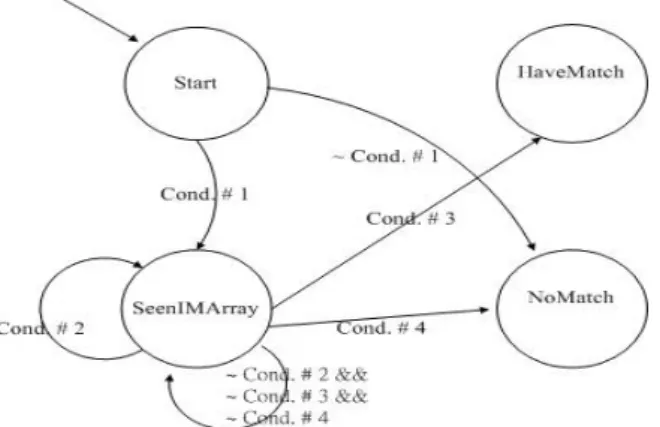
(5) RHS of the assignment. 5. getLhs(assignment): returns the variable on the LHS of the assignment. 6. equalBase(var1, var2): checks if var1 and var2 refer to the same variable. Figure 1 illustrates the valid state transitions of the FSM. There are four states in the FSM, namely Start, SeenIMArray, HaveMatch, and NoMatch, where Start is the initial state and HaveMatch and NoMatch are the ending states. The state transitions among them are determined by the following conditions. z Cond. #1: instanceOf(getRhs(ca), ArrayFieldRef) z Cond. #2: instanceOf(getRhs(ca), ArrayRef) && equalBase(getRhs(ca), ima) && instanceOf (getLhs(ca), Local) z Cond. #3: instanceOf(getLhs(ca), ArrayRef) && equalBase(getLhs(ca), ima) z Cond. #4: !hasNext() Here “ca” stands for the current assignment statement under examination and “ima” for the current intermediate array involved in the assignment (assignee on the left-hand side). We have also used three Jimpledefined types, “ArrayFieldRef”, “ArrayRef” and “Local”, as the second argument to the instanceOf function in the conditions. These function calls check whether the first argument is a class-level variable of the array type, a method-level variable of the array type, or a methodlevel variable of any type, respectively.. the NoMatch state and terminate the matching process. For example, the instruction #1 above indeed starts the join point shadow. Thus the FSM will set ima to r2 and move to SeenIMArray state. Once the FSM has entered the SeenIMArray state, the matchesAt(…) method will iterate through the rest of statements in the method and examine every statement encountered to take proper state transitions according to condition #2, #3 or #4. During the iteration, there are two kinds of situations which will make the FSM stay in the SeenIMArray state. The first kind is specified by Cond. #2, which will be true when an element of the current intermediate array (ima) is assigned to a local variable, such as instruction #2 and #3 above. This amounts to checking if the current assignment statement is an intermediate step of the assignment to an element of a multi-dimensional array. When such cases happen, we shall update the intermediate array (ima) to the local variable on the left-hand side of the current assignment. The other kind corresponds to the scenarios where some irrelevant statements are encountered and none of the Cond. #2, #3 and #4 is true, such as instruction #4 and #5 above. Besides, there are two specific situations which will move the FSM out of the SeenIMArray state. The first one happens when we find the matching array element assignment that marks the end of an arrayset join point. Cond. #3 specifies how we know the matching assignment is encountered. Essentially, if the intermediate array (ima) appears as an element reference on the left-hand side of the current assignment, we know that the end of the arrayset join point shadow is found and we can move to the HaveMatch state, such as the instruction #6 above. Another way to leave the SeenIMArray state is when the end of the method body is reached, which makes Cond. #4 true and moves the FSM to the NoMatch state. After successfully identifying the join point shadow for an arrayset pointcut, the rest of work is pretty standard. We shall prepare the context information and set up the thisJoinPoint object accordingly.. 4: Conclusions Figure 1: The FSM of the Shadow Matcher The entry point of our pointcut matcher is the matchesAt(…) method, which is registered as a callback routine of the abc compiler. When the matchesAt(…) method is invoked for checking the existence of the arrayset join point shadow in the underlying method, . The first task of the matchesAt(…) method is to check that if the current assignment statement is a potential starting instruction of a join point for an arrayset pointcut, namely one with an array field of interest is referenced. If so, Cond. #1 is met and thus the FSM will set ima to the array variable assigned and move to the SeenIMArray state; otherwise the FSM simply moves to. In this paper, we have stated our motivation to extend the field pointcuts of AspectJ to array objects. Our extension is designed to be a conservative one that follows the syntax and semantics of the standard field pointcuts as much as possible. We have also described our implementation of the array field reference pointcuts based on the Aspect Bench Compiler for AspectJ. Due to the nature of Java arrays, the identification of join points for accessing array elements is not directly supported by the pointcut matching mechanism of abc. Therefore, we have developed a finite-state machine based pointcut matcher to realize our requirements. In the future, we shall apply the new pointcuts to our project of Java object memory consumption tracking for further evaluating them.. - 474 -.
(6) 5: References [1] Kiczales, G., Lamping, J., Menhdhekar, A., Maeda, C., Lopes, C., Loingtier, J.M., and Irwin, J., “Aspect-Oriented Programming”, in Proceedings of the 11th European Conference on OOP, LNCS 1241, pp. 220-242, 1997.. [2] Kiczales, G., Hilsdale, E., Hugunin, J., Kersten, M., Palm, J., and Griswold, W.G., Getting Started with AspectJ, Communications of ACM 44, No. 10, pp. 59-65. AspectJ website: http://www.eclipse.org/aspectj/. [3] Morgan Deters, Nicholas A. Leidenfrost, Matthew P. Hampton, James C. Brodman, Ron K. Cytron, "Automated Reference-Counted Object Recycling for Real-Time Java", Proceedings 10th IEEE Real-Time and Embedded Technology and Applications Symposium, May 2004.. [4] P. Avgustinov, A. S. Christensen, L. Hendren, S. Kuzins, J. Lhot’ak, O. Lhot’ak, O. de Moor, D. Sereni, G. Sittampalam, and J. Tibble. “abc: An extensible AspectJ compiler”. Proceedings of the 4th International conference on AspectOriented Software Development (AOSD 2005), Chicago, USA, pp. 87-98, 2005. [5] Programming Tools Group, University of Oxford, Sable Research Group, McGill University and BRICS, Aarhus Universitet, “abc: An extensible AspectJ compiler”, Slides from: http://abc.comlab.ox.ac.uk/documents/aosdnew.pdf [6] Hilsdale, E. and Hugunin, J., “Advice Weaving in AspectJ”, Proceedings of the 3rd Inte’l Conference on Aspect-Oriented Software Development, Lancaster, UK, pp. 26-35, 2004. [7] Raja Vallee-Rai and Laurie J. Hendren, "Jimple: Simplifying Java Bytecode for Analyses and Transformations", Technical Report, Sable Group, McGill University, July 1998.. - 475 -.
(7)
數據
相關文件
(Another example of close harmony is the four-bar unaccompanied vocal introduction to “Paperback Writer”, a somewhat later Beatles song.) Overall, Lennon’s and McCartney’s
Promote project learning, mathematical modeling, and problem-based learning to strengthen the ability to integrate and apply knowledge and skills, and make. calculated
After students have had ample practice with developing characters, describing a setting and writing realistic dialogue, they will need to go back to the Short Story Writing Task
Now, nearly all of the current flows through wire S since it has a much lower resistance than the light bulb. The light bulb does not glow because the current flowing through it
We point out that extending the concepts of r-convex and quasi-convex functions to the setting associated with second-order cone, which be- longs to symmetric cones, is not easy
volume suppressed mass: (TeV) 2 /M P ∼ 10 −4 eV → mm range can be experimentally tested for any number of extra dimensions - Light U(1) gauge bosons: no derivative couplings. =>
• Formation of massive primordial stars as origin of objects in the early universe. • Supernova explosions might be visible to the most
This kind of algorithm has also been a powerful tool for solving many other optimization problems, including symmetric cone complementarity problems [15, 16, 20–22], symmetric
