行政院國家科學委員會補助專題研究計畫
行政院國家科學委員會補助專題研究計畫
行政院國家科學委員會補助專題研究計畫
行政院國家科學委員會補助專題研究計畫
□ 成 果 報 告
□ 成 果 報 告
□ 成 果 報 告
□ 成 果 報 告
□期中進度報告
□期中進度報告
□期中進度報告
□期中進度報告
超快光譜高速掃描系統的開發
計畫類別:□ 個別型計畫 □ 整合型計畫
計畫編號:NSC98-2112-M-009-001-MY3
執行期間: 98 年 04 月 01 日至 100 年 07 月 31 日
計畫主持人:籔下篤史
共同主持人:
計畫參與人員:
成果報告類型(依經費核定清單規定繳交):□精簡報告 □完整報告
本成果報告包括以下應繳交之附件:
□赴國外出差或研習心得報告一份
□赴大陸地區出差或研習心得報告一份
□出席國際學術會議心得報告及發表之論文各一份
□國際合作研究計畫國外研究報告書一份
處理方式:除產學合作研究計畫、提升產業技術及人才培育研究計畫、
列管計畫及下列情形者外,得立即公開查詢
□涉及專利或其他智慧財產權,□一年□二年後可公開查詢
執行單位:國立交通大學
附件一 V V V V(
二)中、英文摘要及關鍵詞(keywords)。
中文摘要 光化學反應在人類生活中扮演重要角色,這方面的超快光化學研究稱為”飛秒化學”。絕 大部分有趣的光化學反應位於可見光波段,也因此產生可見光波段短脈衝雷射的 NOPA(非 共線光參數放大器)不斷被研究發展,其產生的寬頻帶光適用於研究中間物質的超快動態行 為以及反應中分子結構的瞬態變化。 在我們研究室已完成了 NOPA 系統的架設並可產生 10 飛秒以下的雷射脈衝,配合使用 多頻道鎖相放大器提升訊雜比,進行寬頻帶時間解析的超快光激發探測研究,將每一頻道 所偵測到的超快動態反應完整紀錄。 然而,在低頻以及偵測數百飛秒以上長時間訊號變化上,是很難得到重複性高的實驗結 果的。因為當實行光激發探測量測時,1 皮秒時間延遲的單一掃描所需要時間長達一小時, 而 NOPA 系統是靠高階非線性效應來產生脈衝,很容易受環境的溫溼度變化或系統周圍氣 流影響穩定度,所以即使人為加以維持控制也很難保持所有條件不變。 這份計畫是要發展快速掃瞄激發探測系統,並與現有的多頻道量測系統結合;當單一掃 描在數秒內完成(快速掃瞄激發探測)時,無論是多長的時間延遲皆可得到重複的量測訊號 (100 飛秒到 10 皮秒)!它將可以提供我們不同物質更多的飛秒動力學資訊以及光化學反應中 的各種反應機制。 英文摘要Photochemical reactions are of vital importance in human life. Lives are utilizing light for two essentially important purposes in their life. One is the energy source and the other is the information source. The most widely found processes in the former and the latter are photosynthesis and vision, respectively. Photosynthes is the process in plants to fix carbons and provide oxygen in air to form bodies of plants, which in turn become food of animals. Hence, the solar energy is the sources of all livings on the earth . In visual processes, photo-isomerization is initial process of photo-sensor protein. Ultrafast photo processes is also applicable for optical memory or switch. Therefore, these ultrafast photochemical reactions have recently been studied widely for many years in all over the world, called as “femto-chemistry”, which clarified ultrafast phenomena in photochemical reactions.
Interesting photochemical reactions are generally active in visible wavelength region, therefore the technique to generate shortest visible laser pulse was studied hard in these years. In Advanced Laser Research Center (ALRC) of National Chiao-Tung University (NCTU), I have built up a Non-collinear optical parametric amplifier (NOPA) system to generate sub-10fs visible pulse, which can be used for pump-probe measurement to study ultrafast dynamics of various materials. Multi-channel measurement system was also built up for simultaneous observation in broadband spectrum with good signal-to-noise ratio. Using both of them, time-resolved measurement to study ultrafast dynamics can be performed in broadband probe spectral range.
This project is planned to develop a fast scan pump-probe system combined with the multi-channel lock-in amplifier (MLA) system. If one scan of pump-probe measurement can be finished in several seconds (fast scan pump-probe), the observed result can provide reproducible results even for slow dynamics (from 100fs to 10ps). It will provide us full knowledge about the ultrafast dynamics of those materials, and help us to elucidate mechanism of ultrafast phenomena in photochemical reactions of various materials.
關鍵詞
Laser
雷射
Ultrafast spectroscopy
超快光譜
Nonlinear optics
非線性光學
Femtochemistry
飛秒化學
Photochemistry
光化學
Photobiology
光生物學
(
三)報告內容:
前言 前言前言 前言
Photochemical reactions Photochemical reactionsPhotochemical reactions
Photochemical reactions are quite useful for human life as explained below. Photosynthesis process in plants provides oxygen for all livings. Photo-isomerization process in rhodopsin (a protein which works as light sensor in eye) is the initial process when a light sensor protein, rhodopsin, catches light on retina of eye. Ultrafast photo processes in materials can be used as a gimmick for optical memory or switch.
Useful photochemical reactions are generally active in visible wavelength region, which can be studied by ultrashort visible laser pulses generated by non-collinear parametric amplifier (NOPA). Because of its smooth and broad spectrum, the NOPA pulse enabled us to observe ultrafast phenomena in broadband spectral range for the study of probe wavelength dependency of ultrafast dynamics. It helps to clarify ultrafast dynamics of intermediates in the chemical reactionultrafast dynamics of intermediates in the chemical reactionultrafast dynamics of intermediates in the chemical reactionultrafast dynamics of intermediates in the chemical reaction. But also, the ultrashort duration of the pulse width makes it possible to time-resolve the motion of molecular vibration. It enables us to study realrealrealreal----time change of molecular structures of transient states in the time change of molecular structures of transient states in the time change of molecular structures of transient states in the time change of molecular structures of transient states in the photochemical
photochemical photochemical
photochemical reactions. reactions. reactions. After development of multi reactions. multimultimulti----channel lockchannel lockchannel lock----in amplifier (MLA) systemchannel lockin amplifier (MLA) systemin amplifier (MLA) systemin amplifier (MLA) system, ultrafast dynamics at every probe wavelengths can be measured the lock-in detector arrays in a broad spectral range in the same time in the same time in the same time in the same time.
However, one scan of those measurement costs around 1 hour. Therefore, long-term instability of light source contaminates obtained signal seriously, which makes it difficult to obtain reliable data. The other problem caused by long-time measurement period is that the sample is damaged under long-time irradiation by ultrashort laser pulses.
In this project, I plan to develop a fast-scan ultrafast spectroscopy system, which enables us to perform one scan of the ultrafast spectroscopy in several seconds. It is expected to solve above problems being one of the most useful methods for ultrafast spectroscopy.
研究目的 研究目的研究目的
研究目的 (Target of this project)
In Advanced Laser Research Center (ALRC) of National Chiao-Tung University (NCTU), I have built up a NOPA system to generate sub-10fs visible pulse, which can be used for pump-probe measurement to study ultrafast dynamics of various materials. Multi-channel measurement system was also built up to use together with the ultrashort visible laser pulses. Using both of them, time-resolved measurement can be performed in broadband probe spectral range to study ultrafast dynamics.
However, it is difficult to obtain reproducible result especially for low frequency modes
and quantitative change observed in long time scale like several hundred femtoseconds. The
reason is explained in the following. One scan of pump-probe measurement typically costs almost one hour when we want to observe ultrafast dynamics up to 1 picosecond delay time including information of molecular vibration. The light pulse intensity of NOPA, generated by high order nonlinear effect, can be easily affected by environment like temperature, humidity, and airflow around the system, even though we are trying to avoid these environmental effects as far as
possible, The timescale of the modulation is generally in the order of minutes. Even in the current system, we can accurately observe fast signal, like fast decay signal and real-time molecular vibration because NOPA intensity is stabilized in short timescale of seconds by gain saturation in the optical amplification process of NOPA. However, the instability in timescale of
minutes lowers the reproducibility for low frequency modes observed in the signal.
This project is planned to develop a fast scan pump-probe system combined with the
multi-channel lock-in amplifier (MLA) system. If one scan of pump-probe measurement can
be finished in several seconds (fast scan pump-probe), the observed result can provide
reproducible results even for slow dynamics (from 100fs to 10ps). It will provide us full knowledge about the ultrafast dynamics of those materials, and help us to elucidate mechanism
of ultrafast phenomena in photochemical reactions of various materials. The fast scan pump-probe was never tried with MLA system because of its technical difficulties, and it is a very challenging project.
研究方法
研究方法
研究方法
研究方法 (Research method, procedure and execution schedule)
I have already built up the sub-10fs visible pulse and multi-channel lock-in amplifier (MLA) system in the project of Advanced Laser Research Center (ALRC) in National Chiao-Tung University. The project is going to advance in the direction of broader bandwidth generation to develop a measurement system for wider variety of materials that can be investigated with the system. However, during the development in ALRC, I found the instability of light source in long time scale of minutes makes serious problem for analysis of relatively slow dynamics in time range of 100fs to 10ps. To solve this problem, it is necessary to develop a "fast scan" system, which can finish one scan of pump-probe measurements in several seconds. However, the development is quite independent from the direction of the ALRC project. This is the reason why I am applying this project as an independent project. The difficulties in this project are shown in the following together with the possible solutions and schedule.
(1st difficulty : to be solved in the 1st year)
The first difficulty is that a single scan of fast scan measurements should finish in the same time period of several seconds without any delay. During the fast scan on the MLA system, the data cannot be sent to computer to avoid any delay in the scan. The MLA system built in ALRC has memory function. The difficulty can be solved if the fast scan pump-probe data can be stored in the memory. This is planned to be done in the first year of the project by developing software to handle the data storage in the fast scan measurement.
(2nd difficulty : to be solved in the 2nd year)
The second difficulty is that the motorized stage used for standard pump-probe measurement cannot be synchronized well with multi-channel lock-in measurement system, because the stage cannot be synchronized with external trigger signal, which can be used for triggered operation of the lock-in system. Bad synchronization deadens fine time scale signals, like molecular vibration signals observed in pump-probe signal. The problem of bad synchronization can be solved as
follows. In the pump-probe measurement system, we install a fast scan stage, which can be operated by external voltage, and develop an electronic circuit system to scan the fast scan stage synchronized with external trigger signals. Via external trigger signal generated by laser controller, the lock-in system and the fast scan stage can be synchronized well to obtain fine time-resolution even in the fast scan measurement.
結果與討論(含結論與建議) 結果與討論(含結論與建議)結果與討論(含結論與建議) 結果與討論(含結論與建議)
Until this project starts, all of the pump-probe measurements were performed by scanning the motorized stage step by step (called as "step-scan method" in below), and the scan speed could not be fast enough because of the limitation of its speed; the stage should wait at least 600 millisecond before it proceeds for next step. Following the schedule of "Research method, procedure and execution schedule", I started to consider how to solve above problem.
I have developed a system, which emulates the "fast-scan" method. For the estimation of improvement obtained by the system, I demonstrated pump-probe measurement of an organic polymer of poly(3-hexylthiophene) (P3HT) in step-scan measurement and fast-scan emulation. The P3HT is widely studied as a material for organic solar cell, thought to be a promising low-cost replacement for conventional silicon photovoltaics. However, its ultrafast dynamics under photo-excitation is still unknown. Ultrafast time-resolved spectroscopy by NOPA pulses has the ability to elucidate those ultrafast dynamics.
(1) Step-scan measurement of P3HT
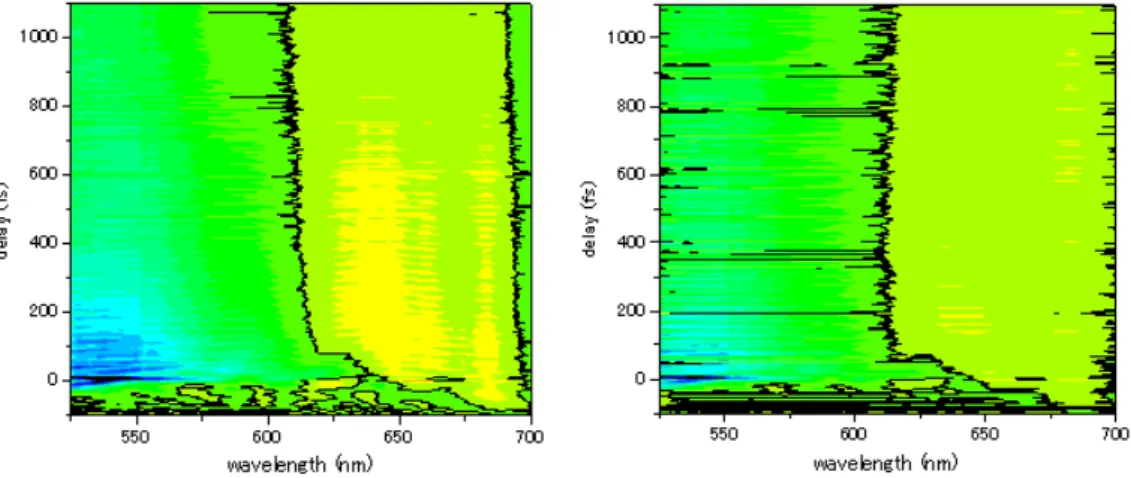
Pump-probe signal of P3HT film was obtained as difference absorption spectra (∆A) by using the ordinal step-scan method consisting of 96 data points in 515-756 nm spectral region and 1200 data points with a 1-fs step between -100 and 1100 fs delay time. At first, delay time was scanned from -100fs to 1100fs (forward scan). Inverse delay scan, from 1100fs to -100fs (backward scan), was performed after the forward scan. Pump-probe data obtained in the two scans are shown in Fig. stepscan-1.
Fig. stepscan-1. Time-resolved difference absorption spectra (∆A) obtained by the step-scan method scanning delay forward (left) and backward (right). Black curves show the point where ∆A=0.
(1-1) Commonly observed electronic dynamics
Figure stepscan-1 shows the sign of ∆A is different in shorter wavelength region (λ<620nm) and longer wavelength region (λ>630nm). It is because the signals in those regions are affected by different electronic states. In shorter wavelength region, where P3HT has strong absorption, ∆A signal has negative value, dominated by photo-bleach of electronic ground state. Positive ∆A signal is thought to be dominated by photo-induced absorption of electronic excited state.
(1-2) Poor reproducibility between forward and backward scans (damage on the sample cause by long measurement time)
However, the ∆A traces of forward and backward scan seems quite different to each other. Forward scan data shows oscillatory signal of wavepacket motion reflecting molecular vibration of P3HT, however backward scan data does not. Signal quality of backward scan seems to be poorer than the other. It can be explained as follows.
To observe real-time molecular vibration signal in pump-probe measurement, we used 10-fs visible NOPA pulse having high peak intensity. And, one scan of the step-scan measurement costs around 1 hour. Therefore P3HT film was damaged even during the first forward scan, and the damage on the sample contaminated backward scan data seriously.
(1-3) Poor signal of molecular vibration (long-term instability of light source)
For the estimation of signal to noise (S/N) ratio, Fourier transform power spectra were calculated for those ∆A traces in the delay time region between 100 and 1100 fs as shown in Fig. stepscan-2.
Pump-probe method excites molecular vibration modes via stimulated Raman excitation, therefore Fourier power spectra of ∆A traces can reflect Raman spectra of the sample. Raman spectrum studied in previous work showed prominent peaks at 726, 1376, and 1450 cm-1. However, in Fourier power spectra, the most intense Raman mode (1450 cm-1) is almost comparable with other modes, considered as noise signal because of non-reproducibility between forward and backward scans in Fig. stepscan-2. The large noise in Fourier power spectrum is explained as follows.
Fig. stepscan-2. Fourier power spectra of ∆A traces obtained in forward (left) and backward (right) scan using the step-scan method.
In step-scan measurement, because of several limitations (speed of motorized stage, time constant of lock-in amplifier, etc.) 1-fs delay can be scanned at speed of 3 seconds. Therefore, 1450 cm-1 molecular vibration mode whose frequency is 1450 cm-1 (period is 23.0 fs) modulates ∆A signal on detector with 69 seconds. It is difficult to be observed by NOPA pulses, which tend to have long-term intensity instability explained as follows. NOPA uses high order non-linear interaction inside, therefore if the character of excitation source of NOPA is slightly modulated by some environmental perturbation, NOPA intensity can be largely affected. Environmental perturbation, like wind, temperature change, and humidity change, generally occurs in long timescale like several seconds, being origin of long-term instability of NOPA intensity.
(2) Emulation of fast-scan measurement by the step-scan motorized stage (for usefulness evaluation of fast-scan method)
A fast-scan method, which is going to be built up in this project, is expected to solve above problems of step-scan method. To confirm that the fast-scan method can solve those problems, I have developed a program, which emulates the fast-scan measurement system with the same motorized stage used for the step-scan method as explained in the following sections. The motorized stage has several problems in usage for fast-scan emulation, however the result obtained in the experimental setup persuaded us that the fast-scan method works much better than the step-scan method.
(2-1) Synchronization between motion of motorized stage and data storage into multi-channel lock-in amplifier (MLA)
The motorized stage used for the step-scan can continuously move in a fixed range with a constant speed. If the storage interval of pump-probe data into a memory of multi-channel lock-in amplifier can be synchronized with the continuous motion of motorized stage, fast-scan measurement can be performed. In the fast-scan emulation program, move command is sent to the stage just after sending the start trigger signal to MLA, which minimizes the delay between the start of the stage movement and the start of data storage in MLA.
However, the continuous scan of the motorized stage cannot be controlled by external trigger signals, which means there is no way to perform perfect synchronization between the stage and MLA. Therefore, the continuous motion of the motorized stage and data storage in MLA were independently controlled by their own internal clocks in the fast-scan emulation program. Because of the small fluctuation in those internal clocks, signal obtained in the fast-scan emulation can be contaminated slightly.
(2-2) Reproducible pump-probe signal measured by fast-scan emulation
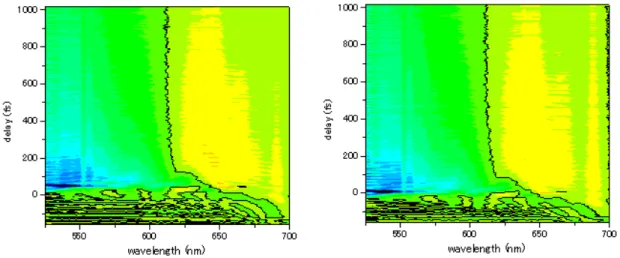
Figure fastscanemulation-1 shows ∆A traces obtained by the fast-scan emulation program in forward and backward scans, which shows good reproducibility between forward and backward scans.
One scan of fast-scan emulation costs 5 seconds for 500 points accumulating data for 10 milliseconds at each delay points. The time constant of sample damage caused by laser pulse irradiation is thought to be about minutes time scale, which is much slower than scanning time of single fast-scan emulation. Therefore, the effect of sample damage, which was serious problem in the step-scan method, becomes negligible on the measured data of fast-scan emulation.
(2-3) Clear molecular vibration signal in fast-scan emulation
Fourier power spectra of the ∆A traces were calculated traces in the delay time region between 100 and 1000 fs (see. Fig. fastscanemunation-2).
Both of the Fourier power spectra show prominent peaks at around 726 and 1450 cm-1, which reflects well the Raman modes, and absence of other modes shows that noise is quite low in signals. Good reproducibility between Fourier power spectra of forward and backward scans certificates the reliability of the measured signals. There are some problems in the observed signals, but they can be solved as follows.
Fig. fastscanemulation-1. ∆A traces of fast-scan emulation scanned forward (left) and backward (right). Black curves show the point where ∆A=0.
Fig. fastscanemulation-2. Fourier power spectra of ∆A traces obtained in forward (left) and backward (right) scan of the fast-scan emulation.
The peaks of 1376 and 1450 cm-1 of Raman modes are mingled together in the Fourier power spectra because the delay region was not enough to resolve those peaks. Measurement in longer time region will solve the problem of frequency resolution. Fourier spectra of backward scan show an intense signal round 500cm-1 that is possibly caused by poor synchronization between the motorized stage and MLA. It will be solved after I develop a real fast-scan measurement system, which perfectly synchronizes the stage and MLA in 2nd year.