E L S E V I E R Surface and Coatings Technology 92 (1997) 206-211
COATIN6S
II#OLO T
Ion nitriding of equiatomic TiNt shape memory alloys II.
Corrosion properties and wear characteristics
S.K. Wu *,
C.L.
Chu, H.C. Lin 1
Institute of Materials Science and JEngineering, National Taiwan Universit); Taipei 106, Taiwan Received 2 January 1997; accepted 10 March I997
Abstract
The corrosion properties and wear characteristics of TisoNis0 and TisoNi40Cule shape memory alloys with and without ion nitriding were investigated by acid immersion test, electrochemical potentiodynamic measurement and sliding wear test. Experimental results indicate that the non-ion-nitrided TiNt specimens are easily attacked by the HC1 and H~_SO4 solutions. However, their corrosion properties in these solutions can be markedly improved by ion nitriding. The improved corrosion resistance is attributed to the TiN compound formed in the outermost part of ion-nitrided layers. In addition, the ion-nitrided TiNt specimens, being hardened by the TiN/Ti2Ni compound layers, can exhibit excellent wear resistance and a low friction coefficient. © 1997 Published by Elsevier Science S.A.
Keywords: Ion nitriding; Shape memory alloys; TiNt alloys
1. Introduction
Among the many shape memory alloys (SMAs), TiNt alloys are the most popular because they possess superior properties in shape memory effect (SME) [1] and pseudoelasticity (PE) [2,3]. Most of their industrial applications may not involve any corrosion problems. Nevertheless, for applications in orthopedic surgery and medical implantation, or for structural components in corrosive environments, corrosion could be a very criti- cal problem. Several investigations [4-8] have been performed on the corrosion resistance of TiNt alloys. These studies concluded that the TiNt alloys can exhibit fairly good corrosion resistance due to the formation of a thin passive film. However, this passive film can be locally destroyed in some specific environments leading to the occurrence of corrosion. Hence, the improvement of the corrosion resistance of TiNt alloys is necessary to extend their applications in corrosive environments.
Nitriding techniques are often used to increase the surface hardness and to improve the fatigue and wear resistance of metals and alloys [9]. In Part I of this study [10], we found that the surface hardness of
* Corresponding author.
1Present address: Department of Materials Science, Feng Chia University, Taichung 400, Taiwan.
TisoNiso and TisoNi4oCulo alloys can be significantly improved by ion nitriding. This improvement in surface hardness is attributed to the formation of TiN and Ti2Ni in the surface layers. Nitriding techniques have also been used to improve the corrosion resistance of titanium and titanium alloys [ti-17]. However, to the best of our knowledge, there have been few investiga- tions on the corrosion characteristics of ion-nitrided TiNt alloys. In the present study, the corrosion proper- ties of ion-nitrided Tis0Niso and TisoNi4oCuzo alloys in hydrochloric acid and sulfuric acid aqueous solutions are investigated. The effects of ion-nitriding parameters on their corrosion resistance are discussed. Meanwhile, the preliminary results of wear characteristics of ion- nitrided TisoNiso and TisoNi4oCulo alloys are also reported.
2. Experimental procedures
2.1. Spec#nen preparation
A conventional tungsten arc melting technique was employed to prepare the TisoNis 0 and Tis0Ni40Cuto (in at.%) alloys. Titanium (purity 99.7%), nickel (purity 99.9%) and copper (purity 99.9%), totaling 200 g, were 0257-8972/97/$17.00 © 1997 Published by Elsevier Science S.A. All rights reserved.
S.K. Wu et aL / Surface and Coatings Technology 92 (1997) 206-211 207 melted and remelted at least six times in an argon
atmosphere.
Ion nitriding was carried out in an N D K furnace model JIN-6SS-C-SV. The specimen's support and holder were made of titanium to reduce contamination of the specimen surface during the sputtering process. After nitriding, the specimens were cooled in vacuum. The cooling rate was approxilnately 20 °C s -~ at the initial stage, but this rate was slow towards the end of the cooling period. The details of the specimen prepara- tion and the ion-nitriding processes have been described in Part I of this study [10].
2.2. Immersion test
All immersion experiments were conducted at 25 °C in 1 M HC1 or 1 M H 2 S O 4 solutions for 5-14 days. Following this, specimens were removed and cleaned in ethyl alcohol using ultrasonic equipment. Thereafter, they were weighed and recorded and the corrosion rates were calculated.
2.3. Electrochemical potentiodynamic measurement
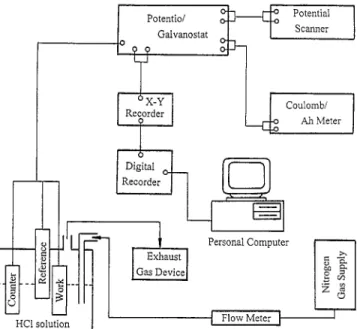
Specimens with and without ion nitriding were exam- ined by electrochemical potentiodynamic measurements. The experimental set-up, shown in Fig. 1, included a three-electrode system, a Nichia model NP G1001ED potentio-galvanostat, a potential scanner ES-511A and a personal computer. Scans were initiated by lowering the corrosion potential of the specimen to a pre-set value of - 1 . 0 V (versus the saturated Ag/AgC1 electrode), and then scanned to + 1.0 V (versus the saturated Ag/AgC1 electrode) at a rate of 1 mV s - l ;
I Potentio/ Galvanostat 0 9 9
F
HCI Potential Scanner Coulomb/ A_h Meter Personal Computer I Flow Meter IFig. 1. Schematic diagram of electrochemical potentiodynamic instruments.
following this, a scan was run from + 1.0 V to - 1 . 0 V at the same rate to complete a cycle. The experiment was conducted in a 0.5 M HC1 solution at room temper- ature under static and atmospheric conditions. A plati- num sheet was used as a counter electrode and oxygen was removed from the electrolyte by purging with purified nitrogen. In order to minimize the internal resistance drop in the solution, the reference electrode was positioned as closely as possible to the working electrode.
2.4. Sutface analysis and cross-section microanalysis
After the experiment in Section 2.2, the surface of the specimens were investigated using a Philips 515 scanning electron microscope (SEM) with an energy-dispersive X-ray (EDX) analysis facility. The cross-sections of these specimens were examined by a JEOL JXA-8600SX electron probe microanalyzer (EPMA). X-ray diffrac- tion (XRD) tests were carried out using a Philips PWl710 X-ray diffractor which provided Cu Kc~ radia- tion. The power was 40 kV x 30 mA and the 20 scanning rate was 3 ° min-1.
1 0 0 ~ ~ " 10 ¸ " O E v u~ 1' ca o "~ 0,1. cr~ 0,01, 0.001 1M HCI 1M H2SO 4 | | I e ? t ton n i t r i d i n c j c o n d , N o . Ti-50AI OO TiBoNis0 m • Ti50Ni40Cul 0
Fig. 2. Immersion test results in 1 M HC1 or H2SO4 solutions. The ion-nitriding conditions are listed in Table 1.
Table 1
Ion-nitriding conditions of Figs. 2 and 7(b)
Number Ion-nitriding conditions Remark
1 2 3 4 5 6 7 None Fig. 2
700 °C for 12 h, 10 torr, [N2]/[H2] = 1 Fig. 2 800 °C for 12 h, 6 torr, [N2]/[H2] =4 Fig. 2
None Fig. 2
700 °C for 4 h, 8 torr, [Nz]/[H2]=4 Fig. 2 900 °C for 4 h, 6 tort, [N2]/[H2] = 1 Fig. 2 900 °C for 12 h, 8 torr, [Nz]/[H2] = I0 Fig. 7(b)
208 S.K. Wu et at. / Surface and Coatings Technology 92 (1997) 206-21t 2.5. Wear test
The wear tests were performed using a TE-53-type uni-directional sliding wear machine made by Plint and Partners Co., UK. The JIS SKS-95 steel, with hardness 700 HV, was used as the against-wear material. The tests were conducted at a constant wear load of 10 N and a sliding speed of 62.8 cm s- ~. The surface morphol- ogies of the worn specimens were observed using a Philips 515 SEM. The average wear rate and friction coefficient were automatically calculated by a digital computer during the sliding wear process.
3. Results and discussion
3.1. Corrosion characteristics o f ion-nitrided TisoNiso and TisoNi4oCuto alloys
Corrosion data from the immersion tests are plotted in Fig. 2 in terms of weight loss versus ion-nitriding conditions. The data from the non-ion-nitrided Ti-50A1 specimens (conditions 1 and 4) are also plotted for comparison. In Fig. 2, the symbols in the left half of the diagram are the data points for samples exposed to a t M HC1 solution; those in the right half are for samples exposed to 1 M H2SO 4. The ion-nitriding conditions of specimens used in Fig. 2 are listed in Table 1. From Fig. 2, one can see that both TisoNiso and TisoNi4oCulo alloys are more corrosion resistant than the Ti-50A1 specimen and the corrosion rate in H 2 S O 4 solution is higher than that in HC1 solution. At the same time, the ion-nitrided specimens have better corro- sion properties than the non-ion-nitrided samples. The higher the nitriding temperatures or the longer the nitriding time, the better the corrosion resistance is. It should also be noted from Fig. 2 that the corrosion resistance of the non-ion-nitrided TisoNis0 alloy is better than that of the non-ion-nitrided Tis0Ni40Cul0 alloy. However, ion-nitrided TisoNiso and TisoNi4oCulo alloys have almost the same corrosion resistance.
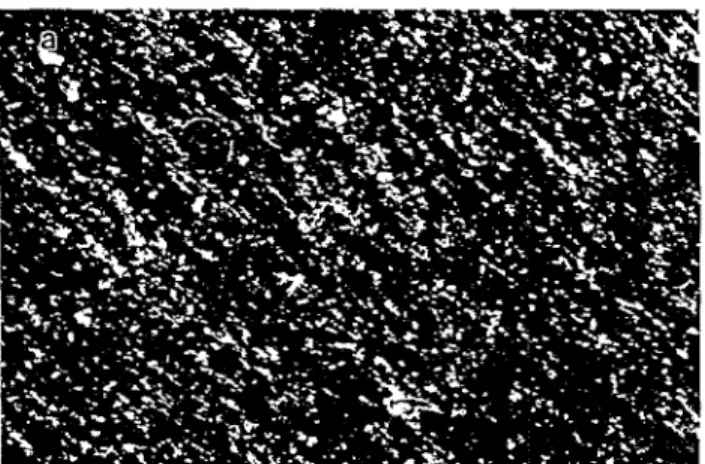
Surface morphologies after the immersion tests for equiatomic TiNi specimens without and with ion nitrid- ing are shown in Figs. 3 and 4, respectively. Those for TisoNi4oCulo specimens are similar to Figs. 3 and 4 and therefore are omitted here. Fig. 3(a and b) show the surface morphologies of non-ion-nitrided specimens after immersion in a 1 M HC1 solution for 14 days and in a 1 M H 2 S O 4 solution for 5 days, respectively. Fig. 4(a) shows the surface morphology of a specimen ion nitrided at condition 3 of Table 1 and then immersed in a 1 M HCI solution for 14 days. Fig. 4(b) shows the surface morphology of a specimen ion nitrided at condi- tion 6 of Table 1 and then immersed in a 1 M H2SO 4 solution for 5 days. The weight loss corresponding to the specimens of Figs. 3 and 4 has been listed in Fig. 2.
Fig. 3. Scanning electron micrographs of the surface morphology of non-ion-nitrided equiatomic TiNi alloys after immersion in: (a) 1 M HC1 solution for 14 days; (b) in 1 M H2SO 4 solution for 5 days.
From these experimental results shown in Figs. 2-4, one can see that the non-ion-nitrided specimens are easily attacked by 1 M HC1 and H2SO 4 solutions. However, their corrosion properties in both 1 M HC1 and H2SO4 solutions can be markedly improved by ion nitriding even at low nitriding temperatures and short nitriding times, as indicated from the low weight loss in Fig. 2 and slightly attacked surface morphologies in Fig. 4. Meanwhile, the improvement in corrosion resistance in 1 M HC1 solution after ion nitriding is found to be more evident than in 1 M H2SO 4 solution.
3.2. Electrochemical potentiodynamic behavior
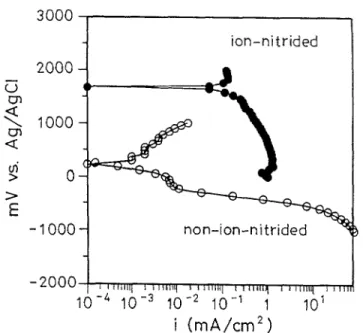
Typical potentiodynamic scanning diagrams for equi- atomic TiNi specimens treated in a 0.5 M HC1 solution are shown in Fig. 5: (a) without and (b) with ion nitriding at 700 °C for 2 h. The anodic potentiodynamic polarization curve of Fig. 5 is shown in Fig. 6. Values of the corrosion potential ~bcor~ and the corrosion current density ioorr from Tafel extrapolation are listed in Table 2. The data for ~b~orr and ioor~ for TisoNi4oCuto alloy are also listed in Table 2. From Table 2, one can see that
S.K. Wu et aI. / Swface and Coatings Technology 92 (1997) 206-21i 209
&--.
E
,.v.
<l:E
v Z w n- n-16
(a) 0 - 1 6 -3 2 - 4 8 - 6 4 - 8 0 - 9 6-1000
I E I I-500
0
500
POTENTIAL (mV)
1000
Fig. 4. Scanning electron micrographs of the surface morphology of ion-nitrided equiatomic TiNi alloys after immersion in: (a) 1 M HC1 solution for 14 days; (b) in I M }-I2SO 4 solution for 5 days.
the corrosion potential ¢oorr of ion-nitrided TisoNiso and TisoNi4oCulo specimens is higher, but the current density ico~r is lower, than the corresponding values for non- ion-nitrided specimens. This means that the ion-nitrided specimens will exhibit better corrosion properties in the acid solutions.
3.3. A discussion on the effect o f ion nitHding on the corrosion properties o f TiNi alloys
As mentioned in Part I of this study, the ion-nitrided TiNi specimens consist of the TiN and Ti2Ni phases in the compound layers [10]. At the same time, higher nitriding temperatures and longer nitriding times cause thicker nitrided layers. It has been reported that TiN is more chemically inert and electrically insulating than titanium alloys [11]. Although the Ti2Ni phase was reported to have a poor corrosion resistance [18], we believe that TiN phase existing in the outermost part of the compound layers makes ion-nitrided TiNi alloys more chemically inert than non-ion-nitrided TiNi alloys. This suggestion is also supported by the results of Fig. 2 and Table 2, in which the weight loss and corrosion
L'-" 4 E
--2 -is
< E ..~ - 3 6 Z w -56 cr" C~ D -76 £.9 - 9 6 _ (b)o
5do
l obo ' l sbo
2000
POTENTIAL (mV)
Fig. 5. Potentiodynamic scan diagrams for eqniatomic TiNi specimens treated in 0.5 M HC1 solution: (a) non-ion-nitrided specimen; (b) ion- nitrided specimen.
current density of ion-nitrided TiNi specimens show lower values and the corrosion potential shows a higher value than those of non-ion-nitrided specimens. This is because TiN layer provides better corrosion resistance than non-ion-nitrided TiNi alloys in the acid solutions. 3.4. Wear characteristics of ion-nitrided TiNi alloys
Fig. 7 shows the surface morphologies of worn tracks after sliding wear for the equiatomic TiNi specimens without and with ion nitriding (a and b, respectively). Those for TisoNi4oCUlo specimens are similar to Fig. 7(a and b) and therefore are omitted here. In Fig. 7(a), a typical worn morphology of TiNi martensite is observed. The TiNi martensite (Hv = 200) is so much softer than the against-wear SKS-95 steel ( H v = 7 0 0 ) ; hence, the adhesive and abrasive wears occur. The adhesive wear will cause fragments of TiNi martensite to be pulled off and to adhere to the surface of the against-wear SKS- 95 steel. The abrasive wear introduces ploughing grooves, which originate from the interaction of micro-
210 S.~2 Wu et aL /Surface and Coatings Technology 92 (1997) 206-211 3000 r j
.I.
>E
2000 1000 O_ - 1 0 0 0 ion-nitrided - 2 0 0 0 i l l l { I l l J I l l l l | l ~ I I I l l l l l { I I l l l l l i ~ I I I[IIII~ } ) I I I 10 - ~ 10 -~ 10 -~ 10 -~ I 10 ~ i ( m A / c m ~ )Fig. 6. Anodic potentiodynamic polarization curves for the ion-nit- Tided and non-ion-nitrided equiatomic TiNi specimens in 0.5 M HC1 solution.
- { i T . : , - _ ~ . . ~ , . -
J
i ; ::::;:i:):22;;;
. ~ @ . - - - - ; r . . . ~ . . > : - - . ~ 2 ~ j ~ L " . * 2 ~ - . : ~ , z _ ~ a d ~ : ~ . ' ~ ' , ' : . ~ . ~ . : '
Fig. 7. Surface morphologies of worn tracks after sliding wear for: (a) non-ion-nitrided; (b) ion-nitrided equiatomic TiNi specimens.
z
~
0 . 4 r ~ 0 C) ~0.2 0,0 + 4- non-ion-nitriding * i o n ~ n i t r i d e d by cond. 7 of Table 1 C * l o n - n i t r i d e c l by czxad. 3 of Table i × i o n - n i t r i d e d by cord. 2 of Table 1 50 I 0 0 150 200 SLIDING DISTANCE(m) 2: 0.4 O 30.2 P~ r.. 0.0 50 I00 /50 200 SLIDING DISTANCE(m)Fig. 8. The friction coefficients for the ion-nitfided TiNi specimens at various nitriding conditions: (a) TisoNi~0; (b) TisoNi4oCuto alloys.
cutting and plastic deformation [19]. As presented in Part I of this study, the surface hardness of TiNi martensite can be rapidly raised by ion nitriding. This feature originates from the hard layers of TiN and Ti2Ni compounds. The thicker the compound layers, the higher the surface hardness. These hard compound layers will affect the wear resistance of TiNi specimens. As shown in Fig. 7(b), main adhesive wear morphology occurs; however, now, fragments of SKS-95 steel have been adhesively transferred to the TiN/Ti2Ni compound layers, instead of the TiNi martensite being transferred to the steel, due to their significant difference of hardness.
Figs. 8 and 9 shows friction coefficients and wear rates, respectively, for the ion-nitrided TisoNiso and TisoNi4oCulo specimens at various nitriding conditions of Table 1. In these figures, friction coefficients and wear rates of ion-nitrided specimens are much lower than those of non-ion-nitrided specimens. These results come from the fact that the wear interfaces are TiN/Ti2Ni compound layers and SKS-95 steel, and hence friction coefficients and wear rates maintain low values due to their high hardness. This indicates that the wear charac- teristics of TiNi specimens can be effectively improved by ion nitriding because TiN/Ti2Ni compound layers provide an important contribution to the improvement of wear resistance. In other words, the ion-nitrided TiNi shape memory alloys, being hardened by TiN/Ti2Ni compounds, can exhibit excellent wear resistance and a low friction coefficient.
S.K. Wu et al. / Smface and Coatings Technology 92 (1997) 206-211 211 Table 2
Corrosion data of the Tafel slope extrapolation calculated from Fig. 6 (0.5 M HC1 solution)
Sample Corrosion potential ¢oor~ (V versus Ag/AgC1) Corrosion current density i .... (mA cm-2)
Tis0Niso (non ion-nitrided) +0.22 0.0018
TisoNi40Culo (non ion-nitrided) +0.07 0.0400
Tis0Niso (ion-nitrided)a + 1.68 0.001 I
Tis0Ni4oCulo (ion-nitrided) ~ + 1.70 &0010
~ion nitrided at 700 °C for 2 h and 6 torr with [N2]/[H2]= 10.
E
Z ¢,e)E
E
t.f3 I O 3.0 2.0- >< ,,4--,,' 0 1.0 r ~ O cD 0.0 + * + Ti50 Ni50* Tiso Ni40 CUlo
I I I 1
1 2 3 7
Ion nitridihg cond. No.
Fig. 9. The wear rates for the ion-nitrided TisoNiso and TisoNi40Cu~0 specimens at various nitriding conditions. The ion-nitriding conditions are listed in Table 1.
4. Conclusions
In this study, the corrosion properties and wear characteristics of equiatomic TiNi shape memory alloys with and without ion nitriding were investigated. The experimental results indicate that the non-ion-nitrided specimens are easily attacked by HC1 and H 2 S O 4 solu- tions. The corrosion rate of TiNi alloys in both HC1 and H 2 S O 4 solutions can be markedly improved by ion nitriding. The improvement in corrosion resistance in HCI solution is more evident than that in H2SO 4 solu- tion. The improved corrosion resistance in these solu- tions is attributed to the TiN compound formed on the outermost part of the ion-nitrided layers. The wear characteristics of TisoNiso and TisoNi40Culo shape memory alloys can also be effectively improved by ion nitriding. The ion-nitrided TiNi specimens, being har- dened by TiN/Ti2Ni compounds, can exhibit an excellent wear resistance and a low friction coefficient.
Acknowledgement
The authors are pleased to acknowledge the financial support of this research by the National Science Council (NSC), Republic of China under Grant No. NSC84- 2216-E002-027.
References
[1] S. Miyazaki, K. Otsuka, Y. Suzuki, Scripta Metall. 15 (1981) 287-292.
[2] S. Miyazaki, Y. Ohmi, K. Otsuka, Y. Suzuki, ICOMAT-82, J. Phys. 43 (I982) 255-260.
[3] S. Miyazaki, T. Imai, Y. Igo, K. Otsuka, Metall. Trans. A 17A (1986) 115-120.
14] Y. Oshia, S. Miyazaki, Corros. Engng 40 (199I) 1009-I025. [5] K.N. Melton, J.D. Harrison, Proc. International Conference on
Shape Memory and Superelastic Technologies, SMST-94, 1994, pp. 187-196.
[6] K. Endo, R. Sachdeva, Y. AraM, Ohno, Proc. International Conference on Shape Memow and Superelastic Technologies, SMST-94, 1994, pp. 197-201.
[7] S. Lombardi, L.H. Yahia, J.E. Klemberg-Sapieha, D.L. Piron, A. Selman, C.H. Rivard, G. Drouin, Proc. International Conference on Shape Memory and Superelastic Technologies, SMST-94, i994, pp. 221-226.
[8] G. Rondelli, B. Vicentini, A. Cigada, Corros. Sci. 30 (1990) 805. [9] American Society for Metals, ASM Handbook, vol. 4, 9th ed.,
ASM, Metals Park, OH, 1991, p. 387.
[10] S.K. Wu, C.L Chu, H.C. Lin, Surf. Coatings Technol. 92 (1997) 197-205.
[11] J. Aromma, H. Ronkainen, A. Mahiout, S.-P. Hannula, Surf. Coatings Technol. 49 (I991) 353.
[i2] M. Taguchi, J. Kurihara, Mater. Trans. Jap. Inst. Metals 33 (7) (1992) 691.
[13] Y. Massiani, P. Gravier, J.P. Cronsier, L. Fedrizzi, M. Dapor, V. Micheli, L. Roux, Sure Coatings Technol 52 (I992) 159. [14] I.M. Penttinen, A.S. Korhonen, E. Harju, M.A. Tnrkia, O.
Forsen, E.O. Ristolainen, Surf. Coatings TechnoI. 50 (1992) 161. [15] F.D. Lai, T.I. Wu, J.K. Wu, Surf. Coatings Technol. 58 (1993) 79. [I6] A. Takasaki, K. Ojima, Y. Taneda, Scr. Metall. 30 (9) (1994.)
1095-i098.
[I7] C.L. Chu, S.K. Wu, Surf. Coatings Technol. 78 (1996) 219-226. [18] R.S. Ruta, Corrosion 28 (3) (1993) 217-22I.
[19] O. Vingsbo, Wear of Materials, ASME, New York, 1979, pp. 620-635.