Admission Control for Variable Spreading Gain
CDMA Wireless Packet Networks
Tsern-Huei Lee, Senior Member, IEEE, and Jui Teng Wang, Student Member, IEEE
Abstract—A technique for variable spreading gain
code-divi-sion multiple access (VSG-CDMA) with transmit power control has recently been proposed [4], [5] to provide integrated services in a wireless packet network. System capacities of VSG-CDMA net-works with and without considering user activity factors were de-rived. The analysis gives a lower bound of system capacity because a user’s transmitted power is considered part of the interference to its own signal. In this paper, we present an optimistic upper bound assuming that there is no multipath fading or the energy of a signal in all multipath components can be fully resolved. An optimum power vector assignment and a simple criterion for all users to simultaneously achieve their quality of service (QoS) re-quirements (in terms of bit energy-to-interference density ratios) are derived. We found from numerical examples that, compared with the lower bound given in [4] and [5], significant improvement can be obtained if multipath fading can be satisfactorily handled. Several access control schemes are also studied to guarantee delay bound requirements. Simulation results reveal that more connec-tions can be further accommodated with access control.
Index Terms—CDMA, packet switching, power control.
I. INTRODUCTION
M
ULTIMEDIA applications over wireless networks have recently attracted much attention from researchers [4], [5], [7]–[16]. It is believed that packet switching can support mixed traffic such as data, voice, and video more efficiently than circuit switching. To implement packet switching in a wireless network, a multiple-access control scheme is required to coordi-nate medium access among active users. Time-division multiple access (TDMA) and code-division multiple access (CDMA) are two categories of medium access control techniques.Using CDMA as the medium access control scheme elimi-nates the need for frequency plan revision and channel reallo-cation every time a new cell is introduced. Moreover, universal frequency reuse makes soft handoff possible which, when com-bined with proper power control, can largely improve system ca-pacity. To support integrated services, multicode CDMA (MC-CDMA) [7], [8] and variable spreading gain CDMA (VSG-CDMA) coupled with transmitting power control [4], [5] were proposed as candidate systems. In the MC-CDMA system, different PN codes are allocated to a user which needs times of a basic rate. The user converts its signal stream into parallel Manuscript received June 13, 1997; revised April 8, 1999. This work was supported in part by the National Science Council under Contract 88-2218-E-009-045 and by the Chung-Shan Institute of Science & Technology under Contract 88EC2A170275.
T.-H. Lee is with the Department of Communication Engineering, National Chiao Tung University, Hsinchu 300, Taiwan, R.O.C.
J. T. Wang is with the Department of Electronic Engineering, Nan-Kai Col-lege of Technology and Commerce, Taiwan, R.O.C.
Publisher Item Identifier S 0018-9545(00)02549-4.
streams, encodes each one with a different PN code, and mod-ulates them with a different Walsh modulator. The modulated signals are superimposed before upconverting for transmission. In the VSG-CDMA system, users are assigned different power levels based on their data rates and quality of ser-vice (QoS) requirements. The QoS requirement is often characterized by bit energy-to-interference density ratio (or signal-to-interference ratio, SIR) because, given a transmission technology, the bit error rate can be derived from SIR. Two users having identical QoS requirements are allocated power levels proportional to their data rates; and two users having identical data rates are allocated power levels proportional to
their QoS requirements. Let and denote
respec-tively the data rate, QoS requirement, and the allocated power level of user As a result, the power levels allocated to user
and user satisfy Under such
a power allocation algorithm, system capacity and admission criterion were derived in [4] and [5]. The calculations provide a lower bound of system capacity because the transmitted power of user is considered part of the total interference to user itself.
In this paper, we present an upper bound of system capacity for the VSG-CDMA system. In our derivations, we assume that there is no multipath fading or the energy of a signal in all multipath components can be 100% resolved (say, with the help of RAKE receivers). We prove a theorem on optimum power vector assignment and derive a simple admission criterion for all users to simultaneously achieve their QoS requirements. We found from numerical examples that, compared with the lower bound provided in [4] and [5], significant improvement can be obtained if multipath fading can be well handled. We also study with numerical examples the improvement assuming the requested QoS can be violated with a certain small probability. In addition to requesting bounds on bit error probability, some applications may ask for guaranteed delivery of packets with time constraints. We propose several access control (AC) schemes to meet the requirements. For a CDMA system which takes advantage of activity factors [1], [2], [6], it may happen from time to time that the requested SIR’s are violated. When it happens, all packets involved are destroyed, resulting in a big loss. Our proposed AC schemes can totally eliminate this possibility.
The rest of this paper is organized as follows. Section II de-scribes the investigated system model. Optimum power assign-ment is derived in Section III. Admission criterion is presented in Section IV. Several AC schemes are studied in Section V. Nu-merical results are discussed in Section VI. Finally, the conclu-sion is in Section VII.
Fig. 1. Source model: two-state Markov process.
II. SYSTEMMODEL
Consider a cellular direct-sequence (DS) CDMA system. To reduce interference and improve system capacity, we assume cells are sectorized ideally so that every cell site is equipped with three perfect directional antennas, each covers 1/3 of the cell area. In this paper, we study the reverse link, i.e., the users-to-base station direction. For each base station, let and denote, respectively, the received power for other-cell interference and the received power for all users in its area. Interference from other cells is characterized by the relative other-cell interference factor [2], [3], [6], which is defined as
In [3], a tight upper bound on other-cell interference was de-rived, the result gives when the propagation attenua-tion is proporattenua-tional to the fourth power of the distance times a lognormally distributed component with 8-dB differential stan-dard deviation.
We assume time is slotted so that the length of a slot is equal to the transmission time of a packet. Each user is modeled as a two-state Markov process. When user is in state 0 (the OFF state), no data is generated. When it is in state 1 (the ON state), data is generated with rate The residence time in state 0 and state 1 are exponentially distributed with parameters and respectively. As a result, the state transition rates from state 0 to state 1 and from state 1 to state 0 are 1/ and 1/ respectively. The relative amount of time for user to stay in the ON state is called its activity factor and is denoted by For the two-state
Markov process model, we have The
probabilities of state transitions during a slot time are shown in Fig. 1.
III. OPTIMUMPOWERASSIGNMENT
Assume there are types of services. For convenience, a user of type service is called a type user. The processing gain for a type user when it is in the ON state, denoted by
is given by where represents the spread
bandwidth. Consider a particular sector and assume there are type users. We assume power control is ideal and the received
power at cell site for type users is As in
[1] and [2], we characterize the type users’ quality of service
by the SIR, which can be determined from the
re-quested bit error probability. For example, it was reported that the required to obtain a bit error probability of 10 (dig-ital voice quality requirement) is 7 dB under some transmission technology [1]. In this paper, the required for any type
user is denoted by Assume all users are in the ON state. As a result, for any type user is given by
(1)
where represents the thermal noise and denotes the relative other-cell interference factor defined in Section II. Notice that in (1) the transmitted power of a user is not considered part of its total interference. This is true if there is no multipath fading or the energy of a signal in all multipath components can be 100% resolved. The system capacity derived based on this assumption is thus an optimistic upper bound.
For type users to meet their QoS requirement, we must have (2)
After neglecting the thermal noise and rearranging (2), we get
(3)
Consequently, all users meet their QoS requirements if one can
find a power vector such that the
in-equality in (3) holds for all Finding a power
vector to meet the inequality in (3) is obviously not a trivial task. In the following theorem, we prove that some constraint can be put on the power vector to simplify the problem.
Theorem 1: Given and If there exists a
power vector such that
for all
then there exists a power vector such
that
for all and and
Proof: Assume there exists a power vector
such that
for all
Let be an integer which satisfies
for all
Let and
for all
It is clear that and, therefore
for all This completes the proof of Theorem 1.
From the above theorem, one can assign power levels with the constraint
for all and (4)
In [4] and [5], the assigned power levels satisfy
for all and (5)
which is slightly different from (4). In [4] and [5], a user’s trans-mitted power is considered part of the interference to its own signal. Consequently, their derivation gives a lower bound of system capacity. According to the numerical results presented in Section VI, the system capacity could be significantly larger than the lower bound if the effect of multipath fading can be re-moved.
IV. ADMISSIONCRITERION
In this section, we first derive an admission criterion for all users to satisfy their QoS requirements at all times. The criterion is then generalized to a system which allows a small probability to violate QoS requirements.
Fig. 2. Time slot structure.
TABLE I
IMPLEMENTATION REQUIREMENTS OF THE
PROPOSEDACCESSCONTROLSCHEMES
Theorem 2: Given and There exists a power
vector such that
for all
if and only if
Proof: Assume there exists a power vector
such that
for all
According to Theorem 1, one can choose a power vector such that
TABLE II
PARAMETERS OF ANEXPERIMENTALSYSTEM(ANINTEGRATEDVOICE/DATACELLULARDS CDMA SYSTEM)
implies
which in turn implies
Conversely, assume that
Select arbitrarily a power level for type 1 users. Let
for all
As a consequence, we have
and thus
implies
which in turn implies
for all
Fig. 3. Comparison of admission regions forf = 0:
As a result of Theorem 2, the admission criterion for all users to meet their QoS requirements at any time is
(6)
The same criterion was also reported in [8] for two types of users in an MC-CDMA system. In [8], the criterion was
ob-tained by setting and
The-orem 2 formally generalizes the criterion to types of users. Obviously, more connections can be accommodated if the QoS requirements can be violated with a certain small proba-bility. Let denote the population size of type users with ac-tivity factor Assuming all users are independent, the instan-taneous number of type users in the ON state is then a binomial distributed random variable whose probability density func-tion is given by
(7)
Let denote the probability that the requested QoS are not satisfied. That is,
(8)
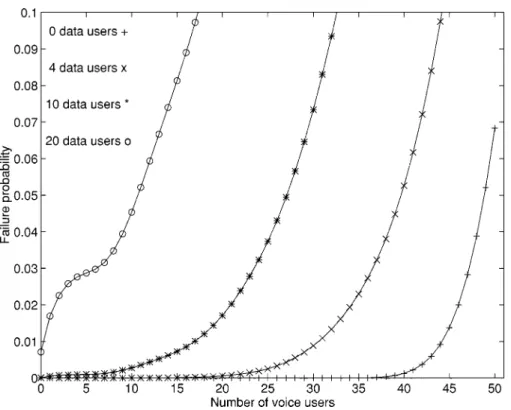
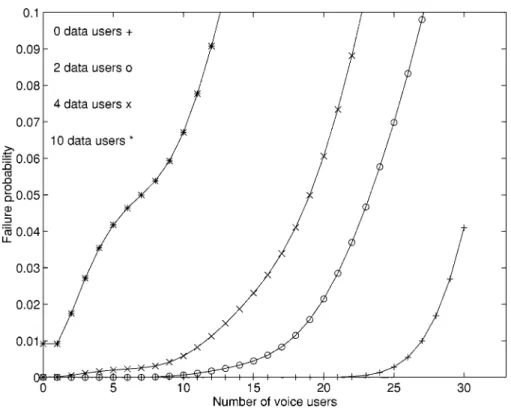
Numerical results presented in Section VI show that signifi-cantly more connections can be accommodated if is al-lowed to be 0.01.
V. ACCESSCONTROLSCHEMES
In addition to a specified SIR, an application may request a maximum packet delay bound or an expected maximum packet delay. Obviously, if inequality (6) is used as the admission cri-terion, then all packets can be delivered to the base station in a single transmission. However, since the users are not always active, the bandwidth can be under utilized most of the time. In this section, we propose AC schemes to increase bandwidth utilization. Again, we assume there are types of users. An in-teger called the delay bound requirement for convenience, is associated with type users.
We classify applications into loss applications and lossless ap-plications. If type users belong to loss applications, then represents a stringent maximum delay bound of all packets gen-erated by any type user. In other words, a packet generated by a type user in slot has to be delivered to the base station no later than slot Otherwise, the packet is useless and discarded by the user. Most voice users can be classified as loss applications. On the other hand, if type users belong to lossless applications, then represents the expected maximum packet delay and no packet will be discarded even if a packet is not deliv-ered within slots after its generation. If delay is not a concern of type users, then one can set Clearly, most data users can be treated as lossless applications. Without loss of
gen-erality, we assume that In this section,
two users are in the same type if and only if they both belong to loss applications or lossless applications and have identical data rates, SIR requirements, and delay bound requirements.
We assume that every admitted user is allocated a unique PN code and there is a correlator at the base station for each user. As a consequence, the base station can tell which users sent packets even if inequality (6) is violated because the output power level of a correlator for a user in the ON state is much greater than
Fig. 4. Comparison of admission regions forf = 0:55:
that for the same user in the OFF state. We further assume that packets generated by the same user are transmitted to the base station in accordance with their order of generation. Suppose that the head-of-line (HOL) packet of a type user was gener-ated in slot and the current time is slot The residual life
of the HOL packet is defined to be and is called
the deadline of the user for convenience. Moreover, the residual life of the packet right after the HOL packet is called the next deadline of the user. The next deadline is equal to if the user has only one packet to be transmitted.
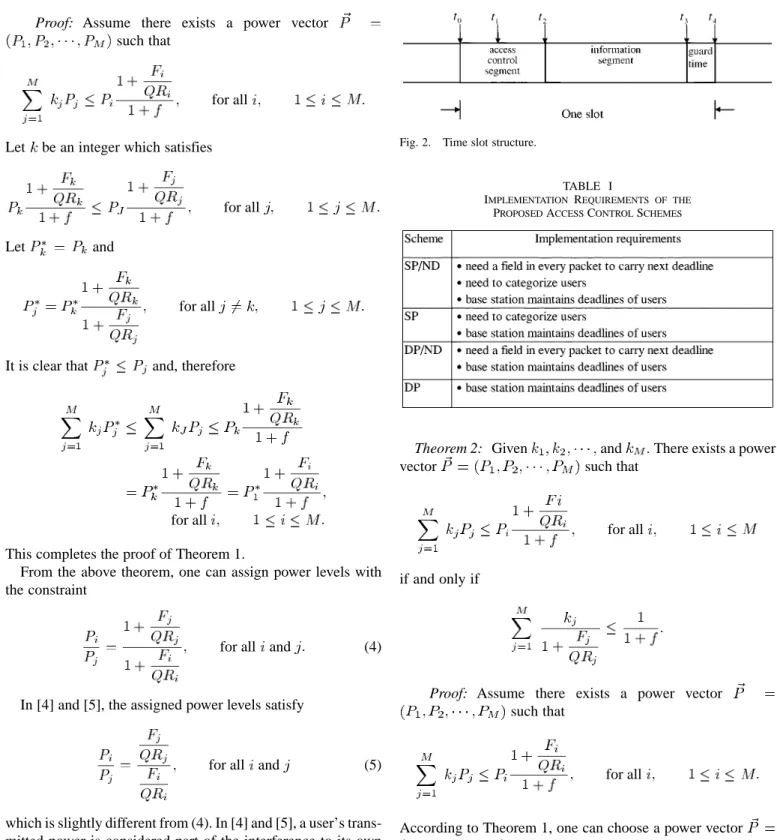
The slot format of our proposed AC schemes is illustrated in Fig. 2. At the beginning of a slot, every user who has packets waiting for transmission sends a short message (say, 50 chips) in time period to The base station detects those users who sent messages and selects from high priority to low priority as many users as possible without violating inequality (6). The pro-posed AC schemes differ in priority assignment and will be dis-cussed later. After selection, the base station sends acknowledg-ments back to the users via the forward channel. This is per-formed in time period to Those users who receive a posi-tive acknowledgment transmit a packet in time period to A guard time of duration follows packet transmission. The process is repeated for every slot. It is clear that inequality (6) is always satisfied in time period to for the proposed AC schemes. In the following, we describe two priority assignment algorithms. For ease of description, we say a collision occurs if inequality (6) is not satisfied in time period to Similar AC schemes which totally eliminate packet loss due to collisions can be found in [17] and [18].
A. Static Priority Assignment
In the static priority (SP) assignment scheme, priorities are assigned to different types of users based on their delay bound
requirements. That is, any type user is assigned a higher pri-ority than any type user if Without loss of gener-ality, we assume that a type user has a higher priority than a type user if For two users of the same type, priorities are assigned according to their deadlines such that the user with a smaller deadline is assigned a higher priority. In case there is a tie, the priorities are assigned randomly. We assume every HOL packet carries the next deadline and base station maintains the deadline of every user. Initially, the deadline for a type user is set to If a user is involved in a collision, then its deadline is reduced by one. After a successful transmission, the deadline is replaced with the next deadline carried in the HOL packet.
It is possible that the next deadline cannot be carried in the HOL packet because of the limitation of packet format. In this case, the next deadline is estimated to be the delay bound re-quirement. For convenience, the SP scheme with and without the next deadline carried in the HOL packet will be referred to as SP/ND and simply SP, respectively.
B. Dynamic Priority Assignment
In the dynamic priority (DP) assignment scheme, all users are treated as if they all are of the same type but with different delay bound requirements. As a consequence, priorities are as-signed on packet level. Again, ties can be broken randomly. As in the SP scheme, base station maintains the deadline of each user and every HOL packet carries the next deadline. The dead-line of a user is reduced by one if it is involved in a collision and is replaced with the carried next deadline after a successful transmission.
The next deadline is again estimated to be the delay bound requirement if it cannot be carried in the HOL packet. The dy-namic priority assignment scheme with and without next
dead-Fig. 5. Failure probabilityp against number of voice users forf = 0:
line carried in the HOL packet will be referred to as DP/ND and DP, respectively.
It should be pointed out that, for all the four schemes, a type user has a smaller packet loss probability than a type user if they both belong to loss applications and Moreover, the packet loss probabilities of two loss application users of the same type are expected to be close to each other. Similarly, the average packet delay of a type user is smaller than that of a type user if both belong to lossless applications and and two lossless application users of the same type are expected to have roughly the same average packet delay. Implementation require-ments of the above AC schemes are summarized in Table I.
VI. NUMERICALEXAMPLES
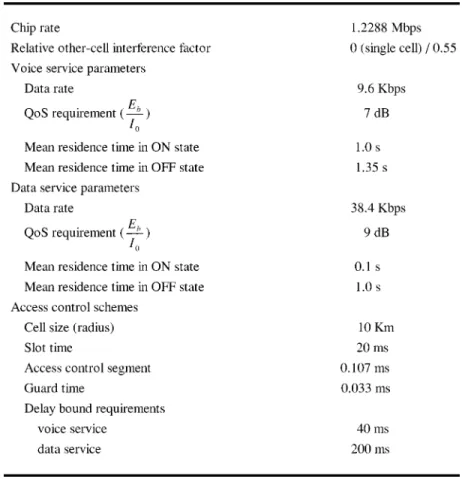
In this section, we study an integrated voice/data system. The parameters of the studied system is depicted in Table II. The chip rate is chosen to be 1.2288 Mbps, the same as that of current IS-95 cellular CDMA system. Relative other-cell interference factor is chosen to be 0 (for single cell) or 0.55 (for multiple cells). The characteristics of voice and data services used in [5] and [8] are adopted here. If inequality (6) is to be satisfied at any time for then this system can accommodate si-multaneously at most 17 voice users in one sector without any data users or at most three data users without any voice users. Let data users and voice users be type 1 and type 2 users, re-spectively. In the following, the discussions are divided into ad-mission criterion and access control schemes.
A. Admission Criterion
Since data users and voice users are considered as type 1 and type 2 users, respectively, is equal to 5.28 if (4) is sat-isfied or 6.34 if (5) is satsat-isfied. In Figs. 3 and 4, we plot the
admission regions for both power assignment algorithms for and 0.55, respectively. As mentioned before, the curve for
is an “upper bound” and that for is
a “lower bound” of admission region. As an example, in Fig. 4, the system can accommodate six voice users and two data users in one sector if or three voice users and two data users if
In Figs. 5 and 6, we plot against the number of voice users for various number of data users for and 0.55, re-spectively. In Fig. 6, for this system can support 27 voice users in one sector without any data user which is about 60% improvement over that for Similarly, if there are no voice users, this system can support ten data users in one sector, a big improvement compared with three for
B. Access Control Schemes
The parameters used in access control schemes are also shown in Table II. We assume that all voice users are loss applications and all data users belong to lossless applications. Time slot duration is set to 20 ms. Assume the base station needs 50 chips to detect users in the ON state. As a result, ms. The time for selecting users to send messages is expected to be small and thus roughly equals maximum round-trip propagation time. The guard time is set to the maximum one-trip propagation time to reduce interference from previous slot due to propagation delay. The radius of cells is 10 Km, and thus the maximum one-trip propagation time is 0.033 ms. Consequently,
ms and ms. The total time spent in access
control, is equal to 0.107 ms, which occupies 0.535% of a slot time.
The locations of the users are uniformly distributed over the cell area and the propagation attenuation is proportional to the
Fig. 6. Failure probabilityp against number of voice users forf = 0:55:
TABLE III
PERFORMANCECOMPARISONS OFACCESSCONTROLSCHEMES FOR
N = 25ANDN = 5
fourth power of the distance times a lognormally distributed component with 8-dB differential standard deviation. Here, rel-ative other-cell interference factor is chosen to be 0.55. The delay bound requirements of voice users and data users are 40 ms (two time slots) and 200 ms (ten time slots), respectively. Any voice packet held beyond two time slots is discarded by its terminal, and data packets will be held until they are success-fully transmitted.
All simulations are performed for 10 slots with a warm-up period of 10 slots. Performance of voice users and data users are measured in terms of packet loss probability and average
TABLE IV
PERFORMANCECOMPARISONS OFACCESSCONTROLSCHEMES FOR
N = 15ANDN = 15
packet delay, respectively. The 95% confidence intervals are all very small and thus not plotted.
In Tables III and IV, we list some simulation results for
and respectively, where
denotes the number of voice users and represents the number of data users. In these tables, maximum (or minimum) packet loss probability is the largest (respectively, smallest) of the loss probabilities encountered by all voice users. Maximum and minimum average packet delay have similar meanings. It can be seen that the difference between maximum and minimum is small. Furthermore, the difference between SP and SP/ND or between DP and DP/ND is also small. However, the average
Fig. 7. Overall average packet loss probability of voice users against the number of voice users for DP and DP/ND schemes.
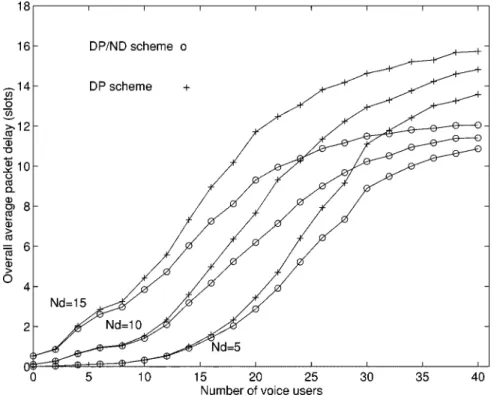
Fig. 8. Overall average packet delay of data users against the number of voice users for DP and DP/ND schemes.
packet delay of data users for DP and DP/ND is much smaller than that of SP and SP/ND. The price to pay is larger packet loss probability for voice users.
In Fig. 7, we plot the overall average packet loss probability of voice users against the number of voice users for various number of data users for DP and DP/ND. It is interesting to note that DP results in a smaller loss probability than DP/ND if there are some data users. This is because voice users are favored in DP. Of course, if there is no data user, then DP/ND results in a
smaller loss probability than DP. The packet loss probabilities for SP and SP/ND with or without data users are very close
to those for DP and DP/ND with and thus are not
presented. The reason is that, for SP and SP/ND, voice users are always assigned higher priority than data users and thus loss probability for voice packets is independent of the number of data users.
In Fig. 8, we plot the overall average packet delay for DP and DP/ND. As expected, DP/ND results in a smaller average delay
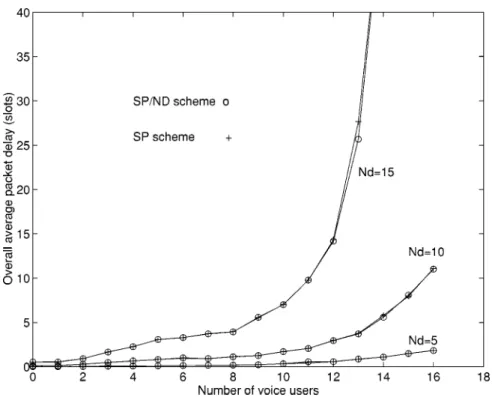
Fig. 9. Overall average packet delay of data users against the number of voice users for SP and SP/ND schemes.
than DP. The maximum difference is about 25%. Notice that the average delay saturates because we specify a finite delay bound requirement for data users and assign priorities on packet level. Fig. 9 shows similar results for SP and SP/ND. The average packet delay may grow unbounded.
For all schemes, simulation results show that the system can accommodate 33 voice users while keeping loss probability smaller than 0.01 when there is no data user present. This is about a 22.2% increase compared with 27 for
discussed in part A. Similarly, 27 data users can be supported with average packet delay no greater than ten slots when there is no voice user present.
VII. CONCLUSION
We have derived in this paper the optimum power vector as-signment for a VSG-CDMA system supporting integrated ser-vices under the assumption that the effect of multipath fading can be removed. A simple admission criterion is also derived for all users to achieve their QoS requirements simultaneously. Nu-merical results show that the admission region could be signifi-cantly larger than the lower bound presented in [4] and [5]. Be-sides, more connections can be accommodated if QoS require-ments can be violated with a small probability.
To guarantee delivery of packets with time constraints, we propose SP, SP/ND, DP, and DP/ND access control schemes. These access control schemes totally eliminate the possibility of packet loss caused by collision. According to the results ob-tained by computer simulations, DP seems to be a good choice for an integrated voice/data system. The assumption of
in computer simulations may not be valid for mixed traffic be-cause users with higher QoS requirements could lead to a higher
factor to other cells. However, we expect similar results for the proposed access control schemes. Detailed analysis and com-puter simulations which take this effect into consideration can be further studied.
ACKNOWLEDGMENT
The authors would like to thank the anonymous reviewers for their valuable comments which improved the presentation of the paper.
REFERENCES
[1] K. S. Gilhousen, I. M. Jacobs, R. Padovani, A. J. Viterbi, L. A. Weaver, Jr., and C. E. Wheatley III, “On the capacity of a cellular CDMA system,” IEEE Trans. Veh. Technol., vol. 40, pp. 303–312, May 1991. [2] A. M. Viterbi and A. J. Viterbi, “Erlang capacity of a power controlled
CDMA system,” IEEE J. Select. Areas Commun., vol. 11, pp. 892–899, Aug. 1993.
[3] A. J. Viterbi, A. M. Viterbi, and E. Zehavi, “Other-cell interference in cellular power-controlled CDMA,” IEEE Trans. Commun., vol. 42, pp. 1501–1504, Feb./Mar./Apr. 1994.
[4] C.-L. I and K. K. Sabnani, “Variable spreading gain CDMA with adap-tive control for true packet switching wireless networks,” in Proc. ICC
’95, June 1995, pp. 725–730.
[5] , “Variable spreading gain CDMA with adaptive control for inte-grated traffic in wireless network,” in Proc. VTC ’95, July 1995, pp. 794–798.
[6] M. G. Jansen and R. Prasad, “Capacity, througput, and delay analysis of a cellular DS CDMA system with imperfect power control and imperfect sectorization,” IEEE Trans. Veh. Technol., vol. 44, pp. 67–75, Feb. 1995. [7] C.-L. I and R. D. Gitlin, “Multi-code CDMA wireless personal
commu-nication networks,” in Proc. ICC ’95, June 1995, pp. 1060–1064. [8] C.-L. I, G. P. Pollini, L. Ozarow, and R. D. Gitlin, “Performance of
multi-code CDMA wireless personal communication networks,” in
Proc. VTC ’95, July 1995, pp. 907–911.
[9] J. Wu and R. Kohno, “A wireless multimedia CDMA system based on transmission power control,” IEEE J. Select. Areas Commun., vol. 14, pp. 683–691, May 1996.
[10] , “Performance evaluation of wireless multimedia CDMA networks using adaptive transmission control,” IEEE J. Select. Areas Commun., vol. 14, pp. 1688–1697, Dec. 1996.
[11] A. C. Cleary and M. Paterakis, “An investigation of reservation random access algorithms for voice-data integration in microcellular wireless environments,” Inte. J. Wireless Information Networks, vol. 2, no. 1, pp. 1–16, 1995.
[12] S. Jangi and L. F. Merakos, “Performance analysis of reservation random access protocols for wireless access networks,” IEEE Trans. Commun., vol. 42, pp. 1223–1234, Feb./Mar./Apr. 1994.
[13] D. J. Goodman, “Cellular packet communications,” IEEE Trans.
Commun., vol. 38, pp. 1272–1280, Aug. 1990.
[14] D. J. Goodman, R. A. Valenzuela, K. T. Gayliard, and B. Ramamurthi, “Packet reservation multiple access for local wireless communications,”
IEEE Trans. Commun., vol. 37, pp. 885–890, Aug. 1989.
[15] S. Nanda, D. J. Goodman, and U. Timor, “Performance of PRMA: A packet voice protocol for cellular systems,” IEEE Trans. Commun., vol. 40, pp. 584–598, Aug. 1991.
[16] R. Wyrwas, W. Zhang, M. J. Miller, and R. Anjaria, “Multiple access options for multi-media wireless systems,” in Wireless
Communica-tions-Future Directions. Norwell, MA: Kluwer Academic, 1993, pp. 305–317.
[17] N. Amitay and S. Nanda, “Resource auction multiple access (RAMA) for statistical multiplexing of speech in wireless PCS,” in Proc. ICC ’93, pp. 605–609.
[18] K. C. Chen and C. H. Lee, “RAP—A novel medium access control protocol for wireless data networks,” in Proc. GLOBECOM ’93, pp. 1713–1717.
[19] W. C. Y. Lee, Mobile Cellular Telecommunications, 2nd ed. New York: McGraw-Hill, 1995.
[20] , Mobile Communications Design Fundamentals. New York: Wiley, 1993, ch. 2nd ed.
Tsern-Huei Lee (S’86–M’87–SM’98) received the
B.S. degree from National Taiwan University, Taipei, Taiwan, R.O.C., in 1981, the M.S. degree from the University of California, Santa Barbara, in 1984, and the Ph.D. degree from the University of Southern Cal-ifornia, Los Angeles, in 1987, all in electrical engi-neering.
Since 1987, he has been a Member of the Faculty of National Chiao Tung University, Hsinchu, Taiwan, where he is a Professor with the Department of Com-munication Engineering and a Member of the Center for Telecommunications Research. His current interests are in communication protocols, broad-band internet technologies, and wireless packet networks.
Dr. Lee received an Outstanding Paper Award from the Institute of Chinese Engineers in 1991.
Jui Teng Wang (S’98) received the B.S., M.S., and
Ph.D. degrees from National Chiao Tung University, Hsinchu, Taiwan, R.O.C., in 1990, 1992, and 1999, respectively, all in communication engineering.
He is now an Associate Professor with the Depart-ment of Electronic Engineering, Nan-Kai College of Technology and Commerce, Taiwan. His research in-terests are in wireless communications.