Preparation and Characterization of Low-Methoxyl Pectin/Bletilla Striata
Composite Membranes
Ching-Wen Lou
1, Jin-Jia Hu
2,b*, Chao-Tsang Lu
3,c*, Chao-Chiung Huang
4,
Ming-Yuan Sie
5and Jia-Horng Lin
5,6,a*
1
Institute of Biomedical Engineering and Material Science, Central Taiwan University of Science and Technology, Taichung 406, Taiwan, R.O.C.
2
Department of Biomedical Engineering, National Cheng Kung University, Taiwan, R.O.C.
3
Institute of Life Sciences, Central Taiwan University of Science and Technology, Taichung 406, Taiwan, R.O.C.
4
Department of Textiles & Clothing, Fu Jen Catholic University, Taipei County 242, Taiwan, R.O.C.
5
Laboratory of Fiber Application and Manufacturing, Department of Fiber and Composite Materials, Feng Chia University, Taichung City 407, Taiwan, R.O.C.
6School of Chinese Medicine, China Medical University, Taichung 40402, Taiwan, R.O.C.
*corresponding email: [email protected], b [email protected], [email protected]
Keywords: Pectin, Bletilla striata, Composite membrane, Moisture retention, Swelling ratio
Abstract.
The skin is the largest organ in the body composed of the epidermis, dermis, and subcutaneous tissue through the latter it is integrated with deeper tissues. The major function of the skin is to shield out attacks, acting as a barrier. The skin can trigger a series of self-healing procedure when it is damaged. The healing process can be divided into three phases: inflammatory, tissue hyperplasia, and tissue reconstruction. Particularly during tissue hyperplasia, fibroblast proliferation and collagen deposition play important roles in the healing. The healing could be accelerated if wound dressing can be properly applied. An ideal wound dressing is capable of absorbing tissue fluid, keeping the wound moistured, stopping bleeding, attaching to the wound surface properly without sticking to the wound tissues, protecting the wound from infection, and accelerating the wound recovery. In this study, the composite membranes was made by adding mixed solutions of low-methoxyl pectin and Bletilla striata, which is a traditional Chinese medicine, into calcium chloride solution. The low-methoxyl pectin is cross-linked with calcium ions, forming a hydrogel. Membranes of varying ratio of the low-methoxyl pectin and Bletilla striata were prepared seeking for the optimal manufacturing parameters to use to investigate its effects on the water stability, water retention, contact angle and degree of swelling of the composite membranes. The results showed that when the ratio of low-methoxyl pectin solutioin (2 wt%) and Bletilla striata extract is 80/20 was added into 40 ml of 0.3 wt% calcium chloride solution, the composite membrane had the optimal performance in terms of the water stability, water retention, and swelling.
Introduction
The skin is the outermost layer of the body and plays important physiological roles in the immune system. If we cannot deal with the wound properly at the first time, the wound infection may delay wound healing and may lead to bacteremia, septicemia, or cellulitis in the worst cases. An ideal wound dressing is capable of absorbing tissue fluid, keeping the wound moistured, stopping bleeding, attaching to the wound surface properly without sticking to the wound tissues, protecting the wound from infection, and accelerating the wound recovery.[1-2] Pectin is commonly used in food industry because it can increase the viscosity and provide the gelling ability of a solution. While commonly used in food industry, pectin has been mixed with other components to be used in cosmetic products. It can be used to fabricate composite capsules and membranes for other applications. Depending on the degree of esterification, pectin can be grouped into high-methoxyl pectin if the content of
methoxyl group is greater than 7% and low-methoxyl pectin if the content of methoxyl group is less than 7%. Note that the methoxyl content is 16.32% if all the carboxyl groups of the pectin are esterified.[3] Bletilla striata, a traditional Chinese medicine, can be used as an effective ingredient of natural cosmetic products for its anti-bacterial, anti-inflammatory, whitening, anti-wrinkle and anti-senility abilities. It has been proved by modern pharmocology that Bletilla striata can enhance platelet activity, shorten the time required for thrombin generation, inhibit the activity of proteases, and promote cell aggregation, stopping bleeding.[4-5] Applying dressing to a wound is a necessary procedure to accelerate wound healing. The wound could get worse if proper treatment does not carry out at the first time. Currently in the market, there are many dressings for different wounds; the majority of which is to protect the wound. Limited by the healing of epidermis and conncetive tissues, it takes 1-2 months for the wound to completely recover no matter what dressing is applied. Also these dressings cannot provide satisfactory performance in all kinds of conditions. In this study, pectin was used as the wound contact material, providing capability of moisture absorption and moisture retention. Bletilla striata as an effective medicine, on the other hand, was used to accelerate healing. We mixed pectin and Bletilla striata at different ratios and have the solution cross-linked with calcium chloride to form the composte membrane. Physical properties such asdegree of swelling, stability in water stability, water retention, and wetability were examined in order toobtain the manufacturring parameters for the optimal low-methoxyl Pectin/Bletilla striata composite membrane
Materials and Methods Materials
Low-Methoxyl Pectin (Genu Pectin Type LM-104AS, degree of esterification: 31 %) was purchased from Gemfont Co., Ltd., Taiwan. Bletilla striata was purchased from Cheng Yang Pharmaceutical Co. Ltd., Taiwan. Calcium chloride was purchased from Nihon Pharmaceutical Co., Ltd., Japan. DMEM (Dulibecco’s Modified Eagle’s Medinm) was purchased from DIFCO LABORITORIES, U.S.A. L929 mouse fibroblasts was purchased from Food Industry Research and Development Institute, Taiwan.
Preparation of Pectin/Bletilla striata composite membrane
Pectin was dissolved in deionized water with heat and agitation to prepared 2 wt% pectin solution. A block of dried Bletilla striata (~5 g) was added into 130 ml of deionized water and subjected distillation for six hours to obtain Bletilla striata extract. Calcium chloride was dissolved in deionized water with heat and agitation to prepare 0.3 wt% calcium chloride solution. Pectin solution and Bletilla striata extract were mixed at different ratios (100/0, 80/20, 60/40, 50/50). The mixture was then added to different amounts of of calcium chloride solution (30, 40, 50 ml) for gelation. The gel was dried in an oven to form the composite membrane.
Stability in water
A given weight of Pectin/Bletilla striata composite membrane was placed in the deionized water at 37°C and agigated for 1, 3, and 5 hour, respectively. At certain intervals, the sample was removed from water and placed in oven 37°C at 24 hour. The water stability was calculated using Equation (1) :
(%) Wo Wt 100
S
Wo
(1)
where Wo is the dried weight of the sample, Wt is the dried weight of the sample at time t, and t= 1, 3, and 5 hour.
Swelling ratio
A given weight of Pectin/Bletilla striata composite membrane was placed in the deionized water at room temperature for an hour. At certain intervals, the sample was removed from water and weighted. The swelling ratio was calculated using Equation (1):
(%) Wt Wo 100
Sw
Wo
(2)
where Wo is the dried weight of the sample, Wt is the dried weight of the sample after a period of time t in water.
Moisture retention
Samples were first soaked in water for 2 hours. The samples were then placed in a chamber with relative humidity of 43%. The moisture retention of the sample was calculated using Equation (3):
(%) Hn 100
Rh
Ho
(3)
where Ho is the wet weight of the sample, Hn is the wet weight of the sample after n hours, and n= 2, 4, 6, 8, 10, and 12.
Wetability
Drops of water are placed on the surface of a testing membrane, and at least X values of contact angle were measured and then averaged.
Results and Discussion
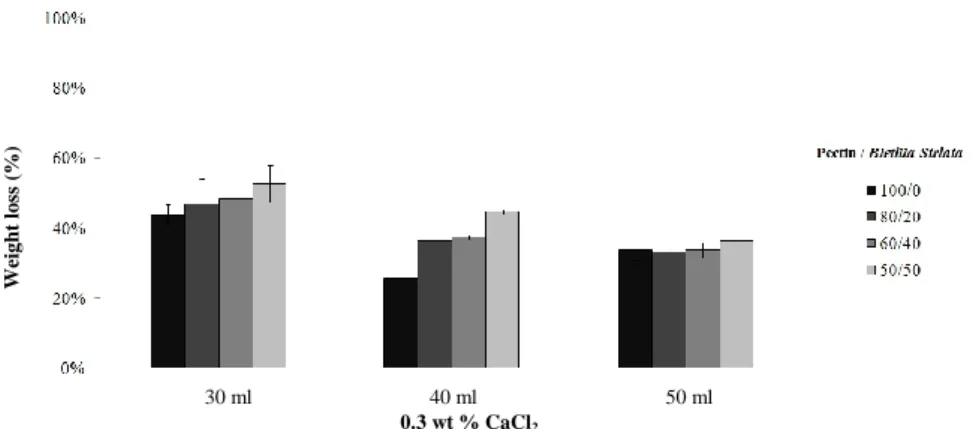
Figure 1. The weight loss of Pectin/Bletilla striata composite membranes placed in water for 24 hours. Figure 1 showed that as the volume of calcium chloride solution increased, the structure of the composite became more stable and not prone to collapse. Also, as the proportion of pectin decreased in the composite, the structure turned into a semi-interpenetrating network. When the membrane is placed in water, the embedded Bletilla striata will be released. The empty space that was originally occupied by Bletilla striata will be filled with water, making the matrix more vulnerable to water dissolution. The weight loss increased as the increased proportion of Bletilla striata increased.
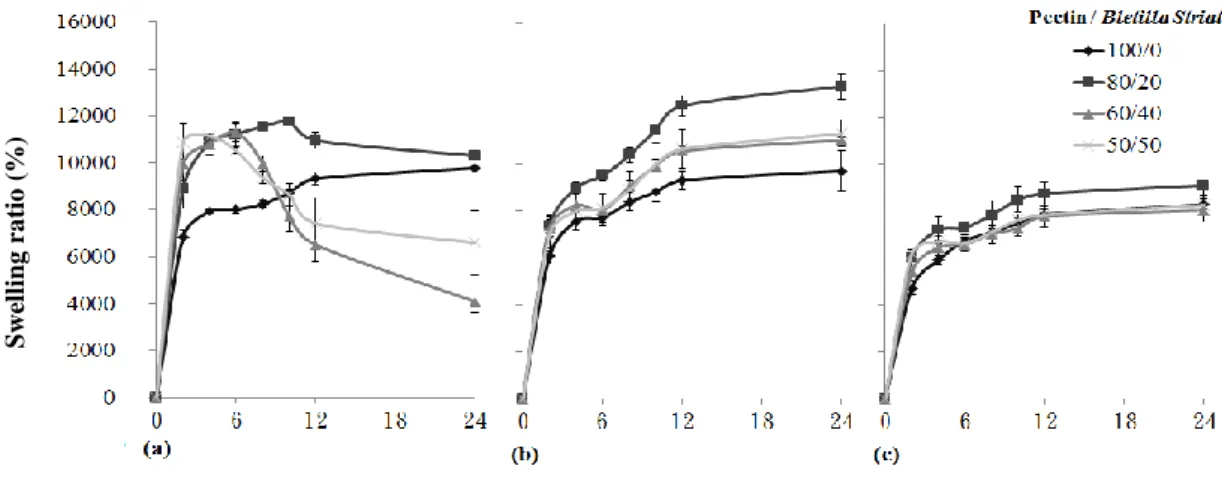
In Figure 2(a), we found that the 3-D network structure is not fully established. This may be due to insufficient calcium ions in the 30 ml of calcium chloride solution. As the proportion of Bletilla striata increased, the time required for the swelling to reach equilibrium was reduced. When the ratio of pectin and Bletilla striata is 50/50, the swelling ratio reached the maximum in 2 hours. The released Bletilla striata allows more water to infuse into the matrix, swelling the matrix. As we increased the volume of calcium chloride solution to 40 ml, the hydrogels become more stable. We found that the pure pectin membrane did not dissolve with 24 hours (Figure 2(b)). If 50 ml of calcium chloride is used, granular hydrogel formed possibly due to the strong cross-linking reaction and the phenomena of water separation. In this case, the swelling of pure pectin increased. On the other hand, the stable structure remained intact after swelling. The swelling capacity, however, reduced as proportion of pectin decreased.
Figure 3 showed that all membranes have a certain capacity of moisture retention. For composite membranes made at ratio of pectin/Bletilla striata of 80/20, 40 ml of calcium chloride solution have moisture retention of 49.80%, greater than 46.27% for 30 ml of calcium chloride solution and 46.33% for 50 ml of calcium chloride solution. This may be due to the stable structure of the hydrogel, keeping the water from evaporating into the air.with the amounts of carboxyl and hydroxyl groups as these hydrophilic functional groups can form hydrogen bonds with water and retain water near the surface of the membrane. Increased the volume of calcium chloride reduced the amounts of exposed hydrophilic functional groups, however. Note also that all the composite membrane retained hydrophilicity with increased content of Bletilla striata.
30 ml 40 ml 50 ml 0.3 wt % CaCl2 We igh t los s (%)
Figure 2. The swelling ratio of Pectin/Bletilla striata composite membranes. Volumes of CaCl2 solution used are 30 (a), 40 (b), and 50 ml (c), respectively.
Figure 3. The moisture retention of Pectin/Bletilla striata composite membranes in 12 hours. Table 1.The water contact angle of Pectin/Bletilla striata composite membranes.
contact angle CaCl2(aq) 30 ml 40 ml 50 ml P./B.S. 100/0 37.85±2.57 42.19±2.09 44.64±3.31 80/20 46.47±1.76 46.44±2.05 44.23±2.15 60/40 48.54±1.81 48.43±1.97 48.53±1.90 50/50 50.91±1.86 52.39±2.53 50.83±3.30
Table 1 showed that the wetability (i.e., contact angle) of pure pectin membranes can be correlated
Conclusion
We developed a manufacturing process to make low-methoxyl pectin/Bletilla striata composite membranes. The optimal working parameters (pectin/Bletilla striata=80/20, 40ml of calcium chloride solution) were obtained in terms of swelling ratio, stability in water, moisture retention, and wetability.
Acknowledgement
This work would especially like to thank National Science Council of the Republic of China, Taiwan, for financially supporting this research under Contract NSC 99-2622-E-166-004-CC3.
References
[1] G. D. Winter: Nature Vol. 197 (1963), p. 91-92.
[2] D. H. Cameron and M. Howard: Nature Vol. 200 (1963), p. 377-378. [3] S. B. Lin: Food Industry Vol. 11 (1995), p. 46-55.
[4] R. Li and Z.Z.Wang, Research survey and countermeasure on resources utilization in stem tuber of Bletilla striata, Vol. 37(11) (2006), p. 1751-1755.
[5] Z. G. Geng, S. L. Zheng and Z. Q. Wang: Chinese Traditional Herbal Drugs Vol. 21(2) (1990), p. 24. M ois tu re r et en tion ( %) S we ll in g r a tio (%) Time (hr) 30 ml 40 ml 50 ml 0.3 wt % CaCl2