Investigating Online Trust Formation and Duration: The Roles of Market
Maven and Product Involvement
Shu-Chen Yang National University of
Kaohsiung
No. 700, Kaohsiung University Rd., Nan Tzu Dist., Kaohsiung 811,Taiwan
886-7-5919715 [email protected]
Yi-Ming Tai
National Pingtung Institute of Commerce
No.51, Minsheng E. Rd., Pingtung City, Pingtung County 900, Taiwan
886-8-7238700 ext. 6172 [email protected]
Wen-Hsien Feng National Pingtung Institute of
Commerce No.51, Minsheng E. Rd.,
Pingtung City, Pingtung County 900, Taiwan
886-8-7238700 ext. 3251 [email protected]
Abstract
Initial trust formation and duration in Internet shopping was investigated in this study from the perspective of the elaboration likelihood model by conducting a 2x2 factorial laboratory experiment. We focused on the moderating effects of market maven and product involvement. Based on data collected from 211 respondents, the results indicate that an Internet consumer’s initial trust formation is highly dependent on whether he is highly engaged in general purchasing behaviors or involved in specific product. Besides, we also show that initial trust formed through central route is more durable than that formed through peripheral route. This study suggests that customizing the persuasive arguments for different consumers is a critical strategy for initial online trust building.
Keywords: Elaboration Likelihood Model, Internet Shopping, Involvement, Market Maven, Online Trust.
1. Introduction
Several studies have observed that individuals are usually reluctant to purchase products over the Internet because of high uncertainty and risk (e.g. Kim & Benbasat, 2003; Yang et al., 2006). It may be worse for unfamiliar e-tailers which are usually new entrants in online market. For new entrant, differentiated or niche strategies are often employed to compete with market pioneers. However, the popularization of IT has dramatically decreased customers’ searching cost for information, thus makes it much harder for e-tailers to differentiate their product from those of their competitors. The online marketplace is gradually characterized by more intense competition and increasing difficult to differentiate. As products’ differentials are diminishing, companies have to seek competitive advantage in closer, service-focused relationships. The relationship building between consumers and businesses is thus becoming an important issue for e-tailers. As Hoffman et al. (1999) suggested, trust building between businesses and consumers is critical for e-tailer success. Thus, e-tailers should try to persuade consumers that they are trustworthy in order to motivate the consumers to purchase products or provide private information over the Internet. Accordingly, consumers’ formation of online trust could be regarded as a persuasion process that demonstrates how people change their attitudes.
An elaboration likelihood model can be employed to clarify the persuasion process when people face various incoming messages and arguments (Petty and Cacioppo, 1981). The peripheral route
occurs when the formation of attitude or belief is just from simple heuristic cues without diligent consideration. A consumer forms his trust toward an e-tailer through his friends’ evaluation about the e-tailer can be regarded an example of peripheral route. Judgments made through the peripheral route are transient because they are based on simple and intuitive inferences taken from easily processed cues (Meyers-Levy and Malaviya, 1999). In contrast, the central route occurs when the formation of attitude or belief is determined by the issue-related arguments of the message claims. Attitude formation through the central route produce more enduring judgments as they are based on extensive and critical evaluation of message claims (Mackenzie and Spreng, 1992).
Besides, ELM also suggests that one’s involvement and information-processing capability will determine how one deals with various persuasive appeals (Yang et al., 2006). When people are highly involved with the communicated topics and have a high level of ability to process the arguments, the central route of persuasion occurs. However, the peripheral route of persuasion occurs when involvement and information-processing capability are limited. Kim and Benbasat (2003) suggest that Website trust formation can be explicated from the perspective of ELM. In our study, we will thus employ ELM to investigate the formation and duration of online trust. Several studies have suggested that market mavens may become more important for marketers, mainly due to their high engagement in shopping and potential for influencing other consumers (e.g. Clark and Goldsmith, 2005; Feick and Price, 1987). Mavens are inclined to be product innovators, heavy information seekers and opinion leaders (Feick and Price, 1987) and they tend to be more deliberate in their purchasing behaviors. Whether a consumer is a market maven may affect how he forms his trust toward an e-tailer. Besides, as ELM claims, a consumer’s involvement in specific product may also determine the route of his online trust formation. Our study thus investigates the roles of market maven and product involvement in Internet consumers’ trust formation from the ELM perspective. We conducted an experiment to examine our research hypotheses by manipulating word-of-mouth effect and product information quality as the peripheral and central cues respectively for online trust formation. Word-of-mouth effect triggers the peripheral route of online trust formation while product information quality triggers the central route of online trust formation.
2. Literature Review and Hypotheses Development 2.1 Elaboration Likelihood Model
Petty and Cacioppo (1981) propose Elaboration Likelihood Model (ELM) to explicate how an individual deals with various persuasive appeals. ELM suggests that the cognitive effort an individual devotes to processing an argument depends on his likelihood of elaboration. The degree of elaboration likelihood represents the extent to which an individual carefully evaluates the argument. Based on elaboration likelihood, ELM postulates there are two different routes to persuasion: central and peripheral. When an individual has the time or opportunity to process the coming messages, attitude changes will be induced via central route when he is highly involved with the arguments and has a high level of ability to process the arguments (Petty and Cacioppo, 1986). When an individual lacks either the motivation or the ability to process the detailed information in incoming messages, persuasion will occur via peripheral route. Overall, central processing requires more cognitive effort than does peripheral processing.
Under the central route, an individual attempts to deliberately and thoughtfully evaluate the content of incoming messages. Thus, attitude changes are determined by the issue-related arguments of the message claims. If the arguments are strong rather than questionable, then an individual’s beliefs and attitudes toward the communicated topic will be changed favorably (O’Keefe, 1990).Factors that lead to positive attitude changes under the central route are called central cues. The central cues include all the evidence that is directly related to the central issues of the communicated topic, such as those that emphasize the superiority of the product (Petty et al., 1983), indicate how the product is different from competitive product offerings (Lord et al., 1995), and offer high quality product information (Yang et al., 2006).
Under the peripheral route, however, people devote limited cognitive effort to process incoming message due to a lack of motivation and ability. Thus, they judge the message claim according to simple heuristic cues in the persuasion context without diligent consideration (Kim and Benbasat, 2003). For example, one’s favorable attitude toward a product may result simply from that he like the endorser. The simple heuristic cues are also called peripheral cues and include famous endorsers (Petty et al., 1983), high expertise of the source of the message (Petty and Cacioppo, 1984), and professional third-party seals (Yang et al., 2006).
2.2 Online Trust Formation and ELM
With high uncertainty and risk, consumers’ trust is a key determinant of transaction completion in Internet shopping (Kim and Benbasat, 2003). McAllister (1995, p. 25) defines trust as “the extent to which a person is confident in, and willing to act on the basis of, the words, actions, and decision of another.” In this definition, trust encompasses beliefs about others and willingness to behave. In our study, trust toward an e-tailer is regarded as “trusting belief that represents consumers’ perceived trustworthiness about the e-tailer’s characteristics and actions”. From the ELM perspective, these antecedents of trusting beliefs can be regarded as trust-related arguments and categorized as either central cues or peripheral cues. For example, third-party seals, links from reputable sites, presentation style of website, and word of mouth are peripheral cues. Privacy and security policies as well as product information are examples of central cues that directly relate to central issues of Internet shopping.
Consumers may develop their trust toward an unfamiliar e-tailer through central or peripheral routes of persuasion. In our study, word of mouth effect and product information quality are regarded as peripheral cues and central cues respectively. For the peripheral route, it is argued that an individual’s initial trust toward an e-tailer will be affected by his friends’ evaluation about the Website through social desirability. For the central route, however, it is argued that the quality of product information may affect an individual’s initial trust toward an e-tailer.
2.3 Market Maven and Product Involvement
As ELM claims, the routes to trust formation highly depend on an individual’s desire to think about problems or things when they are exposed to persuasion situation (Mackenzie et al., 1986). Prior literature on consumer behaviors suggests certain individuals feel obligated to be informed about marketplace and various products and these individuals are highly deliberate and devoted in their purchasing behaviors (e.g. Price et al., 1988; Williams and Slama, 1995). Feick and Price (1987, p. 85) first called these consumers “market mavens” and defined them as “individuals who have information about many kinds of products, place, and shop, and other facets of markets,
and initiate discussions with consumers for market information.” Market mavens are usually highly engaged in shopping and try to acquire in-depth information on selected products and marketplace. Thus, they are quite knowledgeable about buying and usually actively share their opinions with other consumers (Goldsmith et al., 2003). The product information quality is an important central cue for market mavens. From the perspectives of ELM, a market maven will form his initial trust toward an unfamiliar e-tailer via central routes due to his tendency to be highly involved in purchasing behavior. On the other hand, a non-maven who devotes less cognitive effort to buying will be easily influenced by his peers’ opinions and form his initial trust via peripheral routes. Accordingly, we have the following hypothesis:
H1a: The central route will be better at explaining how a market maven forms initial trust toward an e-tailer.
H1b: The peripheral route will be better at explaining how a non-maven forms initial trust toward an e-tailer.
Based on the arguments of ELM, individual involvement will determine the routes to attitude change (Petty & Cacioppo, 1986). Argument quality is a critical determinant of attitude toward the communicated topics when people are highly involved in the incoming message. Laurent and Kapferer (1985) suggest that people who are highly involved in a certain object (such as product, issues, advertisement et al.) tend to actively search and process related information for decision making. In Internet shopping, as consumers perceive that the product is highly relevant and important for them, they will expend much more cognitive effort to process the product information. Thus, the product information quality is an important central cue for Internet shopping when an individual is highly involved in the target product. However, consumers with low involvement will devote less cognitive effort to evaluate the issue-relevant arguments and change their attitudes according to the simple affective cues (Petty et al., 1983). Unlike the high involvement group, people who perceive less relevance about the product will not deliberately process the product information in Internet shopping and form their initial trust via peripheral routes. The following hypothesis is then proposed:
H2a: The central route will be better at explaining how a consumer with high product involvement forms initial trust toward an e-tailer.
H2b: The peripheral route will be better at explaining how a consumer with low product involvement forms initial trust toward an e-tailer.
2.4 Duration of Online Trust
Whether attitude change specified in ELM is inclined to be transient or endurable is dependent on whether attitudes are formed through the central or peripheral route. Mackenzie and Spreng (1992) suggest that attitude formation through the central route produce more enduring judgments as they are based on extensive and critical evaluation of message claims. That is to say, consumers who are willing to devote themselves in buying will form their initial trust via central route and the trust formation will be longer lasting and more resistant to change. Thus, we have the third hypothesis as following:
H3: A consumer’s initial trust toward an e-tailer will positively lead to continuous trust toward an e-tailer when his trust formed through central route.
Our research framework is shown in Figure 1.
Fig. 1. Research Model
3. Research Method
This study employed a laboratory experiment that manipulated word-of-mouth effect (WOM) and product information quality, thus resulting in a 2 (WOM versus non-WOM) x 2 (high- versus low-quality) between-subjects factorial design. Two dependent variables and two moderators were measured. The dependent variables were initial trust toward an e-tailer and continuous trust toward an e-tailer. The moderators were market maven and product involvement. In order to investigate the formation and duration of online trust, a two-stage approach is adopted to collect data for examining the relationship between initial trust and continuous trust.
This experiment was carried out in two universities in southern and northern Taiwan. The main criterion for sample selection was that students be Web surfers in order to be potential Internet shopping customers. We posted an announcement on the campus BBS in order to recruit volunteers. In order to motivate potential respondents to participate, volunteers can earn NTD $100 after first stage and second stage respectively. Each participant also gets a chance to draw for the prize after both stages of the experiment.
3.1 Target Product Selection and Websites Development
A pretest was conducted in order to select a target product that was highly discriminable in individual involvement. Researchers and several MIS graduate students participated in brainstorming for possible products. Products were chosen on the premise that they were relevant to the target sample and that they could be bought over the Web. After brainstorming, six products were chosen to be included in the pretest questionnaire. Fifty-one respondents were invited to report their involvement with the six products based on Zaichkowsky’s (1994) product involvement scale. Results showed that the standard deviations of product involvement for mp3 player, mobile phone, Web camera, digital camera, notebook computer, personal digital assistant are 10.92, 8.36, 9.11, 8.11, 6.78, and 5.98 respectively. Higher standard deviation indicates higher discrimination in individual involvement. Thus, mp3 player was chosen as the target product in our experiment. The mean of mp3 player involvement was 32.18. In order to elicit more natural responses from participants, all Web pages and pictures used were taken from
Word-of-Mouth Effects Product Information Quality Initial Trust toward an e-Tailer
Market Maven or High Involvement
Continuous Trust toward an e-Tailer Initial Trust toward a e-Tailer non-Maven and Low Involvement
Dashed lines indicate non-significant paths
Continuous Trust toward an e-Tailer Word-of-Mouth Effects Product Information Quality
actual sites and modified to fit our study’s objectives. We constructed two versions of a fictitious shopping website in which all pages kept an identical style and layout throughout, and differed only in the manipulations.
3.2 Manipulation and Measures
We manipulated product information quality based on the result of a pretest. Researchers and several MIS master students participated in brainstorming for possible product-related attributes. After brainstorming, thirteen attributes of mp3 player were chosen to be included in the pretest questionnaire. Forty-seven respondents were invited to rate the importance of these thirteen attributes. Among these attributes, each respondent was asked to choose six most important ones when he considers buying an mp3 player. Each attribute is assigned a score of six as it is chosen as the most important. After calculation, the top four (memory capacity, appearance, and etc.), bottom four (voice recording, service, and etc.), and other (built-in microphone, price, and etc.) attributes were labeled as most important product attributes, least important product attributes, and other product attributes respectively. The high quality conditions were manipulated by presenting all of these thirteen attributes, while the low quality conditions were manipulated by presenting least important product attributes and other product attributes.
We employed a measurement of affect-based trust adapted from McAllister (1995) as a manipulation check for word-of-mouth effect. Each respondent assigned to WOM groups was asked to suppose that one of his best friends has told him about the merits of the trial shopping website in our experiment. This friend must be a particular one whom the focal respondent most trusts in real life. We then request each respondent in WOM groups to report his affect-based trust toward this friend. Data was discarded when the average score of affect-based trust is lower than or equal to four (seven point Likert scale). This check can ensure the validity of our manipulation of word-of-mouth effect.
All dependent variables, contingent variables, and measurement of manipulation check were measured using multiple-item scales with seven-point Likert Scale, drawn from pre-validated measures in previous related studies (see Table 1). All items were translated into Chinese, and then wordings were modified by researchers and several MIS graduate students to reflect cultural subtlety. A pilot test was conducted to ensure the wordings were understandable.
Table 1. Measurs
Measures Operational definition # of items Sources
Initial/ Continuous Trust toward an e-Tailer
The degree to which an e-tailer’s characteristics and actions are trustworthy
7 Kaplan and Nieschwietz, 2003 Affect-Based Trust The degree to which an individual was
trustworthy emotionally.
5 McAllister, 1995 Product Involvement The degree of an individual’s perceived
relevance of the product based on inherent needs, values, and interests.
10 Zaichkowsky, 1994
Market Maven The degree to which an individual has information about many kinds of products, place, and shop, and other facets of markets, and initiate discussions with consumers for market information
3.3 Experimental Procedure
Respondents were told that they were participating in testing a trial mp3 player shopping website and requested to choose an mp3 player that they were most likely to buy after browsing the website. In the beginning, a short description of the experiment was given, and then respondents were requested to report their individual involvement with mp3 player. Respondents were classified based on the means of mp3 player involvement (32.18) from our pretest. High involvement respondents were told that they could possibly win the mp3 player they chose after the experiment, while low involvement respondents were told that they could possibly win a Web camera that was equivalent to the price of an mp3 player. The reason we varied the prizes was to increase the difference in perceived relevance of the mp3 player between high involvement respondents and low involvement respondents.
Each respondent was randomly assigned to one of the four conditions in the experiment. After browsing the website and choosing an mp3 player, respondents were asked to fill out an online questionnaire used to measure initial trust toward an e-tailer and market maven. All respondents were given a gift that valued about NTD $100 and told that they will earn another NTD $100 if they participate in second stage of our experiment in two weeks. Respondents in second stage were first remind what we have done in previous stage and then asked to fill out another questionnaire used to measure continuous trust toward an e-tailer according to their impression in first previous stage.
3.4 Data
A total of 240 respondents participated in first state of our experiment and were equally distributed across the four conditions. Fourteen respondents in WOM groups cannot pass our manipulation check and twenty one respondents were absent in second stage. Because six absentees in second stage were discarded through our manipulation check, 211 valid respondents remain. Of all the valid respondents, 60.7 percent were men and the age is between 19 and 25 years old. 68.22 percent of the respondents were undergraduate students and 31.78 percent were graduate students. We also employed t-test to test the differences between the datasets collected from two universities. The results indicate that initial trust and continuous trust in these two datasets are not significantly different.
4. Analyses
4.1 Measurement Validation
In order to discriminate between initial trust and continuous trust, we first employ exploratory factor analysis (EFA) with a varimax rotation to assess the underlying factor structures of the measurement items of dependent variables in our model. EFA results indicate that the measurement items are adequately explained by two factors and the factor loadings range from .883 to .958. Furthermore, the AVE (average variance extracted) for initial trust and continuous trust are .875 and 0.835 respectively, suggesting acceptable convergent validity (Fornell & Larcker, 1981). In order to assess discriminant validity of the constructs, we calculated the squared interconstruct correlation between initial trust and continuous trust and compared it to the AVE estimate for each construct. Both AVE estimates are greater than the squared interconstruct correlations (the correlations is .322), thus discriminant validity is supported (Fornell & Larcker, 1981).
4.2 Moderating Effects Testing
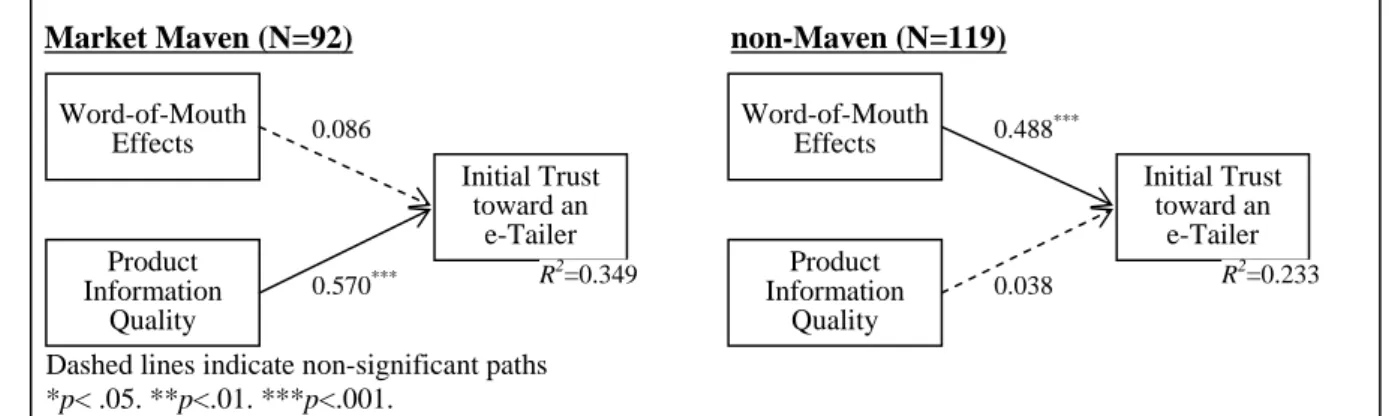
In order to examine our hypotheses, 211 respondents were classified based on the average score (32.18) of product involvement in pretest and the midpoint (4) of market maven. We then employed regression analyses for each classification in order to verify the moderating effects. Results are shown in Fig. 2, 3, and 4. For hypothesis 1, 92 respondents are market maven and 119 respondents are non-maven. Result of t-test indicates that the two groups are significant different (t-value is 22.914). As shown in Fig. 2, in the market maven group, product information quality positively affects initial trust toward an e-tailer while the relationship between word-of-mouth effect and initial trust is not significant. It implies that market mavens develop their trust toward unfamiliar e-tailers through the central route exclusively. H1a is supported. Also shown in Fig. 2, in the non-maven group, only word-of-mouth effect positively affects initial trust toward an e-tailer. It implies that consumers who are not market mavens develop their trust toward unfamiliar e-tailers through the peripheral route exclusively. H1b is supported.
Fig. 2. Moderating Effect of Market Maven
For hypothesis 2, 111 respondents have high involvement and 100 respondents have low involvement. Result of t-test indicates that the two groups are significant different (t-value is 20.908). As shown in Fig. 3, in the high involvement group, both word-of-mouth effect and product information quality positively affect initial trust toward an e-tailer. It implies that consumers who have high product involvement develop their trust toward unfamiliar e-tailers through both the central and peripheral route. H2a is partially supported. Also shown in Fig. 3, in the low involvement group, word-of-mouth effect positively affects initial trust toward an e-tailer while the relationship between product information quality and initial trust is not significant. It implies that consumers who have low product involvement develop their trust toward unfamiliar e-tailers through the peripheral route exclusively. H2b is supported.
Word-of-Mouth Effects Product Information Quality Initial Trust toward an e-Tailer
Market Maven (N=92) non-Maven (N=119)
Dashed lines indicate non-significant paths *p< .05. **p<.01. ***p<.001. 0.086 0.570*** Word-of-Mouth Effects Product Information Quality Initial Trust toward an e-Tailer 0.488*** 0.038 R2=0.349 R2=0.233
Fig. 3. Moderating Effect of Product Involvement
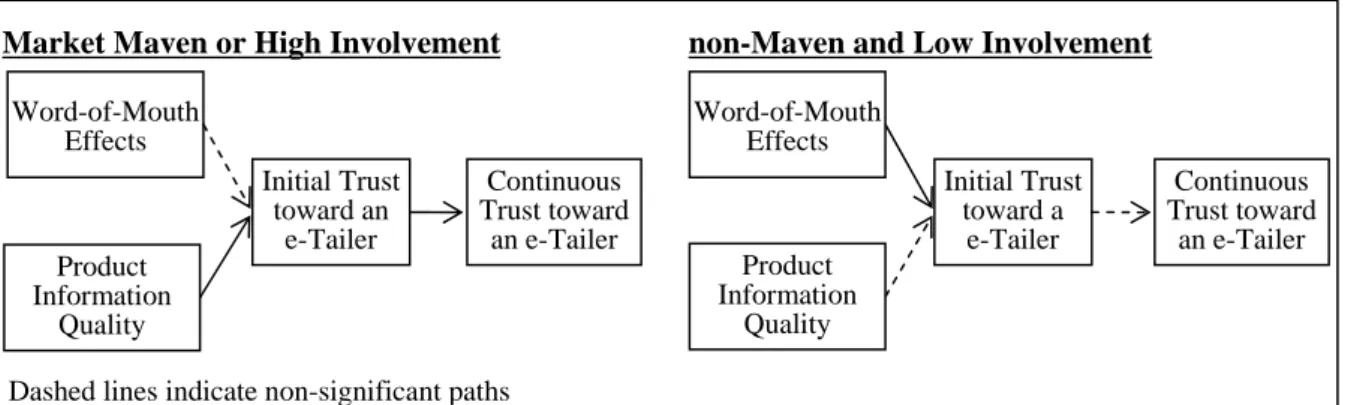
For hypothesis 3, 125 respondents are market mavens or have high involvement and 86 respondents are not market mavens and have low involvement. Result of t-test indicates that the two groups are significant different (t-value for involvement and market maven are 14.110 and 10.667 respectively). As shown in Fig. 4, initial trust positively leads to continuous trust for the “market maven or high involvement” group, while the relationship between initial trust and continuous trust is not significant for the “non-maven and low involvement” group. It implies that the trust formation through central route will be longer lasting and more resistant to change. H3 is then supported.
Fig. 4. Moderating Effect of Market Maven and Product Involvement
5. Discussion and Conclusion
Overall, results support the claims that an Internet consumer’s initial trust formation is highly dependent on whether he is highly engaged in general purchasing behaviors or involved in specific product. Based on our analyses, consumers who are market mavens or have high involvement will develop their initial trust toward an e-tailer through the central route. For those who are highly involved will be also influenced by peripheral cues. One the other hand, consumers who are not market maven or less involved in certain product will develop their initial trust toward an e-tailer through the peripheral route rather than central route. As ELM claims, our study also shows that consumers who form their initial trust through central route will not easily change their trust toward an e-tailer for a certain period of time.
Initial Trust toward an e-Tailer
Market Maven or High Involvement (N=125)
Continuous Trust toward an e-Tailer
non-Maven and Low Involvement (N=86)
Dashed lines indicate non-significant paths *p< .05. **p<.01. ***p<.001. Initial Trust toward an e-Tailer Continuous Trust toward an e-Tailer 0.525*** R2=0.276 0.033 R2=0.001 Word-of-Mouth Effects Product Information Quality Initial Trust toward an e-Tailer
High Product Involvement (N=111) Low Product Involvement (N=100)
Dashed lines indicate non-significant paths *p< .05. **p<.01. ***p<.001. 0.197* 0.421*** Word-of-Mouth Effects Product Information Quality Initial Trust toward an e-Tailer 0.570*** 0.005 R2=0.224 R2=0.325
Several ELM literatures have claimed that attitude change induced through central route is more durable (e.g. Mackenzie and Spreng, 1992), but extant empirical studies that confirm this claim are not abundantly available. This study provides a compelling theoretical framework for conducting an empirical study for this line of research. Later studies can extend this study to better explicate online trust formation and duration. For marketers, it is necessary to customize the persuasive arguments for different audiences since our results show that initial trust formation toward an e-tailer highly depends on an individual’s product involvement and proficiency in general purchasing behaviors. For consumers who are market maven or have high involvement, central cues are appropriate in trust building. However, for consumers who are not market maven and have low involvement, peripheral cues are beneficial. The importance of market maven has been addressed by several researchers (e.g. Feick and Price, 1987; Goldsmith et al., 2003; Willams and Slama, 1995). Market mavens are usually smart shoppers and likely to influence the buying decisions of a variety of consumers who seek their advices. E-tailers can improve the information quality of their Website to attract market mavens.
Future research may be conducted with limitations of this study in mind. First, our results were restricted to shopping for mp3 player which feature relatively low price and risk. The research questions should be further examined in other kinds of Internet shopping websites in order to clarify our understanding about online trust formation and duration. Second, we choose only one peripheral cue and one central cue in order to reduce our experiment to a manageable size. Further studies should be conducted to explore other cues that are critical for trust formation toward e-tailers.
References
1. Clark, R. A., and Goldsmith, R. E. “Market Maven: Psychological Influences,” Psychology & Marketing (22:4), 2005, pp. 289-312.
2. Feick, L. F., and Price, L. L. “The Market maven: A Diffuser of Marketplace Information,” Journal of Marketing (51), 1987, pp. 83-97.
3. Fornell, C., and Larcker, D. F. “Evaluating Structural Equation Models with Unobservable Variables and Measurement Error,” Journal of Marketing Research (28:1), 1981, pp. 39-50.
4. Goldsmith, R. E., Flynn, L. R., and Goldsmith, E. B. “Innovative Consumers and Market Mavens,” Journal of Marketing Theory & Practice (11:4), 2003, pp. 54-64.
5. Hoffman, D. L., Novak, T. P., & Peralta, M. “Building Consumer Trust Online,” Communications of the ACM (42:4), 1999, pp. 80-85.
6. Kaplan, S. E., and Nieschwietz, R. J. “A Web Assurance Services Model of Trust for B2C e-Commerce,” International Journal of Accounting Information Systems, (4:2), 2003, pp. 95-114. 7. Kim, D., and Benbasat, I. “Trust-related Arguments in Internet Stores: A Framework for Evaluation,”
Journal of Electronic Commerce Research (4:2), 2003, pp. 49-63.
8. Laurent, G., and Kapferer, J. “Measuring Consumer Involvement Profiles,” Journal of Marketing Research (22:1), 1985, pp. 41-53.
9. Lord, K. R., Lee, M. S., and Sauer, P. L. “The Combined Influence Hypothesis: Central and Peripheral Antecedents of Attitude toward the Ad,” Journal of Advertising (24:1), 1995, pp. 73-85. 10. Mackenzie, S. B., Lutz, R. J., and Belch, G. E. “The Role of Attitude toward the Ad as a Mediator of
Advertising Effectiveness: A Test of Competing Explanation,” Journal of Marketing Research (23), 1986, pp. 130-143.
11. Mackenzie, S. B., and Spreng, R. A. “How Does Motivation Moderate the Impact of Central and Peripheral Processing on Brand Attitudes and Intentions?” Journal of Consumer Research, (18:4), 1992, pp. 519-529.
12. McAllister, D. J. “Affect- and Cognition-based Trust as Foundations for Interpersonal Cooperation in Organizations,” Academy of Management Journal (38:1), 1995, pp. 24-59.
13. Meyers-Levy, J., and Malaviya, P. “Consumers’ Processing of Persuasive Advertisements: An Integrative Framework of Persuasion Theories,” Journal of Marketing (63), 1999, pp. 45-60.
14. O’Keefe, D. J. Persuasion: Theory and Research, Sage, Newbury Park, CA, 1990.
15. Petty, R. E., and Cacioppo, J. T. Attitude and Persuasion: Classic and Contemporary Approaches, Wm. C. Brown Company, Dubuque, IA, 1981.
16. Petty, R. E., & Cacioppo, J. T. “Source Factors and the Elaboration Likelihood Model of Persuasion,” Advances in Consumer Research (11:1), 1984, pp. 668-672.
17. Petty, R. E., and Cacioppo, J. T. Communication and Persuasion: Central and Peripheral Routes to Attitude Change, Springer-Verlag, New York, 1986.
18. Petty, R. E., Cacioppo, J. T., and Schumann, D. “Central and Peripheral routes to Advertising Effectiveness: The Moderating Role of Involvement,” Journal of Consumer Research (10:2), 1983, pp. 135-146.
19. Price, L. L., Feick, L. F., and Guskey-Federouch, A. “Couponing Behaviors of Market Maven: Profile of a Super Couponer,” Advances in Consumer Research (15), 1988, pp. 354-359.
20. Willams, T. G., and Slama, M. E. “Market Mavens’ Purchase Decision Evaluative Criteria: Implications for Brand and Store Promotion Efforts,” Journal of Consumer Marketing (12:3), 1995, pp. 4-21.
21. Yang, S.C., Hung, W.C., Sung, K., and Farn, C.K. “Investigating Initial Trust toward E-tailers from the Elaboration Likelihood Model Perspective,” Psychology & Markeing (23:5), 2006, pp. 429-445. 22. Zaichkowsky, J. L. “The Personal Involvement Inventory: Reduction, Revision, and Application to