High-sensitivity microwave vector detection at extremely power levels for
low-dimensional electron systems
W. H. Hsieh, C. H. Kuan, Y. W. Suen, S. Y. Chang, L. C. Li, B. C. Lee, and C. P. Lee
Citation: Applied Physics Letters 85, 4196 (2004); doi: 10.1063/1.1814797
View online: http://dx.doi.org/10.1063/1.1814797
View Table of Contents: http://scitation.aip.org/content/aip/journal/apl/85/18?ver=pdfcov
Published by the AIP Publishing
Articles you may be interested in
Microwave power generation by magnetic superlattices
Appl. Phys. Lett. 99, 242107 (2011); 10.1063/1.3670400
Semimetal-semiconductor rectifiers for sensitive room-temperature microwave detectors
Appl. Phys. Lett. 87, 163506 (2005); 10.1063/1.2112201
Instrumentation of a high-sensitivity microwave vector detection system for low-temperature applications
Rev. Sci. Instrum. 76, 084704 (2005); 10.1063/1.2006327
Single-photon detector in the microwave range
Appl. Phys. Lett. 80, 4250 (2002); 10.1063/1.1482787
A device layout for tunneling spectroscopy of barrier-separated electron systems with tunable dimensionality
Appl. Phys. Lett. 74, 1758 (1999); 10.1063/1.123679
This article is copyrighted as indicated in the article. Reuse of AIP content is subject to the terms at: http://scitation.aip.org/termsconditions. Downloaded to IP: 140.113.38.11 On: Thu, 01 May 2014 04:07:15
High-sensitivity microwave vector detection at extremely low-power levels
for low-dimensional electron systems
W. H. Hsieh and C. H. Kuan
Graduate Institute of Electronics Engineering and Department of Electrical Engineering, National Taiwan University, Taipei, Taiwan, Republic of China
Y. W. Suen,a) S. Y. Chang, and L. C. Li
Department of Physics, National Chung Hsing University, 250, Kuo Kuang Road, Taichung 402, Taiwan, Republic of China
B. C. Lee and C. P. Lee
Department of Electronics Engineering, National Chiao Tung University, Sinchu, Taiwan, Republic of China
(Received 25 March 2004; accepted 7 September 2004)
We present a high-sensitivity microwave vector detection system for studying the low-dimensional electron system embedded in the gaps of a coplanar waveguide at low temperatures. Using this system, we have achieved 0.005% and 0.001° resolutions in amplitude and phase variations, respectively, at 10 GHz in a magnetotransport measurement on a quantum-wire array with an average signal power less than −75 dBm into the sample at 0.3 K. From the measured phase variation, we can distinguish a very tiny change in the induced dipole moment of each quantum wire. © 2004 American Institute of Physics.[DOI: 10.1063/1.1814797]
Coplanar waveguides (CPWs) have been successfully used as broadband sensors in investigating the high-frequency magnetotransport phenomena of low-dimensional electron systems(LDESs), such as two-dimensional electron systems (2DESs),1–5 and anti-quantum dots (QDs),6 etc. In these works, a commercial vector network analyzer(VNA) is the major tool to measure the variation of the propagation constant, including the attenuation constant 共␣兲 and the phase constant 共兲, of the CPW that containing the active LDES in the gaps between the metal electrodes. From␣and
one can extract the longitudinal conductivity 共xx兲1 (both real and imaginary parts) of the LDES. However, since the microwave power delivered to samples at temperature 共T兲 below a few hundred millidegrees Kelvin must be very low, the resolution of the data becomes very poor, especially for the phase part. Thus in most of the previous studies using CPW sensors, they only presented Re兵xx其 data derived from
␣ and discarded the phase part. Even though Hohls et al.7 and Lewis et al.8have addressed the Im兵xx其 behavior in the integer quantum Hall (IQH) regime based on other tech-niques, still, the resolution of Im兵xx其 is mediocre due to the constrain of VNAs. Nevertheless, Im兵xx其, proportional to the change of the real part of dielectric constant, gives im-portant information about the electric polarization, that is of special interest in the case of QDs, quantum wires(QWs), or 2DESs at high magnetic fields 共B兲. Furthermore, the rela-tively small effective area of QDs or QWs compared to 2DES samples leads to a very small signal variation(or dy-namic range), that makes the conventional VNA measure-ment very difficult and impractical.
In this letter, we present a detection scheme and the in-strumental implementation, which can resolve very small variations not only in the amplitude but also the phase of an extremely low-power-level microwave signal traveling
through a CPW with LDESs embedded in the gaps while some external sample parameters, such as the applied mag-netic field 共B兲 or, T etc., is changed. The data of a low-T magnetotransport measurement on a QW-array sample mani-fest the high-resolution capability of this system.
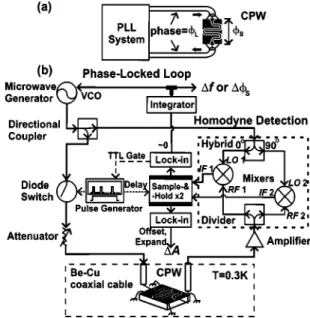
A simplified schematic diagram to illustrate the principle of phase detection by a phase-lock loop9(PLL) is depicted in Fig. 1(a). The CPW sample is connected to a PLL through two semirigid coaxial cables of total length L. The PLL will force the total phase change 共⌬兲, including the phase change of the semirigid cables共⌬L兲 and the CPW sample 共⌬s兲, to be 0 by tuning the frequency 共f兲 of the voltage-controlled oscillator(VCO) during the experiments, that is, ⌬=⌬L+⌬s= 0, or ⌬s= −⌬L. Hence, ⌬s can be ob-tained directly from the frequency change共⌬f兲 of VCO via
a)Author to whom correspondence should be addressed; electronic mail:
FIG. 1. Simplified schematic diagram for phase detection using a PLL.(b) Block diagram of the vector detection system. The meandering CPW con-taining a LDES in the gaps is part of the microwave signal path in the PLL.
APPLIED PHYSICS LETTERS VOLUME 85, NUMBER 18 1 NOVEMBER 2004
0003-6951/2004/85(18)/4196/3/$22.00 4196 © 2004 American Institute of Physics
This article is copyrighted as indicated in the article. Reuse of AIP content is subject to the terms at: http://scitation.aip.org/termsconditions. Downloaded to IP: 140.113.38.11 On: Thu, 01 May 2014 04:07:15
⌬s= −⌬L= − 2⌬fL/vL= −⌬L, 共1兲 wherevLis the phase velocity of the signal in the cable. The result can be expressed as the product of the change of the angular frequency共⌬兲 and the delay time 共L兲 of the con-necting cables with a different sign.
A complete block diagram, including the pulse handling circuits, the microwave PLL, and the amplitude readout cir-cuit, together with the CPW sample in a cryogenic environ-ment, is shown in Fig. 1(b). The microwave part of this system is basically a pair of homodyne detectors (mixers) with reference signals of quadrature phase difference. One of the mixers with 0° reference共LO1兲, used as the phase sen-sitive detector (PSD), has zero output 共IF1兲 forced by the PLL, while the other one with 90° reference共LO2兲 has an output共IF2兲 proportional to the amplitude of the signal.
Besides homodyne detection we employ a double-pulse modulation scheme to detect and average the microwave sig-nal. A short pulse train with a 0.2– 2s pulse width and a 0.1% – 10% duty cycle, provided by a pulse generator and gated by a slow square-wave TTL signal with a period of 1 – 10 ms from a lock-in amplifier, modulates the microwave signal sent to the sample. A time-delayed pulse with a 0.1– 1s pulse width triggered by the modulating pulses controls a sample-and-hold(S&H) circuit that samples the IF output of the microwave mixer. The holding capacitor in the S&H circuit is discharged through an analog switch when the TTL gating signal is low. Finally, the lock-in amplifier reads the output of the S&H circuit. There are two sets of pulse averaging circuits, one for the PLL and the other for the amplitude readout. Note that the time constant of the lock-in amplifier for the PLL is about 1 – 30 ms, in contrast to 300 ms or 1 s for the amplitude readout part. The average of the PSD output共IF1兲 is sent to an integrator (loop filter of PLL) with a time constant of 26.3 ms. The output of the integrator connects to the frequency modulation(FM) input of the microwave source (VCO), thus closing the PLL. In fact this PLL system is modified from what people used in surface-acoustic-wave detection experiments,10 but with im-proved pulse averaging and amplitude detection methods.
We use three sets of microwave modules to cover the frequency from about 60 MHz to 18 GHz. The details of our instrumentations and circuit designs will be published else-where. To gain an idea of the detection limit, we tested our system with only an 11 m semirigid cable connected to the PLL without samples. The input microwave signal is attenu-ated down to −70 dBm peak power, and less than −90 dBm in average. The background phase fluctuation we obtain in this test is less than 0.0003° (root-mean-squared value) for fⱗ6 GHz and 0.006° for 6ⱗ f ⱗ18 GHz, which is remark-ably low for such a low-power signal. In fact, the signal power reaching the low-noise amplifier(LNA) is even lower than the input value claimed earlier due to the loss of the cable, which is about −9 dB at 1 GHz and raises to −41 dB at 10 GHz. This may explain why the noise in phase in-creases at high frequencies. The resolution with a low-T sample loaded is slightly worse due to the loss of the sample and extra noise from the cryogenic environment. The resolu-tion of the amplitude readout for a small-variaresolu-tion signal can be enhanced by the use of the “offset” and “expand” func-tions of the lock-in amplifier.11
In the following we will present measured results for a QW array sample to demonstrate the resolving power of this
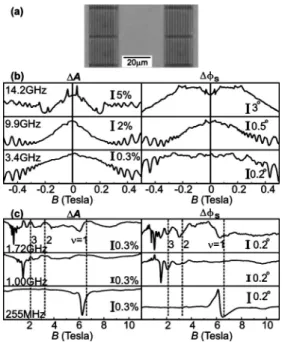
method. The sample is fabricated from a standard molecular beam epitaxy (MBE)-grown modulation-doped GaAs/ AlGaAs heterostructure containing a 2DES, which is 150 nm under the surface. The 2DES has a mobility of about 1.5⫻105cm2/ V s at 4 K, and a density of 1.1⫻1011cm−2. Before evaporating the Cr/ Au共10/300 nm兲 metal layers for the CPW pattern, we etch away the 2DES part underneath. The widths of the center conductor and the gap of the 50⍀ CPW are 36 and 23m, respectively. A meandering pattern1 is used to increase the effective length of the CPW. Subse-quently we pattern the 2 DES left in the gap into about 7000 identical QW mesas, each of 0.7m wide and 20m long, by using electron-beam lithography and chemical etching [Fig. 2(a)]. The QWs, parallel to the propagating direction of microwave signals, occupy only about 6 mm in length of the straight sections of the meandering CPW.
The CPW sample is immersed in liquid3He共0.3 K兲 with applied B perpendicular to the sample surface. The total time delay given by the connection cables and microwave mod-ules is 51.1 ns. From Eq.(1), this time delay multiplied by ⌬f gives the phase change 共⌬s兲 of the CPW sample. Here ⌬f can be either obtained from the output voltage of the integrator in the PLL scaled with the FM deviation setting of the VCO, or measured directly with a microwave counter. The peak power of the pulsed microwave signals is −50 dBm (about −66 dBm in average) at the input end of the semirigid cable.
Figure 2(b) displays low-field results for both directions of B. Besides the apparent Shubinkov–de-Hass(SdH) oscil-lations, we can observe additional intriguing features for B below 0.2 T. For frequency higher than a few gigahertz, the high- B data exhibit behaviors similar to a 2DES, showing IQH states. The SdH oscillations become less pronounced at lower f and even completely disappear below 600 MHz. In Fig. 2(c), the data are shown up to B=11 T. An extra adsorp-tion peak appears at B = 6 T associated with a unique phase change nearby for f = 255 MHz, and moves to lower B for
FIG. 2. Scanning electron micrograph of the quantum wire mesas in the gaps of CPW.(b) Low-field amplitude and phase variations for both direc-tions of magnetic fields for various f.(c) High-field data showing EMP adsorption peak and IQH states at different f.
Appl. Phys. Lett., Vol. 85, No. 18, 1 November 2004 Hsiehet al. 4197
This article is copyrighted as indicated in the article. Reuse of AIP content is subject to the terms at: http://scitation.aip.org/termsconditions. Downloaded to IP: 140.113.38.11 On: Thu, 01 May 2014 04:07:15
higher f, indicating that this feature relates to the edge magnetoplasma12(EMP) excitations. More detailed data and an explanation of these interesting results will be published separately. Here we will emphasize mainly the resolution of the measurements and also the polarization of each QW that can be extracted from our data.
The background noise of the data shown in Figs. 2(b) and 2(c) is extremely low. The amplitude and phase fluctua-tions in ⌬A and ⌬s data are less than 0.003% and 0.001° for fⱗ10 GHz, and 0.05% and 0.03° for f ⲏ10 GHz, re-spectively. These resolution limits actually depend on the power reaching the LNA, which is f dependent due to the loss of the sample and the semirigid cables. The average power into the sample and into the LNA are about −70 and −76 dBm at f⬃1 GHz, and down to −80 and −107 dBm at 14 GHz, respectively. Moreover, the 0.3% scale bar in the ⌬A plot is equivalent to only 53 nS 2D conductivity in av-erage, which is very small compared to the signal levels in previous studies.1–6
The susceptibility ␥ of each QW and ⌬s can be related13by␥=⌬s2/ NZ0, where N is the total number of
QWs, Z0is the characteristic impedance of the CPW, andis a length scale related to the distribution of the tangential electric field 共E兲 on the surface and the geometry of the CPW. The induced dipole moment of each QW segment, p, is then␥E. For our CPW structure,is about 21m. The␥ value corresponding to the 0.2° scale bar in Fig. 2(c) for 255 MHz is about 3⫻10−27F / m2. For a signal of
−51.5 dBm peak power, we can estimate p accordingly to be about 3⫻10−25C m, equivalent to about 17 electrons being transferred across a 0.1m effective QW width, assuming a 0.3m depletion length near each edge.
Finally, we want to discuss the effect of the cable length and related instrumental considerations. Usually as we in-crease L, the sensitivity in phase is inin-creased according to Eq.(1), and so is the loop gain of the PLL. However, if L is too big, the PLL will have a very small capture range, and
the effect of noise and drift in electronic components become serious. In addition, high-frequency signals will suffer a very severe loss.
In conclusion, we have developed and demonstrated a high-sensitivity vector detection system for very low-power microwave signals used in a CPW broadband sensor. This system is a very powerful tool in studying the dynamic be-haviors, including the electric polarizations, of LDESs at low temperatures.
This work was supported by the National Science Coun-cil of the Republic of China.
1
L. W. Engel, D. Shahar, C. Kurdak, and D. C. Tsui, Phys. Rev. Lett. 71, 2638(1993).
2
C.-C. Li, L. W. Engel, D. Shahar, D. C. Tsui, and M. Shayegan, Phys. Rev. Lett. 79, 1353(1997).
3
P. D. Ye, L. W. Engel, D. C. Tsui, R. M. Lewis, L. N. Pfeiffer, and K. West, Phys. Rev. Lett. 89, 176802(2002).
4
R. M. Lewis, P. D. Ye, L. W. Engel, D. C. Tsui, L. N. Pfeiffer, and K. W. West, Phys. Rev. Lett. 89, 136804(2002).
5
Y. Chen, R. M. Lewis, L. W. Engel, D. C. Tsui, P. D. Ye, L. N. Pfeiffer, and K. W. West, Phys. Rev. Lett. 91, 016801(2003).
6
P. D. Ye, L. W. Engel, D. C. Tsui, J. A. Simmons, J. R. Wendt, G. A. Vawter, and J. L. Reno, Phys. Rev. B 65, 121305(2002).
7
F. Hohls, U. Zeitler, and R. J. Haug, Phys. Rev. Lett. 86, 5124(2001). 8
R. M. Lewis and J. P. Carini, Phys. Rev. B 64, 073310(2001). 9
For the design of PLLs, please see, e.g., R. E. Best, Phase-Locked Loops, 5th ed.(McGraw-Hill, New York, 2003).
10
A. Wixforth, J. Scriba, M. Wassermeier, J. P. Kotthaus, G. Weimann, and W. Schlapp, Phys. Rev. B 40, 7874(1989).
11
SR830 from Stanford Research Systems, Inc., Sunnyvale, CA. 12
I. Grodnensky, D. Heitmann, K. v. Klitzing, K. Ploog, A. Rudenko, and A. Kamaev, Phys. Rev. B 49, 10778(1994).
13
This equation can be derived simply by equating the energy stored in the field for the electric dipole moment of all the QWs, N␥E2/ 2, and the energy increment due to change of the effective capacitance per unit length, ⌬CV2/ 2. The length scale can be shown to be 关2共C
a/⑀0兲 ⫻具V2/ E2典兴1/2, where C
ais the capacitance of the CPW if the substrate is replaced by air, and具V2/ E2典 is the average of square of voltage signal over square of tangential field on the surface across the gap of the CPW.
4198 Appl. Phys. Lett., Vol. 85, No. 18, 1 November 2004 Hsiehet al.
This article is copyrighted as indicated in the article. Reuse of AIP content is subject to the terms at: http://scitation.aip.org/termsconditions. Downloaded to IP: 140.113.38.11 On: Thu, 01 May 2014 04:07:15