Highly efficient white organic light-emitting diodes with single small molecular emitting
material
Lei Wang, Mei-Fang Lin, Wai-Kwok Wong, Kok-Wai Cheah, Hoi-Lam Tam, Zhi-Qiang Gao, and Chin H. Chen
Citation: Applied Physics Letters 91, 183504 (2007); doi: 10.1063/1.2804003 View online: http://dx.doi.org/10.1063/1.2804003
View Table of Contents: http://scitation.aip.org/content/aip/journal/apl/91/18?ver=pdfcov Published by the AIP Publishing
Articles you may be interested in
Dual efficiency enhancement by delayed fluorescence and dipole orientation in high-efficiency fluorescent organic light-emitting diodes
Appl. Phys. Lett. 99, 123303 (2011); 10.1063/1.3637608
Triplet annihilation exceeding spin statistical limit in highly efficient fluorescent organic light-emitting diodes J. Appl. Phys. 106, 124510 (2009); 10.1063/1.3273407
Color-stable, efficient fluorescent pure-white organic light-emitting diodes with device architecture preventing excessive exciton formation on guest
Appl. Phys. Lett. 92, 223504 (2008); 10.1063/1.2926423
Efficient single-layer “twistacene”-doped polymer white light-emitting diodes Appl. Phys. Lett. 85, 3357 (2004); 10.1063/1.1808250
Highly efficient molecular organic light-emitting diodes based on exciplex emission Appl. Phys. Lett. 82, 2209 (2003); 10.1063/1.1563838
This article is copyrighted as indicated in the article. Reuse of AIP content is subject to the terms at: http://scitation.aip.org/termsconditions. Downloaded to IP: 140.113.38.11 On: Thu, 01 May 2014 00:05:12
Highly efficient white organic light-emitting diodes with single small
molecular emitting material
Lei Wang,a兲Mei-Fang Lin, and Wai-Kwok Wongb兲,c兲
Centre for Advanced Luminescence Materials, Department of Chemistry, Hong Kong Baptist University, Hong Kong, People’s Republic of China
Kok-Wai Cheah, Hoi-Lam Tam, and Zhi-Qiang Gao
Centre for Advanced Luminescence Materials, Department of Physics, Hong Kong Baptist University, Hong Kong, People’s Republic of China
Chin H. Chenb兲,d兲
Display Institute, Microelectronics and Information Systems Research Center, National Chiao Tung University, Hsinchu, Taiwan 300, Republic of China
共Received 31 July 2007; accepted 10 October 2007; published online 30 October 2007兲
We demonstrate a highly efficient white organic light emitting device with fluorescent small molecule 4 , 4
⬘
-bis共9-共1-naphthyl兲anthracene-10-yl兲biphenyl 共BUBH-3兲. With a simple device architecture of indium tin oxide/tris 4 , 4⬘
, 4⬙
-tris-N-naphthyl-N-phenylamino-triphenylamine 共60 nm兲/N,N⬘
-bis-共1–naphthyl兲-N,N⬘
-diphenyl-1 , 1⬘
-biphenyl-4 , 4⬘
-diamine 共10 nm兲/BUBH-3 共45 nm兲/Alq3共15 nm兲/LiF 共1 nm兲/Al 共150 nm兲, a white light with CIEx,ycolor of共0.31,0.36兲 wasgenerated. The device achieved one of the best single-emitting-material electroluminescence performance of white organic light-emitting devices with efficiencies of 7.0 cd/ A and 3.17 lm/ W at 6.9 V. © 2007 American Institute of Physics.关DOI:10.1063/1.2804003兴
White light organic light-emitting devices 共WOLEDs兲 have attracted much current interest because of their poten-tial applications for large area solid-state lightings, maskless full color OLED fabrication with color filter, as well as back-lights for liquid crystal display.1Many methods of develop-ing WOLEDs have been reported, such as usdevelop-ing a multilayer structure in which each layer emits a complimentary color of light to generate white-light emission,2–6 or using single-layer structure into which different luminescent red-green-blue dyes are doped.7–10In the case of multilayer white de-vices, charge blockers are usually needed to confine the carriers and excitons within the desired regions for improved emission, but the usage of blockers often causes high driving voltages and, consequently, low power efficiencies. In the method using multiple dopants to tune the emission to generate WOLED, precise control of individual dopant concentration within the emissive layer is very critical as it usually requires very low doping concentration of yel-low or orange dye to which the resulting color can be very sensitive. Nonetheless, good result could be obtained, such as that of Williams et al. who reported a WOLED with the nearly 100% internal quantum efficiency with effi-ciencies of 42.5 cd/ A and 29 lm/ W using phosphorescent material platinum共II兲关2-共4
⬘
, 6⬘
-difluorophenyl兲pyridinato-N , C2兲兴共2,4-pentanedionato兲.8
In certain cases, white-light emission can also be obtained from a single emissive layer: WOLEDs such as polymeric chromophores,11–15 or the for-mation of electromer,16,17 excimers,18 exciplexes,19 and aggregation.20 Compared to WOLEDs with multiemitting component, those with a single-emitting material is advanta-geous in terms of stability, reproducibility, and a much
sim-plified fabrication process. There have been many reports about polymeric materials, but their color instability due to phase separation of various emissive components, color variation upon driving voltage, and undesired Förster-type energy transfer between chromophores remain to be key is-sues that need to be resolved.17
Recently, Lee et al. reported a single-emitting-component small molecule WOLED derived from the elec-tromer formation of 1,3,5-tris共2-共9-ethylcarbazyl-3兲ethylene兲 benzene with a maximum brightness of 1200 cd/ m2 and a
current efficiency of 1.1 cd/ A.17Liu et al. group obtained a single-emitting-component white electroluminescence 共EL兲 with blue emission originated from an isolated molecule and orange emission from its excimers. The maximum brightness was 1395 cd/ m2and the current efficiency was 2.07 cd/ A at the drive voltage of 16 V with CIEx,y of共0.32,0.33兲.18
How-ever, the current efficiency of both single-emitting-component WOLEDs are low. Until now, few small molecu-lar materials have been reported to emit satisfactory white emission with both good color and luminous efficiency.
Recently, we have developed a highly efficient and stable white OLED with fluorescent dopant BUBD 共Ref. 21兲 which achieved an efficiency of 17.1 cd/A with
CIEx,y 共0.29,0.41兲 and a long half lifetime of 40 000 h at an
initial luminance of 300 cd/ m2. In this letter, we report highly efficient WOLEDs with a single-emitting-fluorescent material of 4 , 4
⬘
-bis共9-共1-naphthyl兲anthracene-10-yl兲 biphenyl共BUBH-3兲 in a trilayer device structure. The device achieved an EL efficiencies of 7.0 cd/ A and 3.17 lm/ W at 6.9 V with CIEx,y 共0.31,0.36兲. According to the previously published literatures, the current efficiency of this trilayer device is among the best ever reported for any WOLEDs based on a single-emitting-small molecular material without the use of a dopant.Prior to the deposition of organic materials, the indium tin oxide 共ITO兲/glass was cleaned with a routine cleaning procedure and pretreated with UV ozone.22 Devices were
a兲Electronic mail: [email protected]
b兲Authors to whom correspondence should be addressed.
c兲Tel: 共852兲 3411-7014. FAX: 共852兲 3411-5862. Electronic mail: [email protected]
d兲Electronic mail: [email protected]
APPLIED PHYSICS LETTERS 91, 183504共2007兲
0003-6951/2007/91共18兲/183504/3/$23.00 91, 183504-1 © 2007 American Institute of Physics
This article is copyrighted as indicated in the article. Reuse of AIP content is subject to the terms at: http://scitation.aip.org/termsconditions. Downloaded to IP: 140.113.38.11 On: Thu, 01 May 2014 00:05:12
fabricated under a base vacuum of about 10−6Torr in a thin-film evaporation coater following a published protocol.22 In devices II, III, and IV, 4 , 4
⬘
, 4⬙
-tris-N-naphthyl-N-phenylamino-triphenylamine共2–TNATA兲 was used as hole-injection layer, N , N⬘
-bis共1-naphtyl兲-N , 共1-naphtyl兲-N
⬘
-diphenyl-1 , 1⬘
-biphenyl-4 , 4⬘
-diamine 共NPB兲 served as hole-transporting layer; tris共8-hydroxyquinoline兲 alumi-num 共Alq3兲 was used as electron-transporting layer. The current-voltage-luminance characteristics of the devices were measured with a diode array rapid scan system using a Photo Research PR650 spectrophotometer and a computer-controlled, programable, direct-current source.The structure of BUBH-3 is composed of two 9-共1-naphthyl兲-anthracene moieties, chemically bridged by biphe-nyl, as depicted in Fig.1. It was purified by train sublimation in vacuum共10−6 Torr兲 at about 375 °C prior to device fab-rication. It is interesting to note that BUBH-3 has no detect-able Tg after quick cooling and repeated scan up to 450 ° C
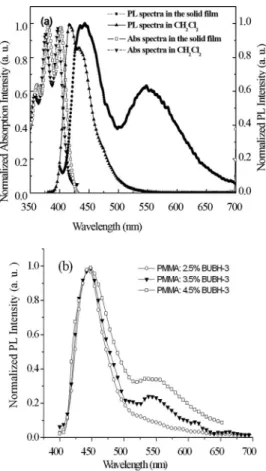
but it melts with decomposition at 487 ° C directly as deter-mined by differential scanning calorimetry. Figure 2共a兲 shows the absorption and fluorescence spectra of BUBH-3 in dilute dichloromethane solution and as vacuum-evaporated thin film on quartz substrate. On irradiation at 376 nm in CH2Cl2, BUBH-3 exhibits intense blue fluorescence, with an
emission peak centered at max417 nm. In solid state thin film, the blue emission of BUBH-3 is redshifted to 444 nm and an additional broad band emission at 530– 570 nm tail-ing to 670 nm is also observed. The redshifted emission ob-served in solid photoluminiscence 共PL兲 has been observed for organic and polymer materials probably due to intermo-lecular interactions or exciton hopping in the solid state,23 but the appearance of the orange emission is interesting and requires further investigation.
Usually, an appearance of additional band gap in the solid may be caused by aggregation, phosphorescence, or excimer. To probe the origins of the long-wavelength broad emissions at about 545 nm, PL excitation spectra, absorption and solid state thin-film spectra of BUBH-3 were studied first. As shown in Fig.2共a兲, this broad emission band stems from species that appears to exist only in the excited state since no absorption is detected in this spectral region. There-fore, we can rule out aggregate state between subunits of the solid as the source of the additional luminescence band.24 In order to further verify this conclusion, the PL of BUBH-3 in polymethyl methacrylate 共PMMA兲 were measured 关Fig.2共b兲兴. In the PMMA sample, BUBH-3 did not form any
aggregates, but the green emission band was observed again and the relative intensity of this band was found to increase-with the concentration of BUBH-3. As supported by this ex-perimental result, we assign the additional green band to the formation of excimer, for the efficient formation of excimer process goes within microcrystallites which is formed only in high concentrated solid solution of BUBH-3 in PMMA.23 Secondly, low temperature photoexcition of BUBH-3 at −78 ° C in liquid nitrogen was investigated and the absence of phosphorescence suggests that it could not have been the origin of this broad emission band. Further, our results共Table
I兲 on time-resolved PL decay dynamics of BUBH-3 films
show that the radiative lifetime which increases as the spec-trally selected band shifts toward the long wavelength emis-sion threshold, suggesting the formation of at least one more well-defined BUBH-3 excimer共around =545 nm兲. We also note that the nanosecond scale of the decay times could rule out the involvement of possible triplet excitons and their excimers as a possible source of the long-wavelength emis-sion band. As a result, it is reasonable to assign the additional broad orange emission band to singlet excimeric states formed by BUBH-3 in the solid state.
To investigate the EL properties of this molecule, a single-layer device with a structure of ITO/BUBH-3共60 nm兲/LiF/Al 共device I兲 was fabricated by vacuum depo-sition. Compared to the PL spectrum of the BUBH-3 film,
FIG. 1. Molecular structure of BUBH-3 and the structure of devices共I, II, III, and IV兲; the thicknesses of the BUBH-3 in devices II, III, and IV are 40, 45, and 50 nm, respectively.
FIG. 2. 共a兲 Photoluminescence 共PL兲 共ex= 376 nm兲 and absorption spectra of BUBH-3.共b兲 PL spectra of solid films with 2.5%, 3.5%, and 4.5% of BUBH-3 dispersed in polymethyl methacrylate共PMMA兲 共ex= 376 nm兲.
TABLE I. Excited states lifetime of BUBH-3 at different wavelengths.
Wavelength共nm兲 430 460 490 530
Lifetime共兲 共ns兲 0.31 0.45 0.49 1.13
183504-2 Wang et al. Appl. Phys. Lett. 91, 183504共2007兲
This article is copyrighted as indicated in the article. Reuse of AIP content is subject to the terms at: http://scitation.aip.org/termsconditions. Downloaded to IP: 140.113.38.11 On: Thu, 01 May 2014 00:05:12
the long wavelength emissions found around 545 nm of the EL spectrum became stronger共Fig.3兲. The difference in line
shape 共or emission intensity兲 between the EL and the PL spectra might be due to electron injection which can some-times generate excitations that cannot be induced by optical excitation.18,25 Since the overall EL pattern of the BUBH-3 trilayer devices 共II, III, and IV兲 was similar to that of the single-layer device I共Fig. 3兲, we conclude that the
longer-wavelength EL emissions共545 nm兲 of these devices should have similar origins of excimer. It also rules out the possi-bility of formation of a species such as an exciplex at the NPB/BUBH-3 interface 共or Alq3/ BUBH-3 interface兲 in
the case of devices II, III, and IV兲.18 In device III, the emission is close to white with Commission Internationate de’Eclairage共CIEx,y兲 coordinates of 共0.31, 0.36兲 and 共0.29,
0.32兲 when the drive current increased from 20 to 200 mA/ cm2共see the inset of Fig.4兲. As shown in Fig.3, in
devices II, III, and IV, the EL spectra change a little when the thickness of the BUBH-3 was increased from 40 to 50 nm, thus demonstrating also that the CIEx,y of the device is not
dependent on the thickness of the BUBH-3 emitting layer. The current efficiency versus current density character-istics of device III is shown in Fig. 4, which shows maxi-mum efficiencies of 7.0 cd/ A at 20 mA/ cm2and 3.17 lm/ W at 6.9 V with its current density–voltage–brightness charac-teristics of device III shown in the inset. The brightness of device III is 1396 cd/ m2driven at 6.9 V, which is among the
lowest drive voltages ever reported for a emitting-component fluorescent device. For benchmark, a single-component WOLED device which exhibited a maximum brightness of 1200 cd/ m2 at 18 V was reported in 2004,17
and more recently, in 2006, another device of 1395 cd/ m2at
a drive voltage of 16 V was disclosed.18
In summary, the present results demonstrate that the blue fluorescent small molecular material BUBH-3 without the addition of any dopant is capable of producing white light in the single-emitting-component EL devices with white-light emission consisting of two fluorescence and one excimer components. The three-layer EL devices fabricated with BUBH-3 exhibit bright and efficient white light with a good luminance of 1396 cd/ m2 and a current efficiency of
7.0 cd/ A obtained at a low drive voltage of 6.9 V. The CIEx,y color is 共0.31,0.36兲, which does not change
signifi-cantly with drive current densities. The EL performance is among the best reported for most WOLEDs based on a single-emitting material without dopant.
This work was supported by the central allocation grant from the Research Grants Council of Hong Kong SAR
共GHP/057/05兲 and Faculty Research Grant 共FRG/05-06/II-43兲 of HKBU.
1
B. W. D’Andrade, J. Y. Tsai, C. Lin, P. B. Mackenzie, and M. S. Weaver, Inf. Disp. 2, 24共2007兲.
2Y. S. Wu, S. W. Hwang, H. H. Chen, M. T. Lee, W. J. Shen, and C. H. Chen, Thin Solid Films 488, 265共2005兲.
3S. Tokito, T. Tsuzuki, F. Sato, and T. Iijima, Curr. Appl. Phys. 5, 331 共2005兲.
4B. W. D’Andrade, M. E. Thompson, and S. R. Forrest, Adv. Mater. 共Weinheim, Ger.兲 14, 147 共2002兲.
5H. Kanno, Y. Sun, and S. R. Forrest, Appl. Phys. Lett. 86, 263502共2005兲. 6B. W. D’Andrade, R. J. Holmes, and S. R. Forrest, Adv. Mater.
共Weinheim, Ger.兲 16, 624 共2004兲.
7S. L. Tao, Z. K. Peng, X. H. Zhang, and S. K. Wu, J. Lumin. 121, 568 共2006兲.
8E. L. Williams, K. Haavisto, J. Li, and G. E. Jabbour, Adv. Mater. 共Weinheim, Ger.兲 19, 197 共2007兲.
9M. Cocchi, J. Kalinowski, D. Virgili, V. Fattori, S. Develay, and J. A. G. Williams, Appl. Phys. Lett. 90, 163508共2007兲.
10T. Nakayama, K. Hiyama, K. Furukawa, and H. Ohtani, Proceedings of the Society For Information Display, Long Beach, California, 23–25 May 2007共unpublished兲, p. 1018.
11S. Tasch, E. J. W. List, O. Ekström, W. Graupner, G. Leising, P. Schlichting, U. Rohr, Y. Geerts, U. Scherf, and K. Müllen, Appl. Phys. Lett. 71, 2883共1997兲.
12X. Gong, S. Wang, D. Moses, G. C. Bazan, and A. J. Heeger, Adv. Mater. 共Weinheim, Ger.兲 17, 2053 共2005兲.
13X. Gong, W. L. Ma, J. C. Ostrowski, G. C. Bazan, D. Moses, and A. J. Heeger, Adv. Mater.共Weinheim, Ger.兲 16, 615 共2004兲.
14Y. Z. Lee, X. Chen, M. C. Chen, and S. A. Chen, Appl. Phys. Lett. 79, 308共2001兲.
15J. Liu, Q. G. Zhou, Y. X. Cheng, Y. H. Geng, L. X. Wang, D. G. Ma, X. B. Jing, and F. S. Wang, Adv. Funct. Mater. 16, 957共2006兲.
16X. J. Xu, G. Yu, C. A. Di, Y. Q. Liu, K. F. Shao, L. M. Yang, and P. Lu, Appl. Phys. Lett. 89, 123503共2006兲.
17J. Y. Li, D. Liu, C. Ma, O. Lengyel, C. S. Lee, C. H. Tung, and S. T. Lee, Adv. Mater.共Weinheim, Ger.兲 16, 1538 共2004兲.
18Y. Liu, M. Nishiura, Y. Wang, and Z. M. Hou, J. Am. Chem. Soc. 128, 5592共2006兲.
19V. Adamovich, J. Brooks, A. Tamayo, A. M. Alexander, P. I. Djurovich, B. W. D’Andrade, C. Adachi, S. R. Forrest, and M. E. Thompson, New J. Chem. 26, 1171共2002兲.
20J. Kalinowski, G. Giro, M. Cocchi, V. Fattori, and P. Di Marco, Appl. Phys. Lett. 76, 2352共2000兲.
21M. F. Lin, L. Wang, W. K. Wong, H. L. Tam, K. W. Cheah, M. T. Lee, M. H. Ho, and C. H. Chen, Appl. Phys. Lett. 91, 73517共2007兲.
22S. A. Van Slyke, C. H. Chen, and C. W. Tang, Appl. Phys. Lett. 69, 2160 共1996兲.
23N. J. Turro, Modern Molecular Photochemistry 共Benjamin Cummings, Menlo Park, CA, 1978兲.
24S. Tao, S. D. Xu, and X. H. Zhang, Chem. Phys. Lett. 429, 622共2006兲. 25M. Berggren, G. Gustafsson, O. Inganäs, M. R. Andersson, and T. O.
Wennerström, J. Appl. Phys. 76, 7530共1994兲.
FIG. 4. Dependence of the EL efficiency on the drive current density for BUBH-3 based device III 共inset: current density–voltage–brightness characteristics兲.
FIG. 3. Electroluminescence共EL兲 spectra of BUBH-3 based devices I, II, III, and IV. Inset: EL spectra of device III driven at 20 and 200 mA/ cm2.
183504-3 Wang et al. Appl. Phys. Lett. 91, 183504共2007兲
This article is copyrighted as indicated in the article. Reuse of AIP content is subject to the terms at: http://scitation.aip.org/termsconditions. Downloaded to IP: 140.113.38.11 On: Thu, 01 May 2014 00:05:12