國立交通大學
管理科學系碩士班
碩士論文
探討產品知識與自尊人格特質的交互作用對於
資訊接收者受到口碑影響的差異
The Interactive Effect of Product Knowledge and
Self-Esteem on the Impact of Word of Mouth
研 究 生:賴彥勳
指導教授:張家齊 博士
中華民國九十八年六月
探討產品知識與自尊人格特質的交互作用對於
資訊接收者受到口碑影響的差異
The Interactive Effect of Product Knowledge and
Self-Esteem on the Impact of Word of Mouth
研 究 生: 賴彥勳 Student: Yen-Hsin Lai
指導教授: 張家齊 博士 Advisor: Dr. Chia-Chi Chang
國 立 交 通 大 學 管 理 科 學 系
碩 士 論 文 A Thesis
Submitted to Department of Management Science College of Management
National Chiao Tung University in Partial Fulfillment of the Requirements
for the Degree of Master
In
Management Science June 2008
Hsinchu, Taiwan, Republic of China
探討產品知識與自尊人格特質的交互作用對於資訊接收者受到口碑
影響的差異
學生: 賴彥勳 指導教授: 張家齊 博士國立交通大學管理科學系碩士班
中文摘要
在消費市場裡,口碑是影響消費者決策與態度一個很強大的力量,尤其現在 網路發達,使得人們口耳相傳的現象更加的頻繁。過去的研究已經著眼於資訊接 收者的說服效果。本篇論文主要是在找出人格特質與非人際因素(產品知識)的交 互作用對於資訊接收者說服效果的影響。本研究主要探討四個假設,自尊愈高 時,資訊接收者比較不易受到口碑的影響,他們會傾向相信自己的判斷,為了維 持心中的一致性而默視口碑的影響,也比較不會去尋求外界的資訊;而高知識的 人比起低知識同樣地比較不易受到口耳相傳的影響,更不願意去搜尋產品資訊。 而過去研究裡,對於高知識的族群受到說服效果的影響和搜尋資訊的程度眾說紛 云,因此本篇論文將自尊為干擾變數,探討它們間的交互作用會產生什麼樣的結 果,認為高知識且高自尊的人比較不會受到口碑的影響;而高知識且低自尊的人 比較易受到口碑的說服。The Interactive Effect of Product Knowledge and Self-Esteem on the
Impact of Word of Mouth
Student: Yen-Hsin Lai Advisor: Dr. Chia-Chi Chang
Department of Management Science
National Chiao Tung University
Abstract
Word-of-Mouth was a strong effect which influenced the decision and attitude of consumers in the consumer market. Particularly, since the development of Internet, the phenomenon of Word-of-Mouth (WOM) communication happened frequently in modern society. Several researchers had done studies on the effect of persuasion about information receivers.
In this study, we discovered the interaction between the non-interpersonal forces (Product Knowledge) and personality corresponding to the information receiver. This study set four hypotheses and further verified them. The higher self-esteem of the information receiver, the less the influence of the sender’s WOM resulted in the receiver’s perceived quality. The receivers with higher self-esteem preferred to trust their decisions according to their results, and they had no intention to seek for information from others; the highly knowledgeable receiver was less likely to seek information than the lowly knowledgeable ones, and less likely to rely on WOM
effect as well. In the past studies, it was an argument regarding the group whose persuasion effect of the highly knowledgeable and level of information searching. Therefore, the self-esteem was a moderating variable in this study, and the research results were gained from such interaction. The study assumed that for highly knowledgeable receivers, their personality of higher self-esteem resulted in less influences of the WOM on the receiver’s perceived quality. As for the highly knowledgeable receiver, their personality of lower self-esteem resulted in greater influences of the WOM on the receiver’s perceived quality.
致謝辭
短短的二年研究生活,隨著這篇論文的完成也將告一段落了,這裡面的內容 包含了我這二年的學習,雖然它不是偉大的作品,不過卻是我投注最多心力與時 間完成的。在這過程中,幸好有許多人的支持與幫助,可以讓我順利的將它完成。 首先我非常感謝我的指導老師–張家齊博士,從一開始的架構構念形成,之間遇 到的許多問題到最後的完成,都要虧功於她給我的意見。平易近人的指導方式讓 我覺得學習也可以如此輕鬆。 我也非常感謝我的父母可以讓我毫無後顧之憂的在學校中學習,他們的支持 才讓我有機會不斷的學習。另外要感謝和我同是身為張家齊老師指導學生的成員 們,要謝謝佳誼學長讓我從對統計軟體原先一無所知,變成輕鬆上手,在研究上 許多的統計問題他都可以為我解答。還有學姊們提供相關的文獻供我參考。更要 感謝同門的五位同學一直的協助與幫忙,讓我更順利的一步一步的完成。 最後我要謝謝曾經幫我填過問卷和幫我發放問卷的朋友們,要同時對同個人 發放二次問卷實在不是一件簡單的事,第二次發放時必須要去找出第一次填過的 那些人,謝謝他們不嫌麻煩的幫我,也謝謝幫我填過二次問卷的朋友們,不停的 被我問卷打擾,要不是有你們的幫忙也不會有這份論文的完成。謝謝。 賴彥勳謹誌 交通大學管理科學所 九十八年六月Index
中文摘要... i
Abstract ... ii
致謝... iv
Index ... v
Table Index ... vii
Figure Index ... viii
Chapter 1 Introduction ... 1
1.1 Research Background ... 1
1.2 Research Motivation ... 3
1.3 Research Objectives ... 4
1.4 Research Process ... 5
Chapter 2 Literature Review ... 6
2.1 Word-of-Mouth (WOM) ... 7 2.2 Self-Esteem ... 11 2.3 Consumer Knowledge ... 13 2.4 Perceived Quality ... 14 2.5 Hypotheses ... 15 2.6 Research Framework ... 18
Chapter 3 Research Methodology ... 20
3.1 Conceptual Research Framework ... 20
3.2 Overview ... 21 3.3 Experimental Design ... 21 3.3.1 Experiment Procedure ... 21 3.3.2 Manipulation ... 24 3.4 Measurement ... 25 3.4.1 Perceived Quality ... 25 3.4.2 Self-Esteem ... 26 3.4.3 Product Knowledge ... 27
3.4.4 Information sought by Receiver ... 30
3.5 Pretest ... 30
Chapter4 Research Analysis and Results ... 32
4.1 Background of Participants ... 32
4.1.1 Demographics of Participants ... 32
4.1.2 Knowledge and Self-Esteem of Participants ... 34
4.2 Reliabilities ... 36
4.3.1 Effects of the Self-Esteem ... 36
4.3.2 Effects of the Knowledge ... 38
4.3.3 Interaction between Self-Esteem and Knowledge ... 40
4.3.4 Effect of the cell ... 44
Chapter 5 Discussion and Future Research ... 46
5.1 Discussion for Results... 46
5.2 Implication ... 47
5.3 Limitation ... 48
5.4 Future research ... 49
Reference ... 50
Appendix 1 Research Questionnaire (First) ... 55
Table Index
Table 1 Questionnaire Design ... 22
Table 2 Investigation for Sony T-700 ... 24
Table 3 Reliability Statistic ... 31
Table 4 Descriptive Statistics (Knowledge) ... 31
Table 5 Demographics of Participants ... 33
Table 6 Personality and Knowledge of Participants ... 34
Table 7 Descriptive Statistics (Knowledge) ... 34
Table 8 Correlation (Perceived Knowledge and Test) ... 35
Table 9 Descriptive Statistics of Self-Esteem ... 35
Table 10 Reliability Statistic ... 36
Table 11 Descriptive Statistics (Variance of Perceived Quality) ... 40
Table 12 Descriptive Statistics (Level of Information sought) ... 40
Table 13 MANOVA ... 41
Table 14 ANOVA of Variance of Perceived Quality ... 42
Table 15 ANOVA of Level of Information Sought ... 42
Table 16 Cell Design ... 44
Table 17Group Statistics ... 44
Figure Index
Figure 1 Research Flow ... 5
Figure 2 Influence of moderated variables on persuasion ... 9
Figure 3 Research Framework (1) ... 19
Figure 4 Main effect of Self-Esteem (1) ... 38
Figure 5 Main Effect of Self-Esteem (2) ... 39
Figure 6 Main effect of knowledge (1) ... 40
Figure 7 Main effect of knowledge (2) ... 40
Figure 8 Interaction effects (1) ... 44
Chapter 1 Introduction
1.1 Research Background
In recent years, several studies indicated that word-of-mouth (WOM)
communications often significantly influenced consumers’ purchasing behavior. This kind of personal-sourced information presented in words regarding the product, brand or service. The nature of non-commercial communication or recommendation is thus produced by interpersonal relationship. When making a purchase of a new product or service, people always rely on WOM. They will not only take the initiative in
searching for information but also get the opportunity to contact passively. In fact, WOM has been demonstrated in practice to be more effective than traditional marketing or various types of advertising. (Katz and Lazarfeld, 1955; Engel et al., 1969). Moreover, along with the popularization of the Internet, information acquisition and dissemination become easier. Owing to the lower searching cost, people access to the Internet for data searching in a more convenient way. The concept of electronic word-of-mouth (eWOM) developed in much research have shown that eWOM might have the same effect as WOM.
One study indicated that a dissatisfied customer was expected to tell nine other people about his bad experiences while satisfied customers can be expected to tell five others (Knauer, 1992). Due to the intense influences, obtainable way was convenient.
Many companies start to emphasize such concept. They will build a BLOG to let the customers to discuss and share their experiences. A brief example was offered from Cape NO.7, a movie eked out a box-office win. Much of success of Cape NO.7 can be attributed to positive WOM communication resulted from BLOG. Because of lacking of budget, it selects WOM communication as an advertising tool. Finally, it causes the populace and the echoes from mess media. Bulletin Board System (BBS) was also a WOM tools in Taiwan. Companies will take advantage of the platform to understand customer and simultaneously maintain the positive WOM. For example, Healthful Pilaco Wafer Roll, a company producing wafer roll snacks, which firstly attracted great discussion at the BBS, and became successful suddenly.
Consequently, the customer shares his purchasing experience voluntarily with other people through interpersonal interaction, becomes a free spokesman for the product. Such message source was perceived to be highly credible (Cox, 1963; Richins, 1983) and more persuasive than other message by customer. Positive WOM communication increased value for the company; on the contrary, negative WOM would reduce the value of company. To the company, WOM was one of the crucial variables to expand market share (Frenzen & Nakamoto, 1993). It is important to know how this research can make good use of WOM for achieving maximal value.
1.2 Research Motivation
There were many WOM-related studies discussing nothing but the process of information dissemination and the influences on purchasing decision. Especially, they analyzed the effect of the persuasion. However, there exists controversies between scholars.
Studies of WOM process may be categorized into two principal rubrics of
non-interpersonal forces and interpersonal forces (Bansal & Voyer, 2000). It discussed three kinds of relationship of WOM. They proposed that the greater the receiver’s level of expertise, the less the influence of the sender’s WOM effect was on the receiver’s purchase decision. Antecedent authors held the same opinion about it; highly knowledgeable customers were less likely to rely on WOM information than costumers with less knowledge (Bone, 1995). They suggested that the customers with higher knowledge intended to judge the product with their original cognition.
However, the customers with less knowledge do not adequately understand the product and intend to search for information before making any decision.
However, the effects of level of receiver’s expertise on the influence of WOM on purchase decisions or perceived quality are not significant. The determined
relationship was found to be extremely weak and not statistically significant. It was worthwhile to discuss such result.
1.3 Research Objectives
According to the foregoing argument, this study would like to search for a variable that influences the research outcome. If the receiver’s level of expertise served as a moderating variable with statistically significant effect, it will be found the other variable which would moderate the effect of the receiver’s level of expertise.
Among all personalities, self-esteem has reflected the degree of self-confidence. When making decision, people with higher self-esteem used to determine through their cerebration and prefer to stick to their cognition. Regarding to foregoing characteristics of self-esteem, this study tried to determine whether such personality would moderate the total effect.
1.4 Research Process
Figure1 Research Flow
Determine the Research Question
Literature Review
Developing Research Hypotheses
Deciding Measurements of Variables
Pretest and Modifying scales
Designing Questionnaire
Sampling and Collecting Data
Analyzing Data
Research result
Chapter 2 Literature Review
This study assumed that the greater receiver’s level of expertise or knowledge, the less influence on the effect of persuasion through WOM communications it was. Related subjects had already been demonstrated by many scholars. When making purchase, consumers relied more on their internal evaluation on service than on goods (Murray, 1991). Due to the difficulty of searching for service information, consumers had a greater preference for evaluating internal source of information. It appeared that the consumers’ expertise of purchasing nondurable products was more easily
influenced by external source comparing to durable products (Gilly et al., 1998). Their studies divided products into two categories. Due to higher financial risk, consumers purchasing durable products relied on their expertise than others; and due to higher perceived risk, consumers purchasing products with services relied more on their experience.
They brought up a consensus, no matter the category of product was; the consumers with less knowledge were easily persuaded due to poor understanding. Consumers with low knowledge were more likely to question their own ability on making decisions. Therefore, they were more likely to ask for other’s advice. (Furse et al., 1984)
2.1 Word of Mouth (WOM)
Bone (1995) pointed out the definition: “Word-of-mouth communications (WOM),
interpersonal communications in which none of the participants are marketing sources, have been studied as both an input into consumer decision-making and an outcome of the purchase process” (p. 213). It referred to informal communications
between two individuals about evaluating service or goods. (Anderson, 1998) In the extremely early stage, WOM mainly discussed the product which was newly launched, rather than existing product (Richins, 1983). Innovator who firstly contacting with the new product than other people in the social group diffused their using experience and recommend about the product to others in the community (Midgley, 1978). Later buyers were easily influenced by the messages received.
Afterwards, several scholars assumed these messages had strong influences on existing products as well. It was an important force which made impacts on attitude, preference, purchase intention and purchase decision in the marketplace
(Wangenheim, 2005).
There were three kinds of characters: positive, neutral and negative. If someone had a joyful feeling about consumption experience, positive word-of-mouth effect would push the customer to tell his friends how delightful was the experience. However, if he encountered great service failure, negative word-of-mouth effect
would also push the customer to share dissatisfaction with family and friends. Many research intended to investigate the influential factors of WOM
communication, since it had great influence on consumers. One research indicated that it had more influence on spreading positive word-of-mouth through
customer-employee relationships than through company (Gremler et al., 2001). The study recognized that relationship between employee and customer was established, such like familiarity, care and personal connection, and therefore customer’s trust was enhanced. Then they would perform behaviors of positive word-of-mouth.
There was also a research discussing the causal relationship of negative
word-of-mouth. When customer switched their service provider due to dissatisfaction, they engaged in sharing with their friends. Especially, the higher level of product involvement and market mavenism would easily result in such behavior (Wangenheim, 2005). When Service failure happened, customer without opportunity to make
complaints to the company would turn to tell their bad experiences to other people. Besides, the reason of failure was blamed on provider instead of customer; they comparatively spread negative information. (Richins, 1983)
The process of word-of-mouth communication has been studied in much
research. The scholars discovered a variety of moderating variables which influenced information receiver’s attitude. This study arranged previous literatures and showed in
figure 2.
Figure 2 Influence of moderated variables on persuasion
People with higher level of expertise upon product would have strong impact on information receivers (Gilly et al., 1988). Source credibility also supported such expertise (Dholakia and Sternthal, 1977). When someone suffering a hard time to make decisions, and was eager to inquire others’ opinion, he would rely on the expert who had more knowledge than him (Bansal and Voyer, 2000; Bone, 1995). According to distinct product attributes, the influential factors were totally different. With high heterogeneity on preference, influence from similar message had strong impact on receivers, while in the case of low heterogeneity on preference, influence of expertise’ message had strong effect on receivers (Feick and Higie, 1992). Message obtaining
WOM Influence of sender’s WOM on receiver Moderated variables Source of information Tie strength Situation factor Individual factor
with oneself similarity, the source would exert strong effect (Wengenheim and Bayon, 2004).
People who had a strong tie bear greater influence on the receiver than weak ties (Bansal and Voyer, 2000; Brown and Reingen, 1987, Frenzen and Nakamoto, 1993). People who are in the ambiguity situation bear greater impact on the receiver than in the obvious situation (Bone, 1995).
Finally, the individual characteristics were the most important factors in this study, including receiver’s perceived risk and receiver’s expertise.
In the past, they focused on the characteristics of information and source from sender’s information with considering the moderating variables. There were few studies focusing on individual factors, and it should hardly been manipulated.
Although there were some authors purposing that receiver’s knowledge had negative correlation with persuasion effect, such results were not statistically significant (Bansal and Voyer, 2000; Bone, 1995). Nevertheless, there were few researches concerning such contradiction. What casual relationship resulted in such outcome? The gap of research has been formed concerning individual factor. Most of the studies had demonstrated that information source of experts could influence the receivers.
Some authors suggested that receiver’s knowledge had negative correlation with persuasion effect under some circumstances (Murray, 1991; Gilly et al., 1998). The
study wants to find a manner to be suitable overall product no longer classify in term of product attribute. Finding out the reason to explain why will have two kind of contradictory phenomena.
2.2 Self-Esteem
Self-esteem was defined as a degree of people’s perception upon their capability of doing everything and evaluation of their self-worth (Gardner and Pierce, 1998). It was frequently confused to distinguish self-esteem and self efficacy, which were slightly different from each other. Self-efficacy represented a kind of self-evaluation showing that they had possibility to successfully achieve some result or complete task (Gardner and Pierce, 1998).
Self-esteem was applied mainly in the field of organization behavior. Many phenomenons about employees’ job satisfaction and job performance were adequately explained by self-esteem. For example: employees with higher
self-esteem selected more difficult goals than lower self-esteem employees (Hall, 1971). Since the higher self-esteem ones may experience more success than failure in the past, they had more confidence with themselves (Levy and Baumgardner, 1991). The researches in marketing concerning self-esteem were mostly about the performance of salesperson. For example: there was a positive relationship between self-esteem and job expectation (Kohli, 1985).
One study indicated that people with high self-esteem generally had greater confidence in their ability to overcome problems (Anton et al., 2008).
There were few studies about relationship between consumer and self-esteem. At first, the study suggested that someone was stimulated by external factors, and the influence about level of self-esteem of the role played. A study suggested that people with high self-esteem needed to obtain social approval (Rosenbaum).
More scholars introduced the relationships between the effect of persuasion and personalities. They attempted to discover some factors influencing persuasion. Most of the works focused on the personality variable of self-esteem (Skolnick et al., 1971). Many studies had demonstrated a negative relationship between them (Janis and Rif, 1959).
The higher self-esteem to help information seeker, but they don’t want to seek help (Nadler, 1985), however, the study was unilaterally discussed that they were reluctant to seek for information. While other studies indicated that low self-esteem was more subject to social influence than high self-esteem (Stutland and Cottrell, 1961). The reason is their belief which is ability certain themselves. Low self-esteem and self-evaluation always relied on the basis of others’ perception. They would like to make themselves as the same other people. According to theory of cognitive dissonance, people achieved dissimilar opinions, and they will reduce inconsistency
with them. They could find other explanation, especially in high self-esteem (Glass, 1964).
Most of these related researches were aged, fewer suggestions about
relationships between self-esteem and persuasion were introduced in recent years. It was believable that self-esteem was positively related to confidence of ability to evaluating alternatives and making purchase decisions.
2.3 Consumer Knowledge
Mitchell and Dacin (1996) indicated that “Research in cognitive psychology has
shown that experts differ from novices in the amount, content, and organization of their domain knowledge” (p.219). The greatest difference were abilities of diagnose,
judgment, recall of present information and problem solving.
There had no different explanations for consumer knowledge. One study indicated that knowledge helped consumer know what, when and how the market tried to influence them (Friestad and Wright, 1994). They recognized what the
strategies were used by company. Besides, they proposed an influence of commercial communication on consumer. Although it was different from the noncommercial communication in this study, it still helped in understanding how the consumer knowledge influenced the persuasion effect.
One study discriminated two components from the consumer knowledge, including familiarity and expertise. Familiarity represented to which amount of related product experienced by consumer. Expertise was defined as how consumer can successfully understand the product (Alba and Hutchinson, 1987). There also existed a positive relationship. If consumer accumulated enough familiarity about the product, he will be an expert when dealing with related products. They also proposed five dimensions of expertise: cognitive effort, cognitive structure, analysis, elaboration and memory.
In the past, many literatures were concerned about the relationship between levels of possessing knowledge and levels of information searching. One study
recognized that less amount of external information searching behaviors would appear when people possessed with highly usable prior knowledge. And they discovered that cost of search behavior had a negative relationship with external searching behavior (Punj and Staelin, 1983). However, the other study indicated that once the cost of external searching for higher knowledge were lower; they were possible to search for external information (Bansal and Voyer, 2000).
2.4 Perceived Quality
Perceived quality was an actual superiority and excellence whereas consumer’s perceptions or judgments of the overall quality of a product or service, especially comparable to other competitor’s brand (Zeithaml, 1988). Customers were influenced
by appearance, feature, price or advertisement of product deeply. This study indicated that price, brand and store information of extrinsic cues could influence consumer’s perceived quality. There existed positive relationship between perceived quality and purchase intention (Dodds et al., 1991).
The other research discovered that perceived quality was composed of four dimensions: acquisition value, transaction value, in-use value and redemption value (Parasuraman and Grewal, 2000).
When consumer faced a situation of ambiguity or everything remaining in unclear state, perceived quality would be a strong force that influenced customers’ judgment through external stimulation. They had demonstrated that word of mouth would influence the consumer’s judgment in short-term and long-term (Bone, 1995). It customers had weaker accessibility of information; the diagnosticity information Would have more influences on the consumer’s judgment (Herr et al., 1991).
2.5 Hypotheses
The relations between self-esteem and persuasion effect were previously discussed. Some studies indicated that low self-esteem was more subject to social influence than high self-esteem (Stutland and Cottrell, 1961).Word of Mouth, a kind of persuasion effect, served as an interpersonal communication and would further influence other’s attitude.
Hypothesis 1a: The higher a consumer’s self‐esteem, the less WOM will have
an influence on his/her perceived quality.
In this research, it assumed the people with high self-esteem preferred using their internal source of information. In other words, people with personality of higher self-esteem had no attention to seek for help (Nadler, 1985). When they want to make a purchase, compared to the low self-esteem people, they would not actively seek for product information.
Hypothesis 1b: The higher a consumer’s self-esteem, the less he/she actively
seeks product information.
It had been suggested that consumers with prior impressions of target brands were less likely influenced by WOM than those with little or no previously conceived notions (Herr, Kardes, and Kim 1991). Consequently, this study suggested that there existed such negative relationship.
Hypothesis 2a: The greater the consumer’s knowledge about the product, the
less WOM will have an influence on his/her perceived quality.
There were some researches establishing the relationship between the amount of experience of an information seekers and the degree to which they conducted an external search for information (Brucks, 1985). There were some scholars holding opposite opinions. They considered the cost of searching was less significant for
customers with higher knowledge level (e.g., Johnson and Russco 1984; Punj and Staelin 1983).
In light of the foregoing explanation, this research set following hypothesis:
Hypothesis 2b: The greater the consumer’s knowledge about the product,
the less he/she actively seeks product information.
The results were inconsistent in the behavior of highly knowledgeable consumers. Some studies recognized the negative relationship between highly knowledgeable consumers and persuasion effect. However, some others suggested they had positive relationship between highly knowledgeable consumers and persuasion effect. In order to determine the real outcome, this study took self-esteem as a moderating variable. When a consumer has lower self-esteem, the effect of WOM does not differ regardless the level of consumer product knowledge; When a consumer has higher self-esteem the effect of WOM will different in term of level of consumer product knowledge.
Hypothesis 3a: The interaction between product knowledge and Self-Esteem
has an impact on WOM effect.
The results regarding the highly knowledgeable consumers were inconsistent. Some studies suggested negative relationship between highly knowledgeable consumers and information seeking. However, the others suggested a positive relationship between highly knowledgeable consumers and information seeking. In
order to determine the real outcome, this study took self-esteem as a moderating variable. When a consumer has lower self-esteem, the level of information searching does not differ regardless the level of consumer product knowledge; When a
consumer has higher self-esteem, the level of information searching will different in term of level of consumer product knowledge
Hypothesis 3b: The interaction between product knowledge and Self-Esteem
has an impact on information searching.
According to distinct viewpoint, this study assumed that the consumer with higher knowledge and the higher self-esteem would be less influenced by WOM than others. Thus, this research set following hypothesis:
Hypothesis 4: When consumers are highly knowledgeable, WOM will have a
greater impact on those with low Self-Esteem than those with high Self-Esteem.
2.6 Research Framework
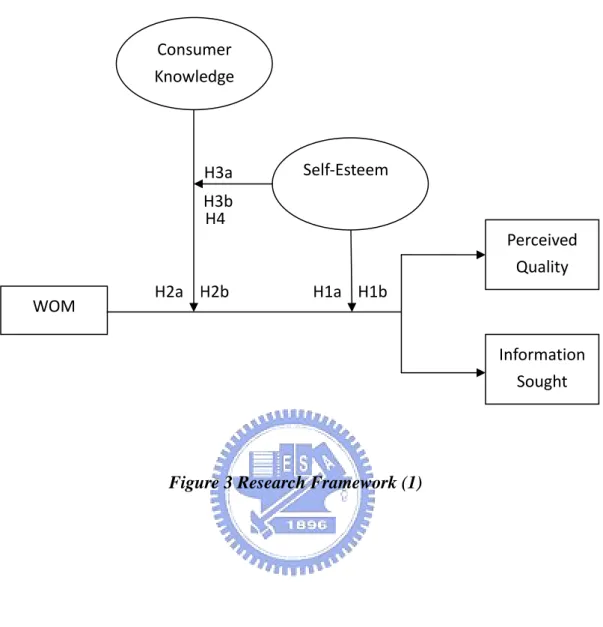
The major focus of this study was the interaction effect between consumer’s knowledge and self-esteem. The model guiding the overall research was presented in Figure 3.
Figure 3 Research Framework (1) H4 H3a H2b H2a H1a H1b WOM Perceived Quality Information Sought Consumer Knowledge Self‐Esteem H3b
Chapter 3 Research Methodology
3.1 Conceptual Research Flow
Find out fit product for experiment and Knowledge examine design for
receiver’s knowledge
Pre-test and modify Scale
Execute the sampling process
Data collection
Design relate experiment product knowledge examine that can distinguish between high knowledge and low knowledge group.
Chose 80 participants to make sure the efficiency product, examine and scale.
Sample size would be 2(high knowledge and low knowledge) X 2(high self-esteem and low
self-esteem).
Assign participant to a cell
according to self-esteem scale and knowledge examine.
Total samples is 157 Determine the sample size
3.2 Overview
This study mainly wants to find out the change which is information receiver’s attitude through influence of WOM. There were several studies had been confirmed that they had the same effect between WOM and eWOM in the past. The statement of WOM was expressed by BBS homepage, since such platform provided much
information. Especially, it served as a search tool when students would like to know a variety of products.
3.3 Experimental Design
In order to make effective manipulation on variables, this study would like to select a product which had a same value perceived by all people. Then the WOM gave them distinct comments.
3.3.1 Experiment Procedure
This study constructed an experiment to mainly survey self-esteem and knowledge. It assign the participants to one of the four cells in a 2(high and low self-esteem) by 2(highly knowledgeable and lowly knowledgeable) matrix. Each of the four cells was influenced by the strength of WOM. Such design was summarized in Table 1.
Table1 Questionnaire Design knowledge Self-esteem Low High Low High In the past, there are scholars studying the effect of WOM through two stages. At the first stage, they asked subjects to measure the product performance by themselves. One to two weeks later, the subjects were contacted by phone and asked to rate the product again using the same scales (Bone, 1995). This research separately sends the questionnaire in two stages. At the first stage, this research was mainly to know the perceived quality of the product by participants. Second, the questionnaire gave them WOM which is different from them. At the second stage, this study observed the change of the perceived quality compared to the first questionnaire. To avoid
ineffective measure, one week later, the participants received the second questionnaire after sending the first questionnaire.
To be more discreet, the study expected the participants not knowing that there were connections between the two questionnaires. Once they are aware that the two questionnaires were correlated, they might be influenced in rating the perceived quality at the second time. To construct such independency, at the first questionnaire;
the participants read a variety of product, and then they were asked to rate their perceived quality about five products. They were television, notebook, digital camera, cell phone and travel trip in order. At the last page, it showed a self-esteem scale. It is a registered questionnaire. At the second questionnaire, the participants who complete the fist questionnaire were asked to do the second one, which included the perceived quality of objective product, and their knowledge of objective product was further examined.
At the part 1 in the second questionnaire, initially, they looked at the picture of the objective product. It also presented the functions of such product. It may help them to initially realize the product. Next, they would read a lot of discussion on the picture that was intercepted from BBS.
At the part 2, it was an elevation of their product knowledge. According to their understanding, they rated the product through the scale. Finally, it showed a test about product knowledge consisted of ten multiple-choice questions.
When all the data were collected, they were asked about the two questionnaires. None of these participants indicated any suspicions regarding the two questionnaires. They were not influenced by the first questionnaire while rating the second scale. They forgot their selection last time. It was proved to be effective. Both
person.
3.3.2 Manipulation
In this study, manipulation of WOM maintained a constant direction with
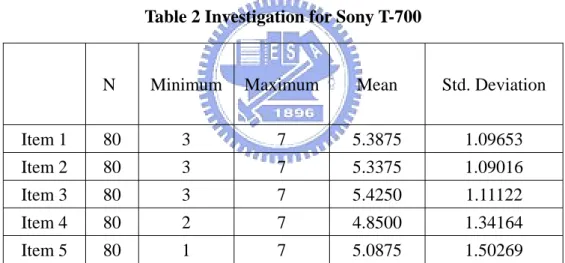
negative information. Therefore, the study would like to search for the positive image perceived by most people. Initially, the study investigated five products: Sony T-700, one kind of digital camera, was found to have positive image. The perceived quality was confirmed by a five-item, seven-point scale. Such result was summarized in Table 2.
Table 2 Investigation for Sony T-700
N Minimum Maximum Mean Std. Deviation Item 1 80 3 7 5.3875 1.09653
Item 2 80 3 7 5.3375 1.09016 Item 3 80 3 7 5.4250 1.11122 Item 4 80 2 7 4.8500 1.34164 Item 5 80 1 7 5.0875 1.50269 Generally, the study chose Sony T-700 as the objective product since it had a high perceived quality.
The article in the picture was described by the person who would like to purchase a digital camera, and he would like to refer to others’ recommendations. There were five people answering him and giving him information about the product. To ensure that there was a significant effect. Such selection was confirmed by a
three-item, seven-point scale, asking the following questions: 1. These people provided sufficiently new information.
2. The opinion of these people would influence my attitude about the product.
3. These people really did not change my mind about perception upon the product.
3.4 Measurement
All items in the questionnaire which were used to measure the constructs in the study were modified from past studies except the test of knowledge about digital camera. Each construct was measured by multiple items. this research used six-point scale to measure perceived quality, four-point scale to measure self-esteem,
seven-point scale to measure elevation of mine for knowledge and ten multiple choice questions to measure knowledge about the product.
3.4.1 Perceived Quality
The 5-item scale used to measure Perceived Quality was developed by Dodds et al. (1991). Petrick (2002) developed scale which is external quality, reliability, dependency and consistency to measure service quality. But his research mainly aimed at service industry, this study still use the scale which was developed by Dodds et al. s
Scale items:
2. In my mind, the product should be good quality (very degree to very disagree). 3. In my mind, the product would be dependable (very degree to very disagree). 4. In my mind, the product would seem to be durable (very degree to very disagree). 5. The product would have better quality compare with other brand (very degree to
very disagree).
This scale was measured by seven-point in Pretest. It was become to be
measured by six-point in formal study. Because there were some people who indicate that they have no common about the product, the study wants to find out the people who have the opinion to the product. Then this research can get variation of perceived quality between the first questionnaire and the second.
3.4.2 Self-Esteem
The scale was a ten-item Likert scale with item answered on a four point scale from strongly agrees to strongly disagree. The original sample for which the scale was
developed consisted of 5,024 Senior High School from 10 randomly selected schools in New York State. Then the scale became a target for sense of self-esteem which widely used by different occupation for adults.
Scale items:
1. On the whole, I am satisfied with myself (strongly agree to strongly disagree). 2. At times, I think I am no good at all (strongly agree to strongly disagree).
3. I feel that I have a number of good qualities (strongly agree to strongly disagree). 4. I am able to do things as well as most other people (strongly agree to strongly
disagree).
5. I feel I do not have much to be proud of (strongly agree to strongly disagree). 6. I certainly feel useless at times (strongly agree to strongly disagree).
7. I feel that I’m a person of worth, at least on an equal plane with others (strongly agree to strongly disagree).
8. I wish I could have more respect for myself (strongly agree to strongly disagree). 9. All in all, I am inclined to feel that I am a failure (strongly agree to strongly
disagree).
10. I take a positive attitude toward myself (strongly agree to strongly disagree).
3.4.3 Product Knowledge
The study divided the scale into two parts. First, it was an elevation of mind. In part 1, Measures of the two dimensions of consumer knowledge were adapted from Brucks (1985), Rao and Monroe (1988) and Bone(1995).
Scale Items:
1. I think that I have more understanding of digital camera as compared to the
average person’s (strongly agree to strongly disagree).
(strongly agree to strongly disagree).
3. The different of function for digital camera that I quite know (strongly agree to
strongly disagree).
4. On average, the frequency of using digital camera is very high (strongly agree to
strongly disagree).
5. Regarding digital in general, I consider myself extremely familiar (strongly agree
to strongly disagree).
6. I have ever bought the camera, or I have had it (strongly agree to strongly
disagree).
The six items used a Likert seven-point response format. It were standardized and summed for the final measure.
In Part 2 of the knowledge scale, actual product knowledge was scored as the total number of multiple choice questions that a participant answered correctly. Every option had an “I don’t know” selection, which was coded as incorrect. The ten
questions are in search of BBS. The study has discussed the questions with the expertise of digital camera. They all consider the level of knowledge about digital camera could be discriminated by the questions
Questions:
(D) I don’t know.
2. What the statement was true (A) the value of Aperture was bigger, the Aperture was bigger - the light of entering was less (B) the value of Aperture was smaller, the Aperture was bigger - the light of entering was more (C) the value of Aperture was bigger, the Aperture was bigger - the light of entering was more (D) I don’t know.
3. What was the ISO in the digital camera (A) Sensitivity (B) Aperture (C) Exposure (D) I don’t know.
4. The ISO was higher; the noise in photo was (A) less (B) more (C) no influence (D) I don’t know.
5. What was the EV in the digital camera (A) Aperture (B) Shutter (C) Exposure (D) I don’t know.
6. What was the flower mode (A) Macro (B) long-range (C) Flash mode (D) I don’t know.
7. What was the best match for Depth of field (A) value of Aperture was big; Zoom Out (B) value of Shutter was big; Zoom In (C) value of the Aperture was small; Zoom Out (D) I don’t know.
8. What was the GN? If the value was higher, the influence is? (A) Flash; better (B) White balance; better (C) Exposure Compensation; better (D) I don’t know.
9. If I want to set manual mode, the adjustment of mode will turn to (A) M mode (B) P mode (C) Auto adjustment mode (D) I don’t know.
10. What was the best effect for periscopic lens (A) F=28~140mm (B) F=35~105mm (C) F=24~140mm (D) I don’t know. 2:00
3.4.4 Information actively sought by Receiver
The item were adapted from Bansal and Voyer(2000). But they mainly research in WOM searching. The construct was measured by simply asking the participant to indicate the degree to which he or she agreed with the statements. It was adjusted by this study for the questionnaire.
Items:
1. If I want to buy the product, I would gather information from others (strongly agree to strongly disagree).
3.5 Pretest
A pilot study was conducted to test the reliabilities of the questionnaire.
Researchers use this method to discover problems or misunderstandings in the design of the experiment and then modify it before the official study. After our
questionnaires failed and were modified one times, the second edition of pilot study was successful. Eighty participants participated in this pretest. The process of the formal test was the same as pretest. There were fifty-two male and twenty-eight
female participants. Sixty-three of the participants were students.
The reliabilities were tested with Cronbach’s alpha. All factors were found to be above 0.7. The study summarized the data on Table 3.
Table 3 Reliability Statistic
Factors Cronbach’s alpha N of items Perceived Quality 0.939 5 Elevation of mind for
knowledge
0.881 6 Self-Esteem 0.831 10 The correlation between knowledge test and elevation of mind about knowledge were tested with Pearson correlation. The correlation coefficient between perceived knowledge and test is 0.603, and it is significant at the 0.01 level. They have moderate correlation. The study summarized the data on Table 4.
Table 4 Descriptive Statistics (Knowledge)
Mean Std. Deviation N Perceived
Knowledge 4.4296 1.27786 80 Test 4.5875 2.62266 80
Chapter 4 Research Analysis and Results
This chapter contains the analysis and the results of this study, including the
background of respondents, and reliability of the results. According to the measurement, the participants would be divided into 2(high self-esteem and low self-esteem) X 2(high knowledge and low knowledge). Data analysis techniques such as ANOVA were employed to test the hypotheses. The study used SPSS 15.0 to analyze the data.
4.1 Background of Participants
In the study, this research finds that the most people search for information
through Internet when they want to buy something. The possibility was the low cost of searching information. Second, they may get information from their family or friends.
4.1.1 Demographics of Participants
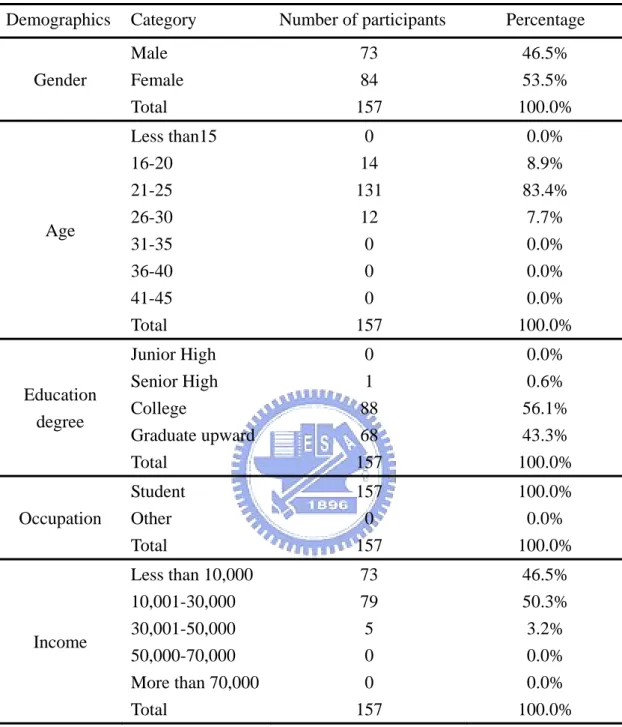
Of the total of 257 participants, 100% were students, 46.5% were males, 83.4% were between 21and 25 years old, 56.0 % had college degree, 43.2% had graduate degree or higher, and 46.5% had income of below NT10,000 per month, 50.3% had income between NT10,000 and NT30,000. All the demographics of respondents were listed on Table 5:
Table 5 Demographics of Participants
Demographics Category Number of participants Percentage Gender Male Female Total 73 84 157 46.5% 53.5% 100.0% Age Less than15 16-20 21-25 26-30 31-35 36-40 41-45 Total 0 14 131 12 0 0 0 157 0.0% 8.9% 83.4% 7.7% 0.0% 0.0% 0.0% 100.0% Education degree Junior High Senior High College Graduate upward Total 0 1 88 68 157 0.0% 0.6% 56.1% 43.3% 100.0% Occupation Student Other Total 157 0 157 100.0% 0.0% 100.0% Income Less than 10,000 10,001-30,000 30,001-50,000 50,000-70,000 More than 70,000 Total 73 79 5 0 0 157 46.5% 50.3% 3.2% 0.0% 0.0% 100.0%
4.1.2 Knowledge and Self-Esteem of Participants
According to the personality and knowledge, the respondents were listed on
Table 6:
Table 6 Personality and Knowledge of Participants
Product Knowledge Self-Esteem N Low knowledge Low self-esteem
High self-esteem Total
49 43 92 High knowledge Low self-esteem
High self-esteem Total
35 30 65 Total Low self-esteem
High self-esteem Total
84 73 157
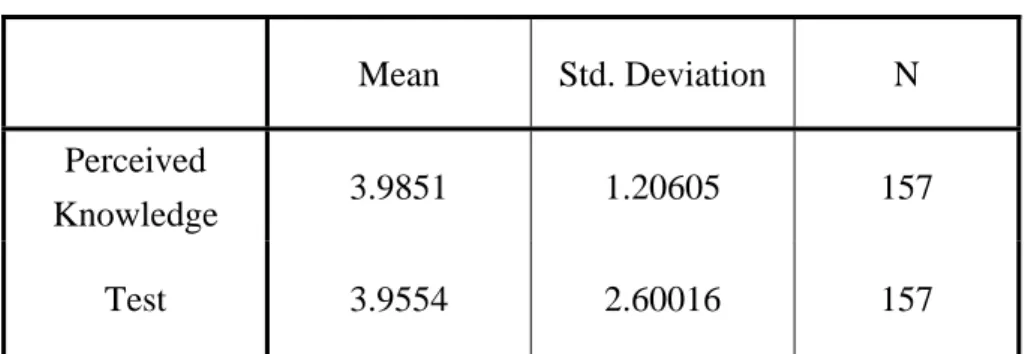
The identification of product knowledge was conducted by Pearson correlation.
If it was an effective test, they will have high correlation between the test and elevation of mind. The results were listed on Table 7, and 8:
Table 7 Descriptive Statistics (Knowledge)
Mean Std. Deviation N Perceived
Knowledge 3.9851 1.20605 157 Test 3.9554 2.60016 157
Table 8 Correlation (Perceived Knowledge and Test) Perceived Knowledge Test Perceived Knowledge Pearson Correlation 1 .608(**) Sig. (2-tailed) .000 Sum of Squares and
Cross-products 226.910 297.229 Covariance 1.455 1.905
N 157 157
Test Pearson Correlation .608(**) 1 Sig. (2-tailed) .000
Sum of Squares and
Cross-products 297.229 1054.688 Covariance 1.905 6.761
N 157 157
** Correlation is significant at the 0.01 level (2-tailed).
The mean of the test was 3.9554. High knowledge was classified according the score which was more than 5. The score was less than4, it was classified to low knowledge. The mean of the Self-esteem was 17.8344. High Self-Esteem was
classified according total score which was more than 19. The total score was less than 18; it was classified to low Self-Esteem. The Descriptive Statistics of Self-Esteem was listed on Table 9:
Table 9 Descriptive Statistics of Self-Esteem
N Minimum Maximum Mean
Std. Deviation Self-Esteem 157 5.00 29.00 17.8344 4.31581 Valid N (listwise) 157
4.2 Reliabilities
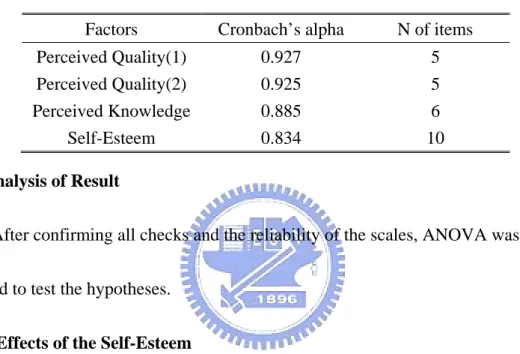
The reliabilities of all constructs in this research were tested with Cronbach’s alpha. Table 10 shows all reliabilities as all above .7 across all factors which means the high internal consistency of each item of the same factor.
Table 10 Reliability Statistic
Factors Cronbach’s alpha N of items Perceived Quality(1) 0.927 5 Perceived Quality(2) 0.925 5 Perceived Knowledge 0.885 6
Self-Esteem 0.834 10
4.3 Analysis of Result
After confirming all checks and the reliability of the scales, ANOVA was applied to test the hypotheses.
4.3.1 Effects of the Self-Esteem
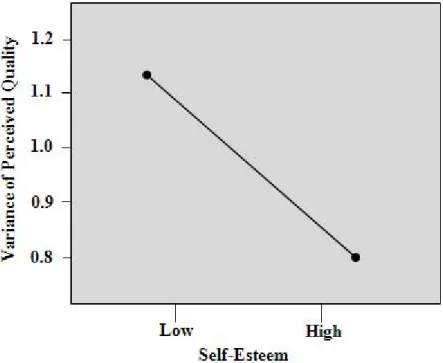
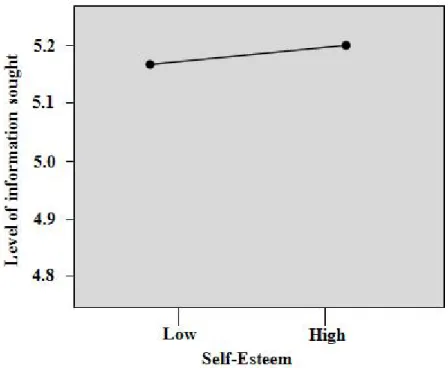
To examine whether there were effects of Self-Esteem on information receiver’s Perceived Quality and information searching, MANOVA was used here. H1a
speculated that the high Self-Esteem about information receiver was less affected on Perceived Quality than the low Self-Esteem about information receiver. H1b
speculated that the higher Self-Esteem about information receiver less actively searches information.
significant main effects on information searching (F=0.001, p=0.971). It appears that the level of information searching was not dependent on an individual’s level of Self-Esteem. H1b which proposes that the higher Self-Esteem about information
receiver less actively searches information were not supported. See Figure 4 and 5 for two graph of the hypothesis.
Figure 5 Main effect of Self-Esteem (2 )
4.3.2 Effects of the Knowledge
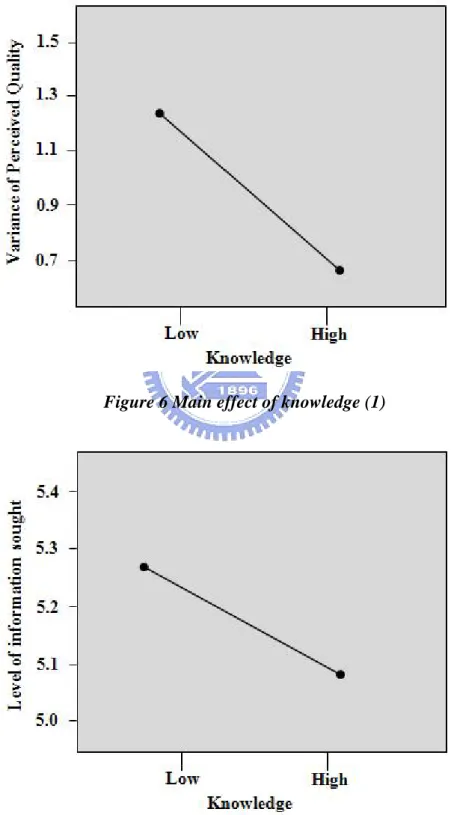
To examine whether there were effects of receiver’s knowledge on information receiver’s Perceived Quality and information searching, MANOVA was used here. H2a speculated that the high knowledge with information receiver was less affected
on Perceived Quality than the low knowledge with information receiver. H2b
speculated that the higher knowledge with information receiver less actively searches information.
The MANOVA showed significant main effects for knowledge (F=13.040, p=0.0001) on Perceived Quality. H2a was supported. None of the knowledge variable
had significant main effects on information searching (F=1.774, p=0.185). It appears that the level of information searching was not dependent on an individual’s level of
knowledge. H1b which proposes that the higher knowledge with information receiver
less actively searches information were not supported. See Figure 6 and 7 for two graph of the hypothesis.
4.3.3 Interaction between Self-Esteem and Knowledge
In this section an attempt was made to demonstrate whether there was an interaction effect between Self-Esteem and the level of knowledge on Perceived Quality and level of information sought. H3a assumed that the Self-Esteem was a
moderate variable which influence the effect of knowledge on the WOM.
H3b assumed that the Self-Esteem was a moderate variable which influence the effect
of knowledge on the level of information sought. This research used MANOVA to test H3a and H3b. Table 11 and Table 12 give the descriptive statistics of variance of perceived quality and level of information sought respectively.
Table 11 Descriptive Statistics(Variance of Perceived Quality)
Self-Esteem
Low High
Mean (Std. Deviation) N Mean (Std. Deviation) N
Low knowledge 1.2163(.89799) 49 1.1953(.96460) 43
High knowledge 1.0343(.79036) 35 .3933(.54452) 30
Table 12 Descriptive Statistics(Level of information sought)
Self-Esteem
Low High
Mean (Std. Deviation) N Mean (Std. Deviation) N
Low knowledge 5.3265(.77427) 49 5.2326(.89542 43
Table 13 MANOVA
Source Dependent Variable
Type III Sum of
Squares df Mean Square F Sig.
Corrected Model Variance of perceived quality 14.991(a) 3 4.997 7.104 .000
Level of information sought 1.991(b) 3 .664 .788 .502
Intercept Variance of perceived quality 139.626 1 139.626 198.496 .000
Level of information sought 4067.109 1 4067.109 4827.971 .000
knowledge Variance of perceived quality 9.173 1 9.173 13.040 .000
Level of information sought 1.494 1 1.494 1.774 .185
Selfesteem Variance of perceived quality 4.150 1 4.150 5.900 .016
Level of information sought .001 1 .001 .001 .971
knowledge * Selfesteem Variance of perceived quality 3.641 1 3.641 5.176 .024
Level of information sought .374 1 .374 .444 .506
Error Variance of perceived quality 107.624 153 .703
Level of information sought 128.888 153 .842
Total Variance of perceived quality 283.640 157
Level of information sought 4372.000 157
Corrected Total Variance of perceived quality 122.615 156
Level of information sought 130.879 156
a R Squared = .122 (Adjusted R Squared = .105) b R Squared = .015 (Adjusted R Squared = -.004)
Table 14 shows that there was interaction effect on variance of perceived quality (F = 5.176, p=0.024) and Table 15 shows that there was no interaction effect on level of information sought (F =0.444, p=0.506). Thus hypotheses 3a were supported but 3b
aren’t. The results were more clearly shown on Figure 8 and Figure 9.
Table 14 ANOVA of Variance of Perceived Quality
Source Type III Sum of Squares df Mean Square F Sig. Corrected Model 14.991(a) 3 4.997 7.104 .000 Intercept 139.626 1 139.626 198.496 .000 knowledge 9.173 1 9.173 13.040 .000 Selfesteem 4.150 1 4.150 5.900 .016 knowledge * Selfesteem 3.641 1 3.641 5.176 .024 Error 107.624 153 .703 Total 283.640 157 Corrected Total 122.615 156 a R Squared = .122 (Adjusted R Squared = .105)
Table 15 ANOVA of Level of Information Sought
Source Type III Sum of Squares df Mean Square F Sig. Corrected Model 1.991(a) 3 .664 .788 .502 Intercept 4067.109 1 4067.109 4827.971 .000 knowledge 1.494 1 1.494 1.774 .185 Selfesteem .001 1 .001 .001 .971 knowledge * Selfesteem .374 1 .374 .444 .506 Error 128.888 153 .842 Total 4372.000 157 Corrected Total 130.879 156 a R Squared = .015 (Adjusted R Squared = -.004)
Figure 8 Interaction effects (1)
Figure 9 Interaction effects (2)
High Self‐Esteem Low Self‐Esteem High Self‐Esteem Low Self‐Esteem
4.3.4 Effect of the cell
According to different cell, this research would like to know the result which was relatively compared with the four different cells. The study posit that the consumer who have higher knowledge and higher Self-Esteem have the less influence of WOM than others. The cell was designed on Table 16. T test was used here. The cell 4 has significant different with cell 2. To highly knowledgeable receiver, the personality of higher self-esteem, the less the influence of the WOM was on the receiver’s perceived quality. H4 was supported. The results were shown on Table 18.
Table 16 Cell Design
Self-Esteem
Knowledge
Low High
Low 1 2
High 3 4
Table 17 Group Statistics
cell N Mean Std. Deviation Std. Error Mean Variance of Perceived Quality 2.00 35 1.0343 .79036 .13360 4.00 30 .3933 .54452 .09942
Table 18 Independent Samples Test
Levene's Test for
Equality of Variances t-test for Equality of Means
F Sig. t df Sig. (2-tailed) Mean Difference Std. Error Difference 95% Confidence Interval of the Difference Upper Lower Variance of Perceived Quality Equal variances assumed 5.465 .023 3.743 63 .000 .64095 .17123 .29878 .98312
Equal variances not
Chapter 5 Discussion and Future Research
5.1 Discussion and Results
The results of this study indicated that hypothesis 1a holds, which means that
people with higher self-esteem would cause less influence due to the sender’s WOM on the receiver’s perceived quality, since that people with higher self-esteem are generally more confident with their ability (Anton et al., 2008). The hypothesis 1b does not hold, which mean that the information searching is not influenced by
self-esteem. It the higher self-esteem doesn’t want to seek information through others. They still search information depend their ability.
Besides, the hypothesis 2a also holds, which mean that highly knowledgeable
consumers are less likely to rely on information when making judgments, since they considered that they have enough knowledge to make judgment. The hypothesis 2b does not hold. It is possible that knowledge also helps the individual reducing the cognitive cost of searching information and increasing the benefit of obtaining it (Bansal and Voyer, 2000).
Furthermore, H3a and H4 are supported. It is inconsistent with the previous
perception upon the highly knowledgeable consumers. The study discovered that self-esteem played the moderating role which influences the persuasion effect of knowledge. The significant interaction suggests that the effect of WOM is moderated
by self-esteem. Highly knowledgeable consumers with high self-esteem are less likely to rely on WOM information when making judgments than consumers with high knowledge and low self-esteem. The H3b does not hold, which means it had not only
main effect but also interaction effect on level of information sought.
5.2 Implication
According to the forgoing argument, the effect of knowledge on the persuasion effect was argued by many scholars. The study finds out a variable which influence the outcome of the research. To high knowledge consumers, the condition was dissimilar, the result was dissimilar.
The implications of this study were that personality can help companies to understand what kind people can be affected easily. However, results can be different for different kinds of people across difference personality. If the companies can obtain easily the material of personality characteristic in the future, they will consider
formulating strategy through it. When making market segment, they can use different strategy according to different personality. They can easily find out the human who were likely persuaded and then give them WOM.
It was important regarding information searching whatever the level of
knowledge. The companies must make the populace easy to obtain their information and reduce cost of information searching.
5.3 Limitation
One of limitations in this study was the type of respondents used. All of
participants were students, and most of them were under 25 years old, which was not a reflection of the real demographics of a society. Younger people may have different perceptions about Word-of-Mouth from people at older ages.
Second, the common method bias was possible to exist. The second
questionnaire regarding statement of WOM refers to the fact that items may convey hidden cues as to how to respond to them. This research measured customer Perceived Quality after WOM given, which may lead participants to believe that they will need to reduce their attitude.
Third, the study attempted to make all participants contacted with WOM more involved in the face to face. However, as the questionnaire was used to collect samples, it was possible that the situation was not truth. Participants did not
concentrate on the experiments during the process. If participants could contact with WOM through face to face, the situation may be improved. But it also costs more time.
Furthermore, the study manipulated the negative WOM. It can’t be observed what the result would be through positive WOM, because the negative WOM has bigger strong influence than positive WOM according to past research.
5.4 Future Research
In order to establish the real feelings of WOM and to enhance the interaction
between information sender and receiver, future research could consider the receiver contacting the information sender face to face. Therefore, information sender offers them the different comment in term of their different judgments. If the receiver has a negative judgment, they will give them positive commend, and vice versa.
Maybe there were some personalities that could influence persuasion of WOM
except self-esteem. Future research could attempt to discover other personalities which could influence persuasion of WOM.
The research focused on effect of WOM in the product industry. However, service industries were studied by other scholars. It was, therefore, suggested that the researches into the WOM of service industry would be appropriate and valuable.
Reference
Anderson, Eugene W. (1998), "Customer Satisfaction and Word of Mouth," Journal of
Service Research, 1 (1), 5-17.
Arie Nadler, Netanel Peri Abigail Chemerinski (1985), "Effects of opportunity to reciprocate and self-esteem on help-seeking behavior," Journal of Personality, 53 (1), 23-35.
Bearden, William O., Richard G. Netemeyer, and Jesse E. Teel (1989), "Measurement Of Consumer Susceptibility To Interpersonal Inf," Journal of Consumer
Research, 15 (4), 473.
Bone, Paula Fitzgerald (1995), "Word-of-mouth effects on short-term and long-term product judgments," Journal of Business Research, 32 (3), 213.
Brown, Jacqueline Johnson and Peter H. Reingen (1987), "Social Ties and
Word-of-Mouth Referral Behavior*," Journal of Consumer Research, 14 (3), 350.
Brucks, Merrie (1985), "The Effects of Product Class Knowledge on Information Search Behavior," Journal of Consumer Research, 12 (1), 1.
Cox, D., 1962 The Measurement of Information Value: A Study in Consumer
Decision-Making, In Proceedings of the American Marketing Association, ED.
William Decker. Chicago: American Marketing Association, 413-421. David, C. Glass (1964), "Changes in liking as a means of reducing cognitive
discrepancies between self-esteem and aggression<sup>1</sup>," Journal of
Personality, 32 (4), 531-49.
David, H. Furse, N. Punj Girish, and W. Stewart David (1984), "A Typology of Individual Search Strategies Among Purchasers of New Automobiles,"
Journal of Consumer Research (pre-1986), 10 (4), 417.
de Man, Anton F., Steve Harvey, Sandy-Lee Ward, and Annie Benoit (2008), "Ego-Identity, Self-Esteem, and Psychological Stress in Adolescents Who Attend School and Work Part-Time," Individual Differences Research, 6 (4), 245-52.
Dodds, William B., Kent B. Monroe, and Dhruv Grewal (1991), "Effects of Price, Brand, and Store Information on Buyers' Product Evaluations," JMR, Journal
of Marketing Research, 28 (3), 307.
Dwayne, D. Gremler, P. Gwinner Kevin, and W. Brown Stephen (2001), "Generating positive word-of-mouth communication through customer-employee
relationships," International Journal of Service Industry Management, 12 (1), 44.
to Adopt an Innovation. Journal of Advertising Research, 9(4), 3-8.
Eric, J. Johnson and J. Edward Russo (1984), "Product Familiarity and Learning New Information," Journal of Consumer Research (pre-1986), 11 (1), 542.
Ezra Stutland, Nickolas B. Cottrell (1961), "Self-esteem, group interaction, and group influence on performance<sup>1</sup>," Journal of Personality, 29 (3), 273-84.
Feick, Lawrence and Robin A. Higie (1992), "The Effects of Preference
Heterogeneity and Source Characteristics on Ad Processing and Judgements about Endorsers," Journal of Advertising, 21 (2), 9-24.
Florian v, Wangenheim (2005), "Postswitching Negative Word of Mouth," Journal of
Service Research : JSR, 8 (1), 67.
Florian, V. Wangenheim and Bayon Tomas (2004), "The effect of word of mouth on services switching: measurement and moderating variables," European
Journal of Marketing, 38 (9/10), 1173.
Frenzen, Jonathan K. and Harry L. Davis (1990), "Purchasing Behavior In Embedded Markets," Journal of Consumer Research, 17 (1), 1.
Frenzen, Jonathan and Kent Nakamoto (1993), "Structure, cooperation, and the flow of market information," Journal of Consumer Research, 20 (3), 360.
Friestad, Marian and Peter Wright (1994), "The persuasion knowledge model: How people cope with persuasion attempts," Journal of Consumer Research, 21 (1), 1.
Gardner, Donald G. and Jon L. Pierce (1998), "Self-Esteem and Self-Efficacy within the Organizational Context: An Empirical Examination," Group Organization
Management, 23 (1), 48-70.
Gilbert, A. Churchill Jr and P. Moschis George (1979), "Television and Interpersonal Influences on Adolescent Consumer Learning," Journal of Consumer
Research (pre-1986), 6 (1), 23.
Girish, N. Punj and Staelin Richard (1983), "A Model of Consumer Information Search Behavior for New Automobiles," Journal of Consumer Research (pre-1986), 9 (4), 366.
Harrison-Walker, L. Jean (2001), "The measurement of word-of-mouth communication and an investigation of service quality and customer
commitment as potential antecedents," Journal of Service Research : JSR, 4 (1), 60.
Hartline, Michael D. and Keith C. Jones (1996), "Employee performance cues in a hotel service environment: Influence on perceived service quality, value, and word-of-mouth intentions," Journal of Business Research, 35 (3), 207. Harvis, S. Bansal and A. Voyer Peter (2000), "World-of-mouth processes within a
services purchase decision context," Journal of Service Research : JSR, 3 (2), 166.
Haywood, K. Michael (1989), "Managing Word Of Mouth Communications," The
Journal of Services Marketing, 3 (2), 55.
Herr, Paul M., Frank R. Kardes, and John Kim (1991), "Effects of Word-of-Mouth and Product-Attribute Information on Persuasion: An
Accessibility-Diagnosticity Perspective," Journal of Consumer Research, 17 (4), 454.
James, F. Petrick (2002), "Development of a multi-dimensional scale for measuring the perceived value of a service," Journal of Leisure Research, 34 (2), 119. Janis & Rife, D Personality and emotional disorder In C Hovland and I Jams (Eds ),
Personality and persuasibility New Haven Yale University Press, 1959
Jennifer, L. Aaker (1997), "Dimensions of brand personality," JMR, Journal of
Marketing Research, 34 (3), 347.
Joseph Sirgy, M. (1982), "Self-Concept in Consumer Behavior: A Critical Review,"
Journal of Consumer Research (pre-1986), 9 (3), 287.
Joseph, W. Alba and Wesley Hutchinson J (1987), "Dimensions of Consumer Expertise," Journal of Consumer Research (1986-1998), 13 (4), 411.
Judge, Timothy A. and Joyce E. Bono (2001), "Relationship of core self-evaluations traits--self-esteem, generalized self-efficacy, locus of control, and emotional stability--with job satisfaction and job performance: A meta-analysis," Journal
of Applied Psychology, 86 (1), 80-92.
Katz, Elihu and Paul Lazarsfeld (1955), Personal Influence. New Youk: Free Press. Knauer, V. (1992), Increasing Customer Satisfaction, United States Office of
Consumer
Kohli, Ajay K. (1985), "Some Unexplored Supervisory Behaviors and Their Influence on Salespeople's Role Clarity, Specific Self-Esteem, Job Satisfaction, and Motivation," Journal of Marketing Research (JMR), 22 (4), 424-33. Mangold, W. Glynn, Miller Fred, and R. Brockway Gary (1999), "Word-of-mouth
communication in the service marketplace," The Journal of Services
Marketing, 13 (1), 73.
Mary, C. Gilly, L. Graham John, Wolfinbarger Mary Finley, and J. Yale Laura (1998), "A dyadic study of interpersonal information search," Academy of Marketing
Science. Journal, 26 (2), 83.
McGUIRE, William J. (1976), "Some Internal Psychological Factors Influencing Consumer Choice," Journal of Consumer Research (pre-1986), 2 (4), 302. Midgley, David F. and Grahame R. Dowling (1978), "Innovativeness: The Concept