Theoretical Problems
Grading Scheme
"Bonding the World with Chemistry"
49
thINTERNATIONAL CHEMISTRY OLYMPIAD
Problem 1 A B C Total A1 A2 A3
Total 4 1 2 7 6 20
Score
Problem 1: Production of propene using heterogeneous catalysts
Propene or propylene is one of the most valuable chemicals for the petrochemical industry in Thailand and around the world. One good example of the commercial use of propene is for the production of polypropylene (PP).
Part A.
Propene can be synthesized via a direct dehydrogenation of propane in the presence of a heterogeneous catalyst. However, such a reaction is not economically feasible due to the nature of the reaction itself. Provide a concise explanation to each of the questions below. Additional information: Hbond(C=C) = 1.77Hbond(C-C), Hbond(H-H) = 1.05Hbond(C-H), and
Hbond(C-H) = 1.19Hbond(C-C), where Hbond refers to average bond enthalpy of the indicated chemical bond.
1-A1) What is the enthalpy change of the direct dehydrogenation of propane? Show your calculation and express your answer in terms of Hbond(C-C).
Calculation:
ΔHrxn = -{Hbond(C=C)+ Hbond(C-C)+ 6Hbond(C-H)+ Hbond(H-H)}
+{2Hbond(C-C)+8Hbond(C-H)} (2 points)
= -{1.77Hbond(C-C)+ Hbond(C-C)+ 6(1.19Hbond(C-C)+ 1.05(1.19Hbond(C-C)}
+{2Hbond(C-C)+8(1.19Hbond(C-C)}
= +0.360Hbond(C-C) (2 points)
Problem 1
6% of the total1-A2) It is difficult to increase the amount of propene by increasing pressure at constant temperature. Which law or principle can best explain this phenomenon? Select your answer by marking “” in one of the open circles.
⃝ Boyle’s law ⃝ Charles’ law ⃝ Dalton’s law ⃝ Raoult’s law
⃝Le Chatelier’s principle
1-A3) Initially, the system is in equilibrium. Consistent with question 1-A1), what is/are correct set(s) of signs for the following thermodynamic variables of the system for the direct dehydrogenation of propane? Select your answer(s) by marking “” in any of the open circle(s). H S G T* ⃝ - + + lower ⃝ - + - higher ⃝ - - + lower ⃝ - - - higher ⃝ + + + lower ⃝ + + - higher ⃝ + - + lower ⃝ + - - higher
⃝ None of the above is correct
* Relative to the initial temperature at the same partial pressure.
If a student provides a negative enthalpy in question 1-A1, full credit will be given if the student selects the 2nd choice. If a student does not answer question 1-A1, he or she will still
get full credit if either the two choices indicated above or the 2nd choice are selected.
Part B.
A better reaction to produce large quantity of propene is the oxidative dehydrogenation (ODH) using solid catalysts, such as vanadium oxides, under molecular oxygen gas. Although this type of reaction is still under intense research development, its promise toward the production of propene at an industrial scale eclipses that of the direct dehydrogenation.
1-B) The overall rate of propane consumption in the reaction is
2 8 3 8 O ox H C red H C p k p p k p 1 r 3 ,
where kred and kox are the rate constants for the reduction of metal oxide catalyst by propane
and for the oxidation of the catalyst by molecular oxygen, respectively, and p is the standard pressure of 1 bar. Some experiments found that the rate of oxidation of the catalyst is 100,000 times faster than that of the propane oxidation. The experimental
p p k rCH obs C3H 3 8 8 at 600 K,
where kobs is the observed rate constant (0.062 mol s-1). If the reactor containing the catalyst is
continuously passed through with propane and oxygen at a total pressure of 1 bar, determine the value of kred and kox when the partial pressure of propane is 0.10 bar. Assume that the partial
pressure of propene is negligible.
Calculation:
From the information given, the oxidation step is much faster than the propane reduction. Thus, 2 8 3H ox O C red k p 1 p k 1 . (1 point) We then have 8 3 8 3H red CH C k p r . (2 points)
Therefore, kobs = kred = 0.062 mol s-1. (1 point)
Since 8 3 2 red CH O oxp 100,000k p k , (1 point) -1 2 -1 ox 100,000(0.062mol s )(0.10)/(0.90) 6.9 10 mol s k . (2 points)
[Deduction of 1 point for incorrect unit(s). In any case, the total point for this question cannot be negative.]
Part C.
The metal oxide catalyst contains oxygen atoms on its surface that serve as active sites for the ODH. Denoting red* as a reduced site and O(s) as an oxygen atom on the surface of the catalyst, one of the proposed mechanisms for the ODH in the presence of the catalyst can be written as follows:
C3H8(g) + O(s) k1 C3H6(g) + H2O(g) + red* (1)
C3H6(g) + 9O(s) k2 3CO2(g) + 3H2O(g) + 9red* (2)
O2(g) + 2red* k3 2O(s) (3)
Given sites active of number total sites reduced of number
, the rate laws for the above 3 steps are:
) 1 ( 8 3 1 1 k pCH r , ) 1 ( 6 3 2 2 k pCH r , and 2 3 3 k pO r .
1-C) Assuming that the amount of oxygen atoms on the surface stays constant at any time of reaction, calculate as a function of k1, k2, k3,
8 3H C p , 6 3H C p , and 2 O p . Calculation:
Consumption of oxygen atoms in steps 1+2 = Production of oxygen atoms in step 3
3 2 1 9r 2r r (3 points) 3 6 2 8 3 2 3 1pCH (1 ) 9k pCH (1 ) 2k pO k (1 point) 2 6 3 8 3 6 3 8 3 2 1 2 3 1pCH 9k pCH (k pCH 9k pCH ) 2k pO k 6 3 8 3 2 6 3 8 3 2 3 1 2 1 9 2 ) 9 (k pCH k pCH k pO k pCH k pCH Thus, 2 6 3 8 3 6 3 8 3 3 2 1 2 1 2 9 9 O H C H C H C H C p k p k p k p k p k . (2 points)
Problem 2 A Total A1 A2 A3 A4 A5 A6 A7 A8
Total 2 2 7 3 3 1 5 1 24
Score
Problem 2: Kinetic isotope effect (KIE) and zero-point vibrational energy (ZPE) Calculation of ZPE and KIE
Kinetic isotope effect (KIE) is a phenomenon associated with a change in rate constant of the reaction when one of the atoms is replaced by its isotope. KIE can be used to confirm whether a particular bond to hydrogen is broken in the reaction. Harmonic oscillator model is used to estimate the difference in the rate between C-H and C-D bond activation (D = 12H).
The vibrational frequency () represented by harmonic oscillator model is
k 2 1 ,
where k is the force constant and is the reduced mass. The vibrational energies of the molecule are given by
2 1 h n En ,
where n is vibrational quantum number with possible values of 0, 1, 2, ... The energy of the lowest vibrational energy level (En at n= 0) is called zero-point vibrational energy (ZPE).
2-A1) Calculate the reduced mass of C-H (CH) and C-D (CD) in atomic mass unit. (2 points)
Assume that the mass of deuterium is twice that of hydrogen.
Calculation:
Full credit will also be given using mH = 1.00 amu, mD = 2.014 or 2.00 amu.
008 . 1 01 . 12 ) 008 . 1 )( 01 . 12 ( H C H C CH m m m m (0.5 point) 0.9299 02 . 13 11 . 12 amu (0.5 point)
If the answer is not in atomic mass unit, 0.5 point will be deducted.
) 008 . 1 2 ( 01 . 12 ) 008 . 1 2 )( 01 . 12 ( D C D C CD m m m m (0.5 point) 1.726 03 . 14 21 . 24 amu (0.5 point)
If the answer is not in atomic mass unit, 0.5 point will be deducted.
Problem 2
6% of the total[If students are unable to calculate the values for CH and CD in 2-A1), use CH = 1.008 and
CD = 2.016 for the subsequent parts of the question. Note that the given values are not
necessarily close to the correct values.]
2-A2) Given that the force constant (k) for C-H stretching is the same as that for the C-D stretching and the C-H stretching frequency is 2900 cm-1, find the corresponding C-D stretching frequency (in cm-1). (2 points)
Calculation:
1. Use the correct reduced mass.
CH CH k 2 1 CD CD k 2 1 1.362 1.856 0.9299 1.726 μ μ ν ν CH CD CD CH (1 point) 1 -CH CD 2129cm 1.362 2900 1.362 ν ν (1 point)
2. Use the reduced mass given.
1.414 2.000 1.008 2.016 μ μ ν ν CH CD CD CH (1 point) 1 -CH CD 2051cm 1.414 2900 1.414 ν ν (1 point)
Alternatively, full credit is given when students use
CH CH k 2 1 to evaluate
force constant, then use the force constant to calculate CD. In this case, if the CDis wrong, but the force constant k is correct, only 1 point will be given.
2-A3) According to the C-H and C-D stretching frequencies in question 2-A2, calculate the zero-point vibrational energies (ZPE) of C-H and C-D stretching in kJ mol-1. (7 points)
Calculation: . .. 2, 1, 0, , 2 1 n h n En h n 2 1 E ZPE 0 (1 point) CH CH h 2 1 ZPE kJ) )(10 mol 10 )(6.0221 s cm 10 )(2.9979 cm s)(2900 J 10 (6.6261 2 1 -34 -1 10 -1 23 -1 -3 -1 mol kJ 17.35 (3 points)
If either calculation error or wrong unit is found, 0.5 point will be deducted. If one of the conversion factors is missing, 1 point will be deducted.
If one of the conversion factors is missing and either calculation error or wrong unit is found, 1.5 points will be deducted.
If two of the conversion factors are missing, 2 points will be deducted.
If two of the conversion factors are missing and either calculation error or wrong unit is found, 2.5 points will be deducted.
Either 1. or 2. below is accepted.
1. Use the correct reduced mass.
CD CD h 2 1 ZPE kJ) )(10 mol 10 )(6.0221 s cm 10 )(2.9979 cm s)(2129 J 10 (6.6261 2 1 -34 -1 10 -1 23 -1 -3 -1 mol kJ 12.73 (3 points)
2. Use the given reduced mass.
CD CD h 2 1 ZPE kJ) )(10 mol 10 )(6.0221 s cm 10 )(2.9979 cm s)(2051 J 10 (6.6261 2 1 -34 -1 10 -1 23 -1 -3 -1 mol kJ 12.27 (3 points)
If either calculation error or wrong unit is found, 0.5 point will be deducted. If one of the conversion factors is missing, 1 point will be deducted.
If one of the conversion factors is missing and either calculation error or wrong unit is found, 1.5 points will be deducted.
If two of the conversion factors are missing, 2 points will be deducted.
If two of the conversion factors are missing and either calculation error or wrong unit is found, 2.5 points will be deducted.
[If students are unable to calculate the values for ZPE in 2-A3), use ZPECH = 7.23 kJ/mol and
ZPECD = 2.15 kJ/mol for the subsequent parts of the question. Note that the given values are
not necessarily close to the correct values.]
Kinetic isotope effect (KIE)
Due to the difference in zero-point vibrational energies, a protonated compound and its corresponding deuterated compounds are expected to react at different rates.
For the C-H and C-D bond dissociation reactions, the energies of both transition states and both products are identical. Then, the isotope effect is controlled by the difference in the ZPE's of the C-H and C-D bonds.
2-A4) Calculate the difference in the bond dissociation energy (BDE) between C-D bond and C-H bond (BDECDBDECH)in kJ mol-1. (3 points)
Calculation:
From the ZPECH and ZPECD in question 2-A3), 1. Use the correct reduced mass.
CD CH
CH
CD BDE ZPE ZPE
BDE (1.5 point)
17.35-12.73kJmol-1
4.62kJmol-1
(1.5 point) 2. Use the given reduced mass.
CD CH
CH
CD BDE ZPE ZPE
BDE (1.5 point) -1 mol kJ 12.27 -17.35 5.08kJmol-1 (1.5 point) 3. Use the given ZPE.
CD CH
CH
CD BDE ZPE ZPE
BDE (1.5 point) -1 mol kJ 2.15 -7.23 5.08kJmol-1 (1.5 point)
The answer calculated from BDECDBDECH ZPECDZPECHwill be given only 1
2-A5) Assume that the activation energy (Ea) for the C-H/C-D bond cleavage is approximately
equal to the bond dissociation energy and the Arrhenius factor is the same for both C-H and C-D bond cleavage. Find the relative rate constant for the C-H/C-D bond cleavage (kCH/kCD) at
25 oC. (3 points)
Calculation:
1. Use the correct reduced mass.
RT ZPE ZPE CD CH e CD CH k k ( )/ (1 point)
e-( -4.62103Jmol-1)/( 8.3145JK-1mol-1)( 25273.15K) (1 point)
= e1.86 = 6.45 (1 point)
2. Use the given reduced mass or the given ZPE.
RT ZPE ZPE CD CH e CD CH k k ( )/ (1 point) e-( -5.08103Jmol-1)/( 8.3145JK-1mol-1)( 25273.15K) (1 point)
=e2.05 = 7.77 (1 point)
The answer calculated from ZPE ZPE RT
CD
CH e CH CD
k
k ( )/
will be given only 1 point for question 2-A5).
[The answer must be consistent with the answer in question 2-A4).]
Using KIE to study reaction mechanism
The oxidation of nondeuterated and deuterated diphenylmethanol using an excess of chromic acid was studied.
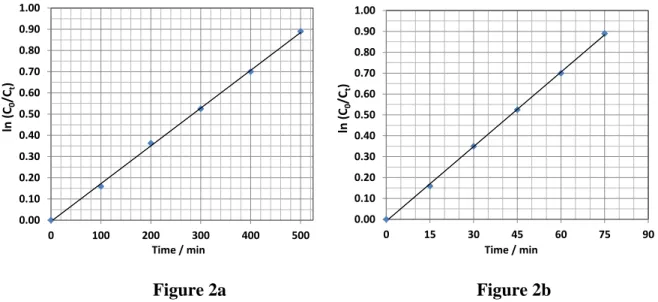
2-A6) Let C0 be the initial concentration of either nondeuterated diphenylmethanol or
deuterated diphenylmethanol and Ct its concentration at time t. The experiment led to two plots
Figure 2a Figure 2b
Which plot should be for the oxidation of nondeuterated diphenylmethanol and which one is for the oxidation of deuterated diphenylmethanol? (1 point)
For each statement, select your answer by marking “” in one of the open circles.
The oxidation of nondeuterated diphenylmethanol: ⃝ Figure 2a ⃝ Figure 2b The oxidation of deuterated diphenylmethanol: ⃝ Figure 2a ⃝ Figure 2b
[1 point for 2 correct answers; 0.5 point for 1 correct answer; 0 point for 2 wrong answer; 0 point for 1 wrong & 1 correct answer]
[The answer must be consistent with the answer in question 2-A5).]
0.00 0.10 0.20 0.30 0.40 0.50 0.60 0.70 0.80 0.90 1.00 0 100 200 300 400 500 ln ( C0 /Ct ) Time / min 0.00 0.10 0.20 0.30 0.40 0.50 0.60 0.70 0.80 0.90 1.00 0 15 30 45 60 75 90 ln ( C0 /C t ) Time / min
2-A7) Determine kCH, kCD (in min-1), and the kCH/kCD of this reaction from the plots in question 2-A6. (5 points) Calculation: t kCH t 0 C C ln t kCD t 0 C C ln (1 point) 012 . 0 CH
k min-1 (from the slope of the plot in Figure 2b) (1.5 points)
Example: 0.012 30 60 35 . 0 70 . 0 CH k min-1
[If kCH is calculated from the slope of the plot in Figure 2a, 1 point will be deducted.]
0018 . 0 CD
k min-1 (from the slope of the plot in Figure 2a) (1.5 points)
Example: 0.0018 200 400 35 . 0 70 . 0 CD k min-1
[If kCD is calculated from the slope of the plot in Figure 2b, 1 point will be deducted.]
7 . 6 0018 . 0 012 . 0 CD CH k k (1 point)
[The answer must be consistent with the answer in question 2-A6).]
2-A8) The mechanism has been proposed as follows:
According to the information in 2-A6) and 2-A7), which step should be the rate determining step? (1 point)
Select your answer by marking “” in one of the open circles. ⃝ Step (1)
⃝ Step (2) ⃝ Step (3)
Problem 3 A B Total A1 A2 A3
Total 7 3 8 6 24
Score Problem 3: Thermodynamics of chemical reactions
Part A.
Methanol is produced commercially by using a mixture of carbon monoxide and hydrogen over zinc oxide/copper oxide catalyst:
CO(g) + 2H2(g) CH3OH(g).
The standard enthalpy of formation (Hfo) and the absolute entropy (So) for each of the three
gases at room temperature (298 K) and at a standard pressure of 1 bar are given as follows. Gas Hfo (kJ mol-1) So (J K-1 mol-1)
CO(g) -111 198
H2(g) 0 131
CH3OH(g) -201 240
3-A1) Calculate Ho, So, Go, and K
p for the reaction at 298 K. (7 points)
Calculation: Ho (reaction) = H fo (CH3OH)- Hfo (CO)- 2Hfo (H2) kJ = -201-(-111)-2(0) kJ (1 point) Ho = ………..-90 ……… kJ (0.5 point) So (reaction) = So (CH 3OH)- So (CO)- 2So (H2) J K-1 = 240-(198)-2(131) J K-1 (1 point) So = ………….-220…….. J K-1 (0.5 point) and Go = Ho-TSo = -90-[(298)(-220)/1000] kJ (1.5 points) Go = ………..-24…………. kJ (0.5 point)
A value for the equilibrium constant, Kp, can be found from the expression, Go = -RT ln K p So that, Kp = exp (-Go/RT) = exp [24000/(8.3145)(298)] (1.5 point) = exp (9.69) Kp = ….1.6×104…… (0.5 point)
If you are unable to calculate Kp at 298 K in problem 3-A1), use Kp = 9 × 10⁵ later on.
Problem 3
6% of the total3-A2) A commercial reactor is operated at a temperature of 600 K. Calculate the value of Kp
at this temperature, assuming that Ho and So are independent of temperature. (3 points) Calculation:
To find value of Kp at 600 K, we use the van’t Hoff Isochore
ln Kp = − 𝐻 𝑅𝑇 + constant It follows that ln Kp(600) = ln Kp(298) + K 600 1 K 298 1 R H = ln (1.6×10⁴) + K 600 1 K 298 1 ) mol K J (8.3145 ) mol J 10 (-90 1 -1 --1 3 (2 points) Kp = 1.8 × 10⁻⁴
or Kp = 1 × 10⁻² (if using Kp, 298K = 9 × 10⁵ fake value)
(1 point)
3-A3) Production of methanol in industry is based on flowing of the gas comprising 2.00 moles of H2 for each mole of CO into the reactor. The mole fraction of methanol in the exhaust gas from the reactor was found to be 0.18. Assuming that equilibrium is established, what is the total pressure in the reactor at a high temperature of 600 K? (8 points)
Calculation:
It is helpful to consider the amounts of different species present before the reaction and during the equilibrium.
CO(g) + 2H2(g) ⇌ CH3OH(g) (0.5 point)
Before reaction 1 mol 2 mol 0 mol
At equilibrium 1-y mol 2-2y mol y mol (0.5 point)
The amount of methanol, y moles, can be found from the fact that the mole fraction of methanol is 0.18, so 0.18 OH CH no.mol CO mol no H no.mol OH CH no.mol 3 2 3 . 2y -3 y
So, y = 0.40 mol (1 point)
From the above, it is possible to find the mole fraction x of different species:
x(CH3OH) 0.18 0.40) (2 -3 0.40 (0.5 point) x(CO) 0.27 0.40) (2 -3 0.40 -1 (0.5 point) x(H2) 0.55 0.40) (2 -3 0.40) (2 -2 (0.5 point)
The corresponding partial pressures are
p(CH3OH) = 0.18×pTOT, (0.5 point)
p(CO) = 0.27×pTOT, (0.5 point)
and p(H2) = 0.55×pTOT, (0.5 point)
where pTOT is the total pressure. Since the reactor operates at 600 K,
Kp = 1.8×10⁻⁴ 2 2) ( ) ( ) H p CO p OH p(CH3 (1 point) 2 TOT TOT TOT ) (0.55p 0.27p 0.18p (1 point)
Solving this equation gives pTOT = 111 bar (or 15 bar if Kp = 1.0×10⁻² is used)
(1 point)
3-B) Consider the following closed system at 300 K. The system comprises 2 compartments, separated by a closed valve, which has negligible volume. At the same pressure P, compartment A and compartment B contain 0.100 mol argon gas and 0.200 mol nitrogen gas, respectively. The volumes of the two compartments, VA and VB, are selected so that the gases behave as ideal
gases.
After opening the valve slowly, the system is allowed to reach equilibrium. It is assumed that the two gases form an ideal gas mixture. Calculate the change in Gibbs free energy at 300 K, G. (6 points)
Calculation:
At constant T, U= 0 and H= 0. (0.5 point)
S
of the process can be found as described below.
For an irreversible process (at constant pressure), qwPV , while (0.5 point)
1 2 ln V V nRT w
q for a reversible process (at constant temperature). The change in
entropy can then be found from:
1 2 1 2 ln ln V V nR T V V nRT T q S rev . (0.5 point)
Therefore, for this process:
B B A B A B A A V V V R n V V V R n S ln( ) ln( ) (1 point) 2 3 ln 200 . 0 1 3 ln 100 . 0 R R (1 point) = 1.59 J K-1 (1 point)
Lastly, the change in Gibbs free energy can be found as follows:
S T -S T H G (0.5 point) -3001.59-477J (1 point) orGnARTlnxAnBRTlnxB 477J
If you are unable to calculate Kp at 298 K in problem 3-A1), use Kp = 9 × 10⁵ later on
A1 A2 A3 A4
Total 4 1 5 6 16
Score
Problem 4: Electrochemistry Part A. Galvanic cell
The experiment is performed at 30.00ºC. The electrochemical cell is composed of a hydrogen half-cell [Pt(s)│H2(g)│H+(aq)] containing a metal platinum electrode immersed in a buffer solution under a pressure of hydrogen gas. This hydrogen half-cell is connected to a half-cell of a metal (M) strip dipped in an unknown concentrationof M2+(aq) solution. The two half-cells are connected via a salt bridge as shown in Figure 1.
Note: The standard reduction potentials are given in Table 1.
Figure 1 The galvanic cell
Problem 4
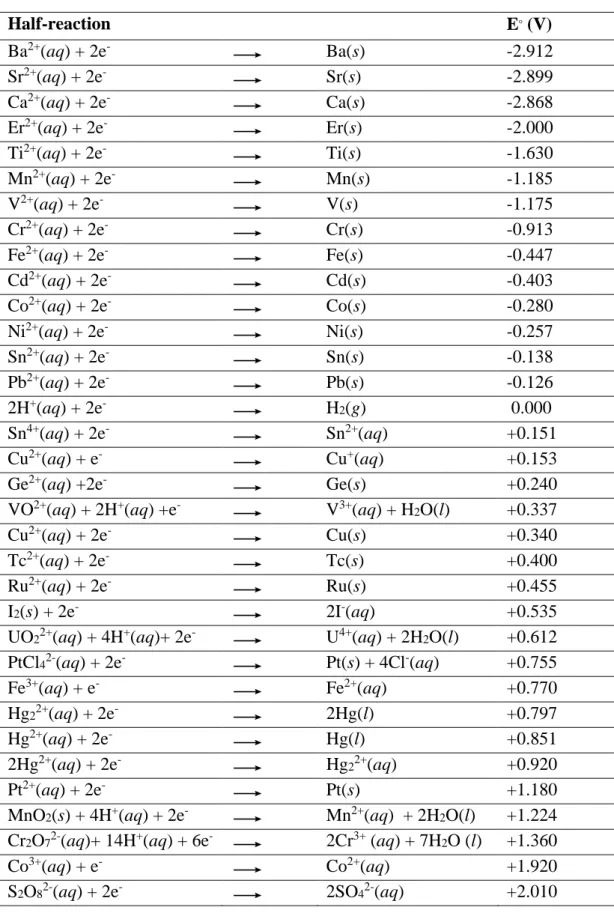
Table 1. Standard reduction potential (range 298-308 K) Half-reaction E๐ (V) Ba2+(aq) + 2e- Ba(s) -2.912 Sr2+(aq) + 2e- Sr(s) -2.899 Ca2+(aq) + 2e- Ca(s) -2.868 Er2+(aq) + 2e- Er(s) -2.000 Ti2+(aq) + 2e- Ti(s) -1.630 Mn2+(aq) + 2e- Mn(s) -1.185 V2+(aq) + 2e- V(s) -1.175 Cr2+(aq) + 2e- Cr(s) -0.913 Fe2+(aq) + 2e- Fe(s) -0.447 Cd2+(aq) + 2e- Cd(s) -0.403 Co2+(aq) + 2e- Co(s) -0.280 Ni2+(aq) + 2e- Ni(s) -0.257 Sn2+(aq) + 2e- Sn(s) -0.138 Pb2+(aq) + 2e- Pb(s) -0.126 2H+(aq) + 2e- H2(g) 0.000 Sn4+(aq) + 2e- Sn2+(aq) +0.151 Cu2+(aq) + e- Cu+(aq) +0.153
Ge2+(aq) +2e- Ge(s) +0.240
VO2+(aq) + 2H+(aq) +e- V3+(aq) + H2O(l) +0.337
Cu2+(aq) + 2e- Cu(s) +0.340
Tc2+(aq) + 2e- Tc(s) +0.400
Ru2+(aq) + 2e- Ru(s) +0.455
I2(s) + 2e- 2I-(aq) +0.535
UO22+(aq) + 4H+(aq)+ 2e- U4+(aq) + 2H2O(l) +0.612 PtCl42-(aq) + 2e- Pt(s) + 4Cl-(aq) +0.755 Fe3+(aq) + e- Fe2+(aq) +0.770 Hg22+(aq) + 2e- 2Hg(l) +0.797 Hg2+(aq) + 2e- Hg(l) +0.851 2Hg2+(aq) + 2e- Hg22+(aq) +0.920 Pt2+(aq) + 2e- Pt(s) +1.180
MnO2(s) + 4H+(aq) + 2e- Mn2+(aq) + 2H2O(l) +1.224 Cr2O72-(aq)+ 14H+(aq) + 6e- 2Cr3+ (aq) + 7H2O (l) +1.360
Co3+(aq) + e- Co2+(aq) +1.920
4-A1) If the reaction quotient (Q) of the whole galvanic cell is equal to 2.18 x 10⁻⁴ at 30.00๐C, the electromotive force is +0.450 V. Calculate the value of standard reduction potential (E๐) and identify the metal “M”.
Note; GGo RTlnQ
Calculations
Ecell = E๐cell – (RT/nF) ln Q
+0.450 = E๐cell – (8.314 J K-1 mol-1) × (303.15 K) ln 2.18 𝑥 10-4 (1 points)
2 × 96485 C mol-1
+0.450 = E๐cell + 0.110, (0.5 point)
then E๐cell = +0.450 V – 0.110 V = + 0.340 V (0.5 point)
Therefore, E๐cell = E๐cathode - E๐anode
+0.340 V = E๐cathode – 0.000 V ; E๐cathode = +0.340 V (0.5 point)
The standard reduction potential of M is ……....+0.340………..………V (0.5 point)
(answer with 3 digits after decimal point) Therefore, the metal “M” strip is …………..Cu(s)……… (1 point) or
Calculations
Ecell = E๐cell – (2.303RT/nF) log Q
+0.450 = E๐cell - 2.303 (8.314 J K-1 mol-1) × (303.15 K) log 2.18×10⁻⁴
2 × 96485 C mol-1
+0.450 = E๐cell + 0.110,
then E๐cell = +0.450 V – 0.110 V = + 0.340 V
Therefore; E๐cell = E๐cathode – E๐anode
+0.340 V = E๐cathode – 0.000 V; E๐cathode = +0.340 V
The standard reduction potential of M is ……....+0.340………... V (Answer with 3 digits after decimal point)
4-A2) Write the balanced equation of the spontaneous redox reaction of the galvanic cell.
H2(g) + Cu2+(aq) 2H+(aq) + Cu(s) (1 point)
1 point for correct balanced equation.If students choose a wrong metal (M) from 4-A1 but they write the correct balanced equation, they still get 1 point.
4-A3) The unknown concentration of M2+(aq) solution in the cell (Figure 1) can be analyzed by iodometric titration. A 25.00 cm3 aliquot of M2+(aq) solution is added into a conical flask and an excess of KI added. 25.05 cm3 of a 0.800 mol dm-3 sodium thiosulfate is required to reach the equivalent point. Write all the redox reactions associated with this titration and calculate the concentration of M2+(aq) solution.
Calculations
Iodometric titration of copper is based on the oxidation of iodide to iodine by copper (II) ions
Reactions taking place,
2Cu2+(aq) + 4I-(aq) 2CuI (s) + I
2(aq) (1 point)
This is followed during titration by the reaction of iodine with the thiosulfate: 2Na2S2O3 (aq) + I2(aq) Na2S4O6 (aq) + 2NaI(aq) (1 point)
or 2Cu2+ (aq) + 4I-(aq) 2CuI(s) + I
2(aq) (1 point)
I2(aq) + I-(aq) I3-(aq)
I3-(aq) + 2Na2S2O3(aq) Na2S4O6 (aq) + 2NaI (aq) + I-(aq) (1 point)
At equivalent point, mol of Cu2+ = mol of S 2O32- (1 point) (CCu2+ × V Cu2+/1000) = (CS2O32- × V S2O32-/1000) CCu2+ = (0.800 mol dm-3 × 25.05 cm3) /25.00 cm3 (1 point) CCu2+ = 0.802 mol dm-3 (0.5 point)
The concentration of M2+(aq) solution is…… 0.802 ….…mol dm-3 (0.5 point) (answer with 3 digits after decimal point)
If student cannot find the answer, the student can use 0.950 mol dm-3 as the concentration of M2+ for further calculations.
4-A4) In Figure 1, if the hydrogen half-cell is under 0.360 bar hydrogen gas and the platinum electrode is immersed in a 500 cm3 buffer solution containing 0.050 mol lactic acid (HC3H5O3) and 0.025 mol sodium lactate (C3H5O3Na), the electromotive force of the galvanic cell measured is +0.534 V. Calculate the pH of the buffer solution and the dissociation constant (Ka) of lactic acid at 30.00๐C.
Calculations of pH of the buffer solution
From the Nernst’s equation:
Ecell = E๐cell – (RT/nF) ln ( [H+]2/ PH2 ×[Cu2+])
+0.534 V = +0.340 V – (8.314 J K-1 mol-1)
× (303.15 K) ln [H+]2 (1 point)
2 × 96485 C mol-1 (0.360 bar) × (0.802 mol dm-3) -14.9 = ln [H+]2 (0.360 bar) × (0.802 mol dm-3) 3.52 × 10-7 = [H+]2 (1 point) (0.360 bar) × (0.802 mol dm-3) [H+] = 3.19 × 10⁻⁴ (0.5 point) pH = 3.50
pH of the buffer solution is ………3.50……… (0.5 point) (answer with 2 digits after decimal point)
or
Ecell = E๐cell – (2.303 RT / nF) log ( [H+]2 / PH2 × [Cu2+])
+0.534 V = +0.340 V - 2.303 × (8.314 J K-1 mol-1) × (303.15 K) log [H+]2
2 × 96485 C mol-1 (0.360 bar) × (0.802 mol dm-3) -6.45 = log [H+]2 (0.360 atm) × (0.802 mol dm-3) 3.53 × 10-7 = [H+]2 (0.360 atm) × (0.802 mol dm-3) [H+] = 3.19 × 10⁻⁴ pH = 3.50 (2 digits)
pH of the buffer solution is ………3.50……… (Answer with 2 digits after decimal point)
If student cannot find the answer, the student can use 3.46 as the buffer pH for further calculations.
Calculations of the dissociation constant (Ka) of lactic acid
The buffer solution composes of HC3H5O3 and C3H5O3Na,
the pH of the solution can be calculated from the Henderson-Hasselbalch Equation. [ C3H5O3Na] = 0.050 mol × 1000 cm3 = 0.10 mol dm-3
500 cm3
[HC3H5O3] = 0.025 mol × 1000 cm3 = 0.050 mol dm-3 (0.5 point)
500 cm3
pH = pKa + log ([C3H5O3Na] / [HC3H5O3]) (1 point)
3.50 = pKa + log (0.050/0.10)
pKa = 3.80 (0.5 point)
Ka = 1.58 × 10⁻⁴ (0.5 point)
The dissociation constant of lactic acid is …………1.58 × 10⁻⁴…… (0.5 point)
Problem 5 A B C D Total A1 A2 B1 C1 C2 D1 Total 1 1 3 1 2 2 10 Score
Problem 5: Phosphate and silicate in soil
Distribution and mobility of phosphorus in soil are usually studied by sequential extraction. Sequential extraction is performed by the use of acid or alkaline reagents to fractionate inorganic phosphorus in soil. Soil sample was extracted and analyzed as follows:
Part A. Determination of total phosphate (PO43-) and silicate (SiO44-)
A 5.00 gram of soil sample is digested to give a final volume of 50.0 cm3 digesting solution which dissolves total phosphorus and silicon. The extract is analyzed for the total concentrations of phosphorus and silicon. The concentrations of phosphorus and silicon are found to be 5.16 mg dm-3 and 5.35 mg dm-3, respectively.
5-A1) Determine the mass of PO43- in mg per 1.00 g of soil. (1 point) Calculations P 30.97 g from PO43- 94.97 g P 5.16 mg from PO43- (94.97/30.97) × 5.16 = 15.82 mg dm-3 In 50 cm3 solution, PO 43- = (15.82/1000) × 50 = 0.791 mg 5 g of soil contains PO43- 0.791 mg
1 g of soil contains PO43-= 0.158 mg (answer in 3 digits after decimal point) (1 point)
5-A2) Determine the mass of SiO44- in mg per 1.00 g of soil. (1 point)
Calculations
Si 28.09 g from SiO44- 92.09 g
Si 5.35 mg from SiO44- (92.09/28.09) × 5.35 = 17.539 mg In 50 cm3 solution, SiO44- = (17.539/1000)×50 = 0.877 mg 5 g of soil contains SiO44- 0.877 mg
1 g of soil contains SiO44-= 0.175 mg (answer in 3 digits after decimal point) (1 point)
Problem 5
5% of the totalPart B. Determination of available PO43- in acid extract
Phosphate can be analyzed by using molybdenum blue method. One mole of phosphate is converted into one mole of molybdenum blue compound. This method is used for determination of phosphate in the acid extract. Absorbance (A) and transmittance (T) are recorded at 800 nm. The molar absorptivity of the molybdenum blue compound is 6720 dm3 mol-1 cm-1 and all measurement is carried out in a 1.00-cm cuvette.
Transmittance and absorbance are given by the following equations: T = I / Io
A = log (Io / I)
where I is the intensity of the transmitted light and Io is the intensity of the incident light.
5-B1) When the sample containing high concentration of phosphate is analyzed, a reference solution of 7.5 x 10⁻⁵ mol dm-3 of molybdenum blue compound is used for adjusting zero absorbance. The transmittance of the sample solution is then measured to be 0.55. Calculate the concentration of phosphate (mol dm-3) in the sample solution. (3 points)
Calculations At a given wavelength Atotal = A1 + A2
-log (Ttotal) = -log(T1) + -log(T2) = -log(T1T2)
T1 = Tsolution for adjusting zero absorbance = 10(-bC)
= 10-(6720 dm3mol-1cm-1)(1 cm)( 7.5 x 10⁻⁵ mol dm-3) = 10(-0.504) = 0.3133 (1 point) T2 = Tmeasured= 0.55
Method 1) Tsample = Tsolution for adjusting zero absorbance Tmeasured
= 0.313 × 0.55 = 0.1723 (1 point) -log (T) = bC C = -log(0.1723) / (6720 dm3mol-1cm-1)(1 cm) = 1.136 × 10⁻⁴ mol dm-3 (1 point) Or Method 2) If T = 0.313, A = -log(T) = 0.504 If T = 0.55, A = -log(T) = 0.2596 (1 point)
Asample = Ameasured + Asolution for adjusting zero absorbance = 0.2596 + 0.504 = 0.7636 (1 point)
C = 0.7636 / (6720 dm3 mol-1cm-1)(1 cm) = 1.136 × 10⁻⁴ mol dm-3 (1 point)
Part C. Determination of PO43- and SiO44- in alkaline extract
Both phosphate and silicate ions can react with molybdate in alkaline solution, producing the yellow molybdophosphate and molybdatosilicate. Further reduction with ascorbic acid produces intense color molybdenum blue compounds. Both complexes exhibit maximum absorption at 800 nm. Addition of tartaric acid helps preventing interference from silicate in the determination of phosphate.
Two series of phosphate standard are treated with and without tartaric acid whereas a series of silicate standard is not treated with tartaric acid. Linear equations obtained from those calibration curves are as follows:
Conditions Linear equations
Phosphate with and without tartaric acid y = 6720x1 Silicate without tartaric acid y = 868x2 y is absorbance at 800 nm,
x1 is concentration of phosphate as mol dm-3, x2 is concentration of silicate as mol dm-3
Absorbance at 800 nm of the alkaline fraction of the soil extract after treated with and without tartaric acid are 0.267 and 0.510, respectively.
5-C1) Calculate the phosphate concentration in the alkaline soil extract in mol dm-3 and calculate the corresponding phosphorous in mg dm-3. (1 point)
Calculations
Conc. PO43- = (0.267 / 6720) = 3.97 × 10⁻⁵mol dm-3
concentration of PO43- = 3.97 × 10⁻⁵ mol dm-3 (0.5 point)
Conc. P = (3.97 x 10⁻⁵mol dm-3)(30.97 g mol-1)(1000 mg g-1) = 1.23 mg dm-3
concentration of P = 1.23 mg dm-3 2 digits after decimal point (0.5
5-C2) Calculate the silicate concentration from the soil sample in t the alkaline fraction in mol dm-3 and calculate the corresponding silicon in mg dm-3. (2 points)
Calculations
Abs of PO43- = ( 3.97 × 10⁻⁵mol dm-3)(6720) =0.267
Abs of SiO44-in sample = 0.510 – 0.267 = 0.243
Conc. SiO44- = (0.243 / 868) = 2.80 × 10⁻⁴ mol dm-3
concentration of SiO44- = 2.80 × 10⁻⁴ mol dm-3 (1 point)
Conc. Si= (2.80 × 10⁻⁴mol dm-3)(28.09 g mol-1)(1000 mg g-1) = 7.87 mg dm-3
concentration of Si = 7.87 mg dm-3 2 digits after decimal point (1 point)
Part D. Preconcentration of ammonium phosphomolybdate
A 100 cm3 of aqueous sample of ammonium phosphomolybdate ((NH4)3PMo12O40) compound is extracted with 5.0 cm3 of an organic solvent. The organic-water partition coefficient (Kow) is defined as the ratio of the concentration of the compound in the organic phase (co) to that in the water phase (cw). Kow of the ammonium phosphomolybdate is 5.0. The molar absorptivity of ammonium phosphomolybdate in the organic phase is 5000 dm3 mol-1 cm-1. 5-D) If the absorbance in the organic phase is 0.200, calculate the total mass of phosphorus (in mg unit) in the original aqueous sample solution. The optical pathlength of the cuvette is 1.00 cm. (2 points)
Calculations
Co = 0.200/5000 = 4 × 10⁻⁵ mol dm-3
The volume of the organic phase is 5.0 cm3, therefore ammonium phosphomolybdate
in the organic phase
= (4 × 10⁻⁵ mol dm-3)(5 cm3) / 1000 cm3 dm-3 = 2 × 10⁻⁷ mol (0.5 point)
From Kow = Co / Cw = 5.0
Cw = (4 × 10⁻⁵ mol dm-3) / 5 = 8 × 10⁻⁶ mol dm-3 (0.5 point)
The volume of the aqueous solutionis 100 cm3, therefore ammonium phosphomolybdate
in the aqueous solution
= (8 × 10⁻⁶ mol dm-3)(100 cm3) / 1000 cm3 dm-3
= 8 × 10⁻⁷ mol
Therefore, the total mol of ammonium phosphomolybdate = (2 × 10⁻⁷) + (8 × 10⁻⁷) mol
= 1 × 10⁻⁶ mol (0.5 point)
Total amount of P = (1 × 10⁻⁶ mol)(30.97 g mol-1)(1000 mg g-1) = 0.031 mg (0.5 point)
Problem 6 A B C Total A1 A2 B1 B2 B3 C1 C2
Total 3 8 4 3.5 5 2 4 29.5
Score Problem 6: Iron
Iron (Fe) is the fourth most abundant element in the Earth’s crust and has been used for more than 5,000 years.
Part A.
Pure iron is easily oxidized, which limits its utilization. Element X is one of the alloying elements that is added to improve the oxidation resistance property of iron.
6-A1) Below is some information about the element X:
(1) In first ionization, an electron with quantum numbers n1 = 4 – l1 is removed. (2) In second ionization, an electron with quantum numbers n2 = 5 – l2 is removed. (3) The atomic mass of X is lower than that of Fe.
What is the element X? (3 points)
(Answer by writing the propersymbol according to the periodic table.)
Answer Cr (3 points) (1 point for Cu)
Problem 6
6% of the total6-A2) Both Fe and X crystallize in the body centered cubic structure. Approximating the Fe atoms as hard-spheres, the volume taken up by the Fe atoms inside the unit cell is 1.59x10⁻²³ cm3. The volume of the unit cell of X is 0.0252 nm3. A complete substitutional solid solution usually occurs when R = (|𝑅𝑋−𝑅𝐹𝑒|
𝑅𝐹𝑒 ) × 100 is less than or equal to 15, where RX and RFe are the atomic radii of X and Fe, respectively. Can X and Fe form a complete substitutional solid solution? Show your calculation. No credit is given without calculation presented
.
The volume of sphere is 4/3r3. (8 points)Answer (Mark in an appropriate box.)
Yes (R 15) No (R > 15) (0.5 points,Y or N relates to the calculated R
Calculation
For Fe
V = 2(4/3)r3 (“2” => 1 point, the bcc unit cell contains 2 atoms of Fe) r3 = (V*3)/(8*) = (1.59x10⁻²³ cm3*3)/(8*) = 1.90x10⁻²⁴ cm3
r = 1.24x10-8 cm x (1 nm/10-7 cm) (conversion factor => 1 point)
r = 0.124 nm (2 points) For X V = a3 => a = √𝑉3 = 3√0.0252 = 0.293 nm (1 point) r = (√3a)/4 = (√3 0.293 nm)/4 = 0.127 nm (1.5 points) R = (|𝑅𝑋−𝑅𝐹𝑒| 𝑅𝐹𝑒 ) × 100 = ( |0.127 𝑛𝑚−0.124 𝑛𝑚| 0.124 𝑛𝑚 ) × 100 = 2.42, less than 15
(1 point for a correct calculation)
RFe =...…0.124……..nm RX =……0.127…….nm R = ……2.42…….. a
4r a
(This figure will not appear in the exam paper and no credit will be given for drawing this structure)
Part B.
Iron in natural water is in the form of Fe(HCO3)2, which ionizes to Fe2+ and HCO3-. To remove
iron from water, Fe(HCO3)2 is oxidized to an insoluble complex Fe(OH)3, which can be filtered out of the water. (4 points)
6-B1) Fe2+ can be oxidized by KMnO4 in a basic solution to yield Fe(OH)3 and MnO2 precipitates. Write the balanced ionic equation for this reaction in a basic solution.
3Fe2+ + MnO4 + 5OH + 2H2O 3Fe(OH)3 + MnO2 (3 points)
Under this condition, HCO3 ions are converted to CO32. Write the balanced ionic equation for this reaction in a basic solution.
HCO3 + OH CO32 + H2O (1 point)
6-B2) A covalent compound A which contains more than 2 atoms and, a potential oxidizing agent, can be prepared by the reaction between diatomic halogen molecule (Q2) and NaQO2.
1Q2 + xNaQO2 yA + zNaQ where x+y+z ≤ 7
where x, y and z are the coefficients for the balanced equation. Among the binary compounds between hydrogen and halogen, HQ has the lowest boiling point. Identify Q and if A has an unpaired electron, draw a Lewis structure of compound A with zero formal charge on all atoms. (Answer by writing the propersymbol according to the periodic table.)
Q = ……..Cl……... (1.5 points)
Lewis structure of compound A (1.3 points)
(All are correct answers. Student draws only one structure.)
What is the molecular geometry of compound A? (Mark in the appropriate boxes.)
(0.7 point)
6-B3) Compound D is an unstable oxidizing agent that can be used to remove Fe(HCO3)2 from natural water. It consists of elements G, Z and hydrogen and the oxidation number of Z is +1. In this compound, hydrogen is connected to the element having the higher electronegativity among them. Below is some information about the elements G and Z:
(1) G exists in its normal state as a diatomic molecule, G2.
(2) Z has one proton fewer than that of element E. E exists as a gas under standard conditions. Z2 is a volatile solid.
(3) The compound EG3 has a pyramidal shape.
Identify the elements G and Z and draw a molecular structure of compound D. (Answer by writing the propersymbol according to the periodic table.)
Part C.
59Fe is a radiopharmaceutical isotope which is used in the study of iron metabolism in the spleen. This isotope decays to 59Co as follows:
2659𝐹𝑒 2759𝐶𝑜 + a + b (1)
6-C1) What are a and b in equation (1)? (Mark in the appropriate boxes.)
proton neutron beta positron alpha gamma
(total = 2 points, 1 for each correct answer)
G = …….O……… Z = ……...I…….. (2 points for each)
Molecular structure of compound D (1 points)
hydrogen is connected to the element having the highest electronegativity (0.5 points) the oxidation of Z in compound D is +1 (0.5 point)
6-C2) Consider equation (1), if the 59Fe isotope is left for 178 days which is n times of its half-life (t1/2), the mole ratio of 59Co to 59Fe is 15:1. If n is an integer, what is the half-life of 59Fe in day(s)? Show your calculation.
Calculation: (total = 4 points)
t = 0 59Fe = N0 and 59Co = 0 t = 178 d 59Fe = Nt and 59Co = N0-Nt the ratio of 59Co to 59Fe at t = 178 d is 15 = (N0-Nt)/Nt so Nt = N0/(15+1) (2 points) At 178 day => Nt = No/(15+1) = N0/16 = 0.0625N0 Suppose that N0 = 100%, so Nt = 6.25% t = 0 => N0 = 100 % t = 1(t1/2) => Nt = 50 % t = 2(t1/2) => Nt = 25 % t = 3(t1/2) => Nt = 12.5 % t = 4(t1/2) => Nt = 6.25 %
So, n = 4 and t1/2 = 178/4 = 44.5 days
ln(Nt/N0) = -kt ln[(N0/16)/N0] = -k(178 d) ln(1/16) = -k(178 d) k = [ln(1/16)]/(-178) d-1 t1/2 = ln2/k = 44.5 days 1 pt
Problem 7 A Total
A1 A2 A3 A4 A5
Total 4.5 1.5 6 6 2 20 Score
Problem 7: Chemical Structure Puzzles
Titanium complexes have been investigated for their antitumor activity. Many factors including isomerism and sizes have shown to affect the potency of the complexes. This question deals with the synthesis and characterization of some titanium complexes.
7-A1) A reaction of 2 equivalents of 2-tert-butylphenol, 2 equivalents of formaldehyde, and N,N'-dimethylethylene-1,2-diamine under acidic conditions at 75 C affords three major products with the same chemical formula of C26H40N2O2, as shown in the equation below. Draw the structure of each product.
Ans
(4.5 points) Score distribution: +1.5 points for each product If phenolic OH is used as a nucleophile for the iminium ion, get 0.5 point.
Reasonable structures with missing Cs results in 0.25 deduction
Problem 7
7-A2) If 2,4-di-tert-butylphenol is used as a substrate instead of 2-tert-butylphenol using the same stoichiometry as that in 7-A1), only one product X was obtained. Draw the structure of X.
Ans
(1.5 points) 0 point for other isomers (meta-substitutions, etc.) If 2,6-di-tert-butylphenol is drawn (with correct substitution), 0.25 deduction.
A reaction between X from 7-A2) and Ti(OiPr)4 [iPr = isopropyl] in diethyl ether under an inert atmosphere resulted in the six-coordinate Ti complex Y, as a yellow crystalline solid and isopropanol at room temperature.
(equation 1) UV-Vis spectra of X, Ti(OiPr)4, and Y reveal that only the product Y has an absorption at = 370 nm. By varying the volumes of X and Ti(OiPr)4, each with the concentration of 0.50 mol dm-3, and using benzene as the solvent, the absorbance data at = 370 nm are given below:
Volume of X (cm3) Volume of Ti(OiPr) 4 (cm3) Volume of benzene (cm3) Absorbance 0 1.20 1.80 0.05 0.20 1.00 1.80 0.25 0.30 0.90 1.80 0.38 0.50 0.70 1.80 0.59 0.78 0.42 1.80 0.48 0.90 0.30 1.80 0.38 1.10 0.10 1.80 0.17 1.20 0 1.80 0.02
7-A3) Fill in appropriate values in the table provided below.
mole of X
mole of X + mole of Ti(OiPr)4 Absorbance
0 0.05 0.17 0.25 0.25 0.38 0.42 0.59 0.65 0.48 0.75 0.38 0.92 0.17 1.00 0.02
(2 digits after the decimal)
(0.25 points for each correct value in the left column)
Plot a graph showing a relationship between mole of X
mole of X + mole of Ti(OiPr)4 and absorbance in the space provided below.
Ans
mole of X
mole of X + mole of Ti(OiPr)4
(0.25 point for each data)
The trendlines are not considered for scoring.
The value of mole of X
mole of X + mole of Ti(OiPr)4 which maximizes the amount of the product Y represents the stoichiometry of X in the chemical formula of Y. Based on the graph above, what is the molar ratio between Ti:X in the complex Y?
The molar ratio between Ti:X in the complex Y is ...1:1...or 1... (2 points for the ratio)
1 point for the correct answer without the graph If the ratio is >1.2 or <0.8 (0 point)
Note: Based on the given data, the turning point in Job's plot occurs at mole fraction of X ~
0.5. As a result, we conclude that the product has the ratio of Ti:X = 1:1.
0.00 0.10 0.20 0.30 0.40 0.50 0.60 0.70 0.80 0.90 1.00 0.00 0.10 0.20 0.30 0.40 0.50 0.60 0.70 0.80 0.90 1.00
Absorbanc
e
7-A4) The Ti complex Y is six-coordinated. The IR spectrum of Y does not contain a broad absorption band in the range of 3200–3600 cm-1. Y exists as three diastereomers. Ignoring stereochemistry at N atoms, draw clearly the structures of all three diastereomers.
Note that you do not need to draw the complete structure of the ligand. Only identify donor atoms that involve in coordination with titanium and the ligand framework between the donor atoms can be drawn as follows:
For example: can be drawn as:
**If you did not get a structure of X from 7-A2), use the following ligand symbol to represent X (A and Z are donor atoms):
Ans
A B C
(6 points) Score distribution: 1.5 points for each isomer 1.5 points if the proposed structures do have three possible diastereomers. Bidentate ligands will not be considered for partial credits. Any O-H functional groups in the structure will get 0.25 point deduction. Without any reasonable monodentate ligands, 0.25 point deduction.
7-A5) Under certain conditions, the reaction shown in equation 1 affords only one diastereomer of Y. Given that structures of Y are "fixed" (no intramolecular movement), the 1H NMR spectrum of Y in CDCl3 shows four singlet resonances at 1.25, 1.30, 1.66, and 1.72 corresponding to the tert-butyl groups. Draw a structure of the only possible diastereomer of Y.
(You do not need to draw the complete structure of the ligand. Only identify donor atoms that involve in coordination and the ligand framework between the donor atoms can be drawn as shown in 7-A4))
or
(2 points) Only six-coordinated structures featuring tert-butyl groups in the chelate ligand structure will be considered for any credits.
Note for mentors: The 1H NMR spectra of isomers A and B contain two resonances assignable to the tert-butyl groups.
Problem 8 A Total
A1 A2 A3 A4 A5
Total 6 5.5 3 4 1.5 20
Score Problem 8: Silica Surface
Silica exists in various forms like amorphous and crystalline. Silica can be synthesized via sol-gel process by using silicon alkoxides like tetramethoxysilane (TMOS) and tetraethoxysilane (TEOS) as the details below:
a. Hydrolysis
b. Water condensation
c. Alcohol condensation
Problem 8
5% of the totalIn bulk silica, all silicon atoms are tetrahedrally bonded to four oxygen atoms giving three-dimensional solid network. The silicon environments found inside silica is presented below:
8-A1) Three silicon atom environments (similar to the example above) are commonly observed at the silica surface. The three structures of the silicon environments must be drawn in the provided boxes.
Silica can be used as an effective metal ion adsorbent in water. The proposed structure for metal-silica complex is as follows:
I II
x y z
Answer (total = 6 points)
Marking scheme Draw 1 structure => 2 points Draw 2 structures => 4 points Draw 3 structures => 6 points
8-A2) After Cu2+ is being adsorbed, the color of silica changes from white to pale blue. The visible spectrum shows a broad absorption band (with a shoulder) at max = 550 nm. If Cu2+ can bind with silica and adopt the structure similar to II, draw the splitting diagram of the d-orbitals of Cu2+ ion including the label of the d orbitals in the complex and specify the corresponding electronic transition(s) for the visible absorption.
The splitting diagram:
The corresponding electronic transition(s) (indicate the lower energy d-orbital and higher energy d-orbital)
Answer (total = 5.5 points) Cu2+: 1s2 2s2 2p6 3s2 3p6 3d9
Cu2+-complex tetragonal distortion Tetragonal elongation or tetragonal compression
Electronic Transition:
1. Tetragonal compression: dxy dz2 and dxz , dyz dz2 2. Tetragonal elongation: dxz , dyz dx2-y2 and dxy dx2-y2 Marking scheme
Draw one splitting diagram with d-orbital label; tetragonal compression or tetragonal elongation => 3.5 points
Specify the correct electronic transitions according to the drawn diagram => 2 points
For partial credits:
- The label of certain orbital is missing => 0.5 point is deleted for each missing d-orbital label
- Draw a regular octahedral field splitting with d-orbital label => 1.5 points and specify the corresponding electronic transition => 0.5 point
- Only the splitting diagram without d-orbital label => 0 point - Write the third electronic transition => -0.5 point
8-A3) If the first row transition metal ions form complexes with silica analogous to Cu2+, which metal ion(s) do(es) have the analogous to electronic transition(s) to Cu2+? The metal ion(s) must be in +2 or +3 oxidation state. Please note that the silanol groups (Si-OH) and water are weak field ligands.
However, silica is randomly bonded to various types of metal ion. To increase the selectivity, modification of silica surface has been performed by grafting with various organic molecules like 3-aminopropyltrimethoxysilane and 3-mercaptopropyltrimethoxysilane.
8-A4) If Hg2+ is only bonding to sulfur binding sites in silica-SH, the symmetric complex of [Hg(silica-SH)2]2+ is formed. Draw the structure of [Hg(silica-SH)2]2+, specify the direction of the bond axes, and draw the corresponding d-orbital splitting. (You may use R-SH instead of drawing the whole structure of silica-SH.)
Answer (total = 3 points)
Cr2+, Mn3+
(1.5 point for each metal ion)
The structure: d-orbital splitting diagram :
Answer (total = 4 points) Linear structure:
Marking scheme Draw the correct structure => 1 point Draw the correct d-orbital splitting diagram (no need to fill in the electrons)- corresponding
to the specified axes =>0.5 point for the axes =>2.5 points for the diagram
For partial credits:
- Draw the correct structure without axes but possible splitting diagram => 1+2 points - Draw the correct structure with wrong axes but possible splitting diagram => 1+2 points
8-A5) Specify true or false for the following statements:
a) d-d transition is found in [(Hg(silica-SH)x)]2+
True False
b) The [Cu(silica-NH2)x]2+ in a similar geometry, is expected to have a color similar to other copper(II) amine complexes.
True False
c) In the visible absorption spectra, max of [Cu(silica-NH2)x]2+ is greater than that of [Cu(silica-OH)x]2+.
True False
Answer (total = 1.5 points)
a) d-d transition is found in silica-SH-Hg2+.
True False
Explanation : Hg2+ is a d10- metal ion in which d-d transition is not found. b) The [(Cu(silica-NH2)x]2+ is expected to have a color similar to other copper(II)
amine complexes.
True False
Explanation : Various copper amine complexes like [Cu(en)(H2O)4]2+, [Cu(en)2(H2O)2]2+ and [Cu(en)3]2+ have deep blue color. [(Cu(silica-NH2)x]2+ containing similar ligands to these copper complexes is expected to have a similar color.
c) In the visible absorption spectra, max of [(Cu(silica-NH2)x]2+ is greater than that of [(Cu(silica-OH)x]2+.
True False
Explanation :R-NH2 is a stronger field ligand as compared to R-OH. This results in a larger energy gap or a smaller max of [(Cu(silica-NH2)x]2+ as
compared to that of [(Cu(silica-OH)x]2+.
Marking scheme 0.5 point for each correct answer
Problem 9 A Total
A1 A2 A3
Total 6 6 11 23
Score
Problem 9: Into the Unknown
9-A1) Organic compound A is chiral and contains only three elements with the molecular weight (MW) of 149 (rounded to an integer).
1H NMR spectrum of compound A shows among others, three types of aromatic
protons, and its 13C NMR spectrum shows eight signals, of which four signals are in the range
of 120-140 ppm.
Compound A can be prepared by treating a carbonyl compound with methylamine followed by NaBH3CN. Write all possible structural formulae of compound A. No stereochemistry is required, and do not include stereoisomers.
2 points each
Grading Scheme:
No points will be given if the structure drawn does not have molecular weight = 149. No points will be given if the structure drawn contains more than three elements. Partial credits will be given to each incorrect structure as follows
Contains a benzene/aromatic ring = 0.25 points Mono substituted aromatic ring = 0.25 points
Contains –NHCH3 group = 0.25 points
Contains 1 chiral carbon = 0.25 points
If two or three structures look exactly the same or they are stereoisomers, partial credits will be given to only one structure)
0.25 points will be deducted if H on O, N or C (e.g. –C=CHCH3) is missing.
Problem 9
6% of the total9-A2) One of the position isomers of compound A (structure A1, A2 or A3) can be synthesized from compound B or C and D as shown in the diagram below. Write down the structural formulae of compounds B-F, and the position isomer of compound A.
Grading Scheme for Structures B-F: (1 point for each structure)
0 points if the structure drawn does not contain a benzene/aromatic ring.
0 points if the molecular weight of the structure drawn does not match the molecular weight given.
0.25 points will be deducted if H on O, N or C (e.g. –C=CHCH3) is missing
Partial credits (maximum 0.5 points for each structure and maximum 1 point for each reaction) will be given to other structures if
both the starting material and the product are incorrect and the starting material can be converted to the corresponding product with a given name reaction or reagent(s).
9-A3) Compound A is the (R)-form of one of structures A1-A3. It can be prepared from vicinal diols X and Y as shown in the diagram below. Both diols are structural isomers, and each structure contains one carbon less than that of compound A. Write down the structural formulae of compounds G-N, X, Y and the (R)-form of compound A. You must show stereochemistry of all compounds.
Grading Scheme for Structures G-N, X and Y: (1 point for each structure) Same grading scheme as in question 9-A2 and
0.5 points will be deducted for incorrect stereochemistry.
For structures Y, L and M, 0.25 points will be deducted for incorrect stereochemistry at each chiral carbon.