行政院國家科學委員會專題研究計畫 成果報告
利用高壓合成新材料及其特性分析(3/3)(中波國合計畫)
計畫類別: 個別型計畫 計畫編號: NSC93-2113-M-002-001- 執行期間: 93 年 02 月 01 日至 94 年 01 月 31 日 執行單位: 國立臺灣大學化學系暨研究所 計畫主持人: 劉如熹 共同主持人: 楊弘敦 計畫參與人員: Subramanian Mylswamy, 王健源, 康佳正 報告類型: 完整報告 報告附件: 國際合作計畫研究心得報告 處理方式: 本計畫可公開查詢中 華 民 國 94 年 1 月 26 日
摘要(Abstract) 中文摘要 本計畫經由波蘭科學院之協助已設置完成高壓合成設備(壓力可達 1.5 GPa),其包含三種不同之高壓反應裝置,並可於大範圍之壓力與溫度環境下合 成樣品。 本計畫並建立以真空電弧鎔鍊爐於氬氣環境反應合成 YMn2 合金,並於 800ºC 之真空狀態煆燒十一天以使其成分均勻。再以此 YMn2合金為起始物, 於 200ºC 之高壓氘氣(1.7KPa) 之環境合成新型之氘化物 YMn2D6合金,並以 X 光粉末繞射 (XRD)、中子繞射 (NPD)、高解析穿透式電子顯微鏡 (HRTEM)、X 光吸收近邊緣結構(XANES)與超導量子干涉(SQUID)分析 YMn2D6 合金之特 性。 關鍵字 氘化物,高壓合成設備,真空電弧熔鍊,YMn2合金,YMn2D6合金 英文摘要
High pressure piston-cylinder apparatus for pressure upto 1.5 GPa was designed and installed in our laboratory with the help of Polish Academy of Sciences, Poland. It consists of three different types of high pressure reactors which can be operated under different temperature and pressure conditions from low pressure/temperature combinations to high pressure/temperature combinations.
The YMn2 intermetallic alloy was synthesized in an arc-melting chamber under
argon atmosphere and annealed at 800ºC for 11 days in vacuum furnace to get homogeneity. The novel intermetallic deuteride YMn2D6 was synthesized at 200ºC under
high deuterium pressure of 1.7 KPa. The material was characterized by advanced instrumental techniques such as X-ray diffraction (XRD), neutron powder diffraction (NPD), high-resolution transmission electron microscopy (HRTEM), Mn X-ray
From the results of the above analysis crystal structure, valence state of Mn and magnetic properties were discussed in detail. Structure of YMn2D6 differs greatly from the parent
C15 symmetry of the parent material which is unique property of this material. keyword
Deuteride, High pressure apparatus, Arc-melting method, YMn2 alloy, and YMn2D6
目錄
中英文摘要………I
目錄………II
報告內容
簡介………..……..1
高壓設備架設………..…..3
實驗設備操作方法…...………...7
實驗………..….….8
結果與討論……….…….10
計畫成果自評………....19
參考文獻………....19
附錄一………23
簡介 (Introduction)
Treatment of metals and alloys under high hydrogen/deuterium pressure proved to be an efficient synthetic technique to synthesize novel hydrides and deutrides. It has been used to synthesize many important hydrides of industrial importance such as NiH, MnHx,
FeHx (1-3). In most of the cases the hydrides formed at high hydrogen pressure are not
stable at normal conditions. It is expected that the application of high hydrogen pressure on intermetallic compounds may be extended to the hydrogen absorption to higher values with formation of new crystalline structures which are stable normal conditions.
In the present study we concentrate on the synthesis of YMn2D6 Laves phase
deutride which is an interesting material among metal deutrides. The parent compound YMn2 has unusual properties among intermetallic compounds. Under ambient conditions
(4) this intermetallic Laves compound has a cubic C15 crystal structure with Fd-3m space group. The results of heat capacity and thermal expansion measurements as a function of temperature indicate that this compound exhibits a first order phase transition at TN
accompanied with a giant volume change of about 5%, which is ascribed to the spontaneous volume magnetostriction due to the collapse of the Mn moment at TN (5,6).
Another anomalous behavior of YMn2 is its large thermal expansion coefficient
above TN. Such behavior can be interpreted by a rapid recovery of the amplitude of spin
fluctuations with increasing temperature above TN (7). Oomi et al. (8) found that the
magnetism of YMn2 is very sensitive to external pressure: the onset of magnetic order is
not observable at 3.7 kbar. Ballou et al. (9) elucidated the helimagnetic structure with a period of about 400 A° of YMn2, which is consistent with an angle modulation of the
antiferromagnetic structure, based on the results of neutron diffraction experiments and NMR spectra arising from a perturbation of the helix by the magnetocrystalline anisotropy.
It was observed that the absorption of hydrogen in YMn2 or decrease in
that up to x = 3.5, YMn2Hx exhibits as solid solution of hydrogen in C15 structure. The
cell parameters at room temperature continuously increases with increasing x. For 3.5 < x < 4, a two phase range with the mixture of cubic and rhombohedral phases exists. For 4 < x < 4.3, YMn2Dx exhibits a single phase hydride with a rhombohedral structure (11).
Latroche et al. performed neutron diffraction studies of YMn2Dx (1 ≤ x ≤ 4.5) at
temperatures above magnetic transition and reported that the deuterium occupies only the A2B2 sites in this range of concentration (12).
The magnetic ordering temperatures TN of YMn2Hx compounds (x = 0.5, 2 and 3)
increases with increasing x (13). Figiel et al. (14) attributed this deviating behavior to an increase in Mn–Mn distances during hydrogenation. This causes the increasing localization of more stable Mn moments resulting in the suppression of the spin fluctuations. Consequently, the volume anomalies of YMn2Hx compounds at TN decrease
with increasing x. Some works on hydrogen induced phase transitions of YMn2Hx 0 < x
<1.2 were also done by Figiel et al. (14). In their studies, the phase transitions were interpreted in terms of Mn–Mn magnetic interactions which depend on the lattice expansion caused by hydrogen.
From the above discussion it is clear that the magnetic properties of these compounds are very sensitive to Mn–Mn distances. It can be expected that progressive filling of the Mn d-band by electrons derived from hydrogen/deuterium which enter the metallic lattice sites in the form of proton will also influence magnetic structure of YMn2.
Moreover, if some hydrogen or deuterium ordering occurs, it will change, to a certain extent, the magnetic interaction between Mn atoms. Therefore, it could influence the magnetic order not only by varying the lattice constant but also by changing the local environment of the Mn atoms and by inducing distortions in the metal lattice (15). Based on previous works, a phase diagram can be proposed for YMn2Hx and YMn2Dx systems
0 ≤ x ≤ 4.2 (14,16).
single-existence is confirmed, to determine their properties. It was already proved that the application of high deuterium pressure can be effectively used for synthesis of novel hydrides in several Laves intermetallic compounds (17). As we expected, we have also succeeded to synthesize new deuteride and in order to identify its structure and characterize its magnetic properties, the powder X-ray diffraction (XRD), Mn X-ray absorption near edge structure (XANES) and magnetization measurements were carried out.
高壓設備架設 (Setup of high pressure equipment)
We have created a very good high pressure synthesis facility in our department which is st of its kind in Taiwan. With this we can synthesize novel materials which are not be able to preparedin atmospheric pressure condition. Also it is possible to find out different kinds of novel high pressure phases under different high pressure conditions with this facility. We are the leaders in Taiwan in such kind of high pressure research.
We have setup three different kinds of high pressure equipments to operate in different temperature and pressure conditions. These are discussed in the following sections.
1. High pressure range:
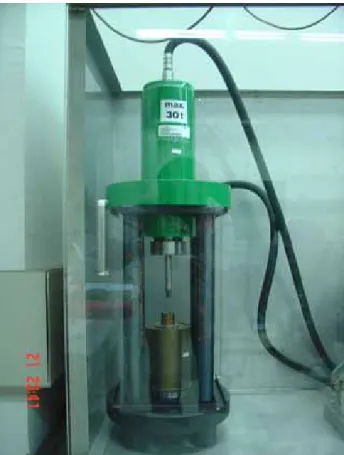
Fig 1. Pressure intensifier and multiplicator
It contains three important sections as follows:
(i) Pressure intensifier:
a. Basic functions:
Main function of this section is to intensify the hydrogen pressure up to 1000 atm from cylinder pressure. Also this is useful to control the pressure at lower levels even below cylinder pressure. So it acts as a key control system upto a pressure of 1000 atm. Hydrogen cylinder is connected to the multiplicator of pressure intensifier through heavy copper capillary tube which can withstand very high pressures at the order of 1.5 GPa. Metallic ferrules and rubber sealing were used to avoid any leakage near joints.
b. Construction:
It contains a cylinder piston arrangement where hydrogen gas is compressed and fed into the system through multiplicator. Multiplicator is used to split the reactor and hydrogen cylinder by two valves. The pressure of this intersifier is measured by a pressure gauge mounted near hand press which is the pressure inside the reactor also.
c. Working:
Hydrogen cylinder is opened and the gas allowed entering into the intensifier through multiplicator. Hydrogen cylinder and inlet valve in multiplicator are closed and the pressure is increased to the required pressure by pumping the hand pump. During pumping outlet valve of multiplicator kept open to allow the pressurized hydrogen into the reactor. After attaining the required pressure in the reactor, reactor is disconnected from by closing valve near reactor head.
(ii) High pressure piston-cylinder and reactor:
(a) Basic function:
High pressure piston-cylinder is used to increase the hydrogen pressure to a higher range above 1000 atm to a maximum of 15000 atm. Reactor is used to synthesize the samples.
(b) Construction:
Both of these two sections assembled in a single unit with protecting shield as shown in Fig 1. The whole assembly is mounted on a heavy iron base and the piston is connected hydraulically to a hand press which is used to pump the hydrogen to a high pressure.
Reactor is made up of heavy walled beryllium bronze material with a small cylindrical hole in the centre to accommodate sample cells and the piston from the upper side. Lower side is closed by a stopper made up of the same material. Normally material of construction for high hydrogen pressure is beryllium bronze because of hydrogen embrittlement property of stainless steel. Upto 1000 atm pressure stainless steel can be
conveniently used without any problem. Beyond such pressure it is very difficult to maintain a smooth surface of the stainless steel. High pressure hydrogen will penetrate into stainless and start destroying the surface as well as inner structure of stainless steel which will result in the amorphisation of stainless steel.
(c) Working:
After reaching 1000 atm hydrogen pressure from pressure intensifier it is disconnected from the reactor and further increase of pressure is done by high pressure piston-cylinder connected directly to the reactor. Upto four sample cells are kept inside the reactor cylinder and the pressure is slowly raised to the required pressure level.
(iii) Heating coil:
In this high pressure range equipment external heating coil is used to heat up the reactor. Heating coil is covered around the thick walled beryllium bronze and connected to the temperature control device. Thermocouple is connected to the control device and the sensor is inserted near central cylindrical reactor. Maximum temperature attained is about 300 ºC in this setup.
2. Medium pressure range:
It contains only two sections that are pressure intensifier and main reactor.
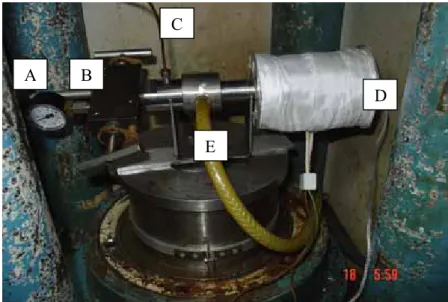
Pressure intensifier is the same as in the above said high pressure range set up. It can operate upto a pressure of 1000 atm only. Reactor is made up of stainless steel cylinder which is connected to a multiplicator. Multiplicator is further connected to vacuum line and hydrogen cylinder through pressure intensifier. Pressure inside the rector is measured by a small pressure gauge which is used to measure both vacuum as well as pressure upto maximum pressure of 10 atm. After that pressure will be measured by big pressure gauge which is situated near hand press. The reactor assembly is shown in Fig. 2. Cooling water circulation was provided in-between sample and multiplicator to avoid heating up of multiplicator.
A B
D E
C
A. Pressure gauge B. Multiplicator C. Capillary D. External heater E. Cooling water circulation
Fig 2. Experimental setup for high pressure synthesis 3. Low pressure and high temperature setup:
In this equipment also pressure intensifier is used to increase the pressure in the reactor as in the case of medium pressure range equipment. But the heating system is entirely different from the above two kinds. It contains a small tiny ceramic wounded coil which is used for the sample vessel holder. Inside the ceramic heated small sample cells will be kept and heated. Very near to sample cell bottom one small thermocouple will be made and the ends of wires will be taken out through stopper to multimeter.
The whole assembly is carefully arranged and kept inside the steel tube with tight sealings. Hydrogen gas will be passed through a small threaded hole by copper capillary from the pressure intensifier.
實驗設備操作方法 (General operation of the equipment)
The samples were loaded into sample cells and closed with threaded covers, placed into the reactor. Cooling water circulation was switched on to avoid heating up of multiplicator. The whole assembly was mounted on protected solid base with heavy
transparent windows. Temperature was slowly increased to 100°C and the sample case is evacuated with vacuum pump for over night. The heater was switched off and the temperature is lowered down to ambient temperature.
Hydrogen pressure was slowly increased from atmospheric pressure to a very low pressure. If absorption is observed periodically pressure level is maintained at low pressure until get saturation. After the saturation point again hydrogen is charged from the cylinder and pressure is increased slowly upto 100 atm and maintained upto two days to complete the absorption. Temperature is slowly increased from room temperature to 100°C and pressure maintained for about an hour to monitor any further absorption. Hydrogen pressure increased slowly and steadily to get maximum hydrogen absorption. Absorption time, pressure and temperature will vary depending on the nature of the sample. After completion of the reaction rector is cooled down to room temperature without disturbing the pressure. On attaining room temperature hydrogen pressure is slowly reduced in steps to the atmospheric pressure over a period of four to five hours.
Immediately after the discharge of the samples they should be preserved in glove or in liquid nitrogen to avoid any loss of hydrogen from the sample due to desorption phenomenon.
實驗 (Experimental Section)
The YMn2 sample was prepared by induction melting of the pure components
(yttrium, 99.9%; manganese, 99.99%) in a water-cooled copper crucible under vacuum then under argon atmosphere to avoid sublimation of manganese (18, 19). In order to prevent the precipitation of Y6Mn23 compound, a 3–5% yttrium excess was added to
obtain a single-phase YMn2 compound. To ensure good homogeneity, the sample was
melted five times and annealed for 11 days at 800 ºC.
The homogeneity of the sample was checked by metallographic examination and the composition was analyzed by electron microprobe analysis (EMPA). The powder X-ray diffraction was performed on a PW1710 Philips diffractometer with Cu Ka radiation (λ = 1.5406 Å) and the XRD pattern was successfully indexed as a cubic Fd-3m space group with cell parameter a = 7.681 Å.
About 8 g of the alloy ingot were ground mechanically under argon atmosphere and then sieved for the grain size less than 36 mm. Samples were located in a high pressure apparatus described elsewhere (20) and treated at 100 ºC in vacuum before deuterium charging. Without this treatment, the presence of water adsorbed on the surface of the alloy affects the penetration of deuterium into the bulk (17). The deuterization was performed at pressures of 1.7 kbar of deuterium and temperatures of 200 ºC for 12 h. After the apparatus was cooled down to room temperature, the deuteride was discharged and immediately stored in liquid nitrogen for further investigations. However, soon it became clear that this new deuteride is very stable and can be preserved in ambient conditions without any changes.
Density measurements have been performed using a volumetric method with an Accupyc 1330 Picnometer from Micromeritics Company.
X-ray diffraction (XRD) analyses were carried out with a Brucker diffractometer with Cu Kα radiation. Data for the Rietveld refinement were collected in the 2θ range 10– 120º with a step size of 0.02º and a count time of 10 seconds per step. The lattice image of the sample was obtained by high resolution transmission electron microscopy (HRTEM; JEOL 4000EX). The samples for the microscopy were dispersed in alcohol before being transferred to the carbon coated copper grids. The magnetization measurements were done by superconducting quantum interference device (SQUID) magnetometer (Quantum Design).
Density measurements have been performed using a volumetric method with an Accupyc 1330 Picnometer from Micromeritics Company. The neutron powder diffraction (NPD) patterns of the deuteride have been registered at 2 K and 80 K on the 3T2 diffractometer and from 1.4 K to 290 K on the G4.1 diffractometer at the Laboratoire Léon Brillouin (LLB) at Saclay. For the 3T2 experiment the wavelength was 1.225 Å and the angular range 6 ° < 2θ < 125 ° with a step of 0.05 °. For the G4.1 experiments the wavelength was 2.427 Å and the angular range was 2 ° < 2θ < 82 ° with a step of 0.1°. The deuteride sample was contained in a vanadium sample holder. All the XRD and NPD patterns were refined with the Rietveld method, using the Fullprof program (15).
Differential Scanning Calorimetry (DSC) was performed on TA-Q100 DSC apparatus from TA instrument. The samples were placed in aluminum pan under argon
atmosphere. The experiments were performed from 313 K to temperature ranging from 523 K to 873 K with a rate of 20 K/mn.
Magnetization measurements were performed on a Quantum Design PPMS magnetometer.
The valence of Mn in the synthesized intermetallic deuteride was determined by the X-ray absorption technique. The spectra were obtained using synchrotron radiation with the electron beam energy of 1.5 GeV at NSRRC. They were recorded by measuring the I/I0 ratio, where I0 is the intensity of the incident beam. The incident photon flux (I0)
was monitored simultaneously by an ion-chamber which was positioned after the exit slit of the monochromator. The intensity of the transmitted X-ray monitored in the same way was considered as I0 of the standard metal foil for calibrating the energy of the beam. All
the measurements were performed at room temperature. The photon energies were calibrated to an accuracy of 0.1 eV via the theoretical values of the Mn metal K-edge absorption energies. The reproducibility of the absorption spectra of the same sample in different experimental runs was found to be extremely good.
The neutron powder diffraction (NPD) patterns of the deuteride have been recorded at 2 K and 80 K on the 3T2 diffractometer and from 1.4 K to 290 K on the G4.1 diffractometer at the Laboratoire Léon Brillouin (LLB) at Saclay. For the 3T2 experiment the wavelength was 1.225 Å and the angular range 6 ° < 2θ < 125 ° with a step of 0.05 °. For the G4.1 experiments the wavelength was 2.427 Å and the angular range was 2° < 2θ < 82 ° with a step of 0.1°. The deuteride sample was kept in a vanadium sample holder. All the XRD and NPD patterns were refined with the Rietveld method, using the Fullprof program (21).
結果與討論 (Results and Discussion)
Density measurements lead to a value of d=4.63(1) g/cm3. This experimental density is in good agreement with the calculated one: d=4.636 g/cm3 for YMn2D6 in a
FCC cell with a=6.709 Å and Z= 4 formula units per unit cell.
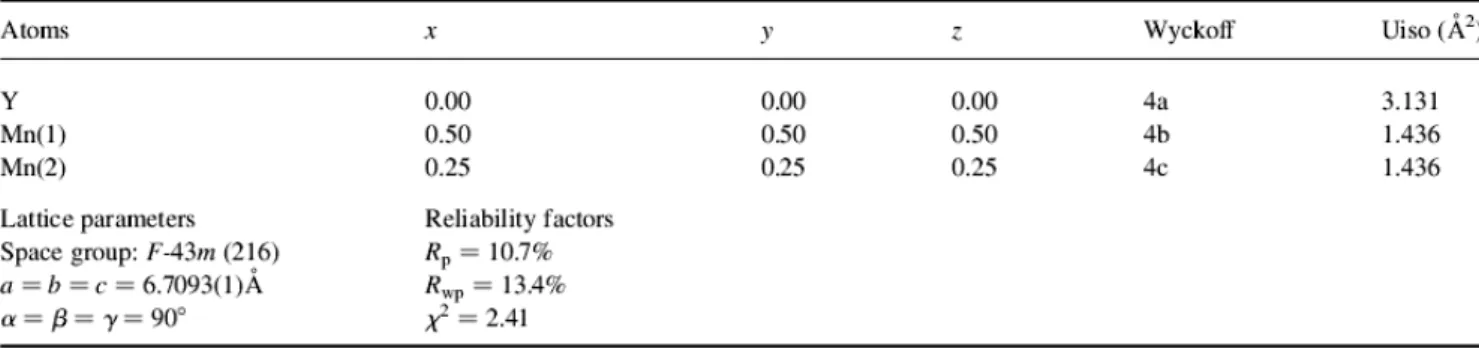
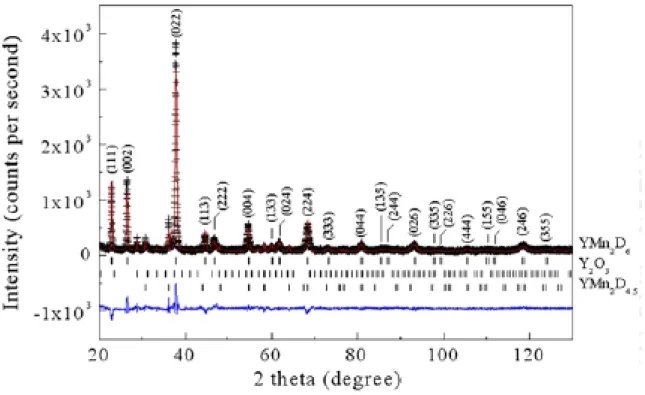
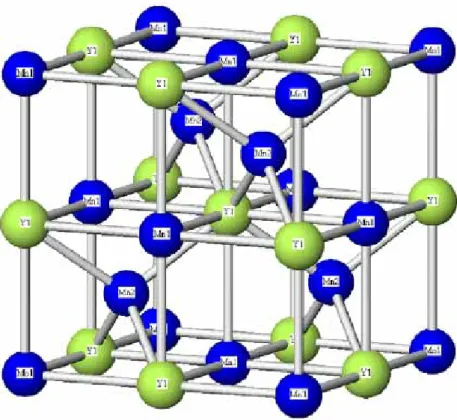
respectively. The values of reliability factors, Rp; Rwp and x calculated from the XRD patern were all acceptable. The pattern could be indexed on the basis of a cubic cell [a = b = c = 6.7093(1) Å, α = β = γ = 90°] and the space group of its crystal structure is F-43m: The crystal structure of the YMn2D6 compound plotted with ATOMS software is shown
in Fig. 4.
Table 1 Refined atomic positions, unit cell parameter and reliability factor of YMn2D6 at 300 K. Some lines are attributed to small amount of Y2O3 and YMn2D4.5
Fig. 3. Rietveld fits to powder XRD data of YMn2D6 with F-43m space group.
Observed (cross) and calculated (solid line) intensities are shown with the difference at the bottom.
In the C15 type of structure, three kinds of tetrahedral interstitial sites are available for deuterium occupation: AB3, A2B2 and B4. Experimentally, it has been found
that A2B2 sites are the most favorable for deuterium bonding, thus they should be filled
first. The possibility of filling other two sites, however, could not be excluded, (22, 23) especially when the deuterium content is higher. Moreover, it has been proposed that filling into AB3 sites might induce a rhombohedral distortion of the host structure (18).
However, the crystal symmetry of the YMn2D6is not directly related to the C15 structure.
Formation of YMn2D6 is accompanied with strong rearrangement of both yttrium and
manganese atoms. Also the sites available for deuterium can be very different from A2B2,
AB3and B4present in the C15 lattice. For instance we can distinguish A3B sites in each
Fig. 4. Crystal structure of the YMn2D6 with cubic unit cell (space group: F- 3m).
Fig. 5 shows the lattice image by HRTEM along the [001] zone-axis direction of the cubic crystal system corresponds to its ab plane. This photo also indicates a high crystallinity of the synthesized YMn2D6 compound.
Fig. 5. HRTEM lattice image recorded along the [001] zone-axis direction of YMn2D6.
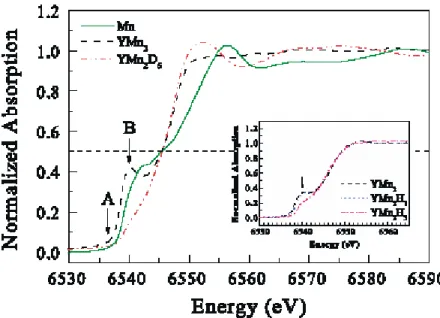
X-ray energies are sufficiently high to eject, via the photoelectric effect, one or more core electrons from an atom. Each core electron has a well-defined binding energy, and when the energy of the incident X-ray is varied across one of these energies, there is an abrupt increase in the absorption coefficient. This is the so-called ‘absorption edge’ of the element. Absorption edges are named according to the electron of which shell is excited, for example, K = 1s; LI = 2s, LII,III = 2p, etc. The Mn K-edge XANES spectra of
the YMn2 and YMn2D6 compounds are shown in Fig. 6. The Mn foil was used as a
reference. Knowing reference spectrum at the absorption edge, it is possible to use it as a fingerprint of the valence and site symmetry, so to characterize the investigated sample.
In other words, although the differences between the energy values (E0)
fairly similar structural coordination environment. It is very important to keep this point in mind as we examine these spectra. Therefore, as shown in Fig. 4, we proposed that the E0 at such little different energy values was attributed to the different chemical
environment of Mn. It is more plausible to determine the valence of Mn based on the energy value of the onset of XANES spectrum (as the arrow A in Fig. 4 shows). Viewed in this light, the valence of Mn in the intermetallic alloy and its deuteride can be regarded as the same metallic state as that of Mn foil.
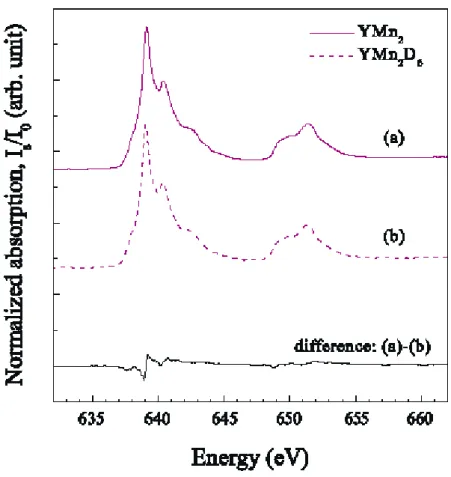
In the case of K-edge XANES spectrum, the X-ray absorption of a 3d transition metal is mainly due to the excitation process of its 1 s core electron to higher 4p manifold electronic states. For L-edge XANES spectrum, the absorption corresponds to the 2p to 3d transition. The d electrons are more shielded from the chemical environment than p electrons and therefore in greater degree have retained their atomic character. As a consequence, it is suggested that the L-edge XANES spectrum has less interference from the site symmetry. The Mn L edge XANES spectra of the YMn2 and YMn2D6 are shown
in Fig. 5. The spectra show two separated broad multiple structures arising from the spin-orbital splitting of Mn 2p electronic energy levels. The former and latter peaks correspond to 2p3/2 to 3d and 2p1/2 to 3d transitions, named LIII and LII-edge, respectively.
Fig. 6. Normalized Mn K-edge XANES spectra of the YMn2 and YMn2D6
compounds and that of the standard sample (Mn foil). For reference the results of YMn2, YMn2H and YMn2H3 are shown in the inset.
Using the integrated area under the LIII- and LII-edge XANES spectra it is even
possible to quantify the changes in d-band occupancy. When we consider the role of deuterium in the host, the state of Mn influenced by complicate electronic interactions becomes more open to question. After careful comparison, it seems that the L-edge spectra of these two samples do not differ markedly. It can be then concluded that the manganese is metallic and alloyed with yttrium. An obvious change in the intensity of the pre-edge peak located at 6540 eV, as shown by arrow B in Fig. 6, is observed. For the YMn2D6 compounds this peak even completely vanished. This result is in agreement with
tendency observed for smaller hydrogen concentration (inset in Fig. 6). As we mentioned above, according to the dipolar selection rules, the K-edge corresponds to an electronic transition from 1 s core state to empty p state and the XANES spectrum probes the empty projected local electronic density of p state (24). The Mn 4p states are hybridized with partially empty Mn 3d states, i.e. the pre-edge structure is related to the hybrid p–d states. Since the Mn 3d states are dominant at the Fermi level, the dramatic change of the pre-edge peak might indicate a reduction of the number of 3d holes due to the shift of 3d
Fig. 7. Normalized Mn L-edge XANES spectra of YMn2 and YMn2D6
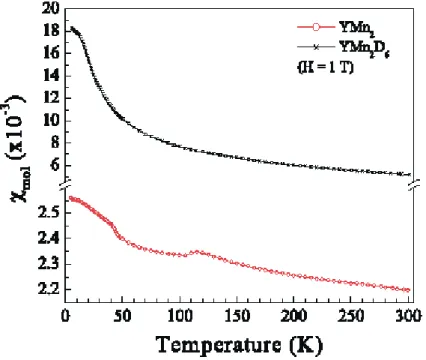
The magnetization curves of the YMn2 and YMn2D6 compounds as a function of
temperature were shown in Fig. 8. The absorption of deuterium results in the two-orders enhanced magnetic moment of Mn and there is a rapid increase of magnetization of the YMn2D6 compound when temperature decreases from 120 K down to 5 K. In Fig. 9 the
magnetization loops for the YMn2 and YMn2D6 compounds are compared. The
magnetization curves measured at 5 K show a larger magnetic hysteresis for YMn2D6
than YMn2. It was found that the deuteride exhibits magnetic moment higher than its
parent alloy (YMn2). The magnetization of both, YMn2 and YMn2D6 samples was not
Fig. 8. Temperature dependence of magnetization of YMn2 and
結論(Conclusions)
The novel intermetallic deuteride YMn2D6 was successfully synthesized under
high deuterium pressure conditions. The structure of YMn2D6 (F-43m) differs
dramatically from C15 symmetry (Fd-3m) of the parent material. Such a great rearrangement of the metal lattice due to deuterium absorption is rather exceptional for C15 Laves phases. Some chemical and physical properties of YMn2D6 were also
examined by several analytic methods. X-ray absorption spectroscopy indicates progressive filling of the Mn d band by electrons derived from deuterium which, in ionic form, occupies sites in the metallic lattice. During reaction of deuterium with YMn2,
leading to formation of YMn2D6, the changes of electronic structure, crystal symmetry,
atomic environment and interatomic distances occur.
計畫成果自評 (Evaluation of the project)
We have reached the goals of the research plan, some parts of the results have already been published in scientific journals (26-27). Moreover, we have also presented the outcome of this project in various international conferences (28-33).
參考文獻 (References)
1. B. Baranowski, R. Wiśniewski, Bull. Polon. Acad. Sci., 14 (1966), 273 2. S.M. Filipek, B. Baranowski, M.Yoneda, Roczniki Chem., 51 (1977) 2243 3. M. Krukowski, B. Baranowski, Roczn. Chem., 49 (1975) 1183
4. A.E. Dwight, Trans. Am. Soc. Met. 53 (1961) 479.
5. H. Wada, H. Nakamura, K. Yoshimura, M. Shiga, Y. Nakamura, J. Magn. Magn. Mater. 70 (1987) 134.
6. T. Okamoto, H. Nagata, H. Fujii, Y. Makihara, J. Magn. Magn. Mater. 70 (1987) 139.
7. M. Shiga, H. Wada, H. Nakamura, K. Yoshimura, Y. Nakamura, J. Phys. F 17 (1987) 1781.
8. G. Oomi, T. Terada, M. Shiga, Y. Nakamura, J. Magn. Magn. synthesis, J. Jurczak, B. Baranowski, editors, Elsevier, Mater. 70 (1987) 137.
9. R. Ballou, J. Deportes, R. Lemaire, Y. Nakamura, B. Ouladdiaf, J. Magn. Magn. Mater. 70 (1987) 129.
10. H. Fuji, M. Saga, T. Okamoto, J. Less-Common Met. 130 (1987) 25.
11. J. Przewoznik, V. Paul-Boncour, M. Latroche, A. Percheron- Guegan, J. Alloys Compd. 225 (1995) 436.
12. M. Latroche, V. Paul-Boncour, J. Przewoznik, A. Percheron-Guegan, F. Bouree-Vigneron, J. Alloys Compd. 231 (1995) 99.
13. H. Figiel, A. Lindbaum, Cs. Kapusta, E. Gratz, J. Alloys Compd. 217 (1995) 157.
14. H. Figiel, J. Przewoznik, V. Paul-Boncour, A. Lindbaum, E. Gratz, M. Latroche, M. Escorne, A. Percheron-Gue´gan, P. Mietniowski, J. Alloys Compd. 274 (1998) 29.
15. I.N. Goncharenko, I. Mirebeau, A.V. Irodova, E. Suard, Phys. Rev. B 56 (1997) 2580.
16. J. Przewoznik, J. Zukrowski, K. Krop, J. Magn. Magn. Mater. 140 (1995) 807. 17. S.M. Filipek, V. Paul-Boncour, A. Percheron-Guegan, I. Jacob, I. Marchuk, M. Dorogova, T. Hirata, Z. Kaszkur, J. Phys.: Condens. Matter 13 (2001) 475. 18. M. Latroche, V. Paul-Boncour, A. Percheron-Guegan, F. Bouree-Vigneron, J.
Alloys Compd. 274 (1998) 59.
19. M. Latroche, V. Paul-Boncour, A. Percheron-Gue gan, F. Boure´e-Vigneron, G. Andre´, J. Solid State Chem. 154 (2000) 398.
20. B. Baranowski, S.M. Filipek, High pressure chemical synthesis, J. Jurczak, B. Baranowski, editors, Elsevier, Amsterdam, pp. 55–100.
21. Rodríguez-Carvajal J 1990 in proceedings of Congr. Int. Union of
Crystallography, p. 127.
22. D. Fruchart, A. Rouault, C.B. Shoemaker, D.P. Shoemaker, J. Less-Common Met. 73 (1980) 363.
23. A.V. Irodova, O.A. Lavrova, G.V. Laskova, L.N. Padurets, Sov. Phys. Solid State 24 (1982) 22.
25. S. Matar, V. Paul-Boncour, Proceedings of the groupement francais de spectroscopie mo¨ssbauer, Juins, Bordeaux, 1998.
26. C.Y. Wang, V.P. Boncour, C.C. Kang, R.S. Liu, S.M. Filipek, M. Dorogova, I. Marchuk, T.Hirata, A.P. Guegan, H. S. Sheud, L. Y. Jang, J.M. Chen, H.D. Yang, Solid State Commun. 130 (2004) 815.
27. V. Paul-Boncour, S.M. Filipek, M. Dorogova, F. Bourée, G. André, I. Marchuk, A. Percheron-Guégan, R. S. Liu, J. Solid State Chem. 178 (2005) 356.
28. Characterization of several Laves phase hydrides recently synthesized under high hydrogen pressure, S.M. Filipek, V. Paul-Boncour, H. Sugiura, Ru-Shi Liu F. Bourée, G. Wiesinger, T. Hirata, A. Percheron-Guégan, I. Marchuk, M. Dorogova; Joint 19th AIRAPT - 41st EHPRG International Conference on High Pressure Science and Technology, Bordeaux, Francja, 7-11 July, 2003
29. A new hydride phase of YMn2 synthesized under high hydrogen pressure and its
characterization, S. M. Filipek, V. Paul-Boncour, C. Y. Wang, R. S. Liu, T. Hirata, I. Marchuk, M. Dorogova, A. Percheron-Guegan, H.-S. Sheu, L.-Y. Jang, J. M. Chen and H. D. Yang, Joint 19th AIRAPT - 41st EHPRG International Conference on High Pressure Science and Technology, Bordeaux, Francja, 7-11 July, 2003
30. Properties of Novel Hydrides Synthesized under High Hydrogen Pressures from
C15 Laves Phases S.M. Filipek, V. Paul-Boncour, H. Sugiura, R.S. Liu and I.
Marchuk, III International Conference, “Phase Transformations under High Pressures”, HPP-2004, June 1-3, 2004, Chernogolovka.
31. High Pressures Studies on Hydrides of Selected Manganese Alloys, H. Sugiura,
S.M. Filipek, V. Paul-Boncour, I. Marchuk, R.S. Liu M. Dorogova, S.I. Pyun, IV International Conference “Hydrogen Treatment of Materials” May 17-21. 2004 Donieck (Ukraine).
32. Studies on the Magnetic Properties and Low-Temperature Specific Heat of a Novel YMn2D6 Compound Synthesized under High Pressure of Gaseous
Deuterium Chien-Yuan Wang, Chun-Bo Tsai, Yang-Yuan Chen, Valerie Paul-Boncour, Chia-Cheng Kang, Ru-Shi. Liu, Stanislaw M. Filipek, Maria Dorogova,
Iryna Marchuk, International Conference on Metal Hydrogen Systems, MH2004. 5 – 10 Sept. 2004, Krakow POLAND.
33. Low-Temperature Specific Heat and Magnetic Properties of a Novel YMn2D6
Deuteride, C. Y. Wang, C. B. Tsai, Y-Y. Chen, V. Paul-Boncour, C-C.Kang, R-.S. Liu, S. M. Filipek, M. Dorogova, I. Marchuk, A. Percheron-Guegan, and H-D.
Yang International Conference on Metal Hydrogen Systems, MH2004. 5 – 10 Sept. 2004, Krakow POLAND.
(附錄一)
行政院國家科學委員會補助專題研究計畫
利用高壓合成新材料及其特性分析(中波國合計畫)
發表論文清單
1. C.Y. Wang, V.P. Boncour, C.C. Kang, R.S. Liu, S.M. Filipek, M. Dorogova, I. Marchuk, T.Hirata, A.P. Guegan, H. S. Sheud, L. Y. Jang, J.M. Chen, H.D. Yang, Solid State Commun. 130 (2004) 815.
2. V. Paul-Boncour, S.M. Filipek, M. Dorogova, F. Bourée, G. André, I. Marchuk, A. Percheron-Guégan, R. S. Liu, J. Solid State Chem. 178 (2005) 356.
![Fig. 5. HRTEM lattice image recorded along the [001] zone-axis direction of YMn 2 D 6](https://thumb-ap.123doks.com/thumbv2/9libinfo/8676836.196708/18.892.224.693.154.613/fig-hrtem-lattice-image-recorded-zone-axis-direction.webp)