Introduction
Call centers are a rapidly growing industry in many countries. The call center industry experiences an annu-al growth of 30–35% in terms of cannu-all volumes and 20–25% in numbers of agents1). Rocha et al.2) reported a 30% increase in the number of call centers in Brazil during the last 20 yr. Moreover, an estimated 1–2% of the European work-force is employed in call centers, and
this proportion is expected to grow3). Call center opera-tors spend most of their time transacting business via phones fitted with earpieces, usually supported by com-puters, and possibly using catalogue holders for ease of access of reference materials, calculators, and other acces-sories4). Call center services generally comprise one of the following two types. The first type deals with incom-ing customer calls (inbound services), with the workers providing customer services. The second type conducts simple sales activities or market surveys (outbound
ser-Perceived Job Stress and Health Complaints
at a Bank Call Center: Comparison between
Inbound and Outbound Services
Yen-Hui LIN
1, 2*, Chih-Yong CHEN
3, Wei-Hsien HONG
4and Yu-Chao LIN
51School of Occupational Safety and Health, Chung Shan Medical University, No. 110, Sec.1 Jianguo North
Rd., Taichung 402, Taiwan, R.O.C.
2Department of Occupational Medicine, Chung Shan Medical University Hospital, Taiwan, R.O.C. 3Institute of Occupational Safety and Health, Council of Labor Affairs, Taiwan, R.O.C.
4Department of Sports Medicine, China Medical University, Taiwan, R.O.C. 5Department of Business Management, National United University, Taiwan, R.O.C.
Received February 19, 2009 and accepted October 27, 2009
Abstract: This study investigated how perceived job stress and health status differ, as well as the relationships to inbound (incoming calls) versus outbound (outgoing calls) calling activities, for call center workers in a bank in Taiwan. The sample bank employed 289 call center work-ers at the time of the survey, ranging in age from 19 to 54 yr old. Data were obtained on indi-vidual factors, health complaints, perceived level job stress, and major job stressors. Overall, 33.5% of outbound operators and 27.1% of inbound operators reported frequently or always experiencing high stress at work, however, the differences between inbound and outbound oper-ators were insignificant. “Having to deal with difficult customers” was the most frequent job stressor for all workers. Musculoskeletal discomfort, eye strain, and hoarse or sore throat were the most prevalent complaints among call center workers. The relationship between perceived job stress and health complaints indicated that workers who perceived higher job stress had sig-nificantly increased risk of multiple health problems, including eye strain, tinnitus, hoarse or sore throat, chronic cough with phlegm, chest tightness, irritable stomach or peptic ulcers, and mus-culoskeletal discomfort (with odds ratios ranging from 2.13 to 8.24). These analytical results sug-gest that perceived job stress in the call center profoundly affected worker health. This study identified main types of job stressors requiring further investigation.
Key words: Health complaints, Call center, Perceived job stress, Incoming call, Outgoing call, Questionnaire
tasks, as performed for inbound or outbound services, are unique and thus require special study. Ferreira and Saldiva indicated that call centers working on outbound services faced higher productivity pressures and conflicts associated with supervisors than did those working on inbound services, but that work related to inbound ser-vices was more repetitive, and lacked autonomy and a structured work/rest schedule. Previous studies have demonstrated clear differences between the work loads of workers providing inbound and outbound services. However, no previous study has identified specific stres-sors for the two types of call center tasks.
Numerous studies have examined productivity, work-related stress, musculoskeletal disorders and caller quali-ty service issues in call-center workers6–14). For instance, Burton et al.12) indicated that productivity decreases as the health risks faced by call center operators increase. Furthermore, DiTecco et al.6) developed a questionnaire which contains measures of perceived stress, potential job stressors, management practices in feedback and moni-toring, and worker monitoring preferences. Their ques-tionnaire was distributed among 411 long-distance tele-phone operators and 396 directory-assistance teletele-phone operators working in a large Canadian telecommunica-tions company. They identified call-time pressures i.e., having to process a customer call within a specific num-ber of seconds has having the strongest relationship to job stress as perceived by workers, and furthermore over 50% of workers reported that call monitoring contributed to stress.
However, few studies have examined the multiple health risks that call center workers face in relation to job stress in the workplace, particularly in banks, which are currently facing intense market competition. This study thus employed a cross-sectional questionnaire survey dealing with individual factors, health status, perceived job stress levels, and main job stressors to examine rates of subjective physical discomfort, prevalence of job stress and patterns of major job stressors among two main groups of call center workers at a bank, i.e. those deal-ing with inbound and outbound services. Additionally, this study examined the associations between job stress and self-perceived health status, as well as, and how they differed between inbound and outbound services.
Subjects and Methods
Subjects and job description
The call center in this study was established in 2001 by a commercial bank to provide telecommunication and information-related services, for example handling ques-tions related to commercial bank products and services, including information on product promotions, customer
account status and service fees. The center employs 308 operators (188 inbound operators and 120 outbound oper-ators, aged 19 to 54 yr old, with a mean of 33.6 yr), super-vised by one director and two assistant supervisors. For inbound services, the pace of work is machine-controlled i.e., calls are computer-routed to available operators, and operators handle approximately 120 to 150 calls each 8 h day. Outbound operators comprise the first link between customers and the commercial bank regarding business matters. Outbound operators are primarily responsible for sales (explaining bank services and costs to customers), and handle approximately 120 calls daily. All staff required a high school diploma and proficient communi-cation skills, including the ability to express themselves clearly. Among them, only general employees belonging to the two major concerned groups of inbound and out-bound services were considered for further study. Overall, 308 call center operators agreed to participate. Nineteen operators were excluded for being at their cur-rent job less than six months, leaving a final sample of 289 operators. Inbound operators provided 171 usable returns, while outbound operators provided 118 usable returns, representing response rates of 91% and 98%, respectively, for the two groups.
Questionnaire design
The self-administered questionnaires were accompanied by a letter encouraging participation, signed by both the managers and supervisors of the call centers and deliv-ered to each subject by a trained interviewer in May 2006. All subjects were informed of the study objectives prior to participation, and participated voluntarily. Subjects completed the questionnaires during their leisure time, with the process taking between 15 and 20 min. To pro-tect the confidentiality of individual worker data against managerial or employer access, subjects completed the questionnaires anonymously and returned them directly to the interviewers. On completing the questionnaire, the interviewer performed an on-site check for completeness. The questionnaire obtained data on the following main areas: (1) Individual factors: age, sex, marital status, length of employment in current company, full/part time work, and weekly hours spent on physical exercise. (2) Health status: participants were asked if over the past 12 months they had experienced the following symptoms at least weekly, and were further asked to rank the sever-ity on a scale ranging from moderate to severe (yes/no): “itchy skin”, “eye strain”, “tinnitus”, “hoarse or sore throat”, “chronic coughing with phlegm”, “chest tight-ness”, “irritable stomach or peptic ulcers”, and “muscu-loskeletal discomfort”. (3) Perceived job stress and major job stressors. Psychological stress and potential job stres-sors were gathered via a series of questions translated
from DiTecco et al6). Perceived stress was measured using self-reported responses to the question “How fre-quently do you feel very stressed at work?”, with respons-es being recorded on a five-point scale, comprising 1=never, 2=seldom, 3=sometimes, 4=frequently, and 5=always. Regarding job stressors, participants were asked to rank the main stressors contributing to their work stress referring to a list of possible job stressors. Ten job stressors believed to capture the main sources of job stress among workers were described, including: (1) being mon-itored by a manager without being informed; (2) having to deal with difficult customers; (3) system monitoring of operator call activities; (4) calls that take a long time to process; (5) difficulties in talking to co-workers while sit-ting at their workstations; (6) difficulty in providing good customer service while simultaneously meeting time tar-gets; (7) devices for controlling call time; (8) insufficient rest breaks; (9) being expected to remain constantly at ones workstation; and (10) being distracted by other work-ers.
Psychosocial job characteristics were assessed using a 22-item Job Content Questionnaire (C-JCQ), revised from the Job Content Questionnaire (JCQ) of Karasek et al. and translated into Chinese15). These analyses employed the job control dimension by summing two subscales: skill discretion, comprising six measurement items, and deci-sion authority, comprising three measurement items. The job demand scale comprised five items. The work-relat-ed social support scale was the sum of two subscales, namely support from supervisors and support from co-workers, each measured using four items. The response to each item was recorded using a four-point Likert scale, ranging from 1 (strongly disagree) to 4 (strongly agree). The C-JCQ was designed for domestic workers in Taiwan and was tested and validated16). Briefly, psychosocial job constraint was measured with a twenty-two-item scale with internal consistency reliability (Cronbach’s alpha) of 0.85.
Data analysis
A comparison was made of demographic characteris-tics between inbound and outbound workers, including such characteristics as age, sex, length of employment in their current company, weekly time spent on physical exercise, marital status, full time versus part time work, and frequency of health problems based on the Student’s t-test or Pearson χ2test. Multivariate logistic regression models were used to assess the associations between per-ceived levels of job stress and various health complaints. The odds ratio (OR) and its 95% confidence interval (CI) were calculated for each independent variable. All
sta-Results
Prevalence of individual and health complaints
Table 1 lists the self-reported demographic data for both groups. Inbound and outbound services displayed no significant difference for age, sex, length of employ-ment, weekly time spent on physical exercise, marital sta-tus, and full-time versus part-time work (Table 1). Table 1 also lists reports of health complaints occurring in the current job differences between the inbound and outbound services. For inbound services, “musculoskeletal dis-comfort” (88%) was the most prevalent health complaint, followed by “hoarse or sore throat” (85%), “eye strain” (84%), “tinnitus” (59%), “chronic cough with phlegm” (50%), “irritable stomach or peptic ulcers” (42%), “chest tightness” (35%), and “itchy skin” (29%). Meanwhile, “musculoskeletal discomfort” (85%) was found to be the most frequent health complaint across all body areas in outbound services, but the rankings of other health com-plaints differed between inbound and outbound services. Furthermore, for all body areas, inbound services dis-played higher prevalence of “itchy skin” (29% vs. 22%), “eye strain” (84% vs. 79%), “tinnitus” (59% vs. 32%), “hoarse or sore throat” (85% vs. 70%), and “muscu-loskeletal discomfort” (88% vs. 85%) than did outbound services. Significant differences existed for “tinnitus” (p<0.01), “hoarse or sore throat” (p<0.01), and “irritable stomach or peptic ulcers” (p<0.05) between inbound and outbound services (Table 1).
Perceived job stress and major job stressors
To compare the association between perceived job stress and the two call center tasks, the authors choose to describe level of job stress at work frequently or always as a high-stress. The observed results revealed that out-bound services (33.5%) displayed a higher prevalence of high-stress than inbound services (27.1%), but the differ-ence was insignificant (p=0.247). This study also exam-ined patterns of major job stressors. For inbound ser-vices, the most significant source of job stress was ‘hav-ing to deal with difficult customers’, identified by 54.0% of subjects. ‘Devices for controlling call time’ (46.3%) were the second-most-frequent source of job stress, fol-lowed by ‘being monitored by a manager without being informed’ (44.1%), ‘system monitoring of operator call activities’ (36.8%), ‘calls that take a long time to process’ (32.9%), ‘difficulty in providing good customer service while simultaneously meeting time targets’ (31.3%), ‘insufficient rest breaks’ (23.9%), ‘being expected to remain constantly at ones workstation’ (23.1%), ‘diffi-culty in talking to co-workers while sitting at their
work-customers’ (54.4%) was also found to be the most fre-quent job stressor for outbound services, while the ranks of the other major OR main job stressors differed between inbound and outbound services (Table 2).
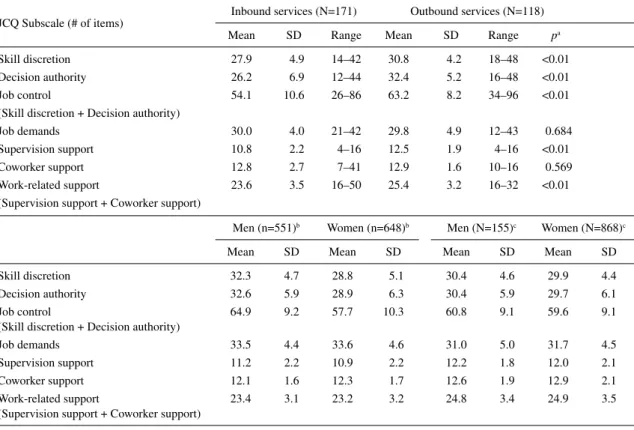
Ratings for psychosocial factors differed significantly between the inbound and outbound operators (Table 3). Outbound operators significantly outscored inbound oper-ators in skill discretion, decision authority, job control, supervision support, and work-related support. In con-trast, inbound operators scored slightly higher in job demands. Thus, outbound operators reported high job
control and low work demands in this study. Ratings on C-JCQ for the psychosocial factors of outbound workers were compared with those obtained from the survey of Taiwanese workers conducted by Cheng et al16). Table 3 clearly shows that outbound operators scored slightly lower than male operators in skill discretion, decision authority, job control, and job demands. However, out-bound operators scored slightly higher than male telecom-munication company call center operators in skill discre-tion, decision authority, job control. Conversely, out-bound operators displayed low job demands and high
Industrial Health 2010, 48, 349–356
Table 1. Comparison of mean and percentage distribution of demographic characteristics and health complaints for inbound and outbound services
Table 2. Rankings of major job stressors and reporting percentages of study subjects for inbound operators (n=171) and outbound operators (n=118)
work-related support8).
Association between perceived levels of job stress and health complaints
Table 4 summarizes the results of the multivariate logistic regression analyses. Subjects who reported “always” or “frequently” feeling very stressed at work were classified as the High-Stress group, those who reported only “sometimes” feeling very stressed were classed as the Intermediate-Stress group, and those who reported “never” or “seldom” feeling very stressed were assigned to the Low-Stress group. Since the prevalence of high stress did not differ significantly between inbound and outbound services (p=0.247), these two service groups were combined for the purposes of this investiga-tion. Compared with the Low-Stress group, The High-Stress group had significantly increased risks of various health problems. Table 3 showed that higher levels of job stress were associated with “eye strain” (odds ratio [OR]=2.50, 95%CI=1.07–5.87), “tinnitus” (OR=4.53, 95%CI=2.05–9.98), “hoarse or sore throat” (OR=2.96, 95%CI=1.16–7.54), “chronic cough with phlegm” (OR=2.13, 95%CI=1.02–4.44), “chest tightness” (OR=3.85,
comfort” (OR=6.46, 95%CI=2.27–18.33).
Discussion
Health complaints and job stress survey
Call center workers displayed a significantly raised prevalence of “musculoskeletal discomfort” (inbound: 88% vs. outbound: 85%), as listed in Table 1. The preva-lence of “musculoskeletal discomfort” was compared with data obtained by the Institute of Occupational Safety and Health of Taiwan17)for all industries, as part of its peri-odic survey of physical discomfort. The analytical results indicated that the prevalence of “musculoskeletal dis-comfort” for workers in this call center significantly exceeded the industry average (63.3% for “muscu-loskeletal discomfort”). Self-reported “muscu“muscu-loskeletal discomfort” is associated with activities such as heavy physical work, and with psychosocial and environmental stress. In call center work, the main influences besides non-dynamic sitting are psychosocial factors5). In this investigation, 33.5% of outbound service call center work-ers and 27.1% of inbound service call center workwork-ers were classified as suffering high stress, considerably higher Table 3. Distributions of the C-JCQ scores of the study sample vs. those of Taiwanese workers in general
of male workers and 6.5% of female workers18). Furthermore, this study observed that inbound services may be associated with higher prevalence of “muscu-loskeletal discomfort” than outbound services. Differences in task loads should be compared between inbound and outbound services. Unfortunately, this study did not use self-reporting or observation to identify dif-ferences, for example differences related to mental, emo-tional, psychosocial, and environmental loads.
Nearly one-third of the workers (inbound: 27.1% vs. outbound: 33.5%) were classified as belonging to the high stress group, significantly lower than in the study of DiTecco et al.6) (57%). One explanation for this phe-nomenon was that inbound service call-center workers handled between 120 and 150 calls daily, each averaging 120–150 s, representing a reasonably manageable work-load. Supervisors paid attention to workers who under-performed the office average but did not penalize them. Furthermore, the finding that outbound services were
associated with higher job stress than inbound services was consistent with the finding of Ferreira and Saldiva5) that outbound services faced greater productivity pressure and supervisor-related conflicts than did inbound services. The association between high levels of job stress and health complaints in this study suggests that call center work is characterized by job stress, in turn possibly result-ing in high levels of health problems. Several studies have identified job stress as an important risk factor for health-related quality of life19, 20). Consistent with previ-ous studies, dose-response associations were observed between levels of job stress and increased risks of multi-ple self-reported health complaints in bank call center workers.
Comparison of job stressors
This study identified differences in sources of job stres-sors between call center workers providing inbound and outbound services (Table 2). Notably, most of the study
Industrial Health 2010, 48, 349–356
Table 4. Multivariable odds ratio (OR) with 95% confidence intervals (CI) for health complaints and stress levels among call center operators
subjects, namely 54.0% for inbound services and 54.4% for outbound services, considered “having to deal with difficult customers” to be the top job stressor. This find-ing differed from that of DiTecco et al.6), namely that the main job stressor was “difficulty in providing good cus-tomer service while simultaneously meeting time targets”. This study and that of DiTecco et al.6) examined all the main job stressors, and operators of both studies report-ed similar specific stressors contributing to their feelings of job stress, for example “difficulty in providing good customer service while simultaneously meeting time tar-gets”, “system monitoring of operator call activities”, and “being monitored by a manager without being informed”. However, this investigation asked workers to rank the main stressors, which was a forced choice task. Possibly, subjects would have preferred to indicate no, or just one or two major stressors; in which case the forced choice task would lead to unrealistically high percentages and overestimations of the importance of stressors. Additionally, information on minor stressors, with poten-tial to differentiate between groups, is lost in this situa-tion.
Study limitations and future research
Various improvements could refine the current investi-gation. For example, the investigation focuses on a sin-gle banking call center, it would be interesting to analyze call centers of firms engaged in different businesses. Additionally, both self-recording and observation meth-ods could be used to identify differences, such as those involving mental, emotional, psychosocial, and environ-mental load. Possible (semi-) quantitative parameters could also be obtained, including call number and dura-tion, number of conflicting calls, number of calls catego-rized according to difficulty, and computer workstation parameters. A further limitation of this study is that the sample size of subjects (171 inbound and 118 outbound operators) could be considered too small to clearly iden-tify relationships between stress and health complaints, preventing the generalization of the results to all studies involving call center tasks, however, they represent almost all workers in current activity in those departments, thus helping avoid selection bias5). Another limitation of this investigation is that health complaints were self-reported and based on symptoms rather than on detailed medical examinations. Meanwhile, the study adopted a transver-sal design, and data on stress and medical conditions were collected simultaneously. Thus it is impossible to con-clude to a causal relationship between stress and medical conditions subjects with bad medical conditions are pos-sible to describe a high level of perceived stress.
Conclusion
This study identified “musculoskeletal discomfort”, “eye strain”, and “hoarse or sore throat” as the most prevalent health complaints at a bank call center. Additionally, call center workers providing outbound vices were more likely than those providing inbound ser-vices to report frequently or always feeling very stressed at work. Furthermore, “having to deal with difficult cus-tomers” was the most frequent job stressor facing opera-tors. Finally, the association between perceived job stress and health complaints indicated that workers who per-ceived high job stress had significantly increased risks of multiple health problems.
References
1) Norling P (2001) Call centre companies and new pat-terns of organization. Economic and Industrial Democracy 22, 155–68.
2) Rocha LE, Glina DMR, Marinho MF, Nakasato D (2005) Risk factors for musculoskeletal symptoms among call center operators of a bank in São Paulo, Brazil. Ind Health 43, 637–46.
3) Sprigg CA, Smith PR, Jackson PR (2003) Psychosocial risk factors in call centers: an evaluation of work design and well-being. Health and Safety Executive, research report 169.
4) Smith MJ, Bayehi AD (2003) Do ergonomics improve-ments increase computer workers’ productivity?: an intervention study in a call centre. Ergonomics 46, 3–18. 5) Ferreira Jr. M, Saldiva PHN (2002) Computer-telephone interactive tasks: predictors of musculoskeletal disorders according to work analysis and workers’ perception. Appl Ergon 33, 147–53.
6) DiTecco D, Cwitco G, Arsenault A, Andre M (1992) Operator stress and monitoring practices. Appl Ergon
23, 29–34.
7) Smith MJ, Carayon P, Sanders KJ, Lim SY, LeGrande D (1992) Employee stress and health complaints in jobs with and without electronic performance monitoring. Appl Ergon 23, 17–27.
8) Lin YH, Chen CY, Lu SY (2008) Physical discomfort and psychosocial job stress among male and female operators at telecommunication call centers in Taiwan. Appl Ergon 40, 561–8.
9) Charbotel B, Croidieu S, Vohito M, Guerin AC, Renaud L, Jaussaud J, Bourboul C, Imbard I, Ardiet D, Bergeret A (2009) Working conditions in call-centers, the impact on employee health: a transversal study. Part II. Int Arch Occup Environ Health 82, 747–56.
10) Croidieu S, Charbotel B, Vohito M, Renaud L, Jaussaud J, Bourboul C, Ardiet D, Imbard I, Guerin AC, Bergeret A (2008) Call-handlers’ working conditions and their
(2007) Work characteristics, musculoskeletal disorders, and the mediating role of psychological strain: a study of call center employees. J Appl Psychol 92, 1456–66. 12) Burton WN, Conti DJ, Chen CY, Schultz AB, Edington, DW (1999) The role of health risk factors and disease on worker productivity. J Occup Environ Med 41, 863–77.
13) Burton WN, Conti DJ, Chen CY, Schultz AB, Edington DW (2001) The impact of allergies and allergy treat-ment on worker productivity. J Occup Environ Med 43, 64–71.
14) Halford V, Cohen HH (2003) Technology use and psy-chosocial factors in the self-reporting of musculoskele-tal disorder symptoms in call center workers. J Safety Res 34, 167–73.
15) Karasek R, Brisson C, Kawakami N, Houtman I, Bongers P, Amick B (1998) The Job Content Questionnaire (JCQ): an instrument for internationally comparative assessments of psychosocial job
character-16) Cheng YW, Luh WM, Guo YL (2003) Reliability and validity of the Chinese version of the job content ques-tionnaire in Taiwanese workers. Int J Behav Med 10, 15–30.
17) Institute of Occupational Safety and Health (IOSH) of Taiwan (2001) Survey of employees’ perceptions of safety and health in the work environment in 2001 Taiwan (IOSH90-H304). IOSH, Taipei.
18) Cheng YW, Guo YL, Yeh WY (2001) A national sur-vey of psychosocial job stressors and their implications for health among working people in Taiwan. Int Arch Occup Environ Health 74, 495–504.
19) Lerner D, Levine S, Malspeis S, D’Agostino R (1994) Job strain and health-related quality of life in a nation-al sample. Am J Public Henation-alth 84, 1580–5.
20) Amick BC, Kawachi I, Coakley EH, Lerner D, Levine S, Colditz GA (1998) Relationship of job strain and iso-strain to health status in a cohort of women in the United States. Scand J Work Environ Health 24, 54–61.