Exploring Teacher Beliefs about English
Talented Programs
in Senior High School: An Application of
Repertory Grid Technique
Christine Chifen Tseng
National Taichung University of Science and Technology [email protected]
Abstract
Teacher beliefs have been proven to influence classroom practices. However, they cannot be inferred from direct classroom observation or by checking an inventory of pedagogical beliefs. The present study aimed to explore an EFL teacher’s beliefs about English talented program implementation by applying the repertory grid technique, a qualitative research method which has its roots in Kelly’s Personal Construct Theory. Through the repertory grid technique interviews and with the help of Principal Component Analysis method from SPSS package, six beliefs of the participant’s were extracted about this innovative implementation. Further examination of these beliefs revealed that certain societal and cultural factors have great influence on teacher beliefs and that some important curriculum modifications for gifted and talented learners were not given due attention. It is suggested that social and cultural factors should be taken into consideration when developing such talented programs and when providing in-service teacher training so as to enhance the efficacy of the programs.
Key Words: English talented programs, teacher beliefs, the repertory grid technique
INTRODUCTION
English talented programs in senior high schools in Taiwan were first established in 2003 and have been implemented since then. To help school administrators and teachers develop a full-fledged English talented program, I conducted a research by applying the Delphi technique and delineated a set of principles for English talented program development and a set of criteria for evaluation of such programs (Tseng, 2008). Twenty experts, ten senior high school teachers and ten college professors were invited as experts in my study. The results showed that senior high school teachers and college professors hold different views on certain principles concerning English talented curriculum development at senior high school level. Such divergence of opinions suggests discrepancy between practical and theoretical concerns, with high school teachers’ opinions conveying more practical concerns while college professors’ more theoretical concerns. It further implies that high school teachers may hold beliefs and conceptions that do not fully comply with the spirit of gifted education, which may contribute to a compromised talented program, or worse, a program which is not worthy of the name.
English talented programs are an innovative implementation in senior high school curriculum. As Munby (1984) pointed out, “if we want to understand how a teacher might deal with an innovation, then we must first understand his or her beliefs and principles” (p. 28) because “a teacher’s unique beliefs and principles can have influence at the interface upon a designed curriculum” (Munby, 1983, p. 4). Therefore, exploration of teacher beliefs on English talented programs will provide a better understanding of the implementation of such 2
programs. Moreover, teacher beliefs repertoire may provide suggestions for teacher in-service training programs to advocate empowering beliefs and modify detrimental ones so as to enhance quality and efficacy of such programs.
LITERATURE REVIEW
Characteristics of BeliefsAjzen and Fishbein (1980) viewed beliefs as “underlying a person’s attitudes and subjective norms” and contended that beliefs “ultimately determine intentions and behavior” (p. 62). Rokeach (1980) saw a belief as “any simple proposition, conscious or unconscious, inferred from what a person says or does, capable of being preceded by the phrase ‘I believe that…’” (p. 113). He also pointed out that a belief has cognitive, affective and behavioral components and that the kind of action a belief leads to is dictated by the content of the belief. Nespor (1987), following Abelson (1979), delineated four structural features of beliefs that distinguish them from knowledge. The first feature is existential presumption. Belief systems frequently contain propositions or assumptions about the existence or nonexistence of entities. Second, beliefs manifest
alternaltivity, which “refers to conceptualizations of ideal situations
different significantly from present realities” (p. 319). Third, belief systems rely much more heavily on affective and evaluative components than knowledge systems. Fourth, unlike knowledge systems which are composed of information stored in semantic networks, beliefs are composed of “episodically-stored material derived from personal experience or from cultural or institutional
sources of knowledge transmission” (p. 320). In a similar vein, Barcelos and Kalaja (2003) characterized beliefs as dynamic and
emergent, socially constructed and contextually situated, experiential, mediatory, and paradoxical and contradictory.
Put precisely, people may hold distinct, sometimes even contradictory beliefs toward the same event, entity, or situation, according to their individual social and cultural backgrounds, personal experiences and how they evaluate the particular event, entity or situation. Moreover, people’s behaviors are a manifestation of a collection of their beliefs, which, in Rokeach’s (1980) term, “dictate” (p. 114)1 their action.
Exploration of Teacher Beliefs
Teacher beliefs refer to teachers’ educational beliefs related to the situation where their teaching takes place (Pajares, 1992). Clark and Peterson (1986) defined teacher beliefs as “the rich store of knowledge that teachers have that affects their planning and their interactive thoughts and decisions” (p. 258). Tabachnick and Zeichner (1984), incorporating teachers’ teaching context, defined teacher beliefs as “the ways in which teachers think about their work (e.g., purposes, goals, conceptions of children, curriculum) and the ways in which they give meaning to these beliefs by their behavior in classroom” (p. 28). Clark (1988) defined teachers’ beliefs as “preconceptions and implicit theories” (p. 5), which suggests that these beliefs and thoughts are unclearly explicated or difficult to systematize by the teachers. Kagan (1992) defined teacher beliefs as
1 “The kind of action it leads to is dictated strictly by the content of the belief” (Rokeach, 1980, p. 114).
“tacit, often unconsciously held assumptions about students, classrooms and academic material to be taught” (p. 60). Shavelson and Stern (1981) suggested that teachers’ theories and beliefs serve as a filter through which a host of instructional judgments and decisions are made. Put together, teacher beliefs can thus be defined as a system
of thoughts, conceptions and assumptions held by teachers, consciously or unconsciously, concerning what takes place in the classroom.
A number of studies have explored teacher beliefs about different subfields of the profession (Andrews, 2003; Cabaroglu & Roberts, 2000; Chang, 2000; Flores, 2001; Johnson, 1994; Lai, 2004; Liao, 2003; Lin, 2002; Munby, 1982, 1983, 1984; Nespor, 1985; Nien, 2002; Olson, 1981) and have made the following findings. First of all, teacher beliefs cannot be inferred directly from classroom practices. For one thing, one practice may derive from different beliefs or one belief may result in different teaching practices. Moreover, teachers are not necessarily aware of their own beliefs, nor do they always possess language with which to describe and label their beliefs (Kagan, 1992). Second, teacher beliefs play an important role in their teaching practice (Borg, 2005; Calderhead, 1996; Clark & Peterson, 1986; Kagan, 1992; Pajares, 1992; Richards, 1998). As Nespor (1987) has put it, “teachers’ beliefs play a major role in defining teaching tasks and organizing the knowledge and information relevant to those tasks” (p. 324). Barcelos and Kalaja (2003) also pointed out that “beliefs exert a strong influence on how teachers plan their lessons” (p. 236). Richards (1998) contended that a primary source of teachers’ classroom practices is their belief systems. Third, teachers’ beliefs are shaped by their experiences as students, called “apprenticeship of
observation” by Lortie (1975, p. 61). Fourth, teachers’ beliefs are not
static; instead, they are flexible and can be modified and changed by prior and posterior experiences of all sorts; some beliefs are more incontrovertible than others and the earlier a belief is incorporated into the belief structure, the more difficult it is to alter.
Differentiated Curriculums for Language Talented Students
The U.S. Office of Education’s Office of the Gifted and Talented (1976) defined differentiated education or services as “process of instruction which is capable of being integrated into the school program and is adaptable to varying levels of individual learning response in the education of the gifted and talented” (U.S. Office of Education [USOE], 1976, p. 18665, as cited in Maker, 1982, p. 4). Thus, a differentiated curriculum for gifted and talented students “should provide more advanced, rigorous curriculum experiences to satisfy intellectual needs, which are not addressed in regular classes” (Feldhusen & Jarwan, 2000, p. 278). Implementation of differentiated curriculums is to help enhance the learning and development of gifted and talented students so that they can excel themselves in the fields where their specific gifts and talents will shine (Ho, 1998), and this is the goal and the very spirit of gifted education.
Maker (1982) highlighted qualitative differences of a differentiated curriculum and proposed modifications in four areas to construct a differentiated curriculum for gifted and talented students. Table 1 summarizes delineation of the modifications, including delimitations and characteristics pertaining to each area. Following Maker’s (1982) emphasis on qualitative modifications, Maker and 6
Table 1
Maker’s (1982) Modifications for Differentiated Curriculums
Areas of Modification Delimitation Characteristic
Content What is taught, including ideas, concepts and facts presented to students
abstractness, complexity, variety, study of methods
Process How teachers teach and involve the ways material is presented to students, questions are asked to them, and mental or physical activities expected from them
higher levels of thinking, open-endedness,
discovery, evidence of reasoning, freedom of choice, faster pace, a wider variety of procedures
Product Ideas, research reports, compositions, plays, displays, anything produced by students
profession-type,
addressing real problems to real audience, with identified purposes and unique transformation of information
Learning Environment Classrooms, labs, libraries, any place where learning activities are arranged student-centered, independence-encouraging, open, accepting, complex, highly mobile
Nielson (1995) further pointed out that modifications made in a differentiated curriculum “must build upon and extend the characteristics (both present and future) that make the children different from other students” (p. 3). Accordingly, in developing language talented programs or English talented programs, it is necessary that curriculum modifications address students’ talents and potentials in language learning. Tseng (2008) summarized some outstanding abilities and traits demonstrated by language talented learners as Table 2 shows. Among the fields of excellence, precocity
in linguistic development and rich imagination and creativity are
more often observed in language talented students. Therefore, outstanding performances pertaining to these two fields of excellence may serve as indicators of language talentedness. Meanwhile, they also indicate the areas where modifications should be made in a curriculum for language talented students.
Table 2
Traits of the Language Talented
Fields of Excellence Specific Outstanding Performance
Precocity in linguistic development 1. A large and advanced vocabulary; 2. Early beginning and a sustained love of
reading;
3. Early beginning of writing; 4. Knowledge of language structure.
Rich imagination and creativity 1. Demonstrating high level of thinking (critical thinking and productive thinking);
2. Showing a sense of humor; 3. Being imaginative and passionate; 4. Enjoying talking about literature; 5. Ability to express complex thoughts.
Acute sensitivity to life 1. Observant about human behaviors; 2. Sensitive to other’s feelings, emotions and
interpersonal relations; 3. Sensitive to life experiences.
Positive attitude toward challenge 1. Enjoying challenges; 2. Enjoying intellectual stimuli; 3. Being focused in literal world. Source: Tseng (2008, p. 35).
While Maker (1982) stressed qualitative modifications of a differentiated curriculum, VanTassel-Baska (1994b) on the other hand focused mainly on what to incorporate into a language program, with an emphasis on content modification. She proposed seven 8
components of a language program for gifted students, which act as helpful and useful guidelines for developing programs like English talented programs (Tseng, 2008). They include (1) reading and literature, (2) bibliotherapy, (3) exploration of library, (4) creative writing, (5) linguistics, (6) oral communication, and (7) foreign language learning. Among them, foreign language learning can be modified into “second foreign language learning” for students enrolled in an English talented program (Tseng, 2008, p. 55).
Taking into account the most often observed outstanding performances in the fields of linguistic development and imagination and creativity, Maker’s (1982) qualitative modifications and VanTassel-Baska’s (1994b) components, in my doctoral dissertation (Tseng, 2008), I made out principles for English talented program development and finalized them by conducting Delphi surveys into 119 principles, 29 of them related to classroom practices, among which 21 are of primary importance, three of secondary importance and five of tertiary importance (See Appendix A). These principles serve as guidelines in making qualitative modifications to curriculums for English talented students. As mentioned previously, I also found divergent views held between the two groups of experts, with teachers paying more attention to practical concerns while college professors more on theoretical concerns. Teachers’ practical concerns include limited class hours, parents’ expectations, and pressure from college entrance exams in particular. When too much teacher attention is paid to these matters, it is very likely that talented programs fail to comply with the spirit of gifted education—to help students excel themselves in the fields where their specific gifts and talents will shine. Thus, it is advisable to explore teachers’ beliefs about English talented program 9
implementation, which will shed light on how teachers deem and understand English talented programs and whether the programs are implemented with efficacy.
RESEARCH DESIGN
Method: The Repertory Grid Technique
The study reported in this paper applied the Repertory Grid Technique (RGT), categorized as a verbal commentary approach2 to beliefs by Borg (2006). With its constructivist orientation, this method is portrayed by Pope and Denicolo (1993) “not as a scientific tool but one that has scientific and artistic aspects to its execution” (p. 531). RGT evolved from Kelly’s (1955) Personal Construct Theory, which “holds that people construct their own realities in idiosyncratic ways and that the constructions consist of a finite number of dichotomous constructs which are employed to order, process and give meaning to events” (Munby, 1983, p. 15). It has been frequently used in many subfields of education, such as science education, mathematics education, music education and teaching writing, to explore teachers’ and students’ beliefs (K. K. Chen, 2005; Y. F. Chen, 2001; Cheng, 1999; Huang, 2007; Kuo, 2006; Lee, 2002; Liu, 1999; Munby, 1982, 1983, 1984, 1986; Nespor, 1985; Olson, 1981), but not as often in the field of TESOL (Borg, 2006).
2 Borg (2006) classifies methods to explore teacher cognition and beliefs into four main groups: (1) self-report instruments, including methods like questionnaires, scenario rating and tests; (2) verbal commentaries, such as types of interviews, the repertory grid technique, stimulated recall, and think-aloud protocols; (3) observation, unstructured and structured ones; (4) reflective writing, such as journal writing, biographical accounts, retrospective accounts and concept maps.
Beail (1985) summarized RGT into three main components and five stages. The three components are (1) elements, to “define the area of construing to be investigated;” (2) constructs, “ways that a person groups and differentiates between the elements;” (3) a linking
mechanism “which shows how each element is judged on each
construct” (p. 2). The five stages of the whole procedure are (1)
eliciting elements; (2) eliciting constructs; (3) completing the grid or scaling; (4) analysis and (5) interpretation. There are two principles
for selecting the elements. First, “the elements must be within the range of convenience of the constructs to be used” (Fransella & Bannister, 1977, p. 13). Second, “the elements must be representative of the pool from which they are drawn” (Fransella & Bannister, 1977, p. 13). There is no perfect number for elements or constructs, though the greater the number, the greater the likelihood of being representativeness. In practice, Pope and Keen (1981) considered eight to 15 elements as providing a useful basis for eliciting a reasonable grid; yet Alban-Meteaf (1997) and Cohen, Manion, and Morrison (2000) considered optimal numbers to range from 10 to 25. Once the elements are in place, elicitation of constructs can begin with application of the triadic method (Pope & Denicolo, 1993). With this method, the participant is asked to state how two of the elements are alike and thus different from the third one. The description of similarity is called the likeness pole, and the description of difference is the contrast pole (Corporaal, 1991). Both poles form constructs, on which each element will be sorted later on. It is vital that the elements and the constructs be stated in the participant’s language, not the researcher’s (Munby, 1983). The triad may go on until the participant
thinks the list of constructs is exhausted (Pope & Keen, 1981). Thus a grid is set up for subsequent element sorting.
Three mostly applied ways of sorting the elements are
dichotomizing (tick-cross), rank ordering, and rating scales. Among
them, rating offers the participant greater latitude in distinguishing between elements than dichotomizing, and it is not as demanding as rank ordering in terms of the degree of differentiation. Each element will be assigned a rating which reflects its position on a particular construct (Beail, 1985; Pope & Keen, 1981). When each cell in the grid is assigned a rating, the raw grid is thus completed and ready for further statistical analysis. A principal component factor analysis of the grid reveals the relationships among constructs, which serves as the basis for a second, more in-depth interview with the participant. The second interview is to identify beliefs and principles underlying these factors or relationships under the co-efforts of the researcher and the participant (Munby, 1982, 1983). Active participation of the participant forms one important feature of RGT. It is advisable to take a flexible attitude when the participant feels it necessary to make adjustment to elements, constructs or categorization of constructs (Fransella & Bannister, 1977; Pope & Keen, 1981). Participants’ perspectives make belief statements meaningful and also serve as a way to triangulate the data and increase validity (Huang, 2007; Pan, 2004).
Fransella and Bannister (1977) considered that the grid was “best looked on as a particular form of structured interview” (p. 4). Olson (1981) however argued that RGT took the form of an unstructured interview which was developed “on the spot, unique to the individual” (p. 5). Therefore, RGT has “both an air of precision 12
and research respectability—the data seems to accrue the advantages of both qualitative and quantitative approaches to understanding human being” (Pope & Denicolo, 1993, p. 534). It is thus “a practically useful, contextually apt and theoretically sound approach” (Munby, 1983, p. 51) to delving into how the participant construes the area of interest under investigation.
Participant
The participant teacher Ya-Ting (a pseudonym) is an English teacher in a public senior high school in central Taiwan. Ya-Ting has twenty years of teaching experience, three years at junior high level, and 17 years at senior high level. She graduated from a teacher training university, majoring in English, and got her Master’s degree in linguistics. She had three years of teaching English talented students and two years’ experience as coordinator of English teachers of her school. She is an expert teacher with solid professional training and ample teaching experience.
Procedure
The whole procedure was composed of three stages: (1) elements and constructs elicitation, (2) rating and data processing, and (3) labeling and in-depth interview.
Elements and constructs elicitation. Before the elicitation
began, I first explained to Ya-Ting the theoretical basis of the Repertory Grid Technique and summarized for her one study exploring Chinese teachers’ beliefs about teaching L1 writing (Huang, 2007). Then I began the elicitation by asking Ya-Ting to describe how she conducted an English class for English talented students,
including all the activities that she could think of related to classroom teaching, pre-class, in-class and after-class. As Ya-Ting was describing her teaching activities, I wrote down each activity on a piece of card in Chinese, which formed the elements of the grid. Elicitation of elements went on until Ya-Ting felt the list included most, if not all, of her teaching activities. All the elements elicited were further confirmed by Ya-Ting.
To elicit constructs, I picked three cards from among the pile and asked Ya-Ting to pin-point what quality is shared by two of the three activities and the quality which differentiates them from the third. Then I wrote down this quality and its contrast quality on two separate cards, which formed two constructs. Then I chose another three cards and repeated the procedure and thus had another two constructs. The construct elicitation went on until Ya-Ting thought the list was complete. Then Ya-Ting was asked to go over the constructs to see if there was any one of them that she wanted to delete or revise. The confirmed elements and constructs were to be made into a grid for later rating.
Rating and data processing. A matrix (or grid) of Ya-Ting’s
elements and constructs was developed after the first interview. Then the grid was emailed to Ya-Ting for rating. A five-point Likert scale was applied, with 1 indicating “very low degree of relatedness” and 5 indicating “highly related” between elements and constructs. Once the rating was finished and emailed back to me, the grid data were analyzed with the help of Exploratory Factor Analysis from the SPSS package, which would yield a rotated component matrix via the application of Principal Components as the extraction method and Varimax with Kaiser Normalization as the rotation method (Munby, 14
1982, 1983); the matrix would show loading of each construct under each component; each construct goes to the component group (i.e., factor) where this very construct bears the highest loading. Then I labeled each component group. The labeling was later to be confirmed by Ya-Ting in a follow-up interview.
Belief extraction and in-depth interview. In this in-depth
interview, Ya-Ting was to confirm the labeling (i.e., meta-construct). For each confirmed meta-construct, explication was provided by Ya-Ting to further clarify how this specific meta-construct was applied to her implementation of an English talented program. Meanwhile, Ya-Ting could move the constructs to the component group where she felt it better described her classroom practice. To do so, she needed to give explanation to justify the change.
Data Analysis
The grid data were analyzed with the help of Exploratory Factor Analysis from the SPSS package. Initial Eigenvalue over 1 was the criterion for deciding the number of components (or factors) extracted. With the application of Varimax with Kaiser Normalization as the rotation method, a rotated component matrix was produced. As Varimax is the rotation method used, it assumes that the components are orthogonal. Ideally, all the components are orthogonal while constructs that fall in the same component are correlated.
RESULTS
Ya-Ting’s Elements and Constructs
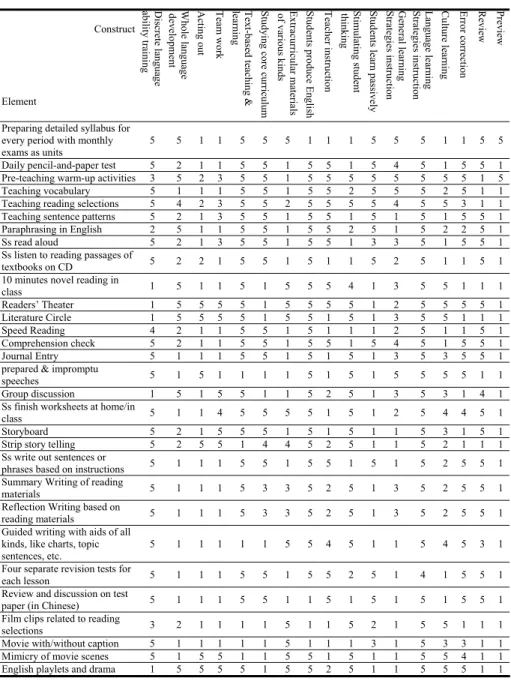
A total of 31 elements were elicited from Ya-Ting. These were the activities she employed before, during and after the class. At the beginning of each semester, Ya-Ting makes it a point to make up detailed syllabi for every period of class, including what activities to do for how long, and what words, phrases and grammar points to teach. She considers detailed syllabi a good way to control class time well, which helps to render more effective and efficient teaching. While making class activities versatile, Ya-Ting also places great stress on teaching the core curriculum. Activities such as giving daily pencil-and-paper tests, teaching vocabulary, sentence patterns, reading selections, listening to reading passages of textbooks on CDs, preparing four separate tests for each lesson, and reviewing test papers are all directed toward solid learning of the core curriculum. When students are engaged in these activities, they learn English mostly as a subject.
Other activities, on the other hand, engage students more holistically. They would have to listen, respond, comprehend, write, and sometimes act it out in English to accomplish tasks assigned to them. In doing so, they learn English as a language for communication. Activities such as Readers’ Theater, Literature Circle, Journal Entry, public speaking, panel discussion, storyboard, strip story telling, summary writing and reflective writing, movie and film clips appreciation, mimicry of movie scenes, and drama performance all require students to engage their visual, audio, and hands-on channels of learning. These are activities where English serves as a 16
means of learning, not the focus of learning. To successfully accomplish tasks, students would have to use not only their knowledge about English, but also their world knowledge, creativity, and imagination.
From these 31 elements, 17 constructs were elicited by applying the triad method and were subsequently confirmed by Ya-Ting. The elements and constructs along with the ratings assigned by Ya-Ting are shown in Table 3. Appendix B presents the inter-correlation matrix (Pearson’s r) for the constructs.
Extraction of Meta-Constructs
Table 4 presents the five extracted components with initial eigenvalues over one. The total variance explained is shown in Appendix C. For each component group, a meta-construct would be extracted, which becomes one of Ya-Ting’s beliefs concerning implementing English talented programs. As Table 4 shows, seven constructs go to the first component group, four constructs go to component group 3, and two constructs go to component groups 2, 4 and 5 respectively. Two things about this matrix are worthy of note. First, the highest loadings of C4 and C13, not reaching .5, are much lower than those of the other constructs. Second, as far as Component 1 is concerned, C3 and C4 are highly correlated but C4 does not fall into this group; on the other hand, C3 and C5 are not loadings of C4 and C13, not reaching .5, are much lower than those of the other constructs. Second, as far as Component 1 is concerned, C3 and C4 are highly correlated but C4 does not fall into this group; on the other hand, C3 and C5 are not significantly correlated, yet they fall into the same component group. It seemed another component group was
Table 3 Ya-Ting’s Raw Grid
Construct Element Di scr ete la ng u d evelop men t age ab ili ty tr aini ng Wh ol e langu ag e Ac ti ng o ut Team wor k T ext-ba se d te ach ing & lear ning St udy ing core curricul um E xtra cur ric ular ma ter ial s of va ri ou s ki nd s Stu de nts pro du ce E ngl is h Teacher ins tru ction St imul at ing st ud en t thi nki ng St ud ent s l earn pass ivel y Ge nera l le arn ing St rat eg ies ins tru ction St rat eg ies ins tru ction L ang ua ge l ear ni ng Cu ltu re learn ing Error c orrec tion Revie w Previe w
Preparing detailed syllabus for every period with monthly
exams as units 5 5 1 1 5 5 5 1 1 1 5 5 5 1 1 5 5
Daily pencil-and-paper test 5 2 1 1 5 5 1 5 5 1 5 4 5 1 5 5 1
Pre-teaching warm-up activities 3 5 2 3 5 5 1 5 5 5 5 5 5 5 5 1 5
Teaching vocabulary 5 1 1 1 5 5 1 5 5 2 5 5 5 2 5 1 1
Teaching reading selections 5 4 2 3 5 5 2 5 5 5 5 4 5 5 3 1 1
Teaching sentence patterns 5 2 1 3 5 5 1 5 5 1 5 1 5 1 5 5 1
Paraphrasing in English 2 5 1 1 5 5 1 5 5 2 5 1 5 2 2 5 1
Ss read aloud 5 2 1 3 5 5 1 5 5 1 3 3 5 1 5 5 1
Ss listen to reading passages of
textbooks on CD 5 2 2 1 5 5 1 5 1 1 5 2 5 1 1 5 1
10 minutes novel reading in
class 1 5 1 1 5 1 5 5 5 4 1 3 5 5 1 1 1 Readers’ Theater 1 5 5 5 5 1 5 5 5 5 1 2 5 5 5 5 1 Literature Circle 1 5 5 5 5 1 5 5 1 5 1 3 5 5 1 1 1 Speed Reading 4 2 1 1 5 5 1 5 1 1 1 2 5 1 1 5 1 Comprehension check 5 2 1 1 5 5 1 5 5 1 5 4 5 1 5 5 1 Journal Entry 5 1 1 1 5 5 1 5 1 5 1 3 5 3 5 5 1
prepared & impromptu
speeches 5 1 5 1 1 1 1 5 1 5 1 5 5 5 5 1 1
Group discussion 1 5 1 5 5 1 1 5 2 5 1 3 5 3 1 4 1
Ss finish worksheets at home/in
class 5 1 1 4 5 5 5 5 1 5 1 2 5 4 4 5 1
Storyboard 5 2 1 5 5 5 1 5 1 5 1 1 5 3 1 5 1
Strip story telling 5 2 5 5 1 4 4 5 2 5 1 1 5 2 1 1 1
Ss write out sentences or
phrases based on instructions 5 1 1 1 5 5 1 5 5 1 5 1 5 2 5 5 1
Summary Writing of reading
materials 5 1 1 1 5 3 3 5 2 5 1 3 5 2 5 5 1
Reflection Writing based on
reading materials 5 1 1 1 5 3 3 5 2 5 1 3 5 2 5 5 1
Guided writing with aids of all kinds, like charts, topic
sentences, etc. 5 1 1 1 1 1 5 5 4 5 1 1 5 4 5 3 1
Four separate revision tests for
each lesson 5 1 1 1 5 5 1 5 5 2 5 1 4 1 5 5 1
Review and discussion on test
paper (in Chinese) 5 1 1 1 5 5 1 1 5 1 5 1 5 1 5 5 1
Film clips related to reading
selections 3 2 1 1 1 1 5 1 1 5 2 1 5 5 1 1 1
Movie with/without caption 5 1 1 1 1 1 5 1 1 1 3 1 5 3 3 1 1
Mimicry of movie scenes 5 1 5 5 1 1 5 5 1 5 1 1 5 5 4 1 1
English playlets and drama 1 5 5 5 5 1 5 5 2 5 1 1 5 5 5 1 1
Table 4
Rotated Component Matrix from Ya-Ting’s Raw Grid: Five Components*
Component Construct
1 2 3 4 5
C1: Discrete language ability training .329 -.861 -.009 -.132 .077
C2: Whole language development -.132 .925 .020 .019 .303 C3: Acting out -.652 .170 -.082 .343 -.024 C4: Team work -.318 .436 -.245 .487 -.135
C5: Text-based teaching .689 .434 .194 .300 .195 C6: Studying core curriculum .817 -.182 .179 .015 .237 C7: Extracurricular materials of various kind -.673 .209 -.300 -.238 -.156 C8: Students produce English .096 .037 .152 .885 -.024
C9: Teacher instruction .209 .136 .873 .065 .072 C10: Stimulate student thinking -.636 .099 -.317 .494 .046 C11: Students learn passively .480 -.020 .606 -.398 .288 C12: General learning strategies instruction .047 -.044 .057 .138 .887 C13: Language learning strategies instruction -.114 .043 -.479 .061 .352 C14: Culture learning -.837 .246 -.093 .227 .119 C15: Error correction -.037 -.492 .610 .317 .085
C16: Review .828 -.057 -.026 .097 -.206
C17: Preview .033 .219 -.016 -.325 .739
Note. Extraction Method: Principal Components with Initial Eigenvalue over 1.
Rotation Method: Varimax with Kaiser Normalization. *Rotation converged in 8 iterations.
required to categorize these constructs. Thus, the factor number in processing Principal Component Analysis was set at 6, and another rotated component matrix was yielded as shown in Table 5 with the highest loading of each construct reaching over .5. When presented with the two matrices, Ya-Ting considered it was easier for her to extract meta-constructs based on the matrix in Table 5, which better describes her teaching practice. After a discussion with Ya-Ting in an
Table 5
Rotated Component Matrix from Ya-Ting’s Raw Grid: Six Components*
Component Construct
1 2 3 4 5 6 C1: Discrete language ability training .260 -.188 -.893 .028 .128 -.101 C2: Whole language development -.078 .133 .908 -.094 .328 .027 C3: Acting out -.543 .596 .107 -.064 .057 -.161 C4: Team work -.174 .727 .319 -.256 -.038 -.164 C5: Text-based teaching .756 .093 .438 .201 .143 .058
C6: Studying core curriculum .801 -.119 -.235 .095 .318 -.196
C7: Extracurricular materials of various kind -.700 .010 .190 -.355 -.119 .034 C8: Students produce English .289 .742 .040 .397 -.132 .084 C9: Teacher instruction .221 -.218 .284 .802 .031 -.227 C10: Stimulate student thinking -.507 .660 .064 -.096 -.028 .241 C11: Students learn passively .388 -.523 .023 .359 .406 -.377 C12: General learning strategies instruction .079 .057 -.007 .272 .749 .423 C13: Language learning strategies instruction -.109 -.015 .092 -.162 .090 .780 C14: Culture learning -.757 .392 .274 .043 .047 .196
C15: Error correction .009 .075 -.370 .769 -.015 -.045 C16: Review .822 -.111 -.082 -.041 -.221 -.015
C17: Preview -.010 -.143 .149 -.162 .866 -.073
Note. Extraction Method: Principal Components with number of factor extracted
equal to 6. Rotation Method: Varimax with Kaiser Normalization. *Rotation converged in 11 iterations.
in-depth interview, I revised the categorization in Table 5. The finalized categorization and meta-constructs, also confirmed by Ya-Ting, are shown in Table 6.
Category I was originally composed of five constructs, but a further inspection revealed that C7 and C14 are not as compatible with the other three, which are more related to the learning of the core curriculum. Ya-Ting agreed to this distinction and suggested putting 20
Table 6
Categorization of Ya-Ting’s Beliefs about English Talented Program Implementation
Components/Meta-Constructs Constructs Category I:
Solidifying students’ learning of the core curriculum
- Text-based teaching & learning (C5) - Studying core curriculum (C6) - Review (C16)
Category II:
Cultivating creativity and
communicative abilities in students
- Acting out (C3) - Team work (C4)
- Students produce English (C8) - Stimulate student thinking (C10) Category III:
Training and development of four language skills
- Discrete language ability training (C1) - Whole language development (C2) - Language learning strategies instruction
(C13)a Category IV:
Teacher’s role as a knowledge provider - Teacher instruction (C9) - Error correction (C15) - Students learn passively (C11)b Category V:
Instruction of general learning strategies - General learning strategies instruction (C12) - Preview (C17)
Category VI:
Providing materials of various kinds involving multiple cultures
- Extracurricular materials of various kinds (C7)c
- Culture learning (C14)c
Note. a: Moved from a category of its own; b: Moved from Category II; c: Moved
from Category I to form a category of their own.
these two in a separate group, hence forming Category VI, which stresses the importance of multiple-cultural learning through materials of various kinds. One particular feature about the learning of core curriculum is its test-orientation and relation to the general curriculum for normal students. Ya-Ting mentioned that just because the students are English talented doesn’t mean that they don’t have to learn what normal students learn. They have to take mid-terms, final exams and 21
the entrance exams just as their normal counterparts. Ya-Ting feels that she is held accountable for students’ learning in this regard.
Category II was originally composed of five constructs, but C11 “students learn passively” is apparently incompatible with the other four constructs, which focus on holistic learning and active participation in the part of students. Ya-Ting singled it out and wanted to put it together with C9 “teacher instruction” and C15 “error
correction” in Category IV, which demands more of the teacher’s role
in transmitting knowledge. Thus, C3, C4. C8 and C10 together form Category II, which demands active student participation, including communicating and negotiating with teammates, exercising creativity in performances, etc. Category II manifests learner-centeredness, while Category IV is rather teacher-centered.
Category III originally contained two constructs related to training and development of language ability. Ya-Ting suggested that another construct related to language learning in particular should go to this category, too. Therefore, C13 “language learning strategies
instruction,” which had originally formed a category of its own, was
moved to Category III, forming a meta-construct relating to the training and development of the four language skills. Note that C1 and C2 are contrast poles from a triad, but they are highly correlated (See Appendix B). Such correlation is explicable in terms of language ability development. On the other hand, although C13 is not correlated to the other constructs, it is assigned the highest rating of 5 against almost every element except one as Table 1 shows, which suggests that Ya-Ting emphasizes the importance of language learning strategies and their acquisition. Grouped together, C1, C2 and C13 form a category that focuses on enhancing students’ 22
command of English, but not as much on mastering learning materials and preparing for exams as Category I does.
Category V is related to general learning strategies. Previewing is also a strategy that applies not only to learning English but also to learning of other subjects. When doing previewing, Ya-Ting has in mind to help students build up schemas, thus facilitating subsequent learning, and by doing so, she expects students to internalize this learning strategy and apply it in other learning contexts. English is used as a medium in doing previewing activities. By contrast, in most reviewing activities, English is the subject being reviewed. Because English plays different roles in the activities of previewing and reviewing, these two constructs are placed in different component groups.
Category VI contains C7 and C14, both moved from Category I due to their being not so related to the core curriculum as the other constructs. Multicultural learning is an aspect that Ya-Ting lays much emphasis on, and she introduces students to cultural matters through materials of various kinds, hoping to raise students’ awareness of cultural differences and global thinking. Compared with Category I, Category VI is more related to extending what the core curriculum offers and expanding students’ horizons.
Ya-Ting’s Beliefs about English Talented Program Implementation
The meta-constructs in Table 6 can be taken as the abstract of Ya-Ting’s beliefs about English talented program implementation. Following Rokeach’s (1980) definition of beliefs, we may transform these meta-constructs into six propositions being preceded by the phrase “Ya-Ting believes that ....” Then, we get six beliefs as listed in
Table 7. Put simply, Ya-Ting believes that in implementing an English talented program, as far as classroom practice is concerned, an English teacher, as a knowledge provider both in subject content and in language studies, is to help students get to know how to learn more effectively, further build up four language skills of English, and solidify their learning of the core curriculum. Meanwhile, she also believes that the teacher should enhance students’ creativity, communicative abilities and multiple-culture perception by providing various kinds of teaching materials and activities.
Table 7
Ya-Ting’s Beliefs about English Talented Program Implementation
Belief Statement
Belief A In implementing an English talented program, the teacher is to help solidify students’ learning of the core curriculum.
Belief B In implementing an English talented program, the teacher is to cultivate students’ creativity and communicative abilities.
Belief C In implementing an English talented program, the teacher is to provide students with opportunities for four language skills training and development and help them become autonomous language learners.
Belief D In implementing an English talented program, the teacher is to provide students with knowledge both in subject content and in language studies.
Belief E In implementing an English talented program, the teacher is to give instruction of general learning strategies and help them become autonomous learners.
Belief F In implementing an English talented program, the teacher is to provide various kinds of extracurricular materials to enhance students’ multi-cultural learning.
DISCUSSION
A close examination of Ya-Ting’s beliefs against Tseng’s (2008) principles of primary importance related to classroom practice for English talented programs (See Appendix A) reveals a few points worthy of note. First of all, Ya-Ting makes it a point to solidify students’ learning of the core curriculum (i.e., Belief A). She accelerates the core courses; she also arranges review activities with as many as four quizzes for each lesson of the English textbook to make sure students learn all the important vocabulary items, phrases and grammar points in the textbook. To her, it is of vital importance that her English talented students have a good command of the core curriculum. After all, as she believes, solid learning of the core curriculum is the prerequisite for passing entrance exams for college, which should be given a top priority in the whole curriculum. She also recognizes her role as a knowledge provider who sometimes has to take an active role in lecturing and transmitting knowledge while students learn in a relatively passive way (i.e., Belief D). One advantage of teacher lecturing is that it saves time and thus helps to accelerate coverage of the core course, which in turn reserves more class time for other activities. Therefore, as far as Ya-Ting is concerned, student-centeredness is a matter of degree, not an all-or-none option. In conducting classroom activities, the teacher moves along the spectrum with student-centeredness at one end and teacher-centeredness at the other, depending on the activities and objectives. Ya-Ting’s attention to students’ mastery of the core curriculum and her recognition of teacher’s role in transmitting knowledge attests to the fact that college entrance exams still impose great pressure on 25
teachers, and helping students pass the exams is therefore the top priority, even for teachers teaching English talented students. For teachers to help students pass entrance exams for college has a bearing on social expectations, and to transmit knowledge is a role assigned by the culture. Influence on teacher beliefs from these social and cultural factors is far-reaching and hard to eradicate. It is therefore suggested that they be taken into account in implementing English talented programs so that the teacher may feel more assured in conducting alternative classroom activities.
Second, Ya-Ting recognizes not only the importance of developing students’ four skills of the English language (i.e., Belief C) but also the importance of general learning strategies (i.e., Belief E). Her classroom practices engage students both to learn English as a subject and use English as a language. She believes that as English talented students, her students need to know the language well and use it well. She also instructs students about learning strategies both explicitly and implicitly, either in the way she arranges and conducts classroom activities or in sessions specifically arranged for learning strategies instruction. The ultimate goal of learning strategies instruction is to help students become independent and autonomous learners who can take full responsibility of learning themselves, who can learn independently, know what to learn and how to learn it well.
Third, Ya-Ting places great emphasis on cultivating students’ creative thinking, communicative abilities (i.e., Belief B) and multi-cultural appreciation (i.e., Belief F) by engaging students in a wide variety of activities, like literature circle, storyboard, public speaking, group discussion, and drama performance. It takes a student-centered, independence-encouraging, open, accepting and highly mobile 26
environment to have these activities successfully accomplished, which conforms to modifications of the learning environment suggested by Maker (1982). On the other hand, these activities involve a non-teacher-fronted way of presenting materials and require students to take a more active role as participants, thus making process modifications. However, two important abilities were not emphasized in Ya-Ting’s classroom practices, nor were they mentioned by her in the interviews—critical thinking and cognition. To cultivate students’ critical thinking and raise their meta-cognition is considered essential in gifted education (Maker, 1982; Maker & Nielson, 1995; VanTassel-Baska, 2003). Critical thinking involves higher levels of thinking, such as application, analysis, synthesis and evaluation; 3 meta-cognition involves students in reflection on their own learning process, like “consciously planning, monitoring and assessing their own learning for efficient and effective use of time and resources” (VanTassel-Baska, 2003, p. 177). A lack of these two abilities may put the program at stake. It is thus suggested that an in-service teacher training program accentuating gifted education be provided to adequately prepare teachers for implementation and management of an English-talented program.
Fourth, Ya-Ting does not place much emphasis on literature in her classroom practice. Inclusion of literature in a language program for gifted and talented students has been supported by many (Parker, 1989; Passow, 1996; Taylor, 1996; Thompson, 1996). Benefits from studying literature include exposure to an advanced vocabulary and
3 Bloom (1974) made distinction among six levels of thinking in a hierarchical taxonomy: low-level academic knowledge, comprehension, application, analysis, synthesis, and evaluation.
sentence structures, development of critical thinking, intellectual and aesthetic experience, gaining insights to human understanding, development of values and humanity. Therefore, the study of literature is not meant to nurture future literati but to provide students access to the above mentioned benefits, which contribute to an intellectual, creative, logical and insightful mind with critical thinking and aesthetic experience and human understanding (Tseng, 2008).
Finally, in making product modifications for gifted and talented curriculum, Maker (1982) suggested that professional-type products should be produced. Renzulli (1977) distinguished professional-type products from student-type products. Unlike student-type products which mostly tend to be contrived and artificial, made to satisfy some requirements for certain subjects with the teacher as audience, professional-type products have a real purpose in students’ lives and address real problems and appeal to a real audience. Many of the classroom activities Ya-Ting arranges for students involve students in making productions of different sorts, including public speeches, pamphlets, drawings, and drama performances. These products, however, are not aimed to solve any real problems nor do they have a real audience. They are only meant for enhancing students’ language abilities and for the sake of assessment. To modify these student-type products to become more professional-type, it is advisable to expand the scale of one particular activity, say drama performance, to make it a performance or exhibition for the whole school or the public. This way a real audience will be brought to the performance, making it more professional-like and thus conforming to product modification for a differentiated curriculum for English talented students. Another modification that helps produce professional-type products but is not 28
given due attention from Ya-Ting is incorporation of independent
study. Independent study addresses real problems and reports to a real
audience (Tseng, 2008). The purpose of independent study is to “engage students in problem finding and problem solving”, during which process “students are engaged in the act of constructing knowledge for themselves” (VanTassel-Baska, 1994a, p. 10). A lack of incorporating independent study into the curriculum thus subtracts a distinguishing feature from the talented program.
CONCLUSION
This paper demonstrated how to apply the repertory grid technique to explore an English teacher’s beliefs about English talented program implementation. The results showed that social and cultural factors—the college entrance exams and teacher’s role in transmitting knowledge—exert a great influence on the participant teacher’s beliefs and that the importance of critical thinking and inclusion of literature and independent study in the program are not given due attention from the teacher. Implementation of programs like English talented programs requires professional knowledge in fields of TESOL or EFL, special education, curriculum development and program evaluation. Any misinterpretation or lack of recognition and perception of the required interdisciplinary knowledge may contribute to a tilted development of the program. An in-service teacher training program thus will be called for to adjust teachers’ detrimental beliefs and complement teachers’ beliefs repertoire. A better understanding of teachers’ beliefs about this special program thus helps to examine the program in perspective. As Pajares (1992) has put it, “the
investigation of teachers’ beliefs is a necessary and valuable avenue of educational inquiry” (p. 326). Especially when it is an innovative undertaking like English talented programs that is implemented, an understanding of teachers’ beliefs is most required and indispensible (Munby, 1984). The more we know how teachers perceive such programs, the more likely a sound program, both in theory and in practice, is to take form and to produce pedagogical efficacy as expected.
REFERENCES
Abelson, R. (1979). Differences between belief systems and knowledge systems. Cognitive Science, 3, 355-366.
Alban-Meteaf, R. J. (1997). Repertory grid technique. In J. P. Keeves (Ed.), Educational research, methodology and measurement:
An international handbook (2nd ed., pp. 315-318). New York,
NY: Pergamon.
Andrews, S. (2003). “Just like instant noodles”: L2 teachers and their beliefs about grammar pedagogy. Teachers and Teaching:
Theory and Practice, 9, 351-375.
Ajzen, I., & Fishbein, M. (1980). Understanding attitudes and
predicting social behavior. Englewood Cliffs, NJ: Prentice-Hall.
Barcelos, A. M. F., & Kalaja, P. (2003). Conclusion: Exploring possibilities for future research on beliefs about SLA. In P. Kalaja & A. M. F. Barcelos (Eds.), Beliefs about SLA: New
research approaches (pp. 231-238). Dordrecht, The
Netherlands: Kluwer Academic. 30
Beail, N. (1985). An introduction to repertory grid technique. In N. Beail (Ed.), Repertory grid technique and personal constructs:
Applications in clinical and educational settings (pp. 1-24).
London, England: Croom Helm.
Bloom, B. S. (1974). Taxonomy of educational objectives. New York, NY: McKay.
Borg, S. (2005). Teacher cognition in language teaching. In K. Johnson (Ed.), Expertise in second language learning and
teaching (pp. 190-209). New York, NY: Palgrave Macmillan.
Borg, S. (2006). Teacher cognition and language education:
Research and practice. New York, NY: Continuum.
Cabaroglu, N., & Roberts, J. (2000). Development in student teachers’ pre-existing beliefs during a 1-year PGCE programme.
System, 28, 387-402.
Calderhead, J. (1996). Teachers’ beliefs and knowledge. In D. Berliner & R. Calfee (Eds.), Handbook of educational
psychology (pp. 709-725). New York, NY: Simon & Schuster
Macmillan.
Chang, B. L. (張碧玲). (2000). A study of junior high school English
teachers’ beliefs towards the communicative approach
(Unpublished master’s thesis). National Taiwan Normal University, Taipei, Taiwan.
Chen, K. K. (陳可恭). (2005). 從系統典範探討板塊構造學說多重 類比教學──凱利方格法之系統性應用 [A study on teaching Plate Tectonics with multiple analogies from the perspective of system paradigm: An application of Repertory Grid Technique] (Unpublished doctoral dissertation). National Taiwan Normal University, Taipei, Taiwan.
Chen, Y. F. (陳雅芬). (2001). 以凱利方格法探討學生對於氣體的 概念理解 [A study of the understanding of “gas” for students
by RGT] (Unpublished master’s thesis). National Taiwan Normal University, Taipei, Taiwan.
Cheng, F. J. (鄭斐娟). (1999). 探討國中生生物科自我效能與教師 期望之關係 [A study on the relationship between self-efficacy
and teacher expectation in biology] (Unpublished master’s thesis). National Taiwan Normal University, Taipei, Taiwan. Clark, C. M. (1988). Asking the right questions about teacher
preparation: Contributions of research on teacher thinking.
Educational Researcher, 17(2), 5-12.
Clark, C. M., & Peterson, P. L. (1986). Teachers’ thought processes. In M. C. Wittrock (Ed.), Handbook of research on teaching (pp. 255-296). New York, NY: Macmillan.
Cohen, L., Manion, L., & Morrison, K. (2000). Research methods in
education (5th ed.). London, England: Routledge Falmer.
Corporaal, A. H. (1991). Repertory grid research into cognition of prospective primary school teachers. Teaching and Teacher
Education, 7, 315-329.
Flores, B. B. (2001). Bilingual education teachers’ beliefs and their relation to self-reported practices. Bilingual Research Journal,
25, 275-299.
Feldhusen, J. F., & Jarwan, F. A. (2000). Identification of gifted and talented youth for educational programs. In K. A. Heller, F. J. Mönks, R. J. Stermberg, & R. F. Subotnik (Eds.), International
handbook of giftedness and talent (2nd ed., pp. 271-282).
Oxford, England: Elsevier Science.
Fransella, F., & Bannister, D. (1977). A manual for repertory grid
technique. New York, NY: Academic Press
Ho, C. L. (侯秋玲). (1998).〈語文資優生的學習特質與課程設計原 則 之 探 討 〉[Learning features of and curriculum design principles for verbally talented students]。《資優教育季刊》 [Journal of Gifted Education],67,頁 24-27 [67, 24-27]。 Huang, Y. J. (黃郁茸). (2007). 國民中學國文教師作文教學信念及
其形成因素 [A study of junior high school Chinese teachers’ beliefs on teaching composition and their formative factors] (Unpublished master’s thesis). National Taiwan Normal University, Taipei, Taiwan.
Johnson, K. E. (1994). The emerging beliefs and instructional practices of preservice English as a second language teachers.
Teaching & Teacher Education, 10, 439-452.
Kagan, D. M. (1992). Implications of research on teacher belief.
Educational Psychologist, 27, 65-90.
Kelly, G. A. (1955). The psychology of personal constructs (Vols. 1-2). New York, NY: Norton.
Kuo, T. J. (郭姿均). (2006). 幼兒音樂教師教學信念之研究 [The study on teacher beliefs of young children music teachers] (Unpublished master’s thesis). National Taiwan Normal University, Taipei, Taiwan.
Lai, S. J. (賴淑靖). (2004). High school English teachers’ beliefs on
grammar instruction in Taiwan (Unpublished master’s thesis).
National Taiwan Normal University, Taipei, Taiwan.
Lee, C. H. (李瓊慧). (2002). 以凱利方格探究國三學生電化學迷思 概 念 [A study of 9th grader students’ misconceptions of electrochemistry] (Unpublished master’s thesis). National Taiwan Normal University, Taipei, Taiwan.
Liao, W. W. (廖娩雯). (2003). Senior high school English teachers’
beliefs towards communicative language teaching and their classroom practice (Unpublished master’s thesis). National
Taiwan Normal University, Taipei, Taiwan.
Lin, H. J. ( 林 芯 汝 ). (2002). Teachers’ beliefs and practice of
communicative language teaching: A case study of a junior high school English teacher (Unpublished master’s thesis).
National Taiwan Normal University, Taipei, Taiwan.
Liu, W. D. (劉德威). (1999). 教師教學信念系統之分析及其與教學 行為關係之研究 [Analysis of teachers’ teaching belief system and the relationship between teaching beliefs and teaching behavior] (Unpublished doctoral dissertation). National Taiwan Normal University, Taipei, Taiwan.
Lortie, D. (1975). Schoolteacher: A sociological study. Chicago, IL: University of Chicago Press.
Maker, C. J. (1982). Curriculum development for the gifted. Austin, TX: PRO-ED.
Maker, C. J., & Nielson, A. B. (1995). Teaching models in education
of the gifted (2nd ed.). Austin, TX: PRO-ED.
Munby, H. (1982). The place of teachers’ beliefs in research on teaching thinking and decision making, and an alternative methodology. Instructional Science, 11, 201-225
Munby, H. (1983). A qualitative study of teachers’ beliefs and
principles. Retrieved from ERIC database. (ED228215)
Munby, H. (1984). A qualitative approach to the study of a teacher’s beliefs. Journal of Research in Science Teaching, 21, 27-38. Munby, H. (1986). Metaphor in the thinking of teachers: An
exploratory study. Journal of Curriculum Studies, 18, 197-209. 34
Nespor, J. K. (1985). The role of beliefs in the practice of teaching:
Final report of the teacher beliefs study. Retrieved from ERIC
database. (ED270446)
Nespor. J. K. (1987). The role of beliefs in the practice of teaching.
Journal of Curriculum Studies, 19, 317-328.
Nien, Y. S. (粘玉秀). (2002). Teacher beliefs and their influence on
classroom practice: A case study of a senior high school English teacher (Unpublished master’s thesis). National
Taiwan Normal University, Taipei, Taiwan.
Olson, J. K. (1981). Teacher constructs and curriculum change.
Journal of Curriculum Studies, 12, 1-11.
Pajares, M. F. (1992). Teachers’ beliefs and educational research: Cleaning up a messy construct. Review of Educational
Research, 62, 307-332.
Pan, H. L. (潘慧玲). (主編). (2004). 《教育研究方法論:觀點與方 法 》[Educational research methodology: Perspectives and
methods]。臺北:心理 [Taipei, Taiwan: Psychological]。
Parker, J. (1989). Instructional strategies for teaching the gifted. Boston, MA: Allyn & Bacon.
Passow, A. H. (1996). Talent identification and development in the language arts. In J. D. VanTassel-Baska, T. Johnson, & L. N. Boyce (Eds.), Developing verbal talent (pp. 23-33). Boston, MA: Allyn & Bacon.
Pope, M. L., & Denicolo, P. (1993). The art and science of constructivist research in teacher thinking. Teaching and
Teacher Education, 9, 529-544.
Pope, M. L., & Keen, T. R. (1981). Personal construct psychology
and education. New York, MA: Academic Press.
Renzulli, J. S. (1977). The enrichment triad model: A guide for
developing defensible programs for the gifted and talented.
Wethersfield, CT: Creative Learning Press.
Richards, J. C. (1998). Beyond training: Perspectives on language
teacher education. Cambridge, MA: Cambridge University
Press.
Rokeach, M. (1980). Beliefs, attitudes and values: A theory of
organization and change. London, England: Jossey-Bass.
Shavelson, R. J., & Stern, P. (1981). Research on teachers’ pedagogical thoughts, judgments, decisions, and behavior.
Review of Educational Research, 51, 455-498.
Tabachnick, B. R., & Zeichner, K. (1984). The impact of the student teaching experience on the development of teacher perspectives.
Journal of Teacher Education, 35(6), 28-36.
Taylor, B. A. (1996). The study of literature: Insights into human understanding. In J. D. VanTassel-Baska, T. Johnson, & L. N. Boyce (Eds.), Developing verbal talent (pp. 75-96). Boston, MA: Allyn & Bacon.
Tseng, C. C. ( 曾 琦 芬 ). (2008). Establishment of principles for
English talented curriculum development and their transformation into criteria for English talented program evaluation in senior high school in Taiwan (Unpublished
doctoral dissertation). National Taiwan Normal University, Taipei, Taiwan.
Thompson, M. C. (1996). Mentors on paper. In J. D. VanTassel-Baska, T. Johnson, & L. N. Boyce (Eds.), Developing verbal
talent (pp. 56-74). Boston, MA: Allyn & Bacon.
U.S. Office of Education. (1976). Program for the gifted and talented.
The Federal Register, 41, 18665-18666.
VanTassel-Baska, J. D. (1994a). Curriculum for the gifted: An overview of theory, research and practice. In J. D. VanTassel-Baska (Ed.), Comprehensive curriculum for gifted learners (pp. 1-16). Boston, MA: Allyn & Bacon.
VanTassel-Baska, J. D. (1994b). Language art curriculum for the gifted. In J. D. VanTassel-Baska (Ed.), Comprehensive
curriculum for gifted learners (pp. 129-165). Boston, MA:
Allyn & Bacon.
VanTassel-Baska, J. D. (2003). What matters in curriculum for gifted learners: Reflections on theory, research, and practice. In N. Colangelo & G. A. Davis (Eds.), Handbook of gifted education (3rd ed., pp. 174-183). Boston, MA: Allyn & Bacon.
ABOUT THE AUTHOR
Christine Chifen Tseng is an assistant professor of Department of Applied English, National Taichung University of Science and Technology. She got her PhD degree in TESOL from National Taiwan Normal University, specializing in curriculum development and program evaluation. Before she took her present job, she had taught in high school for 16 years. Her experience of teaching gifted and talented students in senior high school prompted her to do further research about English talented curriculum development and program evaluation, which later became her doctoral dissertation. Her research interests include teacher beliefs and learner beliefs about EFL teaching and learning, EFL writing, and ESP.
APPENDIX A
Principles Related to Classroom Practice for English Talented Program Development
Category Principles
Primary
Importance 1. Teaching methods and skills help to foster critical thinking in students. 2. Teaching methods and skills help to foster creative thinking
in students.
3. Teaching methods and skills help to enhance growth of meta-cognitive awareness and control in students.
4. Teaching methods and skills help to encourage active learning in students.
5. Teaching methods and skills help to raise students’ awareness and appreciation of cultural diversity.
6. Teaching methods and skills help to foster independence in students.
7. Exploration of issues of significance by using a variety of research techniques is encouraged.
8. Application of differentiated teaching methods and skills facilitates achievement of program goals and objectives. 9. Core courses for regular students are offered.
10. Acceleration of common courses in English. 11. Enrichment of common courses in English.
12. Advanced courses of reading in English are offered. 13. Advanced courses of listening in English are offered. 14. Advanced courses of speaking in English are offered. 15. Advanced courses of writing in English are offered. 16. Courses in literature in English are offered.
17. Courses of independent study are offered.
18. Advanced courses in English facilitate achievement of program goals and objectives.
19. Cultural diversity is emphasized.
20. Exhibition/performance of student achievement is arranged. 21. Arrangement of curricular variations facilitates achievement
of program goals and objectives.
Secondary
Importance 1. Courses in 2nd foreign languages are offered. 2. Multiple choices of 2nd foreign languages are offered. 3. Extended advanced programs on weekends or vacations are
arranged. 38
Tertiary
Importance 1. Application of collaborative learning techniques. 2. There is connection with literature, art, music, social studies and other relevant areas of study.
3. Advanced courses of English grammar are offered. 4. An emphasis on bibliotherapy.
5. Overseas study tours are arranged. Source: Tseng (2008).
APPENDIX B
Pearson’s r between Any Two Constructs
C1 C2 C3 C4 C5 C6 C7 C8 C9 C10 C11 C12 C13 C14 C15 C16 C17 C1 - -.809** -.338 -.401* -.194 .539** -.319 -.110 -.047 -.342 .313 .047 -.112 -.513** .326 .275 -.012 C2 - .262 .391* .344 -.209 .216 .052 .143 .188 .014 .225 .165 .359 -.408* -.204 .411* C3 - .609** -.349 -.500** .389* .224 -.252 .464** -.399* -.040 .106 .540** -.018 -.510** -.068 C4 - -.010 -.272 .295 .301 -.192 .516** -.425* -.205 .142 .437* -.182 -.238 -.047 C5 - .544** -.426* .294 .362* -.268 .335 .268 -.093 -.348 .093 .555** .134 C6 - -.661** .107 .324 -.534** .647** .158 -.151 -.679** .127 .551** .218 C7 - -.299 -.364* .428* -.507** -.226 .162 .551** -.224 -.430* .058 C8 - .213 .280 -.204 .119 -.073 .088 .220 .090 -.288 C9 - -.348 .592** .101 -.201 -.200 .466** .143 .000 C10 - -.714** .021 .133 .782** -.060 -.437* -.048 C11 - .198 -.219 -.508** .193 .215 .316 C12 - .186 .039 .124 -.131 .480** C13 - .213 -.156 -.154 .050 C14 - -.069 -.696* .022 C15 - .173 -.075 C16 - -.061 C17 - * p< .05. ** p< .01 40
APPENDIX C
Total Variance ExplainedInitial Eigenvalues Extraction Sums of Squared Loadings Rotation Sums of Squared Loadings Component
Total Variance% of Cumulative% Total Variance% of Cumulative % Total Variance % of Cumulative% 1 5.501 32.356 32.356 5.501 32.356 32.356 3.908 22.988 22.988 2 2.477 14.569 46.925 2.477 14.569 46.925 2.463 14.489 37.478 3 1.956 11.508 58.432 1.956 11.508 58.432 2.354 13.848 51.325 4 1.537 9.039 67.471 1.537 9.039 67.471 1.915 11.266 62.591 5 1.277 7.509 74.980 1.277 7.509 74.980 1.819 10.703 73.294 6 .912 5.366 80.346 .912 5.366 80.346 1.199 7.052 80.346 7 .824 4.847 85.193 8 .728 4.279 89.472 9 .508 2.988 92.461 10 .325 1.909 94.370 11 .295 1.736 96.106 12 .221 1.300 97.406 13 .163 .960 98.367 14 .121 .709 99.076 15 .077 .455 99.531 16 .045 .263 99.794 17 .035 .206 100.000 Extraction Method: Principal Components.
42