IEEE SIGNAL PROCESSING LETTERS, VOL. 13, NO. 6, JUNE 2006 329
The Multiple-Parameter Discrete
Fractional FourierTransform
Soo-Chang Pei, Fellow, IEEE
, andWen-Liang Hsue
Abstract—The discrete fractional Fourier transform (DFRFT) is a generalization of the discrete Fourier transform (DFT) with one additional order parameter. In this letter, we extend the DFRFT to have order parameters, where is the number of the input data points. The proposed multiple-parameter discrete fractional Fourier transform (MPDFRFT) is shown to have all of the desired properties for fractional transforms. In fact, the MPDFRFT re-duces to the DFRFT when all of its order parameters are the same. To show an application example of the MPDFRFT, we exploit its multiple-parameter feature and propose the double random phase encoding in the MPDFRFT domain for encrypting digital data. The proposed encoding scheme in the MPDFRFT domain signif-icantly enhances data security.
Index Terms—Decryption, discrete fractional Fourier transform (DFRFT), encryption, fractional Fourier transform (FRT).
I. INTRODUCTION
T
HE continuous fractional Fourier transform (FRT) is a generalization of the continuous Fourier transform and has been applied in optics, quantum mechanics, and signal processing areas [1]–[3]. To obtain the discrete version of the continuous FRT, the discrete fractional Fourier transform (DFRFT) was defined [4], [5]. In [4], Pei and Yeh defined the DFRFT based on the eigendecomposition of the DFT matrix. The main features of the eigendecomposition-based DFRFT defined by Pei and Yeh are as follows.1) It is a generalization of the DFT with one additional order parameter and possesses all of the required properties of being a fractional transform.
2) Its transform outputs are similar to samples of the contin-uous FRT.
The continuous FRT was successfully used for data security ap-plications. In [6], Refregier and Javidi proposed a double random phase encoding method to encrypt the images. In that encoding scheme, two random phase encodings in the input plane and the Fourier plane are used to encrypt the input image, and the encoded output image is shown to be stationary white. Unnikrishnan and Singh [7] replaced the conventional Fourier transform with the
Manuscript received October 4, 2005; revised December 12, 2005. This work was supported by the National Science Council, R. O. C., under Contract NSC93-2219-E-002-004 and Contract NSC93-2752-E-002-006-PAE. The associate editor coordinating the review of this manuscript and approving it for publication was Dr. Xiang-Gen Xia.
S.-C. Pei is with the Department of Electrical Engineering, National Taiwan University, Taipei 10617, Taiwan, R.O.C. (e-mail: [email protected]).
W.-L. Hsue is with the Graduate Institute of Communication Engineering, National Taiwan University, Taipei 10617, Taiwan, R.O.C., and also with the Department of Electronic Engineering, Lan-Yang Institute of Technology, I-Lan 261, Taiwan, R.O.C. (e-mail: [email protected]).
Digital Object Identifier 10.1109/LSP.2006.871721
FRT for the conventional double random phase encoding method originally proposed by Refregier and Javidi. The resulting keys for decryption are the fractional order parameters of the FRT and the random phase codes used in the encryption process. There-fore, the continuous FRT can be used for the double random phase encoding method to enhance its data security.
II. PRELIMINARIES
The th-order continuous FRT of is [2]
(1)
where the transform kernel is
(2)
with and being the th-order continuous
Her-mite–Gaussian function [2].
The DFT matrix is defined as
(3) The DFT matrix has only four distinct eigenvalues: 1, 1, , and [8]. Let us define an nearly tridiagonal matrix
whose nonzero entries are [9]
(4)
Since commutes with , i.e., , matrix and
will have the same eigenvectors but different eigenvalues. Based on the eigendecomposition of , Pei and Yeh [4] defined the
th-order DFRFT matrix as
for odd
for even
(5)
1070-9908/$20.00 © 2006 IEEE
330 IEEE SIGNAL PROCESSING LETTERS, VOL. 13, NO. 6, JUNE 2006
where denotes the matrix transpose, the matrix
for odd and
for even , is a diagonal matrix with its diagonal entries corresponding to the eigenvalues for each column eigenvectors in , and is the normalized
th-order discrete Hermite–Gaussian-like eigenvector of . III. DEFINITION OF THEMPDFRFTANDITSPROPERTIES
From the definition of the th-order DFRFT matrix given in (5), we can see that degenerates to the DFT matrix in (3) when [4]. Therefore, the DFRFT is a generalization of the DFT. From (5), we can further generalize the DFRFT if we take different fractional powers for the eigenvalues
of the DFT matrix. This results in the definition
of the -point MPDFRFT matrix
for odd
for even (6)
where represents the diagonal
ma-trix whose diagonal elements are . In (6), is a parameter vector consisting of the independent order parameters of the MPDFRFT
for odd
for even. (7)
To simplify the presentations, let us define
for odd
for even (8) where the vector is given in (7), and is the diagonal matrix of the DFT eigenvalues
for odd for even.
(9) Then, (6) can be rewritten as
(10) The MPDFRFT of the data vector with the param-eter vector can be computed by
(11) The main features of the definition of MPDFRFT in (6) are as follows.
1) If , the MPDFRFT in (6) degenerates to
the DFRFT definition in (5). That is, the DFRFT is a special case of the MPDFRFT.
2) The -point MPDFRFT can have up to independent and possibly different order parameters, whereas the DFRFT has only one order parameter.
3) The computation complexity for the MPDFRFT is , which is the same as that for the DFRFT. This can be seen from definitions (5) and (6).
We show below that the MPDFRFT possesses all of the fol-lowing desired properties for fractional transforms.
1) Unitarity: From (10), we have
(12) where denotes the conjugate transpose operation.
Simi-larly, we have .
2) Identity matrix: If ,
reduces to an identity oper-ator.
3) Fourier transform: If the parameter vector
, .
4) Index additivity: If and are two parameter vectors of the same size of the MPDFRFT, then
(13) 5) Index commutativity:
(14) 6) Inverse transform: The inverse transform of the MPDFRFT
of parameter vector can be simply given by , which can be obtained from properties 2) and 4). 7) Parameter periodicity: The MPDFRFT is periodic in
parameter with period if is nonzero, and is the same for different . This can be seen from (6), and the facts that
if and
(15) Then is periodic in with period 4 for all .
8) From (6), we have
(16) Thus, the th-order discrete Hermite–Gaussian-like DFT eigen-vector is also an eigenvector of , and its corresponding
eigenvalue is .
We want to point out that the idea of taking different fractional powers for different eigenvalues to achieve the multiple-param-eter property of an eigendecomposition-based fractional trans-form can also be applied to the continuous FRT in (1) as well as the discrete fractional cosine and sine transforms in [10]. For example, the transform kernel of the multiple-parameter contin-uous FRT with infinite order parameters is
(17)
PEI AND HSUE: THE MULTIPLE-PARAMETER DISCRETE FRACTIONAL FOURIERTRANSFORM 331
Fig. 1. Encryption process of the double random phase encoding in the MPDFRFT domain.
Fig. 2. Decryption process of the double random phase encoding in the MPDFRFT domain.
IV. IMAGEENCRYPTIONAPPLICATION OF THEMPDFRFT By replacing FRT with MPDFRFT in the double random fractional Fourier domain encoding introduced by Unnikrishnan and Singh [7], we propose the double random phase encoding in the MPDFRFT domain to encrypt digital images, of which the encryption and decryption processes are depicted in Figs. 1 and 2. This encryption method significantly improves data security because the order parameters of the 2D-MPDFRFT can be ex-ploited as extra keys for decryption.
The 1D-MPDFRFT in (11) can be extended to the two-di-mensional case. For an image , the 2D-MPDFRFT of
with parameter vectors is given by
(18) where
and are the -point and -point MPDFRFT matrices, respectively, and and are the parameter vectors of sizes and , respectively.
Let and denote the two
random phase matrices in Fig. 1, where and
as well as and are both white
and uniformly distributed in . and
are independent of each other. From Fig. 1, the relationship between the encrypted output image and the input image in the encryption process is
(19) where denotes the element-by-element multiplica-tion operamultiplica-tion of matrices and , and the result is a matrix
whose th element is . From
(10), . The complex conjugate of the encrypted image in (19) is
(20)
where the input image for encryption is assumed to be real and nonnegative. Thus, the decrypted image in Fig. 2 is
(21) in which is the desired decryption output. In (21), the th element of the magnitude operation of matrix is defined
as .
From the above discussions, the parameter vectors and the random phase codes constitute the keys for decryption of the double random phase encoding in the MPDFRFT domain. If we replace 2D-MPDFRFTs with 2D-DFRFTs in Figs. 1 and 2, the double random phase encoding in the MPDFRFT domain will degenerate to that in the DFRFT domain. The double random phase encoding in the DFRFT domain is the digital implemen-tation of the double random fractional Fourier domain encoding in [7].
V. COMPUTEREXPERIMENTS
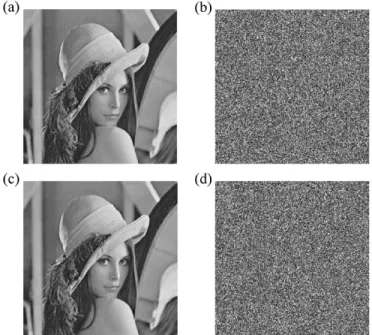
In all of the following computer experiments, we use the same random phase matrices for encryptions and decryptions. Let , , , and denote the parameter vectors employed in the de-cryption process. Fig. 3(a) is the 256 256 original image to be encrypted. Fig. 3(b) shows the magnitude image of its en-cryption output using the double random phase encoding in the MPDFRFT domain, where the elements of the 1 256 encryp-tion parameter vectors , , , and are independent and ran-domly chosen from the interval [0,2]. Then, we use the correct parameter vectors for decryption, and the decrypted output is shown in Fig. 3(c), which is the same as the original image. To give a decryption example of the previous encrypted image with the wrong parameter vectors, we use
and (22)
Error vectors and are independent, and the elements of both and are independent and uniformly distributed over the two-element set { 0.006,0.006}. That is, elements of both
332 IEEE SIGNAL PROCESSING LETTERS, VOL. 13, NO. 6, JUNE 2006
Fig. 3. The double random phase encoding in the MPDFRFT domain. (a) Orig-inal image. (b) Encrypted image. (c) Decrypted image with the correct parameter vectors. (d) Decrypted image with the element errors of two decryption param-eter vectors uniformly distributed over the set {00.006,0.006}.
Fig. 4. Normalized MSEs of decrypted images of the double random phase encodings in the MPDFRFT domain and the DFRFT domain.
and take values either 0.006 or 0.006 with equal prob-ability. Fig. 3(d) is the decrypted image, which shows that the original image is successfully protected.
Next, we perform another computer experiment to illustrate the effects of decryption parameter vector errors on the double random phase encoding in the MPDFRFT domain. Again, the relations of the parameter vectors used for decryption and en-cryption are given by (22). Error vectors and are inde-pendent, and the elements of both and are now indepen-dent and uniformly distributed over the set . Fig. 4 plots the normalized mean squared errors (MSEs) of the resulting de-crypted images for various values of , where the maximum MSE is normalized to be 1. For comparison, Fig. 4 also plots the normalized MSEs of the decrypted images for the double random phase encoding in the DFRFT domain, where the en-cryption and deen-cryption order parameters are (0.75,0.9,1.25,1.1)
and , respectively. In Fig. 4, all of
the normalized MSEs are the averaged results of ten realiza-tions. We also perform many other experiments using different
images and different keys. For example, we also perform ex-periments to compute the MSEs of the decrypted images with errors in the decryption parameter vectors and . Experiment results all show that the double random phase encoding in the MPDFRFT domain is much more sensitive to the decryption pa-rameter error than that in the DFRFT domain.
Finally, assume that the errors for all elements of decryp-tion parameter vectors and are uniformly distributed. From computer experiment, in order to have a successful brute-force cracking, all of these parameter errors should be very small and within 0.012 to 0.012, even though both of the other two encryption parameter vectors and and the random phase keys are known. For the th element of both and , each of its probability is
from the parameter periodicity property of the MPDFRFT. Thus, the probability of a successful cracking is smaller than . Therefore, it takes s to have a successful brute-force cracking, where 3.1 s is the time required for a PC (Pentium 4, 2.4-GHz CPU) to decrypt an image. This is equivalent to
years!
VI. CONCLUSION
In this letter, a new MPDFRFT is defined from the eigen-decomposition-based DFRFT by taking different fractional powers for different eigenvalues. The MPDFRFT is much more flexible than the DFRFT because it has order parameters, where is the number of input data points. The MPDFRFT is shown to have all of the desired properties for fractional transforms. To give an application example, we propose the double random phase encoding in the MPDFRFT domain to encrypt digital images. This new encryption method signifi-cantly enhances data security, because the order parameters of the MPDFRFT can be exploited as extra keys for decryption.
REFERENCES
[1] L. B. Almeida, “The fractional Fourier transform and time-frequency representations,” IEEE Trans. Signal Process., vol. 42, no. 12, pp. 3084–3091, Nov. 1994.
[2] H. M. Ozaktas, Z. Zalevsky, and M. A. Kutay, The Fractional Fourier
Transform with Applications in Optics and Signal Processing. New York: Wiley, 2000.
[3] V. Namias, “The fractional order Fourier transform and its applica-tion to quantum mechanics,” J. Inst. Math. Appl., vol. 25, pp. 241–265, 1980.
[4] S. C. Pei and M. H. Yeh, “Improved discrete fractional Fourier trans-form,” Opt. Lett., vol. 22, pp. 1047–1049, 1997.
[5] C. Candan, M. A. Kutay, and H. M. Ozaktas, “The discrete fractional Fourier transform,” IEEE Trans. Signal Process., vol. 48, no. 5, pp. 1329–1337, May 2000.
[6] P. Refregier and B. Javidi, “Optical image encryption based on input plane and Fourier plane random encoding,” Opt. Lett., vol. 20, pp. 767–769, 1995.
[7] G. Unnikrishnan and K. Singh, “Double random fractional Fourier-do-main encoding for optical security,” Opt. Eng., vol. 39, pp. 2853–2859, 2000.
[8] J. H. McClellan and T. W. Parks, “Eigenvalue and eigenvector decom-position of the discrete Fourier transform,” IEEE Trans. Audio.
Elec-troacoust., vol. AU-20, no. 1, pp. 66–74, Mar. 1972.
[9] B. W. Dickinson and K. Steiglitz, “Eigenvectors and functions of the discrete Fourier transform,” IEEE Trans. Acoust., Speech, Signal
Process., vol. ASSP-30, no. 1, pp. 25–31, Jan. 1982.
[10] S. C. Pei and M. H. Yeh, “The discrete fractional cosine and sine trans-forms,” IEEE Trans. Signal Process., vol. 49, no. 6, pp. 1198–1207, Jun. 2001.