Tecionophysics, 183 (1990) 57-76
Elsevier Science Publishers B.V., Amsterdam
57
Geotectonic evolution of late Cenozoic arc-continent collision
in Taiwan
Louis S. Teng
Department of Geology, National Taiwan University, 245 Choushan Road, Taipei (Taiwan, China) (Received February 25,1989; revised and accepted December 12,1989)
ABSTRACT
Teng, LX, 1990. Geotectonic evolution of late Cenozoic arc-continent collision in Taiwan. In: J. Angelier (Editor), Geodynamic Evolution of the Eastern Eurasian Margin. Tectonophysics, 183: 57-76.
The active collision between the Luzon arc and the Asian continent in the Taiwan area is investigated in terms of plate kinematics and geological records. Regarding plate kinematics, the tectonic evolution of the collision can be reconstructed by superimposing the paleopositions of Luzon arc on the pre-collisional Asian continental margin. Regarding geological records, the collisional history can be interpreted from the stratigraphy of the Coastal Range and the Western Foothills and from the diastrophism of the Central Range of Taiwan. By incorporating geological information into plate kinematics, it appears that the Luzon arc could have begun overriding the Asian continental margin in the late Middle Miocene (about 12 Ma). In the Late Miocene, the impingement of the arc deformed part of the continental margin and might have caused metamorphism of part of the Central Range, but no distinct effects were produced in the sedimentary record. In Mio-Pliocene times (about 5 Ma), the arc changed its direction of motion from north-northwesterly to west-northwesterly and began to override the continental margin rapidly. The accretionary wedge grew increasingly to emerge above sea level and feed continental detritus to the Luzon forearc basin and to induce foreland subsidence on the continental margin. In the early Late Pliocene (about 3 Ma), the collision drastically uplifted the mountain ranges in northern Taiwan, which shed voluminous erogenic sediments into the forearc and foreland basins. As the collision propogated toward the west and the south, the forearc and foreland basins were progressively accreted to the collisional orogen which eventually grew up to its present configuration.
Introduction
Taiwan
comprises
an
active
mountain
belt
formed
by the collision
between
the Luzon
arc
and the Asian continent
(Biq, 1973; Chai, 1972;
Bowin et al., 1978; Ho, 1986). In the last two
decades,
numerous
studies have been undertaken
on the geophysics
and geology
of the Ryukyu-
Taiwan-Luzon
area and these studies
have con-
tributed
an important
database
for understanding
the collision
in Taiwan
(Bowin et al., 1978; Chai,
1972;
Cardwell
et al., 1980;
Chi et al., 1981;
Eguchi and Uyeda, 1983; Ernst et al., 1985; Ham-
burger
et al., 1983; Ho, 1982; Karig, 1973; Page
and
Suppe,
1981; Pelletier
and Stephan,
1986;
Shiono et al., 1980; Suppe, 1981, 1984; Teng and
Wang,
1981; Tsai, 1978, 1986; Tsai et al., 1977).
Despite
the general
acceptance
of the arc-conti-
nent
collision,
many
basic
issues
remain
con-
troversial.
For
instance,
the collision
has been
interpreted
as resulting
from impingement
of the
Luzon arc by northwesterly
motion (Barrier, 1985;
Chi et al., 1981; Karig,
1973; Page and Suppe,
1981; Suppe,
1981, 1984; Suppe et al., 1981) or
north-northeasterly
motion
(Wang,
1976;
Tsai,
1978; Chen and Wang, 1988), with clockwise rota-
tion (Seno, 1977; Teng, 1986) or counterclockwise
rotation
(Fuller
et al., 1983; Halloway,
1982; Pel-
letier
and Stephan,
1986; Stephan
et al., 1986).
The onset of the collisional
orogeny
is inferred
to
have
taken
place
in the Late
Miocene
(Karig,
1973; Pelletier
and
Stephan,
1986; Jahn
et al.,
1986), Early Pliocene
(Chi et al., 1981; Lundberg
and
Dorsey,
1988;
Teng,
1982), Late
Pliocene
(Teng, 1987a; Wu, 1978) or PIio-Pleistocene
(Ho,
1988). The various arguments
demonstrate
the lack
0040-1951/90/$03.50 0 1990 - Elsevier Science Publishers B.V.58 L.S. TENG
of agreement
on the collisional
process
and call
for more
investigation.
This
study
attempts
to
look into this subject
from two independent
ap-
proaches:
plate kinematics
and geological
records.
Plate kinematics
offers a general
view over the
tectonic
evolution
of arc-continent
collision
and
the geological
information
provides
evidence
and
constraints
for the collisional
events. By integrat-
ing
the information
obtained
from
these
two
sources, the acquisition
of a more comprehensive
conception
of
the
arc-continent
collision
in
Taiwan is intended.
Geotectonic framework
Taiwan
is presently
sitting
on the boundary
between the Philippine
Sea plate and the Eurasian
Pliocrnr-Quotemary
zE:Z’ Sequonca
Miocono Slot*
m Paloogono Slate
Mesozoic Bosomon t m Schist Complex LVF Lonoitudinot Valley ~a~1
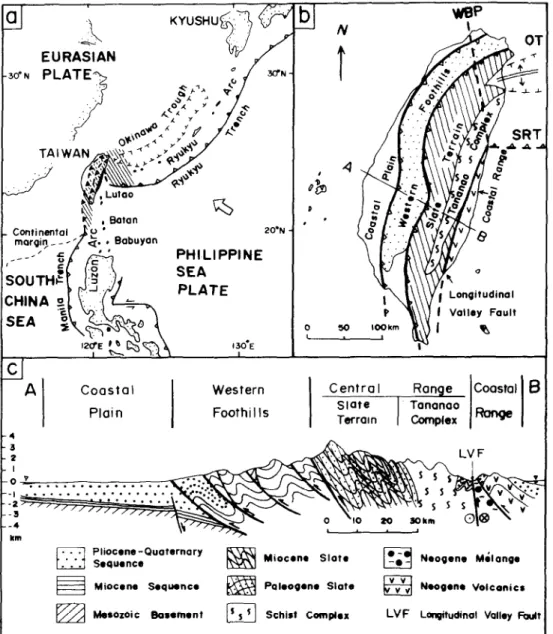
Fig. 1. Geotectonic framework of Taiwan. (a) Plate tectonic configuration of the Ryukyu-Taiwan-Luzon area. Shaded area shows the collisional orogen in the onshore (broken lines) and offshore (continuous lines) region. Modified from Ho (1986). Letouzey and Kimura (1986), Lewis and Hayes (1983, 1984), Sibuet et al. (1987). Stephan et al. (1986) and Suppe (1981). (b) Tectonic framework and geological terrains of Taiwan, Summarized from Bowin et al. (1978). Ho (1982) Liu and Wang (1982) and Tsai et al. (1977. 1981). OT= Okinawa trough; SRT= seismological Ryukyu trench; WBP = western boundary of the subducting Philippine Sea plate. (c) Schematic cross section of Taiwan. Location shown in Fig. lb. Summarized from Barrier and Angelier (1986). Chi et al.
LATE CENOZOIC ARC-CONTINENT COLLISION IN TAIWAN 59
plate (Fig. la). The Philippine Sea plate is sub-
ducting beneath the Eurasian plate at the Ryukyu
trench and overriding the crust of the South China
Sea at the Manila trench. The SE-facing Ryukyu
arc-trench
system extends from southern Kyushu
down to the east of Taiwan (about 123“E) with
associated subduction and backarc spreading ex-
tending further into northeastern Taiwan (Fig. lb)
(Bowin et al., 1978; Roecker et al., 1987; Sibuet et
al., 1987; Tsai et al., 1977; TsaiJ986). The W-fac-
ing Luzon arc-Manila
trench system (hereafter
abbreviated
to “Luzon arc-trench
system”) ex-
tends from southern Luzon up to about 22”N
(Cardwell et al., 1980; Hamburger et al., 1983;
Hayes and Lewis, 1984; Lewis and Hayes, 1984;
Lin and Tsai, 1981) and merges into the mountain
ranges of Taiwan further to the north. Taiwan is
not only a collisional zone between the Luzon arc
and the Asian continent but also a transform zone
between the opposite-facing
Ryukyu and Luzon
arcs (Wu, 1978).
The mountain ranges of Taiwan can be divided
into two geological provinces by the Longitudinal
Valley Fault, which is the geological suture be-
tween the coalesced Philippine Sea plate and the
Eurasian plate (Figs. lb and c) (Ho, 1988). The
Coastal Range to the east of the fault comprises
volcanic and siliciclastic sequences of the accreted
Luzon arc-trench
system and the area west of the
fault consists of metamorphic
and sedimentary
sequences of the deformed
continental
margin
(Chai, 1972; Teng, 1987a). The Tananao metamor-
phic complex of the Central Range can be re-
garded as the unroofed continental besement and
the Tertiary sequences of the slate terrain and the
Western Foothills as the overlying sedimentary
cover. In addition to the exposed part in Taiwan,
deformed rock sequences of the collisional orogen
can also be traced offshore to the accretionary
wedge of the Manila trench to the south (Hayes
and Lewis, 1984; Lewis and Hayes, 1984; Page
and Suppe, 1981) and to the southern end of the
Ryukyu arc to the northeast (Fig. la) (Letouzey
and Kimura, 1986; Sun, 1989, and unpublished
data). The coastal plain of western Taiwan and
the offshore areas further to the west are under-
lain by mostly flat-lying Cenozoic sedimentary
sequences which have not yet been deformed by
the collision (Figs. lc and 3) (Sun, 1982, 1985).
Plate kinematics
The kinematic reconstruction
of the collision
between the Luzon arc and the Asian continent is
possible by first restoring the pre-collisional mor-
photectonic
settings of the Asian continental
margin and the travel path of the Luzon arc-trench
system, and then superimposing the travel path of
the Luzon arc on the pre-collisional Asian con-
tinental margin.
Reconstruction of the Asian continental margin
The present Asian continental
margin near
Taiwan can be divided into three parts, the Ryukyu
arc-trench system and associated Okinawa trough,
the Taiwan collisional zone, and the southeast
China continental margin (Figs. la, 2 and 3). The
Ryukyu arc-trench
system has been developing
on the Asian continent since at least the Early
Miocene (Kizaki, 1986; Letouzey and Kimura,
1986; Shiono et al., 1980). The Okinawa trough is
a nascent backarc basin which opened up in the
Late Pliocene as a result of the collision in Taiwan
(Lee et al., 1980; Letouzey and Kimura, 1986;
Suppe, 1984; Viallon et al., 1986). To restore the
pre-collisional
Ryukyu
arc-trench
system, the
Okinawa trough must be closed and the arc-trench
shifted northwestward. By subtracting the amount
of rifting estimated from seismic reflection studies
(Kimura,
1985; Letouzey
and Kiumra,
1986;
Sibuet et al., 1987) the Late Miocene Ryukyu
arc-trench
system may be ascertained
to have
been about 80 km northwest of its present posi-
tion (Fig. 2). The southern end of the pre-colli-
sional Ryukyu arc is set at the southermost exten-
sion of the Miocene volcanics (Letouzey
and
Kimura, 1986) and at the easternmost end of the
collision-deformed
continental
margin sediments
(Fig. la).
The southeast China continental
margin has
been a rifted margin since the Cretaceous (Hollo-
way, 1982; Ru and Pigott, 1986; Taylor and Hayes,
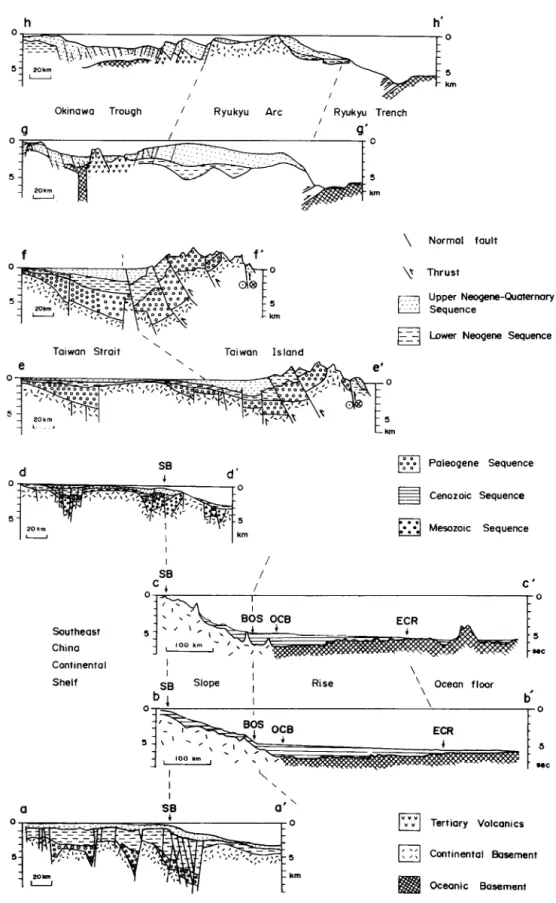
1980, 1983). As shown in seismic sections (Fig. 3)
60 L.S. TENG Fig. 2. Modem
BOS
ECR MT OCB OT RA RT SB Base of SlopeEdge of Continental Rise Manila Trench
Oceanic Crust Boundary Okinawa Trough Ryukyu Arc Ryukyu Trench Shelf Break
PHI LI PPINE
SEA
A Late Arc Miocene Ryukyu Volcanoes Late Miocene Ryukyu-o?>
Isobaths in km g=c$ Cross Sections0 100 200 3OOlm
SOUTH CHINA SEA
and reconstructed Late Miocene pre-collisional morphotectonic settings of the Asian continental margin Geological cross sections (a-a’ to h-h’) are shown in Fig. 3. See text for explanation.
near Taiwan.
(Ru and Pigott, 1986) this part of the continental
margin
is floored
with an attenuated
Mesozoic
basement
covered with late Mesozoic
and Ceno-
zoic sedimentary
sequences.
As far as the morpho-
tectonic
framework
is concerned,
the southeast
China
continental
margin
is characterized
by
well-developed
shelf-slope-rise
settings. The shelf
break
(SB) and the base-of-slope
(BOS) can be
approximated
by the 200 m and 3000 m isobaths
(Figs. 2 and 3). The outer edge of the continental
rise (ECR)
can be recognized
from the seismic
sections
and the oceanic
crust boundary
(OCB)
delineated
on the basis of geomagnetic
and bathy-
metric data (Bowin et al., 1978; Taylor and Hayes,
1983).
Except
for minor
normal
faulting,
the
Neogene-Quatemary
sequence
is not structurally
disrupted,
as shown in the seismic sections
(Fig.
3). Hence, the morphotectonic
settings of this part
of the continental
margin
appear
to have
re-
mained
unchanged
during
Neogene-Quaternary
times and can be regarded
as the pre-collisional
settings.
In the Taiwan
collisional
zone, the flat-lying
Cenozoic
sedimentary
sequences
and underlying
rifted Mesozoic
basement
in Taiwan
Strait repre-
sent the undeformed
rock suite of the Asian con-
tinental
shelf,
similar
to that
of the southeast
China continental
margin (Bosum et al., 1970; Liu
and Pan, 1984; Sun, 1982,1985;
Teng 1987a) (Fig.
3). In the Taiwan
orogen,
the original
morpho-
tectonic
settings have been destroyed
by the colli-
sion but facies characteristics
and structural
geo-
logical
information
on the deformed
sequences
allow
partial
reconstruction.
By untangling
the
imbricated
folds and thrusts
in northern
Taiwan
(Suppe,
1980b), the Paleogene
Szeleng Sandstone
exposed
in the northern
slate terrain
can be re-
located 160-200
km southeast
of its present
posi-
LATE CENOZOIC ARC-CONTINENT COLLISION IN TAIWAN h h’
0
0 5 5 km /Okinawa Trough / Ryukyu Arc ,I Ryukyu Trench
/
0 0 5 5 km\
Normal fault \t Thrusl I_ Upper Neogene-Quoternary Sequenceq
Lower Neogene Sequence0 0 5
i-
tkm
f?zJ Paleogene Sequenceq
Cenozoic Sequenceq
Mesozoic Sequence Southeast 5 Chino Contmentol Shelf .\ a a 0 0q
Tertiary Volcanics e e Continental Basement km Oceanic BasementFig. 3. Geological cross sections through the Asian continental margin near Taiwan. Locations and symbols are shown in Fig. 2. Modified from Ru and F’iggott (1986) (a-a’, d-d’), Taylor and Hayes (1980) (b-b’, c-c’), Sun (1982) (e-e’, f-f), and Letouzey and Kimura (1986) (g-g’, h-h’). The structural complexities of the Taiwan orogen as shown in Fig. lc are omitted in sections e-e’ and
62 I s I-F.NG
tion (point A in Fig. 2). Since the Szeleng Sand-
stone is composed
of coastal deposits accumulated
on the original continental
shelf, this point shows
where the innermost
limit of the pre-collisional
shelf break was. In southern
Taiwan,
the outer
shelf to upper slope deposits of the Late Miocene
Lilungshan
Formation
(point B in Fig. 2) exposed
on the west Hengchun
Peninsula
(Chen
et al.,
1985; Pelletier
and Stephan,
1986; Sung, 1987)
provide
another
control
point for delineating
the
pre-collisional
shelf break. By following
these two
control
points,
the pre-collisional
shelf break
of
the southeast
China
continental
margin
can be
extrapolated
to Taiwan as shown in Fig. 2. So far,
no control
points
for the pre-collisional
base-of-
slope, oceanic crust boundary,
and outer edge of
the continental
rise can be obtained
in Taiwan.
Therefore,
these lines are simply extrapolated
from
southeast
China by paralleling
the shelf break line.
The reconstructed
continental
margin
exhibits
a
rather
simple
morphotectonic
pattern
with
the
Ryukyu
arc-trench
system
bordering
the con-
tinental
margin to the north and a rifted continen-
tal margin
to the south. The boundary
between
the Ryukyu
arc and the rifted continental
margin
is tentatively
marked
by a transform
fault
to
accommodate
the motion of the Luzon arc (Karig,
1973; Suppe et al, 1981).
Backtracking
Luzon arc
The Luzon
arc has been
developing
on the
Philippine
Sea plate since the Early Miocene
or
the Late Oligocene
(Bachman
et al., 1983; Balce et
al., 1982; Karig, 1983; Richard
et al., 1986). The
Philippine
Sea plate is presently
rotating
clockwise
and moving toward the Eurasian
plate at a speed
of 7-9 cm/yr
due WNW in the Taiwan-Luzon
area (Minster
and Jordan,
1979; Ranken
et al..
1984; Seno, 1977; Seno and Eguchi, 1983; Seno et
al., 1987). Paleomagnetic
data from DSDP cores
(Kinoshita,
1980; Louden,
1977) and outcrops
on
the surrounding
islands (Fuller
et al., 1980, 1983;
Haston et al., 1988; Hsu, et al., 1966; Jarrard
and
Sasajima,
1980;
Keating
and
Helsley,
1985;
Kodama
et al., 1983; Larson et al., 1975; McCabe
et al., 1987) together with geomagnetic
data from
the Philippine
Sea basin
(Hilde
and Lee, 1984;
Shih,
1980) reveal
a fast northward
movement
with significant
clockwise
rotation
since the early
Tertiary
but yield no information
about the longi-
tudinal
movement.
The present-day
motion of the
Philippine
Sea plate has been applied back through
time to account
for the Neogene
tectonic events in
Taiwan,
Japan
and
the Marianas
(Barrier
and
Angelier.
1986; Chi et al., 1981; Matsubara
and
Seno. 1980; Suppe.
1981, 1984) which, however.
may conflict
with paleomagnetic
data and other
geological
evidence
(Fuller
et al., 1983;
Karig.
1985; McCabe
et al., 1987; Sarewitz
and Karig.
1986; Seno and Maruyama,
1984). The motion
of
the Philippine
Sea plate can apparently
be divided
into
two stages
in the last 15 Ma (Seno
and
Maruyama,
1984; Sarewitz
and Karig,
1986). In
the Pliocene
and Quaternary
the plate
followed
the present-day
mode of motion,
but with a re-
duced
(about
two
thirds)
speed
(Seno
and
Maruyama,
1984;
Karig,
1985)
whereas
in the
Miocene
it moved
rapidly
(at about
7 cm/yr
at
Luzon) toward the north-northwest
(Sarewitz
and
Karig, 1986; Seno and Maruyama,
1984) with a
strong (about
2”/Ma)
clockwise
rotation
(Fuller,
1985; Keating
and Helsley,
1985; McCabe
et al..
1987). The change
of motion
from north-north-
westerly
to west-northwesterly
is believed
to have
taken place at around
5 Ma, as indicated
by the
geological
information
in Japan,
the Marianas.
Mindoro
and Taiwan (Matsubara
and Seno, 1980;
Sarewitz
and Karig.
1986; Seno and Maruyama.
1984; Teng, 1987a).
By following
the motion
of the Philippine
Sea
plate.
the travel path of the Luzon
arc can be
backtracked,
as shown in Fig. 4a. The backtrack-
ing is performed
by moving the southern
segment
of the Luzon
arc, such as Babuyan
and Luzon
islands, which are not yet involved
in the collision
(Fig. la). The segment
of the arc from Batan to
Lutao, although
already
involved
in the collision,
does not appear
to be significantly
deformed,
as
shown by marine seismic data (Bowin et al., 1978;
Chen and Juang,
1986). Hence, the relative
posi-
tion of this part of the arc with respect to Babuyan
and Luzon is assumed
to be unchanged.
For the
deformed
segment in the Coastal Range of eastern
Taiwan,
the arc is restored
by simply
extending
the trend of the arc for a comparable
length (Fig.
LATE CENOZOIC ARC-CONTINENT COLLISION IN TAIWAN 63 200 Km ;i’ Taiwan I
‘-...;
Bobulot
.IO
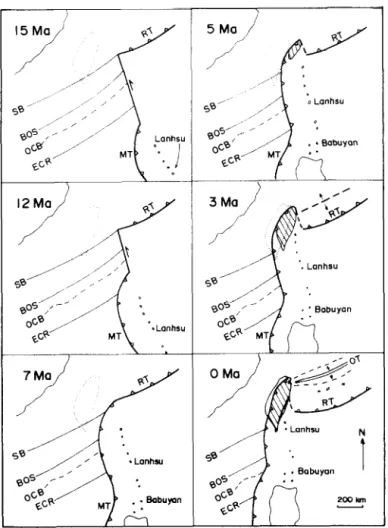
. Manila Trrnch 12 (il 15Fig. 4. Paleopositions and travel path of the Luzon arc-trench system. Numbers denote different stages in Ma. Note the change in motion at 5 Ma. (a) Luzon volcanic arc with respect to Taiwan and the Ryukyu arc-trench system. Heavy dashed lines denote the submarine traces of the Luzon volcanic arc and the stippled area shows the travel path of the northern segment of the arc that has been accreted to the collisional orogen. (b) Manila trench with respect to the pre-collisional Asian continental margin. Note the
surficial deflection of the Manila trench in Taiwan from 3 Ma to 0 Ma. Symbols and abbreviations as in Fig. 2.
4a). Based on the reconstructed Luzon volcanic
arc (Fig. 4a), the paleopositions of the Manila
trench can be established by extending the trace of
the trench at a distance equivalent to the width of
the present-day arc-trench gap (about 150 km)
away from the volcanic arc (Fig. 4b).
Arc-continent
collision
By superimposing the paleopositions of the
Luzon arc-trench
system on the pre-collisional
continental margin, a series of paleotectonic pic-
tures of successive stages of arc-continent
colli-
sion can be established (Figs. 4b and 5). It is clear
that the Luzon arc encroached upon the continen-
tal margin obliquely, with the northern segment of
the arc colliding with the continent earlier (Biq,
1973; Suppe, 1981). The northern tip of the Luzon
arc might have begun overriding the continental
margin sediment as early as in the Middle Miocene
(12 Ma). At about 5 Ma, the motion of the arc
changed from north-northwesterly to west-north-
westerly and began to override the continental
margin more orthogonally and more rapidly. Both
the continental margin and the arc were succes-
sively deformed by the collision from north to
south and uplifted as the mountain ranges of
Taiwan (Suppe, 1984; Barrier, 1985; Teng, 1987a,
b). In northern Taiwan and southern Ryukyu, the
change in Luzon arc motion at 5 Ma induced
westward propogation of the boundary of the
subducting Philippine Sea plate and consequently
extend the Ryukyu arc-trench system into north-
eastern Taiwan (Figs. 4b and 5) (Suppe, 1984).
Meanwhile the collision at Taiwan obstructed the
plate convergence at the Ryukyu trench and re-
sulted in rifting and opening of the Okinawa
trough (Lee et al., 1980; Letouzey and Kimura,
1986; Sibuet et al., 1987; Viallon et al., 1986).
64 L.S. TENG
Fig. 5. Kinematics of the collision between the Luzon arc and the Asian continent. Integrated using Figs. 2 and 4. Note the opening of the Okinawa trough after 3 Ma. Shaded areas show the exposed accretionary wedge (collisional orogen) as indicated by geological
data (Table 1). Symbols and abbreviations as in Fig. 2.
Geo1ogiea.l
recordsArc-continent collision has dominated the late
Cenozoic magmatism, metamorphism, sedimenta-
tion and structural deformation of Taiwan (Ange-
her et al., 1986; Barrier and Angelier, 1986; Ernst,
1983a; Ernst and Jahn, 1987; Jahn et al., 1986;
Lee and Wang, 1987; Richard et al., 1986; Suppe,
1981; Teng, 1987a). The geological history of the
collision can be interpreted from the erogenic
records preserved in rock sequences of the moun-
tain ranges (Central Range) and surrounding
basins (Coastal Range and Western Foothills). In
this study, the erogenic records of the Coastal
Range, Central Range and Western Foothills that
offer essential clues and chronological constraints
to the collisional events are discussed in the fol-
lowing.
Coastal Range
The Coastal Range comprises rocks of the pre-
collisional Luzon arc-trench system and overlying
syn-collisional erogenic sediments (Figs. lb and c)
(Teng, 1987b). The collisional history can be il-
lustrated by the composition and facies character-
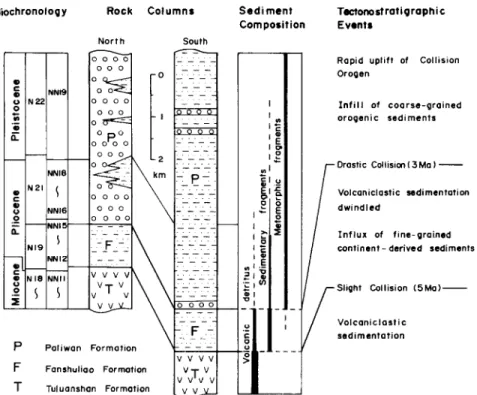
istics of the thick slope to deep-sea fan deposits of
the forearc basin sequences (Fig. 6). The exclusive
dominance of andesitic detritus in the Miocene
Tuluanshan deposits indicates that the arc was
situated away from continental influence (Wang,
1976). The presence of a significant amount of
LATE CENOZOIC ARC-CONTINENT COLLISION IN TAIWAN 65
Biochronology Rock Columns Sediment
Composition Tectonostrotigrophic Events NNl6 r N21 ( :: NNl6 .e P -NNIS- Nl9 \ NNIZ z t NIB NNll North P Paliwan Formatw F Fonshuliao Formation T Tuluanshan Formation
Rapid upllfl of Collision orogen Infill of coarse-grained erogenic ssdlments Drastic Collis~ml3Ma
I-
Volcaniclwtic sadimcntotion dwndled Influx of fins-grained continent-derived sediments / Slight Collision (5t.40)~ Volcaniclostic sedimentationFig. 6. Tectonostratigraphic record of the forearc basin sequence of the Coastal Range of eastern Taiwan. The stratigraphic column of the northern part is compiled from the Shuilien and Hsiukuhtanchi sections and that of the southern part from the Matagida and Chengkung sections. Biochronology summarized from Chang (1967, 1968, 1969), Chang and Chen (1970), Chen (1989) and Chi et al. (1981). Rock columns and sediment composition summarized from Chen (1989), Dorsey (1988) and Teng (1979, 1987b). For
lithological symbols, see Fig. 7.
fine-grained
continent-derived
detritus in the
Lower Pliocene Fanshuliao deposits shows that
the arc moved sufficiently close to receive sedi-
ment from the continent (Chen and Wang, 1988;
Yao et al., 1988; Buchovecky and Lundberg, 1988;
Teng, 1979, 1980). The influx of voluminous
coarse-grained continent-derived sediments in the
Upper Pliocene Paliwan Formation demonstrates
that the continental margin was rapidly uplifted,
to form high mountains (Teng, 1979, 1982). The
upward increase in grain size, metamorphic grade
and accumulation rate of the continent-derived
sediments in the Fanshuliao-Paliwan
sequences
reflects not only the approach of the Luzon arc
toward the continent but also the progressive up-
lift and unroofing of the collisional
orogen
(Dorsey, 1988; Dorsey et al., 1988; Teng, 1987b;
Teng and Wang, 1981). The southerly fining facies
character of the Paliwan deposits implies that the
collisional orogen formed earlier in the north
(Teng, 1982, 1988; Chen, 1989). The persistent
deposition of Fanshuliao-Paliwan
sediments in a
deep-sea setting, however, requires continued sub-
sidence of the forearc basin during the collision
until the basin was rapidly deformed and uplifted
in the late Quaternary (Lundberg and Dorsey,
1988; Teng, 1987b).
Western Foothills
The Western Foothills, as a part of the foreland
fold-and-thrust belt (Ho, 1976, 1988), are under-
lain by thick Cenozoic siliciclastic deposits that
include the Oligocene-Miocene
pre-collisional
continental margin sequence and the Pliocene-
Quaternary
syn-collisional
foreland basin se-
quence (Figs. lb and c) (Chou, 1973; Covey, 1986;
Ho, 1986; Teng, 1987a). The continental margin
sequence consists of coastal to shallow-marine
siliciclastic sediments derived from the granitic
terrain of the Asian continent (Fig. 7) (Chai, 1972;
Chou, 1973, 1980). The lateral facies variations of
the continental margin sequence correspond to the
original depositional settings on the continental
66 L.S ‘I-ENG
Magnetobio- chronology
Rock Columns Depositional Sediment Tectonostmtigraphic
Settings Composition Events
North South RapId basin subsidence Intill at orogwtic sediments
/
Drastic Coll1s1on(3Ma) - Accelerated bosln subsidence and sedimenlatlonSlight Coll~s~on( 5Ma) -
Poss,ve morgl” sedtmenlorlon
Sandstone
Volconiclostics
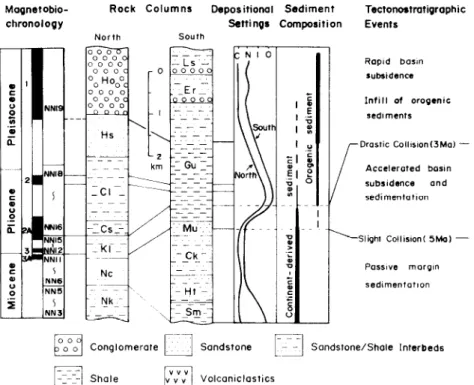
Fig. 7. Tectonostratigraphic record of the foreland basin sequence of the Western Foothills of western Taiwan. The stratigraphic column of the northern part is compiled from the Chuhuangkeng and Huoyenshan sections, and that of the southern part from the Hunghuatze and Chibshan sections. Magnetobiochronology summarized from Chen et al. (1977a, b), Chi (1979). Chi and Huang (1981), Huang (1976), Homg et al. (1989) and Lee and Lue (1984). Rock columns, depositional settings and sediment composition summarized from Chi and Huang (1981), Chou (1973, 1976, 1977, 1980), Huang (1976), Lee (1963), Lin and Hsueh (1979), Oinomikado (1955), Ting (1986), Teng (1987a) and Yu and Teng (1988). Depositional settings: C = coastal; N = nearshore; I = inner offshore; 0 = outer offshore. Rock units: Ck = Changchihkeng; Cl = Cholan; Cs = Chinshui; Er = Erchungchi; Gu = Gutingkeng; Ho = Huoyenshan; Hs = Hsianshan; Hf = Hunghuatze;
Kl
= Kueichulin; LJ = Liushuang; Mu = Mucha; NC = Nanchuang; Nk =Nankang; Sm = Sanmin.
shelf (Ho, 1971; Teng, 1987a; Wang,
1987) and
the vertical
facies variations
conform
with global
eustatic fluctuactions
(Huang,
1982; Yu and Teng,
1988). The basin
subsided
slowly and smoothly,
with no distinct changes in facies and composition
related
to the collision
(Chou,
1973; Hsueh
and
Johns, 1985; Yu and Teng, 1988). The first indica-
tion of the collision
is shown by the rapid facies
change,
accelerated
basin
subsidence,
and influx
of lithic sediments
and reworked
fossils in the
Lower
Pliocene
foreland
basin
sequence,
which
indicates
the initiation
of foreland
subsidence
and
derivation
of erogenic
sediments
from the east
(Chi and Huang,
1981; Chou, 1977; Huang,
1976;
Teng, 1987a; Yu and Teng, 1988). The southerly
fining
facies character
of the foreland
basin
de-
posits
demonstrates
that
the collisional
orogen
was uplifted
earlier
in the north
(Covey,
1984,
1986; Teng, 1987a, 1988). The upward
increase in
sediment
grain
size, sediment
accumulation
rate
and basin subsidence
rate of the Late Pliocene and
Quaternary
foreland
basin
sequence
reflects
the
accelerated
foreland
subsidence
and the westward
progradation
of erogenic
sediments
from
the
growing
orogen
until
the basin
was eventually
deformed
in the late Quatemary
(Covey,
1986;
Teng, 1987a).
Central Range
The Central
Range
comprises
the tectonized
pre-Tertiary
continental
basement
(Tananao
com-
plex) and Cenozoic
sedimentary
cover (slate ter-
rain) (Figs. lb and c) (Chai,
1972; Ernst et al.,
1985; Liou and Ernst,
1984; Suppe et al., 1976).
The geological
history
of the Tananao
Complex
LATE CENOZOIC ARC-CONTINENT COLLISION IN TAIWAN
can
be traced back to the Paleozoic and involves
multiple crustal defo~ation
and metamo~~sm
in the Mesozoic and early Tertiary (Ernst, 1983a;
Ernst and Jahn, 1987; Liou, 1981; Liou and Ernst,
1984). In spite of the geological complexities, the
effects of arc-continent collision can be illustrated
by the late Cenozoic diastrophism of the gneiss
bodies exposed in the Hoping-C~pan
area (Fig.
8) which is believed to be the location of the
deep-seated part of the Tananao complex (Chen et
al., 1983; Wang Lee et al., 1982). According to
petrological studies (Ernst, 1983b; Wang Lee et
67
al., 1982), these gneiss bodies have been buried to
a depth of about 13 km and subjected to upper
greenscbist facies metamorphism during the arc-
continent collision. K-Ar and Rb-Sr radiometric
ages of the collisional metamorphism fall mainly
in the range 9-3 Ma (Jahn et al., 1986; Juang and
Bellon, 1986), whereas fission-track ages of zircon
and apatite center around 2 Ma and 0.5 Ma
respectively (Liu, 1982, and unpublished data). By
plotting the ages of different minerals versus their
blocking temperatures and equivalent depth of
burial, it is clear that the gneiss bodies were de-
-
Initial Collision ---+Early Cdlision+-- Late Collision ---+I ( Collisional Stages1
L 14 - - Uplift Curve of 1 A Central Range !L..J’
z
I
“t”t,”
Sediment Accumulation 7 6 5 4 3 2 I 0 - Time (Ma)Fig. 8. Comparative curves of the uplift of the collisional orogen (Central Range) (upper part) and the sediment accumulation in the forearc (Coastal Range) and foreland (Western Foothills) basins (lower part). The uplift curve of the collisional orogen is delineated on the basis of radiometric dating of the gneiss bodies in the Hoping-Chipan area (inset). The sediment accumulation curves are established on the basis of the stratigraphic information shown in Figs. 6 and 7. Note the accelerated uplift of the collisional orogen and the increase in sediment accumulation rates in forearc and foreland basins at 5 and 3 Ma. A = fission-track ages of apatite;
68 L.S TEN<;
eply buried
before 3 Ma and rapidly
uplifted
to
the surface
afterwards
(Liu,
1982) (Fig.
8). A
comparable
burial-and-uplift
history
is also re-
corded in other parts of the Central
Range (Liu,
1982, 1988), indicating
that
the entire
Central
Range was first metamorphosed
at depth before 3
Ma and then rapidly
uplifted
to form the high
mountains.
Integrated geological records
By integrating
the geological
records (Table 1).
it appears that no clear erogenic
effects older than
5 Ma can be recognized
either
in the Coastal
Range or in the Western
Foothills,
although
part
of the Central
Range
might
have
been
meta-
morphosed.
From 5 Ma to 3 Ma, the collision
not
only caused
intense
deformation
and metamor-
phism of the Tananao
complex
but also induced
the foreland
subsidence
in the Western
Foothills.
Part of the continental
margin
might have been
uplifted
as the sediment
source
for the forearc
basin
of the Coastal
Range,
but no significant
mountain
ranges took shape at this time, as shown
by the lack of coarse-grained
erogenic
sediments
in the stratigraphic
records
(Figs. 6 and 7). At
about 3 Ma, the mountain
ranges of Taiwan began
to rise rapidly,
as shown
by the uplift
of the
Tananao
complex
and the influx
of voluminous
erogenic
sediments
into the forearc and foreland
basins (Fig. 8). The mountain
ranges most likely
took shape first in the north and then grew toward
the south, as shown by the southerly
fining facies
pattern
of the erogenic
sediments
(Figs. 6 and 7).
Synthesis
By incorporating
geological
information
into
plate kinematics,
a geotectonic
model for the late
Cenozoic
arc-continent
collision in Taiwan can be
delineated
(Fig. 9). The Luzon arc, which has been
moving toward the Asian continent
since the Early
TABLE 1Integrated erogenic record of late Cenozoic arc-continent collision in Taiwan Collisional (erogenic) stages - OMa Continental margin (Western Foothills) Accretionary wedge (Central Range) Luzon forearc (Coastal Range) Late collision (morphogenic stage) - 3Ma Rapid deformation Progradation of erogenic sediment Rapid foreland subsidence Exhumation of metamorphic core Intense erosion Rapid uplift Rapid deformation Progradation of erogenic sediment Influx of coarse-grained erogenic sediment Early collision (metamorphic stage) _ 5Ma Continued passive margin sedimentation Initial foreland subsidence Intense metamorphism Mild erosion Rapid growth to sea level Influx of fine-grained continental sediment Volcanicalstic sedimentation dwindled
Initial collision Passive margin Initial metamorphism (metamorphic stage) sedimentation
Slow subsidence Gradual growth below
Volcaniclastic sedimentation
_ lo-12 Ma
LATE CENOZOIC ARC-CONTINENT COLLISION IN TAIWAN 69
(a) 12Ma
Continental Mangin LUZOn Arc Shelf Slope Rise Trench Faeorc Vdcti
basin Arc____ X 0 Shm (b) 5Ma‘, ‘\,
1
\
Continental ‘, Luzon S4elf Accretionary \ Wedge Arc \1
Foreland1
‘,
(Outer arc) (Forearc)&clX
' Rapid subsidence Metamorphism
I
(cl 3Ma
/
I
Crntinental Accretionory Luzon
Shklf Wedge Arc
X
(
Fbrelond 1 (Orogen ) ( Forearc)0
\ 1 Rapid subsidence Ropld uplift
I
(d
1
Present’/
I
Taiwan Coastal Central Coastal Strait Piain Range Range (Foreland) Kkogen) (Arc) X
Rapid subsidence Rapid uplift
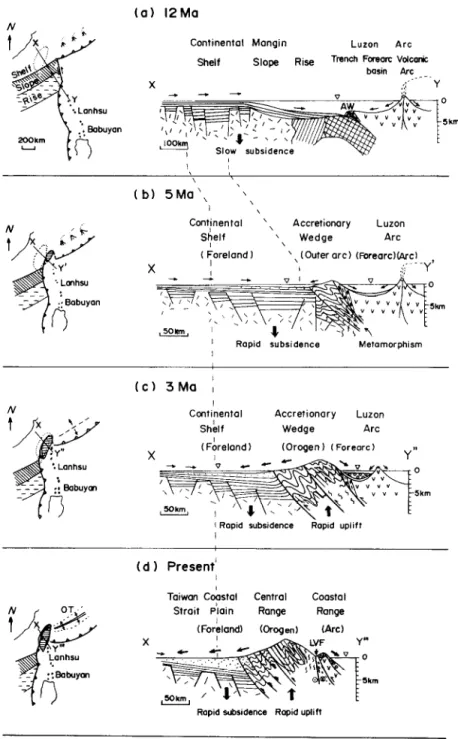
Fig. 9. Geotectonic evolution of the late Cenozoic arc-contment cornsron m Taiwan. The figures on the left are collisional kinematics modified from Fig. 5 and those on the right are the corresponding schematic cross sections. Note the reduced horizontal scale of Fig. 9a compared with the others. Dashed lines connect sites for reference. Small arrows near the ground surface indicate the major sediment influx. (a) Beginning of initial collision. The northern tip of the Luzon arc began to override the continental rise. The accretionary wedge (A W) remained as a submarine high but progressively grew upwards as continental materials were incorported into the subduction zone. (b) Beginning of early collision. The northern tip of the Luzon arc encroached upon the continental shelf and the accretionary wedge grew above sea level as an outer arc. Note that an appreciable amount of continental slope and rise materials has been pulled into the deep subduction zone since 12 Ma and has become metamorphosed in the deeper part of the accretionary wedge. (c) Beginning of late collision. The accretionary wedge rapidly uplifted as mountain ranges which shed voluminous coarse-grained erogenic sediments into forearc and foreland basins. (d) The present collisional orogen of Taiwan. Note the accreton of the forearc and foreland basins to the orogen in north-central Taiwan and the ongoing accretion in southern Taiwan
70 L S TEN<i
Miocene, did not have any contact with the conti-
nent until the late Middle Miocene (about 12 Ma),
when the northern
tip of the arc began to override
the continental
rise (Fig. 9a). As the Luzon arc-
trench system progressively
encroached
upon the
continental
margin,
the
continental
crust
and
overlying
sediment
were either dragged deep down
into the subduction
zone or scraped
off at the
trench
to add to the accretionary
wedge. In the
Late Miocene
(lo-5
Ma), the accretionary
wedge
grew slowly and remained
as a submarine
high
while some of the continental
materials
were pulled
into the deep subduction
zone to become
meta-
morphosed
(Figs. 5 and 9b). In the Mio-Pliocene
(about
5 Ma) (Fig. 9b), the Luzon arc shifted its
direction
of motion
from
north-northwest
to
west-northwest
and an increasing
amount
of con-
tinental
materials
was incorporated
into the sub-
duction
zone.
The
accretionary
wedge
at the
northern
end of the arc grew rapidly
to emerge
above sea level as an outer arc which began
to
shed fine-grained
continental
detritus
to the fore-
arc basin
(Teng,
1987b).
In the meantime,
the
impingement
of the arc caused flexural bending
of
the continental
crust
to induce
foreland
subsi-
dence. In spite of the intense diastrophism
associ-
ated with this early
stage of the collision,
no
significant
high mountains
appear
to have taken
shape during the Early Pliocene
(5-3 Ma). In the
early Late Pliocene
(3 Ma) (Fig. SC), drastic colli-
sion commenced
and caused
rapid
uplift
of the
mountain
ranges in northern
Taiwan.
Voluminous
erogenic
sediments
were derived
from the rising
mountain
ranges
and dumped
into
the rapidly
subsiding
forearc
and
foreland
basins
(Covey,
1986; Lundberg
and Dorsey,
1988; Teng, 1987a).
As the oblique
collision
proceeded,
the orogeny
propogated
toward
the west and the south
and
progressively
accreted
the forearc
and
foreland
basins
to the collisional
orogen
which eventually
grew up to its present
configuration
(Fig. 9d). In
the north, a flip in subduction
induced
westward
propogation
of the Ryukyu arc-trench
system and
opening
of the Okinawa
trough since the Pliocene
(Suppe,
1984). To the south, active collision
and
mountain
building
are still going on today and the
tectonic
events
presently
taking
place
south
of
Taiwan
probably
resemble
those which occurred
in Taiwan at earlier times (Suppe, 1981; Page and
Suppe, 1981; Teng, 1987a).
Discussion
The geotectonic
model proposed
herein (Fig. 9)
is established
on the basis of the available
plate
kinematic
and geological
information
and is thus
subjected
to the uncertainties
associated
therewith.
Regarding
geological
records,
the tectonostrati-
graphic
records
of the Coastal
Range
and
the
Western
Foothills
are well constrained
by sedi-
mentological
and magnetobiochronological
data,
and the diastrophic
history
of the Central
Range
is well delineated
by petrological
and radiochrono-
logical
data (Figs. 6. 7 and 8). The consistency
between
the diastrophic
records of the collisional
orogen
and the stratigraphic
records
of the sur-
rounding
forearc and foreland
basins substantiates
the validity
of the interpreted
erogenic
history
(Table 1). Regarding
plate kinematics,
restoration
of the pre-collisional
morphotectonic
settings
of
the continental
margin
and the travel path of the
Luzon arc involves extrapolation
and this may not
be as tightly constrained
as the information
pro-
vided
by the geological
data.
Nevertheless,
re-
gional
geophysical
and
geological
information
confines
the uncertainties
to a limited range such
that the proposed
kinematics
(Figs. 4 and 5) should
not be far from the truth. The model is believed to
be more reliable
for the Pliocene
and Quaternary
because of the abundant
geophysical
and geologi-
cal constraints.
For the Miocene,
the model is less
constrained
and relies heavily
on paleomagnetic
data and geological
interpretations.
In spite of the intrinsic
uncertainties,
the model
provides
a useful guideline
for understanding
the
late Cenozoic
orogeny
in Taiwan.
In addition
to
the aforementioned
erogenic
effects on metamor-
phism,
sedimentation
and uplift,
the model
also
sheds light on other aspects of the orogeny.
For
instance,
the onset
of Pliocene-Quaternary
arc
magmatism
and the change
from compressional
tectonism
to extensional
tectonism
in northern
Taiwan
and southern
Ryukyu
can be related
to
the westward
propagation
of the Ryukyu volcanic
arc and associated
Okinawa
trough
(Kuramoto
and Konishi,
1989: Lee and Wang, 1987; Suppe,
LATE CENOZOIC ARC-CONTINENT COLLISION IN TAIWAN 71
1984; Wang,
1989). The increase
in alkalinity
of
the volcanic rocks of the Coastal Range in the last
10 Ma can be attributed
to the incorporation
of
continental
matc,rials
into the magma
generation
zone as the Lr.zon arc encroached
upon the conti-
nent (Juanp, and Chen,
1988; H.J. Lo and C.H.
Chen,
pe:s. commun.,
1989). Possible
complica-
tions
in this simplified
model
might
also have
important
geological
implications.
For instance,
blocks of oceanic crust or rifted continental
frag-
ments could have been incorporated
into the sub-
duction
zone before the Luzon
arc collided
with
the continent
(Suppe
et al., 1981; Suppe,
1988).
Transcurrent
movement
associated
with the ob-
lique plate convergence
might also transpose
oce-
anic or continental
blocks laterally
and result in
juxtaposition
of incongruent
terranes (Karig, 1983;
Karig et al., 1986). Some of the isolated
blocks
and incongruent
terranes could have been accreted
to the collisional
orogen,
showing
up as erratic
terranes
in the Tananao
Complex
of the Central
Range (Lan and Liou, 1981; Lin et al., 1984; Liou,
1981; Wang
Lee et al., 1985; Yang
and Wang,
1985) or as exotic blocks in the Lichi Melange
of
the Coastal Range (Page and Suppe, 1981; Suppe
et al., 1981).
Because
Taiwan
is one of the world’s
active
collisional
orogens,
the information
revealed
by
the proposed
model is also useful for understand-
ing basic mountain
building
processes.
For in-
stance,
metamorphism
associated
with the colli-
sional orogeny in Taiwan
might have commenced
in the Late Miocene
while no erogenic
effects can
be recognized
in the sedimentary
record until the
Early
Pliocene
(Table
1). The
morphological
buildup
of mountain
ranges (3 Ma) clearly post-
dates
the onset
of orogeny
in the sedimentary
record (5 Ma) by two million years (Table 1). The
diachronous
relationships
between
the orogeny,
metamorphism
and morphogenesis
of the Taiwan
orogen can be well accounted
for by the progres-
sive encroachment
of the Luzon
arc upon
the
Asian
continent
(Fig. 9), and hence
provide
an
actualistic
model for the same types of relation-
ships that have been widely reported
in ancient
orogens
(Gansser,
1983;
Miyashiro,
1982). For
other basic studies, such as the mechanical
analyses
attempted
by Suppe (1981)
Dahlen
et al. (1984)
and Huchon
et al. (1986),
the model
may also
provide
some time-space
constraints.
Conclusions
On the basis of the available
geophysical
and
geological
information,
the geotectonic
evolution
of late Cenozoic
arc-continent
collision
in Taiwan
can be delineated
by incorporating
geological
data
into plate
kinematics.
The collision
might
have
commenced
in the late Middle Miocene
(about
12
Ma), when
the northern
tip of the Luzon
arc
began
to override
the Asian
continental
rise. In
spite of some subduction-zone
metamorphism
as-
sociated
with the initial phase of the collision,
no
distinct
tectonic
effects can be recognized
in the
sedimentary
record until Mio-Pliocene
time (about
5 Ma), when the Luzon forearc basin received the
continent-derived
sediment
and the foreland
basin
began
to subside
rapidly.
Drastic
co&son
com-
menced
in the early Late Pliocene
(about
3 Ma)
and caused
rapid uplift
of the collisional
orogen
which shed a large amount
of erogenic
sediment
into the forearc
and foreland
basins.
Continued
collision
accreted
the forearc and foreland
basins
to the collisional
orogen which progressively
grew
toward
the west and
the south
to its present
configuration.
Acknowledgements
I am grateful
to Profs. C. S. Ho and J. Angelier
for their encouragement
and great help in making
this study possible.
Special thanks
are due to Dr.
T. K. Liu for stimulating
discussion
and generos-
ity in releasing
unpublished
data. The ideas in this
paper
also
benefited
from
discussions
with
J.
Suppe, M. Fuller, W.S. Chen, C.S. Ho, J. Angelier,
Y. Wang, W.R. Chi, P.M. Liew, H.J. Lo, T.Q. Lee,
C.S. Horng, C.T. Lee and C.Y. Lu. Profs. C.S. Ho
and J.Angelier
and an anonymous
reviewer
criti-
cally read the manuscript
and offered
valuable
comments.
This study
was supported
by grants
NSC77-0202-M002-26
and NSC79-0202-M002-05.
References
Angelier, J., Barrier, E. and Chu, H.T., 1986. Plate collision and paleostress trajectories in a fold-thrust belt: the foothills of Taiwan. Tectonophysics, 125: 161-178.
72
Bachman, S.B., Lewis, SD. and Schweller, W.J., 1983. Evolu- tion of a forearc basin, Luzon Central Valley, Philippines. Am. Assoc. Pet. Geol. Bull., 67: 1143-1162.
Balce, G.R., Encina, R.Y., Momongan, A. and Lara, E.. 1982. Geology of the Baguio district and its implication for the tectonic development of the Central Luzon Cordillera. Geol. Paleontol. Southeast Asia, 21: 265-287.
Barrier, E., 1985. The two stage collision of Taiwan: an active orogen. Tectonophysics, 115: 167-175.
Barrier, E. and Angelier, J., 1986. Active collision in eastern Taiwan: the coastal range. Tectonophysics, 125: 39-72. Biq, C.C., 1973. Kinematic pattern of Taiwan as an example of
actual continent-arc collision. Report of the Seminar on Seismology, US-ROC Coorperative Science Program. pp. 21-26.
Bosum, W., Burton, G.D., Hsieh, S.H., Kind, E.G., Schreiber, A. and Tang, C.H., 1970. Aeromagnetic survey of offshore Taiwan. UN ECAFE CCOP Tech. Bull., 3: l-34.
Bowin, C., Lu, R.S., Lee, C.S. and Schouten. H., 1978. Plate convergence and accretion in the TaiwanLuzon region. Am. Assoc. Pet. Geol. Bull., 62: 1645-1672.
Buchovecky, E.J. and Lundberg, N., 1988. Clay mineralogy of mudstones from the southern Coastal Range, eastern Taiwan: unroofing of the orogen versus in-situ diagenesis. Acta Geol. Taiwan., 26: 247-261.
Cardwell, R.K., Isacks, B.L. and Karig, D.E., 1980. The spatial distribution of earthquakes, focal mechanism solutions, and subducted lithosphere in the Philippine and northeastern Indonesian islands. In: D.E. Hayes (Editor), The Tectonic and Geologic Evolution of Southeast Asian Seas and Is- lands. Am. Geophys. Union Geophys. Monogr., 23: l-36. Chai, B.H.T., 1972. Structure and tectonic evolution of Taiwan.
Am. J. Sci., 272: 389-442.
Chang, L.S., 1967. A biostratigraphic study of the Tertiary in the Coastal Range, eastern Taiwan, based on smaller for- aminifera (I, southern part). Proc. Geol. Sot. China, 10: 64-76.
Chang, L.S., 1968. A biostratigraphic study of the Tertiary in the Coastal Range, eastern Taiwan, based on smaller for- aminifera (II, northern part). Proc. Geol. Sot. China. 11: 19-33.
Chang, L.S., 1969. A biostratigraphic study of the Tertiary in the Coastal Range, eastern Taiwan, based on smaller for- aminifera (III, middle part). Proc. Geol. Sot. China, 12: 89-101.
Chang, L.S. and Chen, T.H., 1970. A biostratigraphic study of the Tertiary along the Hsukuluanchi in the Coastal Range, eastern Taiwan, based on smaller foraminifera. Proc. Geol. Sot. China, 13: 115-128.
Chen, C.H., Chu, H.T., Liou, J.G. and Ernst, W.G., 1983. Explanatory notes for the metamorphic facies map of Taiwan. Cent. Geol. Surv. China, 2, 35 pp.
Chen, M.P. and Juang, W.S., 1986. Seafloor physiography off southeastern Taiwan. Acta Oceanogr. Taiwan., 16: 1-7. Chen, P.H., Huang, T.C., Huang, C.Y., Jiang, M.J., Lo. S.L.
and Kuo, CL., 1977a. Paleomagnetic and coccolith stratig-
L.S. ‘TEN<;
raphy of Plio-Pleistocene shallow marine sediments, Chuhuangkeng, Miaoli. Pet. Geol. Taiwan, 14: 219-239. Chen, P.H., Huang, C.Y.. Huang, T.C. and Tsai, L.P., 1977b.
A study of the Late Neogene marine sediments of the Chishan area, Taiwan: Paleomagnetic stratigraphy. bio- stratigraphy, and paleoclimate. Mem. Geol. Sot. China, 2: 169-190.
Chen, W.S., 1989. Tectonic evolution of sedimentary basins in the Coastal Range, Taiwan. Ph.D. Dissert.. National Taiwan Univ.. Taipei (Unpubl.).
Chen. W.S. and Wang, Y.. 1988. Development of deep-sea fan systems in the Coastal Range basin, eastern Taiwan. Acta Geol. Taiwan., 26: 37-56.
Chen. W.S., Cheng, Y .M. and Huang, C.Y., 1985. Geology of the Hengchun Peninsula, southern Taiwan. Ti-Chih, 6(2): 41-74.
Chi, W.R.. 1979. Calcareous nannoplankton biostratigraphy of the Hunghuatzu section, Kaohsiung area. J. Explor. Prod. Res.. 2: 41-54.
Chi. W.R. and Huang, H.M., 1981. Nannobiostratigraphy and paleoenvironments of the late Neogene sediments and their tectonic implications in the Miaoli area, Taiwan. Pet. Geol. Taiwan, 18: 111-129.
Chi, W.R.. Namson, J. and Suppe. J., 1981. Stratigraphic record of plate interactions in the Coastal Range of eastern Taiwan. Mem. Geol. Sot. China. 4: 155-194.
Chou, J.T., 1973. Sedimentology and paleogeography of the upper Cenozoic system of western Taiwan. Pet. Geol. Taiwan, 16: 111-143.
Chou. J.T.. 1976. Sedimentology and paleogeography of the Miocene elastic sequence in northern Taiwan, with empha- sis on its sandstones. Pet. Geol. Taiwan. 13: 83-118. Chou. J.T., 1977. Sedimentology and paleogeography of the
Pleistocene Toukoshan Formation in western Taiwan. Pet. Geol. Taiwan. 14: 25-36.
Chou, J.T.. 1980. Stratigraphy and sedimentology of the Miocene in western Taiwan. Pet. Geol. Taiwan, 17: 33-52. Covey, M., 1984. Lithofacies analysis and basin reconstruction,
Plio-Pleistocene western Taiwan foredeep. Pet. Geol. Taiwan. 20: 53-83.
Covey, M., 1986. The evolution of foreland basins to steady state: evidence from the western Taiwan foreland basin, In: P.A. Allen and P. Homewood (Editors). Foreland Basins. Int. Assoc. Sedimentol. Spec. Publ., 8: 77-90.
Dahlen, F.A.. Suppe. J. and Davis. D., 1984. Mechanics of fold-and-thrust belts and accretionary wedges: Cohesive Coulomb theory. J. Geophys. Res., 89: 10087-10101. Dorsey, R.J., 1988. Provenance evolution and unroofing his-
tory of modern arc-.continent collision: evidence from pet- rography of Plio-Pleistocene sandstone, eastern Taiwan. J. Sediment. Petrol.. 58: 208-218.
Dorsey, R.J., Buchovecky. E.J. and Lundberg, N., 1988. Clay mineralogy of Pliocene-Pleistocene mudstones, eastern Taiwan: Combined effects of burial diagenesis and prove- nance unroofing. Geology. 16: 944947.