Study on the transportation of
high-concentration sediment flow and the operation
of sediment de-silting in Deji Reservoir
Chi-Lin Yang , Pang-ku Yang , Fu-June Wang , Kuo-Cheng Hsieh
Abstract
In 2016 , the " Master Plan for Effective Maintenance of Reservoirs Volume", as the policy of the Water Resources Agency of Ministry of Economic Affairs, noticed that the Deji Reservoir was listed as an important reservoir for the sustainable sediment management in Taiwan. This study aims to establish the allocation of measures for sediment de-silting for aforementioned policy . For the limitation of that Deji Reservoir located in mountains territory and shortage in traffic volume which are unfavorable to mechanical excavation and transportation, the focus of this study will lead to sediment sluicing and returning to the rivers of reservoir sediments.
There are 3 steps for this study. Firstly, analyzing relevant documents and site investigation data with bed material in reservoir ponding area, and then set up sediment releasing countermeasures analysis according to international professional experience. Secondly, simulation of turbid density currents with FLOW-3D numerical model in various scenarios of hydrological status, sediment flow status and gate operation rule, and the numerical calibration and verification by site data taken from 4 survey station. Finally, this study suggests the “Integrated Sediment De-silting Strategy of the Deji Reservoir” based on the sustainable sediment management, in order to improve the efficiency of the sediment sluicing and returning to the rivers of reservoir sediments and the effective allocation of water resources utility.
Keywords: Dajia river、Deji Reservoir、density currents、sediment sluicing
1 The profile of sediment deposition of Deji Reservoir
Deji Reservoir located in upstream of Dajia river the major river at central Taiwan. Deji Reservoir for hydro-power generation and established at 1976. The basic data for Deji Reservoir as below with reference to design report:
Catchment area:592.0 square kilometers
Dam height / normal water level (NWL):180m / El.1,408m (NWL)
Total storage volume capacity / Dead storage / Active storage: 232 million m3 /187 million m3 / 45 million m3
Annual inflow:about 1,200 million m3
Annual sediment transport inflow:about 2.15 million m3
The annual sediment transport inflow was 2.15 million m3 estimated at design stage, and was 0.6 million m3 estimated from survey of reservoir deposition volume from 1976 to 2003. However since the deterioration of the geological conditions of the catchment area after the Chi-chi earthquake at 1999, the soil erosion at catchment area became extreme, such as typhoon Milndule at 2004 make the debris flow disaster and the loss of capacity almost 20% of total storage volume from 2004 to 2009. The change of cumulative sedimentation deposition of Deji Reservoir over the years as Abb. 1.
Abb.1: The cumulative sedimentation deposition change of Deji Reservoir
2 The difficulties for maintenance of the storge volume of Deji
Reservoir
A. Environmental restrictions
For high altitude, lacking of land transportation and the dredging depth 90 meters, the difficulties in repairing or updating the discharge equipment after sediment sluicing operations.
B.Shortage of discharge for sediment de-silting
Deji Reservoir was originally the single object for hydropower generation, however the water demand for downstream city increase gradually, Deji Reservoir take into account the downstream water demand in recent years, so the discharge for sediment sluicing in flood season decrease. For example, estimated with statistical period from 2005 to 2017, the release flow at flood period about 140 million m3 being 11% of the annual inflow. C. The operation of water treatment plant in downstream limit the days for sediment sluicing 0 10,000 20,000 30,000 40,000 50,000 60,000 1,975 1,980 1,985 1,990 1,995 2,000 2,005 2,010 2,015 2,020 The cumul at ive sedi ment at ion depos it ion (1 0 3m 3)
The Feng-yuan water treatment plant at downstream Dajia river, which provide public water supply for million people living in city. The Feng-yuan water treatment plant can only process raw water from Dajia river with water body turbidity up to 3,000 NTU. When the turbidity of the water body becomes larger, the upstream reservoir is required to reduce the operation period of sediment sluicing operations.
3 Integrated sediment de-silting strategy of the Deji Reservoir
The Water Resources Planning Institute (WRPI) as the affiliated units of The Water Resources Agency (WRA, MOEA, ROC) published " The Strategy Study of Reservoir Sediment Monitoring and De-silting Operation" ( 2014 ) and suggested the flow chart for assessment of effective sediment releasing countermeasure in Taiwan’s reservoirs. The flow chart revised from the international achievement (with ICOLD(1999), Basson et al. (1997), White (2001), WEC(2005) and Sumi et al.(2005)) and survey experience of many reservoirs in Taiwan.
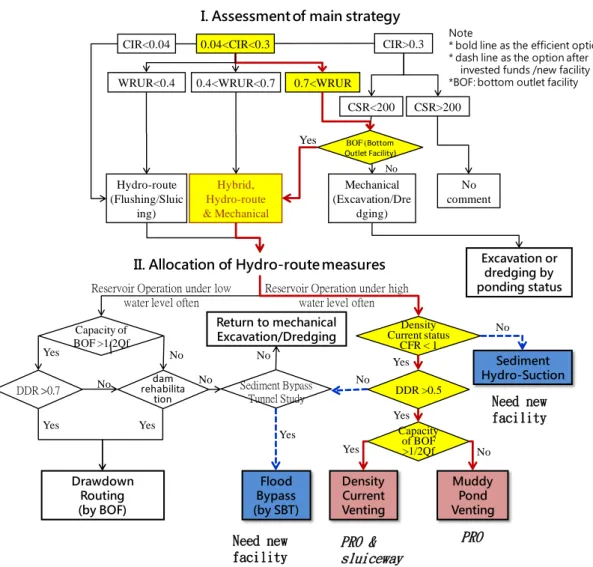
The assessment results of Deji Reservoir as Abb. 2 and Tab.1 , and brief comment as follows.
A. the main strategy for sediment releasing of Deji Reservoir
It is recommended that Deji Reservoir use hybrid measures (Hydro-route & Mechanical ) to control the storage capacity.
B. Allocation of hydro-route measures
B1. For reservoir operation under high water level often, so the drawdown routing is not accepted.
B2. As the density current does not happen/approach at dam site, such as in dry season, the sediment hydro-suction is required and has to invest relative instruction.
B3. As the density current happens/approaches at dam site and the sluiceway (with discharge capacity 1,400 cms) is greater than 1/2Qf , the density current venting is effective as that the density current elevation higher than the top of sluiceway.
B4. As the density current happens/approaches at dam site and the permanent river outlet (with total discharge capacity 130 cms) is less than 1/2Qf , the muddy pond venting is effective at the period of flood recession.
C. Recent research results for establishing the sustainable sediment management in reservoirs
Taipower company as the owner of Deji Reservoir planning the master plan of sustainable sediment management in recent years (from 2017 until now) in order to the vision as no more deposition increasing inside reservoir around 2030 as Abb.3 shown.
Abb. 2 : The flow chart for assessment of effective sediment releasing countermeasure in Deji Reservoir
Tab. 1 : Notation definition of the flow chart for assessment of effective sediment releasing countermeasure Notation Definition Below quality with the unit by volume
CAP:capacity of reservoir
MAR:mean annual inflow of reservoir MAS : mean annual sediment inflow of reservoir
MAWS:mean annual water supply
BOL : bottom outlet level, the NWL to the centerline level of bottom outlet
CIR Capacity-Inflow Ratio CAP/MAR
CSR Capacity-Sediment Ratio CAP/MAS
WRUR Water Resources Utilization Rate MAWS/MAR
DDR Drawdown Ratio DDR >0.7
Assessment of sediment releasing in Taiwan Reservoir ( Deji Reservoir as example)
0.4<WRUR<0.7 0.7<WRUR Mechanical (Excavation/Dre dging) Hybrid, Hydro-route & Mechanical Hydro-route (Flushing/Sluic ing) Excavation or dredging by ponding status
CIR<0.04 0.04<CIR<0.3 CIR>0.3
WRUR<0.4
CSR<200 CSR>200
No Yes BOF (Bottom Outlet Facility)
II. Allocation of Hydro-route measures
Muddy Pond Venting Sediment Hydro-Suction No Flood Bypass (by SBT) Drawdown Routing (by BOF)
Reservoir Operation under low water level often
Reservoir Operation under high water level often
No No No Density Current status CFR < 1 No DDR >0.5 dam rehabilita tion Capacity of BOF >1/2Qf Capacity of BOF >1/2Qf Density Current Venting Yes No Return to mechanical Excavation/Dredging Yes Yes Yes Yes Yes Sediment Bypass Tunnel Study No PRO & sluiceway PRO Need new facility Note
* bold line as the efficient option * dash line as the option after
invested funds /new facility *BOF: bottom outlet facility
I. Assessment of main strategy
No comment
Yes
Need new facility
1-BOL/SWL SWL :Surcharge water level, the NWL to the bottom of reservoir
Qf : inflow of frequently flood , like 2 year flood frequency
CFR Capacity -Flood Ratio CAP/Qf
Abb.3: Deji Reservoir 2030 vision for the sustainable sediment management in reservoirs
3.1 Stage I : Monitoring of density current and analysis of de-silting effect of exited facility (2018~2020)
A. Monitoring of Density Current in Ponding Area and River
Deji Reservoir established four monitoring stations in April 2017, and record density current just one times at July 2017 due to dry year.
#1 station at upstream river : Monitoring inflow sediment
#2 station at ponding area near dam site : Recording the change of suspended sediment concentration (SSC), and analyzing the timing of density current near dam site. For the high SSC monitoring in density current, the time domain reflectometry method (TDR) has been developed recently for SSC monitoring with advantages of economy, maintainability, high SSC monitoring, and relative independence of water salinity and particle size. The recording range for TDR in SSC from 2,000ppm to 600,000 ppm.
#3 station at downstream side of dam site : Monitoring outflow sediment for spillway, PRO , sluiceway, and tail water of plant.
#4 station at downstream side of spillway tunnel : Monitoring outflow sediment for spillway tunnel.
B. The numerical model simulates the flood event
Annual Sediment Inflow 1.86 Million m3
Reservoir Deposition Increasing 0 m3 After 2030
Check dams
Diversion weir
Sediment bypass tunnel
Dam Site
Deji River Reservoir
It needes simulation and analysis of the density current in order to optimize the gate operation of hydro-route type for sediment releasing. The simulation of Deji Reservoir use FLOW-3D which accomplished many density current cases in reservoirs of Taiwan. For lack of new data, the calibration data of numerical model takes Sepat typhoon at August 2007 which with muddy pond in dam site, and the forecast scenario of numerical model takes hydrograph of 2-year flood frequency and 20-year flood frequency. There are some outcome as below:
The plunge point of the density current is about section 28 (shown as Abb. 4), where is the water surface widening and deepening of the water depth .
The time of density current arrives dam site occurs at 11 hours after the density current plunge into the section #28 .
The migration speed of density current is related to the terrain of the valley, the migration velocity in the canyon section is faster than that of the wide valley section.
Abb. 4 : Map of the ponding area of reservoir and the number of survey sections
3.2 Stage II:Optimization for spillways and other discharge facilities
After 3 years works of monitoring and analysis as aforementioned, the optimization for spillways and other discharge facilities will be achieved as follows:
A. Optimization for operation on gate of Deji Reservoir
Optimization for density current venting and muddy pond venting according to the simulation result of Flow-3D, and distinguish the timing of both.
To set up new directions on gate of Deji Reservoir.
Rehabilitation for the gate of PRO to improve the flushing sediment capacity and reduce the repair work.
Adding sediment hydro-suction pipe system which passes through spillway tunnels to reduce the construction and operation costs. And the long-term plan to add curtain in front of spillway to improve the drainage efficiency of the density current at the bottom of the spillway.
3.3 Stage III: Layout of sediment bypass tunnel
The outline of sediment bypass tunnel recommended in May 2017 as below, and the plan layout of tunnel route and intake are shown in Abb.5 to a Abb.6:
Scheduled route :The total length of tunnel about 9.5 km, from the left bank of upstream of ponding area as survey section #39 to 1 km downstream of dam site as the downstream of exit of spillway tunnel..
The longitudinal slope of the tunnel : about 1.37 %.
The tunnel cross section:As the D -shaped cross section, the width is 7.0 m , the height is 8.0m.
The design discharge is 650cms about flood with the return period 2 year.
At present, it is estimated that the flushing sediment rate of the tunnel is limited to: (1) the amount of flushing discharged is not much, and (2) the inlet located at ponding area by backwater of reservoir and the sediment concentration may not be high in the high water level operation of reservoir.
The flushing sediment rate of the tunnel will be reviewed in accordance with the aforementioned #1 monitoring stations taking more trustworthy flood data, and then have the discussion on the effectiveness of the sediment bypass tunnel.
4 Conclusion
The sediment de-silting in Deji Reservoir face the difficulties as high altitude, lacking of land transportation and the dredging depth 90 meters. After taking reference from relevant international study, Taipower company use the flow chart for assessment of effective sediment releasing countermeasure in Taiwan to find out the “Integrated Sediment De-silting Strategy of the Deji Reservoir”. It recommended the main strategy for sediment releasing is hybrid measures (Hydro-route & Mechanical ) to control the storage capacity.
Abb.5: the plan layout of tunnel route Abb.6: the plan layout of intake
“Integrated Sediment De-silting Strategy of the Deji Reservoir ” started at the 3 years of monitoring of density current and analysis of de-silting effect of exited facility. According to the simulation of Flow-3D, we understand the characteristics of density current approaching dam site, and then to optimize operation on gate of spillways and other discharge facilities. However, the monitoring period is too short, it is still impossible to simulate verification. To keep monitoring is important currently, and to rehabilitate and make the best of exited facilities in dam site. In the long term, it will build the new de-silting measures including sediment bypass tunnel, sediment hydro-suction system etc. to control the storage capacity.
References
Basson, G.R., and Rooseboom, A. (1997), Dealing with reservoir sedimentation, Water Research Commission Report No. TT 91/97, Pretoria, xxxiii+395 pp.
ICOLD Bulletins 115 (1999), Dealing with reservoir sedimentation.
Sumi, T., and Iguchi, M.(2005), Technical feasibility study of sediment flushing in reservoirs using the RESCON model, Journal of Japan Society of Dam Engineers, Volume 15 Issue 2.
Water Resources Agency, MOEA, ROC (2014), The Strategy study of reservoir sediment monitoring and de-silting operation. (in Chinese)
Water Resources Environment Center, Japan. (2008),Technical note on sediment control measures for dam. (in Japanese)
White, R. (2001), Evacuation of sediments from reservoirs, HR Wallingford, Thomas Telford.
Authors
Chi-Lin Yang (corresponding Author) Pang-ku Yang
Fu-June Wang, Hsieh-Kuo-Cheng
Taipower Company, Taiwan Email: [email protected]