國
立
交
通
大
學
資訊科學系
碩 士 論 文
使用社會模擬分析傳媒
在政治極化動態中的角色
Analyzing the Role of Mass Media
In the Dynamics of Political Polarization
Using Social Simulation
研 究 生:張其煜
指導教授:孫春在 教授
使用社會模擬分析傳媒
在政治極化動態中的角色
學生:張其煜 指導教授:孫春在 教授
國立交通大學資訊科學研究所
摘要
「 政 治 極 化 」 是 近 年 來 在 許 多 民 主 國 家 中 普 遍 存 在 的 一 種 社 會 現 象 , 頗 受 社 會 科 學 領 域 的 學 者 , 尤 其 是 政 治 學 家 的 重 視 。 本 研 究 從 社 會 極 化 程 度、意 見 群 聚 度 和 意 見 極 化 程 度 三 個 不 同 的 層 面 來 定 義 政 治 極 化 現 象,並 結 合 新 興 的 社 會 科 學 電 腦 模 擬 與 複 雜 網 路 理 論 二 種 研 究 工 具 來 建 立 模 擬 模 型,且 探 索 政 治 極 化 的 發 展 機 制 、 形 成 過 程 與 動 態 結 果 。 我 們 擴 充 單 一 議 題 的 意 見 動 態 模 擬 模 型 成 為 多 議 題 的 意 見 動 態 模 擬 模 型,並 充 分 利 用 人 際 接 觸 社 會 網 路 的 小 世 界 與 無 尺 度 性 質,來 模 擬 與 分 析 媒 體 數 量 和 報 導 內 容 在 政 治 極 化 的 發 展 過 程 中 所 扮 演 的 關 鍵 角 色 。 根 據 模 擬 模 型 的 實 驗 結 果 , 我 們 發 現 , 新 聞 媒 體 渲 染 誇 張 與 重 口 味 的 報 導 方 式 , 是 政 治 極 化 形 成 的 一 個 重 要 因 素 , 而 我 們 也 從 模 擬 模 型 的 敏 感 度 分 析 實 驗 中 發 現,若 能 提 昇 新 聞 報 導 的 公 正 性 , 將 能 有 效 減 緩 該 社 會 的 政 治 極 化 的 形 成 與 程 度 。關鍵字:政治極化、社會模擬、大眾傳播、人際傳播、意見動態、傳
播媒體、小世界網路
Analyzing the Role of Mass Media
In the Dynamics of Political Polarization
Using Social Simulation
Student: Chi-Yu Chang Advisor: Dr. Chuen-Tsai Sun
Institute of Computer and Information Science
National Chiao Tung University
ABSTRACT
“Political polarization”, an arising phenomenon in many countries in recent years, arouses great attention of scholars in social sciences, especially in political science. Our research defines political polarization in terms of the degree of social polarization, the opinion clustering and the extremity of opinion. We build a model, by a combination of computer simulation in social science and complex network theory, and explore the mechanism, the process and the result of political polarization.
We extend a single-issue model of opinion dynamics to a multiple-issue model, and incorporate characteristics in small-world networks and scale-free networks to simulate and analyze the role played by the amount of media and the media content.
According to the results of the experiments, we find that exaggerated reporting is an important factor to political polarization. Moreover, from the sensitivity analysis, we conclude that if the fairness of news could be raised, the degree of political polarization will be reduced and the formation of political polarization will be slowed. Keywords: Political polarization, social simulation, mass communication, interpersonal communication, opinion dynamics, mass media, small word networks
Index
TU摘要UT... I TUABSTRACTUT...II TU1UT TUINTRODUCTIONUT...1 TU2UT TURELATED WORKUT...4 TU2.1UT TUPOLITICAL COMMUNICATIONUT...4 TU2.2UT TUCOMMUNICATIONUT...6 TU2.3UT TUOPINION DYNAMICSUT...10 TU3UT TUMODELUT...12TU3.1UT TUBUILD THE NETWORKUT...12
TU3.2UT TUMEDIAUT...14
TU3.3UT TUINTERPERSONAL INTERACTIONUT...16
TU3.4UT TUFEATURE OF POLITICAL POLARIZATIONUT...18
TU4UT TUEXPERIMENTS AND ANALYSESUT...21
TU4.1UT TUOPINION CHANGING RULESUT...21
TU4.2UT TUAMOUNT OF MEDIAUT...25
TU4.3UT TUMEDIA BIASUT...26
TU5UT TUCONCLUSIONUT...30
TUAPPENDIX A 補充實驗UT...31
List of Tables
TUTABLE 1 THE COMPARISON OF THREE KINDS OF OPINION DYNAMICS MDOELSUT...10
TUTABLE 2LIST OF FOUR OPINION CHANGING RULESUT...22
List of Functions
TUFUNCTION 1 OPINION CHANGEUT...17TUFUNCTION 2 OPINION ALIGNMENTUT...17
TUFUNCTION 3EXTREMITY OF OPINIONUT...19
TUFUNCTION 4 OPINION CLUSTERINGUT...19
TUFUNCTION 5EXTREMITY OF SOCIETYUT...20
List of Pictures
TUFIGURE 1RESULT OF COUNTIES OF THE 2004AMERICAN PRESIDENTIAL ELECTION [19]UT...2TUFIGURE 2RESULT OF STATES OF THE 2004AMERICAN PRESIDENTIAL ELECTION [19]UT...2
TUFIGURE 3THE OPINION POLLS OF 2004AMERICAN PRESIDENTIAL ELECTIONUT...2
TUFIGURE 4THE RELATION OF OUR STUDY TO RELATED STUDIESUT...4
TUFIGURE 5MACRO VIEW OF COMMUNICATION ACTIVITIES [25]UT...7
TUFIGURE 6LASSWELL’S COMMUNICATION MODEL [27]UT...8
TUFIGURE 7THE COMMUNICATION MODEL OF OSGOOD AND SCHRAMMUT...9
TUFIGURE 8CELLULAR AUTOMATA,NEIGHBOR MODEL,OPINION MODELUT...13
TUFIGURE 9THE CONNECTIONS ON DIFFERENT ISSUESUT...14
TUFIGURE 10THE EXTREMITY OF OPINION POLARIZATION OF DIFFERENT OPINION CHANGING RULESUT...23
TUFIGURE 11THE OPINION CLUSTERING OF DIFFERENT OPINION CHANGING RULESUT...24
TUFIGURE 12THE EFFECTS OF THE AMOUNT OF MEDIA ON POLITICAL POLARIZATIONUT...26
TUFIGURE 13THE EFFECTS OF MEDIA BIAS ON POLITICAL POLARIZATION (MEDIA=1)UT...27
TUFIGURE 14THE EFFECTS OF MEDIA BIAS ON POLITICAL POLARIZATION (MEDIA=2)UT...27
TUFIGURE 15THE EFFECTS OF THE AMOUNT OF MEDIA ON POLITICAL POLARIZATION (MEDIA BIAS=0.6)UT...29
TUFIGURE 16THE EFFECTS OF MEDIA BIAS ON POLITICAL POLARIZATION (MEDIA=1)UT...31
TUFIGURE 17THE EFFECTS OF MEDIA BIAS ON POLITICAL POLARIZATION (MEDIA=3)UT...32
TUFIGURE 20THE EFFECTS OF MEDIA BIAS ON POLITICAL POLARIZATION (MEDIA=10)UT...34
TUFIGURE 21THE EFFECTS OF MEDIA BIAS ON POLITICAL POLARIZATION (MEDIA=30)UT...34
TUFIGURE 22THE EFFECTS OF MEDIA BIAS ON POLITICAL POLARIZATION (MEDIA=50)UT...35
1 Introduction
In 2004, both of the presidential elections were won by one of two major parties in a close distance to the other. [1][2] During of the campaign, no predictions could confidently tell the winner, a lot of exertions were devoted to the race, and relative reports occupied the media, which tied continuous high concern and notice to. After the polling day, some studies pointed out that the country seemed split. [3] People became closer to the party they supported, and even treated others supporting the other party as another kind of people and refused to talk with, viewed them as enemies. This phenomenon is called Political Polarization. [23] In our research, we wish to investigate the process of political polarization, including the essential factors and the effects of these factors and the integrated effects.
There are three attractive features in polarized society: (1) In plural society, people have preferences and values, but in polarized society the people following the same party have identical opinions of political issues even and even show identical value, which makes the differences between people indistinct. Hence, the society seems simplified, the supports of one party are one kind of people, and there are only two kinds of people in the two-party system. (2) The supporters of one party take care on only positive information on their party, and dwell together. It appears not only at the micro level, the counties (Figure 1), but also at the macro level, the states (Figure 2). [19] (3) According to the researches, there will be group polarization effects when people discuss in a group, which makes the average opinions of group members more extreme. In the polarized society, it’s found that the extreme voices were hared more but the moderate voices less. Figure 3 shows that most of Americans had decided the candidate to vote many days in advance of the polling day.
Figure 1Result of counties of the 2004 American presidential election [19]
Figure 2 Result of states of the 2004 American presidential election [19]
Figure 3 The opinion polls of 2004 American presidential election (From www.pollingreport.com)
by the compound effect of these reasons, which may not only directly affect political polarization but also affect each other. Besides, we should take time into consideration, for example, the effects from media at this time may affect the effect from media at the next time. There have been some studies providing inferences to political polarization, but the actual reasons of political polarization are still not clear. What is sure is that political polarization is not caused in a short while; it must be caused in a long term and during that many occasional and still reasons affect and reinforce each other. Therefore, when studying political polarization caused by the compound effect of many reasons it’s needed to consider the time and the dynamics in it. In other words, political polarization is a process not a result. By means of analyzing the dynamics of political polarization in the society we can know more about how the reasons affect the society and how they affect each other. This paper focuses on the role of media in the dynamics of political polarization.
By means of the features, crowded audiences, of media, politicians and parties spread their belief and opinions through media to the people. And by the help of media, the people realize politics. Our research does focus on what differences will the media having large influence bring the opinion dynamics of the society. Our result advocates that media could promote the political polarization.
This paper refers to the researches on political communication and communication, and uses computer simulation to make the study, which is introduced in section 2. The detail of the model is presented in section 3. The experiments and analyses are in section 4. We conclude in section 5.
2 Related Work
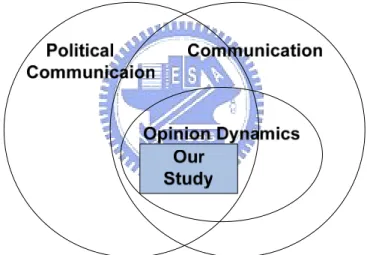
We start the study of political polarization on three directions. First, in the direction of politics, of course political polarization is a problem about politics. We will introduce the status of the researches. Second, because political polarization partly stands for that the opinions of people on some issues separate to two polar. For the sake of realizing the changes and distributions of the opinions in the society, it’s better to begin with the studies of communication. The third is about out approach for experiments. The progress of our approach, using computer simulation, is explained here.
Figure 4 The relation of our study to related studies
2.1 Political Communication
Political polarization is about political communication which means the communication process of messages in the political system. [24] Political communication, which has an important function of input in the political system, and political developments are mentioned in the same breath. Moreover, from the viewpoint of communication, R. Fagen views the flow of political information as a
include “the degree of control of government on media”, and “the union of communication media and political elites”. The essential components of political communication are as following:
1. Communicator: A person or a group wants to influence the policy of the
government, such as parties or government organizations.
2. Message: What is used to communicate thoughts to receivers, such as words or
body language.
3. Media: What can deliver messages which communicators want to send to
receivers, such as TV or broadcasters.
4. Receiver: A person receives messages through media from communicators, such
as audiences watching TV programs.
5. Response: What are expected by communicators on receivers. It can be
categorized into four.
5.1 Enlighten: Receivers start to consider a new problem.
5.2 Change: Receivers change their position of an issue, to agree or to oppose. 5.3 Enhance: The original opinions of the receivers become more deep-rooted. 5.4 Act Out: Receivers not only response on their opinion but also take actions. Our research didn’t consider the effect of parties but emphasize on media and people. People play both the roles, communicators and receivers. They affect the others and are affected, such that we treated all people the same and didn’t separate them to communicators or receivers. Our model only simply takes the responses, change and enhance, into consideration that means in our model the number of issues is fixed, no new issues would be added by enlightenment, and people would take no actions even if their opinions comes to the extremity.
2.2 Communication
Communication is a social phenomenon since the beginning of human. Encyclopedia Britannica’s explanation of communication is “the exchange of meaning between individuals through a common system of symbols”. When explaining communication, Wilbur Schramm quoted the words, “every cultural pattern and every single act of social behavior involve communication in either an explicit of implicit sense”, which was written by Edward Sapir. [26] Claude E. Shannon and Warren Weaver broadly defined communication as “all of the procedures by which one mind may affect another”. The first study of communication can be traced to the course “yan-yu”, the spoken language, set by the east scholar Confucius and the book, Rhetoric, written by west scholar Aristotle. [25] Nowadays, through continuous studies, communication has been extended to many other fields and a lot of results have accumulated. In order to connect with previous studies, we can use the sort of the studies of communication to know more about the relation between previous studies and political polarization. The Scholar, Frederick T. C. Yu, concluded that there are three basic objects of the studies of communication: (1) individual (2) group (3) channel. Then, we can have a sort of communication as following: [25]
Public Communication
Figure 5 Macro view of communication activities [25]
1. Intra-personal communication 2. Interpersonal communication 3. Small-group communication 4. Organizational communication 5. Public communication 6. Mass Communication 7. International communication
Among them, we emphasize on interpersonal communication which is the basis of other multiple-person communication. Besides, the studies of mass communication can assist us in building the model of media. There are some other studies about the communication models, which can make the variables of communication clearer and more exact. The first communication model was proposed in Aristotle’s Rhetoric, which brought up five components of communication: source, context, receiver, environment, and effect. But how these components work was not addressed. Harold
Lasswell’s communication model proposed in 1948 could be known as one sentence, “Who Says What in Which Channel to Whom with What Effect”. [27] (Figure 6)
Figure 6 Lasswell’s communication model [27]
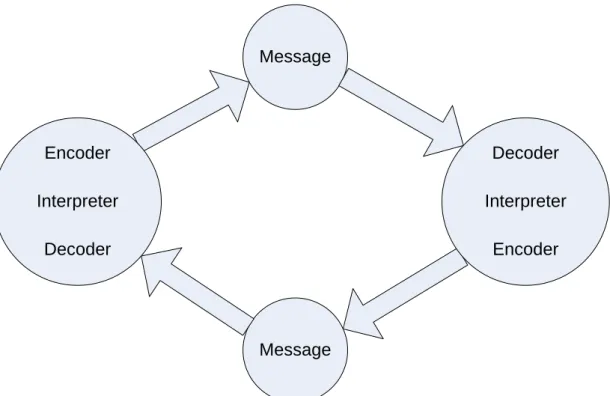
Lasswell’s model tried to explain the components of communication and the different fields of communication research. However, it’s found later that Lasswell’s model lacks feedback and it is single-direction not bidirectional. The model of C.E. Osgood and Wilbur Schramm (Figure 7) is bidirectional; both sides in communication could send and receive messages. Moreover, the model also shows that communication isn’t perfect. The sender encodes the meaning which is expected to be known by the receiver as messages. Through media, the messages are sent to the receiver. Then, the receiver decodes the messages to retrieve the meaning. However, the meaning retrieved is more or less different to the original meaning.
Message Message Interpreter Encoder Decoder Interpreter Decoder Encoder
Figure 7 The communication model of Osgood and Schramm
These models depict the key components and flow of communication, which could help us know the basis of communication. In the studies on mass communication, we have more interest in how mass media affect what people think. We could start from the effect and the flow of communication. In the field of the effect of mass communication, scholars in early days supposed that people are blind and have no definite views. People may change their minds through persuasive or authoritative messages. Like be injected into an anesthetic, people lose consciousness right after the injection. Therefore, this viewpoint of mass communication is called “Hypodermic Needle Model” or “Bullet Theory”. But this viewpoint was argued later. The effect of mass communication was found not as effective as indicated in previous studies. It is Limited Effects Model, which points out that people do not trust mass media completely. Even some other studies showed that people is affected more by face-to-face communication than mass communication. These studies made a progress in the flow of mass communication, which came to “two-step flow of
communication”, which considered that the flow of mass communication is firstly from media to opinion leaders, and then from opinion leaders to other people. [18] The newer studies even considered that the flow is not only two steps but multiple steps. [29] Our model takes these studies into account and is a bidirectional model. The detail is described in section 3.
2.3 Opinion Dynamics
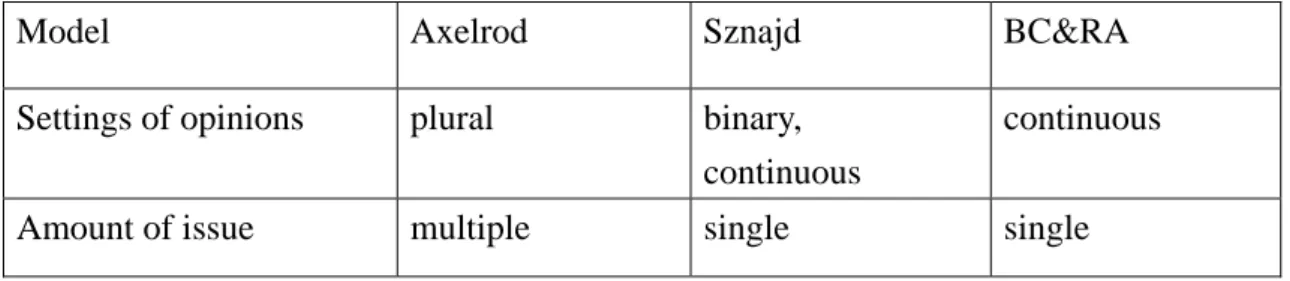
Most of the traditional approaches to study communication problems are by observation or survey. Yet these approaches are hard to carry out when dealing with the communication problems which a lot of people involve in, such as political polarization. The approach of computer simulation can overcome this problem. Social simulation is a more and more usually used method which using computer simulation to study social problems. Comparing with traditional methods, it can make the social process clearer. [5] There were many studies about communication using social simulation, for example, Axelrod’s culture communication, J. Kottonau and C. Pahl-Wostl’s simulation on political attitude and voting behavior. [7][31] There are different social influence models on these simulations. Many of them put emphasis on social influence, opinion formation, and opinion dynamics, such as Sznajd model [6][21], Bounded Confidence Model [14][20], and Relative Agreement Model [9][30]. We can categorize these models by opinion setting, binary or plural or continuous, and number of issue, single or multiple. (Table 1)
Table 1 the comparison of three kinds of opinion dynamics mdoels
Model Axelrod Sznajd BC&RA
Settings of opinions plural binary,
continuous
continuous
Our research is on the polarized society with multiple issues. Because binary or plural opinions are hard to present polarized opinions, we extend the single-issue BC model to a multiple-issue model.
People in the society are not alone but have interactions with others. We can make use of this feature to simulate a society. If we use nodes to represent people and connections between nodes to stand for interaction between people, we can build a social network that represents a society. There are many kinds of interaction, such as the sexual relation and the relation of friendship. Different relation could build unlike social network. It’s a significant direction to investigate social problems. Modern researches on society and communication place importance on social network. But former researches on opinion dynamics didn’t consider the features on real social network. Much of them used 2-d lattice or cellular automata to represent to society, which using grids to stand for agents and only agents neighbored with can establish connections to execute opinion exchange or communication. [7][13] Later researches brought the results on social networks to researches of opinion dynamics, for example, scale-free network [11][12] and small-world network [30]. Our model has a social network possessing the features of real society, small world properties [22] and scale free topology. The process of building the network will be discussed in section 3.
3 Model
Most models of opinion dynamics could be separated as two parts, social
networks and interpersonal interaction. Our model, added the media, has three parts, the first part is the social network as the basis, it is described in section 3.1. The second part in section 3.2 details the setting of the media. The third part is in section 3.1, and it describes the interaction of two agents and how the opinions of them change. The last section 3.4 gives the definitions of the features of political polarization in our model.
3.1 Build the Network
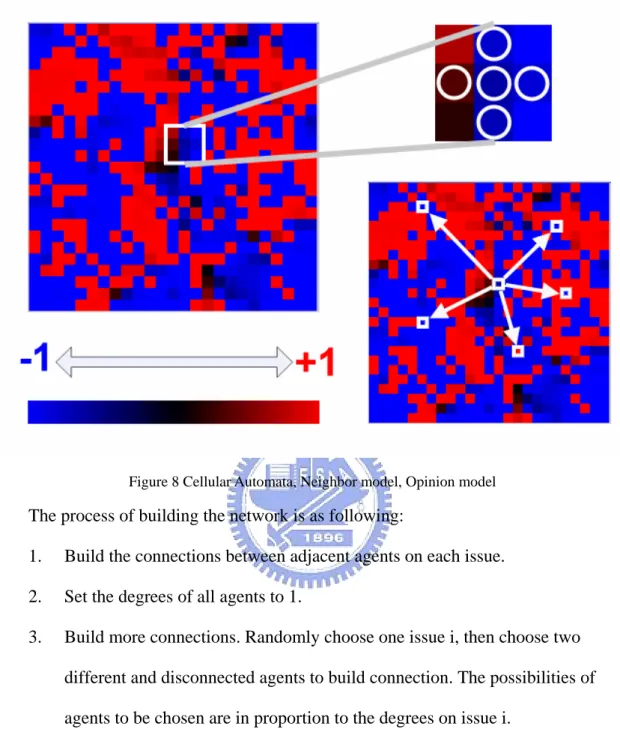
In the recent researches on social networks point out that real social network possess three features, high clustering, low degrees of separation and scale free topology, former two is called small world property [22]. There are many methods to build a network which has the features described above. We use cellular automata (Figure 8, upper left) with von Neumann neighborhood model (Figure 8, upper right) and add some short-cuts (Figure 8, lower right) to build the social network having the features of real social network.
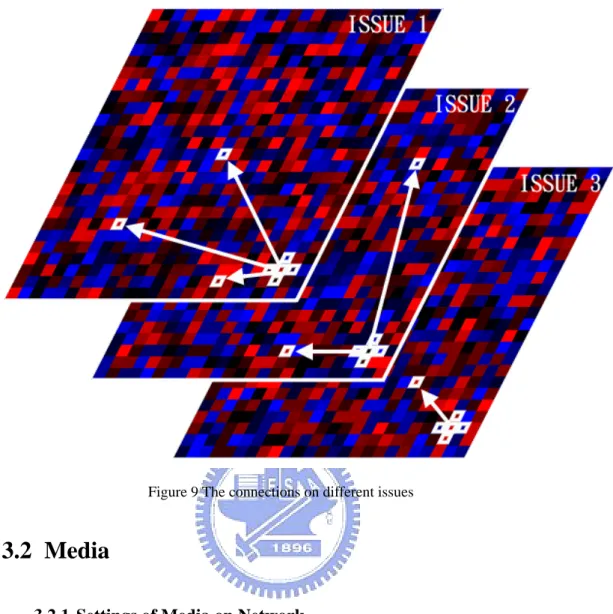
The social network is composed of the connections between agents. The difference to other opinion dynamics models is that the connection between two agents isn’t binary, existed or not, but is more possibilities. (As in Figure 9, the agents linked to the agent A are different on different issue.) If there are I issues in the agent
society, the number of possibilities between two agents will be . Every agents has
the opinion of his own, which is a real number ranged from 1 to -1.
I
Figure 8 Cellular Automata, Neighbor model, Opinion model
The process of building the network is as following:
1. Build the connections between adjacent agents on each issue.
2. Set the degrees of all agents to 1.
3. Build more connections. Randomly choose one issue i, then choose two
different and disconnected agents to build connection. The possibilities of agents to be chosen are in proportion to the degrees on issue i.
4. Add the degrees of the agents chosen 1.
Figure 9 The connections on different issues
3.2 Media
3.2.1 Settings of Media on Network
Many researches about media on opinion dynamics make media independent of interpersonal network and have the setting that every agent in the simulated society could be affected by media. But such communication-flow model doesn’t match two-step process or multiple-step process in the researches of mass communication. Our model makes use of the features of media, a lot of audiences, for example, the volume of circulation of Washington Post is about 780 thousands[32], and the scale-free feature of social networks, to set media as the nodes having the highest degree in social networks. Then the opinion of media could deliver to the agents connected to media and through them the opinion spreads out. This
communication-flow has better conformity with two-step or multiple-step flow of mass communication.
After media added, the process of building the network is as following:
1. Build the connections between adjacent agents on each issue.
2. Set the degrees of all agents to 1.
3. Build more connections. Randomly choose one issue i, then choose two
different and disconnected agents to build connection. The possibilities of agents to be chosen are in proportion to the degrees on issue i.
4. Add the degrees of the agents chosen 1.
5. Repeat 3. until 17*population connections is built.
6. Select some nodes in social network as media by degree. The number of
media differs by the experiments.
7. Connect media to its audiences which have any connections with the media
on all issues.
3.2.2 Other Settings of Media
There is a lot of news reported by media everyday, and there are even 24-hours news programs. But most of the news is not the concern of people, only little news could be the concern which is the focus of our research. Then, in this section we will explain how media report in our model. In our model the way media report reflects that in real world media expect to have more audiences. Therefore, we set two rules. First, media try to satisfy as many audiences as possible. Second, media views each opinion from distinct individual as different. Media pay more attention on the opinion from an individual having higher degree (more connections to others), which may reflect the opinion of a larger group of people. There are some methods that media
can use to know what the audiences think. 1. Letters to the editor 2. Program rating 3. Opinion polls. According to the delay of feedback in mass media proposed by Ray Hiebert, Donald Unqurait and Thomas Bohn, the media in our model carry out opinion polls in certain time span. Then, the media multiply the opinions gathered with the degrees as weight to get a weighted average opinion and take it as media opinion to report. Before the next opinion poll, media keeps reporting last opinion calculated.
The process that media update its opinion is as following:
1. On each distinct issue, separately gather the opinions of audiences and by
multiplying the degree of the opinion source get the weighted average opinion.
2. Do report according to the weighted opinion on all issues.
3.3 Interpersonal Interaction
In each of iteration, the operation of the simulation is to exchange the opinion on a certain issue between two agents.
There are three kinds of reactions after the interactions between agents: 1. Modify the original opinion to be like the other’s. 2. Modify the original opinion to dislike the other’s. 3. Do nothing. They are distinguished by the degree of opinion difference between two agents on the issue interacted on. [15] The opinion difference is the absolute value of one opinion subtracts the other. The opinion is ranged from 1 to -1, such that the opinion difference is ranged from 0 to 2. With the opinion difference, two thresholds, U and T, help to distinguish three interactions. If the opinion difference between two agents is lower than T, they take the first reaction, approaching the other’s opinion. If the opinion difference between two agents is
higher than U, they take the second reaction, leaving the other’s opinion. Besides, agent’s do nothing. It could be described as following.
U O O If m,i − n,i < dOm,i =μ*(On,i−Om,i) T O O If m,i− n,i > dOm,i =μ*(Om,i −On,i)
Function 1 opinion change
(OBm,iB、OBn,i Bstands for the opinions of agent m, n on issue i, μmeans how quickly the
opinion changes.)
It is the setting on a single issue as above. The following is the setting between issues affecting each other.
In real society, people contact others, exchange their opinions, and what they talk about usually doesn’t restricted to only one issue. In one conversation, there may be one major issue and many minor issues that may ever not be discussed. The
discussion on the major issue will compose the main part of the impression to the conversation. And that affects other opinions of minor issues. We introduce it into our multi-issued model. Besides changes of the opinion of the discussing issue, the
opinions of other issues are aligned to the discussed issue. The rule is: if the discussing on the major issue makes the both opinions closer, the opinions of other issues are adapted to be closer. On the contrary, if the discussing on the major issue makes the both opinions farther, the opinions of other issues are adapted to be farther. The way that the opinions of other issues change is as following:
' ' ' , O , U O If mi− ni < ∀j∈I∧ j≠i dOm,j =μ'*(On,j −Om,j) ' ' ' , O , T O If mi− ni > ∀j∈I∧ j≠i dOm,j =μ'*(Om,j −On,j)
Function 2 opinion alignment
(O’Bm,iB、O’Bn,iB stands for the opinions of agent m, n on issue i, μ’ means how quickly
the opinion changes. I means the set of all issues. U’ means the minimum alignment threshold. If the distance between the opinions is lower than U’, the alignment of being closer could take place. T’ means the maximum alignment threshold. If the
distance between the opinions is higher than T’, the alignment of being further could take place.)
In all cases, U’ will be smaller or equal to U and T’ will be larger or equal to T. The longer the distance between U’ and U and the distance between T’ and T, the weaker the strength of alignment is. When U’ is equal to 0 and T’ is equal to 2, alignment will never take place. Yet when U’ is equal to U and T’ is equal to T, alignment will occur that cooperate to the change of opinions on major issue.
The process of iteration is as following:
1. Select an agent A1 from all of them. All agents have same chances to be
selected.
2. Select an issue I from all issues that agent A1 has opinions. All the issues
have same chances to be selected.
3. Select another agent A2 which has a connection with agent A1 on issue I. All
the agents have same chances to be selected.
4. Collect to opinions from both agents on issue I and calculate the new
opinions of them (Function 1).
5. Make use of the new opinions from step 4 calculate opinion alignment
(Function 2).
3.4 Feature of Political Polarization
Three features of Political Polarization in our model, social polarization, opinion clustering, and opinion polarization, are defined as following:
Extremity of Opinion Polarization﹝EOBavgB﹞:
The opinion is ranged from 1 to -1, and the extremity of opinion is defined as the average of all averaged absolute opinions of all issues. The maximum of the extremity of opinion is 1 meaning that all opinions are extreme, and the minimum of the
extremity of opinion is 0 meaning that most opinions are moderate and uncertain. N O EO N k i k i
∑
= = 1 , EO EO I I i i avg∑
= = 1Function 3 Extremity of Opinion
(OBk,i Bmeans the opinion of agent k on issue i, and there are N agents and I issues.)
Opinion Clustering﹝OCBavgB﹞:
Opinion Clustering of one agent means the proportion of connections with both agents having same direction of opinions to all connections between the agent and all other agents connected. For Example, in one group of five agents connected with each other only one of them has different opinion to the others. Then the Opinion
Clustering of those agents having same opinion is(C25 −5) C25. Opinion Clustering of the Social is the average of all Opinion Clustering of all agents.
(
LOS L)
N OC N k i k i k i∑
= = 1 , , OC OC I I i i avg∑
= = 1Function 4 opinion clustering
(SBk,i Bmeans the set of agents containing agent k and all other agent connected to agent
k on issue i. LBk,i Bmeans all distinct connections between two agents in set SBk,iB. LOSBk,i
Bmeans all distinct connections between two agents having same direction of the
opinion in set SBk,iB. There are I issues.)
Opinion Type on One Issue:
There are two Opinion Types on One Issue, the opinion larger than zero and smaller or equal to zero.
Opinion Type﹝OT﹞:
When there is only one issue, the Opinion type is equivalent to the Opinion type on One Issue. When there are two issues, the Opinion type is the permutation of two Opinion Types on One Issue. There are four Opinion Types. (1)The opinions of two issues are both larger than zero. (2)The opinions of two issues are both smaller of equal to zero. (3)The first opinion of two issues is larger than zero, and the second is smaller or equal to zero. (4) The first opinion of two issues is smaller or equal to zero,
and the second is larger than zero. Hence, if there are I issues, there will be Opinion types.
I
2
Opposite Opinion Type﹝OOT﹞:
If the opinions of all issues in two different Opinion Types are separately opposite, one is larger than zero and the other is smaller or equal to zero, we define one of the Opinion Type is the Opposite Opinion Type of the other.
Extremity of Social Polarization﹝ES﹞:
The ratio of the maximum number of the agents having certain Opposite Opinion Types to the number of all agents is defined as Extremity of Social Polarization. The maximum of Extremity of Social Polarization is 1, which stands for fully polarized society. The Opinion Types in fully polarized society must be one of the Opposite
Opinion Types. The minimum of Extremity of Social Polarization is , I stands for
the number of issues.
I − 2 N NOOT MAX ES = ( k)
Function 5 Extremity of Society
(NOOTBkB means the number of agents having the Opposite Opinion Type OOTBkB, there
4 Experiments and Analyses
There are three experiments. In the first experiment we extend the single-issue model [15] to a multiple-issue model, and observe the performance of different opinion changing rules on extremity of opinion polarization and extremity of social polarization. Its objective is to choose the proper one of the opinion changing rules to do the following experiments. We start experiments about media from the second. This experiment reflects the developments of various media in real society which make the world filled with useful and useless information. This experiment expects to examine how the amount of media affects political polarization. Following the
previous experiment the third inspects that how the biased reports affect political polarization.
4.1 Opinion Changing Rules
The most appealing question of the studies of opinion dynamics is that what change, such as consensus or separation, of the opinions of people will occur with the different ways which people change their mind after some interactions with others. [15] The goal of this experiment is to observe that how the opinion of people will change with four different opinion changing rules when the there is single issue or multiple issues. The opinion changing rules are differentiated by two thresholds. They are values on the axis of opinion difference between two people which ranges from 0 to 2. The larger one, T, means the minimum that people could tolerate the opinion of the other. The smaller one, U, means the maximum that people would be attracted to the other’s opinion.
Table 2 List of four opinion changing rules
(U,T) = (0.4, 0.6) (1) Repelling higher then being attracted
(U,T) = (1.2, 1.6) (2) Being attracted higher then repelling
(U,T) = (0.2, 1.6) (3) Balanced being attracted and repelling
(U,T) = (0.6, 1.2) (4) easier to change the (3)
The opinion changing rule 1:
The values of U and T are 0.4 and 0.6 which denotes that there are higher
possibilities to repel the opinions of others than to be attracted. The distance between U and T is 0.2, which is the smallest of all four opinion changing rules, which means that this rule is sensitive small difference may bring out distinct reactions.
The opinion changing rule 2:
The values of U and T are 1.2 and 1.6 which denotes that it is easier for people to be attracted by the opinion of the other than to repel the opinion.
The opinion changing rule 3:
The values of U and T are 0.2 and 1.6 which denotes the chances of being
attracted and repelling are more balanced. The distance between U and T is 1.4, which is the largest of all four opinion changing rules, which means that the different
reactions taken by people come from really different opinion, and there are lower possibilities to adjust the opinions. In other words, people insist their opinions more and are more unwilling to change the opinions of their own
The opinion changing rule 4:
The values of U and T are 0.6 and 1.2 which denotes the chances of being attracted and repelling are more balanced, too. But this opinion changing rule has higher chances to alter the opinions.
Under this setting, as explained in section 3, the alignment of other issues will take place when the opinion of major issue changes, which makes the people become more similar or dissimilar after an interaction.
We performed the experiment with single issue and five issues, and used the extremity of opinion polarization and the opinion clustering to present the differences between opinion changing rules.
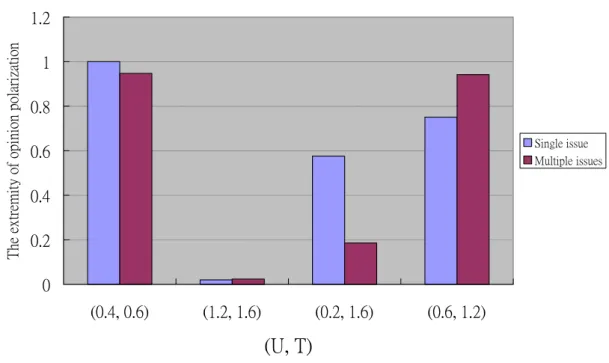
The comparison of four opinion changing rules is as Figure 10, 11. The extremity of opinion polarization is higher in first and fourth opinion changing rules (Figure 10). The difference between them can be found on the average opinion clustering in
multiple issues (Figure 11), which indicates that the fourth rule has higher average opinion clustering. The analyses are as following:
0 0.2 0.4 0.6 0.8 1 1.2 (0.4, 0.6) (1.2, 1.6) (0.2, 1.6) (0.6, 1.2)
(U, T)
The extremity o f opi nion p olariz atio n Single issue Multiple issues0 0.2 0.4 0.6 0.8 1 1.2 (0.4, 0.6) (1.2, 1.6) (0.2, 1.6) (0.6, 1.2)
(U, T)
The o pinion cluste ring Single issue Multiple issuesFigure 11 The opinion clustering of different opinion changing rules
The opinion changing rule 1:
The extremity of opinion polarization is the highest of four opinion changing rules, but the opinion clustering is the lowest. The result comes from the tendency to repel opinions of others that make the chances to be attracted relatively lower. Keeping this kind of interactions brings the polarized society with people opposing to each other and having a low opinion clustering.
The opinion changing rule 2:
The extremity of opinion polarization is the lowest of four opinion changing rules. The result comes from that this rule tends to be attracted by opinions of others, which results in that the repelling conditions are hard to occur. The more people are attracted to others than repelling others, the more opinions are close to the middle.
The opinion changing rule 3:
The extremity of opinion polarization gets much lower by the effect of alignment of multiple issues.
The opinion clustering in multiple issues is higher than in single issue. This may result from that more issues make people have higher possibilities to find appealing opinions.
We use the opinion changing rule 4 (U=U’=0.6, T=T’=1.2) to perform the following experiments because the higher extremity of opinion polarization and opinion clustering matches more what we observed in the society of political polarization.
4.2 Amount of Media
This experiment is planned to know how the increase of media affects three features of political polarization, the extremity of the social polarization, the opinion clustering, and the extremity of opinion polarization.
The result (Figure 12) shows that with the increase of media, the opinion
clustering becomes higher but the extremity of opinion polarization is lower. There is no significant change on the extremity of social polarization.
The reason why the extremity of opinion polarization becomes lower is that the opinion of media is near zero, which comes from that the opinion polls taken as the opinion of media is on a great number of people. These opinions near zero could attract the extreme opinions, and then the extremity of opinion polarization becomes lower. The increase of opinion clustering comes with the decrease of the extremity of opinion polarization. The more opinions become moderate, the higher possibilities the opinions would be attracted. Therefore, the opinion clustering gets rising. However, no significant relation is found between the extremity of social polarization and the increase of media in this experiment. The result is different from what observed in the society of political polarization, such that we perform the next experiment to discuss
other variables of media on political polarization. The opinion clustering The extremity of opinion polarization The extremity of social polarization 0 0.2 0.4 0.6 0.8 1 0 2 4 6 8
The amount of media
Figure 12 The effects of the amount of media on political polarization
4.3 Media Bias
The reports of media could look different by altering the frame and length, etc. We performs this experiment to know what the media bias caused by the arrangement of content would affect political polarization.
The setting of media bias have two parts, the first part is the direction. The
direction of bias is determined by the opinion polls. When the opinion poll on an issue is above zero, the media bias is positive, and vice versa. The second part is the degree of media bias, which could be explained by some example. When the opinion poll on an issue is 0.1 but media report it as 0.3 or when the opinion poll on an issue is -0.3 but media report it as -0.5, the degree of media bias is 0.2. In another example, the media bias is 0.8. Then the media will report 1 when the opinion poll on the issue is
It could be found in the result that with the increase of media bias, the extremity of social polarization is rising and the opinion clustering and the extremity of opinion polarization have the same rising tendency (Figure 13, 14).
The opinion clustering The extremity of opinion polarization The extremity of social polarization 0 0.2 0.4 0.6 0.8 1 0 0.2 0.4 0.6 0.8 1
The degree of media bias
Figure 13 The effects of media bias on political polarization (Media=1)
The opinion clustering The extremity of opinion polarization The extremity of social polarization 0 0.2 0.4 0.6 0.8 1 0 0.2 0.4 0.6 0.8 1
The degree of media bias
The analysis about the increase of the extremity of opinion polarization with the increase of the degree of media bias is that the higher degree of media bias results in the disappearance of the moderate voice of media with no bias and more reaction of repelling, which makes the extremity of opinion polarization higher. The rising extremity of social polarization coming with the increase of the degree of media bias comes from the greater effect of media which makes the step size of changing the opinions larger. Then the opinion types of people change to the opinion type like or opposite to that of media sooner. The higher opinion clustering with the increase of the degree of media bias results from the rising extremity of social polarization. The alignment of certain opinion would damage the opinion clustering on other issues. But when the opinion types decreases caused by the rising extremity of social polarization, there would be more interactions between two people having the same opinion type. As a consequence, the damage to the opinion clustering of other issues caused by alignment reduces. Then the opinion clustering rises with the increase of the degree of media bias.
Figure 15 shows the effects of the number of media with the same degree of media bias on political polarization. The result indicates that the more media with the same degree of media bias, the higher extremity of social polarization and opinion clustering.
The opinion clustering The extremity of opinion polarization The extremity of social polarization 0 0.2 0.4 0.6 0.8 1 1 2 3
The amount of media
Figure 15 The effects of the amount of media on political polarization (media bias=0.6)
In our analysis, a biased media bring some effects to the society. Because of the broad range of opinion polls, the recipients of opinion polls from different media have numerous overlaps. Relying on the feature of opinion polls to reflect average opinions, the additional media are similar to the paths added to spread one opposite opinion type, which makes the extremity of social polarization rise. And as the previous analysis, the opinion clustering becomes higher.
5 Conclusion
Our research takes the responses, change and enhance, of political communication into consideration and builds a model of interpersonal communication and mass communication, which is extended from a single-issue model to a multiple-issue model.
On political polarization, we use computer simulation to analyze the difference on opinion clustering and extremity of opinion polarization between single issue and multiple issues. We do some experiments on the variables of media which may affect political polarization in addition.
When media which could objectively reflect the opinion of audiences increase, the extreme opinions will decrease, and it will be easier for audiences to find the mates having same opinions.
In contrast, when the degree of media bias becomes higher, the opinions will be more extreme, audiences will polarize, and the extremity of social polarization will rise. Furthermore, when the biased media increase, three features of political
polarization, the extremity of opinion polarization and the opinion clustering and the extremity of social polarization, will get higher.
As the results of the experiments, we find that the increased media won’t push political polarization to be more severe, but biased media play a more importance role in political polarization.
Appendix A 補充實驗
補充實驗有兩個目的,第一個是要試驗較長的代理人互動回合數,是否能有 如相同的結論。第二個目的是試驗不同類型的媒體對於政治極化的影響,這裡利 用到媒體連結度的設定,和大眾媒體不同,取用較低的連結度以模擬小眾媒體。A.1 補充實驗一
本實驗延長原先 50 萬次互動成為 500 萬次互動,分別進行了媒體數量為 1、 3、5,報導偏向為 0、0.1、0.2、0.3,0.4 的實驗。 在圖表 16、17、18 分表示媒體數量為 1、3、5 時,媒體偏向程度對於政治極 化的影響,與之前的實驗比較﹝如圖表 13、14﹞,除了媒體數量為 1 的實驗, 都反應出相同的傾向,也就是隨著媒體偏向的增加,意見群聚度、意見極化程度 與社會極化程度都會上升。在圖表 19 表示了媒體數量對於政治極化的影響,與 圖表 15 表示的較短互動時間的實驗比較,也呈現一致的傾向。 0 0.2 0.4 0.6 0.8 1 1.2 0 0.1 0.2 0.3 0.4The degree of media bias
The opinion clustering The extremity of opinion polarization The extremity of social polarization
0 0.2 0.4 0.6 0.8 1 1.2 0 0.1 0.2 0.3 0.4
The degree of media bias
The opinion clustering The extremity of opinion polarization The extremity of social polarization
Figure 17 The effects of media bias on political polarization (Media=3)
0 0.2 0.4 0.6 0.8 1 1.2 0 0.1 0.2 0.3 0.4
The degree of media bias
The opinion clustering The extremity of opinion polarization The extremity of social polarization
0 0.2 0.4 0.6 0.8 1 1.2 1 3 5
The amount of media
The opinion clustering The extremity of opinion polarization The extremity of social polarization
Figure 19 The effects of the amount of media on political polarization (media bias=0.4)
A.2 補充實驗二
此實驗的小眾媒體設定是利用減低的連結數量來設定小眾媒體,和大眾媒體 相比,在實驗中我們設定小眾媒體的連結數量約為大眾媒體的十分之一,並依此 設定進行了小眾媒體數量為 10、30、50,報導偏向為 0、0.1、0.2、0.3,0.4 的 實驗。 固定小眾媒體數量為 10、30、50 的實驗結果分別為圖表 20、21、22,如同 大眾媒體實驗所得到的結果,小眾媒體若增加了偏頗報導的程度,意見群聚度、 意見極化程度與社會極化程度也會隨之提高。 圖表 23 表示了固定的媒體偏頗程度設定時,不同小眾媒體數量的比較,與之 前大眾媒體的實驗結果比較﹝圖表 15、19﹞,社會極化程度並沒有明顯的上升 傾向。這應該是因為這時候的社會極化程度已經來到了高點,才表現不出明顯的 傾向。0 0.2 0.4 0.6 0.8 1 1.2 0 0.1 0.2 0.3 0.4
The degree of media bias
The opinion clustering The extremity of opinion polarization The extremity of social polarization
Figure 20 The effects of media bias on political polarization (Media=10)
0 0.2 0.4 0.6 0.8 1 1.2 0 0.1 0.2 0.3 0.4
The degree of media bias
The opinion clustering The extremity of opinion polarization The extremity of social polarization
0 0.2 0.4 0.6 0.8 1 1.2 0 0.1 0.2 0.3 0.4
The degree of media bias
The opinion clustering The extremity of opinion polarization The extremity of social polarization
Figure 22 The effects of media bias on political polarization (Media=50)
0 0.2 0.4 0.6 0.8 1 1.2 10 30 50
The amount of media
The opinion clustering The extremity of opinion polarization The extremity of social polarization
Figure 23 The effects of the amount of media on political polarization (media bias=0.4)
綜合以上的實驗結果,延長的互動回合數並不改變原有的觀察結果,小眾媒 體也表現出與大眾媒體一致的傾向。
Reference
[1] http://www.pollingreport.com/2004.htm [2] http://210.69.23.140/Excel/chart41.xls
[3] http://www.washingtonpost.com/ac2/wp-dyn/A39044-2004Apr24
[4] Moscovici, S. & Zavalloni, M., “The group as a polarizer of attitude”, Journal of Personality and Social Psychology 12, 125-135 1969
[5] Nigel Gilbert., “Simulation: A new way of doing social science”, The American Behavioral Scientist. Thousand Oaks: Aug 1999.Vol.42, Iss. 10; pg. 1485, 3 pgs [6] K. Sznajd-Weron and J. Sznajd, Opinion evolution in closed community, Int. J. Mod. Phys. C 11, 6 (2000).
[7] AXELROD, R., “The Dissemination of Culture: A Model with Local Convergence and Global Polarization”, J. Conflict Resolut. 41, pp. 203-226; The Complexity of Cooperation: Agent-Based Models of Competition and Collaboration, Princeton University Press, Princeton NJ. 1997
[8] Ray Hiebert, Donald Unqurait, Thomas Bohn, “Mass Media: An Introduction to Modern Communication”, New York: David Mckay, 1974
[9] Guillaume Deffuant, Frédéric Amblard, Gérard Weisbuch and Thierry Faure, “How can extremism prevail? A study based on the relative agreement interaction model”, Journal of Artificial Societies and Social Simulation vol. 5, no. 4 2002 [10] von Neumann Neighborhood,
http://mathworld.wolfram.com/vonNeumannNeighborhood.html
[11] Dietrich Stauffer, Adriano Sousa and Christian Schulze, “Discretized Opinion Dynamics of The Deffuant Model on Scale-Free Networks”, Journal of Artificial Societies and Social Simulation vol. 7, no. 3 2004
[12] Fang Wu and Bernardo A. Huberman , “Social Structure and Opinion Formation”, arXiv:cond-mat/0407252 v3 20 Jul 2004
[13] NOWAK A and Lewenstein M (1996) “Modeling social change with cellular automata”. In HEGSELMANN R, Mueller U and Troitzsch K G (Eds.) Modeling and Simulation in the Social Sciences from the Philosophy of Science Point of View. Dordrecht, Kluwer: pp. 249-286.
[14] Hegselmann, R. and Krause, U., “Opinion dynamics and Bounded Confidence Models”, Analysis and Simulation, Journal of Artificial Societies and Social
Simulation vol. 5, no. 3 2002
[15] Jager, W. and Amblard, F., 2004, "A dynamical perspective on attitude change", accepted to NAACSOS Conference, Pittsburgh, 2004
[16] K. Sznajd-Werona, R. Weronb, “How effective is advertising in duopoly markets?” Physica A 324 (2003) 437–444
[17] Ana Proykova and Dietrich Stauffer, “Social Percolation and the Influence of Mass Media”, arXiv:cond-mat/0203375 v1 19 Mar 2002
[18] P.J. Lazarsfeld, B. Berelson & H. Gaudent, “The People’s choice”, New York: Harper & Row, 1944
[19] http://www.usatoday.com/news/politicselections/front.htm
[20] G. Deffuant, F. Amblard and G. Weisbuch, (2004), “Modelling group opinion shift to extremism: the smooth bounded confidence model”, Proceedings of Vallalodid ESSA 2004 conference
[21] Santo Fortunato, “The Sznajd Consensus Model with Continuous Opinions”, arXiv:cond-mat/0407353 v1 14 Jul 2004
[22] NEWMAN M E J and Watts D J (1999) “Renormalization Group Analysis of the Small-world Network Model”. Physics Letters A, 263, pp. 341-346.
[24] 彭懷恩, 進階政治學Q&A [25] 李茂政, 人類傳播行為通論
[26] W. Schramm, “Man, Messages and Media”, New Work: Harper & Row, Publishers, 1973.
[27] Harold D Lasswell, (1948). “The Structure and Function of Communication in Society”, in Lyman Bryson, ed, The Communication of Idea, New York: Harper & Row, 1948. p37
[28] McQuail, Denis and Sven Windahl, “Communication Models for the Study of Mass Communication”, Longman, New York, 1981.
[29] Heinemann, G. Mersham and C. Skinner, “New Insights into Communication and Public Relations”, 1999.
[30] Frederic Amblard, Guillaume Deffuant, “The role of network topology on extremism propagation with the Relative Agreement opinion dynamics”, arXiv:cond-mat/0404574 v1 23 Apr 2004
[31] Johannes Kottonau and Claudia Pahl-Wostl, “Simulating political attitudes and voting behavior”, Journal of Artificial Societies and Social Simulation vol. 7, no. 4 [32] The Washington Post Company - Business Properties,
![Figure 1Result of counties of the 2004 American presidential election [19]](https://thumb-ap.123doks.com/thumbv2/9libinfo/8150314.167067/8.892.306.592.127.310/figure-result-counties-american-presidential-election.webp)
![Figure 5 Macro view of communication activities [25]](https://thumb-ap.123doks.com/thumbv2/9libinfo/8150314.167067/13.892.141.755.110.522/figure-macro-view-communication-activities.webp)
![Figure 6 Lasswell’s communication model [27]](https://thumb-ap.123doks.com/thumbv2/9libinfo/8150314.167067/14.892.125.758.200.289/figure-lasswell-s-communication-model.webp)