
一個在無線行動通訊下的二階段適性式通話允入控制機制
48
0
0
全文
(2) 一個在無線行動通訊下的二階段適性式通話允入控制機制 A Two-Phase Adaptive Call Admission Control Scheme for Wireless Mobile Communications. 研 究 生:彭 康 益. Student: Kung-Yi Pang. 指導教授:羅 濟 群. Advisor: Chi-Chun Lo. 國立交通大學 資訊管理研究所 碩士論文. A Thesis Submitted to Institute of Information Management College of Management National Chiao Tung University in Partial Fulfillment of the Requirements for the Degree of Master of Business Administration in Information Management June 2004 Hsinchu, Taiwan, the Republic of China. 中華民國 九十三 年 六 月.
(3) A Two-Phase Adaptive Call Admission Control Scheme for Wireless Mobile Communications Student: Kung-Yi Pang. Advisor: Dr. Chi-Chun Lo. Institute of Information Management Nation Chiao Tung University. Abstract In general, an abrupt termination of an on-going conversation will definitely upset the caller more than a rejection of the call in the first place. Call admission control is one of the essential elements for ensuring the QoS of forced call terminations due to handoff call dropping. In the thesis, we present a two-phase adaptive call admission control scheme based on the guard channel scheme to guarantee handoff call dropping probability and keep new call blocking probability as low as possible. The phase one is to allocate guard channels based on a non-linear programming model subject to minimize the absolute difference between theoretical handoff call dropping probability and QoS threshold of it, then to operate in coordination with a channel adjustment mechanism in phase two for guaranteeing the QoS agreement of handoff call dropping probability. The features of the proposed mechanism are 1) perform a simple measurement on call arrivals and dropping rate in response to traffic fluctuation; 2) periodical channel allocation by an adequate number of guard channels to lower the blocking probability of new calls; 3) automatic adjust guard channel space by estimated dropping rate to guarantee the handoff dropping probability. Extensive simulation results show that our scheme outperforms other adaptive schemes by steadily satisfying the hard constraint on handoff call dropping probability while maintaining new call blocking probability lower than it. Keywords: QoS guarantee, adaptive call admission control, wireless mobile networks, dynamic channel allocation. I.
(4) Acknowledgements 論文完成了,在寫誌謝時的心情真好!二年的時間一下就過了,在經歷了這 段過程後才能體會做研究的辛苦。碩一剛入學時懵懂無知,升碩二後努力的閱讀 文獻以尋找自己有興趣的領域及進一步找到研究題目,確定方向後肩膀上的重擔 可以說是輕了一半,接著就是更認真的朝著既定的方向往前走,一直到今天論文 寫完了,才能真正地鬆一口氣。做研究的過程雖然很辛苦,但卻也讓自己成長了 許多,研究的方法、研究的精神都是我所得到的珍貴寶藏。 在整個過程中,雖然老師常常怒目相對,但如果沒有這些苦口良藥,就沒有 這篇論文的誕生,老師自由又嚴厲的指導方式對我而言受益匪淺。除此之外,給 我啟蒙教育的宇佐學長、在口試前幫我實戰模擬的俊龍學長,再加上永鑫、明橋、 乃文、秋皓及其他在我身邊的家人朋友的關心,我的第一篇論文終於誕生。我相 信每一個過程只要認真努力過,對自己都是一種很大的收獲,我期望在自己的下 一個階段能夠善加利用這個過程的收獲,並且更加地認真努力使自己更進一步。. II.
(5) Table of Contents Abstract.........................................................................................................................I Acknowledgements .................................................................................................... II Table of Contents ......................................................................................................III List of Figures............................................................................................................ IV List of Tables................................................................................................................V Chapter 1. Introduction............................................................................................ 1. 1.1 Research Background and Motivation...........................................................1 1.2 Approach and Result......................................................................................3 1.3 Thesis Outline ................................................................................................4 Chapter 2 Related Works ........................................................................................ 5 2.1 Admission Control Overview ........................................................................5 2.1.1 Traffic Descriptors ...........................................................................6 2.1.2 Measurement Process.......................................................................7 2.1.3 Admission Criteria ...........................................................................8 2.2 Researches on Call Admission Control........................................................10 2.2.1 Guard Channel Scheme..................................................................10 2.2.2 Existing Call Admission Control Strategies...................................12 2.2.2.1 Localized Schemes...............................................................12 2.2.2.2 Distributed Schemes ............................................................18 Chapter 3 The Two-Phase Scheme ....................................................................... 20 3.1 Problem Analysis .........................................................................................20 3.2 Channel Allocation – Phase 1 ......................................................................22 3.2.1 M/M/c/c priority queuing model....................................................22 3.2.2 The Proposed Non-Linear Programming Model ...........................23 3.3 Channel Adjustment – Phase 2 ....................................................................27 3.4 The Two-Phase Adaptive CAC Scheme ......................................................28 Chapter 4 Simulation and Analysis ...................................................................... 30 4.1 Simulation Parameters .................................................................................31 4.2 The Simulation Results ................................................................................32 4.3 Analysis........................................................................................................35 Chapter 5 Conclusions and Future Works .......................................................... 36 5.1 Conclusions..................................................................................................36 5.2 Future Works................................................................................................37 REFERENCES.......................................................................................................... 38. III.
(6) List of Figures Figure 2-1: Components of Admission Control.............................................................6 Figure 2-2: Token Bucket Concept ................................................................................7 Figure 2-3: Guard Channel Scheme.............................................................................10 Figure 2-4: Call processing flow diagram for GCS ..................................................... 11 Figure 2-5: Fractional Guard Channel Algorithm........................................................12 Figure 2-6: Request Probability (C=60, T=48, a is the mobility of calls) ...................14 Figure 2-7: Call processing flow diagram for an adaptive GCS proposed by Zhang..16 Figure 2-8: An adaptive CAC algorithm proposed by Zhang......................................17 Figure 3-1: State transition diagram of M/M/c/c priority model .................................23 Figure 3-2: Difference between new call dropping probability and QoS threshold ....25 Figure 3-3: Call processing flow diagram of two-phase adaptive CAC algorithm .....28 Figure 4-1: Simulation Architecture ............................................................................30 Figure 4-2: Experiment result on handoff call dropping probability ...........................32 Figure 4-3: Experiment result on new call blocking probability .................................33. IV.
(7) List of Tables Table 3-1: Notations in the proposed two-phase scheme.............................................21 Table 4-1: Simulation parameters ................................................................................31 Table 4-2: Experiment result on handoff call dropping probability.............................33 Table 4-3: Experiment result on new call blocking probability...................................33. V.
(8) Chapter 1. Introduction. 1.1 Research Background and Motivation The design of modern wireless mobile networks is based on a cellular architecture that allows efficient use of the limited available spectrum, such as GSM, GPRS, and 3G. The cellular architecture consists of a number of base stations, and mobile units; the mobile units communicate with other ones through the base stations via wireless links. The cell is a geographical region that a base station can serve, and the procedure when a mobile user moves from one cell to another is called handoff. How to maintain the continuity and the required Quality of Service (QoS) when handoff occurs is a focal issue. We can simply classify the incoming calls of a base station into two categories, new calls, and handoff calls. No matter what type of call, before a mobile user wants to communicate with other ones, it must first obtain a channel from one of base stations. If a base station doesn’t have available channel when the call is arriving, this call would be dropped. The action of dropping a handoff call causes abruptly force terminating an on-going call, and dropping a new call means rejecting a call in the first place. In users’ perspective, it can’t be tolerated that stopping a conversation rather than disallowing a session initialization. In wireless mobile circumstance, blocking probability of new calls and dropping probability of handoff calls are critical QoS parameters. Therefore, we need to keep the dropping probability of handoff calls under a required threshold to guarantee the QoS of handoff calls. In order to achieve the goal, handoff prioritization scheme is most often adopted. There are two generic handoff prioritization schemes, Handoff Queuing Scheme (HQS) and Guard Channel Scheme (GCS) [10]. In HQS, handoff calls are queued in the new base station if no channel is available at the time of arrival. As soon as one channel is released in the new base station, it is offered to the handoff call in the queue. Besides, new calls are served only when a channel is available and no handoff calls in the queue. HQS decreases the dropping probability of handoff calls, but results in starvation of new calls and high system complexity. 1.
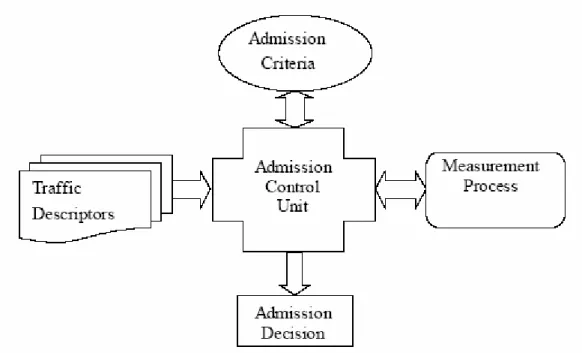
(9) Call Admission Control (CAC) provide the users with access to a wireless network for services. On the other hand, they are the decision making part of the network carriers with the objectives of providing services to users with guaranteed quality and increasing resource utilization as much as possible at the same time. Therefore, it is conceivable that CAC policy is one of the critical design considerations in any wireless networks [33]. Another scheme is GCS, one kind of CAC, which assign higher priority to handoff calls by reserving a fixed number of channels for them, which called Guard Channel. In other words, handoff calls are served when any channel in base station is available, but new calls are accepted only when a channel except for reserved channels is available. GCS is developed under the assumption of stationary of call arrivals; it causes QoS degradation under non-stationary traffic patterns due to fluctuation of mobility. As the variation of traffic condition, how to reserve channels for handoff calls is an important issue. Many researchers studied on it [1]-[5][7][8] [11]-[17][26]-[32]. In the present thesis, we proposed a two-phase adaptive call admission control scheme to dynamically deploy the number of guard channels in response to traffic fluctuations. The phase one is to allocate guard channels based on a non-linear programming model subject to minimize the absolute difference between theoretical handoff call dropping probability and QoS threshold of it, then to operate in coordination with a channel adjustment mechanism in phase two for guaranteeing the QoS agreement of handoff call dropping probability. The main objective of our research is to guarantee the required dropping probability of handoff calls while keeping blocking probability of new calls as low as possible.. 2.
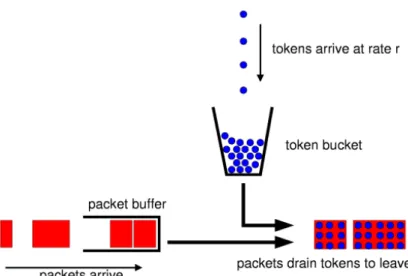
(10) 1.2 Approach and Result The proposed scheme is built upon Guard Channel Scheme to prioritize handoff calls, and adaptively adjust the number of reserved channels as network condition changes. Due to limitation of fixed channels in a base station, reserving more channels for handoff calls will lead to a base station can serve less new call requests. So how to determine the number of guard channels reserved for handoff calls is a key problem. In the thesis, we make use of a non-linear programming model to solve an adequate parameter for the number of guard channels. The proposed non-linear programming model is to minimize the absolute difference between theoretical handoff call dropping probability and QoS threshold. The effect of this soft constraint design may result in a slight violation of QoS agreement, but relatively provide more channel capacity for new calls. For making up for the QoS violation, another channel adjustment mechanism is adopted to automatically increase the number of guard channels when measured dropping rate exceeds a predetermined threshold. The former mechanism, we call it channel allocation, and the latter is channel adjustment. By integrating these two components, a two-phase adaptive call admission control scheme is formed. The mechanism of channel allocation runs in phase one to lower the new call blocking probability, and channel adjustment resides in phase two to guarantee the QoS agreement. Comparing with static GCS, present scheme can guarantee the dropping probability of handoff calls under a predefined QoS level, though this would result in the degradation of new call blocking probability. However, comparing with another adaptive CAC scheme [33], the handoff call dropping probability of our scheme is 5.28% lower than it in average, and the new call blocking probability of our scheme is 4.92% lower than it in average. The experiment result shows that the proposed scheme not only diminishes the dropping probability, but also keeps the blocking probability lower than it, which means that the proposed scheme can serve more new calls and handoff calls than another adaptive scheme.. 3.
(11) 1.3 Thesis Outline In this chapter, we have generally introduced the research background, motivation, and the proposed scheme. The rest of the thesis is organized as follows. In Chapter 2, Call Admission Control, and related researches on CAC are introduced. Details of the proposed two-phase adaptive CAC scheme are presented in Chapter 3. In Chapter 4, we show the simulation result compared with Guard Channel scheme and another adaptive CAC scheme to point out the contribution of our research. At the last, the future work discussion and conclusion are made in Chapter 5.. 4.
(12) Chapter 2. Related Works. 2.1 Admission Control Overview Admission Control is a decision process of accepting or rejecting a new incoming traffic flow. Some applications, such as video conferencing or streaming audio often require a level of QoS to work properly, and these QoS are related to end-to-end delay, delay variation (jitter) and loss rate. For satisfying the demand of service, the network devices such as switch, router, gateway or base station need to provide sufficient resources for these applications. Thus, Admission Control is necessary to run in these network devices, and responsible for rejecting some traffic flows in certain case to uphold the QoS guarantee. Many. researches. divide. the. admission. control. into. two. categories:. parameter-based and measurement-based. The former mainly reply on flow-specified statistical models that are used to obtain parameters which describes the traffic characteristics of the flows. These parameters are then used to estimate the amount of resources which the flows need. Due to the variation of network condition, it’s difficult to obtain a priori parameter that accurately characterizes flow traffics. In addition, over-booking of network resources will result in low network utilization. The latter, measurement-based admission control (MBAC) is an alternative to parameter-based admission control, which makes admission decisions based on traffic parameter estimates from measurements obtained from an existing traffic. In this thesis, we focus on MBAC. Admission Control consists of three basic components: traffic descriptors, admission criteria, and measurement process [20][25]. Figure 2-1 illustrates the relationship among these components. Admission control unit makes use of traffic descriptors which characterize traffic flows, admission criteria, and estimated network state and flow information obtained from measurement process, then produce an admission decision. The details of the components will be introduced in the following sections. 5.
(13) Figure 2-1: Components of Admission Control. 2.1.1. Traffic Descriptors. A traffic descriptor specifies the characteristics of a traffic stream. For achieving the QoS guarantee of a service, a traffic descriptor is adopted to exhibit the usage requirement to admission control unit. For example, a traffic descriptor based on a token bucket may consist of two parameters: token rate r and bucket size b. Figure 2-2 is a simple token bucket, the incoming packets will be discarded if there are not enough tokens in the bucket. In others words, the token is a ticket for packet transmitting. Token flows into the bucket from the top at rate r, and the bucket is able to accommodate b tokens. When the bucket is full of tokens, new tokens are thrown away. Consequently, assumed that a token allow one byte transmission, during period t, the maximum traffic amount admitted to transit is r * t + b.. 6.
(14) Figure 2-2: Token Bucket Concept. 2.1.2. Measurement Process. Network state and flow information are necessary and useful to admission control unit. Measurement Process is responsible for monitoring the real time information of network flow and has an estimate of future network state. The result of measurement process influences substantially the admission decision, thus the accurate and precise estimate is significant to admission control mechanism. Here we introduce three measurement mechanisms: time window, point samples, and exponential averaging. In the time window scheme, the network state such as network load or arrival rate, is sampled every S period and stored. After a number of samples (window size, T), the highest sampled network state is used as the estimated network state of the next window. If a new sample is found to be greater than the current estimate, the estimate is immediately replaced by the new sample. Besides, when an admitted decision is making, the estimate is increased and window is restarted. The sampling period S and window size T are the critical parameters in time window scheme, adjusting these two parameters will have a significant affect on the estimation result used by the admission control unit. The point samples mechanism simply takes a sample every S period, and uses the sample as the estimate network state. This scheme is very simple, but also lowering 7.
(15) the precision of estimation relatively. In exponential averaging scheme, like point sample, the network state is measured with a sampling period of S. In Different, the estimate network state is computed with the infinite impulse response function, where w is a user-specified weight. v ' = (1 − w) ⋅ v + w ⋅ v pre ,. v' v. : estimated network state : instantaneous network state : previous estimated network state. v pre. 2.1.3. w ∈ [0,1]. Admission Criteria. Admission criteria are sets of rules that determine whether the admission control unit accepts or refuses an incoming flow. A number of admission criteria were studied, here we describe two admission criteria schemes: rate sum, and equivalent capacity (Hoeffding Bound). The basic idea of the rate sum scheme is to ensure that the sum of the existing reservations and the new flow’s rate does not exceed a threshold. This scheme does not make any assumptions about the source behavior or aggregate traffic arrival process except those provided in the traffic descriptors. The scheme accept an incoming flow if v + r ≤ u , where v is the total amount of existing reservations, r is the new flow’s rate and u is the admission threshold. This scheme can guarantee that even if all the flows send at their sustained rate, the network will be able to deliver them at their reserved QoS. However, this hard guarantee is achieved at the expense of low utilization of the network when some flows are inactive or sending at a lower rate than the reserved rate. A way to increase the utilization is to measure the actual network load and substitute v with the measured load. However, when the actual load approaches. m,. average. packet. delay. approaches. infinite.. Therefore,. measurement-based schemes lower the threshold to am (0 < a < 1). Increasing the utilization target a will make the admission control scheme more aggressive. The equivalent capacity C(e) is an estimation of the arrival rate of a class of 8.
(16) traffic such that the stationary arrival rate of the traffic exceeds C(e) with a probability of e. An admission control decision is made based on C(e), the peak rate of the new flow, P, and the bandwidth allocated to the class, C. More specifically, a new flow is admitted if C (e) + P ≤ C . The scheme proposed by Floyd derives the equivalent capacity from the Hoeffding Bound, which is a looser bound of the sum of N independent variables. Since the Hoeffding Bound does not assume normal distribution of the aggregate traffic, this scheme is valid for small size classes and traffic from heterogeneous sources. Given the peak rate of N sources, {Pi}, the equivalent capacity estimated by. the Hoeffding Bound is. ln(1 / e)∑ ( Pi ) 2. C (u ,{Pi }, e) = u +. 2. .. Applying admission control in telephony system, such as GSM, UMTS, or VoIP is Call Admission Control. In mobile wireless environment, there are two critical QoS parameters: dropping probability of handoff calls and blocking probability of new calls. In this thesis, we focus on these two parameters to develop an adaptive CAC algorithm. Before introducing the proposed scheme, we describe the survey of related researches on call admission control.. 9.
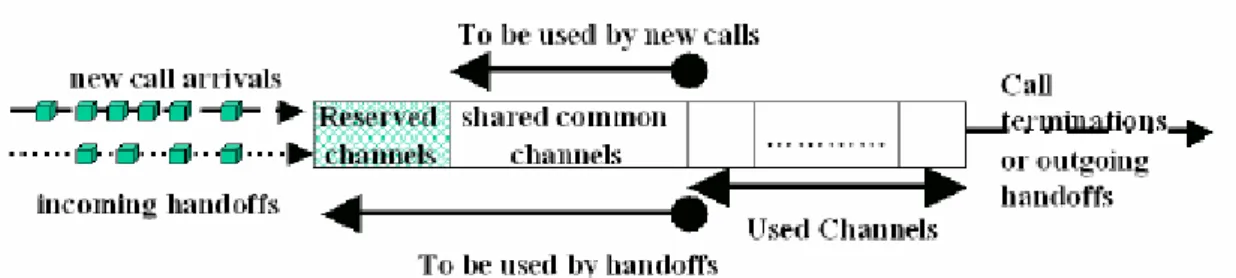
(17) 2.2 Researches on Call Admission Control In chapter 1, we can realize that CAC is a critical mechanism to guarantee the QoS of telephony services. In mobile cellular architecture, each base station has fixed resources for providing call requests. More exactly, a set of channels (frequency bands or codes) is allocated to each base station. When a mobile user wants to communicate with others, it must obtain a channel from a neighbored base station first. Without CAC mechanism, any user who issues a request first can obtain a channel as long as more than one channel is free. In this case, the dropping probability of handoff calls may raise substantially, it means that many on-going conversations will be terminated abruptly and unexpectedly. There are two generic handoff prioritization schemes, Handoff Queuing Scheme (HQS) and Guard Channel Scheme (GCS), used to solve this problem. Our research is based on GCS to develop a dynamically CAC scheme, and one of the important reasons to adopt GCS is that HQS may result in starvation of new calls and high system complexity. GCS and related researches on call admission control are depicted in the following sections.. 2.2.1. Guard Channel Scheme. GCS is a well-known channel reservation scheme. In order to give higher priority to handoff calls than new calls, GCS reserves exclusively a number of channels for handoff calls, called guard channels. The remaining channels are called normal channels, can be shared equally between new and handoff calls. We can catch this idea obviously at figure 2-3.. Figure 2-3: Guard Channel Scheme 10.
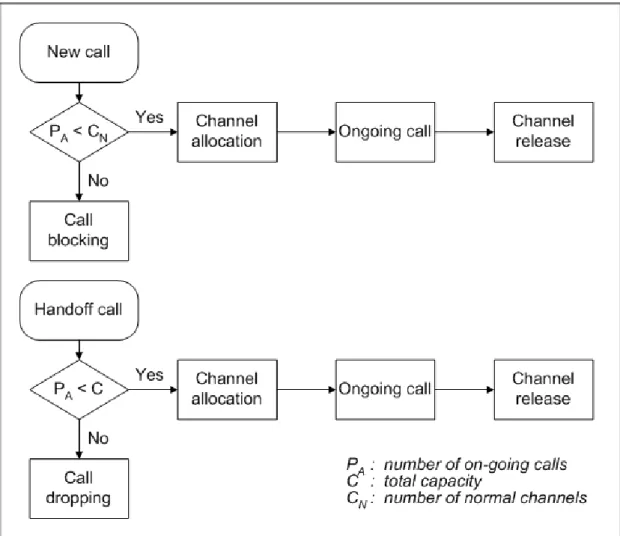
(18) A new call request will be granted for admission if the total number of on-going calls (including handoff calls from other cells) is less than the number of normal channels. A handoff call request will be granted for admission if the total number of on-going calls in the base station is less than the total capacity. This part of CAC mechanism can be illustrated in figure 2-4.. Figure 2-4: Call processing flow diagram for GCS It offers a generic means to decrease the dropping probability of handoff calls but. causes reduction of total carried traffic. The second drawback of GCS is lack. of hard constraint on dropping probability of handoff calls. Several researchers devote to solve this problem and develop a dynamic CAC which can adapt to changes in the traffic pattern.. 11.
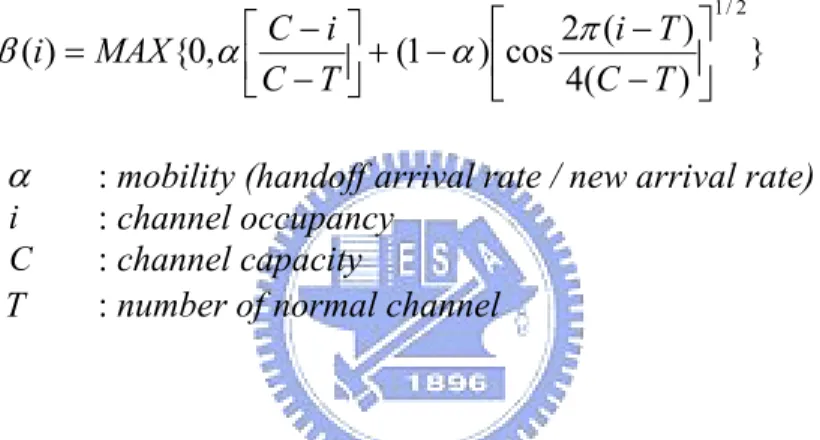
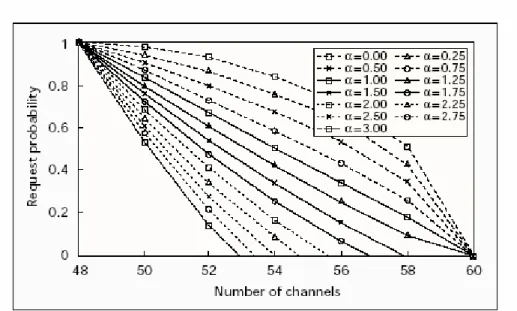
(19) 2.2.2. Existing Call Admission Control Strategies. CAC in wireless networks has been studied by many researchers. We can simply divide the existing CAC into 2 categories: localized and distributed CAC. Distributed schemes make use of the information of a cluster of cells to do an admission decision, and this information will not be utilized in localized schemes. The distributed CAC may get a better result than the localized CAC, but the system complexity also will be increased. Here we describe some proposals on these two types of schemes.. 2.2.2.1 Localized Schemes In GCS, the guard channels, the remaining channels above the threshold which is the boundary between normal and guard channels, are reserved preferentially for handoff calls in order to provide their required QoS. However, those channels can also be allocated according to a probability for new calls instead of immediately blocking in fractional guard channel scheme [22]. This approach makes the possibility of accepting new calls when the channel occupancy is over the threshold. The probability ( β ) used in fractional guard channel scheme is related to the channel occupancy, it means that the more ongoing calls, the less possible to admit a new call. New call starvation problem can be solved in this scheme, and fractional guard channel scheme takes the advantage of higher channel utilization than GCS. The figure 2-5 depicts the complete algorithm of fractional guard channel scheme. IF (new call) THEN IF ( randdom (0,1) ≤ β (ChannelOcc upancy ) ) THEN admit call ELSE reject call IF (handoff call) THEN IF (channel occupancy < channel capacity) THEN admit call ELSE reject call Figure 2-5: Fractional Guard Channel Algorithm Young follows the concept of fractional guard channel to propose a Dynamic Channel Reservation Scheme (DCRS) [10]. The main feature of DCRS is that the 12.
(20) mobility (handoff call arrival rate / new call arrival rate) is considered in the admission probability, called request probability. When the arrival rate of handoff calls is larger than that of new calls (the mobility of calls is larger than one), the request probability should quickly be reduced to give more opportunity for accessing guard channels to handoff calls. On the other hand, when the arrival rate of handoff calls is lower than that of new calls (the mobility of calls is smaller than one), the request probability for new calls should slowly be reduced in the guard channels to give more opportunity to new calls. DCRS defined a heuristic formula of the request probability for the new calls considering the mentioned concepts as follows. The request probability increases relative to decreasing call mobility and decreases relative to increasing call mobility under the same network situation. ⎡ 2π (i − T ) ⎤ ⎡ C −i ⎤ β (i ) = MAX {0, α ⎢ + (1 − α ) ⎢cos ⎥ 4(C − T ) ⎥⎦ ⎣C − T ⎦ ⎣. α i C T. 1/ 2. }. : mobility (handoff arrival rate / new arrival rate) : channel occupancy : channel capacity : number of normal channel. Figure 2-6 shows an example of the request probability determined by the proposed heuristic formula under the total number of channels of 60, threshold of 48, and various degrees of call mobility. When the mobility of calls equals one, the request probability is reduced linearly in proportion to the increase in the number of busy channels in a cell. When the mobility of calls is smaller than one, the request probability is smoothly decreased in order to provide more opportunity to new calls. When the mobility of calls is larger than one, the request probability is abruptly decreased in order to provide more service opportunity to handoff calls.. 13.
(21) Figure 2-6: Request Probability (C=60, T=48, a is the mobility of calls) An optimal call admission control scheme was proposed by Ramjee et al [22]. The approach use Markov decision process to solve the three optimal problems: MINOBJ, MINBLOCK, and MINC. The analysis contains both guard channel scheme and fractional guard channel scheme. The following are these three problems: MINOBJ: Minimizing a linear objective function of the two blocking probabilities MINBLOCK: Minimizing the new call blocking probability subject to a hard constraint on the handoff blocking probability. MINC: Minimizing the number of channels subject to hard constraints on the new and handoff call blocking probabilities. The result shows that the guard channel scheme is optimal for the MINOBJ problem, while a new fractional guard channel scheme is optimal for the MINBLOCK and MINC problems. From this research, we see that the fractional guard channel scheme offers more flexibility than the guard channel scheme in the sense of a richer set of parameters, but the algorithms developed in this proposal for determining the optimal parameter settings for the fractional scheme are computationally inexpensive. Further, in order to ensure that the QoS requirements are continuously met, it may be necessary to adapt to variations in traffic load. For example, in the guard channel scheme it may be necessary to dynamically change the number of guard channels with the traffic load. The critical contribution of the proposal is that they 14.
(22) explore the possibility of exploiting the combination of these features of the fractional guard channel and its concomitant algorithms for real-time control of cellular networks. Another CAC scheme was proposed by Zhang [33]. They developed an adaptive algorithm based on GCS, and it can search automatically the optimal number of guard channels to be reserved at each base station. The feature of this proposal is a simple measurement-based admission algorithm. In figure 2-7, a call processing flow diagram for this algorithm was drawn. When a base station experiences high handoff call dropping rate, the number of guard channels will be increased until the handoff dropping rate lower to below its threshold. When a base station does not get to use a significant portion of the guard channels over a period of time, the number of guard channels will be gradually decreased until most of the guard channels are used frequently. Figure 2-8 depicts the detail algorithm.. 15.
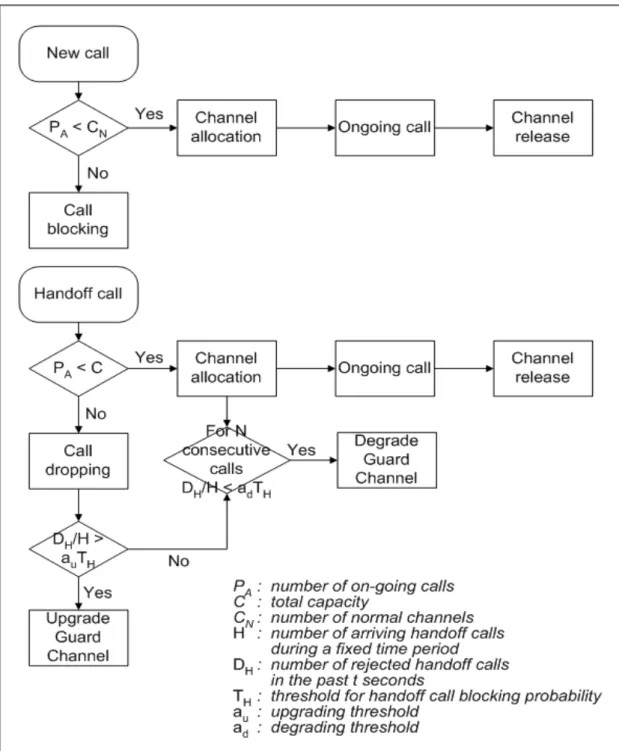
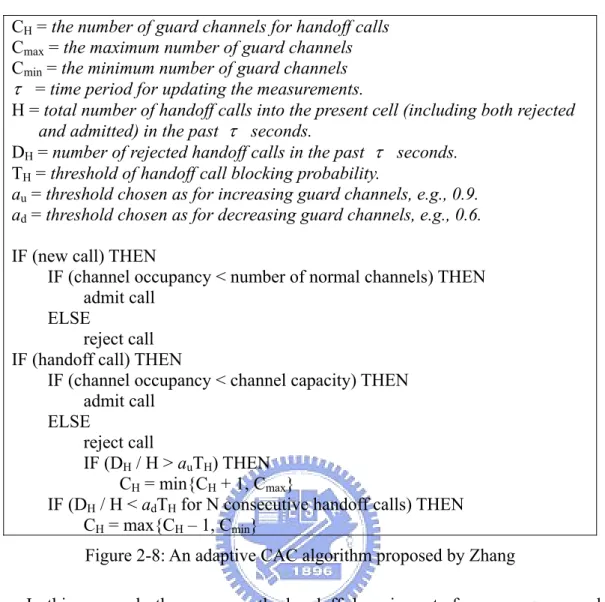
(23) Figure 2-7: Call processing flow diagram for an adaptive GCS proposed by Zhang. 16.
(24) CH = the number of guard channels for handoff calls Cmax = the maximum number of guard channels Cmin = the minimum number of guard channels τ = time period for updating the measurements. H = total number of handoff calls into the present cell (including both rejected and admitted) in the past τ seconds. DH = number of rejected handoff calls in the past τ seconds. TH = threshold of handoff call blocking probability. au = threshold chosen as for increasing guard channels, e.g., 0.9. ad = threshold chosen as for decreasing guard channels, e.g., 0.6. IF (new call) THEN IF (channel occupancy < number of normal channels) THEN admit call ELSE reject call IF (handoff call) THEN IF (channel occupancy < channel capacity) THEN admit call ELSE reject call IF (DH / H > auTH) THEN CH = min{CH + 1, Cmax} IF (DH / H < adTH for N consecutive handoff calls) THEN CH = max{CH – 1, Cmin} Figure 2-8: An adaptive CAC algorithm proposed by Zhang In this approach, they measure the handoff dropping rate for every τ seconds, and use it for adaptively adjusting the number of guard channels. When the measured handoff dropping rate is greater than a predetermined threshold, the number of guard channel is increased one to guarantee the handoff calls dropping probability. In addition, when the measured handoff dropping rate is less than another predetermined threshold for N consecutive handoff calls, the guard channels will be reduced one for new calls. This algorithm has the following important features: 1) It adjusts the number of guard channels CH adaptively according to the estimated dropping rate of handoff calls that is measured for every time period τ ; and 2) It tries to make sure that the handoff call blocking rate is below the given threshold TH and it also tries to reduce the new call blocking rate by decrementing CH when it is observed to be more than needed. In this adaptive CAC scheme, they increase or decrease one channel at a time, 17.
(25) and this mechanism may not respond to enormous traffic changes immediately. Besides, a parameter N exists in the scheme may influence the result severely, so how to determine a proper N is another issue.. 2.2.2.2 Distributed Schemes The shadow cluster mechanism by Levine et al. [14] is based on the observation that “every mobile terminal with an active wireless connection exerts an influence upon the cells (and their base stations) in the vicinity of its current location and along its direction of travel.” The coverage of a shadow cluster for a given active mobile mainly consists of the cell where the mobile is currently present (i.e., the center of the shadow cluster) and all its adjacent cells along the direction of travel. This area changes when the mobile call is handed off to other cells, thus a tentative shadow cluster needs to be implemented for every new call as well as every handoff call. Simulations show that the shadow cluster mechanism is able to reduce the percentage of dropped calls in a controlled fashion. The efficiency of this scheme depends on the accuracy of prediction of the future mobile movement, which makes it most suitable for a strong directional environment such as the highway. On the other hand, the distributed call admission (DCA) scheme by Naghshineh and Schwartz [17] does not need the status information exchange upon each call arrival (new call and handoff). Rather, it only requires the exchange of such information periodically [17]. The admission control algorithm calculates the maximum number of calls that can be admitted to a given cell without violating the QoS of the existing calls in the cell as well as calls in its adjacent cells. One of the main features of the DCA is its simplicity in that the admission decision can be made in real time and does not require much computational effort. In [18], an admission control scheme based on adaptive bandwidth reservation to allocates bandwidth to a connection in the cell where the connection request originates and reserves bandwidth in all neighboring cells. When a user moves to a new cell and a hand-off occurs, bandwidth is allocated in the new cell; bandwidth is reserved in the new cell’s neighboring cells; and reserved bandwidth in more distant cells is released. The amount of bandwidth to reserve is dynamically adjusted, 18.
(26) reflecting the current network conditions. Virtual Bottleneck Cell (VBC) concept in [23] aggregate users and a cluster of cells into a virtual system, and ensure that parameters of the aggregated VBC are properly controlled. As VBC is an aggregate QoS scheme, an important issue is the mechanism for aggregation of cells, i.e., the cell clustering policy. To address this issue, they formulate the clustering policy as a constrained optimization which seeks to maximize system utilization subject to a limit on inter-cluster handoffs. The clustering algorithm’s key technique is to discover the correlations among occupancies of neighboring cells, and form clusters based on these correlations only as resources become overloaded.. 19.
(27) Chapter 3. The Two-Phase Scheme. 3.1 Problem Analysis In wireless mobile circumstance, the two critical QoS parameters are extremely concerned: handoff call dropping probability, and new call blocking probability. As the limitation of resource in each base station, we can not guarantee the service quality of both new calls and handoff calls. From the user’s perspective, terminating abruptly an ongoing conversation will make user uncomfortable. As the result, recent researches focus on guaranteeing the handoff call dropping probability under a threshold while keeping the new call blocking probability as low as possible. The well-known Guard Channel policy was adopted by many researches to develop a CAC scheme. In order to adapt the changes in the network condition, dynamic channel allocation becomes the core problem in CAC scheme. In this thesis, we develop a two-phase adaptive CAC scheme that consists of the following two parts: Phase 1: Channel Allocation Phase 2: Channel Adjustment For responding to the changes of network traffic, the arrival rates and dropping rates need to be measured in time. In phase 1, we devise a non-linear programming model to dynamically solve an adequate parameter for the number of guard channels and update this parameter. Before building the non-linear programming model, theoretical handoff call dropping probability and new call blocking probability must be derived from the M/M/c/c priority queuing model first. Then the proposed non-linear programming model is to minimize the absolute difference between theoretical handoff call dropping probability and QoS threshold. The effect of this soft constraint design may result in a slight violation of QoS agreement, but relatively provide more channel capacity for new calls. For making up for the QoS violation, another channel adjustment mechanism is adopted in phase 2 to automatically 20.
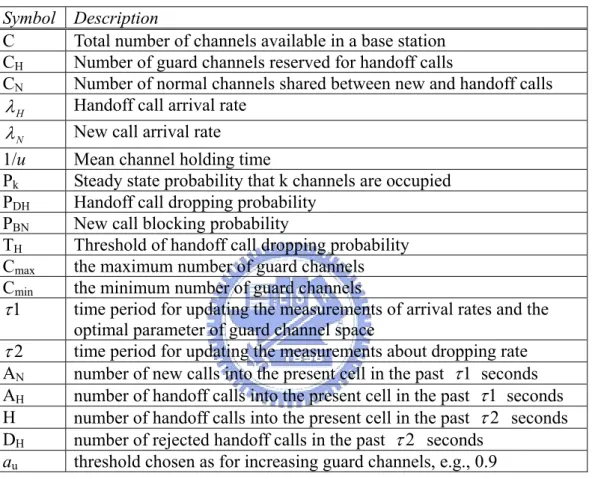
(28) increase the number of guard channels when measured dropping rate exceeds a predetermined threshold. In the following sections, we will describe the detail of Channel Allocation (phase 1) and Channel Adjustment (phase 2), and at last present comprehensively the proposed two-phase adaptive CAC scheme. Table 3-1 lists the symbols used in entire scheme. Table 3-1: Notations in the proposed two-phase scheme Symbol C CH CN. Description Total number of channels available in a base station Number of guard channels reserved for handoff calls Number of normal channels shared between new and handoff calls Handoff call arrival rate New call arrival rate. 1/u Pk PDH PBN TH Cmax Cmin τ1. Mean channel holding time Steady state probability that k channels are occupied Handoff call dropping probability New call blocking probability Threshold of handoff call dropping probability the maximum number of guard channels the minimum number of guard channels time period for updating the measurements of arrival rates and the optimal parameter of guard channel space time period for updating the measurements about dropping rate number of new calls into the present cell in the past τ 1 seconds number of handoff calls into the present cell in the past τ 1 seconds number of handoff calls into the present cell in the past τ 2 seconds number of rejected handoff calls in the past τ 2 seconds threshold chosen as for increasing guard channels, e.g., 0.9. λH λN. τ2 AN AH H DH au. 21.
(29) 3.2 Channel Allocation – Phase 1 The channel allocation phase is mainly to periodically compute an adequate parameter of guard channel space then to allocate channel space by this parameter. Guard channel space computation process consists of two steps: 1) find the closed form formulas of handoff call dropping probability and new call blocking probability by queuing theory M/M/c/c priority model, and 2) using non-linear programming technique to solve an adequate guard channels space by minimizing the absolute difference between theoretical new call dropping probability derived in step 1 and QoS threshold.. 3.2.1. M/M/c/c priority queuing model. Assumptions: 1. New call and handoff call arrivals are modeled by a Poisson process with rate λ N ,. λH 2. Channel holding time follows an exponential distribution with mean 1 / u 3. A base station has fixed number of channels available, C. 4. The guard channel space, CH can be allocated to handoff calls only. 5. The system will enter in steady state. Under the above assumptions, the handoff priority system can be modeled using the Markov process, and the state transition diagram is shown as figure 3-1. Before the channel occupancy is less than the number of normal channels, the arrivals will be served still contain both new and handoff calls, so that the state transition rates from state k to state k+1 are λ H + λ N . When the channel occupancy is over the threshold, the system will only serve handoff calls, so that the state transition rates from state k to state k+1 become to λ H . Besides, there are fixed number of channels, C, in a base station, it means that the system contains C servers which can serve C arrivals at most simultaneously. Therefore, the state transition rates from state k to state k-1 are all. k ⋅u .. 22.
(30) Figure 3-1: State transition diagram of M/M/c/c priority model According to Queuing Theory [6][12], we can derive the steady state probability Pk which represents the probability of k channels are occupied as following formula. (λ N + λ H ) k , k ≤ CN k ! k ⋅ u Pk = { ( k −C N ) (λ N + λ H ) C N ⋅ λ H P0 ⋅ , k > CN k!⋅u k P0 ⋅. C. ∵. ∑P k =0. k. (1). =1 C (λ N + λ H ) k (λ N + λ H ) C N ⋅ λ H + ∑ k!⋅u k k!⋅u k k =0 k =C N +1 CN. ∴ P0 = [∑. ( k −C N ). ] −1. (2). Finally, the handoff call dropping probability is equal to the probability that all channels are occupied, PC, and the new call dropping probability is correspondent with the probability that more than CN channels are occupied,. C. ∑P. k =C N. K .. By (1) and (2),. we can easily compute the handoff call dropping probability PDH and new call blocking probability PBN as following. PDH. (λ N + λ H ) C N ⋅ λ H = PC = P0 ⋅ C!⋅u C. PBN =. 3.2.2. C. ∑P. k =C N. k. = P0 ⋅. C. ∑. k =C N. CH. ,. (3). (λ N + λ H ) C N ⋅ λ H k!⋅u k. ( k −C N ). (4). The Proposed Non-Linear Programming Model. Before introducing the proposed non-linear programming (NLP) model, a simple 23.
(31) non-linear programming model subject to minimize the new call blocking probability with hard constraint on handoff call dropping probability is depicted as follows. Given: C, λN , λ H , u , TH Decision variables: CN, CH Objective: Minimize P0 ⋅. C. ∑. (λ N + λ H ) C N ⋅ λ H. ( k −C N ). k!⋅u k. k =C N. Constraints: C = CN + CH 0 ≤ CH ≤ C CH is Integer P0 ⋅. (λ N + λ H ) C N ⋅ λ H C!⋅u C. CH. ≤ TH. In this NLP model, total channel capacity C, arrival rates λN , λ H , mean holding time u, and QoS threshold TH, are given variables, and the decision variables are guard channel space CH, shared channel space CN. This model set a hard constraint that theoretical dropping probability, the closed form formula (3) derived from previous section must be less than a predetermined QoS threshold TH, and the objective is to minimize blocking probability, the closed form formula (4) derived from previous section. Due to the number of channel is integral, the handoff call dropping probability solved by the non-linear programming model with hard constraint may be much less then QoS threshold. From the figure 3-2, we can see that the when we reserve 3 guard channels, the handoff call dropping probability exceeds the QoS threshold 0.001562, but when we reserve 4 guard channels, the handoff call dropping probability less than the QoS threshold 0.006277. If we can tolerate a little QoS violation, more channels can be allocated for new calls, and decrease the blocking probability of new calls.. 24.
(32) Handoff Call Dropping Probability. 1e+0. 1e-1. 1e-2. 1e-3. 1e-4. 3. 4. Number of Guard Channels. Figure 3-2: Difference between new call dropping probability and QoS threshold The objective in the thesis is to guarantee the handoff call dropping probability while keeping the new call blocking probability as low as possible, so we propose an non-linear programming model that tolerates a little QoS violation on handoff call dropping probability to reduce the new call dropping probability more. Because the nature of integral channel, we try to minimize the absolute difference between handoff call dropping probability and QoS threshold to free more channels for new calls. This way can not 100% ensure the QoS agreement of handoff call dropping probability, so another mechanism is developed in phase 2 of the proposed two-phase adaptive CAC scheme to solve violation problem. The proposed non-linear programming model is depicted as follows. Given: C, λN , λ H , u , TH Decision variables: CN, CH Objective: (λ + λ H ) C N ⋅ λ H Minimize ( P0 ⋅ N C!⋅u C. CH. ) − TH. Constraints: C = CN + CH 25.
(33) 0 ≤ CH ≤ C CH is Integer The given variables and decision variables of the proposed NLP model are as same as previous NLP model, and the differences between them are: 1) the objective of the proposed NLP model is to minimize the absolute difference between theoretical dropping probability (3) and QoS threshold; 2) the proposed NLP model removes the constraint that theoretical dropping probability must less than QoS threshold. In the proposed NLP model, the parameters of arrival rate, λN , and λ H , are critical input variables from measurement process of CAC scheme. With the estimation of arrival rate, we can predict the number of guard channels exactly as the change in network condition.. 26.
(34) 3.3 Channel Adjustment – Phase 2 In the section above, we mentioned that a QoS violation problem will be produced from the channel allocation phase. For solving the problem, we adopt a channel adjustment mechanism in phase 2 which automatically increases the capacity of guard channels to maintain the handoff call dropping probability. The concept was described in chapter 2, we need to measure the number of arriving handoff calls (H) and rejecting handoff calls (DH) in time period τ 2 first, then the estimated dropping rate is calculated as DH/H. When the estimated dropping rate is higher then a chosen threshold (auTH), the number of guard channel is increased by one for allowing more handoff calls. The detail algorithm is shown as follows. Step 1: Call arrival Step 2: Start measurement process Step 3: If arrival is new call, go to Step 7 Step 4: If the number of on-going calls (PA) is less than total channel capacity (C), go to Step 10 Step 5: If measured dropping rate (DH/H) is equal to or greater than a predefined threshold (auTH), increase the guard channel space (CH) by one Step 6: Drop the handoff call, and go to Step 10 Step 7: If the number of on-going calls (PA) is less than the capacity of shared channels (CN), go to Step 9 Step 8: Block the new call, go to Step 10 Step 9: Admit the call Step 10: Finished. 27.
(35) 3.4 The Two-Phase Adaptive CAC Scheme After introducing the detail of both phases individually, now we combine these 2 phases into an adaptive CAC scheme. From the figure 3-3, we can see that the Channel Allocation procedure is arranged outside the admission decision process, and the task of Channel Allocation process is to periodically (for every τ 1 period) allocate/reallocate the guard channel space. Guard Channel policy is used to make admission decision, when a decision of disallowing is made, the Channel Adjustment process is triggered to increase the guard channels by one. More exactly, the detail algorithm is shown as follows.. Figure 3-3: Call processing flow diagram of two-phase adaptive CAC algorithm Step 1: Call arrival Step 2: Start measurement process Step 3: Dynamically compute an adequate parameter of guard channel space (CH) by proposed NLP model, and update it for every τ 1 period Step 4: If arrival is new call, go to Step 9 28.
(36) Step 5: If the number of on-going calls (PA) is less than total channel capacity (C), go to Step 11 Step 6: Drop the handoff call Step 7: If measured dropping rate (DH/H) is less than a predefined threshold (auTH), go to Step 12 Step 8: Increase the guard channel space (CH) by one, go to Step 12 Step 9: If the number of on-going calls (PA) is less than the capacity of shared channels (CN), go to Step 11 Step 10: Block the new call, go to Step 12 Step 11: Admit the call Step 12: Finished In the above algorithm, τ 1 is a time period for channel allocation, AH and AN are the number of arriving handoff and new calls in the past τ 1 seconds used to estimate the arrival rates, AH/ τ 1, AN/ τ 1. Another set of measurement parameters consist of τ 2 , H, DH, H is the number of arriving handoff calls from the terminating of previous measurement up to now, DH is the number of dropped handoff calls in the measurement period. For every τ 2 seconds, H and DH will be initialized to restart a measurement period. In phase 2, we need to choose a threshold (au), au is higher than zero and often less than one. When au is high, such as 0.99, the dropping probability will also increase. Summarizing the chapter, our two-phase adaptive CAC scheme has four important features: 1. Perform a simple measurement on call arrivals and dropping rate 2. Compute adequate number of guard channels through building a non-linear programming model subject to minimize the absolute difference between theoretical handoff call dropping probability and QoS threshold 3. Automatic adjust guard channel space by estimated dropping rate to guarantee the handoff call dropping probability. 29.
(37) Chapter 4. Simulation and Analysis. The simulation system is composed of three modules: 1) Traffic Generator, 2) CAC Enforcer, and 3) Analyzer. Traffic Generator produces traffic patterns and delivers to CAC Enforcer, then CAC Enforcer adopts different CAC policies for make admission decision. At the last, the Analyzer collects the information from Traffic Generator and CAC Enforcer to compute simulation results. This architecture is illustrated in figure 4-1. Traffic Generator is responsible to generate different traffic patterns, and we also use Poisson process to simulate the both handoff and new call arrivals as same as most researches on CAC. In Traffic Generator implementation, Poisson process is simulated through producing a sequence of exponential inter-arrival time, and the exponential random variable generator can be easily induced as. X =−. 1. λ. ln[1 − U ]. where U represents a random value with uniform linear distribution, and λ is the arrival rate. In CAC Enforcer, we implement three CAC policies: GCS, an adaptive CAC [33], and proposed two-phase adaptive scheme. CAC Enforcer receives input patterns from queue and performs different admission policies. The parameters of Traffic Generator and the results of CAC Enforcer will be utilized to compute dropping probability and blocking probability by Analyzer.. Figure 4-1: Simulation Architecture. 30.
(38) 4.1 Simulation Parameters In the simulation, we need to customize several parameters to form the network patterns in a mobile wireless environment, and to control the properties of CAC Enforcer. For comparing another adaptive CAC scheme, the simulation parameters in the thesis are set as same as it. We consider that the number of channels available in a base station, C = 50, the new call arrival follows Poisson process with rate λ N from 10 ~ 35 (calls per minute), and handoff call arrival follows Poisson process with rate. λ N /5 as well as. The channel holding time, or call service time, is assumed to follow exponential distribution with mean 1/u = 3(minutes). The dropping probability threshold we want to guarantee is 0.01. Table 4-1: Simulation parameters Parameter C. λH λN. Value 50 λ N /5 10 ~ 35 calls/minute. 1/u TH τ1 τ2 au. 3 minutes 0.01 12 minutes 2 hours 0.95. τ 1 used in phase 1 is set to two 12 minutes, τ 2 used in phase 2 is set to 2 hours, and au is 0.95. The total simulation period is 12 hours. The table 4-1 lists all parameters used in the proposed two-phase CAC schemes.. 31.
(39) 4.2 The Simulation Results We compare with two schemes to evaluate the proposed scheme. One is static Guard Channel Scheme (GCS), and the other is an adaptive CAC scheme [33]. In the following sections, we represent the second scheme as Dual Threshold Channel Allocation (DTCA) for convenience. Now we start to examine the simulation results, and make a discussion. The parameters in this simulation are shown in figure 4-1, C = 50, λ N = 10 ~ 35(calls/minute), λ H = λ N /5, 1/u = 3(minutes), and the decreasing threshold, au, used in DTCA is set as 0.6. We enforce three Guard Channel schemes with CH = 1, 2, 3, DTCA scheme, and the proposed scheme in CAC Enforcer. The main metrics used to compare these schemes are handoff call dropping probability and new call blocking probability, the result is illustrated in the following figures and tables.. Handoff Call Dropping Probability. 1e+0 GCS-1 GCS-2 GCS-3 DTCA Proposed. 1e-1. 1e-2. 1e-3. 10. 20 30 New call arrival rate (calls/minute). Figure 4-2: Experiment result on handoff call dropping probability. 32. 40.
(40) New Call Blocking Probability. 1e+0. 1e-1 GCS-1 GCS-2 GCS-3 DTCA Proposed 1e-2. 10. 20 30 New call arrival rate (calls/minute). 40. Figure 4-3: Experiment result on new call blocking probability Table 4-2: Experiment result on handoff call dropping probability. λN. Proposed. GCS-1. GCS-2. GCS-3. DTCA. 10. 0.00379. 0.000688. 0.000346. 0.000000. 0.003102. 15. 0.00928. 0.033113. 0.006961. 0.001389. 0.008792. 20. 0.006863. 0.074199. 0.018545. 0.003948. 0.008072. 25. 0.007772. 0.118075. 0.034859. 0.011379. 0.010415. 30. 0.007348. 0.159267. 0.056272. 0.020999. 0.008531. 35. 0.00916. 0.207497. 0.07681. 0.031685. 0.009661. Table 4-3: Experiment result on new call blocking probability. λN. Proposed. GCS-1. GCS-2. GCS-3. DTCA. 10. 0.003526. 0.005948. 0.008162. 0.011691. 0.004358. 15. 0.201972. 0.179805. 0.20118. 0.218465. 0.208485. 20. 0.422586. 0.378684. 0.407355. 0.424746. 0.433839. 25. 0.584236. 0.532335. 0.562214. 0.578927. 0.592361. 30. 0.688133. 0.626683. 0.657823. 0.674058. 0.699233. 35. 0.771849. 0.699898. 0.732585. 0.75009. 0.785573. 33.
(41) From the figures 4-2 and 4-3, when the traffic load is low, the proposed scheme has the lowest new call blocking rate, which means that the proposed scheme sacrifice some handoff calls to provide more channels for new call request. Although the handoff call dropping rate increases, it is still lower than the QoS threshold. When the traffic load is high, the proposed scheme maintains the handoff call dropping rate lower than the QoS threshold. Comparing with static Guard Channel scheme, the proposed scheme can guarantee the handoff call dropping probability to be always below the given QoS threshold, which is a critical issue in mobile wireless environment. From the experiment result, we can also know that the percentage of decrease in the new call blocking rate is greater than the percentage of increase in the handoff call dropping rate. For instance, when new call arrival rate is 30 calls/minute, the new call blocking rate of the scheme (0.688133) is 9.81% higher than GCS-1 (0.626683), 4.61%, higher than GCS-2 (0.657823), and 2.09% higher than GCS-3 (0.674058). On the other hand, at the same arrival rate, the handoff call dropping rate of the proposed scheme (0.007348) is 20.7 times lower than GCS-1 (0.159267), 6.7 times lower than GCS-2 (0.056272), and 1.9 times lower than GCS-3 (0.020099). The detail data are shown in tables 4-3 and 4-4. Another adaptive scheme, DTCA, can also guarantee the handoff call dropping rate. Comparing the proposed scheme with DTCA scheme, we not only guarantee the handoff call dropping rate, but also keep the new call blocking rate lower than it. From the simulation result, the proposed scheme shows the handoff call dropping rate to be 5.28% lower than DTCA scheme in average, and the new call blocking probability to be 4.92% lower than DTCA scheme in average, which means that the proposed scheme can serve more new calls and handoff calls than DTCA scheme.. 34.
(42) 4.3 Analysis Through experiments described in this chapter, the improvements of the proposed scheme ware evaluated. The static Guard Channel scheme provide more channels for new calls than the proposed scheme in most time, so the blocking probabilities in the proposed scheme are hard to reduce. However, the objective in the thesis is to guarantee the dropping probability, and devised two-phase mechanisms indeed ensure that the handoff call dropping probability of the proposed scheme is always lower than a static Guard Channel scheme, and satisfies the QoS threshold in varied traffic load. We compare with an adaptive CAC scheme, DTCA, in both dropping probability and blocking probability. The result depicts that the dropping probability of the proposed scheme is better than DTCA (5.28% averagely), and the blocking probability of the proposed scheme is also lower than DTCA (4.92% averagely). It means that the new calls need not to be sacrificed to satisfy the QoS agreement of lower dropping probability. Applying present algorithm, a base station can increase carried traffic of both type of calls. The effect of the proposed scheme is formed by the following mechanisms. 1. Channel Allocation: Periodically compute the adequate number of guard channels can not only retained the handoff calls dropping probability lower but also free more channels for new call requests to decrease new call blocking probability significantly. 2. Channel Adjustment: In order to make up for the QoS violation, automatic increasing the number of guard channels ensure the handoff call dropping probability lower than a predetermined QoS level.. 35.
(43) Chapter 5. Conclusions and Future. Works 5.1 Conclusions How to maintain the continuity and the required Quality of Service (QoS) in wireless mobile environment when handoff occurs is a focal issue. In users’ perspective, it can’t be tolerated that stopping a conversation rather than disallowing a session initialization, thus many researches on handoff priority CAC scheme are advocated to keep the handoff call dropping probability lower than the QoS agreement and to reduce new call blocking probability. As the network condition changes, a static CAC scheme can not always retain the predetermined QoS, so a two-phase adaptive CAC scheme is proposed to solve the problem in the thesis. The present adaptive CAC scheme is devised to dynamically adjust the number of guard channels in response to traffic fluctuations based on a non-linear programming model subject to minimize the absolute difference between theoretical handoff call dropping probability and QoS threshold of it, and to operate in coordination with an automatic channel adjustment mechanism. We characterize the proposed scheme into following features: 1. Perform a simple measurement on call arrivals and dropping rate 2. Dynamically compute adequate number of guard channels through building a non-linear programming model subject to minimize the absolute difference between theoretical handoff call dropping probability and QoS threshold 3. Automatic adjust guard channel space by estimated dropping rate to guarantee the handoff call dropping probability In order to evaluate the effect of our proposal, several experiments are made. We can prove that not only the blocking probability of the proposed scheme is lower (4.92% in average) than another adaptive CAC scheme [33], but also the dropping probability of the proposed scheme is lower than it (5.28% in average). It means that 36.
(44) no more new calls are sacrificed to guarantee the QoS agreement in handoff dropping probability, and both types of carried traffics are increased.. 5.2 Future Works In the thesis, there are some parameters in the proposed two-phase adaptive CAC scheme need further research, such as τ 1 and τ 2 . τ 1 is a time period for computing the adequate number guard channel, and τ 2 is another time period used to measure in-time dropping rate. If τ 1 or τ 2 is too small, the system will response to changes too often and certain measurements (e.g., arrival rates or dropping rates) may not be precise, which may result in oscillations in system performance. On the other hand, if τ 1 or τ 2 is too large, the system may not response fast enough and thus may not adapt the changes in time. In addition, these time period parameters may have some relations with other parameters, such as TH, so how to determine appropriate values of these parameters is a critical issue. Measurement process of arrival rates is an important part of Channel Allocation phase, a simple point samples method is used to estimate the future arrival rates. The measurement result affects the system performance very much, the point samples method is very simple, but it may not accurately predict the arrival rates. Therefore, we need to spend more effort to find a better approach on call arrival prediction.. 37.
(45) REFERENCES [1] El-Alfy, E.S.; Yao, Y.D., Heffes, H., “Adaptive resource allocation with prioritized handoff in cellular mobile networks under QoS provisioning”, IEEE Vehicular Technology Conference, Volume: 4, pp. 2113-2117, October 2001. [2] Novella Bartolini, Imrich Chlamtac, “Call Admission Control in Wireless Multimedia Networks”, IEEE Personal, Indoor and Mobile Radio Communications, Volume: 1, pp. 285-289, September 2002. [3] S. Boumerdassi, “An efficient reservation-based dynamic channel assignment strategy”, Proceedings of the 1st IEE International Conference on 3G Mobile Communication Technologies, pp. 352-355, March 2000. [4] Chun-Ting Chou and Kang G. Shin, “Analysis of Combined Adaptive Bandwidth Allocation and Admission”, INFOCOM 2002, Volume: 2, pp. 676 -684, June 2002. [5] M.-H. Chiu and M. A. Bassiouni, “Predictive schemes for handoff prioritization in cellular networks based on mobile positioning”, IEEE Journal on Selected Areas in Communications, Volume: 18 Issue: 3, pp. 510-522, March 2000. [6] John N. Daigle, “Queuing Theory for Telecommunications”, Addison-Wesley, 1992. [7] D. Hong and S. S. Rappaport, Traffic Model and Performance Analysis for Cellular Mobile Radio Telephone Systems with Prioritized and Non-Prioritized Handoff Procedures, IEEE Transactions on Vehicular Technology, Volume: 35 No: 3, pp. 77-92, August 1986. [8] Y. Iraqi and R. Boutaba, “An adaptive distributed call admission control for QoS-sensitive wireless mobile networks”, Wireless Communications and Networking Conference, Volume: 1 , pp. 449 -453, September 2000.. 38.
(46) [9] Xiaoye Jiang, Prasant Mohapatra, ”Efficient admission control algorithms for multimedia servers”, Multimedia System, Volume: 7 Issue: 4, pp. 294--304, July 1999. [10] Young Chon Kim, Dong Eun Lee, Bong Ju Lee, Young Sun Kim and Biswanath Mukherjee, ”Dynamic Channel Reservation Based on Mobility in Wireless ATM Networks”, IEEE Communications Magazine, Volume: 37 Issue: 11, pp 47-51, November 1999. [11] Sooyeon Kim, Taekyoung Kwon, Yanghee Choi, ”Call Admission Control for Prioritized Adaptive Multimedia Services in Wireless/Mobile Networks”, IEEE Vehicular Technology Conference Proceedings, Volume: 2, pp. 1536 -1540, May 2000. [12] Leonard Kleinrock, ”Queuing Systems Volume 1: Theory”, John Wiley & Sons, 1975. [13] Taekyoung Kwon, Choi, Y., Bisdikian, C., et al., ”QoS provisioning in wireless/mobile multimedia networks using an adaptive framework”, Wireless Networks, Volume: 9 Issue: 1, pp. 51 - 59, January 2003 [14] D. A. Levine, I. F. Akyildiz, and M. Naghshineh, ”A resource estimation and call admission algorithm for wireless multimedia networks using the shadow cluster concept”, IEEE/ACM Transactions on Networking, Volume: 5 Issue: 1, pp. 1-12, February 1997. [15] B. Li, C. Lin, and S. Chanson, ”Analysis of a hybrid cutoff priority scheme for multiple classes of traffic in multimedia wireless networks”, Wireless Networks, Volume: 4 No: 4, pp. 279-290, August 1998. [16] Y.-B. Lin, S. Mohan, and A. Noerpel, ”PCS Channel Assignment Strategies for Hand-off and Initial Access”, IEEE Personal Communications, Volume: 1 Issue: 3 , PP. 47, 3rd Qtr 1994.. 39.
(47) [17] M. Naghshineh and M. Schwartz, ”Distributed call admission control in mobile/wireless networks”, IEEE Journal on Selected Areas in Communications, Volume: 14 Issue: 4, pp. 711 -717, May 1996. [18] C. Oliveira, J. B. Kim, and T. Suda, ”An adaptive bandwidth reservation scheme for high-speed multimedia wireless networks”, IEEE Journal on Selected Areas in Communications, Volume: 16 Issue: 6, pp. 858 -874, August 1998. [19] L. Ortigoza-Guerrero and A. H. Aghvami, ”A prioritized handoff dynamic channel allocation strategy for PCS”, IEEE Transactions on Vehicular Technology, Volume: 48 Issue: 4, pp. 1203 -1215, July 1999. [20] H. Perros and K. Elsayed, ”Call admission control schemes: A review”, IEEE Magazine on Communications, special issue on Congestion Control, pp. 82-91, November 1996. [21] Ramanathan P., Sivalingam, K.M., Agrawal, P., Kishore, S., ”Resource allocation during handoff through dynamic schemes for mobile multimedia wireless networks”, INFOCOM 1999, Volume: 3, pp. 1204-1211, March 1999. [22] R. Ramjee, D. Towsley, and R. Nagarajan, ”On optimal call admission control in cellular networks”, Wireless Networks, Volume: 3 Issue: 1, pp. 29-41, March 1997. [23] Bahareh Sadeghi, Edward W. Knightly, ”Architecture and Algorithms for Scalable Mobile QoS”, Wireless Networks, Volume: 9 Issue: 1, pp. 7-20, January 2003. [24] Joo-Hwan Seo, Ki-Jun Han, ”Flow Handoff Scheme to Support Group Mobility in Wireless Ad Hoc Networks”, Second International Conference on Human Society@Internet, Seoul, pp. 476-485, Korea, June 2003. [25] Nelson Tang, Sonia Tsui, and Lan Wang, ”A Survey of Admission Control Algorithms”, report for CS 215, December. 1998.. 40.
(48) [26] S. Tekinay and B. Jabbari, ”A Measurement-Based Prioritization Scheme for Handovers in Mobile Cellular Networks”, IEEE Journal on Selected Areas in Communications, October 1992. [27] Jianfeng Wang , Peng Cao, Xuejun Yang, ”Adaptive Mobile Multimedia QoS Control and Resource Management”, IEEE International Conference on Networks, pp. 332-337, October 2001. [28] Si Wu, K. Y. Michael Wong, and Bo Li, ”A Dynamic Call Admission Policy With Precision QoS Guarantee Using Stochastic Control for Mobile Wireless Networks”, IEEE Transactions on Networking, Volume: 10 No: 2, April 2002. [29] Luo, X., Thng, I. Li, B., et al., ”A dynamic measurement-based bandwidth allocation scheme with QoS guarantee for mobile wireless networks”, Wireless Communications and Networking Conference, Volume: 3, 2000. [30] Zhong Xu, Zhenqiang Ye, Srikanth V. Krishnamurthy, Satish K. Tripathi and Mart Molle, ”A New Adaptive Channel Reservation Scheme for Handoff Calls in Wireless Cellular Network”, Networking, 2002. [31] O. T. W. Yu and V.C. M. Leung, ”Adaptive Resource Allocation for Prioritized Call Admission over an ATM-Based Wireless PCN”, IEEE Journal on Selected Areas in Communications, Volume: 15, pp. 1208-1224, September 1997. [32] Oliver Yu and Shashank Khanvilkar, ”Dynamic Adaptive QoS Provisioning over GPRS Wireless Mobile Links”, IEEE International Conference on Communications, Volume: 2, pp. 1100-1104, May 2002. [33] Y. Zhang and D. Liu, ”An adaptive algorithm for call admission control in wireless networks”, Global Telecommunications Conference, Volume: 6 , pp. 3628 -3632, November 2001.. 41.
(49)
數據
+7

相關文件
Take a time step on current grid to update cell averages of volume fractions at next time step (b) Interface reconstruction. Find new interface location based on volume
Take a time step on current grid to update cell averages of volume fractions at next time step (b) Interface reconstruction. Find new interface location based on volume
Take a time step on current grid to update cell averages of volume fractions at next time step (b) Interface reconstruction.. Find new interface location based on volume
Step 3 Determine the number of bonding groups and the number of lone pairs around the central atom.. These should sum to your result from
That, if a straight line falling on two straight lines makes the interior angles on the same side less than two right angles, the two straight lines, if produced indefinitely, meet
For R-K methods, the relationship between the number of (function) evaluations per step and the order of LTE is shown in the following
Lemma 3 An American call or a European call on a non-dividend-paying stock is never worth less than its intrinsic value.. • An American call cannot be worth less than its
Lemma 2 An American call or a European call on a non-dividend-paying stock is never worth less than its intrinsic value.. • An American call cannot be worth less than its
