Magnetic properties of parabolic quantum dots in the presence of the spin–orbit
interaction
O. Voskoboynikov, O. Bauga, C. P. Lee, and O. Tretyak
Citation: Journal of Applied Physics 94, 5891 (2003); doi: 10.1063/1.1614426 View online: http://dx.doi.org/10.1063/1.1614426
View Table of Contents: http://scitation.aip.org/content/aip/journal/jap/94/9?ver=pdfcov
Published by the AIP Publishing
Articles you may be interested in
Tuning of anisotropy in two-electron quantum dots by spin-orbit interactions
Appl. Phys. Lett. 99, 032102 (2011); 10.1063/1.3610961
Tunability of magnetization in lateral few electron double quantum dots
J. Appl. Phys. 108, 094325 (2010); 10.1063/1.3496681
Magneto-optics of single Rashba spintronic quantum dots subjected to a perpendicular magnetic field: Fundamentals
J. Appl. Phys. 104, 083714 (2008); 10.1063/1.3003086
Rashba spin splitting in parabolic quantum dots
J. Appl. Phys. 99, 113708 (2006); 10.1063/1.2201847
Energy levels of a parabolically confined quantum dot in the presence of spin-orbit interaction
J. Appl. Phys. 95, 6368 (2004); 10.1063/1.1710726
Magnetic properties of parabolic quantum dots in the presence
of the spin–orbit interaction
O. Voskoboynikova)
National Chiao Tung University, 1001 Ta Hsueh Road, Hsinchu 300, Taiwan, Republic of China
O. Bauga
Kiev Taras Shevchenko University, 64 Volodymirska st., 01033 Kiev, Ukraine
C. P. Lee
National Chiao Tung University, 1001 Ta Hsueh Road, Hsinchu 300, Taiwan, Republic of China
O. Tretyak
Kiev Taras Shevchenko University, 64 Volodymirska st., 01033 Kiev, Ukraine 共Received 29 April 2003; accepted 6 August 2003兲
We present a theoretical study of the effect of the spin–orbit interaction on the electron magnetization and magnetic susceptibility of small semiconductor quantum dots. Those characteristics demonstrate quite interesting behavior at low temperature. The abrupt changes of the magnetization and susceptibility at low magnetic fields are attributed to the alternative crossing between the spin–split electron levels in the energy spectrum, essentially due to the spin–orbit interaction共an analog of the general Paschen–Back effect兲. Detailed calculation using parameters of InAs semiconductor quantum dot demonstrates an enhancement of paramagnetism of the dots. There is an additional possibility to control the effect by external electric fields or the dot design. © 2003 American Institute of Physics. 关DOI: 10.1063/1.1614426兴
I. INTRODUCTION
With recent advanced technologies it has become pos-sible to study in detail the electron energy levels of different kinds of quantum dots and operate with a precise number of electrons or with stabilized chemical potential in the dots.1,2 Orbital and spin magnetization of those systems has been under an extensive study during the recent decade.3–12 The point of interest is that the magnetization provides with in-formation about multiparticle dynamics of the dots in an ex-ternal magnetic field. In addition, recent development of spintronics requires an extensive study of magnetic proper-ties of nanosystems.13–16The spin states in the quantum dots are promising candidates for realizations of qubit in the quantum computing.17 Therefore, the study of the magnetic properties of quantum dots despite of the fascinating physics can provide us with additional tools to control the electronic magnetism in nanoscale structures.
The electron spin controls design of the energy shells
and magnetic properties of semiconductor quantum
dots.1,18 –20 Among other spin dependent interactions, the spin–orbit interaction共the interaction between orbital angu-lar and spin momenta21,22兲 plays an observable role in the energy spectrum formation for III–V semiconductor nano-structures. When the potential through which the carriers move is inversion asymmetric one, the spin–orbit interaction removes the spin degeneracy of the energy levels even with-out external magnetic fields. It sufficiently alters the elec-tronic properties of semiconductor nano-structures.23–28
The purpose of this article is to study possible conse-quences of the spin–orbit interaction in magnetic properties
of quantum dots at weak magnetic fields. We calculate the magnetization and susceptibility of a cylindrical quantum dot with the parabolic confinement potential for electrons when the spin–orbit interaction is included into consideration. The effective single-particle lateral parabolic potential describes quite well the observed properties of quantum dots共artificial atoms兲 with a small number of electrons.29,30Application of a magnetic field along the dot axes generates a complicated structure of the electron energy levels and the theoretical analysis of the parabolic quantum dots in magnetic fields achieves a rich physics. The energy level behavior and ther-modynamical properties of parabolic quantum dots in mag-netic fields were discussed extensively.4,6,11,12 Recently the well pronounced spin splitting was found for the parabolic confinement potential model of semiconductor quantum dots with parameters of InSb and InAs.28 The spin splitting at zero magnetic field leads to a crossing of the energy levels in weak external magnetic fields 共similarly to the general Paschen–Back effect兲 and can provide unusual magnetic properties of the quantum dots.
In order to examine evidences of the impact of the spin– orbit interaction on the magnetization and susceptibility of quantum dots we focus on the Rashba term22,25in the spin– orbit interaction potential. A generalization with including of the Dresselhaus interaction21 can be done straightforward in future studies.
II. MODEL OF THE QUANTUM DOT
In the presence of a uniform magnetic field B applied along the axis of the dot 共z direction兲 the single-particle Hamiltonian in the lateral cylindrical coordinates 兵,其 is written as28
a兲Author to whom correspondence should be addressed; electronic mail:
5891
0021-8979/2003/94(9)/5891/5/$20.00 © 2003 American Institute of Physics
H⫽⫺ ប 2 2m共E兲
冋
⫹ 1 2 2 2册
⫺ i 2បc共E,B兲 ⫹ 1 8m共E兲c 2共E,B兲2⫹V c共兲⫹Vso R共 ,兲 ⫹ 1 2zBg共E兲B, 共1兲 where Vc共兲⫽1 2m共E兲0 22, 共2兲is the effective parabolic lateral confinement potential, ប0
is the characteristic confinement energy, the electron effec-tive mass is given by25,31
1 m共E兲⫽ 1 m共0兲 Eg共Eg⫹⌬兲 共3Eg⫹2⌬兲
冋
2 E⫹Eg ⫹ 1 E⫹Eg⫹⌬册
共3兲 关E denotes the electron energy in the conduction band, m(0) is the conduction-band-edge effective mass, Egand⌬ are themain band gap and the spin–orbit band splitting, respec-tively兴
c共E,B兲⫽
eB m共E兲
is the electronic cyclotron frequency, wherezis the Pauli z
matrix g共E兲⫽2
冋
1⫺ m0 m共E兲 ⌬ 3共Eg⫹E兲⫹2⌬册
共4兲 is the effective Lande factor of the semiconductor,32 B⫽eប/2m0is the Bohr magneton, e is the electron charge, and
m0 is the free electron mass.
The Rashba spin–orbit interaction term in Eq. 共1兲 is given by25,27,33,34 VsoR共,兲⫽z␣ dVc共兲 d
冉
k⫹ e 2បB冊
, 共5兲where k⫽⫺i(1/)/, and ␣ is the spin–orbit coupling parameter within the Rashba approach.25
The eigenenergies of the Hamiltonian can be obtained by means of a self-consistent solution of the following equation:28 En,l,⫽ប⍀共En,l,,B兲共2n⫹兩l兩⫹1兲⫹l បc共En,l,,B兲 2 ⫹s
冋
B 2 g共En,l,兲B⫹l␣m共En,l,兲0 2册
, 共6兲 where ⍀2共E,B兲⫽ 0 2⫹c 2共E,B兲 4 ⫹s␣ m共E兲02 ប c共E,B兲,n, l, and s⫽⫾1 refer to the main quantum number, orbital quantum number, and the electron spin polarization along the z axis correspondingly. The electron energy levels Eq. 共6兲 with different spins and the same angular momentum 兩l兩 ⬎0 due to the spin–orbit interaction are split at B⫽0 and cross with increasing of the magnetic field关see inset in Fig. 1共b兲兴.28 Note that the levels with parallel spin and angular
momentum 共antiparallel spin and angular momentum兲 re-main twofold degenerated. This is the well known Kramers degeneracy.
The first crossing point for the lowest spin-split levels (兩l兩⫽1) is determined by
⌽ ⌽0⬇
⌬E
ប0Ⰶ1, 共7兲
where ⌽ is the magnetic flux in the dot area, ⌬E is the energy spin splitting at B⫽0, and ⌽0 is the magnetic flux
quantum. The second crossing point occurs at28 ⌽
⌽0
⫽ 2⌬E
共2⌬E⫹gប0兲
. 共8兲
FIG. 1. Magnetization of InAs parabolic quantum dot with and without spin–orbit interaction:共a兲 for one and two electrons; 共b兲 for three and four electrons共inset shows the dot energy levels for 兩l兩⫽1 with the spin–orbit interaction included, arrows refer to the spin polarizations兲; 共c兲 for five and six electrons. Index ‘‘so’’ marks calculations with spin-orbit interaction,
B*⫽eប/2m(0).
5892 J. Appl. Phys., Vol. 94, No. 9, 1 November 2003 Voskoboynikovet al.
Being interested in the impact of the spin–orbit interaction on the magnetic properties of the dots we confine ourself on relatively weak magnetic fields as it is followed from Eqs. 共7兲 and 共8兲.
In our calculation we fix only the thermal average of the total electron number to a given value N. In the case of the fixed number of electrons one should use the canonical en-semble description.6 – 8,35 The thermal average of the total magnetization M and magnetic susceptibilityof the system connected to a reservoir and with a fixed chemical potential35 are given by M⫽
兺
n,l,s冉
⫺ En,l, B冊
f共En,l,⫺兲, 共9兲 and ⫽M B , 共10兲where f (E) is the Fermi distribution function, and is the chemical potential of the system determined by the following equation:
N⫽
兺
n,l,s
f共En,l,⫺兲. 共11兲
III. CALCULATION RESULTS
The ultimate consequence of the spin–orbit interaction in the dot magnetization 共the magnetic momentum of the
dot兲 we describe first at zero temperature for quantum dots with few electrons. For small InAs quantum dots we choose m(0)⫽0.04 m0 共the tuned parameter from Ref. 36兲, Eg
⫽0.42 eV, ⌬⫽0.38 eV, ␣⫽1.1 nm2, and
ប0⫽0.019 eV.28,31,37The calculated magnetization of dots
with 1–2, 3– 4, and 5– 6 electrons 共when we consecutively fill up the energy levels of the dot to the shell with n⫽0, 兩l兩⫽1) is shown in Fig. 1. For comparison, the magnetiza-tion for the same number of electrons but without the spin– orbit interaction is also presented in the figure. The magne-tization calculated without the spin–orbit interaction demonstrates a clear shell filling behavior: for N⫽2, 6 关closed shells, see Figs. 1共a兲 and 1共c兲兴 the magnetic momenta are canceled out at B⫽0; for N⫽1, 3, 4, 5 关partially occu-pied shells, see Figs. 1共a兲, 1共b兲, 1共c兲兴 the magnetization takes a positive value at B⫽0. Our calculation results suggest that the spin–orbit interaction keeps the cancellation for the closed shells and slightly changes the magnetization for N ⫽1, 3.6
The most interesting result we obtain for dots with four and five electrons. The spin–orbit splitting partially lifts up the degeneracy of共0,⫾1,⫾1兲 levels and changes the electron structure making E0,⫾1,⫾1⬎E0,⫿1,⫾1.28 This assures the
magnetization to be zero at B⫽0 for dots with four electrons in contrast to the case without the spin–orbit interaction. When we increase magnetic field strength and reach condi-tion 共7兲 共at B⬇0.14 T) the crossing between levels E0,1,⫺1
and E0,⫺1,1occurs关see inset in Fig. 1共b兲兴. For the quantum
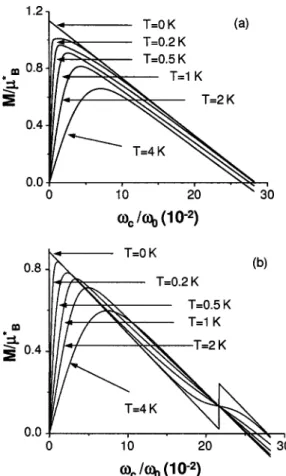
dot with four electrons the level crossing provides a sharp FIG. 2. Temperature dependence of InAs four electron quantum dot
mag-netization共a兲 without and 共b兲 with spin–orbit interaction.
FIG. 3. Temperature dependence of InAs five electron quantum dot magne-tization共a兲 without and 共b兲 with spin–orbit interaction.
jump in the magnetization. For the quantum dot with five electrons the jump reflects a crossing between E0,1,⫺1 and E0,1,1 levels for a higher magnetic field 关condition 共8兲兴: B ⬇1.4 T.
At a low but finite temperature kBTⰆប0 (kB is the Boltzmann constant兲 the magnetization for dots with N⫽1, 2, 3, 6 follows the well known rule: totally occupied shells keep provide diamagnetic properties of the systems and par-tially filled shells demonstrate paramagnetic peaks. The peaks decrease exponentially 关⬃exp(⫺kBT/ប0)兴 and the
magnetization approaches the Landau diamagnetism limit when kBT⬃ប0.35
The magnetization for the dot with four electrons at dif-ferent temperatures is presented in Fig. 2. In this case M →0 for B→0 and T⫽0. When the magnetic field increases the magnetization demonstrates the paramagnetic peak. The spin–orbit interaction shifts the position of the peak. For the dot with five electrons we obtain an additional paramagnetic peak at a higher magnetic field due to the crossing of the E0,1,⫺1and E0,1,1 levels关it is shown in Fig. 3共b兲兴.
The above described peculiarities in the magnetization of dots due to the spin–orbit interaction generate well under-standable features of the magnetic susceptibility. In Fig. 4 we show as a function of B for dots with four and five elec-FIG. 4. Temperature dependence of the susceptibility of InAs parabolic quantum dot:共a兲 N⫽4; 共b兲 Nso⫽4; 共c兲 N⫽5; 共d兲 Nso⫽5; and 共e兲 Nso⫽5, at the
region of the second peak.
5894 J. Appl. Phys., Vol. 94, No. 9, 1 November 2003 Voskoboynikovet al.
trons at different temperatures. At nonzero temperatures without the spin-orbit interaction we obtain the paramagnetic peak near B⫽0 关see Figs. 4共a兲, 4共c兲兴. The spin–orbit inter-action shifts the peak to the field defined by Eq.共7兲 for dots with four electrons关see Fig. 4共b兲兴. In the case of the dot with five electrons we observe at low temperature two peaks: near B⫽0 共the ordinary one兲 and at the field defined by Eq. 共8兲 共generated by the spin–orbit interaction兲 关see Figs. 4共d兲, 4共e兲兴. Clearly, the differential susceptibility demonstrates un-usual behavior, which is generated by the jumps of the mag-netization and certainly occur only when the spin–orbit in-teraction is included.
One can control the spin coupling parameters in planar semiconductor systems by means of external or built-in elec-tric fields.22,25 By variations of the fields one can change magnitudes of the parameters. From the above it appears that the peaks of the magnetic susceptibility which are generated by the spin–orbit interaction should have the following in-teresting properties. It is possible to perform a switching be-tween the configuration presented in Fig. 4共a兲 and the con-figuration of Fig. 4共b兲 for dots with four electrons by means of the external electric field or the design of quantum dots. The switching is also possible between the configurations of Fig. 4共c兲 and the configurations of Fig. 4共d兲 for dots with five electrons.
IV. CONCLUSIONS
Before we conclude, we would like to mention that in this article the Coulomb interaction between electrons is ne-glected for simplicity. The crossing in the energy levels can be generated also by including the electron–electron interac-tion into considerainterac-tion. But in this case the crossing occurs between levels with different l and in stronger magnetic fields.3–5,38,39 To fully understand the described effects a many electron problem should be solved.2,30 However, the recent investigation36suggests that the effect of the electron– electron interaction in systems with strong confinement can enhance the spin–orbit interaction. On the other hand the jumps in the magnetization and following peaks in the sus-ceptibility are clear consequences of the reordering and crossings in the dot energy system provided by the spin– orbit interaction. It is known from the physics of the atomic spectra, that the spin–orbit interaction always provides crossing 共or anticrossing兲 configurations in dependencies of the energy levels on magnetic fields 共the general Paschen– Back effect兲.40 Therefore, the described effect has the clear physical meaning but the actual magnitude of it should be verified both experimentally and by means of more sophisti-cated calculations. We have to mention, that it is worth doing because共in contrast to natural atomic systems兲 quantum dots have an advantage that one can control magnetic properties of the dots by applying external electric fields and changing of the chemical potential.
In summary, we have studied interesting consequences of the spin–orbit interaction in small InAs parabolic quan-tum dots. The magnetization and magnetic susceptibility of dots with few electrons were calculated. The spin–orbit
in-teraction was involved to control magnetic response of the dots at low temperature. An analog of the general Paschen– Back effect was found for dots with partially filled electronic shells. This property of III–V semiconductor material quan-tum dots could be useful for the future spintronics research.
ACKNOWLEDGMENTS
This work was supported in part by the National Science Council of Taiwan under Contract Nos. NSC-91-2215-E-009-059 and NSC-91-2119-M-009-003.
1D. Bimberg, Semiconductors 33, 951共1999兲.
2L. P. Kouwenhoven, D. G. Austing, and S. Tarucha, Rep. Prog. Phys. 64,
701共2001兲.
3P. A. Maksym and T. Chakraborty, Phys. Rev. B 45, 1947共1992兲. 4M. Wagner, U. Merkt, and A. V. Chaplik, Phys. Rev. B 45, 1951共1992兲. 5J. S. De Groote, J. E. M. Hornos, and A. V. Chaplik, Phys. Rev. B 46,
12773共1992兲.
6
D. Yoshioka and H. Fukuyama, J. Theor. Soc. Jpn. 61, 2368共1992兲.
7B. L. Altshuler, Y. Gefen, Y. Imry, and G. Montambaux, Phys. Rev. B 47,
10335共1993兲.
8T. Swahn, E. N. Bogachek, Yu. M. Galperin, M. Jonson, and R. I.
Shek-hter, Phys. Rev. Lett. 73, 162共1994兲.
9K. Tanaka, Ann. Phys.共N.Y.兲 268, 31 共1998兲.
10W. C. Tan and J. C. Inkson, Phys. Rev. B 60, 5626共1999兲.
11I. Magnu´sdoto´ttir and V. Gudmudsoon, Phys. Rev. B 61, 10229共2000兲. 12
Y. P. Krasny, N. P. Kovalenko, U. Krey, and L. Jacak, J. Phys.: Condens. Matter 13, 4341共2001兲.
13G. A. Prinz, Science 282, 1660共1998兲. 14B. E. Kane, Nature共London兲 393, 133 共1998兲.
15D. D. Awschalom and J. M. Kikkawa, Phys. Today 52, 33共1999兲. 16
S. Das Sarma, J. Fabian, X. Hu, and I. Zˇ utic, Solid State Commun. 119, 207共2001兲.
17D. Loss and D. P. DiVincenzo, Phys. Rev. A 57, 120共1998兲.
18O. Steffens, M. Suhrke, and U. Ro¨ssler, Physica B 256–258, 147共1998兲. 19S. Tarucha et al., Physica E共Amsterdam兲 3, 112 共1998兲.
20
H. Tamura, Physica B 249–251, 210共1998兲.
21G. Dresselhaus, Phys. Rev. 100, 580共1955兲.
22Yu. A. Bychkov and E. I. Rashba, J. Phys. C 17, 6039共1984兲. 23D. Richards and B. Jusserand, Phys. Rev. B 59, R2506共1999兲. 24
C. M. Hu, J. Nitta, T. Akazaki, J. Osaka, P. Pfeffer, and W. Zawadzki, Phys. Rev. B 60, 7736共1999兲.
25E. A. de Andrada e Silva, G. C. La Rocca, and F. Bassani, Phys. Rev. B
55, 16293共1997兲.
26A. Voskoboynikov, S. S. Liu, C. P. Lee, and O. Tretyak, J. Appl. Phys. 87,
1共2000兲.
27A. V. Moroz and C. H. W. Barnes, Phys. Rev. B 61, R2464共2000兲; 60,
14272共2000兲.
28O. Voskoboynikov, C. P. Lee, and O. Tretyak, Phys. Rev. B 63, 165306
共2001兲.
29
V. Fock, Z. Phys. 47, 446共1928兲.
30P. A. Maksym, H. Imamura, G. P. Mallon, and H. Aoki, J. Phys.: Condens.
Matter 12, R299共2000兲.
31G. Bastard, Wave Mechanics Applied to Semiconductor Heterostructures
共Les Edition de Physique, Les Ulis, France, 1990兲.
32L. M. Roth, B. Lax, and S. Zwerdling, Phys. Rev. 114, 90共1959兲. 33L. I. Magaril, D. A. Romanov, and A. V. Chaplik, Zh. E´ ksp. Teor. Fiz. 113,
1411共1998兲 关JETP 86, 771 共1998兲兴.
34
L. I. Magaril and A. V. Chaplik, JETP Lett. 64, 460共1996兲; Zh. E´ksp. Teor. Fiz. 115, 1478共1999兲 关JETP 88, 815 共1999兲兴.
35L. D. Landau and E. M. Lifshitz, Statistical Physics, Part 1共Pergamon
International Lib, 1975兲.
36G.-H. Chen and M. E. Raikh, Phys. Rev. B 60, 4826共1999兲. 37
M. A. Cusack, P. R. Briddon, and M. Jaros, Phys. Rev. B 54, 2300共1996兲.
38O. Olenski, C. S. Kim, O. H. Chung, and C. S. Lee, Phys. Rev. B 55, 9834
共1997兲.
39W. X. Qiang, J. Phys.: Condens. Matter 12, 4207共2000兲.
40I. I. Sobelman, Atomic Spectra and Radiative Transitions共Springer,
Ber-lin, 1991兲.