Isolation and Identification of Two Antrodia cinnamomea
Strains from Fruiting Bodies
CHIEN-YU CHANG1,2, MING-YONG LUE3 AND TZU-MING PAN1*
1. Institute of Microbiology and Biochemistry, National Taiwan University, 1, Sec. 4, Roosevelt Rd., Taipei 106, Taiwan, R.O.C. 2. Taiwan Sugar Research Institute, Tainan, Taiwan
3. Department of Cosmetic Science, Chia-Nan University of Pharmacy and Science, Taiwan
(Received: January 26, 2005; Accepted: November 7, 2005) ABSTRACT
Antrodia cinnamomea strains ACTS1 and AC0623 were isolated from the fruiting bodies. The partial sequences of ribosomal
RNA gene, including the internal transcribed spacers, ITS1-5.8S-ITS2, and 18S ribosomal RNA genes, have been sequenced and applied to identify these two strains. Four specific primer sets (NS1/NS2, NS3/NS4, NS5/NS8, and ITS1/ITS4) were utilized to perform PCR experiment of the ribosomal RNA genes. Comparison of partial nucleotide sequences (ITS1-5.8S-ITS2) with strains from different genus (Antrodiella semisupina, Antrodiella romellii and Trametes versicolor) was made. These DNA sequence data demonstrated that there is no difference among ACTS1, AC0623, BCRC 35396 and BCRC 35398. The colony morphology and growth characteristics of Antrodia cinnamomea strains in different culture media of agar plate were also made. No obvious micro-scopic difference of A. cinnamomea strains ACTS1, AC0623, BCRC 35396, and BCRC 35398 were observed. The results from this study suggested that strains ACTS1 and AC0623 isolated from fruiting bodies, and the strains BCRC 35396 and 35398, the original
A. cinnamomea strain obtained from Food Industry Research and Development Institute (FIRDI) are the same species.
Key words: Antrodia cinnamomea, ribosomal RNA genes, polymerase chain reaction (PCR), fruiting bodies
* Author for correspondence. Tel: +886-2-33664519; Fax: +886-2-2362-7044; E-mail: [email protected]
INTRODUCTION
Antrodia cinnamomea, a native species in Taiwan,
grows naturally on Cinnamomum kanehirai Hay, a kind of camphor tree grown only in Taiwan, and is commonly known as “Niu-chang-chih”. This fungus forms fruit bodies that causes brown rot on C. kanehirai(1,2,3).
Aborigines living in Taiwan’s mountain range have used this fungus for the treatment of food and drug intoxications, diarrhea, abnormal pains, hypertension and liver cancer in Taiwanese folk medicine(2,4,5,6). The current price of fresh fruiting bodies of A. cinnamomea is estimated to be US$ 1500 per kg.
Economic incentives are effective for the development of artificial cultivation methods. Some organizations claim to have induced formation of fruiting bodies since early 2001. However, it seems that growth under such artificial environments still depends on luck. Nevertheless, submerged mycelia products have been recently marketed. We have isolated two strains ACTS1 and AC0623 from fruiting bodies of A. cinnamomea at Liou Kuei in southern Taiwan. In order to understand whether strains ACTS1 and AC0623 cultivated in Taiwan Sugar Research Institute (TSRI) and the BCRC 35396 and 35398 strains are the same, some molecular systematic techniques were made(7-22). Random amplified polymorphic DNA (RAPD) markers with polymerase chain reaction (PCR)
amplification of genomic DNA technique were also used for identification of Cordyceps species(17,23,24).
Based on PCR fragments of the whole ribosomal RNA gene (including the internal transcribed spacers [ITS1 and ITS2], plus 5.8S, 18S, and 28S ribosomal RNA genes) we can distinguish whether these strains have the same characteristics from the original species. The results of isolation and identification of these strains are described as follows.
MATERIALS AND METHODS
I. Strains of Antrodia cinnamomea
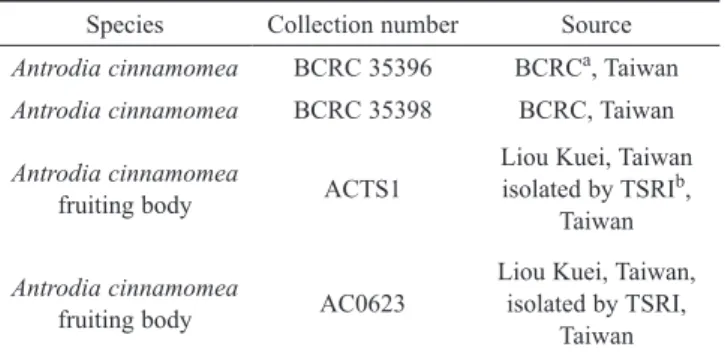
The strains of this study A. cinnamomea BCRC 35396 and A. cinnamomea BCRC 35398 were purchased from Bioresources Collection & Research Center (BCRC, FIRDI, Hsinchu, Taiwan). Strains of ACTS1 and AC0623 were isolated from fruiting bodies of A. cinnamomea at Liou Kuei in southern Taiwan as illustrated in Table 1. II. Isolation of Two Antrodia cinnamomea Strains from
Fruiting Bodies
Firstly the fruiting body was treated with antibiotics penicillin V or ampicillin to inhibit the growth of contaminants. Then it was cut into small pieces, put into the sterilized water and isolated from different dilutions of sterilized water on agar plate. Colonies were grown
on plate for three weeks on M25 plate. Two strains of ACTS1 and AC0623 were isolated from fruiting bodies of A. cinnamomea.
III. Antrodia cinnamomea Cultured Media
A. cinnamomea strains ACTS1, AC0623, BCRC
35396, and BCRC 35398 were cultured and maintained at 28˚C on M25 agar plate (Merck, Germany). Mycelium obtained from the edge of 21-day-old colonies was used as the inoculum source. Other culture media such as PDA (potato dextrose agar, Difco, Becton Dickinson, USA), OAT (oatmeal agar, Difco, Becton Dickinson, USA), SGA (Sabouraud-2% glucose agar, Merck, Germany), and NA (nutrient agar, Merck, Germany) agar plate were used to make a comparison of colony growth. Cell mass production was carried out in 500-mL Hinton flask with rotary shaker of 110 rpm and 28˚C respectively. The M25 cultured media of A. cinnamomea strains are as follows: glucose 3%, bacto-peptone 1.5%, yeast extract 1.5%, malt extract 1.5%, MgSO4•7H2O 0.03%, KH2PO4 0.03% and
K2HPO4 0.03%, pH 5.5.
IV. Extraction of Genomic DNA
Genomic DNA was prepared using plant DNAzol Reagent(25) (Invitrogen, USA). The procedures were as follows.
(I) Extration
Plant tissues of A. cinnamomea were pulverized in liquid nitrogen using mortar and pestle. As the samples were grinded, liquid nitrogen was replenished in the mortar 2 to 3 times. The resulting homogenous frozen powder was then transferred to a microcentrifuge tube containing plant DNAzol. Every gram of plant tissue needed 3 mL of plant DNAzol. The mixture was mixed thoroughly by gentle inversion a few times before incubation at 25˚C and shaking for 5 min. The mixture was then added to 0.3 mL of chloroform and mixed vigorously. After incubation at 25˚C for another 5 min, the mixture was centrifuged. (II) Centrifugation
Following extraction, the extract was centrifuged at 12,000 × g for 10 min. The supernatant was transfer to a fresh tube.
(III) DNA Precipitation
The collected supernatant was mixed with 0.23 mL of absolute ethanol. The compound was mixed by inverting the tube 6 to 8 times before storage at room temperature for 5 min. Precipitated DNA was separated by centrifugation at 5,000 × g for 4 min.
(IV) DNA Wash
1. Plant DNAzol-ethanol Wash
Plant DNAzol–ethanol wash was prepared by mixing 1 volume of DNAzol with 0.75 volume of 100% ethanol. A quantity of 0.3 mL of Plant DNAzol-ethanol wash solution was mixed with the DNA precipitate by vortexing. After 5 min, the mixture was subjected to centrifugation at 5,000 × g for 4 min.
2. Ethanol Wash
After the DNAzol wash solution was removed, the DNA pellet was washed by vigorously mixing with 0.3 mL of 75% ethanol. The mixture was then centrifuged at 5,000 × g for 4 min.
(V) DNA Solubilization
After ethanol layer was removed by decanting, the remaining ethanol was further removed with a micropipette that was allowed to sit vertically for about 2 min. The remaining DNA pellet was air dried and then dissolved in 70 μL of TE buffer (10 mM Tris-HCl, 1 mM EDTA, pH 8.0). If DNA pellet is difficult to dissolve, 8 mM NaOH solution can be used instead of TE buffer. In a typical DNA preparation, the DNA solution is cloudy and Table 1. Source and collection number of Antrodia cinnamomea
strains in this study
Species Collection number Source
Antrodia cinnamomea BCRC 35396 BCRCa, Taiwan Antrodia cinnamomea BCRC 35398 BCRC, Taiwan
Antrodia cinnamomea
fruiting body ACTS1
Liou Kuei, Taiwan isolated by TSRIb,
Taiwan
Antrodia cinnamomea
fruiting body AC0623
Liou Kuei, Taiwan, isolated by TSRI,
Taiwan
a BCRC: Bioresources Collection & Research Center, Hsinchu,
Taiwan.
bTSRI: Taiwan Sugar Research Institute, Tainan, Taiwan.
Table 2. Primers used in this study(21)
Primer
designation Primer sequences (5’→3’) Tm (˚C) NS1 GTAGTCATATGGCTTGTCTC 54 NS2 GGCTGCTGGCACCAGACTTGC 62 NS3 GCAAGTCTGGTGCCAGCAGCC 62 NS4 CTTCCGTCAATTCCTTTAAG 56 NS5 AACTTAAAGGAATTGACGGAAG 49 NS8 TCCGCAGGTTCACCTACGGA 64 ITS1 TCCGTAGGTGAACCTGCGG 62 ITS4 TCCTCCGCTTATTGATATGC 58
may contain insoluble material, which can be removed by centrifugation at 12,000 × g for 4 min.
V. Polymerase Chain Reaction (PCR) of rRNA Gene
The f ragment of ITS1-5.8S-ITS2, 18S rR NA
gene were amplified by polymerase chain reaction. The quantitative analysis of DNA was obtained using OD260/280 after extraction of genomic DNA. Fifty ng of DNA samples from each strain were taken, and the concentration of MgCl2 is 1.5 mM. Four specific
primer sets (NS1&NS2, NS3&NS4, NS5&NS8, and ITS1&ITS4) were utilized to perform PCR experiments of the ribosomal RNA genes. Table 2 shows the primers used in this study. The reaction condition of PCR is shown as follows: reaction volume: 100 µL, dNTP concentration: 200 µM, primer concentration: 0.5 µM, and dosage of Taq polymerase (Promega, USA): 0.1 U/ µL. The procedure of PCR reaction was began with 95˚ C for 5 min. and then heated for 1 min. for denaturation. The annealing temperature is 57˚C (for 1 min) and the elongation temperature is 72˚C (for 2 min) for 40 cycles. The PCR products were separated by electrophoresis in a 2.0% agarose gel, 100 V voltage in 0.5 times TBE (50 mM Tris base, 45 mM boric acid, and 0.5 mM EDTA) buffer (Invitrogen, USA) and then stained with ethidium bromide. The gel was observed and photographed under ultraviolet light.
RESULTS
I. Isolation of Two Antrodia cinnamomea Strains from
Fruiting Bodies
Figure 1 shows the fruiting body of A. cinnamomea strain AC0623 and colonies grew 3 weeks on M25 agar plate (Merck, Germany). The comparison of strains ACTS1, AC0623, BCRC 35396 and BCRC 35398 on M25, PDA, OAT, SGA, and NA agar plate are shown in Table 3. Figure 1. The fruiting body of Antrodia cinnamomea strain AC0623
and colonies grow 3 weeks on M25 agar plate.
(A) (B) (C)
Figure 2. Microscopic characteristics of Antrodia cinnamomea (A) ACTS1 (B) AC0623 (C)
BCRC 35396 (D) BCRC 35398 (×400).
The growth rate of A. cinnamomea on M25 agar was the fastest among all combination tested. The microscopic traits of these strains are shown in Figure 2, and the anatomy microscopic characteristics of A. cinnamomea are depicted in Figure 3.
II. Comparison of the PCR Products of Ribosomal RNA
Genes among the Antrodia cinnamomea Strain ACTS1, AC0623, BCRC 35396, and BCRC 35398
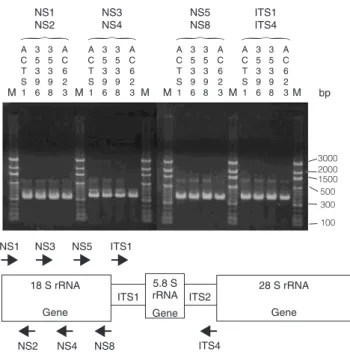
Four specific primer sets (NS1/NS2, NS3/NS4, NS5/NS8, and ITS1/ITS4) were utilized to perform PCR amplification of the ribosomal RNA genes (including 18S and ITS1-5.8S-ITS2 rRNA gene). The results are shown in Figure 4. The fragment length and location with specific primer sets to perform PCR amplification are shown as follows:
The PCR product of NS1 & NS2: 550 bp (18S rRNA gene) The PCR product of NS3 & NS4: 600 bp (18S rRNA gene) The PCR product of NS5 & NS8: 650 bp (18S rRNA gene)
The PCR product of ITS1& ITS4: 700 bp (ITS1-5.8S-ITS2 rRNA gene)
III. DNA Sequence Analysis of Antrodia cinnamomea
Strain(16) and Others
Four specific primer sets (NS1/NS2, NS3/NS4, NS5/ Figure 4. Comparison of the PCR products of ribosomal RNA genes
among the Antrodia cinnamomea strain ACTS1, AC0623 (TSRI), and BCRC 35396, BCRC 35398 strain (FIRDI). PCR products were separated by electrophoresis in a 2.0% agarose gel and then stained with ethidium bromide. The gel was observed and photographed under ultraviolet light. The100-bp ladder (M) as molecular weight standards is shown in intervals.
NS1 NS2 NS1 NS3 NS5 NS2 NS4 NS8 ITS1 3000 2000 1500 500 300 100 A C T S 1 M A C 6 2 3 3 5 3 9 6 3 5 3 9 8
{
NS3 NS4 A C T S 1 M M M M A C 6 2 3 3 5 3 9 6 3 5 3 9 8{
NS5 NS8 A C T S 1 M A C 6 2 3 3 5 3 9 6 3 5 3 9 8{
ITS1 ITS4 A C T S 1 bp A C 6 2 3 3 5 3 9 6 3 5 3 9 8{
ITS4 ITS1 ITS2 18 S rRNA Gene 28 S rRNA Gene 5.8 S rRNA GeneTable 3. Diameter of the colonies of Antrodia cinnamomea strains in
different media Strain
Medium ACTS1 AC0623 BCRC 35396 BCRC 35398 M25 5.0 cma 6.5 cm 6.0 cm 5.0 cm
PDA 4.5 cm 5.5 cm 5.5 cm 5.3 cm OAT 4.5 cm 4.5 cm 5.3 cm 6.5 cm SGA 4.3 cm 4.5 cm 4.0 cm 5.0 cm
NA —b — — —
a cm: the length were measured when the colonies reached their
maximum diameter of A. cinnamomea strains within 21 days after inoculated on the plates.
bNo growth.
(A) (B) (C)
Figure 3. Anatomy microscopic characteristics of Antrodia cinnamomea (A) ACTS1 (B)
AC0623 (C) BCRC 35396 (D) BCRC 35398 on M25 agar (×50).
NS8, and ITS1/ITS4) were utilized to perform primer for direct DNA sequence of PCR product. Ribosomal RNA genes of ACTS1, BCRC 35396, BCRC 35398, and
AC0623 were used for DNA sequence analysis. Based on the ribosomal RNA genes (18S and ITS1-5.8S-ITS2 rRNA genes) and four specific primer sets, the length of PCR product after reaction was 556 bp, 602 bp, 659 bp and 682 bp respectively. The complete sequence of 18S rRNA, ITS1, 5.8S rRNA and ITS2 were obtained. The results of the DNA sequences analysis among ACTS1, AC0623, BCRC 35396, and BCRC 35398 strains are shown in Table 4.
F r o m t h e s e q u e n c e a n a l y s i s o f A n t r o d i a
cinnamomea(26), 18S rRNA is shown to be a high
conservative region (about 1700 bp) and the similarity between BCRC 35396 and BCRC 35398 strains was over 98%. Since the region of partial nucleotide sequence ITS1-5.8S-ITS2 (about 680 bp) is non-conservative evolutionally, it is suitable for species identification. Partial nucleotide sequences (ITS1-5.8S-ITS2) were compared with those of the strains from different genus (Antrodiella semisupina, Antrodiella romellii, and
Trametes versicolor). The sequences were analyzed
Table 4. Similarity of DNA sequences of partial ribosomal RNA
genes [containing partial 18S ribosomal RNA gene, internal transcribed spacer 1 (ITS1), 5.8S ribosomal RNA gene, internal transcribed spacer 2 (ITS2), and partial 28S ribosomal RNA gene] among 4 Antrodia cinnamomea strains including ACTS1 (AY378092), AC0623 (AY378093), BCRC 35396 (AY378094), and BCRC 35398 (AY378095)
Strain AC0623 BCRC 35396 BCRC 35398 ACTS1 ACTS1 100% 99.8% 99.9% 100% AC0623 100% 99.8% 99.9% 100% BCRC 35396 99.8% 100% 99.9% 99.8% BCRC 35398 99.9% 99.9% 100% 99.9% BCRC35396 TCCGTAGGTGAACCTGCGGAAGGACCATTATTGTAT----TTGAAAGGGG BCRC35716 TCCGTAGGTGAACCTGCGGAAGGACCATTATTGTAT----TTGAAAGGGG AC0623 TCCGTAGGTGAACCTGCGGAAGGATCATTATTGTAT----TTGAAAGGGG ACTS1 TCCGTAGGTGAACCTGCGGAAGGATCATTATTGTAT----TTGAAAGGGG BCRC35398 TCCGTAGGTGAACCTGCGGAAGGATCATTATTGTAT----TTGAAAGGGG
Antrodiella semisupina TCCGTAGGTGAACCTGCGGAAGGATCATTAATGAATGAACTTGGGCATAG
Antrodiella romellii TCCGTAGGTGAACCTGCGGAAGGATCATTAATGAATGAACTTGGGCAAAG
Trametes versicolor TCCGTAGGTGAACCTGCGGAAGGATCATTAACGAGT---TTTGAAACGAG BCRC35396 TTGTAGCTGACCTCCTCTTGAAAAGGGGGGAGGTATGTGCACACCTCT-G BCRC35716 TTGTAGCTGACCTCCTCTTGAAAAGGGGGGAGGTATGTGCACACCTCTTG AC0623 TTGTAGCTGACCTCCTCTTGAAAAGGGGGGAGGTATGTGCACACCTCT-G ACTS1 TTGTAGCTGACCTCCTCTTGAAAAGGGGGGAGGTATGTGCACACCTCT-G BCRC35398 TTGTAGCTGACCTCCTCTTGAAAAGGGGGGAGGTATGTGCACACCTCT-G
Antrodiella semisupina TTGTAGCTGGCCTC---AGCAATGAGGCATGTGCACAC-TGT-G
Antrodiella romellii TTGTAGCTGGCCTC---AGCAATGGGGCATGTGCACAC-TTT-G
Trametes versicolor TTGTAGCTGGCCTT---C----CGGGGCATGTGCACGC-TCT-G
BCRC35396 TTCATTCATATTCTCTCACACCTGTGCATGCTTTGTAGGTTGGTTTTGAA BCRC35716 TTCATTCATATTCTCTCACACCTGTGCATGCTTTGTAGGTTGGTTTTGAA AC0623 TTCATTCATATTCTCTCACACCTGTGCATGCTTTGTAGGTTGGTTTTGAA ACTS1 TTCATTCATATTCTCTCACACCTGTGCATGCTTTGTAGGTTGGTTTTGAA BCRC35398 TTCATTCATATTCTCTCACACCTGTGCATGCTTTGTAGGTTGGTTTTGAA
Antrodiella semisupina TTCATCCAC-CCTTCACACCTCTGTGCACTTCTCATGGGTTTGGGTCAAG
Antrodiella romellii TTCATCCAC-C-TTCACACCACTGTGCACTTCTCATGGGTC-GGGTTGCG
Trametes versicolor CTCATCCAC-TCT----ACCCCTGTGCACTTACTGTAGGTTGGCGTGGGC BCRC35396 TGGTTGTCTTCTCTGATGGAGACAGCTGTTTTGACCTTCCTATGTTTTTT BCRC35716 TGGTTGTCTTCTCTGATGGAGACAGCTGTTTTGACCTTCCTATGTTTTTT AC0623 TGGTTGTCTTCTCTGATGGAGACAGCTGTTTTGACCTTCCTATGTTTTTT ACTS1 TGGTTGTCTTCTCTGATGGAGACAGCTGTTTTGACCTTCCTATGTTTTTT BCRC35398 TGGTTGTCTTCTCTGATGGAGACAGCTGTTTTGACCTTCCTATGTTTTTT
Antrodiella semisupina T---CTGAAATATGGCGAAGCCC---CCTTCTCATGTGTTTT
Antrodiella romellii T---CTGAAATATGGCAAAGCCC---TTCTCATGTGTTTT
BCRC35396 AAATTGACTCCGTATCAGTTACAGAATGTA----TGTTGCGTGTAACGCA BCRC35716 AAATTGACTCCGTATCAGTTACAGAATGTA----TGTTGCGTGTAACGCA AC0623 AAATTGACTCCGTATCAGTTACAGAATGTA----TGTTGCGTGTAACGCA ACTS1 AAATTGACTCCGTATCAGTTACAGAATGTA----TGTTGCGTGTAACGCA BCRC35398 AAATTGACTCCGTATCAGTTACAGAATGTA----TGTTGCGTGTAACGCA
Antrodiella semisupina AAACACACACTATACAAGTTTTAGAATGTAACAATCATGCGTC-AATGCA
Antrodiella romellii AC-CACACACT--ACAAGTTTTAGAATGTAACAATCATGCATT-AATGCA
Trametes versicolor ACAAACACTTTA---AAGTATCAGAATGTAA---ACGCGTCTAACGCA
BCRC35396 T--ATTGTATAACTTTCAGCAACGGATCTCTTGGCTCTCGCATCGATGAA BCRC35716 T--ATTGTATAACTTTCAGCAACGGATCTCTTGGCTCTCGCATCGATGAA AC0623 T--ATTGTATAACTTTCAGCAACGGATCTCTTGGCTCTCGCATCGATGAA ACTS1 T--ATTGTATAACTTTCAGCAACGGATCTCTTGGCTCTCGCATCGATGAA BCRC35398 T--ATTGTATAACTTTCAGCAACGGATCTCTTGGCTCTCGCATCGATGAA
Antrodiella semisupina T--ATAATACAACTTTCAGCAACGGATCTCTTGGCTCTCGCATCGATGAA
Antrodiella romellii T--ATAATACAACTTTCAGCAACGGATCTCTTGGCTCTCGCATCGATGAA
Trametes versicolor TCTATAATACAACTTTTAGCAACGGATCTCTTGGCTCTCGCATCGATGAA BCRC35396 GAACACGGCGAAATGTGATAAGTAATGTGAATTGCAGAATTCAGTGAATC BCRC35716 GAACACGGCGAAATGTGATAAGTAATGTGAATTGCAGAATTCAGTGAATC AC0623 GAACACGGCGAAATGTGATAAGTAATGTGAATTGCAGAATTCAGTGAATC ACTS1 GAACACGGCGAAATGTGATAAGTAATGTGAATTGCAGAATTCAGTGAATC BCRC35398 GAACACGGCGAAATGTGATAAGTAATGTGAATTGCAGAATTCAGTGAATC
Antrodiella semisupina GAACGCAGCGAAATGCGATAAGTAATGTGAATTGCAGAATTCAGTGAATC
Antrodiella romellii GAACGCAGCGAAATGCGATAAGTAATGTGAATTGCAGAATTCAGTGAATC
Trametes versicolor GAACGCAGCGAAATGCGATAAGTAATGTGAATTGCAGAATTCAGTGAATC BCRC35396 ATCGAATCTTTGAACGCACCTTGCGCTCCTTGGTATTCTGAGGAGCATGC BCRC35716 ATCGAATCTTTGAACGCACCTTGCGCTCCTTGGTATTCTGAGGAGCATGC AC0623 ATTGAATCTTTGAACGCACCTTGCGCTCCTTGGTATTCTGAGGAGCATGC ACTS1 ATTGAATCTTTGAACGCACCTTGCGCTCCTTGGTATTCTGAGGAGCATGC BCRC35398 ATCGAATCTTTGAACGCACCTTGCGCTCCTTGGTATTCTGAGGAGCATGC
Antrodiella semisupina ATCGAATCTTTGAACGCACCTTGCGCTCCTTGGTATTCCGAGGAGCATGC
Antrodiella romellii ATCGAATCTTTGAACGCACCTTGCGCTCCTTGGTATTCCGAGGAGCATGC
Trametes versicolor ATCGAATCTTTGAACGCACCTTGCGCTCCTTGGTATTCCGAGGAGCATGC
BCRC35396 CTGTTTGAGTGTCATGGAATTATCAACCCTTTTGACTTTTTGT---BCRC35716 CTGTTTGAGTGTCATGGAATTATCAACCCTTTTGACTTTTTGT---AC0623 CTGTTTGAGTGTCATGGAATTATCAACCCTTTTGACTTTTTGT---ACTS1 CTGTTTGAGTGTCATGGAATTATCAACCCTTTTGACTTTTTGT---BCRC35398
CTGTTTGAGTGTCATGGAATTATCAACCCTTTTGACTTTTTGT---Antrodiella semisupina CTGTTTGAGTGTCATGGTATTCTCAACCCTGCTACATTTTTTTGAAAGAT
Antrodiella romellii
CTGTTTGAGTGTCATGGTATTCTCAACCCTGCTACATTTTTT---Trametes versicolor
CTGTTTGAGTGTCATGGAATTCTCAACTT--ATAAATCCTTGTG---BCRC35396 -TGAATGGGCTTGGATTTGGAGGGTTAAATTGCTGGCTCTT----CTTTT BCRC35716 -TGAATGGGCTTGGATTTGGAGGGTTAAATTGCTGGCTCTT----TTTTT AC0623 -TGAATGGGCTTGGATTTGGAGGGTTAAATTGCTGGCTCTT----TTTTT ACTS1 -TGAATGGGCTTGGATTTGGAGGGTTAAATTGCTGGCTCTT----TTTTT BCRC35398 -TGAATGGGCTTGGATTTGGAGGGTTAAATTGCTGGCTCTT----TTTTT
Antrodiella semisupina GTTGCTTGGCTTGGACTTGGAGGTTT--ATTGCTGGCATTCAACTTGTTT
Antrodiella romellii GTAGCTGGGCTTGGACTTGGAGGT----ATTGCCGGTGTTC---TCTTTT
ATCTATAAGCTTGGACTTGGAGGC---TTGCTGGCCCTT---and are shown in Figure 5. The results from this study suggest that the two strains (ACTS1 and AC0623) isolated from fruiting bodies are of the same species, A.
cinnamomea. The nucleotide sequences reported in this
and other paper have been submitted to the GenBank with accession numbers AY378092 (ACTS1), AY378093
(AC0623), AY378094 (BCRC 35396), AY378095 (BCRC 35398), AJ496402 (BCRC 35716)(26), AY309015 (Trametes
versicolor), AF126902 (Antrodiella romellii)(27), and
AF126903 (Antrodiella semisupina)(27). BCRC35396 T-GATTCAGCTCCTCTTGAATGCATTAGCTTGAACCCTTGTGGATTGACC BCRC35716 T-GATTCAGCTCCTCTTGAATGCATTAGCTTGAACCCTTGTGGATTGACC AC0623 TTGATTCAGCTCCTCTTGAATGCATTAGCTTGAACCCTTGTGGATTGACC ACTS1 TTGATTCAGCTCCTCTTGAATGCATTAGCTTGAACCCTTGTGGATTGACC BCRC35398 T-GATTCAGCTCCTCTTGAATGCATTAGCTTGAACCCTTGTGGATTGACC
Antrodiella semisupina GAACGCGGGCTCCTCTGAAATGCATTAGCTGGAATGT-TACCGAGCATGA
Antrodiella romellii GAACGCGGGCTCCTCTGAAATGCATTAGCTGGAATGT-TACCGAGCATGA
Trametes versicolor -GCGGTCGGCTCCTCTTGAATGCATTAGCTTGATTCCGTACGGATCGGCT BCRC35396 TTATCGGTGTGATAGTCATCTATGCCGTGGTTGTCTGAGGTGGGATCGGC BCRC35716 TTATCGGTGTGATAGTCATCTATGCCGTGGTTGTCTGAGGTGGGATCGGC AC0623 TTATCGGTGTGATAGTCATCTATGCCGTGGTTGTCTGAGGTGGGATCGGC ACTS1 TTATCGGTGTGATAGTCATCTATGCCGTGGTTGTCTGAGGTGGGATCGGC BCRC35398 TTATCGGTGTGATAGTCATCTATGCCGTGGTTGTCTGAGGTGGGATCGGC
Antrodiella semisupina TT--CAATGTGATAATTGTCTACGTTGCTTCAACTTGGTATTAATTCTGT
Antrodiella romellii TT--CAATGTGATAATTGTCTACGTTGCTTCAACTTGGTATTAATTCTGT
Trametes versicolor CT--CAGTGTGATAATTGTCTACGCTGT---GACCGTGAAGTGTTTTGGC BCRC35396 TTCTAATGGTGCAAGTCCCTTCAGGGGGATGATTTTCTAATGACCTTCTG BCRC35716 TTCTAATGGTGCAAGTCCCTTCAGGGGGATGATTTTCTAATGACCTTCTG AC0623 TTCTAATGGTGCAAGTCCCTTCAGGGGGATGATTTTCTAATGACCTTCTG ACTS1 TTCTAATGGTGCAAGTCCCTTCAGGGGGATGATTTTCTAATGACCTTCTG BCRC35398 TTCTAATGGTGCAAGTCCCTTCAGGGGGATGATTTTCTAATGACCTTCTG
Antrodiella semisupina TTCAGCTTCTAACCGTCCCCTTTGCGGGACAATATCT---TGAACATCTG
Antrodiella romellii TTCAGCTTCTAACCGTCCGCA----AGGACAATATCT---TGAACATCTG
Trametes versicolor --GAGCTTCTAACCGTCCATT----AGGACAACTTCT---T-AACATCTG
BCRC35396 ACCTCAAATCAGGTAGGACTACCCGCTGAACTTAAGCATATCAATAAGCG BCRC35716 ACCTCAAATCAGGTAGGACTACCCGCTGAACTTAAGCATATCAATAAGCG AC0623 ACCTCAAATCAGGTAGGACTACCCGCTGAACTTAAGCATATCAATAAGCG ACTS1 ACCTCAAATCAGGTAGGACTACCCGCTGAACTTAAGCATATCAATAAGCG BCRC35398 ACCTCAAATCAGGTAGGACTACCCGCTGAACTTAAGCATATCAATAAGCG
Antrodiella semisupina ACCTCAAATCAGGTAGGACTACCCGCTGAACTTAAGCATATCAATAAGCG
Antrodiella romellii ACCTCAAATCAGGTAGGACTACCCGCTGAACTTAAGCATATCAATAAGCG
Trametes versicolor ACCTCAAATCAGGTAGGACTACCCGCTGAACTTAAGCATATCAATAAGCG BCRC35396 GAGGA
BCRC35716
GAGG-AC0623 GAGGA
ACTS1 GAGGA
BCRC35398 GAGGA
Antrodiella semisupina GAGGA
Antrodiella romellii GAGGA
Trametes versicolor GAGGA
Figure 5. Comparison of DNA sequences of partial ribosomal RNA genes (containing partial ITS1, 5.8S rRNA gene, and partial ITS2) among
5 Antrodia cinnamomea strains including ACTS1 (AY378092), AC0623 (AY378093), BCRC 35396 (AY378094), BCRC 35398 (AY378095), and BCRC 35716 (AJ496402), as well as Antrodiella semisupina (AF126903), Antrodiella romellii (AF126902), and Trametes versicolor (AY309015) strains.
DISCUSSION
PCR primers that target conserved regions of fungal rRNA genes, amplifying sequence-variable fragments of genes or intervening noncoding regions, have been used for sequence comparisons. Interspecies variability is also manifested in the fragment size of the internal transcribed spacer 1 and 2 (ITS1 and ITS2, respectively) regions(28).
In order to identify A. cinnamomea rapidly and correctly, the molecular biology methods for A. cinnamomea species and strains analysis were used(26). Firstly, they used 18S rRNA gene, ITS gene and intergenic spacer of rRNA, and Mn-superoxide dismutase gene(26). In addition, phylogenetic analysis methods, Neighbor Joing method, Parsimony method and Maximum Likelihood method were also used to analyze evolution relation of
A. cinnamomea(26). The specific primer sets based PCR
fragments of the whole ribosomal RNA gene [including the internal transcribed spacers (ITS1 and ITS2), 5.8S, and 18S ribosomal RNA genes] combined partial nucleotide sequence (ITS1-5.8S-ITS2) analysis with other genus for negative control could be applied to investigate whether the strain cultivated in Taiwan Sugar Research Institute (TSRI) is the species named A. cinnamomea. Comparison of colony morphology and growth characteristics of
Antrodia cinnamomea strains in different culture media of
agar plates was made. The growth rate of A. cinnamomea on M25 agar was the fastest among all combinations tested. Nutrient agar medium was not suitable for A.
cinnamomea strains. The results demonstrate that there
is no difference in the eletrophoresisgram of the amplified PCR products between strains ACTS1, AC0623, BCRC 35396, and BCRC 35398. No obvious microscopic difference of A. cinnamomea strains ACTS1, AC0623, BCRC 35396, and BCRC 35398 was observed in this study. The major biologically active component triterpenoids will be in conjunction with our continuing research from the cultured A. cinnamomea mycelia.
ACKNOWLEDGEMENTS
We would like to thank Mr. Shun-Yuan Yang for assisting the PCR experiment in this study.
REFERENCES
1. Andersson, B. E., Tornberg, K., Henrysson, T. and Olsson, S. 2001. Three-dimensional outgrowth of a wood-rotting fungus added to a contaminated soil from a former gasworks site. Bioresour. Technol. 78: 37-45. 2. Chang, T. T. and Chou, W. N. 1995. Antrodia
cinna-momea sp. nov. on Cinnacinna-momea kanehirai in Taiwan.
Mycol. Res. 99: 756-758.
3. Wu, S. H., Ryvarden, L. and Chang, T. T. 1997.
Antrodia cinnamomea (“niu-chang-chih”), new
com-bination of a medicinal fungus in Taiwan. Bot. Bull. Acad. Sin. 38: 273-275.
4. Cherng, I. H. and Chiang, H. C. 1995. Three new tri-terpenoids from Antrodia cinnamomea. J. Natural. Products 58: 365-371.
5. Hseu, Y. C., Chang, W. C., Hseu, Y. T., Lee, C. Y., Tech, Y. J., Chen, P. C., Chen, J. Y. and Yang, H. L. 2002. Protection of oxidative damage by aqueous extract from
Antrodia cinnamomea mycelia in normal human
eryth-rocytes. Life Sci. 71: 469-482.
6. Song, T. Y. and Yen, G. C. 2002. Antioxidant properties of Antrodia cinnamomea in submerged culture. J. Agric. Food Chem. 50: 3322-3327.
7. Buzina, W., Doris, L. L., Braun, H., Freudenschuss, K. and Stammberger, H. 2001. Development of molecular methods for identification of Schizophyllum commune from clinical samples. J. Clin. Microbiol. 39: 2391-2396.
8. Chen, Y. Q., Wang, N., Qu, L. H., Li, T. H. and Zhang, W. M. 2001. Determination of the anamorph of Cordyceps sinensis inferred from the analysis of the ribosomal DNA internal transcribed spacers and ITS1-5.8S-ITS2 rDNA. Biochem. Syst. Ecol. 29: 597-607. 9. Chen, Y. Q., Wang, N., Zhou, H. and Qu, L. H. 2002.
Differentiation of medicinal Cordyceps species by rDNA ITS sequence analysis. Planta. Med. 68: 635-639. 10. Eisenga, B. H., Trestrail III, J. H. and Emerson, T. S.
1998. Identification of unknown mushrooms: the good, the bad, and the ugly. J. Toxicol. Clin. Toxicol. 36: 635-636.
11. Henry, T., Iwen, P. C. and Hinrichs, S. H. 2000. Identification of Aspergillus species using internal tran-scribed spacer regions 1 and 2. J. Clin. Microbiol. 38: 1510-1515.
12. Jackson, C. J. 2001. Molecular identification and strain typing of dermatophyte fungi. Nippon Ishinkin Gakkai Zasshi 42: 7-10.
13. James, T. Y., Moncalvo, J. M., Li, S. and Vilgalys, R. 2001. Polymorphism at the ribosomal DNA spacers and its relation to breeding structure of the widespread mushroom Schizophyllum commune. Genetics 157: 149-161.
14. Kelly, J. M. and Cox, R. A. 1982. The nucleotide sequence at the 3’-end of Neurospora crassa 18S-rRNA and studies on the interaction with 5S-rRNA. Nucleic Acids Res. 10: 6733-6745.
15. Lee, S. B. and Taylor, J. W. 1990. Isolation of DNA from fungal mycelia and single spores. In “PCR Protocols: A Guide to Methods and Applications”. 2nd ed. pp. 315-322. Academic Press. San Diego, U. S. A. 16. Lott, T. J., Burns,B. M., Zancope-Oliveira, R., Elie, C.
M. and Reiss, E. 1998. Sequence analysis of the internal transcribed spacer 2 (ITS2) from yeast species within the genus Candida. Curr. Microbiol. 36: 63-69.
17. Lue, M. Y., Chang, C. C. and Liou, J. J. 2002. Identification of Cordyceps species. Rept. Taiwan Sugar Res. Inst. 175-176: 51-58.
18. Turenne, C. Y., Sanche, S. E., Hoban, D. J., Karlowsky, J. A. and Kabani, A. M. 1999. Rapid identifica-tion of fungi by using the ITS2 genetic region and an automated fluorescent capillary electrophoresis system. J. Clin. Microbiol. 37: 1846-1851.
19. Varga, J., Toth, B., Rigo, K., Teren, J., Hoekstra, R. F. and Kozakiewicz, Z. 2000. Phylogenetic analysis of
Aspergillus section circumdati based on sequences of
the internal transcribed spacer regions and the ITS1-5.8S-ITS2 rRNA gene. Fungal Genet. Biol. 30: 71-80. 20. Velegraki, A., Kambouris, M., Kostourou, A.,
Chalevelakis, G. and Legakis, N. J. 1999. Rapid extrac-tion of fungal DNA from clinical samples for PCR amplification. Med. Mycol. 37: 69-73.
21. Vilgalys, R. and Hester, M. 1990. Rapid genetic iden-tification and mapping of enzymatically amplified ribosomal DNA from several Cryptococcus species. J. Bacteriol. 172: 4238-4246.
22. Zhang, D., Yang, Y., Castlebury, L. A. and Cerniglia, C. E. 1996. A method for the large scale isolation of high transformation efficiency fungal genomic DNA. FEMS. Microbiol. Lett. 145: 261-265.
23. Chen, Y., Zhang, Y. P., Yang, Y. and Yang, D. 1999. Genetic diversity and taxonomic implication of
Cordyceps sinensis as revealed by RAPD markers.
Biochem. Genet. 37: 210-213.
24. Chen, Y., Wang, W., Yang, Y. B., Su, Y. P., Zhang, L., Xiong, Z., He, C. S. and Yang, D. 1997. Genetic diver-gence of Cordyceps sinensis as estimated by random amplified polymorphic DNA analysis. Acta. Genet. Sinica. 24: 410-416.
25. Chomczynski, P., Mackey, K., Drews, R. and Wilfinger, W. 1997. DNAzol: a reagent for the rapid isolation of genomic DNA. Biotechniques 22: 550-553.
26. Chang, Y. H. 2002. Molecular systematics of Antrodia cinnamomea. Master Thesis, Graduate Institute of
Agricultural Chemistry, National Taiwan University, Taiwan, R. O. C.
27. Johannesson, H., Renvall, P. and Stenlid, J. 2000. Taxonomy of Antrodiella inferred from morphological and molecular data. Mycol. Res. 104(1): 92-99.
28. Williams, D. W., Wilson, M. J., Lewis, M. A. O. and Potts, A. J. C. 1995. Identification of Candida species by PCR and restriction fragment length polymorphism analysis of intergenic spacer regions of ribosomal DNA. J. Clin. Microbiol. 33: 2476-2479.