Statistical Methods for
Statistical Methods for
Biotechnology Products
Biotechnology Products
Statistical Designs for Stability Studies
by
Jen-pei Liu, PhD, Professor
Division of Biometry, Department of Agronomy
National Taiwan University
and
Outlines
Outlines
Statistical Concepts
- Bias and variability - Confounding
- Interaction
Basic Design Considerations
- Design objective - Information needed - Design factors
- Response variables
- Regulatory requirements – ICH and FDA
Stability Designs
- Assumption - Design strategies
Statistical Concepts
Statistical Concepts
Bias
Variability
Confounding
Interaction
Interaction and No Interaction
Interaction and No Interaction
-1 1 X1 -1 80 75 1 90 85 ) ( 1 ) ( 1 ) ( ) 20 ( 1 ) 10 ( 1 ) ( 2 1 blister bottle Package x mg mg Strength x Let No interaction x2 Interaction x2 -1 1 X1 -1 80 85 1 90 75 10mg 20mg 10mg
An Example
An Example
Condition Lot Package Strength Response Run X1 X2 X3 X4 Y 1 1 1 1 1 Y1 2 1 1 -1 -1 Y2 3 1 -1 1 -1 Y3 4 1 -1 -1 1 Y4 5 -1 1 1 -1 Y5 6 -1 1 -1 1 Y6 7 -1 -1 1 1 Y7 8 -1 -1 -1 -1 Y8 -1 1 X1 -1 Y7, Y8 Y5, Y6 1 Y3, Y4 Y1, Y2 -1 1 X3 -1 Y2, Y8 Y4, Y6 1 Y3, Y5 Y1, Y7 X2 X4 2 2 2 2 & 2 1 6 5 4 3 8 7 2 1 Y Y Y Y Y Y Y Y x x n Interactio
Statistical Design
Statistical Design
Design objectives
Information needed
Design factors
Response variables
Design Objective
Design Objective
Minimize total sample size or minimize
total cost in testing
Reduce number of assays at same time
- Limited laboratory capacity
- Limited resources
Information needed
Information needed
Marking requirements - Package types - Specifications - Desired shelf-life- When analyze? ( submit to FDA) - Where sold?
Manufacturing practices
- Several strengths with same formula
- Common granulation batch into multiple strengths
- Common encapsulation batch into multiple package types
Previous formulation study results
- Factors that might affect stability - Storage conditions
Information needed
Information needed
Method variability
- Between and within run CV’s
Sample variability
- How to sample containers ?
- How to sample from containers ?
Manufacturing capacity
- When will manufacture ? - When will package ?
Design Factors
Design Factors
Strength
Package type Batch
Sampling (or storage) times Storage conditions Replicates ? Analyst Location : etc.
Response Variables
Response Variables
Potency (Quantitative)
Dissolution (Quantitative)
Appearance (Qualitative)
Hardness (?)
Color (?)
Moisture (?)
:
etc.
Regulatory Requirements
Regulatory Requirements
ICH and FDA
ICH and FDA
Sampling Times
“… Stability testing generally may be done at 3-month
intervals during the first year, 6-month intervals during the second year, and yearly thereafter…”
Sampling times: 0, 3, 6, 9, 12, 18, 24, 36, …
Number of batches required
“… At least three primary batches and preferably more should be tested to allow for some estimate of batch-to-batch and to test the hypothesis that a single expiration
Assumptions
Assumptions
The degradation curve is linear
If there is an exponential decay, it may be
linearized by transformation: arithmetic or
logarthmic scale
Sampling times are fixed across all factors
i.e.,
sampling time: 0, 3, 6, 9, 12, 18, 24, …
indirect assays
Design Strategies
Design Strategies
Complete factorial
- Choose all combination of batch, strength, and package
Fractional factorial or matrixing
- Any subset of a complete factorial design is considered a matrix design
- Choose fraction of batch, strength, and package combinations
Bracketing
- Test only extremes e.g.,
Design strategies
Design strategies
Sampling times T1= 0, 3, 6, 9, 12, 18, 24, 36, 48 T2= 0, 3, 9, 18, 36, 48 T3= 0, 6, 12, 24, 48 T5= 0, 3, 12, 36, 48 T6= 0, 6, 18, 48 T7= 0, 9, 24, 48 T8= 0, 3, 9, 12, 24, 36, 48 T9= 0, 3, 6, 12, 18, 36, 48 TA= 0, 6, 9, 18, 24, 48Stability Design
Stability Design
Type Factors Time Points
1 Complete All
2 Complete Partial
3 Matrixing All
TABLE 10.3.5 NDA Stability Designs
Batch Strength Bottle Blister Tube Bottle Blister Tube Design 1: Complete factorial design Design 2: Complete-2/3 design 1 15 30 60 T1 T1 T1 T1 T1 T1 T1 T1 T1 T8 T9 TA T9 TA T8 TA T8 T9 2 15 30 60 T1 T1 T1 T1 T1 T1 T1 T1 T1 TA T8 T9 T8 T9 TA T9 TA T8 3 15 30 60 T1 T1 T T1 T1 T T1 T1 T T9 TA T TA T8 T T8 T9 T
TABLE 10.3.5 Continued
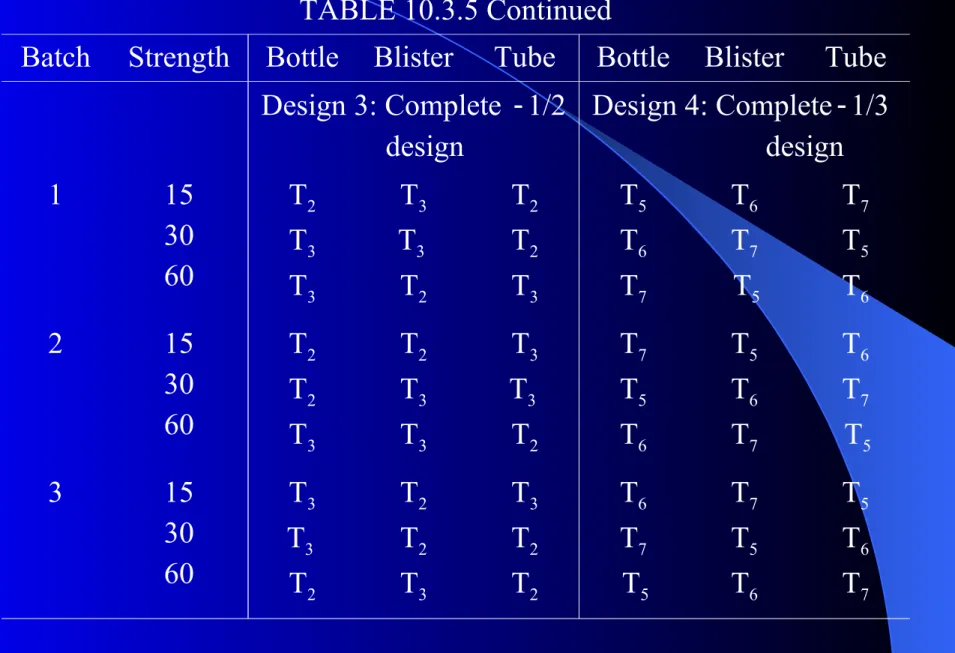
Batch Strength Bottle Blister Tube Bottle Blister Tube Design 3: Complete -1/2 design Design 4: Complete-1/3 design 1 15 30 60 T2 T3 T3 T3 T3 T2 T2 T2 T3 T5 T6 T7 T6 T7 T5 T7 T5 T6 2 15 30 60 T2 T2 T3 T2 T3 T3 T3 T3 T2 T7 T5 T6 T5 T6 T7 T6 T7 T5 3 15 30 60 T3 T3 T T2 T2 T T3 T2 T T6 T7 T T7 T5 T T5 T6 T
TABLE 10.3.5 Continued
Batch Strength Bottle Blister Tube Bottle Blister Tube Design 5: Fractional
factorial design
Design 6: Two strength per batch design
1 15 30 60 T1 T1 — T1 — T1 — T1 T1 T1 T1 — T1 T1 — T1 T1 — 2 15 30 60 — T1 T1 T1 T1 — T1 — T1 — T1 T1 — T1 T1 — T1 T1 3 15 30 60 T1 — T — T1 T T1 T1 — T1 — T T1 — T T1 — T
TABLE 10.3.5 Continued
Batch Strength Bottle Blister Tube Bottle Blister Tube Design 7: Two packages
per strength design Design 8: Fractional-1/2 design
1 15 30 60 T1 T1 — — T1 T1 T1 — T1 T2 T3 — T3 — T2 — T2 T3 2 15 30 60 T1 T1 — — T1 T1 T1 — T1 T2 T2 T3 T2 T3 — T3 — T2 3 15 30 60 T1 T1 — — T1 T T1 — T T3 — T — T2 T T3 T2 —
TABLE 10.3.5 Continued
Batch Strength Bottle Blister Tube Bottle Blister Tube Design 9: Two strength
per batch -1/2 design packages per strength Design 10: Two -1/2 design 1 15 30 60 T1 T1 — — T1 T1 T1 — T1 T2 T3 — T3 — T2 — T2 T3 2 15 30 60 T1 T1 — — T1 T1 T1 — T1 T2 T2 T3 T2 T3 — T3 — T2 3 15 30 T1 T1 — T1 T1 — T3 — — T2 T3 T2
TABLE 10.3.6 Number of Stability Tests Required for Various Designs
Type Design description Number of assays Percent reduced a — Complete 243 — I Complete -2/3 180 25.9 I Complete -1/2 142 41.6 I Complete -1/3 117 51.9 II Fractional 162 33.3
II Two strengths per batch 162 33.3
II Two packages per strength 162 33.3
III Fractional -1/2 99 59.3
Matrixing Designs
Matrixing Designs
Matrixing
(ICH)The design of a stability schedule such that a selected
subset of the total number of possible samples for all factor combinations is tested at a specified time point. At a
subsequent time point, another subset of samples for all factor combinations is tested.
Assumption: The stability of each subset of samples tested represented the stability of all samples at a given time
point.
The differences in the samples for the same drug
product should be identified as, for example, covering different
batches, different strengths, different sizes for the same container closure system, and , possibly in some cases,
Matrixing design
Matrixing design
Example
Table 10.3.2 Two-Thirds Matrixing Design
Dosage strength/lot of granulation Package type 50 mg 75 mg 100 mg A B C A B C A B C Blister + + (+) (+) + + + (+) + HDPE1 (+) + + + (+) + + + (+) HDPE2 + (+) + + + (+) (+) + +
Matrixing Designs
Matrixing Designs
Example (ICH): Two Factors: One-half Reduction
Time Points Strength Batch 0 3 6 9 12 18 24 36 1 1 T T - T T - T T 2 T T - T T T - T 3 T - T - T T - T 2 1 T - T - T - T T 2 T T - T T T - T 3 T - T - T - T T
Matrixing Designs
Matrixing Designs
Example (ICH) Two Factors: One-third Reduction
Time Points Strength Batch 0 3 6 9 12 18 24 36 1 1 T T - T T - T T 2 T T T - T T - T 3 T - T T T T T T 2 1 T - T T T T T T 2 T T - T T - T T 3 T T T - T T - T
Matrixing Designs
Matrixing Designs
Example (ICH) Three Factors:
Time Points 0 3 6 9 12 18 24 36 T1 T - T T T T T T T2 T T - T T - T T T3 T T T T - T T - T
Matrixing Designs
Matrixing Designs
Example (ICH) Three Factors:
Design A Strength S1 S2 S3 Container Size A B C A B C A B C Batch 1 T1 T2 T3 T2 T3 T1 T3 T1 T2 Batch 2 T2 T3 T1 T3 T1 T2 T1 T2 T3 Batch 3 T3 T1 T2 T1 T2 T3 T2 T3 T1
Matrixing Designs
Matrixing Designs
Example (ICH) Three Factors:
Design B Strength S1 S2 S3 Container Size A B C A B C A B C Batch 1 T1 T2 T2 T1 T1 T2 Batch 2 T3 T1 T3 T1 T1 T3 Batch 3 T3 T2 T2 T3 T2 T3
Bracketing Designs
Bracketing Designs
Bracketing (ICH)
The design of a stability schedule such that only
samples on the extremes of certain design factors
(e.g., strength, package size( are tested at all time
points as in a full design.
Assumption: The stability of any immediate levels
is represented by the stability of the extremes
tested.
When a range of strengths is to be tested,
bracketing is applicable if the strengths are
Bracketing design
Bracketing design
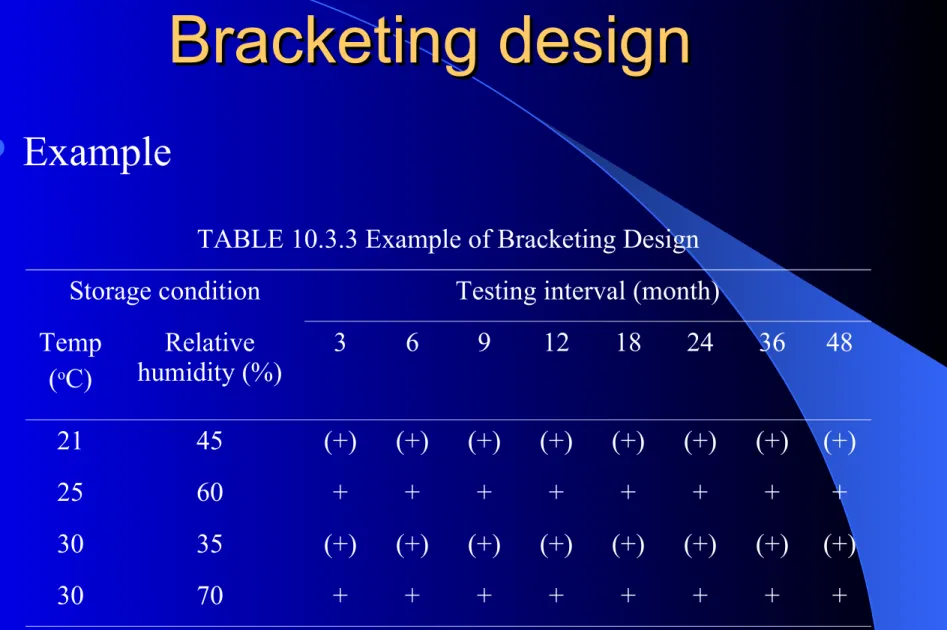
Example
TABLE 10.3.3 Example of Bracketing Design Storage condition Testing interval (month) Temp (oC) Relative humidity (%) 3 6 9 12 18 24 36 48 21 45 (+) (+) (+) (+) (+) (+) (+) (+) 25 60 + + + + + + + + 30 35 (+) (+) (+) (+) (+) (+) (+) (+) 30 70 + + + + + + + +
Matrixing and bracketing design
Matrixing and bracketing design
Remarks
- A matrixing or bracketing design may be applicable to strength if there is no change in proportion of active ingredients,
container size, and intermediate sampling time points (Lin,1994) - A matrixing design is not recommended if there is a significant change in proportions of active ingredients
- A matrixing design should not be applied to sampling times at two endpoints (I.e., the initial and the lsat sampling time points) and at any time points beyond the desired expiration date
Criteria for design comparison
Criteria for design comparison
Power approach
Nordbrock (1992). J. of Biopharmaceutical Statistics, 2, 91-113.
For a fixed sample size, the design with the highest power for
detection of a significant difference between slopes (stability losses) is the best design.
For a fixed desired power, the design with the smallest sample size is the best design.
Precision of shelf-life estimation
Ju and Chow (1995). J. of Biopharmaceutical Statistics, 91-113.
For a fixed sample size, the design with the best precision for shelf-life estimation is the best design.
d*t = {d: min x’(t)(X’X)-1x(t)}
Criteria for design comparison
Criteria for design comparison
Optimal Criteria
Hedayat, Yan, and Lin (2006). J. of Biopharmaceutical Statistics.