行政院國家科學委員會補助專題研究計畫
成果報告
※※※※※※※※※※※※※※※※※※※※※※※※
※ ※
※
電針治療糖尿病(消渴證)之研究
※
※
The Research of Electroacupuncture in Diabetes
※
※
※
※※※※※※※※※※※※※※※※※※※※※※※※
計畫類別:■個別型計畫
□整合型計畫
計畫編號:NSC 89-2314-B-039-046
執行期間:
89 年 8 月 1 日至 90 年 7 月 31 日
計畫主持人:
林昭庚
本成果報告包括以下應繳交之附件:
□赴國外出差或研習心得報告一份
□赴大陸地區出差或研習心得報告一份
□出席國際學術會議心得報告及發表之論文各一份
□國際合作研究計畫國外研究報告書一份
執行單位:中國醫藥學院 中國醫學研究所
中
華
民
國
90
年
10
月
1
日
行政院國家科學委員會專題研究計畫成果報告
電針治療糖尿病(消渴證)之研究
The Research of Electroacupuncture in Diabetes
計畫編號:NSC
89-2314-B-039-046
執行期限:89 年 8 月 1 日至 90 年 7 月 31 日
主持人:林昭庚
計畫參與人員:張世良 劉旭然
執行單位:中國醫藥學院 中國醫學研究所
一、中文摘要 最近我們的研究中發現:電針中脘穴可介由 體內的腦內啡促進胰島素的分泌而調降血糖。本研 究的主要目的是探討腎上腺在 2Hz 電針中脘穴所 扮演的角色,並利用嗎啡受體阻斷作用,進一步探 討嗎啡受體參與血糖調整作用的機轉。 2Hz 電針 30 分鐘之後發現假手術組的大鼠有 顯著的降血糖作用,且可被足夠劑量的納絡酮所阻 斷,在去除μ-嗎啡受體的小鼠身上也可發現阻斷 作用,甚至連μ1-嗎啡受體阻斷劑(Naloxonazine)也 可完全阻斷電針大鼠的降糖作用。在去除腎上腺組 無論是大鼠或小鼠降血糖作用皆因而消失,同時運 用去腎上腺探討電針促使腦內啡刺激胰島素的來 源,使用 ELISA 法測量發現假手術組的大鼠腦內啡 及胰島素皆有增加,此一現象隨著去腎上腺而消 失。而且胰島素增加作用亦隨著加入嗎啡受體阻斷 劑(Naloxone/Naloxonazine)而消失。 由以上的結果建議 2Hz 電針中脘穴刺激腎 上腺的腦內啡釋放經由μ1-嗎啡受體結合刺激胰島 素的釋放而調降血糖。 關鍵詞:電針、中脘穴、血糖、胰島素、腦內啡、 腎上腺、酵素連鎖免疫吸附劑檢驗、納絡酮。 Abstr actIn recent, we found an insulin-dependent hypoglycemic effect in rats receiving electroacupuncture(EA) at zhongwan acupoint. An increase of plasma β-endorphin to stimulate insulin release was introduced as the mechanism. Aim of the present study is to explore the role of adrenal gland in the action, and applying opioid receptor antagoinists to examine what opioid receptor is activated by EA with specific frequency (2Hz).
After electro-stimulating the zhongwan acupoint of sham-operated group for 30 min in wistar rats, a marked hypoglycemic effect was found at 2Hz. This effect was abolished by naloxone at the dose sufficient (1mg/kg, i.v.) to block opioid receptors. In μ-opioid receptor knockout mice (MOR-KOM), the hypoglycemic effect of EA with the same frequency also disappeared. Even this effect in rats also were
blocked by μ 1-opioid receptor antagonist
(naloxonazine 1mg/kg, i.v.). Thus, the response to 2Hz EA at zhongwan can be considered to mediate through μ 1-opioid receptor. Moreover, we choose this
frequency to explore the role of adrenal gland in the hypoglycemic effect. Our results showed that the hypoglycemic effect was disappeared in adrenalectomized group whether rats (ADXR) or mice (ADXM). At the same time, we use adrenalectomy method to discover the source of β-endorphin via stimulating insulin secretion to decrease plasma glucose. Plasma β-endorphin and insulin measured by ELISA method were increased in sham-operated rats receiving 2Hz EA at zhongwan acupoint. These phenomenon disappeared by adrenalectomy in rats. Plasma insulin elevation also vanished when naloxone and naloxonazine were pretreated in rat before EA.
The obtained results suggest that EA at low frequency (2Hz) induced the release of β-endorphin from adrenal gland to result in the lowering of plasma glucose via insulin released by activation of μ
1-opioid receptor.
Keywords: Electroacupucture(EA), Zhongwan acupoint, Plasma Glucose, β -endorphin, Insulin ELISA, Naloxone.
Introduction
Acupuncture had been applied in the treatment of diabetes syndrome for more than thousands of years in Traditional Chinese Medicine(TCM). Follow this experience, we found an insulin-dependent hypoglycemic effect in rats receiving electroacupuncture (EA) at zhongwan point [6]. As we know that involvement of endogenous opioid peptides (EOP) in the analgesic effect of acupuncture has widely been reported [4,5,9,14]. EOP participate in the physiological adaptation to exercise stress in maintaining post-exercise insulin response to glucose [1]. Also, β-endorphin is released into the circulation during exercise, which may have a hormonal action to increase the uptake of glucose during muscular activity [7]. Actually, β-endorphin and/or β -endorphin1-27 induced insulin secretion via an activation of opioid
receptor in pancreatic beta cell and β-endorphin may exert a paracrine control of insulin secretion [3]. Moreover, this peptide or its metabolites may be partly responsible for the insulin-independent uptake of glucose during exercise [7]. Electroacupuncture can cause muscle contraction resembling in a passive exercise, which should has the same mechanism as above reports. In addition, activation of μ-opioid receptor by the agonist, such as loperamide, can decrease plasma glucose in diabetic rats induced by streptozotocin (STZ) [10]. Intravenous injection of synthetic human β-endorphin (12.8 µg/kg) into STZ-induced diabetic rats produced a marked decrease of plasma glucose [11].
In our previous study, we applied electro-stimulation through acupuncture at zhongwan acupoint. A hypoglycemic action related to insulin secretion through endogenous β-endorphin has been mentioned. This hypoglycemic effect was blocked by naloxone in sufficient dose [6]. In fact, it has been documented that analgesia by EA is induced through the combined activation of ì, ä and ê-receptor [5]. different frequencies of EA stimulate different types of opioid receptor [4]. Therefore, we selected a μ
1-opioid receptor antagonist (naloxonazine) to discover
the further mechanism of 2Hz EA to lower down plasma glucose in rats, and applying MOR-KOM to make sure the relationship between ì-opioid receptor and low frequency (2Hz) EA in hypoglycemic action[12]. In addition, it has been documented that pituitary in brain and the medulla of adrenal gland in periphery are the sources of EOP [8,9,13,16]. In the present study, adrenalectomized animals were performed to realize the â-endorphin and role of adrenal gland[15].
Results and Discussions
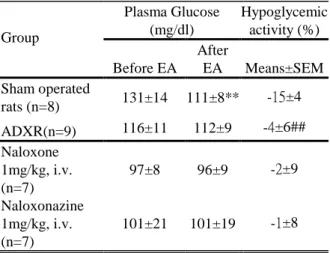
As our data showed, we found a significant hypoglycemic action in sham-operated rats by EA, and this effect disappeared in ADXR. In the naloxone influence, this action was blocked totally by sufficient dose (1mg/Kg, i.v.), even the ì1-opioid antagonist
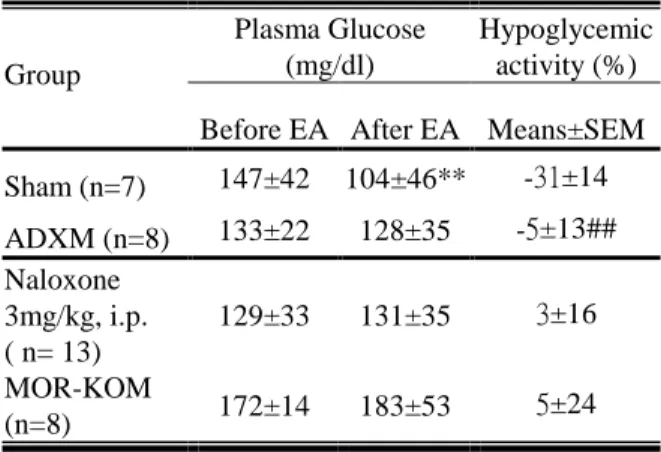
(naloxonazine) can block this action totally (Table A). Moreover, this hypoglycemic effect was also observed in mice which totally blocked by naloxone (3mg/kg, i.p.), this effect also vanished in MOR-KOM. (Table B). Taken together, the adrenal gland plays major role and follows endogenous opioid pathway in the hypoglycemic action of 2Hz EA at zhongwan acupoint. In MOR-KOM, the loss of hypoglycemic response indicated the mediation of µ-opioid receptor, therefore we considered the activation of ì1-opioid receptor to
lower down the plasma glucose because of naloxonazine pretreated to block the hypoglycemic action totally.
In Fig A the plasma peptides (β-endorphin and insulin) were detected by ELISA method in rats. The plasma peptides of sham-operated group increased remarkably by comparing before with after 2 Hz EA at zhongwan acupoint. In ADXR group, this effect
disappeared as data showed in Fig B. Moreover, a sufficient dose of naloxone and naloxonazine can block the secretion of plasma insulin showed in Fig B. It indicates that the adrenal gland is the major role of 2Hz EA at zhongwan acupoint and large amount of
β-endorphin came from adrenal gland via stimulating insulin secretion by activation of ì1-opioid receptor to
lower down plasma glucose.
According our results, we found the fasting plasma glucose of ADX group was lower than that of sham-operated group in Table A, B. Removal of endogenous substances which can increase plasma glucose, such as glucocorticoide and adrenaline by adrenalectomy can be considered [2]. On the other hand, adrenalectomy may increase EOP in front lobe of pituitary gland [13]. It may influence hypoglycemic activity by EA at zhongwan acupoint. As we know, adrenal gland is one of the EOP sources that may contribute to hypoglycemic action in peripheral [16]. ADXR and ADXM whose adrenal gland has been removed then the hypoglycemic effect disappeared, and the hypoglycemic action was abolished by naloxone in rats and mice. Furthermore, this action was blocked by naloxonazine in rats. This result hinted that the activation of ì1-opioid receptor from adrenal
gland lower down the plama glucose.
About the different sufficient dose of naloxone in rats and mice that may due to different route of administration[6,17]. As we know that naloxone can block all kinds of opioid receptors in rats. It is illustrate that the hypoglycemic effect comes from EOP pathway. This hypoglycemic action was blocked in MOR-KOM (Table B) that provided a strong witness, the relationship between ì-opioid receptor and this hypoglycemic effect, because the antagonist administration easy to cause system error from drug loss during injection. All the same mechanism of hypoglycemic action in rats and mice hinted that has animal diversity of EA to regulate plasma glucose.
Moreover, there were no significant changes for the plasma β-endorphin and insulin in ADXR when stimulated by 2Hz EA, we considered that a significant quantity of β-endorphin came from adrenal gland effecting via insulin. Therefore, we suggest that activation of μ1-opioid receptor from adrenal gland
for lowering down the plasma glucose by 2Hz EA at zhongwan acupoint.
Achievements of Self-evaluation
Although we cannot follow the primary protocol completely in one year, but we got a strong witness of the relationship between opioid receptor and the regulation of plasma glucose in specific frequency of EA stimulation. EA for plasma glucose regulation is a very interesting field. Different frequencies and different acupoints have different mechanisms. Not only diabetes control, but also the basic theory of TCM and Acupuncture will be proved. Using EA as a tool, we can study the physiology of the regulation of plasma glucose furthermore.
References
[1] Bouix, O., Najimi, A., Lenoir V., Kerdelhue,B., Orsetti, A., Endogenous opioid peptides stimulate post-exercise insulin response to glucose in rats, Int. J. Sports Med., 17 (1996) 80-84.
[2] Burris,J.F., Waeber,B., Brunner,H.R., Cardiac mass in glucocorticoid-hypertensive rats with and without circulating adrenaline, Cardiovasc. Res., 19(1985)734-736.
[3] Curry, D.L., Bennett, L.L., Li,C.H., Stimulation of insulin secretion by beta-endorphins (1-27 & 1-31), Life Sci., 40 (1987) 2053-2058.
[4] Chen,X.H., Han,J.S., Analgesia induced by electroacupuncture of different frequencies is mediated by different types of opioid receptors: another cross-tolerance study, Behav. Brain Res., 47 (1992) 143-149.
[5] Chen,X.H., Han,J.S., All three types of opioid receptors in the spinal cord are important for 2/15 Hz electroacupuncture analgesia, Europ. J. Pharmacol., 211(1992):203-210.
[6] Chang,S.L., Lin,J.G., Chi,T.C., Liu,I.M., Cheng,J.T., An insulin-dependent hypoglycaemia induced by electroacupuncture at the Zhongwan (CV12) acupoint in diabetic rats, Diabetologia, 42(1999)250-255.
[7] Evans,A.A., Khan,S., Smith,M.E., Evidence for a hormonal action of beta-endorphin to increase glucose uptake in resting and contracting skeletal muscle, J. Endocrinol., 155 (1997) 387-392.
[8] Grossman, A., Clement-Jones, V., Opiate receptors: enkephalins and endorphins, Clin. Endocrinol. Metab., 12 (1983) 31-56.
[9] He L.F., Involvement of endogenous opioid peptides in acupuncture analgesia, Pain, 31(1987) 99-121.
[10] Liu, I.M., Chi, T.C., Chen, Y.C., Lu, F.H., Cheng, J.T., Activation of opioid mu-receptor by loperamide to lower plasma glucose in streptozotocin-induced diabetic rats. Neurosci. Lett ., 265(1999) 183-186. [11] Liu, I.M., Niu, C.S., Chi, T.C., Kuo, D.H., Cheng, J.T., Investigations of the mechanism of the reduction of plasma glucose by cold-stress in streptozotocin-induced diabetic rats, Neuroscience, 92(1999) 1137-1142.
[12] Sora, I., Opioid receptor knockout mice, Nihon Shinkei Seishin Yakurigaku Zasshi, 19(1999) 239-49. [13] Tang, F., Endocrine control of hypothalamic and pituitary met-enkephalin and beta-endorphin contents, Neuroendocrinology, 53 Suppl 1(1991) 68-76.
[14] Ulett, G.A., Han, S., Han, J.S., Electroacupuncture: mechanisms and clinical application, Biol. Psychiatry, 44(1998)129-138. [15] Wakade, A.R., Malhotra, R.K., Sharma, T.R., Wakade, T.D., Changes in tonicity of perfusion medium case prolonged opening of calcium channels of the rat chromaffiin cells to evoke explosive secretion of catecholamines, J. Neurosci., 6 (1986) 2625-2634.
[16] Yang,H.Y., Hexum,T., Costa,E., Opioid peptides in adrenal gland, Life Sci., 27 (1980) 1119-25. [17] Yu,Y., Kasahara,T., Sato,T., Asano,K. Yu,G. Fang,J., Guo,S., Sahara,M., Hisamitsu, T., Role of endogenous interferon-gamma on the enhancement of splenic NK cell activity by electroacupuncture stimulation in mice, J. Neuroimmunol., 90(1998)176-86.
Table A. Plasma glucose and hypoglycemic activity in rats that received 2Hz EA stimulation at zhongwan acupoint Plasma Glucose (mg/dl) Hypoglycemic activity (%) Group Before EA After EA Means±SEM Sham operated rats (n=8) 131±14 111±8** -15±4 ADXR(n=9) 116±11 112±9 -4±6## Naloxone 1mg/kg, i.v. (n=7) 97±8 96±9 -2±9 Naloxonazine 1mg/kg, i.v. (n=7) 101±21 101±19 -1±8
** p<0.01 vs. data from before EA, by self-paired t-test, ##p<0.01vs. data from hypoglycemic activity of sham-operated group, by student’s t-test.
0 1 2 3 4 5 Beta-endorphin (pmol/L) 0 200 400 600 Sham ADXR Insulin (pmol/L) Before EA After EA
Fig A. Plasma peptides in Sham and ADXR groups that received 2Hz EA stimulation at zhongwan acupoint, ** p<0.01 by self-paired t-test.
0 200 400 600 Naloxone Naloxonazine Insulin (pmol/L) Before EA After EA
Fig B. The influence of opioid receptor antagonists in plasma insulin, which was changed by EA
Table B. Plasma glucose and hypoglycemic activity in different type of mice that received by 2Hz EA at zhongwan acupoint Plasma Glucose (mg/dl) Hypoglycemic activity (%) Group
Before EA After EA Means±SEM Sham (n=7) 147±42 104±46** -31±14 ADXM (n=8) 133±22 128±35 -5±13## Naloxone 3mg/kg, i.p. ( n= 13) 129±33 131±35 3±16 MOR-KOM (n=8) 172±14 183±53 5±24
* p<0.05 and ** p<0.01 vs. data from before EA , by self-paired t-test. ## p<0.01 vs. data from hypoglycemic activity of sham-operated group, by student’s t-test.